

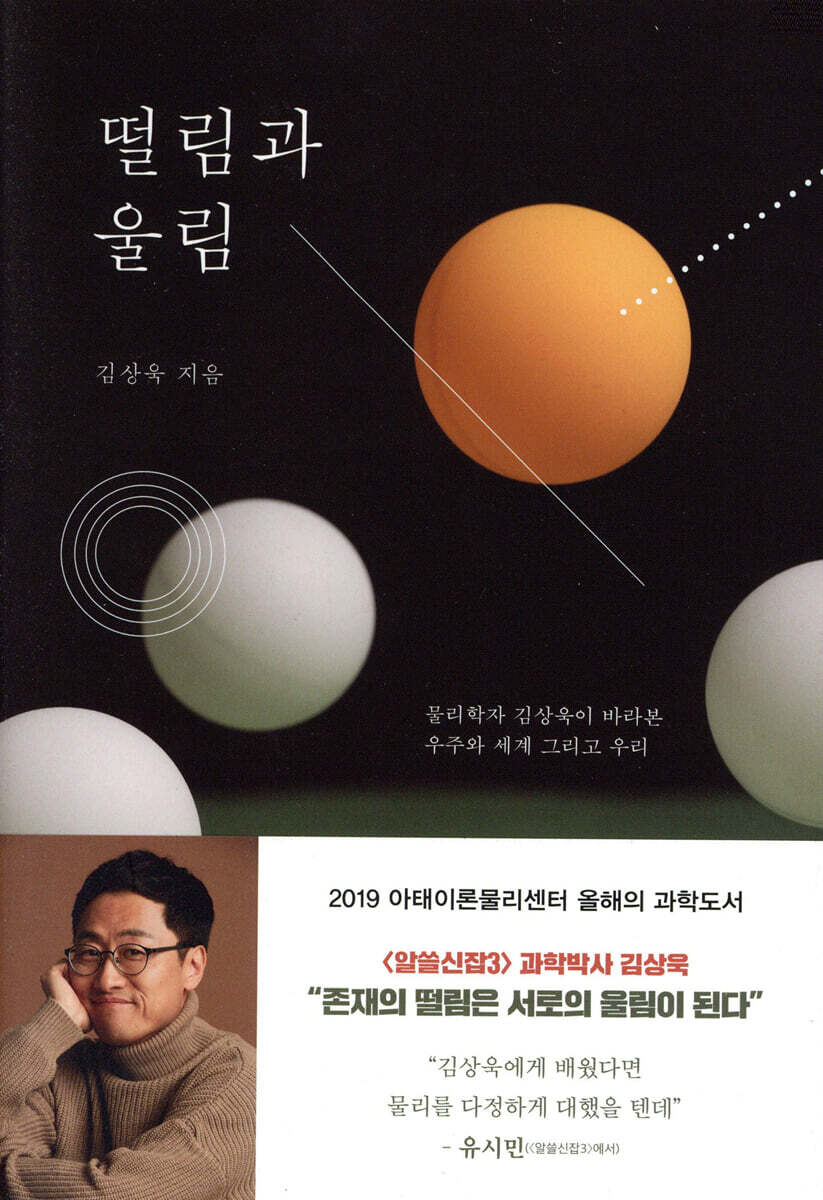
Tremors and vibrations
 |
Description
Book Introduction
How to read the world beautifully through the language of affectionate physics Kim Sang-wook says, “Seeing the essence of the universe means discarding all human common sense and prejudice.” Just as we cannot perceive that the Earth is spinning, the vast world of the universe is filled with countless stories that we cannot intuitively understand. Kim Sang-wook guides us through the world of physics and reveals the profound stories of our daily lives. It guides you to open your mind. What would the world look like through the eyes of a physicist? Our bodies, the air we breathe, the ground and dirt we stand on, and even the laptop monitors and cell phones we encounter every day. All beings in the world are made up of very small units called 'atoms'. Kim Sang-wook looks into the smallest of details, from our very existence to the vast world of the universe, and asks questions. The way physicists view the world of atoms is like reading a passage from Eastern philosophy. Where did the things that make up my existence originate? How can I reflect on death? What is the difference between me and others? Instead of offering rigorous scientific answers, this book offers a new perspective that only a physicist can guide. They say that if you learn a foreign language, a whole world opens up to you. "Trembling and Echoing" is a book in which Kim Sang-wook guides us through a new language called "physics" to view our existence, life, and death, as well as our relationships with others and thoughts about the world, from a new perspective. |
- You can preview some of the book's contents.
Preview
index
prolog
Part 1: Busy Beings - Since that day 13.8 billion years ago, we have become who we are.
[Light] 13.8 billion years ago, it first sparkled
[Space and Time] The Birth of Time and Space
[Universe] Knowing the reason for the world's existence
[Atoms] What makes us, what makes the world
[Electronic] All the same, yet all different
- For life to exist, 『Mitochondria』 are required.
- The difference in existence and the magnitude of the difference as seen by a physicist
- Size speaks for itself 『Alice in Wonderland』
- What is 'topology' in relation to the size of existence?
Part 2: Living in Time, Seeing Space - On Interpreting the World
[Principle of Least Action] Living in the Present for a Being Who Knows the Future
[Chaos] The only sure prediction is
[Entropy] Why Yesterday Never Comes Again
[Quantum Mechanics] We see what we believe
[Duality] Opposites are complementary
- The universe seen from Earth, the universe seen from the moon
Why do you look at the finger when it points to the moon? [Interstellar]
- "Chance" to a Physicist: "The Babylonian Lottery," Fictions
On the Tripartite Relationship - A World of Competing Forces
[Gravity] They fall on each other
[Electromagnetic Force] The trembling of existence connects the void.
Maxwell's Equations: The Formulas That Shaped Modern Civilization
[Reduction/Emergence] Many things are different.
[Condensed Matter Physics] First, they must meet.
- What is typing to AI? [Ex Machina]
- The world's temperature is determined by standard deviation.
Part 4: The Universe Trems and Resonates - How to Read the World Through the Language of Science
[Energy] Nothing disappears, only changes.
[F=ma] The world is movement
[Danjindong] The universe is trembling and resonating
[Human] The wonder of the universe and humanity
- On the imaginary order and believing in it 『Sapiens』
- Knocking on Heaven's Door: Understanding the Truth of the Universe Through Human Power
supplement
From Knowledge to Attitude: Being a Theoretical Physicist in an Opaque World
Part 1: Busy Beings - Since that day 13.8 billion years ago, we have become who we are.
[Light] 13.8 billion years ago, it first sparkled
[Space and Time] The Birth of Time and Space
[Universe] Knowing the reason for the world's existence
[Atoms] What makes us, what makes the world
[Electronic] All the same, yet all different
- For life to exist, 『Mitochondria』 are required.
- The difference in existence and the magnitude of the difference as seen by a physicist
- Size speaks for itself 『Alice in Wonderland』
- What is 'topology' in relation to the size of existence?
Part 2: Living in Time, Seeing Space - On Interpreting the World
[Principle of Least Action] Living in the Present for a Being Who Knows the Future
[Chaos] The only sure prediction is
[Entropy] Why Yesterday Never Comes Again
[Quantum Mechanics] We see what we believe
[Duality] Opposites are complementary
- The universe seen from Earth, the universe seen from the moon
Why do you look at the finger when it points to the moon? [Interstellar]
- "Chance" to a Physicist: "The Babylonian Lottery," Fictions
On the Tripartite Relationship - A World of Competing Forces
[Gravity] They fall on each other
[Electromagnetic Force] The trembling of existence connects the void.
Maxwell's Equations: The Formulas That Shaped Modern Civilization
[Reduction/Emergence] Many things are different.
[Condensed Matter Physics] First, they must meet.
- What is typing to AI? [Ex Machina]
- The world's temperature is determined by standard deviation.
Part 4: The Universe Trems and Resonates - How to Read the World Through the Language of Science
[Energy] Nothing disappears, only changes.
[F=ma] The world is movement
[Danjindong] The universe is trembling and resonating
[Human] The wonder of the universe and humanity
- On the imaginary order and believing in it 『Sapiens』
- Knocking on Heaven's Door: Understanding the Truth of the Universe Through Human Power
supplement
From Knowledge to Attitude: Being a Theoretical Physicist in an Opaque World
Detailed image
Publisher's Review
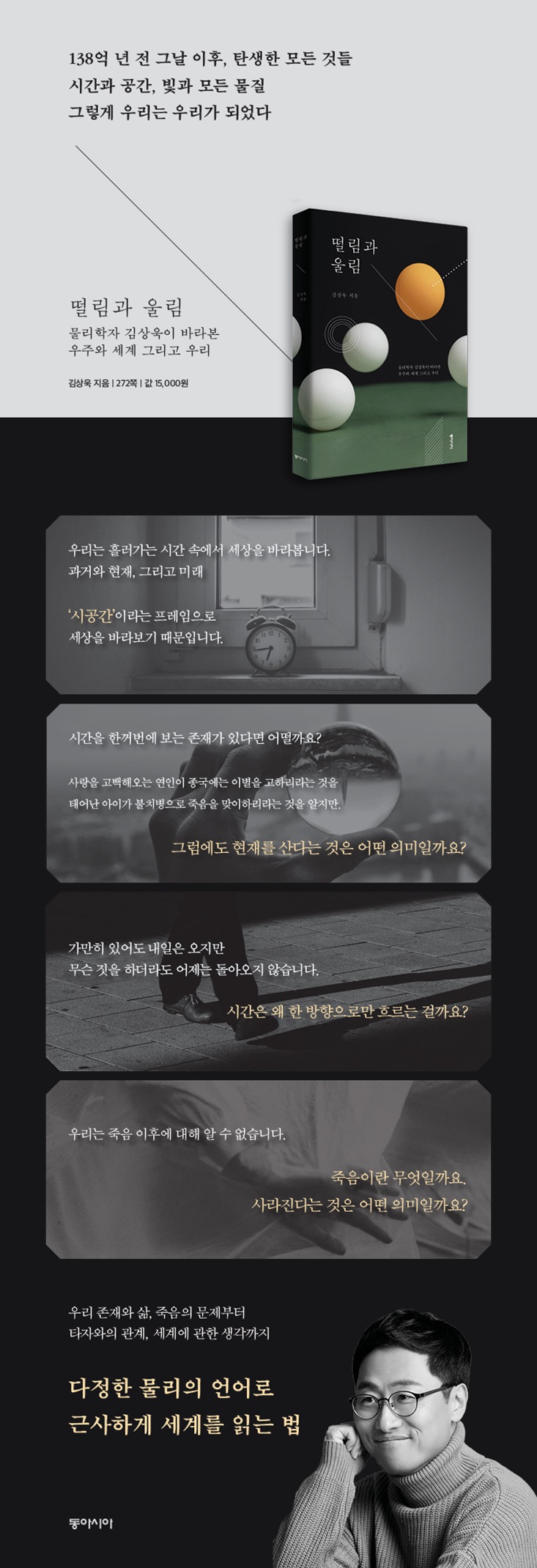
[How to Read the World in a Beautiful Way with the Language of Gentle Physics]
"If I had learned from Kim Sang-wook, I would have treated physics with affection." - Yoo Si-min
How to read and think about the world through the language of physics
- From atoms, light, and spacetime to chaos, entropy, and simple vibrations
The universe, the world, and us, revisited through the gentle language of physics.
Flora Lewis, a journalist who worked as a correspondent and wrote international politics columns for 60 years, said about learning a foreign language, “Learning a new language is not just learning different words for things, but learning another way of thinking about things.”
"Trembling and Resonating" guides us to another way of reading and thinking about the world through the scientific language of "physics."
As author Yoo Si-min said, “If I had learned from Kim Sang-wook, I would have treated physics with affection,” if you follow the writings of physicist Kim Sang-wook, you will find yourself stepping into the world of physics.
Above all, through the language of physics, we gain a different perspective on the world and our existence.
It introduces atoms, one of the core concepts of physics, while raising questions about death.
Our bodies, the air we breathe, the ground and dirt we stand on, and even the laptop monitors and smartphones we encounter every day.
All beings in the world are made up of units called 'atoms', which are much smaller than viruses.
Atoms were first created after the Big Bang, and their existence continues to circulate without disappearing.
This means that a single carbon atom at the tip of our finger could be “a carbon atom that drifted through space, landed on Earth under the gravity of the Sun, passed through cyanobacteria, carbon dioxide, trilobites, triceratops, primitive whales, and apples, and entered our bodies as part of glucose, and then ended up there as part of a skin cell in the process of turning DNA information into protein to fill in the wound on our finger.”
So, Kim Sang-wook says that from an atomic perspective, the birth and death of humans are no different from the gathering and dispersing of atoms.
"Trembling and Resonating" calmly introduces the core concepts of physics, from light, spacetime, atoms, and electrons to the principle of least action, chaos, entropy, quantum mechanics, and simple oscillation. Through the new language of "physics," it guides us to look at our existence, life, and death, as well as our relationships with others and our thoughts about the world, from a new perspective.
The way physicists view the world of atoms is like reading a passage from Eastern philosophy.
Where did the things that make up my existence come from, how can I reflect on death, what is the difference between me and others?
Instead of providing rigorous scientific answers, it offers a new perspective that only a physicist can provide.
The Big Bang Theory: A Guide to Quantum Mechanics, Questioning the World
- Are what we see real? Are our experiences as we perceive them?
“Physics began with the discovery that the Earth rotates.
Nothing is more contrary to experience than this.
“No matter how much I think about it, it feels like the Earth doesn’t rotate.” (Page 7)
Standing with both feet on the ground, being able to breathe, the sunlight shining in the morning—the experiences we take for granted are not natural when viewed within the realm of the universe.
The heliocentric theory, now accepted as common sense, overthrew the geocentric theory and became common sense, which was a process of creating science that went against experience.
Kim Sang-wook says, “Seeing the essence of the universe means discarding all human common sense and prejudice.”
Just as we cannot feel that the Earth is spinning, the world is full of countless stories that we cannot intuitively understand.
The macroscopic world that we see and feel is described by Newton's classical mechanics, and the microscopic world at the atomic level is described by quantum mechanics.
The subject of quantum mechanics is atoms.
Atoms are composed of electrons and a nucleus, and their shape resembles the solar system.
An electron is the smallest unit of matter that cannot be divided any further.
Electrons within an atom can only exist in orbits with specific radii.
So how does movement work? Electrons disappear from one orbit and reappear in another with a "pop."
It is difficult to understand in the macroscopic world we experience that the movement of objects is not continuous.
Is what we see, what we experience, truly "real"? Kim Sang-wook guides us into the astonishing world of physics, posing questions that are both scientific and philosophical.
"If time has a beginning, what does the time before that beginning mean? Is time essential to the universe, or is it a byproduct of something more essential?" (p. 27)
Time and space were created by the Big Bang 13.8 billion years ago.
We can guess that space came into being, but the creation of time is something that is simply beyond human experience.
This is because humans have no choice but to view the world through the frame of ‘space and time.’
So, is it possible to see the world in a different way? What if there were a being who could see all of time simultaneously? What would it mean to live in the present for such a being? What would it mean to live in the present, knowing that the lover who confesses to me will ultimately say goodbye, knowing that my unborn child will die of an incurable disease? Kim Sang-wook guides us through the world of physics, thus revealing the profound stories of our daily lives.
It guides you to open your mind.
Science is an attitude, not knowledge.
“The universe began with the Big Bang, but we don’t know what came before that.
Life on Earth evolved from the first life form, but we don't know what the first life form was.
“We may not know if life exists elsewhere than on Earth.” (p. 268)
This book says that science is a willingness to admit ignorance.
Kim Sang-wook says that while studying as a scientist, “what I learned deeply was the attitude of admitting that I don’t know what I don’t know.”
When you say you know something, you have to be able to provide material evidence to explain exactly what you mean.
He calls this the 'scientific attitude'.
Because “science is not a collection of knowledge, but an attitude and way of thinking about the world.”
"Trembling and Resonating" is a book written from the perspective of physicist Kim Sang-wook on this science.
We've also compiled articles on the same topic, including science-based films and books, to provide additional reading material.
"If I had learned from Kim Sang-wook, I would have treated physics with affection." - Yoo Si-min
How to read and think about the world through the language of physics
- From atoms, light, and spacetime to chaos, entropy, and simple vibrations
The universe, the world, and us, revisited through the gentle language of physics.
Flora Lewis, a journalist who worked as a correspondent and wrote international politics columns for 60 years, said about learning a foreign language, “Learning a new language is not just learning different words for things, but learning another way of thinking about things.”
"Trembling and Resonating" guides us to another way of reading and thinking about the world through the scientific language of "physics."
As author Yoo Si-min said, “If I had learned from Kim Sang-wook, I would have treated physics with affection,” if you follow the writings of physicist Kim Sang-wook, you will find yourself stepping into the world of physics.
Above all, through the language of physics, we gain a different perspective on the world and our existence.
It introduces atoms, one of the core concepts of physics, while raising questions about death.
Our bodies, the air we breathe, the ground and dirt we stand on, and even the laptop monitors and smartphones we encounter every day.
All beings in the world are made up of units called 'atoms', which are much smaller than viruses.
Atoms were first created after the Big Bang, and their existence continues to circulate without disappearing.
This means that a single carbon atom at the tip of our finger could be “a carbon atom that drifted through space, landed on Earth under the gravity of the Sun, passed through cyanobacteria, carbon dioxide, trilobites, triceratops, primitive whales, and apples, and entered our bodies as part of glucose, and then ended up there as part of a skin cell in the process of turning DNA information into protein to fill in the wound on our finger.”
So, Kim Sang-wook says that from an atomic perspective, the birth and death of humans are no different from the gathering and dispersing of atoms.
"Trembling and Resonating" calmly introduces the core concepts of physics, from light, spacetime, atoms, and electrons to the principle of least action, chaos, entropy, quantum mechanics, and simple oscillation. Through the new language of "physics," it guides us to look at our existence, life, and death, as well as our relationships with others and our thoughts about the world, from a new perspective.
The way physicists view the world of atoms is like reading a passage from Eastern philosophy.
Where did the things that make up my existence come from, how can I reflect on death, what is the difference between me and others?
Instead of providing rigorous scientific answers, it offers a new perspective that only a physicist can provide.
The Big Bang Theory: A Guide to Quantum Mechanics, Questioning the World
- Are what we see real? Are our experiences as we perceive them?
“Physics began with the discovery that the Earth rotates.
Nothing is more contrary to experience than this.
“No matter how much I think about it, it feels like the Earth doesn’t rotate.” (Page 7)
Standing with both feet on the ground, being able to breathe, the sunlight shining in the morning—the experiences we take for granted are not natural when viewed within the realm of the universe.
The heliocentric theory, now accepted as common sense, overthrew the geocentric theory and became common sense, which was a process of creating science that went against experience.
Kim Sang-wook says, “Seeing the essence of the universe means discarding all human common sense and prejudice.”
Just as we cannot feel that the Earth is spinning, the world is full of countless stories that we cannot intuitively understand.
The macroscopic world that we see and feel is described by Newton's classical mechanics, and the microscopic world at the atomic level is described by quantum mechanics.
The subject of quantum mechanics is atoms.
Atoms are composed of electrons and a nucleus, and their shape resembles the solar system.
An electron is the smallest unit of matter that cannot be divided any further.
Electrons within an atom can only exist in orbits with specific radii.
So how does movement work? Electrons disappear from one orbit and reappear in another with a "pop."
It is difficult to understand in the macroscopic world we experience that the movement of objects is not continuous.
Is what we see, what we experience, truly "real"? Kim Sang-wook guides us into the astonishing world of physics, posing questions that are both scientific and philosophical.
"If time has a beginning, what does the time before that beginning mean? Is time essential to the universe, or is it a byproduct of something more essential?" (p. 27)
Time and space were created by the Big Bang 13.8 billion years ago.
We can guess that space came into being, but the creation of time is something that is simply beyond human experience.
This is because humans have no choice but to view the world through the frame of ‘space and time.’
So, is it possible to see the world in a different way? What if there were a being who could see all of time simultaneously? What would it mean to live in the present for such a being? What would it mean to live in the present, knowing that the lover who confesses to me will ultimately say goodbye, knowing that my unborn child will die of an incurable disease? Kim Sang-wook guides us through the world of physics, thus revealing the profound stories of our daily lives.
It guides you to open your mind.
Science is an attitude, not knowledge.
“The universe began with the Big Bang, but we don’t know what came before that.
Life on Earth evolved from the first life form, but we don't know what the first life form was.
“We may not know if life exists elsewhere than on Earth.” (p. 268)
This book says that science is a willingness to admit ignorance.
Kim Sang-wook says that while studying as a scientist, “what I learned deeply was the attitude of admitting that I don’t know what I don’t know.”
When you say you know something, you have to be able to provide material evidence to explain exactly what you mean.
He calls this the 'scientific attitude'.
Because “science is not a collection of knowledge, but an attitude and way of thinking about the world.”
"Trembling and Resonating" is a book written from the perspective of physicist Kim Sang-wook on this science.
We've also compiled articles on the same topic, including science-based films and books, to provide additional reading material.
GOODS SPECIFICS
- Date of publication: November 7, 2018
- Page count, weight, size: 272 pages | 145*210*20mm
- ISBN13: 9788962622508
- ISBN10: 8962622505
You may also like
카테고리
korean


korean

![ELLE 엘르 스페셜 에디션 A형 : 12월 [2025]](http://librairie.coreenne.fr/cdn/shop/files/b8e27a3de6c9538896439686c6b0e8fb.jpg?v=1766436872&width=3840)


