

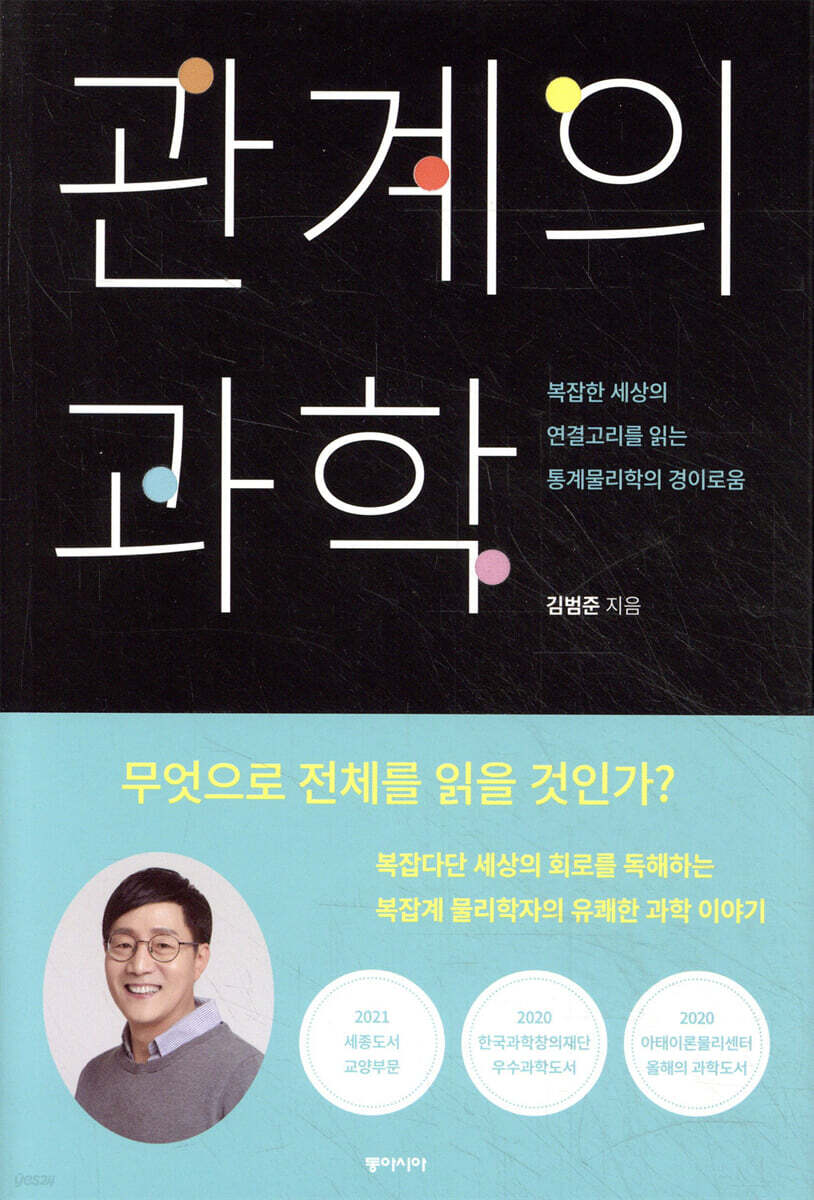
The Science of Relationships
 |
Description
Book Introduction
- A word from MD
-
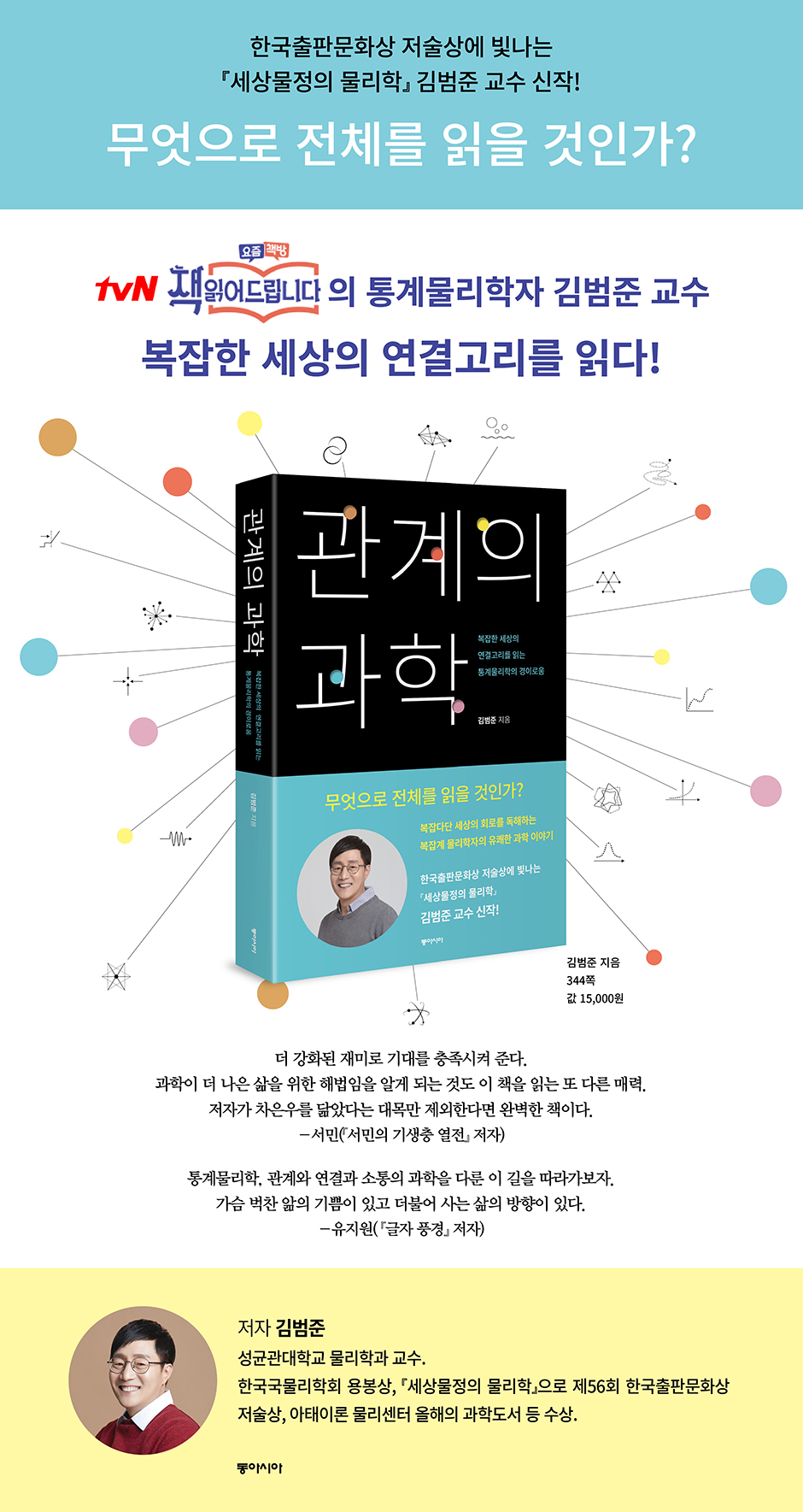
Statistical Physics: Reading the World's ConnectionsA new work by Professor Kim Beom-jun, a complex systems physicist who presents a new perspective on society.
It reveals why trends repeat themselves, whether earthquake damage can be predicted, and how parts and wholes are connected by uncovering hidden rules and patterns in a complex world.
How to read the world through statistical physics.
December 13, 2019. Natural Science PD Kim Tae-hee
How should we interpret the whole? Complexity science's answer lies in examining how parts and the whole are connected, and which connections are particularly powerful.
Professor Kim Beom-jun, a complex systems physicist who presented a new perspective on society through statistical physics in his previous work, “The Physics of Worldly Affairs,” has returned with a new work after four years.
In "The Science of Relationships," we use statistical physics to illuminate how small parts, from our daily lives and friendships to social phenomena and natural phenomena such as disasters, become events and phenomena in their entirety.
We examine the hidden rules and patterns of the complex world by creating a network, and find the links to read the meaning of the whole.
From the perspective of a statistical physicist, it guides you through seeing the forest of the world.
Each article covers a core concept of science, including physics, such as phase transitions, links, artificial intelligence, gravitational waves, and dark matter, while also providing the joy of studying science.
Professor Kim Beom-jun, a complex systems physicist who presented a new perspective on society through statistical physics in his previous work, “The Physics of Worldly Affairs,” has returned with a new work after four years.
In "The Science of Relationships," we use statistical physics to illuminate how small parts, from our daily lives and friendships to social phenomena and natural phenomena such as disasters, become events and phenomena in their entirety.
We examine the hidden rules and patterns of the complex world by creating a network, and find the links to read the meaning of the whole.
From the perspective of a statistical physicist, it guides you through seeing the forest of the world.
Each article covers a core concept of science, including physics, such as phase transitions, links, artificial intelligence, gravitational waves, and dark matter, while also providing the joy of studying science.
index
prolog
1.
Connection - Discovering Moments of Change
[Threshold] When does change occur?
[Timely] Even science has its time.
[Transition] Civil Resistance Movement: The Moment Nonviolence Wins
[Link] The Good Things That Happen When You Choose a Leader Who Has Thin Ears
[Cumulative Probability Distribution] Can We Reduce Wealth Skew?
- Changing your mind while dancing is definitely possible.
The more connected we are, the stronger we become.
2.
Relationships - On the Measurability of Friendship
[Vector] How to Find a Best Friend Scientifically
[Hub] How to Measure the Number of Friendships
[Community] Who are the closest members of the National Assembly?
[Tit-for-Tat] Even members of the National Assembly play games.
[Creation] Learning from ants
- It's not just foxes that need to be tamed.
- We all live in air.
3.
Gaze - What will be the whole reading?
[Fractal] A tree lives in our hearts.
[Dark Matter] Candles in the Square: What You See Isn't Everything
[Cartogram] To know accurately, you must read it differently.
[Gravitational waves] They exist even if they are not visible.
[Artificial Intelligence] On the Intelligence Created by Intelligence
- Happy things in Korea, sad things in Sweden
- How to spot pseudoscience
4.
Flow - A fun way to observe the complex Earth
[Burst] Silence and Sudden
[Poisson distribution] Goman Goman and dynamic
[Walking] A Scientific Method for Finding Lost Intoxicated Persons
[Exponential Function] The Reason for Popularity, the Law of Trends
- Science book vs.
The Secret to the Longevity of Novels and Bestsellers
- We need different names to distinguish each other.
5.
The Future - How Will Time Exist Before Us?
[F=ma] Where will we be in the future?
[Nonlinear] The road to the future is bumpy.
[Time] A possibility we haven't explored yet
- Our life is a ray of light
- Coincidence is everywhere.
supplement.
Complexity physicist Kim Beom-jun's clear and direct approach to our complex world.
- On Beautiful Physics
- If you don't want to receive the Nobel Prize
- About our outside
References
Acknowledgements
1.
Connection - Discovering Moments of Change
[Threshold] When does change occur?
[Timely] Even science has its time.
[Transition] Civil Resistance Movement: The Moment Nonviolence Wins
[Link] The Good Things That Happen When You Choose a Leader Who Has Thin Ears
[Cumulative Probability Distribution] Can We Reduce Wealth Skew?
- Changing your mind while dancing is definitely possible.
The more connected we are, the stronger we become.
2.
Relationships - On the Measurability of Friendship
[Vector] How to Find a Best Friend Scientifically
[Hub] How to Measure the Number of Friendships
[Community] Who are the closest members of the National Assembly?
[Tit-for-Tat] Even members of the National Assembly play games.
[Creation] Learning from ants
- It's not just foxes that need to be tamed.
- We all live in air.
3.
Gaze - What will be the whole reading?
[Fractal] A tree lives in our hearts.
[Dark Matter] Candles in the Square: What You See Isn't Everything
[Cartogram] To know accurately, you must read it differently.
[Gravitational waves] They exist even if they are not visible.
[Artificial Intelligence] On the Intelligence Created by Intelligence
- Happy things in Korea, sad things in Sweden
- How to spot pseudoscience
4.
Flow - A fun way to observe the complex Earth
[Burst] Silence and Sudden
[Poisson distribution] Goman Goman and dynamic
[Walking] A Scientific Method for Finding Lost Intoxicated Persons
[Exponential Function] The Reason for Popularity, the Law of Trends
- Science book vs.
The Secret to the Longevity of Novels and Bestsellers
- We need different names to distinguish each other.
5.
The Future - How Will Time Exist Before Us?
[F=ma] Where will we be in the future?
[Nonlinear] The road to the future is bumpy.
[Time] A possibility we haven't explored yet
- Our life is a ray of light
- Coincidence is everywhere.
supplement.
Complexity physicist Kim Beom-jun's clear and direct approach to our complex world.
- On Beautiful Physics
- If you don't want to receive the Nobel Prize
- About our outside
References
Acknowledgements
Detailed image
Publisher's Review
What should I read the whole thing with?
Complexity physicist Kim Beom-jun's method for connecting parts and wholes
Professor Kim Beom-jun's new book, "The Physics of Worldly Affairs," which won the Korean Publishing Culture Award, is his first in four years.
The wonders of statistical physics: deciphering the connections of a complex world.
― How to see the forest of complex physicists: trends, inequality, earthquakes, etc.
Why are the bucket hats and wide-leg pants, popular in the 1990s, so beloved by twenty-somethings in 2019? What can we anticipate and prepare for to prevent a repeat of the earthquakes in Gyeongju and Pohang? Can the tense relationship between Kim Jong-un and Trump predict the future of the Korean Peninsula? Fashions change at any moment, stocks plummet, natural disasters strike out of the blue, and wars and peaceful incidents can arise in unexpected circumstances.
What do we need to know to see the whole that becomes an event and a phenomenon?
Ice is hard.
But a single water molecule that makes up ice is not solid.
The bonds between water molecules are what create the hardness of ice.
Even if a single entity cannot be interpreted as meaning, when many components come together and influence each other, the whole creates new macroscopic characteristics.
Only then does it become a phenomenon, an event.
The system that creates this phenomenon is called a 'complex system'.
Our human society is also a typical complex system.
So how can we read the 'whole' of a complex and seemingly chaotic system?
A complex system is one in which the internal components of the system are closely interconnected.
Strong connections between components can cause an event occurring in one component to ripple outward, creating a cataclysmic event of enormous magnitude.
This means that one fashionista can create a trend, and the position of a single rock somewhere underground can determine the magnitude of an earthquake.
Seeing what's connected is seeing the whole, and capturing moments of change.
Complexity science looks at the world by examining how parts and wholes are connected and which connections are strong.
In "The Science of Relationships," we use statistical physics to illuminate how small parts, from our daily lives and friendships to social phenomena and natural phenomena such as disasters, become events and phenomena in their entirety.
We examine the hidden rules and patterns of the complex world by creating a network, and find the links to read the meaning of the whole.
From the perspective of a statistical physicist, it guides you through seeing the forest of the world.
It deals with five major themes: connection, relationship, gaze, flow, and future.
Each article covers a core scientific concept, such as phase transitions, links, artificial intelligence, gravitational waves, and dark matter, and provides the joy of studying science.
This is the first new book in four years by Professor Kim Beom-jun of the Department of Physics at Sungkyunkwan University, who won the 56th Korea Publishing Culture Award for Writing and the Asia-Pacific Center for Theoretical Physics Award for Science Book of the Year in 2015 for his book, “Physics of Worldly Affairs.”
What you see when you create a network
― From the secret to popularity of a friend with many friends to how to check your friendships on social media
“The attempt to understand society without considering the structure of human relationships is like a futile attempt to catch fish with a net that is not even a net.
“The structure of connections through which people relate to one another and live tells us a lot about our society.”
- Page 84, “On the Measurability of Friendship”
Among the various methods of complexity science, the method of creating networks reveals the meaning of the random and seemingly random entities and events in our daily lives.
It allows us to discover structural characteristics that are only visible when connected.
For example, the author, Professor Kim Beom-jun, draws a network that measures the strength of relationships by examining the number of friends people have in common on Facebook, and also creates a network to show how relationships change depending on whether there is a common ground in the Facebook friendship.
This book makes several interesting attempts to collect data and create networks, such as measuring the relationships between members of the National Assembly by investigating who collaborates with whom when proposing a bill.
It covers not only networks but also how to collect data, display various graphs, and read relationships in statistical physics.
Studying Science While Reading Society: 22 Core Concepts of Science
From timing, phase transitions, and links to emergence, fractals, dark matter, and artificial intelligence.
Many Hong Kong citizens took to the streets.
Office workers gathered in one place during lunch hour to protest, and university students occupied schools.
What will it take for Hong Kong's protests, now in their sixth month, to succeed?
The book explains social phenomena using scientific concepts. It introduces the concept of 'phase transition' while discussing methods for a successful civil resistance movement, and introduces the concept of 'dark matter' while talking about scientists who analyzed the difference in the number of people estimated by the candlelight vigil protesters and the police.
For example, when dealing with the concept of 'phase transition', he introduces the research of political scientist Chenoweth, who, after examining civil resistance movements from 1900 to 2006, found that 'all' resistance movements in which more than 3.5% of the population participated were successful.
The book also introduces a virtual society model experiment conducted in physics.
In a society where there are many people with opinion B, who support the old regime, there are people with strong convictions called Ac who participate in resistance movements.
Before Ac reaches 13.4%, B is the majority, but the moment it exceeds 13.4%, a sharp change occurs and the consensus converges to a state where no one holds the B opinion.
This is explained as something like 'phase transition' in statistical physics.
We can deduce whether the current civil resistance movement in Hong Kong will succeed by learning the concept of 'phase transition' in physics.
In this book, important concepts of science, including physics, are introduced one by one in each article.
Sometimes we discover them in social phenomena, and sometimes we find them in our daily experiences and introduce them through interesting experiments.
It introduces how to find drunk people, explains the concept of 'walking wildly', and introduces a method of detecting 'gravitational waves' through a composite photo of Cha Eun-woo and the author.
It helps you to study science step by step by looking at the world through the eyes of a complex physicist.
At the end of each article, a separate explanation of the concept was added to increase the level of friendliness.
Complexity physicist Kim Beom-jun's method for connecting parts and wholes
Professor Kim Beom-jun's new book, "The Physics of Worldly Affairs," which won the Korean Publishing Culture Award, is his first in four years.
The wonders of statistical physics: deciphering the connections of a complex world.
― How to see the forest of complex physicists: trends, inequality, earthquakes, etc.
Why are the bucket hats and wide-leg pants, popular in the 1990s, so beloved by twenty-somethings in 2019? What can we anticipate and prepare for to prevent a repeat of the earthquakes in Gyeongju and Pohang? Can the tense relationship between Kim Jong-un and Trump predict the future of the Korean Peninsula? Fashions change at any moment, stocks plummet, natural disasters strike out of the blue, and wars and peaceful incidents can arise in unexpected circumstances.
What do we need to know to see the whole that becomes an event and a phenomenon?
Ice is hard.
But a single water molecule that makes up ice is not solid.
The bonds between water molecules are what create the hardness of ice.
Even if a single entity cannot be interpreted as meaning, when many components come together and influence each other, the whole creates new macroscopic characteristics.
Only then does it become a phenomenon, an event.
The system that creates this phenomenon is called a 'complex system'.
Our human society is also a typical complex system.
So how can we read the 'whole' of a complex and seemingly chaotic system?
A complex system is one in which the internal components of the system are closely interconnected.
Strong connections between components can cause an event occurring in one component to ripple outward, creating a cataclysmic event of enormous magnitude.
This means that one fashionista can create a trend, and the position of a single rock somewhere underground can determine the magnitude of an earthquake.
Seeing what's connected is seeing the whole, and capturing moments of change.
Complexity science looks at the world by examining how parts and wholes are connected and which connections are strong.
In "The Science of Relationships," we use statistical physics to illuminate how small parts, from our daily lives and friendships to social phenomena and natural phenomena such as disasters, become events and phenomena in their entirety.
We examine the hidden rules and patterns of the complex world by creating a network, and find the links to read the meaning of the whole.
From the perspective of a statistical physicist, it guides you through seeing the forest of the world.
It deals with five major themes: connection, relationship, gaze, flow, and future.
Each article covers a core scientific concept, such as phase transitions, links, artificial intelligence, gravitational waves, and dark matter, and provides the joy of studying science.
This is the first new book in four years by Professor Kim Beom-jun of the Department of Physics at Sungkyunkwan University, who won the 56th Korea Publishing Culture Award for Writing and the Asia-Pacific Center for Theoretical Physics Award for Science Book of the Year in 2015 for his book, “Physics of Worldly Affairs.”
What you see when you create a network
― From the secret to popularity of a friend with many friends to how to check your friendships on social media
“The attempt to understand society without considering the structure of human relationships is like a futile attempt to catch fish with a net that is not even a net.
“The structure of connections through which people relate to one another and live tells us a lot about our society.”
- Page 84, “On the Measurability of Friendship”
Among the various methods of complexity science, the method of creating networks reveals the meaning of the random and seemingly random entities and events in our daily lives.
It allows us to discover structural characteristics that are only visible when connected.
For example, the author, Professor Kim Beom-jun, draws a network that measures the strength of relationships by examining the number of friends people have in common on Facebook, and also creates a network to show how relationships change depending on whether there is a common ground in the Facebook friendship.
This book makes several interesting attempts to collect data and create networks, such as measuring the relationships between members of the National Assembly by investigating who collaborates with whom when proposing a bill.
It covers not only networks but also how to collect data, display various graphs, and read relationships in statistical physics.
Studying Science While Reading Society: 22 Core Concepts of Science
From timing, phase transitions, and links to emergence, fractals, dark matter, and artificial intelligence.
Many Hong Kong citizens took to the streets.
Office workers gathered in one place during lunch hour to protest, and university students occupied schools.
What will it take for Hong Kong's protests, now in their sixth month, to succeed?
The book explains social phenomena using scientific concepts. It introduces the concept of 'phase transition' while discussing methods for a successful civil resistance movement, and introduces the concept of 'dark matter' while talking about scientists who analyzed the difference in the number of people estimated by the candlelight vigil protesters and the police.
For example, when dealing with the concept of 'phase transition', he introduces the research of political scientist Chenoweth, who, after examining civil resistance movements from 1900 to 2006, found that 'all' resistance movements in which more than 3.5% of the population participated were successful.
The book also introduces a virtual society model experiment conducted in physics.
In a society where there are many people with opinion B, who support the old regime, there are people with strong convictions called Ac who participate in resistance movements.
Before Ac reaches 13.4%, B is the majority, but the moment it exceeds 13.4%, a sharp change occurs and the consensus converges to a state where no one holds the B opinion.
This is explained as something like 'phase transition' in statistical physics.
We can deduce whether the current civil resistance movement in Hong Kong will succeed by learning the concept of 'phase transition' in physics.
In this book, important concepts of science, including physics, are introduced one by one in each article.
Sometimes we discover them in social phenomena, and sometimes we find them in our daily experiences and introduce them through interesting experiments.
It introduces how to find drunk people, explains the concept of 'walking wildly', and introduces a method of detecting 'gravitational waves' through a composite photo of Cha Eun-woo and the author.
It helps you to study science step by step by looking at the world through the eyes of a complex physicist.
At the end of each article, a separate explanation of the concept was added to increase the level of friendliness.
GOODS SPECIFICS
- Publication date: December 10, 2019
- Page count, weight, size: 344 pages | 462g | 140*210*22mm
- ISBN13: 9788962623154
- ISBN10: 8962623153
You may also like
카테고리
korean


korean

![ELLE 엘르 스페셜 에디션 A형 : 12월 [2025]](http://librairie.coreenne.fr/cdn/shop/files/b8e27a3de6c9538896439686c6b0e8fb.jpg?v=1766436872&width=3840)


