

The Book of Plants
 |
Description
Book Introduction
- A word from MD
-
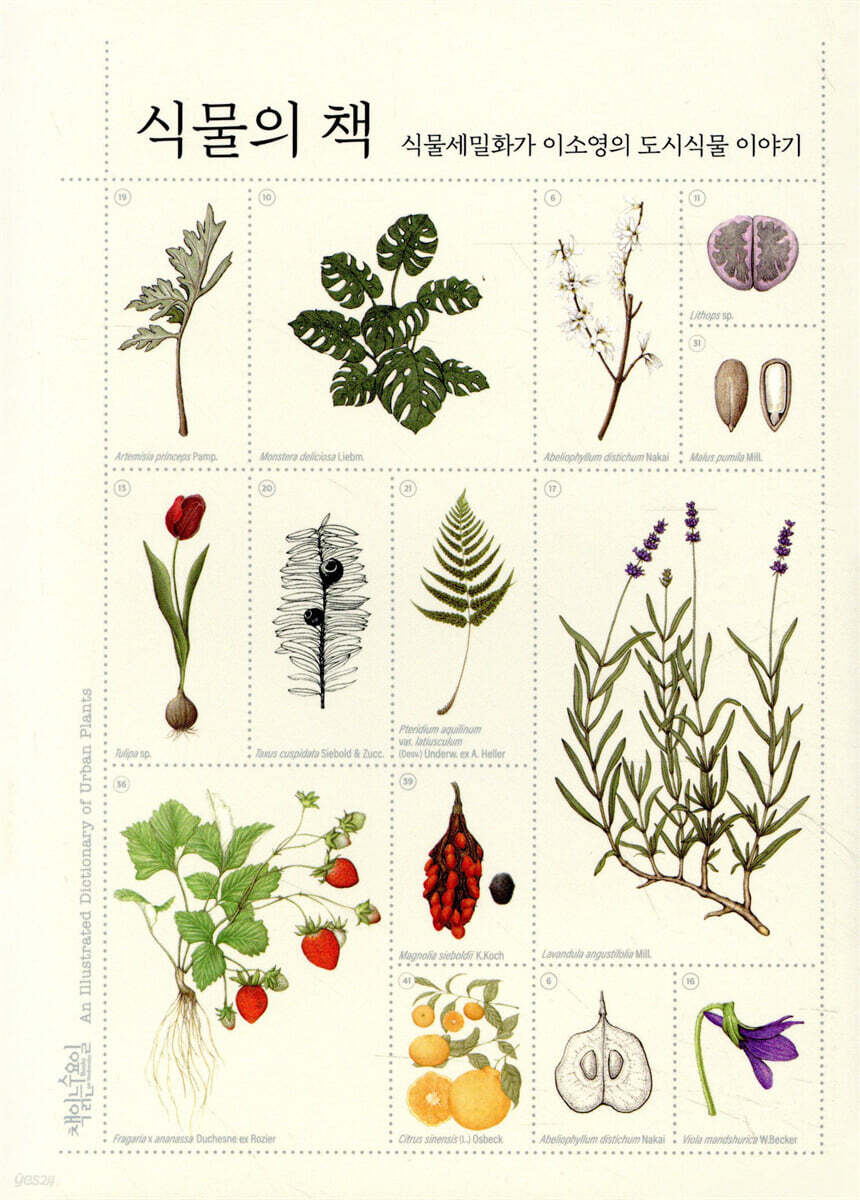
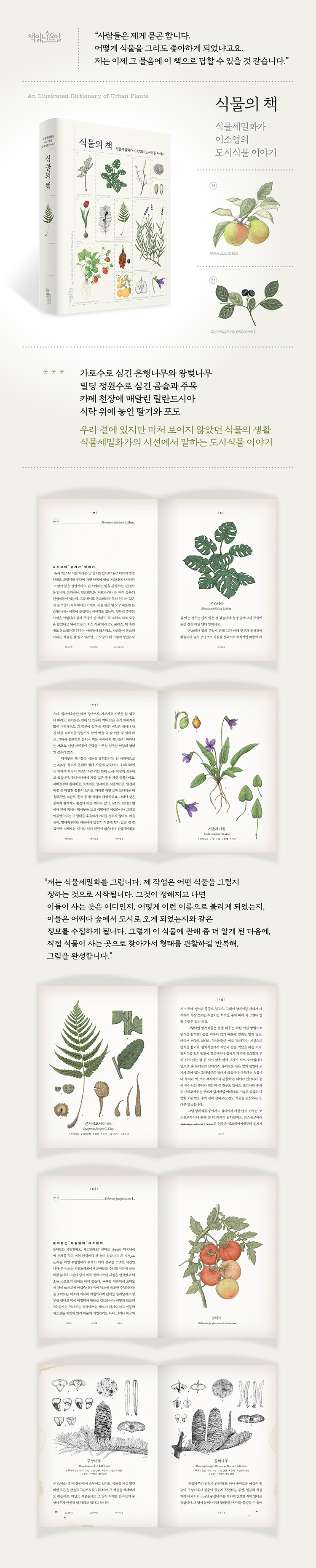
A Botanical Artist Tells the Story of Urban PlantsHow much do we really know about the plants we commonly see on street trees, in parks, and even used as interior decoration? This book introduces fascinating stories, detailed with illustrations, about urban plants that are close by but often overlooked.
The story of plants that left the forest and came to live in the city.
2019.11.01. Natural Science PD Kim Tae-hee
The life of plants that are right next to us but have not yet been seen
A story about urban plants from the perspective of a botanical artist.
Plants are now so deeply ingrained in our lives that we have become familiar with the term 'planterior', which refers to interior design that utilizes plants, as well as parks, street trees, and gardens.
But how well do we really know the plants right next to us? Botanical artist Lee So-young, who has collaborated with domestic and international research institutions, including the National Arboretum and the Rural Development Administration, to create botanical illustrations and observe plants up close, says that simply knowing basic information like plant shape, name, and habitat accurately will allow us to enjoy plants for a longer time.
In 『The Book of Plants』, we have included many interesting stories about urban plants that are always nearby but not well known, such as pine trees, ginkgo trees, forsythia, monstera, and strawberries, along with detailed illustrations.
A story about urban plants from the perspective of a botanical artist.
Plants are now so deeply ingrained in our lives that we have become familiar with the term 'planterior', which refers to interior design that utilizes plants, as well as parks, street trees, and gardens.
But how well do we really know the plants right next to us? Botanical artist Lee So-young, who has collaborated with domestic and international research institutions, including the National Arboretum and the Rural Development Administration, to create botanical illustrations and observe plants up close, says that simply knowing basic information like plant shape, name, and habitat accurately will allow us to enjoy plants for a longer time.
In 『The Book of Plants』, we have included many interesting stories about urban plants that are always nearby but not well known, such as pine trees, ginkgo trees, forsythia, monstera, and strawberries, along with detailed illustrations.
- You can preview some of the book's contents.
Preview
index
Entering
The Uses of Weeds… Dandelion | Edible Plants… Aloe | The Vitality of Large, Old Trees… Zelkova | Have You Ever Seen Forsythia Fruit?… Forsythia | How to Sense Plants… Lilac | The World's Only Flower Festival… Misennamu | The Difference Between Liking and Knowing… Pine Tree | Find the Right Name for You… Stucky | What Plants Are in Airport Florists?… Laurel | The Story Hidden in Leaves… Monstera | The Basics of Plant Cultivation… Lithops | The Heart of Autumn Waiting for Spring… Daffodils | The Beginning of the Plant Bubble… Tulips | When Choosing Plant Seeds… Dahlias | The Plant That Receives the Least but Gives the Most… Tillandsia | Flowers That Bloom Through Brick Cracks… Violet | The Emergence of Herbs… Lavender | Plants That Announce Their Presence with Fragrance… Rosemary | Plants That Won the Nobel Prize… Mugwort | The Healing Power of Plants… Yew | Plants That Don't Bloom… Bracken | Are Tomatoes Fruits or Vegetables?… Tomatoes | Can You Make a Blueberry Guide?… Blueberries | The Fruit of Midsummer… Peach Tree | Vanilla Wars … Vanilla | A summer garden filled with greenery … Bibichu | Sweet scent from leaves … Cinnamon Tree | The tree of trees … Quercus | Conditions for street trees … Ginkgo Tree | Introducing the chive family … Garlic | The reason to record the fruits we eat every day … Apple Tree | The evolution of fruits … Grape | Needle leaves or scale leaves? … Juniper | The origin of the Christmas tree … Korean fir | A plant with Christmas colors … Poinsettia | The most fragrant fruit … Strawberry | Overcoming the barley pass and becoming a health food … Barley | Close but not close … Rose of Sharon | Magnolia living in the mountains … Rose of Sharon | Red flowers that brighten winter … Camellia | The potential in a single fruit … Tangerine | The reason it blooms in the middle of winter … Forsythia
Search
The Uses of Weeds… Dandelion | Edible Plants… Aloe | The Vitality of Large, Old Trees… Zelkova | Have You Ever Seen Forsythia Fruit?… Forsythia | How to Sense Plants… Lilac | The World's Only Flower Festival… Misennamu | The Difference Between Liking and Knowing… Pine Tree | Find the Right Name for You… Stucky | What Plants Are in Airport Florists?… Laurel | The Story Hidden in Leaves… Monstera | The Basics of Plant Cultivation… Lithops | The Heart of Autumn Waiting for Spring… Daffodils | The Beginning of the Plant Bubble… Tulips | When Choosing Plant Seeds… Dahlias | The Plant That Receives the Least but Gives the Most… Tillandsia | Flowers That Bloom Through Brick Cracks… Violet | The Emergence of Herbs… Lavender | Plants That Announce Their Presence with Fragrance… Rosemary | Plants That Won the Nobel Prize… Mugwort | The Healing Power of Plants… Yew | Plants That Don't Bloom… Bracken | Are Tomatoes Fruits or Vegetables?… Tomatoes | Can You Make a Blueberry Guide?… Blueberries | The Fruit of Midsummer… Peach Tree | Vanilla Wars … Vanilla | A summer garden filled with greenery … Bibichu | Sweet scent from leaves … Cinnamon Tree | The tree of trees … Quercus | Conditions for street trees … Ginkgo Tree | Introducing the chive family … Garlic | The reason to record the fruits we eat every day … Apple Tree | The evolution of fruits … Grape | Needle leaves or scale leaves? … Juniper | The origin of the Christmas tree … Korean fir | A plant with Christmas colors … Poinsettia | The most fragrant fruit … Strawberry | Overcoming the barley pass and becoming a health food … Barley | Close but not close … Rose of Sharon | Magnolia living in the mountains … Rose of Sharon | Red flowers that brighten winter … Camellia | The potential in a single fruit … Tangerine | The reason it blooms in the middle of winter … Forsythia
Search
Detailed image
Into the book
A long-haired flower is a flower in which the stamens have degenerated and only the pistils have developed, while a short-haired flower is a flower in which the pistils have degenerated and only the stamens have developed.
For propagation, both long-stemmed and short-stemmed flowers are needed, but the forsythia we plant in the city are all short-stemmed flowers.
If you look closely at forsythia, you will see that the central pistil is short and the outer stamens are long.
So, of course, it cannot be modified and it cannot bear fruit.
It cannot reproduce on its own and is only propagated by humans through cuttings and other methods.
Although forsythia is common around us now, if there are no native individuals and no genetic diversity, it will eventually become extinct.
I hope you look at the forsythia in this situation with a little more compassion.
--- p.40, from “Have you ever seen forsythia fruit?_Forsythia”
If we think about the monstera that we can see around us, the monstera that grows in the rainforest is really huge, but compared to other huge trees that grow tens of meters in the rainforest, the monstera really looks like a plant that is attached to the ground.
Monsteras growing under large trees have limited access to light.
Monstera itself is a plant with many leaves, so if there were no holes in the Monstera leaves, the leaves at the bottom of the plant would have difficulty receiving light.
Fortunately, there are holes in the leaves, so light can pass through the holes and reach the leaves below.
In other words, light is precious, so the leaves have evolved to have holes in them to share that precious light evenly.
--- p.75, from “Stories Hidden in the Leaves_Monstera”
Since both the Keukenhof Flower Festival and the Goyang International Flower Expo are held in early spring, they mainly plant 'autumn bulbs' that are in full bloom at that time.
Some people may wonder if it is a 'spring bulb' since it is a plant that blooms in the spring.
Because the bulbs must be planted in the fall, they are called autumn-planted bulbs, meaning 'bulbs planted in the fall.'
Tulips, hyacinths, and muscari are representative autumn bulb plants.
Of course, there are also 'spring bulbs', such as dahlias, which are planted in spring and bloom in fall.
--- p.84, from “Autumn’s Heart Waiting for Spring_Daffodils”
Vanilla, which was so picky about where to grow, has now become a world-renowned fragrance thanks to a boy named Edmond Albius who was working on a farm in Africa.
A boy who wanted to grow vanilla on his farm figured out how to pollinate the vanilla plants by lifting them up with a bamboo branch, preventing them from self-pollinating.
This method is still used in every vanilla growing region in the world today.
It was thanks to a boy named Edmond that vanilla cultivation became possible in Africa, Madagascar, and Indonesia, beyond Mexico.
The artificial insemination method he invented is called 'Le geste d'Edmond' after the boy.
--- p.169, from "Vanilla War_Vanilla"
Last summer, I drew a detailed illustration of the new variety 'Summer King' developed by the Rural Development Administration.
Summer King is an apple bred to replace the Japanese Tsugaru variety, commonly known to the public as 'Aori'.
It is an early-ripening variety that can be eaten in August. It is less bitter and sweeter than Tsugaru, so people who have tried it once end up looking for Summer King rather than Aori.
The detailed drawing I drew was featured on the cover of that month's magazine published by the Rural Development Administration, and many people said that they recognized the Summer King variety after seeing it.
We were able to reaffirm one of the roles of plant detailing, which is 'cultivar identification'.
In the case of native plants, when a new species is discovered, its anatomical diagram is drawn and published.
New breeds that are bred also need to have their characteristics drawn on an anatomical chart to provide an accurate visual image for morphological classification.
--- p.206, from “The Reason for Recording the Fruits I Eat Every Day_Apple Tree”
The hollyhock is also the national flower of North Korea.
You can easily find the symbol or pattern of the hollyhock tree in the background of photos of North Korean politicians published in the media.
But an interesting fact is that in North Korea, the Magnolia japonica is called 'Mokran'.
And there is a separate plant called the hambak flower.
The plant we call peony in our country is called hambakkkot in North Korea.
The Ministry of Environment compared the plant names listed in our country's 'National Species List' with the list of plant names listed in the 'Korean Flora' published by North Korea.
As a result, we were able to find that more than half of the plants in our country and North Korea have different names.
Of course, botanists usually use scientific names rather than country names when conducting research, but rather than thinking that South Korea and North Korea speak the same language, they may use country names instead of scientific names without much thought, which can lead to confusion.
For propagation, both long-stemmed and short-stemmed flowers are needed, but the forsythia we plant in the city are all short-stemmed flowers.
If you look closely at forsythia, you will see that the central pistil is short and the outer stamens are long.
So, of course, it cannot be modified and it cannot bear fruit.
It cannot reproduce on its own and is only propagated by humans through cuttings and other methods.
Although forsythia is common around us now, if there are no native individuals and no genetic diversity, it will eventually become extinct.
I hope you look at the forsythia in this situation with a little more compassion.
--- p.40, from “Have you ever seen forsythia fruit?_Forsythia”
If we think about the monstera that we can see around us, the monstera that grows in the rainforest is really huge, but compared to other huge trees that grow tens of meters in the rainforest, the monstera really looks like a plant that is attached to the ground.
Monsteras growing under large trees have limited access to light.
Monstera itself is a plant with many leaves, so if there were no holes in the Monstera leaves, the leaves at the bottom of the plant would have difficulty receiving light.
Fortunately, there are holes in the leaves, so light can pass through the holes and reach the leaves below.
In other words, light is precious, so the leaves have evolved to have holes in them to share that precious light evenly.
--- p.75, from “Stories Hidden in the Leaves_Monstera”
Since both the Keukenhof Flower Festival and the Goyang International Flower Expo are held in early spring, they mainly plant 'autumn bulbs' that are in full bloom at that time.
Some people may wonder if it is a 'spring bulb' since it is a plant that blooms in the spring.
Because the bulbs must be planted in the fall, they are called autumn-planted bulbs, meaning 'bulbs planted in the fall.'
Tulips, hyacinths, and muscari are representative autumn bulb plants.
Of course, there are also 'spring bulbs', such as dahlias, which are planted in spring and bloom in fall.
--- p.84, from “Autumn’s Heart Waiting for Spring_Daffodils”
Vanilla, which was so picky about where to grow, has now become a world-renowned fragrance thanks to a boy named Edmond Albius who was working on a farm in Africa.
A boy who wanted to grow vanilla on his farm figured out how to pollinate the vanilla plants by lifting them up with a bamboo branch, preventing them from self-pollinating.
This method is still used in every vanilla growing region in the world today.
It was thanks to a boy named Edmond that vanilla cultivation became possible in Africa, Madagascar, and Indonesia, beyond Mexico.
The artificial insemination method he invented is called 'Le geste d'Edmond' after the boy.
--- p.169, from "Vanilla War_Vanilla"
Last summer, I drew a detailed illustration of the new variety 'Summer King' developed by the Rural Development Administration.
Summer King is an apple bred to replace the Japanese Tsugaru variety, commonly known to the public as 'Aori'.
It is an early-ripening variety that can be eaten in August. It is less bitter and sweeter than Tsugaru, so people who have tried it once end up looking for Summer King rather than Aori.
The detailed drawing I drew was featured on the cover of that month's magazine published by the Rural Development Administration, and many people said that they recognized the Summer King variety after seeing it.
We were able to reaffirm one of the roles of plant detailing, which is 'cultivar identification'.
In the case of native plants, when a new species is discovered, its anatomical diagram is drawn and published.
New breeds that are bred also need to have their characteristics drawn on an anatomical chart to provide an accurate visual image for morphological classification.
--- p.206, from “The Reason for Recording the Fruits I Eat Every Day_Apple Tree”
The hollyhock is also the national flower of North Korea.
You can easily find the symbol or pattern of the hollyhock tree in the background of photos of North Korean politicians published in the media.
But an interesting fact is that in North Korea, the Magnolia japonica is called 'Mokran'.
And there is a separate plant called the hambak flower.
The plant we call peony in our country is called hambakkkot in North Korea.
The Ministry of Environment compared the plant names listed in our country's 'National Species List' with the list of plant names listed in the 'Korean Flora' published by North Korea.
As a result, we were able to find that more than half of the plants in our country and North Korea have different names.
Of course, botanists usually use scientific names rather than country names when conducting research, but rather than thinking that South Korea and North Korea speak the same language, they may use country names instead of scientific names without much thought, which can lead to confusion.
--- p.260, from “Magnolia Living in the Mountains_Hampak Flower Tree”
Publisher's Review
I left the forest and came to live in the city.
Seeing the world from a plant's perspective
The role of the botanical artist Lee So-young is to accurately record the current state of plants.
The subjects he records are mainly plants that are around us, such as indoor spaces, arboretums, and parks, or plants that will be around us in the future, such as new varieties developed by research institutes, that is, plants that have left the forests and come to live in cities.
If we follow his gaze, we too will find ourselves looking at the world from the perspective of plants.
Ginkgo trees and cherry trees planted as street trees, black pines and yew trees planted as garden trees, tillandsia hanging from the cafe ceiling, apples and grapes placed on the table… … .
How did plants that used to live in forests and even deserts end up in the cities where we live?
As you read 『The Book of Plants』, your gaze naturally shifts from people to plants.
As native dandelions disappear and the number of western dandelions increases, people start a fight with the dandelions, saying that the native dandelions are being pushed out by the western dandelions and are losing their territory.
However, the author says, “The reason why native dandelions are increasingly being pushed out of the forest and their numbers are decreasing is precisely because of environmental destruction” (p. 16), and that as mountains were cut down and land was filled to create open spaces, native dandelions that had originally lived there disappeared and western dandelions increased in their place.
The ginkgo tree is also an innocent victim of ‘human greed.’
It is the oldest tree on Earth and is the only one in the world, belonging to one genus, one family, and one species. It is treated as a precious tree in other countries, but in Korea, it is neglected because of the foul smell when the fruit falls.
Before the fruit ripens, the branches are shaken to cause the young fruit to fall, or the male and female trees are separated and planted as male trees only to prevent them from bearing fruit at all.
However, the ginkgo tree's terrible smell is due to the components called bilobol and ginkgo acid, which are the tree's survival method to protect its seeds from animals and insects.
The author asks:
“It is such a natural process for plants to bear fruit and spread seeds for reproduction, so do we really have the right to artificially block it?” (p. 195).
I'm worried because my companion plants keep dying.
The simplest advice for people
As companion plants and planteriums become popular and interest in air-purifying plants grows due to fine dust and sick house syndrome, the number of people growing plants at home is increasing.
The most common question people ask when bringing in plants is this:
“I want to grow plants, but they keep dying.
“What plants don’t die easily?” The author recommends that when you’re unsure about how to grow a plant, first think about the environment in which the plant grew in its native habitat.
For example, when growing succulents such as lithops or cacti, you need to create a dry environment like the desert where they live.
In very humid summers, it is best to limit watering so that the plant can survive on just water from the air.
Even for herbs like rosemary and lavender, if you think about the environment of their native Italy, which has strong sunlight and abundant water, you can expect that it would be good to water them frequently and give them plenty of sunlight.
If it is difficult to obtain immediate information about the plant's origin, one way to do so is to first pay attention to the plant's appearance.
The author emphasizes that observing plants frequently is the most essential basic attitude when growing plants.
Children and animals often express their lack through words or movements, but plants, unable to move, express their lack through form.
You can check the current condition of a plant by observing small changes, such as drooping leaves or changes in color.
Also, the shape of the leaves already contains a lot of information.
The leaves of a plant are closely related to photosynthesis. For example, if a plant has large leaves, the plant has likely evolved to receive a lot of light, so it would be good to grow it in a place that receives a lot of light.
What about Tillandsia, a popular indoor plant these days? A closer look at Tillandsia reveals rough, pore-like structures on the inside of its leaves.
Tillandsia absorbs water and nutrients through these pores, so when watering, it is best to submerge the entire leaf in water or spray water on it.
Remember the names of plants correctly
The importance of calling
In fact, the origin of a plant can often be hinted at from its scientific name.
Scientific names are the names of plants used worldwide and contain information about the plant's taxonomic, historical, and morphological characteristics. Therefore, simply recognizing a plant by its scientific name can bring you closer to the plant.
Among scientific names, the species epithet often contains information about the morphological characteristics or origin of the plant. However, there are quite a few cases where the scientific name includes the name of a Japanese botanist, even though the plant is endemic to Korea, such as 'Abeliophyllum distichum Nakai', which was first discovered by Japanese scholars during the Japanese colonial period.
When a Japanese scholar first discovered a plant growing on Dokdo, it was named 'Takeshimaensis', and when a Korean scholar discovered a plant after liberation, it was recorded in the scientific name as 'Dokdoensis'.
In Europe, where plant culture was developed, the importance of recording cultivars was recognized early on, and botanical gardens and horticultural societies directly hired botanical artists to keep records.
France, where the grape cultivation industry developed due to the popularity of wine, has an abundance of records related to grapes. In particular, Pierre-Joseph Redoute, who was active from the late 1700s, left behind many detailed drawings of grapes.
He is such a well-known figure that when writer Lee So-young introduces his job to people she meets in France, they say, “You do the same job as Aha Redouté!” and pretend to know him.
These records are important because they inform consumers of the existence of different varieties.
In the horticultural industry, growers are bound to follow the choices of consumers, but if consumers continue to consume only a single variety, orchards will eventually end up only growing 'monoculture'.
If a disease or pest becomes prevalent, it could face extinction.
Maintaining the diversity of species is important, and these days, with the concept of 'biological sovereignty' becoming clearer and recognized as a resource, each country is putting more effort into developing species.
Taking the strawberry introduced in the book as an example, before domestic cultivation of varieties such as Maehyang and Seolhyang, mainly Japanese varieties were imported, and royalties alone had to be paid in excess of 3 billion won annually.
However, after 10 years of research, the Seolhyang variety was developed, and now accounts for 80 percent of our country's strawberry consumption, and the royalty paid to Japan has also decreased from 3.2 billion won in 2005 to 50 million won last year.
(Therefore, the publisher produced a New Year's calendar with the theme of new food varieties developed in Korea as a special first edition limited edition gift.)
The Book of Plants also contains many other interesting stories about urban plants, along with detailed illustrations.
Vanilla is used as one of the ingredients in cola, but once Coca-Cola created a new line of cola recipes that did not contain vanilla. That year, global vanilla consumption plummeted, and Madagascar, a major vanilla growing region, suffered an economic collapse.
And various stories related to the life of plants unfold, such as why the cinnamon tree smells sweet when its leaves change color, why the lotus flower blooms in winter, and the origin of the holes in the leaves of the monstera plant.
Remembering the names and forms of each plant, and observing them with interest and attention often, is also our responsibility and duty to invite plants from the forest into the city and utilize them.
Seeing the world from a plant's perspective
The role of the botanical artist Lee So-young is to accurately record the current state of plants.
The subjects he records are mainly plants that are around us, such as indoor spaces, arboretums, and parks, or plants that will be around us in the future, such as new varieties developed by research institutes, that is, plants that have left the forests and come to live in cities.
If we follow his gaze, we too will find ourselves looking at the world from the perspective of plants.
Ginkgo trees and cherry trees planted as street trees, black pines and yew trees planted as garden trees, tillandsia hanging from the cafe ceiling, apples and grapes placed on the table… … .
How did plants that used to live in forests and even deserts end up in the cities where we live?
As you read 『The Book of Plants』, your gaze naturally shifts from people to plants.
As native dandelions disappear and the number of western dandelions increases, people start a fight with the dandelions, saying that the native dandelions are being pushed out by the western dandelions and are losing their territory.
However, the author says, “The reason why native dandelions are increasingly being pushed out of the forest and their numbers are decreasing is precisely because of environmental destruction” (p. 16), and that as mountains were cut down and land was filled to create open spaces, native dandelions that had originally lived there disappeared and western dandelions increased in their place.
The ginkgo tree is also an innocent victim of ‘human greed.’
It is the oldest tree on Earth and is the only one in the world, belonging to one genus, one family, and one species. It is treated as a precious tree in other countries, but in Korea, it is neglected because of the foul smell when the fruit falls.
Before the fruit ripens, the branches are shaken to cause the young fruit to fall, or the male and female trees are separated and planted as male trees only to prevent them from bearing fruit at all.
However, the ginkgo tree's terrible smell is due to the components called bilobol and ginkgo acid, which are the tree's survival method to protect its seeds from animals and insects.
The author asks:
“It is such a natural process for plants to bear fruit and spread seeds for reproduction, so do we really have the right to artificially block it?” (p. 195).
I'm worried because my companion plants keep dying.
The simplest advice for people
As companion plants and planteriums become popular and interest in air-purifying plants grows due to fine dust and sick house syndrome, the number of people growing plants at home is increasing.
The most common question people ask when bringing in plants is this:
“I want to grow plants, but they keep dying.
“What plants don’t die easily?” The author recommends that when you’re unsure about how to grow a plant, first think about the environment in which the plant grew in its native habitat.
For example, when growing succulents such as lithops or cacti, you need to create a dry environment like the desert where they live.
In very humid summers, it is best to limit watering so that the plant can survive on just water from the air.
Even for herbs like rosemary and lavender, if you think about the environment of their native Italy, which has strong sunlight and abundant water, you can expect that it would be good to water them frequently and give them plenty of sunlight.
If it is difficult to obtain immediate information about the plant's origin, one way to do so is to first pay attention to the plant's appearance.
The author emphasizes that observing plants frequently is the most essential basic attitude when growing plants.
Children and animals often express their lack through words or movements, but plants, unable to move, express their lack through form.
You can check the current condition of a plant by observing small changes, such as drooping leaves or changes in color.
Also, the shape of the leaves already contains a lot of information.
The leaves of a plant are closely related to photosynthesis. For example, if a plant has large leaves, the plant has likely evolved to receive a lot of light, so it would be good to grow it in a place that receives a lot of light.
What about Tillandsia, a popular indoor plant these days? A closer look at Tillandsia reveals rough, pore-like structures on the inside of its leaves.
Tillandsia absorbs water and nutrients through these pores, so when watering, it is best to submerge the entire leaf in water or spray water on it.
Remember the names of plants correctly
The importance of calling
In fact, the origin of a plant can often be hinted at from its scientific name.
Scientific names are the names of plants used worldwide and contain information about the plant's taxonomic, historical, and morphological characteristics. Therefore, simply recognizing a plant by its scientific name can bring you closer to the plant.
Among scientific names, the species epithet often contains information about the morphological characteristics or origin of the plant. However, there are quite a few cases where the scientific name includes the name of a Japanese botanist, even though the plant is endemic to Korea, such as 'Abeliophyllum distichum Nakai', which was first discovered by Japanese scholars during the Japanese colonial period.
When a Japanese scholar first discovered a plant growing on Dokdo, it was named 'Takeshimaensis', and when a Korean scholar discovered a plant after liberation, it was recorded in the scientific name as 'Dokdoensis'.
In Europe, where plant culture was developed, the importance of recording cultivars was recognized early on, and botanical gardens and horticultural societies directly hired botanical artists to keep records.
France, where the grape cultivation industry developed due to the popularity of wine, has an abundance of records related to grapes. In particular, Pierre-Joseph Redoute, who was active from the late 1700s, left behind many detailed drawings of grapes.
He is such a well-known figure that when writer Lee So-young introduces his job to people she meets in France, they say, “You do the same job as Aha Redouté!” and pretend to know him.
These records are important because they inform consumers of the existence of different varieties.
In the horticultural industry, growers are bound to follow the choices of consumers, but if consumers continue to consume only a single variety, orchards will eventually end up only growing 'monoculture'.
If a disease or pest becomes prevalent, it could face extinction.
Maintaining the diversity of species is important, and these days, with the concept of 'biological sovereignty' becoming clearer and recognized as a resource, each country is putting more effort into developing species.
Taking the strawberry introduced in the book as an example, before domestic cultivation of varieties such as Maehyang and Seolhyang, mainly Japanese varieties were imported, and royalties alone had to be paid in excess of 3 billion won annually.
However, after 10 years of research, the Seolhyang variety was developed, and now accounts for 80 percent of our country's strawberry consumption, and the royalty paid to Japan has also decreased from 3.2 billion won in 2005 to 50 million won last year.
(Therefore, the publisher produced a New Year's calendar with the theme of new food varieties developed in Korea as a special first edition limited edition gift.)
The Book of Plants also contains many other interesting stories about urban plants, along with detailed illustrations.
Vanilla is used as one of the ingredients in cola, but once Coca-Cola created a new line of cola recipes that did not contain vanilla. That year, global vanilla consumption plummeted, and Madagascar, a major vanilla growing region, suffered an economic collapse.
And various stories related to the life of plants unfold, such as why the cinnamon tree smells sweet when its leaves change color, why the lotus flower blooms in winter, and the origin of the holes in the leaves of the monstera plant.
Remembering the names and forms of each plant, and observing them with interest and attention often, is also our responsibility and duty to invite plants from the forest into the city and utilize them.
GOODS SPECIFICS
- Date of publication: October 25, 2019
- Page count, weight, size: 288 pages | 378g | 121*170*20mm
- ISBN13: 9788986022100
- ISBN10: 8986022109
You may also like
카테고리
korean


korean

![ELLE 엘르 스페셜 에디션 A형 : 12월 [2025]](http://librairie.coreenne.fr/cdn/shop/files/b8e27a3de6c9538896439686c6b0e8fb.jpg?v=1766436872&width=3840)


