

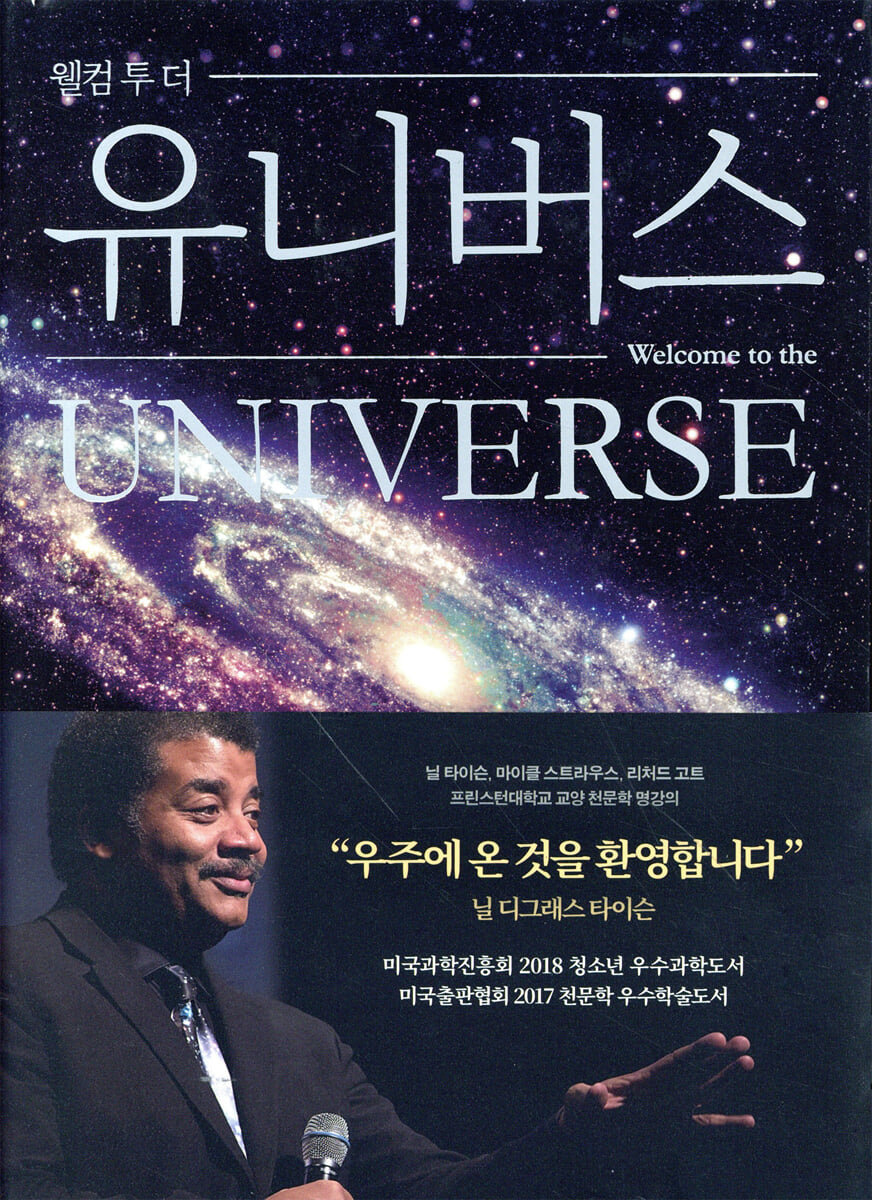
Welcome to the Universe
 |
Description
Book Introduction
Princeton University's Liberal Arts Astronomy Lecture Series Everything about our universe, guided by the best astronomers Selected as a 2018 Outstanding Science Book for Young Adults by the American Association for the Advancement of Science (AAAS). Honorable Mention in Cosmology/Astronomy, 2017, Association of American Publishers Award for Outstanding Academic Book. Using language and clear metaphors that our time's greatest astronomers can understand, they invite readers into the boundless and wondrous universe. "Welcome to the Universe" is a book designed for students who have never taken a science lecture before, and is a compilation of the "Master Lectures on Modern Astronomy" that received acclaim from Time magazine. Neil deGrasse Tyson, the most beloved science communicator since Carl Sagan, and Michael A. Strauss and J. Co-authored by Richard Gott, this book provides an easy-to-understand explanation of the fundamental theories of astrophysics, from Newton's laws to relativity, the Big Bang theory to black holes, as well as cutting-edge theories such as dark matter, the multiverse, string theory, and M-theory. This book, which teaches in detail not only the facts known about the universe so far but also the principles by which we know them, is the best introductory book to astrophysics since Carl Sagan's "Cosmos" and will broaden and deepen your perspective on the universe. Now the universe beckons. Welcome to space. |
- You can preview some of the book's contents.
Preview
index
introduction
Part 1: Stars, Planets, and Life
1 The size and scale of the universe
2 From the sky to the planet's orbit
3 Newton's Laws
4 How do stars emit energy (I)
5 How Stars Radiate Energy (II)
6 Star Spectra
The Life and Death of 7 Stars (I)
The Life and Death of 8 Stars (II)
9 Why Pluto is not a planet
Finding Life in 10 Galaxies
Part 2 Galaxy
11 Interstellar matter
12 Our Milky Way
The Universe of 13 Galaxies
14 The Expanding Universe
15 Early Universe
16 quasars and supermassive black holes
Part 3: Einstein and the Universe
17 Einstein's Journey to the Theory of Relativity
18 The meaning of special relativity
19 Einstein's general theory of relativity
20 black holes
21 Cosmic Strings, Wormholes, and Time Travel
22 The Shape of the Universe and the Big Bang
23 Inflation and Recent Developments in Cosmology
24 Our Future in Space
Appendix 1 Derivation of E=mc2
Appendix 2: Bekenstein, Black Hole Entropy, and Information
main
Translator's Note
Recommended books
Search
Part 1: Stars, Planets, and Life
1 The size and scale of the universe
2 From the sky to the planet's orbit
3 Newton's Laws
4 How do stars emit energy (I)
5 How Stars Radiate Energy (II)
6 Star Spectra
The Life and Death of 7 Stars (I)
The Life and Death of 8 Stars (II)
9 Why Pluto is not a planet
Finding Life in 10 Galaxies
Part 2 Galaxy
11 Interstellar matter
12 Our Milky Way
The Universe of 13 Galaxies
14 The Expanding Universe
15 Early Universe
16 quasars and supermassive black holes
Part 3: Einstein and the Universe
17 Einstein's Journey to the Theory of Relativity
18 The meaning of special relativity
19 Einstein's general theory of relativity
20 black holes
21 Cosmic Strings, Wormholes, and Time Travel
22 The Shape of the Universe and the Big Bang
23 Inflation and Recent Developments in Cosmology
24 Our Future in Space
Appendix 1 Derivation of E=mc2
Appendix 2: Bekenstein, Black Hole Entropy, and Information
main
Translator's Note
Recommended books
Search
Detailed image
.jpg)
Publisher's Review
★The best introductory book to astrophysics recognized internationally★
Honorable Mention in the Cosmology/Astronomy Category of the 2017 PROSE Award, Selected by the Association of American Publishers
2018 Outstanding Science Books for Young Adults by the American Association for the Advancement of Science (AAAS)
[New York Times], [Amazon] Bestseller, [Nature], [Science] Recommended Book
[Men's Journal] Selected as an Outstanding Book of 2016
[Symmetry] Selected as the 2016 Physics Book of the Year
Ars Technica's 2016 Best Nonfiction Book
Forbes.com's Best Science Books of 2016
A Space Guide for Space Citizens
Princeton University's liberal arts astronomy in books
In 1998, Princeton University designed an astrophysics course for non-science undergraduates, students who had never taken a science class, and appointed three professors.
Neil deGrasse Tyson, director of the Hayden Planetarium at the American Museum of Natural History, and Michael A.
Strauss, J.
Richard Gott was the protagonist.
Until 2007, when Time magazine named Tyson one of the "100 Most Influential People in the World," the lectures continued to be acclaimed as "masterful lectures that empower us to understand the universe" through the collaboration of three people.
Furthermore, they wanted to publish the lectures in a book format for the general public who wanted to understand the universe more deeply, and this book, "Welcome to the Universe," reflects all the latest astronomical knowledge added after the lectures.
This book became a New York Times bestseller as soon as it was published in 2016, and was acclaimed as the best introductory book to astrophysics since Cosmos.
Astrophysics is a cutting-edge scientific field that continues to produce major discoveries and Nobel Prizes in just a few decades, enough to change textbooks.
In contrast, there are times when we wonder if our current knowledge of astrophysics is stuck at a level of 10 years ago.
As we race to establish space colonies, "Welcome to the Universe" provides an easy-to-understand explanation of the diverse fields of astrophysics, from fundamental principles to the latest research findings. This book will give readers a quick overview of where astronomy has come from.
Neil Tyson, who wrote Part 1 (Stars and Planets), has over 12 million Twitter followers and has made cameo appearances under his real name in shows like [The Simpsons], [The Big Bang Theory], and [Batman v Superman]. He is the greatest star science communicator since Carl Sagan and an icon in the current astrophysics world.
Tyson has been with Princeton University since 1994, serving as a postdoc and visiting professor, teaching directly to students.
This book demonstrates Professor Tyson's extraordinary talent for conveying complex and difficult concepts in language and metaphors that the general public can easily understand.
Michael A., who wrote Part 2 (Galaxy),
Strauss was the observational astronomer who, in 1998, used the Sloan Digital Sky Survey (SDSS) to discover the most distant quasar known at the time (this was an observation of light emitted when the universe was 850 million years old, meaning it had left the sky about 13 billion years ago).
This record was broken by another research team in 2011).
Strauss clearly explains the structure of galaxies, the Big Bang theory, quasars, and black holes through amazing images taken by the Hubble Space Telescope and space exploration satellites.
J., who wrote Part 3 (Cosmology),
Richard Gott is a world-renowned astrophysicist who discovered the exact solution to the field equations of general relativity for the two strings of the universe and explained the cosmic web structure through inflation.
In 2003, the Sloan Great Wall of a galaxy about 1.4 billion light-years away was discovered, and was listed in the Guinness Book of World Records as the largest structure known at the time in the universe.
Not only does Gott explain Einstein's theory of relativity in a more accessible way than any other book on the market, he also delves into various modern cosmological theories, such as the multiverse, bubble universe, string theory, quantum tunnels, and hyperbolic universes, as well as interesting topics such as time travel and space colonization.
Princeton University is renowned for physicists like Einstein and Feynman, but it has also played a particularly pioneering role in astronomy. Princeton produced astronomers like Henry Norris Russell, who developed the HR diagram; Lyman Spitzer, the father of the Hubble Space Telescope; and Robert Dickey, James Peebles, David Wilkinson, and Peter Roll, who predicted and explained the cosmic microwave background, thereby proving the Big Bang theory. (The WMAP probe, which observed anisotropy in the cosmic microwave background and revealed the existence of dark matter and dark energy, is also named after Wilkinson.)
Now available in book form, this renowned lecture series, brought together scientists working in the most prolific cradle of modern astrophysics and the world's leading scientific commentators, explains everything about the universe in a way that even the general public can understand.
“Welcome to space”
The most friendly introduction to astrophysics you've ever encountered
This book is an introductory book to astrophysics written for the general public. As it is aimed at complete laymen from the beginning, it explains the basics of astrophysics in a friendly and easy-to-understand manner.
For example, in Chapter 1, Tyson starts with 1 and gradually works his way up to larger numbers to give the reader a sense of the scale of the universe.
100 billion hamburgers (he also gives a realistic explanation that if you lined up that many hamburgers, they would circle the Earth 216 times and travel to the moon and back), Cro-Magnon humans from a trillion seconds ago, 1,000 trillion ants, 100 quintillion grains of sand on 10 Copacabana beaches… … and finally, 100 years—the number of stars in the observable universe.
Then, by gradually increasing the level of understanding of the Earth's rotation and revolution, the constellations, and the phases of the moon, it corrects many astronomical misconceptions, such as, 'The day gets longer in winter and shorter in summer,' 'The North Star is the 45th brightest star in the night sky,' and 'There are 13 constellations in the zodiac, not 12.' (Therefore, all daily horoscopes are off by a month.)
Unlike other rigid science books on the market, this book actively incorporates the authors' personal stories to convey difficult astrophysics knowledge in an easy and fun way.
Tyson humorously shares stories of how he named his daughter 'Miranda' after a moon of Uranus, and how he was surprised when he was invited to the premiere of his first movie ([Contact]), using his signature wit. Strauss tells the story of our galaxy through the unforgettable beauty of the Milky Way he saw at the Cerro Tololo Observatory in Chile during his dating days, and Gott calculates the future duration of humanity through his visit to the Berlin Wall during his college days, and he recalls the Apollo 11 launch scene that he witnessed firsthand, giving a moving account of space development and the challenges of humanity.
Additionally, the authors use rich analogies to explain complex and difficult scientific concepts in a way that makes them relatable.
Strauss's famous analogy of bread and raisins beautifully conveys the idea that the Big Bang was an expansion of space itself, and that there was no particular center to the expansion of the universe.
Goat uses the clever premise of "jacket from the future" to clearly present the concepts of time travel and world lines, and reveals various characteristics of black holes through virtual communication between a professor and a graduate student who set out to explore them.
Tyson's knack for explaining difficult concepts through metaphors shines particularly in this book.
He explains the relationship between the distance and brightness of stars using a butter gun (a fictional invention that shoots butter to spread butter on bread), and explains the different spectra emitted by stars using the metaphor of an oak tree and a squirrel.
He also explains that the density of a neutron star is equivalent to compressing 100 million elephants to the size of a thimble, and that the energy required to climb a 20,000-kilometer cliff in Earth's gravity (even if you climbed 100 meters per hour for 24 hours straight, it would take over 22 years) is equivalent to the energy required to climb from a neutron star to a piece of paper.
From the Big Bang Theory to M-Theory
Beyond knowledge, embodying principles
"Welcome to the Universe" not only provides diverse knowledge about the universe, but also focuses on understanding the methods scientists use to figure it out and the principles of exploration.
As Science magazine put it, “This book’s greatest achievement is not so much what we know about the universe as how we know it.” The authors provide a detailed understanding of how to calculate distances to stars using parallax, how to measure the speed of light, how to determine a star’s luminosity and size using its spectrum, how to use redshift and variable stars to determine the distances and velocities of galaxies, and the mechanisms of nuclear fusion inside stars and the evolution of stars (how a main-sequence star becomes a red giant and then explodes in a supernova to become a neutron star or a black hole).
In particular, in the process, rather than simply introducing Kepler and Newton's laws, Einstein's relativity equations, Planck function, Stefan-Boltzmann law, Drake equation, etc., it presents the specific process of deriving the formulas so that anyone can follow along.
Although this book is an introductory text, it also includes many cutting-edge discoveries and theories in astrophysics, such as the multiverse, string theory, and M-theory.
In addition to the controversy surrounding Pluto's expulsion, we consider the meaning of planets by introducing thousands of newly discovered planets orbiting other stars, examine the meaning of gravitational waves created by two colliding black holes successfully detected by LIGO (Laser Interferometer Gravitational-Wave Observatory), and explain the standard cosmological model that has been refined through observations from the Hubble Space Telescope, SDSS, WMAP, and Planck satellites.
It also explains how astronomers know how much dark matter there is in the universe, that it is not made of ordinary matter, and how dense dark energy is and that it has negative pressure.
Welcome to the Universe takes us to the cutting edge of current astrophysical knowledge about the origins and future of the universe.
Honorable Mention in the Cosmology/Astronomy Category of the 2017 PROSE Award, Selected by the Association of American Publishers
2018 Outstanding Science Books for Young Adults by the American Association for the Advancement of Science (AAAS)
[New York Times], [Amazon] Bestseller, [Nature], [Science] Recommended Book
[Men's Journal] Selected as an Outstanding Book of 2016
[Symmetry] Selected as the 2016 Physics Book of the Year
Ars Technica's 2016 Best Nonfiction Book
Forbes.com's Best Science Books of 2016
A Space Guide for Space Citizens
Princeton University's liberal arts astronomy in books
In 1998, Princeton University designed an astrophysics course for non-science undergraduates, students who had never taken a science class, and appointed three professors.
Neil deGrasse Tyson, director of the Hayden Planetarium at the American Museum of Natural History, and Michael A.
Strauss, J.
Richard Gott was the protagonist.
Until 2007, when Time magazine named Tyson one of the "100 Most Influential People in the World," the lectures continued to be acclaimed as "masterful lectures that empower us to understand the universe" through the collaboration of three people.
Furthermore, they wanted to publish the lectures in a book format for the general public who wanted to understand the universe more deeply, and this book, "Welcome to the Universe," reflects all the latest astronomical knowledge added after the lectures.
This book became a New York Times bestseller as soon as it was published in 2016, and was acclaimed as the best introductory book to astrophysics since Cosmos.
Astrophysics is a cutting-edge scientific field that continues to produce major discoveries and Nobel Prizes in just a few decades, enough to change textbooks.
In contrast, there are times when we wonder if our current knowledge of astrophysics is stuck at a level of 10 years ago.
As we race to establish space colonies, "Welcome to the Universe" provides an easy-to-understand explanation of the diverse fields of astrophysics, from fundamental principles to the latest research findings. This book will give readers a quick overview of where astronomy has come from.
Neil Tyson, who wrote Part 1 (Stars and Planets), has over 12 million Twitter followers and has made cameo appearances under his real name in shows like [The Simpsons], [The Big Bang Theory], and [Batman v Superman]. He is the greatest star science communicator since Carl Sagan and an icon in the current astrophysics world.
Tyson has been with Princeton University since 1994, serving as a postdoc and visiting professor, teaching directly to students.
This book demonstrates Professor Tyson's extraordinary talent for conveying complex and difficult concepts in language and metaphors that the general public can easily understand.
Michael A., who wrote Part 2 (Galaxy),
Strauss was the observational astronomer who, in 1998, used the Sloan Digital Sky Survey (SDSS) to discover the most distant quasar known at the time (this was an observation of light emitted when the universe was 850 million years old, meaning it had left the sky about 13 billion years ago).
This record was broken by another research team in 2011).
Strauss clearly explains the structure of galaxies, the Big Bang theory, quasars, and black holes through amazing images taken by the Hubble Space Telescope and space exploration satellites.
J., who wrote Part 3 (Cosmology),
Richard Gott is a world-renowned astrophysicist who discovered the exact solution to the field equations of general relativity for the two strings of the universe and explained the cosmic web structure through inflation.
In 2003, the Sloan Great Wall of a galaxy about 1.4 billion light-years away was discovered, and was listed in the Guinness Book of World Records as the largest structure known at the time in the universe.
Not only does Gott explain Einstein's theory of relativity in a more accessible way than any other book on the market, he also delves into various modern cosmological theories, such as the multiverse, bubble universe, string theory, quantum tunnels, and hyperbolic universes, as well as interesting topics such as time travel and space colonization.
Princeton University is renowned for physicists like Einstein and Feynman, but it has also played a particularly pioneering role in astronomy. Princeton produced astronomers like Henry Norris Russell, who developed the HR diagram; Lyman Spitzer, the father of the Hubble Space Telescope; and Robert Dickey, James Peebles, David Wilkinson, and Peter Roll, who predicted and explained the cosmic microwave background, thereby proving the Big Bang theory. (The WMAP probe, which observed anisotropy in the cosmic microwave background and revealed the existence of dark matter and dark energy, is also named after Wilkinson.)
Now available in book form, this renowned lecture series, brought together scientists working in the most prolific cradle of modern astrophysics and the world's leading scientific commentators, explains everything about the universe in a way that even the general public can understand.
“Welcome to space”
The most friendly introduction to astrophysics you've ever encountered
This book is an introductory book to astrophysics written for the general public. As it is aimed at complete laymen from the beginning, it explains the basics of astrophysics in a friendly and easy-to-understand manner.
For example, in Chapter 1, Tyson starts with 1 and gradually works his way up to larger numbers to give the reader a sense of the scale of the universe.
100 billion hamburgers (he also gives a realistic explanation that if you lined up that many hamburgers, they would circle the Earth 216 times and travel to the moon and back), Cro-Magnon humans from a trillion seconds ago, 1,000 trillion ants, 100 quintillion grains of sand on 10 Copacabana beaches… … and finally, 100 years—the number of stars in the observable universe.
Then, by gradually increasing the level of understanding of the Earth's rotation and revolution, the constellations, and the phases of the moon, it corrects many astronomical misconceptions, such as, 'The day gets longer in winter and shorter in summer,' 'The North Star is the 45th brightest star in the night sky,' and 'There are 13 constellations in the zodiac, not 12.' (Therefore, all daily horoscopes are off by a month.)
Unlike other rigid science books on the market, this book actively incorporates the authors' personal stories to convey difficult astrophysics knowledge in an easy and fun way.
Tyson humorously shares stories of how he named his daughter 'Miranda' after a moon of Uranus, and how he was surprised when he was invited to the premiere of his first movie ([Contact]), using his signature wit. Strauss tells the story of our galaxy through the unforgettable beauty of the Milky Way he saw at the Cerro Tololo Observatory in Chile during his dating days, and Gott calculates the future duration of humanity through his visit to the Berlin Wall during his college days, and he recalls the Apollo 11 launch scene that he witnessed firsthand, giving a moving account of space development and the challenges of humanity.
Additionally, the authors use rich analogies to explain complex and difficult scientific concepts in a way that makes them relatable.
Strauss's famous analogy of bread and raisins beautifully conveys the idea that the Big Bang was an expansion of space itself, and that there was no particular center to the expansion of the universe.
Goat uses the clever premise of "jacket from the future" to clearly present the concepts of time travel and world lines, and reveals various characteristics of black holes through virtual communication between a professor and a graduate student who set out to explore them.
Tyson's knack for explaining difficult concepts through metaphors shines particularly in this book.
He explains the relationship between the distance and brightness of stars using a butter gun (a fictional invention that shoots butter to spread butter on bread), and explains the different spectra emitted by stars using the metaphor of an oak tree and a squirrel.
He also explains that the density of a neutron star is equivalent to compressing 100 million elephants to the size of a thimble, and that the energy required to climb a 20,000-kilometer cliff in Earth's gravity (even if you climbed 100 meters per hour for 24 hours straight, it would take over 22 years) is equivalent to the energy required to climb from a neutron star to a piece of paper.
From the Big Bang Theory to M-Theory
Beyond knowledge, embodying principles
"Welcome to the Universe" not only provides diverse knowledge about the universe, but also focuses on understanding the methods scientists use to figure it out and the principles of exploration.
As Science magazine put it, “This book’s greatest achievement is not so much what we know about the universe as how we know it.” The authors provide a detailed understanding of how to calculate distances to stars using parallax, how to measure the speed of light, how to determine a star’s luminosity and size using its spectrum, how to use redshift and variable stars to determine the distances and velocities of galaxies, and the mechanisms of nuclear fusion inside stars and the evolution of stars (how a main-sequence star becomes a red giant and then explodes in a supernova to become a neutron star or a black hole).
In particular, in the process, rather than simply introducing Kepler and Newton's laws, Einstein's relativity equations, Planck function, Stefan-Boltzmann law, Drake equation, etc., it presents the specific process of deriving the formulas so that anyone can follow along.
Although this book is an introductory text, it also includes many cutting-edge discoveries and theories in astrophysics, such as the multiverse, string theory, and M-theory.
In addition to the controversy surrounding Pluto's expulsion, we consider the meaning of planets by introducing thousands of newly discovered planets orbiting other stars, examine the meaning of gravitational waves created by two colliding black holes successfully detected by LIGO (Laser Interferometer Gravitational-Wave Observatory), and explain the standard cosmological model that has been refined through observations from the Hubble Space Telescope, SDSS, WMAP, and Planck satellites.
It also explains how astronomers know how much dark matter there is in the universe, that it is not made of ordinary matter, and how dense dark energy is and that it has negative pressure.
Welcome to the Universe takes us to the cutting edge of current astrophysical knowledge about the origins and future of the universe.
GOODS SPECIFICS
- Date of issue: September 30, 2019
- Format: Hardcover book binding method guide
- Page count, weight, size: 528 pages | 1,150g | 178*238*43mm
- ISBN13: 9791189932329
- ISBN10: 1189932326
You may also like
카테고리
korean


korean

![ELLE 엘르 스페셜 에디션 A형 : 12월 [2025]](http://librairie.coreenne.fr/cdn/shop/files/b8e27a3de6c9538896439686c6b0e8fb.jpg?v=1766436872&width=3840)


