

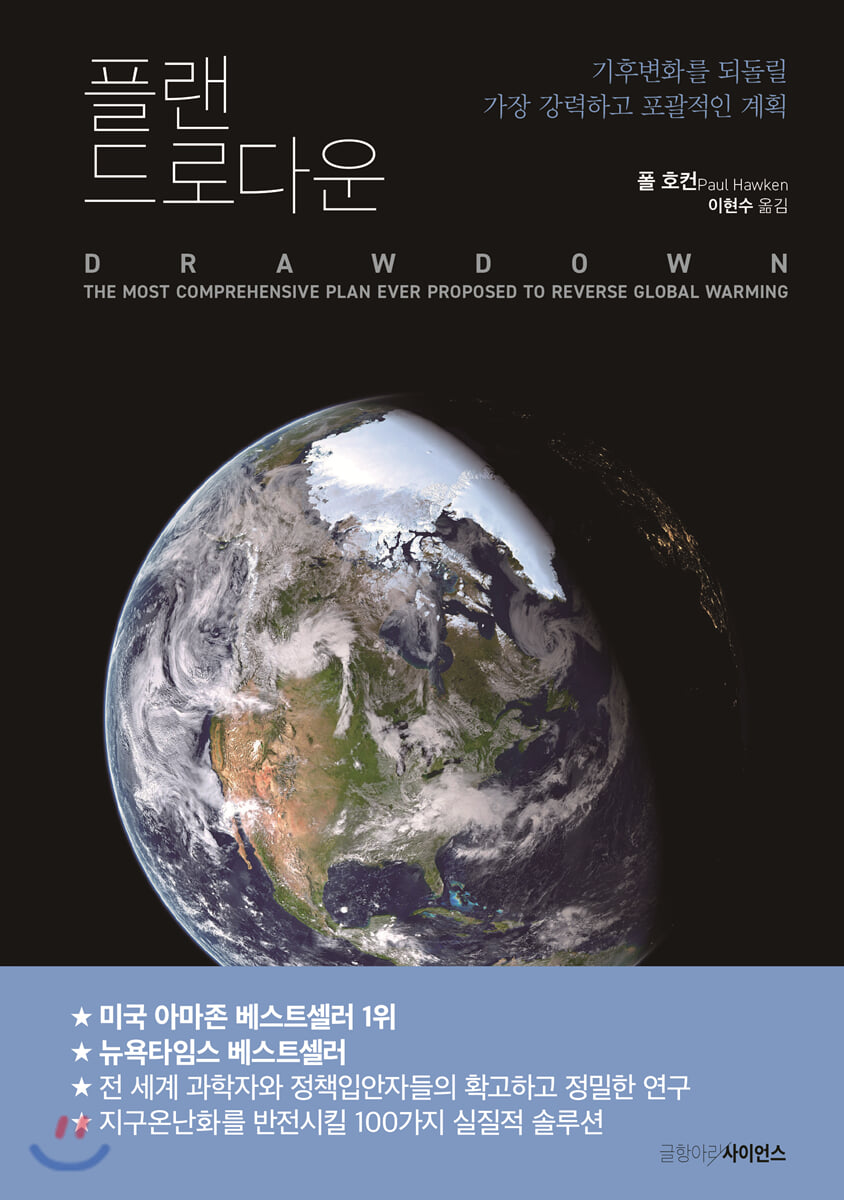
Plan Drawdown
 |
Description
Book Introduction
- A word from MD
-
100 Plans to Reverse Climate Change70 scientists and 120 advisors from 22 countries gathered to prevent and reverse global warming.
It presents practical solutions to reverse global warming in various fields, including energy, food, women, architecture, urban planning, and new energy.
100 of the most powerful and comprehensive climate change measures.
September 27, 2019. Natural Science PD Kim Tae-hee
Carbon reduction scenarios presented by 70 researchers from 22 countries
The most scientific and practical guidance on climate action
The 2018 heat wave, the worst recorded in 112 years, broke the record for the hottest temperature ever recorded and claimed 48 lives (according to the Korea Centers for Disease Control and Prevention).
But the crisis did not end that summer.
Typhoons, fine dust, extreme cold, drought, wildfires, rising sea levels, destruction of biota… Extreme weather events are currently threatening our lives.
Climate change not only harms the planet, but also undermines social structures and the foundations of democracy.
Political conflict, refugees, conflict, displacement of residents, and food security crises continue to occur.
But even as the entire country was suffering from record-breaking heat waves, typhoons, and fine dust, climate change, the cause of all these signs and phenomena, was not our top priority.
Have you ever looked into the faces of climatologists? Their eyes are filled with fear as they stare at the Earth, racing towards its end.
In 2018, the United Nations Intergovernmental Panel on Climate Change (IPCC) released a historic report titled “Global Warming of 1.5°C,” which was the result of research requested by world governments from the climate science community.
This report forecasts and predicts the potential impacts and looming risks of global temperature increases compared to pre-industrial levels, based on scientific, technological, and socioeconomic research.
Statistics also show that by 2050, more than half (55 percent) of the Earth's population will be exposed to lethal warming effects that exceed the survivable limit for more than 20 days a year.
The impacts of extreme warming and destructive climate change on the planet, its biota, and human society are beyond catastrophic.
Climate change is not a crisis affecting just one sector: politics, economy, society, culture, ecosystem, or security.
The irreversible end of it all—this is the scenario predicted at one end of climate change.
"Plan Drawdown" is a blueprint for making the opposite scenario a reality.
Many people, from their own perspectives, worry about the future of this planet and wonder if there is anything they can do about it.
This book is a massive action plan that brings together their stories.
Discussions about climate change (climate crisis) often leave many people feeling fearful and helpless, with fragmented scenarios that fail to consider concrete, scientifically sound data and the impacts that cross multiple sectors.
Even when we try to figure out what we can do and put it into action, we can easily become lost in the enormity of the global system.
It is also difficult to shake off the doubt that it will be buried again in the greatness.
Perhaps what we truly need to achieve a major transformation in climate change is not a sense of crisis or uncertain, fragmented knowledge, but the "most powerful and comprehensive plan" to confront this enormity that fills us with fear and helplessness, scientific data and verified scenarios that will dispel the vagueness.
We're not here because we don't know what causes and exacerbates climate change.
Now, with the severity of climate change in mind, it is time to talk about a global, all-human, all-sector climate action plan to reverse it.
With this problem in mind, 70 scientists and 120 advisors from 22 countries around the world gathered together.
The most scientific and practical guidance on climate action
The 2018 heat wave, the worst recorded in 112 years, broke the record for the hottest temperature ever recorded and claimed 48 lives (according to the Korea Centers for Disease Control and Prevention).
But the crisis did not end that summer.
Typhoons, fine dust, extreme cold, drought, wildfires, rising sea levels, destruction of biota… Extreme weather events are currently threatening our lives.
Climate change not only harms the planet, but also undermines social structures and the foundations of democracy.
Political conflict, refugees, conflict, displacement of residents, and food security crises continue to occur.
But even as the entire country was suffering from record-breaking heat waves, typhoons, and fine dust, climate change, the cause of all these signs and phenomena, was not our top priority.
Have you ever looked into the faces of climatologists? Their eyes are filled with fear as they stare at the Earth, racing towards its end.
In 2018, the United Nations Intergovernmental Panel on Climate Change (IPCC) released a historic report titled “Global Warming of 1.5°C,” which was the result of research requested by world governments from the climate science community.
This report forecasts and predicts the potential impacts and looming risks of global temperature increases compared to pre-industrial levels, based on scientific, technological, and socioeconomic research.
Statistics also show that by 2050, more than half (55 percent) of the Earth's population will be exposed to lethal warming effects that exceed the survivable limit for more than 20 days a year.
The impacts of extreme warming and destructive climate change on the planet, its biota, and human society are beyond catastrophic.
Climate change is not a crisis affecting just one sector: politics, economy, society, culture, ecosystem, or security.
The irreversible end of it all—this is the scenario predicted at one end of climate change.
"Plan Drawdown" is a blueprint for making the opposite scenario a reality.
Many people, from their own perspectives, worry about the future of this planet and wonder if there is anything they can do about it.
This book is a massive action plan that brings together their stories.
Discussions about climate change (climate crisis) often leave many people feeling fearful and helpless, with fragmented scenarios that fail to consider concrete, scientifically sound data and the impacts that cross multiple sectors.
Even when we try to figure out what we can do and put it into action, we can easily become lost in the enormity of the global system.
It is also difficult to shake off the doubt that it will be buried again in the greatness.
Perhaps what we truly need to achieve a major transformation in climate change is not a sense of crisis or uncertain, fragmented knowledge, but the "most powerful and comprehensive plan" to confront this enormity that fills us with fear and helplessness, scientific data and verified scenarios that will dispel the vagueness.
We're not here because we don't know what causes and exacerbates climate change.
Now, with the severity of climate change in mind, it is time to talk about a global, all-human, all-sector climate action plan to reverse it.
With this problem in mind, 70 scientists and 120 advisors from 22 countries around the world gathered together.
- You can preview some of the book's contents.
Preview
index
Preface│Origin│Language│Numbers
Energy - Wind turbines│Microgrids│Geothermal│Solar power farms│Rooftop solar power│Wave and tidal power│Concentrated solar thermal power│Biomass│Nuclear power│Cogeneration│Micro wind power│Alexander von Humboldt - Andrea Wolf│Methane digesters│Tidal hydropower│Waste-to-energy│Grid flexibility│Energy storage (utility)│Energy storage (distributed)│Solar hot water
Food - Plant-Based Diets│Agricultural Restoration│Food Waste Minimization│Safe Cooking Stoves│Multi-Story Agroforestry│Improved Rice Farming│Forest Livestock Farming│Do We Really Need to Do This? _Michael Pollan│Regenerative Agriculture│Nutrient Management│Tree Intercropping│Conservation Agriculture│Composting│Biochar│Tropical Staples│Cropland Irrigation│Nature's Hidden Half _David R.
Montgomery and Ann Bickle│Managed Grazing
Women - Female Peasants│Family Planning│Girls' Education
Architecture and Cities - Net-Zero Buildings│Walkable Cities│Bicycle Infrastructure│Green Rooftops│LED Lighting│Heat Pumps│Smart Glass│Smart Thermostats│District Heating│Landfill Methane│Insulation│Renovation and Maintenance│Water Distribution│Building Automation
Land Use - Forest Conservation│Coastal Wetlands│Tropical Forests│Bamboo│The Man Who Saved the Desert _Mark Hertzgard│Perennial Biomass│Peatlands│Indigenous Land Management│Temperate Forests│The Hidden Life of Trees _Peter Wohlleben│Afforestation
Passive systems - public transportation, high-speed rail, ships, electric vehicles, ride-sharing, electric bicycles, cars, aircraft, trucks, telepresence, trains
Materials - Household Waste Recycling│Industrial Waste Recycling│Alternative Cement│Refrigerant Management│Recycled Paper│Bioplastics│Household Water Conservation
An Enchanting Future of Energy - Regenerating the Mammoth Steppe│No-Till Agriculture│Enhanced Mineral Weathering│Marine Permaculture│Intensive Forest Livestock│Artificial Leaves│Autonomous Vehicles│Solid-State Wave Energy│Living Buildings│On Growing a Common Home -Pope Francis│Direct Air Capture│Hydrogen-Boron Fusion│Smart Highways│Hyperloop│Microbial Farming│Industrial Hemp│Perennial Crops│Cows Walking the Beach│Sea Farming│Smart Grid│Wood Architecture│Reciprocity -Janine Benyus
Getting Started with Project Drawdown│Analysis Methods│Reading the Numbers│Solution Summary│Project Drawdown Research Team│Find Out
Energy - Wind turbines│Microgrids│Geothermal│Solar power farms│Rooftop solar power│Wave and tidal power│Concentrated solar thermal power│Biomass│Nuclear power│Cogeneration│Micro wind power│Alexander von Humboldt - Andrea Wolf│Methane digesters│Tidal hydropower│Waste-to-energy│Grid flexibility│Energy storage (utility)│Energy storage (distributed)│Solar hot water
Food - Plant-Based Diets│Agricultural Restoration│Food Waste Minimization│Safe Cooking Stoves│Multi-Story Agroforestry│Improved Rice Farming│Forest Livestock Farming│Do We Really Need to Do This? _Michael Pollan│Regenerative Agriculture│Nutrient Management│Tree Intercropping│Conservation Agriculture│Composting│Biochar│Tropical Staples│Cropland Irrigation│Nature's Hidden Half _David R.
Montgomery and Ann Bickle│Managed Grazing
Women - Female Peasants│Family Planning│Girls' Education
Architecture and Cities - Net-Zero Buildings│Walkable Cities│Bicycle Infrastructure│Green Rooftops│LED Lighting│Heat Pumps│Smart Glass│Smart Thermostats│District Heating│Landfill Methane│Insulation│Renovation and Maintenance│Water Distribution│Building Automation
Land Use - Forest Conservation│Coastal Wetlands│Tropical Forests│Bamboo│The Man Who Saved the Desert _Mark Hertzgard│Perennial Biomass│Peatlands│Indigenous Land Management│Temperate Forests│The Hidden Life of Trees _Peter Wohlleben│Afforestation
Passive systems - public transportation, high-speed rail, ships, electric vehicles, ride-sharing, electric bicycles, cars, aircraft, trucks, telepresence, trains
Materials - Household Waste Recycling│Industrial Waste Recycling│Alternative Cement│Refrigerant Management│Recycled Paper│Bioplastics│Household Water Conservation
An Enchanting Future of Energy - Regenerating the Mammoth Steppe│No-Till Agriculture│Enhanced Mineral Weathering│Marine Permaculture│Intensive Forest Livestock│Artificial Leaves│Autonomous Vehicles│Solid-State Wave Energy│Living Buildings│On Growing a Common Home -Pope Francis│Direct Air Capture│Hydrogen-Boron Fusion│Smart Highways│Hyperloop│Microbial Farming│Industrial Hemp│Perennial Crops│Cows Walking the Beach│Sea Farming│Smart Grid│Wood Architecture│Reciprocity -Janine Benyus
Getting Started with Project Drawdown│Analysis Methods│Reading the Numbers│Solution Summary│Project Drawdown Research Team│Find Out
Into the book
Because stories about climate change are often doom and gloom, people often go through a process of denial, anger, and resignation.
I was once one of those people.
But this book gave me a different perspective.
Paul Hocan and his colleagues have researched and proposed 100 of the most practical solutions to reverse global warming.
These solutions span multiple sectors, including energy, agriculture, forestry, industry, construction, and transportation.
These solutions also highlight important socio-cultural solutions, such as expanding women's rights, curbing population growth, and changing diets and consumption patterns.
When multiple solutions come together, we can not only slow climate change, but reverse it.
---From the "Preface"
Speck's 'general walkability theory' outlines four criteria that must be met for people to choose to walk.
Walking should be useful and enable individuals to meet their daily needs.
Walking should also feel safe, including protection from cars and other hazards.
It should be comfortable enough to attract pedestrians to the "outdoor living room" that the specs suggest.
And beauty, vitality, and diversity must coexist and be interesting.
(…) As a result, 2.9 gigatons of carbon dioxide emissions could be avoided and vehicle maintenance costs could be reduced by $3.3 trillion.
---From "A City Good for Walking"
According to the journal Nature, approximately 2.4 to 4.6 percent of global carbon emissions are captured and sequestered by marine organisms.
The UN estimates that at least half of this sequestration comes from "blue carbon" wetlands.
When these ecosystems degrade or are destroyed, we should not assume that the carbon absorption process simply stops.
Coastal wetlands are a formidable source of carbon, releasing large amounts of sequestered carbon over long periods of time.
(…) Of the 49 million hectares of coastal wetlands worldwide, 7.2 million hectares are currently protected.
If an additional 23 million hectares were protected by 2050, emissions could be reduced and a total of 3.2 gigatons of carbon dioxide could be sequestered.
Although limited in area, coastal wetlands represent a large carbon sink.
It is estimated that protecting coastal wetlands could retain 15 gigatons of carbon, which is equivalent to more than 53 gigatons of carbon dioxide if released into the atmosphere.
---From "Coastal Wetlands"
Climate change is a global issue that has significant implications for the environment, society, economy, politics, and even the distribution of goods.
This is one of the major challenges facing humanity today.
Developing countries, in particular, will be worst affected in the coming decades.
A significant number of the poor live in areas particularly directly affected by global warming.
Their livelihoods depend primarily on nature reserves and ecosystem services, such as agriculture, fishing, and forestry.
They have no other financial resources or resources to cope with climate change or natural disasters, and their access to social services and protection is very limited.
For example, if plants and animals decline due to climate change to which they cannot adapt, they will have to migrate.
Climate change impacts the livelihoods of the poor who are forced to flee their homes, leaving their future and that of their children in great uncertainty.
I was once one of those people.
But this book gave me a different perspective.
Paul Hocan and his colleagues have researched and proposed 100 of the most practical solutions to reverse global warming.
These solutions span multiple sectors, including energy, agriculture, forestry, industry, construction, and transportation.
These solutions also highlight important socio-cultural solutions, such as expanding women's rights, curbing population growth, and changing diets and consumption patterns.
When multiple solutions come together, we can not only slow climate change, but reverse it.
---From the "Preface"
Speck's 'general walkability theory' outlines four criteria that must be met for people to choose to walk.
Walking should be useful and enable individuals to meet their daily needs.
Walking should also feel safe, including protection from cars and other hazards.
It should be comfortable enough to attract pedestrians to the "outdoor living room" that the specs suggest.
And beauty, vitality, and diversity must coexist and be interesting.
(…) As a result, 2.9 gigatons of carbon dioxide emissions could be avoided and vehicle maintenance costs could be reduced by $3.3 trillion.
---From "A City Good for Walking"
According to the journal Nature, approximately 2.4 to 4.6 percent of global carbon emissions are captured and sequestered by marine organisms.
The UN estimates that at least half of this sequestration comes from "blue carbon" wetlands.
When these ecosystems degrade or are destroyed, we should not assume that the carbon absorption process simply stops.
Coastal wetlands are a formidable source of carbon, releasing large amounts of sequestered carbon over long periods of time.
(…) Of the 49 million hectares of coastal wetlands worldwide, 7.2 million hectares are currently protected.
If an additional 23 million hectares were protected by 2050, emissions could be reduced and a total of 3.2 gigatons of carbon dioxide could be sequestered.
Although limited in area, coastal wetlands represent a large carbon sink.
It is estimated that protecting coastal wetlands could retain 15 gigatons of carbon, which is equivalent to more than 53 gigatons of carbon dioxide if released into the atmosphere.
---From "Coastal Wetlands"
Climate change is a global issue that has significant implications for the environment, society, economy, politics, and even the distribution of goods.
This is one of the major challenges facing humanity today.
Developing countries, in particular, will be worst affected in the coming decades.
A significant number of the poor live in areas particularly directly affected by global warming.
Their livelihoods depend primarily on nature reserves and ecosystem services, such as agriculture, fishing, and forestry.
They have no other financial resources or resources to cope with climate change or natural disasters, and their access to social services and protection is very limited.
For example, if plants and animals decline due to climate change to which they cannot adapt, they will have to migrate.
Climate change impacts the livelihoods of the poor who are forced to flee their homes, leaving their future and that of their children in great uncertainty.
---From “On Cultivating Our Common Home _Pope Francis”
Publisher's Review
Rather than fostering vague fear and helplessness,
Rather than appealing to a sense of duty and justice,
When we come up with feasible solutions and put them into action
After investigation and analysis by 70 expert researchers,
Verified in 3 stages by a 120-member advisory group
The 100 Most Effective Climate Change Solutions
“What should we do to stop and reverse global warming?” Paul Hocan, a world-renowned environmental activist, entrepreneur, and environmental management consultant who wrote and compiled this book, has been asking this question every time he meets with climate and environmental experts since 2001.
Hoping that they will come up with practical measures that take into account both expected effects and costs.
But the answer I got back was always the same: “No such list exists.”
Yet they added:
“But if it does exist, it will be a tremendous resource.”
A decade later, with articles warning of climate change and a growing sense that the game was over, Paul Hocan decided to launch the Drawdown project.
Drawdown is a climate term that refers to the point at which greenhouse gases peak and then begin to decline each year.
Håkan sent out an appeal to scientists and public policy experts from all walks of life and from every country to research, analyze, and model 100 solutions to achieve this goal together.
And the responses came from people with extensive academic and professional experience at some of the world's most prestigious institutions.
The 70 researchers who gathered together formed Project Drawdown and compiled 100 of the most powerful and comprehensive climate change measures.
These solutions cover a wide range of sectors, including energy, food, women's issues, architecture, urban planning, land use, transportation, materials and raw materials, and future energy, and provide an overview of the solutions, calculating the greenhouse gas emission reductions achievable by 2050, and potential costs (financial models).
All solutions were reviewed and evaluated in three stages by a 120-member advisory committee comprised of geologists, engineers, agronomists, politicians, writers, climatologists, biologists, economists, financial analysts, architects, and activists.
People from all walks of life, including Pope Francis and Michael Pollan, who are concerned about the future of the Earth, also added their voices.
Drawdown
A language for all to reverse climate change
The climate crisis we face today stems from the mistakes of past generations.
During the industrial age, humans did not realize how they were destroying the Earth's environment.
Because of this, we easily shift responsibility for climate change to past generations and become caught up in a sense of victimization rather than developing a sense of responsibility as the current generation.
The fate of the Earth was determined by the actions of previous generations, and we are the victims of that fate that is upon us.
Paul Hawken firmly rejects this idea and suggests a shift in thinking and action.
“If we change the subject slightly and think of global warming as happening for us, as an atmospheric shift that forces us to reshape and reinterpret everything we create and do, we can start living in a new world.
We take 100 percent responsibility for our actions and stop blaming others.
We view global warming not as an inevitable consequence, but as an invitation to a world where we can change, innovate, and make an impact.
I see it as a way to awaken creativity, compassion, and genius.
This is neither a progressive agenda nor a conservative agenda.
“It is the human agenda.”
Why is the term "drawdown" so important in realizing this agenda? Action for change requires language.
Drawdown is an action plan that gives a name to a goal that has been absent from the climate discussion so far.
It brings together large and small discussions and solutions scattered across various fields, including energy, food, women, architecture, urban planning, land use, transportation systems, materials and raw materials, and renewable energy, presents reliable data, and revives our confidence in humanity's capacity to realize them.
John Foley, a director of the California Academy of Sciences and executive director of Project Drawdown, who wrote the book's foreword, admits that he too was once caught up in denial, anger, and resignation.
Until I read this book.
As the testimonials from numerous prominent figures, including him, attest, Plan Drawdown offers a new perspective and hope about climate change, the future of the planet, and, most importantly, about ourselves.
We introduce what we can do as family members, corporate employees, community members, citizens, and global citizens, and present scientific evidence to ensure we do not lose hope.
It gives each and every person, regardless of their social status or position, the choice to influence the climate change transition as a special being rather than remaining a powerless individual.
Anyone can contribute to the great transformation known as drawdown by practicing a few or even a few dozen things, and the effects are by no means insignificant.
For example, by minimizing food waste, we could avoid 70.53 gigatons of carbon dioxide emissions by 2050.
A plant-based diet would avoid 66.11 gigatons of emissions.
Girls' education and family planning each save 59.60 gigatons.
If you can't imagine how much reduction in the tens of gigatons of emissions we could achieve in our daily lives, consider the amount of carbon dioxide equivalent to filling 14.4 million Olympic-size swimming pools.
36 gigatons, the total amount of carbon dioxide emitted worldwide in 2016.
The reductions offered by these solutions, which can be implemented in everyday life, far exceed this figure, and they rank among the top 10 solutions among the 100 overall.
Almost all of the solutions presented in this book are no-brainer solutions to climate change, with significant ripple effects and short payback periods.
Rigorous, scientific analysis and forecasts clearly demonstrate how reasonable and powerful the solutions presented here are.
"Plan Drawdown" isn't a lengthy, technical manual that only experts who have been immersed in the science behind the technology can understand.
Rather, by making publicly available solutions that have been blocked by the distance and distinction of specialized fields and thus have not been integrated or widely known, it provides accessible information to anyone who wants to think about and implement what can be done.
Summary of Solutions by Sector
Energy - Solar and wind energy, once considered irrelevant to the energy sector, have persevered and now compete with coal, oil, and gas.
The cost of renewable energy is decreasing every year, while fossil fuels are becoming more difficult to extract, so their costs continue to rise.
The Drawdown researchers assert that anyone who studies energy-related economic data for just one year will arrive at one conclusion:
The age of fossil fuels is over, and the only question is when a completely new era will arrive.
The economic environment makes its arrival inevitable.
Food - It's hard to imagine that global warming is a result of what we eat for breakfast, lunch, and dinner.
But if you add livestock farming to all the other food-related emissions, from agriculture to deforestation to food waste, the food we eat turns out to be the biggest contributor to global warming.
This chapter introduces technologies, actions, and methods that can transform resources into greenhouse gas sinks.
Instead of releasing carbon dioxide and other greenhouse gases into the atmosphere during food production, it suggests ways to capture carbon to increase productivity, improve soil health, better utilize water resources, increase yields, and ultimately, improve the nutritional value of food and enhance food security.
Women - The solutions presented here focus on the majority of humanity, or 51 percent, of women.
Plan Drawdown specifically addresses women's issues because climate change is not gender-neutral.
Existing inequalities leave women particularly vulnerable to the impacts of climate change, from disease to natural disasters.
Women also play a pivotal role in successfully addressing global warming and restoring humanity's overall resilience.
Each solution demonstrates how improving women's rights and well-being can improve the future of the planet.
Buildings and Cities - Cities can be major contributors to environmental destruction, but if properly designed and managed, they can also be places where humanity has the least impact on our planet, and creative and healthy places where education takes place.
Buildings and the wider urban living spaces are a source of innovation in water, energy, lighting, design and their impact.
Biologists are unraveling the mechanisms by which cities can be more productive than the land on which they were built, considering air, water, flora and fauna, pollinators, and carbon sequestration.
Rather than being a cause or factor of degradation, cities are transforming into regenerators of the environment and human well-being.
Land Use - There are two ways to achieve drawdown.
One is to drastically reduce human-caused emissions, and the other is to widely adopt reliable methods to use land and oceans to sequester carbon from the air and store it for decades or even centuries.
This chapter assessed how land is used globally and then measured what would happen if land use changed or if specific techniques used for grazing or growing crops changed.
All solutions increase soil moisture, cloud cover, crop yields, biodiversity, employment, human health, incomes and resilience, while dramatically reducing the need for synthetic fertilizers and pesticides.
Transport systems - The use and sustainability of transport systems cannot be separated from people's daily lives.
Here we present a solution that will significantly improve the fuel efficiency of airplanes, trains, ships, cars, and trucks that rely on fossil fuels.
However, unless these modes of transport are reduced, the efficiency gains will be eroded by increased consumption.
This chapter also includes solutions for transportation that do not rely on fossil fuels.
Electric cars are four times more efficient than gasoline cars.
At current prices, powering wind turbines costs between 8 and 13 cents per liter of gasoline.
Bicycles also offer the mobility of going without fuel.
Materials - Manufacturing has evolved over time, and responsible companies pay close attention to the sourcing of materials and their post-disposal processing.
In other words, society began to redesign its products and construction to use less, reuse more, and recycle less of the materials used.
While we won't cover the latest discoveries here, this chapter details common technologies and techniques that contribute to efforts to reverse global warming.
The fact that the solution with the highest savings ranking is included in this chapter emphasizes the importance of efficient use of materials.
Attractive Future Energy - Drawdown researchers are reluctant to acknowledge that our ability to address global warming is limited to what we already know and what we can do, by focusing only on solutions that are already in place.
This chapter is the research team's favorite, as it provides a window into the near or distant future.
The pace of invention and innovation is slowing in every major sector, and we don't know how much impact existing innovations will have.
Promising ideas are often part of a scientific project and will not extend beyond that scope.
However, or rather, because of that, we present here technologies and solutions that could change the landscape of gaming.
Rather than appealing to a sense of duty and justice,
When we come up with feasible solutions and put them into action
After investigation and analysis by 70 expert researchers,
Verified in 3 stages by a 120-member advisory group
The 100 Most Effective Climate Change Solutions
“What should we do to stop and reverse global warming?” Paul Hocan, a world-renowned environmental activist, entrepreneur, and environmental management consultant who wrote and compiled this book, has been asking this question every time he meets with climate and environmental experts since 2001.
Hoping that they will come up with practical measures that take into account both expected effects and costs.
But the answer I got back was always the same: “No such list exists.”
Yet they added:
“But if it does exist, it will be a tremendous resource.”
A decade later, with articles warning of climate change and a growing sense that the game was over, Paul Hocan decided to launch the Drawdown project.
Drawdown is a climate term that refers to the point at which greenhouse gases peak and then begin to decline each year.
Håkan sent out an appeal to scientists and public policy experts from all walks of life and from every country to research, analyze, and model 100 solutions to achieve this goal together.
And the responses came from people with extensive academic and professional experience at some of the world's most prestigious institutions.
The 70 researchers who gathered together formed Project Drawdown and compiled 100 of the most powerful and comprehensive climate change measures.
These solutions cover a wide range of sectors, including energy, food, women's issues, architecture, urban planning, land use, transportation, materials and raw materials, and future energy, and provide an overview of the solutions, calculating the greenhouse gas emission reductions achievable by 2050, and potential costs (financial models).
All solutions were reviewed and evaluated in three stages by a 120-member advisory committee comprised of geologists, engineers, agronomists, politicians, writers, climatologists, biologists, economists, financial analysts, architects, and activists.
People from all walks of life, including Pope Francis and Michael Pollan, who are concerned about the future of the Earth, also added their voices.
Drawdown
A language for all to reverse climate change
The climate crisis we face today stems from the mistakes of past generations.
During the industrial age, humans did not realize how they were destroying the Earth's environment.
Because of this, we easily shift responsibility for climate change to past generations and become caught up in a sense of victimization rather than developing a sense of responsibility as the current generation.
The fate of the Earth was determined by the actions of previous generations, and we are the victims of that fate that is upon us.
Paul Hawken firmly rejects this idea and suggests a shift in thinking and action.
“If we change the subject slightly and think of global warming as happening for us, as an atmospheric shift that forces us to reshape and reinterpret everything we create and do, we can start living in a new world.
We take 100 percent responsibility for our actions and stop blaming others.
We view global warming not as an inevitable consequence, but as an invitation to a world where we can change, innovate, and make an impact.
I see it as a way to awaken creativity, compassion, and genius.
This is neither a progressive agenda nor a conservative agenda.
“It is the human agenda.”
Why is the term "drawdown" so important in realizing this agenda? Action for change requires language.
Drawdown is an action plan that gives a name to a goal that has been absent from the climate discussion so far.
It brings together large and small discussions and solutions scattered across various fields, including energy, food, women, architecture, urban planning, land use, transportation systems, materials and raw materials, and renewable energy, presents reliable data, and revives our confidence in humanity's capacity to realize them.
John Foley, a director of the California Academy of Sciences and executive director of Project Drawdown, who wrote the book's foreword, admits that he too was once caught up in denial, anger, and resignation.
Until I read this book.
As the testimonials from numerous prominent figures, including him, attest, Plan Drawdown offers a new perspective and hope about climate change, the future of the planet, and, most importantly, about ourselves.
We introduce what we can do as family members, corporate employees, community members, citizens, and global citizens, and present scientific evidence to ensure we do not lose hope.
It gives each and every person, regardless of their social status or position, the choice to influence the climate change transition as a special being rather than remaining a powerless individual.
Anyone can contribute to the great transformation known as drawdown by practicing a few or even a few dozen things, and the effects are by no means insignificant.
For example, by minimizing food waste, we could avoid 70.53 gigatons of carbon dioxide emissions by 2050.
A plant-based diet would avoid 66.11 gigatons of emissions.
Girls' education and family planning each save 59.60 gigatons.
If you can't imagine how much reduction in the tens of gigatons of emissions we could achieve in our daily lives, consider the amount of carbon dioxide equivalent to filling 14.4 million Olympic-size swimming pools.
36 gigatons, the total amount of carbon dioxide emitted worldwide in 2016.
The reductions offered by these solutions, which can be implemented in everyday life, far exceed this figure, and they rank among the top 10 solutions among the 100 overall.
Almost all of the solutions presented in this book are no-brainer solutions to climate change, with significant ripple effects and short payback periods.
Rigorous, scientific analysis and forecasts clearly demonstrate how reasonable and powerful the solutions presented here are.
"Plan Drawdown" isn't a lengthy, technical manual that only experts who have been immersed in the science behind the technology can understand.
Rather, by making publicly available solutions that have been blocked by the distance and distinction of specialized fields and thus have not been integrated or widely known, it provides accessible information to anyone who wants to think about and implement what can be done.
Summary of Solutions by Sector
Energy - Solar and wind energy, once considered irrelevant to the energy sector, have persevered and now compete with coal, oil, and gas.
The cost of renewable energy is decreasing every year, while fossil fuels are becoming more difficult to extract, so their costs continue to rise.
The Drawdown researchers assert that anyone who studies energy-related economic data for just one year will arrive at one conclusion:
The age of fossil fuels is over, and the only question is when a completely new era will arrive.
The economic environment makes its arrival inevitable.
Food - It's hard to imagine that global warming is a result of what we eat for breakfast, lunch, and dinner.
But if you add livestock farming to all the other food-related emissions, from agriculture to deforestation to food waste, the food we eat turns out to be the biggest contributor to global warming.
This chapter introduces technologies, actions, and methods that can transform resources into greenhouse gas sinks.
Instead of releasing carbon dioxide and other greenhouse gases into the atmosphere during food production, it suggests ways to capture carbon to increase productivity, improve soil health, better utilize water resources, increase yields, and ultimately, improve the nutritional value of food and enhance food security.
Women - The solutions presented here focus on the majority of humanity, or 51 percent, of women.
Plan Drawdown specifically addresses women's issues because climate change is not gender-neutral.
Existing inequalities leave women particularly vulnerable to the impacts of climate change, from disease to natural disasters.
Women also play a pivotal role in successfully addressing global warming and restoring humanity's overall resilience.
Each solution demonstrates how improving women's rights and well-being can improve the future of the planet.
Buildings and Cities - Cities can be major contributors to environmental destruction, but if properly designed and managed, they can also be places where humanity has the least impact on our planet, and creative and healthy places where education takes place.
Buildings and the wider urban living spaces are a source of innovation in water, energy, lighting, design and their impact.
Biologists are unraveling the mechanisms by which cities can be more productive than the land on which they were built, considering air, water, flora and fauna, pollinators, and carbon sequestration.
Rather than being a cause or factor of degradation, cities are transforming into regenerators of the environment and human well-being.
Land Use - There are two ways to achieve drawdown.
One is to drastically reduce human-caused emissions, and the other is to widely adopt reliable methods to use land and oceans to sequester carbon from the air and store it for decades or even centuries.
This chapter assessed how land is used globally and then measured what would happen if land use changed or if specific techniques used for grazing or growing crops changed.
All solutions increase soil moisture, cloud cover, crop yields, biodiversity, employment, human health, incomes and resilience, while dramatically reducing the need for synthetic fertilizers and pesticides.
Transport systems - The use and sustainability of transport systems cannot be separated from people's daily lives.
Here we present a solution that will significantly improve the fuel efficiency of airplanes, trains, ships, cars, and trucks that rely on fossil fuels.
However, unless these modes of transport are reduced, the efficiency gains will be eroded by increased consumption.
This chapter also includes solutions for transportation that do not rely on fossil fuels.
Electric cars are four times more efficient than gasoline cars.
At current prices, powering wind turbines costs between 8 and 13 cents per liter of gasoline.
Bicycles also offer the mobility of going without fuel.
Materials - Manufacturing has evolved over time, and responsible companies pay close attention to the sourcing of materials and their post-disposal processing.
In other words, society began to redesign its products and construction to use less, reuse more, and recycle less of the materials used.
While we won't cover the latest discoveries here, this chapter details common technologies and techniques that contribute to efforts to reverse global warming.
The fact that the solution with the highest savings ranking is included in this chapter emphasizes the importance of efficient use of materials.
Attractive Future Energy - Drawdown researchers are reluctant to acknowledge that our ability to address global warming is limited to what we already know and what we can do, by focusing only on solutions that are already in place.
This chapter is the research team's favorite, as it provides a window into the near or distant future.
The pace of invention and innovation is slowing in every major sector, and we don't know how much impact existing innovations will have.
Promising ideas are often part of a scientific project and will not extend beyond that scope.
However, or rather, because of that, we present here technologies and solutions that could change the landscape of gaming.
GOODS SPECIFICS
- Date of issue: September 20, 2019
- Format: Hardcover book binding method guide
- Page count, weight, size: 644 pages | 1,232g | 153*224*35mm
- ISBN13: 9788967356699
- ISBN10: 8967356692
You may also like
카테고리
korean


korean

![ELLE 엘르 스페셜 에디션 A형 : 12월 [2025]](http://librairie.coreenne.fr/cdn/shop/files/b8e27a3de6c9538896439686c6b0e8fb.jpg?v=1766436872&width=3840)


