

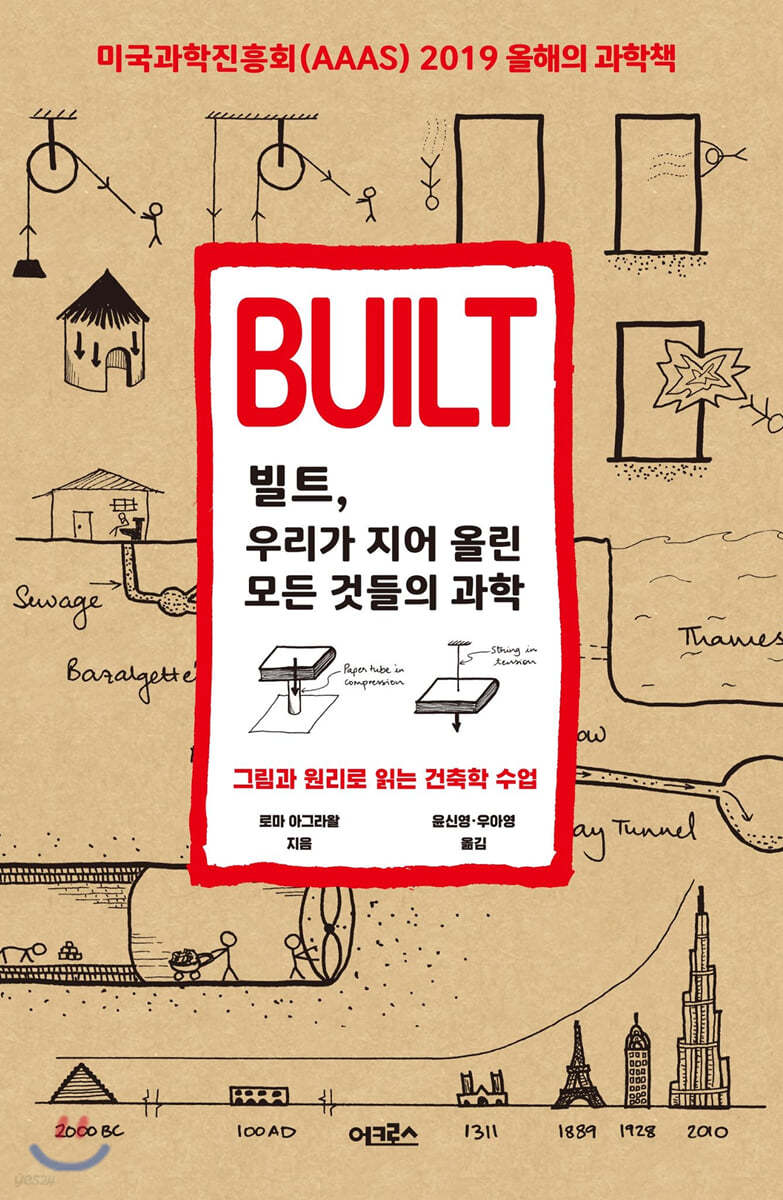
Built, the science behind everything we build
 |
Description
Book Introduction
- A word from MD
-
A secret story hidden in a huge buildingHow do skyscrapers, bridges, and tunnels protect us from the forces of wind, gravity, and water, while connecting us? We delve into the hidden principles of architecture, from the ancient Roman apartments of the Insula to the 828-meter Burj Khalifa in Dubai.
An architectural textbook by Roma Agrawal, a prominent female structural engineer.
August 27, 2019. Natural Science PD Kim Tae-hee
American Association for the Advancement of Science (AAAS) 2019 Science Book of the Year
Recommended reading by the New York Times, the Wall Street Journal, and Science
A story of architectural grandeur and incredible planning
Roma Agrawal, a prominent female structural engineer
From the ancient Roman apartments of the Insula to the world's tallest building, the Burj Khalifa,
Revealing the secret stories hidden in the massive building.
Architecture class with pictures and principles!
Following in the footsteps of Hope Jaran ("Rap Girl"), Mark Miodonic ("The Science of Small Things"), and Bill Bryson ("A Short History of Nearly Everything"), a new science nonfiction author has arrived! Roma Agrawal, one of the most notable structural engineers and physicists in the English-speaking world, is here.
"Built: The Science of Everything We Built" is an architectural textbook that presents us with unique knowledge and surprising perspectives.
This book, which was named the 2019 Science Book of the Year by the American Association for the Advancement of Science (AAAS) and strongly recommended by the New York Times, the Wall Street Journal, and Science, wittily and without any complicated formulas tells the story of how we designed and built the large world we live in, from bridges and tunnels to train stations and skyscrapers.
We can see that the fact that structures such as skyscrapers, bridges, and tunnels protect us from the effects of gravity, wind, and water and connect us is the result of hundreds and thousands of years of discoveries and developments by engineers and technicians.
After reading this book, even the massive bridges, the ornate train stations, and even the elevators at apartment complexes and the cranes at construction sites will never look the same again.
Recommended reading by the New York Times, the Wall Street Journal, and Science
A story of architectural grandeur and incredible planning
Roma Agrawal, a prominent female structural engineer
From the ancient Roman apartments of the Insula to the world's tallest building, the Burj Khalifa,
Revealing the secret stories hidden in the massive building.
Architecture class with pictures and principles!
Following in the footsteps of Hope Jaran ("Rap Girl"), Mark Miodonic ("The Science of Small Things"), and Bill Bryson ("A Short History of Nearly Everything"), a new science nonfiction author has arrived! Roma Agrawal, one of the most notable structural engineers and physicists in the English-speaking world, is here.
"Built: The Science of Everything We Built" is an architectural textbook that presents us with unique knowledge and surprising perspectives.
This book, which was named the 2019 Science Book of the Year by the American Association for the Advancement of Science (AAAS) and strongly recommended by the New York Times, the Wall Street Journal, and Science, wittily and without any complicated formulas tells the story of how we designed and built the large world we live in, from bridges and tunnels to train stations and skyscrapers.
We can see that the fact that structures such as skyscrapers, bridges, and tunnels protect us from the effects of gravity, wind, and water and connect us is the result of hundreds and thousands of years of discoveries and developments by engineers and technicians.
After reading this book, even the massive bridges, the ornate train stations, and even the elevators at apartment complexes and the cranes at construction sites will never look the same again.
- You can preview some of the book's contents.
Preview
index
1st Floor: About Everything We've Built_
2 Forces: How can buildings be made safe from gravity, wind, and earthquakes?
3 Fires: Lessons Learned from Numerous Disasters
4 Bricks: From the Pyramids to the Florence Cathedral and even in our homes
5 Metals: Before steel, there were no railroads or skyscrapers.
6 Rock: How did concrete become the world's most stable material?
7 Sky: The People Who Invented Cranes and Elevators
8 Land: What is built under the building?
9 Underground: The City Beneath Our Feet
10 Water: A building is nothing until water flows through it.
11 Sewer: What if no one cared about poop?
12 Idols: The Story of the Most Advanced Woman Who Built the Most Advanced Bridge
13 Bridges: Thousands of Creative Ways to Cross Valleys and Rivers
14 Dream: Whatever you imagine, we will build it and more.
2 Forces: How can buildings be made safe from gravity, wind, and earthquakes?
3 Fires: Lessons Learned from Numerous Disasters
4 Bricks: From the Pyramids to the Florence Cathedral and even in our homes
5 Metals: Before steel, there were no railroads or skyscrapers.
6 Rock: How did concrete become the world's most stable material?
7 Sky: The People Who Invented Cranes and Elevators
8 Land: What is built under the building?
9 Underground: The City Beneath Our Feet
10 Water: A building is nothing until water flows through it.
11 Sewer: What if no one cared about poop?
12 Idols: The Story of the Most Advanced Woman Who Built the Most Advanced Bridge
13 Bridges: Thousands of Creative Ways to Cross Valleys and Rivers
14 Dream: Whatever you imagine, we will build it and more.
Detailed image

Into the book
We often ignore or forget the existence of buildings.
But the building has many stories to tell.
Tension cables pulling huge bridges from above, steel structures supporting the back of tall buildings' glass facades.
These things are creating our world surrounded by buildings.
Such structures demonstrate the creativity of humankind.
It also reveals the ability to communicate with others and nature.
The ever-changing world we create is full of stories and secrets.
If you are willing to listen and see, you will have a fantastic experience.
--- p.15, from 'Chapter 1, Floor'
I add bones and flesh with a black marker on top of the architect's drawing.
The thick, black lines I added to the drawing in various colors add a kind of solidity.
This is necessarily followed by a lively discussion between the architect and me.
If we are to find answers, we must learn to compromise with each other.
Often, pillars must be erected in places that architects describe as open spaces.
Conversely, there are many places where architects think there should be some structure, but in my view, it is okay if there isn't one.
In this case, architects get a little more space.
When faced with a technical problem, architects and engineers must be able to understand each other's perspectives.
A balance must be struck between visual beauty and technical perfection.
At the end of this process, we arrive at a design that achieves a near-perfect harmony between architectural structure and aesthetic insight.
--- p.29, from 'Chapter 2: Strength'
After the Great Fire of Rome, Emperor Nero ordered several changes to the city.
The streets were widened and buildings were built to be no taller than six stories.
And the bakers' and sheet metal workers' shops were separated from the living quarters by a double wall that contained empty space.
He made the balcony a fireproof space to make it easier to escape in case of fire.
We also invested in repair facilities to fight fires.
The Romans learned from tradition, and we too have learned from that hard-won wisdom.
Thousands of years later, the simple principle of separating rooms, houses, and buildings with fire barriers and spatial separation is still used to protect modern buildings from fire.
--- p.71, from 'Chapter 3 Fire'
The arches that surround me have survived thousands of years.
A beautiful ancient Arabian proverb came to mind.
“Arches never sleep.” The reason arches never sleep is because the elements that make up the arch are constantly in a state of compression.
The arch bears the weight with endless patience.
Even when lava from Mount Vesuvius flooded Pompeii, wiping out people and buildings, the arch remained, overlooking the city.
Even when buried underground, the arch never ceases to function.
--- p.84, from 'Chapter 4 Bricks'
An engineer's job is quite similar to spinning plates.
You need to plan for many problems and take immediate control of them.
Let's take temperature as an example.
Like all structures, the bridge I designed is affected by temperature.
As the temperature changes throughout the year (depending on the season), it is heated or cooled.
Steel has a coefficient of thermal expansion of 12×10-6.
This means that for every 1 degree change in temperature, a 1 millimeter long material expands or contracts by 0.000012 millimeters.
Although it may seem like a very small value, the bridge I designed was nearly 40 meters long and was designed to withstand a temperature difference of 40 degrees.
But the building has many stories to tell.
Tension cables pulling huge bridges from above, steel structures supporting the back of tall buildings' glass facades.
These things are creating our world surrounded by buildings.
Such structures demonstrate the creativity of humankind.
It also reveals the ability to communicate with others and nature.
The ever-changing world we create is full of stories and secrets.
If you are willing to listen and see, you will have a fantastic experience.
--- p.15, from 'Chapter 1, Floor'
I add bones and flesh with a black marker on top of the architect's drawing.
The thick, black lines I added to the drawing in various colors add a kind of solidity.
This is necessarily followed by a lively discussion between the architect and me.
If we are to find answers, we must learn to compromise with each other.
Often, pillars must be erected in places that architects describe as open spaces.
Conversely, there are many places where architects think there should be some structure, but in my view, it is okay if there isn't one.
In this case, architects get a little more space.
When faced with a technical problem, architects and engineers must be able to understand each other's perspectives.
A balance must be struck between visual beauty and technical perfection.
At the end of this process, we arrive at a design that achieves a near-perfect harmony between architectural structure and aesthetic insight.
--- p.29, from 'Chapter 2: Strength'
After the Great Fire of Rome, Emperor Nero ordered several changes to the city.
The streets were widened and buildings were built to be no taller than six stories.
And the bakers' and sheet metal workers' shops were separated from the living quarters by a double wall that contained empty space.
He made the balcony a fireproof space to make it easier to escape in case of fire.
We also invested in repair facilities to fight fires.
The Romans learned from tradition, and we too have learned from that hard-won wisdom.
Thousands of years later, the simple principle of separating rooms, houses, and buildings with fire barriers and spatial separation is still used to protect modern buildings from fire.
--- p.71, from 'Chapter 3 Fire'
The arches that surround me have survived thousands of years.
A beautiful ancient Arabian proverb came to mind.
“Arches never sleep.” The reason arches never sleep is because the elements that make up the arch are constantly in a state of compression.
The arch bears the weight with endless patience.
Even when lava from Mount Vesuvius flooded Pompeii, wiping out people and buildings, the arch remained, overlooking the city.
Even when buried underground, the arch never ceases to function.
--- p.84, from 'Chapter 4 Bricks'
An engineer's job is quite similar to spinning plates.
You need to plan for many problems and take immediate control of them.
Let's take temperature as an example.
Like all structures, the bridge I designed is affected by temperature.
As the temperature changes throughout the year (depending on the season), it is heated or cooled.
Steel has a coefficient of thermal expansion of 12×10-6.
This means that for every 1 degree change in temperature, a 1 millimeter long material expands or contracts by 0.000012 millimeters.
Although it may seem like a very small value, the bridge I designed was nearly 40 meters long and was designed to withstand a temperature difference of 40 degrees.
--- p.110, from 'Chapter 5 Metal'
Publisher's Review
Even the general public who doesn't know science can understand
The structure and principles of architecture are revealed, chatterily.
This book, which has received rave reviews from major English-language media outlets, consists of three components.
First, Roma Agrawal explains scientific principles in an accessible way through sketches and small experiments related to our daily lives.
A natural chatterbox and incredibly passionate speaker, he makes the fundamental principles of architecture and structure accessible using simple models and drawings, without any formulas or physical laws.
It stimulates the curiosity of the majority of the general public who are not interested in the structure and design of buildings, and explains in an easy-to-understand manner the forces applied to buildings (pressure and tension), the columns, beams, and reinforcement that form the skeleton of the building, the core and exoskeleton that firmly fix the building against wind and earthquakes, and the building materials and facilities to prevent fire.
Host of the podcast Building Stories and a TED talker, he skillfully unravels the questions we've all had about architecture: how engineers tunnel through massive, solid mountains that stretch for kilometers, how they build bridges across wide, deep, and mighty rivers, and how they use and control water, nature's most precious and difficult to control.
From the apartments of ancient Rome to the skyscrapers of Dubai today
Explore the historical and scientific secrets hidden in great buildings.
Second, he tells the stories of famous buildings that overcame the technological challenges of each era, from ancient Rome to medieval architecture and modern skyscrapers.
The reader learns from the rich examples provided by Rome that the bricks fired in the kilns of the Indus Valley Civilization were already of the same proportions as those used today, and that the dome of the Taj Mahal was bound together with chuna, a mixture of fired lime, finely ground seashells, marble powder, sugar, egg whites, and fruit juice.
His books also provide an opportunity to enjoy a world tour that transcends time and space.
From Nineveh, the capital of Assyria (present-day northern Iraq), which built an aqueduct 27 meters long, 15 meters wide, and 9 meters high in the late 8th century BC, hundreds of years before Rome, to New York, which built the Brooklyn Bridge, the world's longest suspension bridge at the time, in the 19th century, and the 828-meter Burj Khalifa in Dubai, which has held the title of the world's tallest building since its completion in 2010, readers are invited on an adventure that transcends time and space.
A girl who was afraid of heights
On the road to becoming a star structural engineer who dominates the city skyline.
And thirdly, she weaves all of this together with personal anecdotes to tell the story, and this is what makes this book so captivating.
Roma Agrawal has already garnered significant attention from industry and media alike for her outstanding achievements in the male-dominated world of architecture and engineering, defying stereotypes and conventions.
He was part of the acclaimed design team for The Shard, the tallest building in Western Europe, and has also been involved in the construction of Newcastle's stunning footbridge and the canopy at London's Crystal Palace station.
The moment he tells his story of how an Oxford physics graduate who was afraid of heights became a skyscraper expert despite his fear, readers are instantly drawn to this protagonist.
The ground you stand on, the building you enter, the road you pass by, the tunnel you pass through
All the buildings and structures in the world begin to be seen with new eyes.
Rather than dividing his book into architectural chronologies, Roma Agrawal tells the story by categorizing the building materials and elements that influence them.
For example, she divides the book's chapters into earth, water, brick, rock, and metal.
The story begins with various building materials and their properties, moves on to the history of architecture, especially the fantastic methods used to solve numerous difficult problems in 19th-century architecture and engineering, and continues with anecdotes of the main characters.
It shows the ancient craftsman's technique for creating perfect bricks (in which juices extracted from three types of fruit were added in addition to clay), and tells of the invention of steel and why it was better to use steel instead of iron (iron was too soft to support great forces).
Through this, readers will understand how the foundations of buildings are constructed, and how and why large domes, skyscrapers, bridges, and embankments withstand gravity, wind, water, and earthquakes, maintaining their solid form and function.
This book offers the experience of discovering the role and value of materials and structures in buildings, something that is not visible in rigid, technology-centered structural engineering stories, in everyday life.
After reading this book, readers will begin to see all the buildings and structures in the world—the ground they stand on, the buildings they enter, the roads they pass through, the tunnels they pass through—with new eyes.
- House of Cards (3 Cards Fire)
In his book, Roma Agrawal emphasizes that it is crucial for both engineers and the general reader to learn the right lessons from disasters.
The story of Ivy Hodge, introduced in Chapter 3, 'Fire', clearly shows his will.
One morning in 1968, Ivy Hodge went into the kitchen to make tea.
She turned on the gas and lit a match.
After a while, she found herself lying on the floor, looking up at the sky.
The walls in the kitchen and living room were gone, and the floors below her house had collapsed like a house of cards.
Four people who were sleeping in their beds died in the disaster.
Surprisingly, Ivy's eardrums didn't rupture.
The explosive force itself was not large enough to damage the eardrums.
However, the apartment she was staying in was found to have walls that could be destroyed by an explosion with only one-third the force of an actual explosion.
A subsequent analysis of the incident revealed why this London residential building was so badly damaged.
Made of crude panels instead of reinforced concrete slabs, the building was held together only by a little friction and concrete 'pull'.
Because the force of the explosion was able to overcome the friction and resistance of the concrete, it collapsed in an instant like a house of cards.
Having designed The Shard, the tallest building in Western Europe, she also draws on her expertise to explain why New York's Twin Towers collapsed completely after the terrorist attacks of September 11, 2001.
He then explains why parts of the city of Mexico City, built on a lake, do not sink.
And she tells why the Chinese used sticky rice to build the Great Wall.
Through all these stories, Roma Agrawal skillfully recounts the historical lessons and breakthroughs that led to modern building methods, such as the Romans' discovery of concrete.
- If no one cares about shit (Chapter 11: Sewers)
Chapter 11, “The Sewer,” is perhaps the most intriguing chapter title in this book.
The joy of traveling through the world of sewers is something you won't find anywhere else.
This chapter begins in a toilet in present-day Japan.
It's a small but amazing event space, with music playing, a bidet with a multitude of functions, and even a hand sanitizer spray.
And the story moves on to medieval Japan.
To that place where the stool trade flourished.
The story of that place, where it is said that people even bought excrement with silver to obtain fertilizer, makes us question and seek answers about the role of today's sewer system and the design and effort that goes into processing 'excrement'.
And the story ends in London.
In London, it was not until the 19th century that a sewer system was built to control the plague and other epidemic diseases.
And now Londoners are waiting for one project to be completed.
Because the 19th century system doesn't work anymore.
Currently, the Thames is flooded more than once a week and discharges 62 million tonnes of untreated sewage every year.
By 2020, this figure is expected to nearly double, with urine and faeces potentially polluting the Thames.
That is why the Thames Tideway Tunnel project was launched with a target date of 2023.
The idea is to create a new 'gut' to get the Thames flowing again.
The structure and principles of architecture are revealed, chatterily.
This book, which has received rave reviews from major English-language media outlets, consists of three components.
First, Roma Agrawal explains scientific principles in an accessible way through sketches and small experiments related to our daily lives.
A natural chatterbox and incredibly passionate speaker, he makes the fundamental principles of architecture and structure accessible using simple models and drawings, without any formulas or physical laws.
It stimulates the curiosity of the majority of the general public who are not interested in the structure and design of buildings, and explains in an easy-to-understand manner the forces applied to buildings (pressure and tension), the columns, beams, and reinforcement that form the skeleton of the building, the core and exoskeleton that firmly fix the building against wind and earthquakes, and the building materials and facilities to prevent fire.
Host of the podcast Building Stories and a TED talker, he skillfully unravels the questions we've all had about architecture: how engineers tunnel through massive, solid mountains that stretch for kilometers, how they build bridges across wide, deep, and mighty rivers, and how they use and control water, nature's most precious and difficult to control.
From the apartments of ancient Rome to the skyscrapers of Dubai today
Explore the historical and scientific secrets hidden in great buildings.
Second, he tells the stories of famous buildings that overcame the technological challenges of each era, from ancient Rome to medieval architecture and modern skyscrapers.
The reader learns from the rich examples provided by Rome that the bricks fired in the kilns of the Indus Valley Civilization were already of the same proportions as those used today, and that the dome of the Taj Mahal was bound together with chuna, a mixture of fired lime, finely ground seashells, marble powder, sugar, egg whites, and fruit juice.
His books also provide an opportunity to enjoy a world tour that transcends time and space.
From Nineveh, the capital of Assyria (present-day northern Iraq), which built an aqueduct 27 meters long, 15 meters wide, and 9 meters high in the late 8th century BC, hundreds of years before Rome, to New York, which built the Brooklyn Bridge, the world's longest suspension bridge at the time, in the 19th century, and the 828-meter Burj Khalifa in Dubai, which has held the title of the world's tallest building since its completion in 2010, readers are invited on an adventure that transcends time and space.
A girl who was afraid of heights
On the road to becoming a star structural engineer who dominates the city skyline.
And thirdly, she weaves all of this together with personal anecdotes to tell the story, and this is what makes this book so captivating.
Roma Agrawal has already garnered significant attention from industry and media alike for her outstanding achievements in the male-dominated world of architecture and engineering, defying stereotypes and conventions.
He was part of the acclaimed design team for The Shard, the tallest building in Western Europe, and has also been involved in the construction of Newcastle's stunning footbridge and the canopy at London's Crystal Palace station.
The moment he tells his story of how an Oxford physics graduate who was afraid of heights became a skyscraper expert despite his fear, readers are instantly drawn to this protagonist.
The ground you stand on, the building you enter, the road you pass by, the tunnel you pass through
All the buildings and structures in the world begin to be seen with new eyes.
Rather than dividing his book into architectural chronologies, Roma Agrawal tells the story by categorizing the building materials and elements that influence them.
For example, she divides the book's chapters into earth, water, brick, rock, and metal.
The story begins with various building materials and their properties, moves on to the history of architecture, especially the fantastic methods used to solve numerous difficult problems in 19th-century architecture and engineering, and continues with anecdotes of the main characters.
It shows the ancient craftsman's technique for creating perfect bricks (in which juices extracted from three types of fruit were added in addition to clay), and tells of the invention of steel and why it was better to use steel instead of iron (iron was too soft to support great forces).
Through this, readers will understand how the foundations of buildings are constructed, and how and why large domes, skyscrapers, bridges, and embankments withstand gravity, wind, water, and earthquakes, maintaining their solid form and function.
This book offers the experience of discovering the role and value of materials and structures in buildings, something that is not visible in rigid, technology-centered structural engineering stories, in everyday life.
After reading this book, readers will begin to see all the buildings and structures in the world—the ground they stand on, the buildings they enter, the roads they pass through, the tunnels they pass through—with new eyes.
- House of Cards (3 Cards Fire)
In his book, Roma Agrawal emphasizes that it is crucial for both engineers and the general reader to learn the right lessons from disasters.
The story of Ivy Hodge, introduced in Chapter 3, 'Fire', clearly shows his will.
One morning in 1968, Ivy Hodge went into the kitchen to make tea.
She turned on the gas and lit a match.
After a while, she found herself lying on the floor, looking up at the sky.
The walls in the kitchen and living room were gone, and the floors below her house had collapsed like a house of cards.
Four people who were sleeping in their beds died in the disaster.
Surprisingly, Ivy's eardrums didn't rupture.
The explosive force itself was not large enough to damage the eardrums.
However, the apartment she was staying in was found to have walls that could be destroyed by an explosion with only one-third the force of an actual explosion.
A subsequent analysis of the incident revealed why this London residential building was so badly damaged.
Made of crude panels instead of reinforced concrete slabs, the building was held together only by a little friction and concrete 'pull'.
Because the force of the explosion was able to overcome the friction and resistance of the concrete, it collapsed in an instant like a house of cards.
Having designed The Shard, the tallest building in Western Europe, she also draws on her expertise to explain why New York's Twin Towers collapsed completely after the terrorist attacks of September 11, 2001.
He then explains why parts of the city of Mexico City, built on a lake, do not sink.
And she tells why the Chinese used sticky rice to build the Great Wall.
Through all these stories, Roma Agrawal skillfully recounts the historical lessons and breakthroughs that led to modern building methods, such as the Romans' discovery of concrete.
- If no one cares about shit (Chapter 11: Sewers)
Chapter 11, “The Sewer,” is perhaps the most intriguing chapter title in this book.
The joy of traveling through the world of sewers is something you won't find anywhere else.
This chapter begins in a toilet in present-day Japan.
It's a small but amazing event space, with music playing, a bidet with a multitude of functions, and even a hand sanitizer spray.
And the story moves on to medieval Japan.
To that place where the stool trade flourished.
The story of that place, where it is said that people even bought excrement with silver to obtain fertilizer, makes us question and seek answers about the role of today's sewer system and the design and effort that goes into processing 'excrement'.
And the story ends in London.
In London, it was not until the 19th century that a sewer system was built to control the plague and other epidemic diseases.
And now Londoners are waiting for one project to be completed.
Because the 19th century system doesn't work anymore.
Currently, the Thames is flooded more than once a week and discharges 62 million tonnes of untreated sewage every year.
By 2020, this figure is expected to nearly double, with urine and faeces potentially polluting the Thames.
That is why the Thames Tideway Tunnel project was launched with a target date of 2023.
The idea is to create a new 'gut' to get the Thames flowing again.
GOODS SPECIFICS
- Date of publication: August 23, 2019
- Page count, weight, size: 328 pages | 412g | 135*210*30mm
- ISBN13: 9791190030151
- ISBN10: 1190030152
You may also like
카테고리
korean


korean

![ELLE 엘르 스페셜 에디션 A형 : 12월 [2025]](http://librairie.coreenne.fr/cdn/shop/files/b8e27a3de6c9538896439686c6b0e8fb.jpg?v=1766436872&width=3840)


