

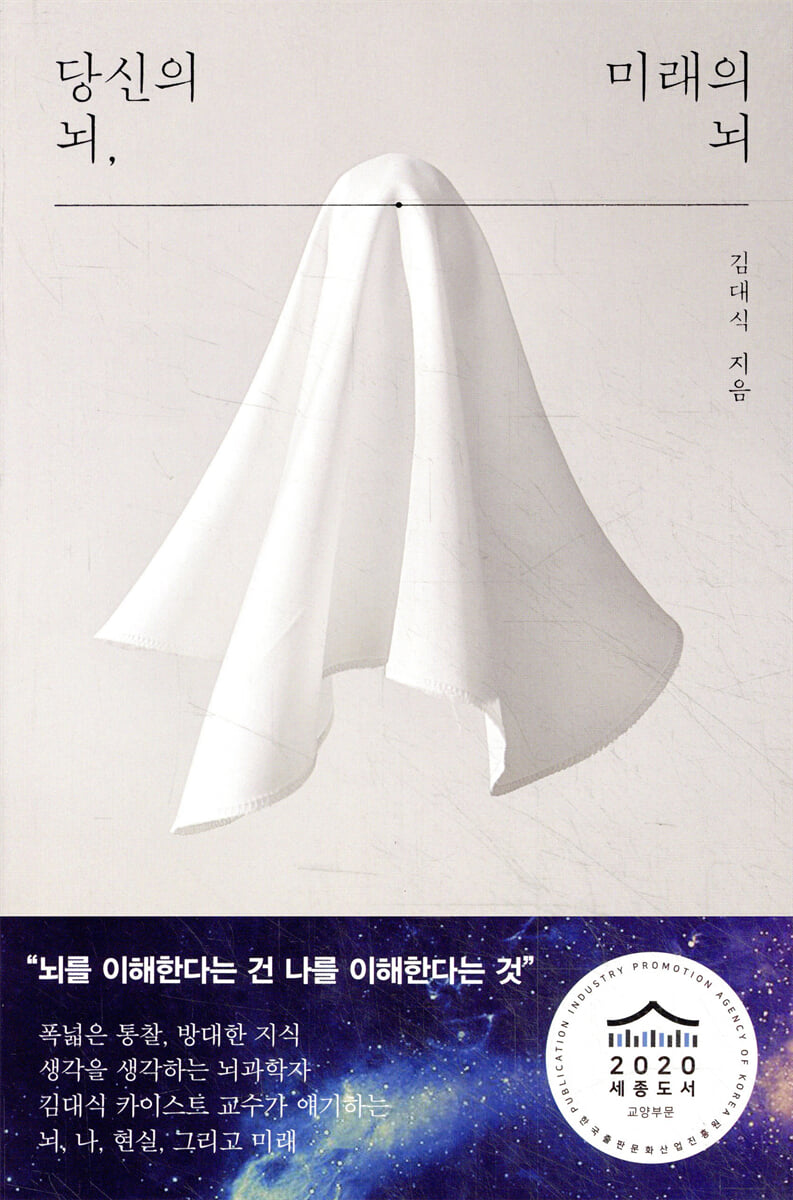
Your brain, the brain of the future
 |
Description
Book Introduction
A popular neuroscience textbook by Professor Dae-sik Kim of KAIST, a neuroscientist who is gaining attention for his extensive knowledge and deep insights.
How do we perceive and understand? What does it mean to feel emotions? What happens when we learn and remember? What does the future of brain science hold? This book offers a concise, accessible introduction to the brain, which interprets the world, sustains our personal history, and is emulated and interpreted by machines.
It provides an easy and interesting explanation of how brain science explains seeing and perceiving, feeling and remembering emotions, and what the future of brain science will be like.
How do we perceive and understand? What does it mean to feel emotions? What happens when we learn and remember? What does the future of brain science hold? This book offers a concise, accessible introduction to the brain, which interprets the world, sustains our personal history, and is emulated and interpreted by machines.
It provides an easy and interesting explanation of how brain science explains seeing and perceiving, feeling and remembering emotions, and what the future of brain science will be like.
- You can preview some of the book's contents.
Preview
index
preface
Chapter 1: Seeing and Perceiving: Vision and Cognition
The moment I saw the brain
I tried coloring the nerve cells
Information coming in through the eyes
Different brain functions in different regions
Following the traces of moving things
Connected neurons
Perception, sense through interpretation
The brain that interprets information, and optical illusions
Chapter 2 Feeling and Remembering: Emotions and Memory
An Apology for Homo Economicus
Choose first, justify later
Storytelling, the driving force behind human progress
The brain where past, present, and future coexist
Traces of memory and self
Education in a Critical Period
Chapter 3: Reading the Brain and Writing to the Brain: The Future of Neuroscience
Brain Reading, Reading the Brain
Brainwriting, memory editing
thinking machine
self-learning machines
A machine that exchanges emotions
self-conscious machines
Will artificial intelligence continue to evolve?
Conclusion
Image source
Search
Chapter 1: Seeing and Perceiving: Vision and Cognition
The moment I saw the brain
I tried coloring the nerve cells
Information coming in through the eyes
Different brain functions in different regions
Following the traces of moving things
Connected neurons
Perception, sense through interpretation
The brain that interprets information, and optical illusions
Chapter 2 Feeling and Remembering: Emotions and Memory
An Apology for Homo Economicus
Choose first, justify later
Storytelling, the driving force behind human progress
The brain where past, present, and future coexist
Traces of memory and self
Education in a Critical Period
Chapter 3: Reading the Brain and Writing to the Brain: The Future of Neuroscience
Brain Reading, Reading the Brain
Brainwriting, memory editing
thinking machine
self-learning machines
A machine that exchanges emotions
self-conscious machines
Will artificial intelligence continue to evolve?
Conclusion
Image source
Search
Into the book
“The moment I saw the brain, I was really amazed.
What was surprising was that there was nothing surprising about it.
It was just a 1.5 kilogram chunk of meat.
It's really nothing special.
It was a disgusting, blood-covered lump of meat.
But with such trivial things, humans are thinking about the principles of the universe and even creating artificial intelligence.” Page 15
“We cannot know how others see us.
In my eyes, only the world I see enters.
I can't see the world you see with my own eyes, can I? By observing your brain, I can discern your sensory sensations.
How, when, and to what do neurons react?
But I don't know if that's really visible to you.
I just believe it because you guys said you could see it.
The same goes for consciousness, soul, and spirit.
“Because the mind is an internal property, only one can feel it.” Page 45
“The most amazing thing about studying the brain is that the brain is inside the head.
What's the point? The idea that the brain is inside the head actually has significant philosophical implications.
It means that the brain cannot know reality.
The brain is a prisoner, imprisoned for life in a dark prison called the skull.
The brain does not experience the world directly.
We perceive the world through our eyes, nose, mouth, and ears.
For example, when the information light energy coming from the retina is converted into electrical energy and a spike occurs, the brain only sees the spike.
Just by looking at the spikes, you can tell whether what you are looking at is an apple or a banana.
There are no sensory sensors on the surface of the brain.
So, there is no problem even if you touch it with your hand.” Page 81
"What is hometown? Hometown is the environment where the brain is optimized.
So, hometown can only be comfortable.
Because during that critical period, the brain becomes accustomed to that environment.
The remaining third are said to be randomly generated.
Even identical twins cannot have 100 percent identical brains.
Even if they are genetically identical, their environments cannot be 100 percent identical.
So to speak, everyone has a slightly different brain.
If we have slightly different brains, slightly different calculations will occur, and accordingly, the interpretations will inevitably be slightly different.
In fact, the world appears different to our eyes every time.
“It’s even more fascinating to think that we live in the same world, even though it always seems different.” Pages 103-104
Economists argue that people make irrational choices only under special conditions or in very exceptional circumstances.
But neuroscientists argue the opposite.
In other words, most people make irrational choices, and very rarely, exceptionally, they make rational choices.” Page 115
“The self doesn’t actually exist.
Rationalize your own choices that remain in your memory
It's just drawing a line and connecting it as if you were the only one who exists in this world.
There is no such thing as self, or there are multiple self.
“The person I am now and the person I was 20 years ago are completely different people.” Page 129
“Daily life is a series of choices.
The choice itself is a kind of pattern.
It is known that selection behavior occurs when certain patterns are skewed to one side in the frontal lobe.
But in people with depression, this pattern is not skewed to one side of the frontal lobe, like an airplane that can't land and keeps spinning around.
So you can't make a choice.
It is said that if you give a strong stimulus at this time, the pattern will shift to one side.” (pp. 202-203)
“When discussing the future of applied brain science, artificial intelligence is always a constant topic.
The field of artificial intelligence is broadly divided into two.
First, artificial intelligence that sees the world and recognizes information at a level similar to that of humans is called 'weak artificial intelligence'.
And when independence, mind, and free will are added to this weak AI, it is called ‘strong AI.’” (Page 213)
“The moment machines become intelligent and conscious, they will want to retain their own perception, memory, thinking, and feeling.
If given the chance, humans would want to take intelligence and consciousness away from machines.
There's no way the machine wouldn't know.
So what should machines do? Will humans be meaningful to machines? Perhaps they will become as insignificant as the insects beneath our feet.
So what should we do now? What should we teach our children? Perhaps it's the uniquely human ability that will enable us to win the race against machines."
What was surprising was that there was nothing surprising about it.
It was just a 1.5 kilogram chunk of meat.
It's really nothing special.
It was a disgusting, blood-covered lump of meat.
But with such trivial things, humans are thinking about the principles of the universe and even creating artificial intelligence.” Page 15
“We cannot know how others see us.
In my eyes, only the world I see enters.
I can't see the world you see with my own eyes, can I? By observing your brain, I can discern your sensory sensations.
How, when, and to what do neurons react?
But I don't know if that's really visible to you.
I just believe it because you guys said you could see it.
The same goes for consciousness, soul, and spirit.
“Because the mind is an internal property, only one can feel it.” Page 45
“The most amazing thing about studying the brain is that the brain is inside the head.
What's the point? The idea that the brain is inside the head actually has significant philosophical implications.
It means that the brain cannot know reality.
The brain is a prisoner, imprisoned for life in a dark prison called the skull.
The brain does not experience the world directly.
We perceive the world through our eyes, nose, mouth, and ears.
For example, when the information light energy coming from the retina is converted into electrical energy and a spike occurs, the brain only sees the spike.
Just by looking at the spikes, you can tell whether what you are looking at is an apple or a banana.
There are no sensory sensors on the surface of the brain.
So, there is no problem even if you touch it with your hand.” Page 81
"What is hometown? Hometown is the environment where the brain is optimized.
So, hometown can only be comfortable.
Because during that critical period, the brain becomes accustomed to that environment.
The remaining third are said to be randomly generated.
Even identical twins cannot have 100 percent identical brains.
Even if they are genetically identical, their environments cannot be 100 percent identical.
So to speak, everyone has a slightly different brain.
If we have slightly different brains, slightly different calculations will occur, and accordingly, the interpretations will inevitably be slightly different.
In fact, the world appears different to our eyes every time.
“It’s even more fascinating to think that we live in the same world, even though it always seems different.” Pages 103-104
Economists argue that people make irrational choices only under special conditions or in very exceptional circumstances.
But neuroscientists argue the opposite.
In other words, most people make irrational choices, and very rarely, exceptionally, they make rational choices.” Page 115
“The self doesn’t actually exist.
Rationalize your own choices that remain in your memory
It's just drawing a line and connecting it as if you were the only one who exists in this world.
There is no such thing as self, or there are multiple self.
“The person I am now and the person I was 20 years ago are completely different people.” Page 129
“Daily life is a series of choices.
The choice itself is a kind of pattern.
It is known that selection behavior occurs when certain patterns are skewed to one side in the frontal lobe.
But in people with depression, this pattern is not skewed to one side of the frontal lobe, like an airplane that can't land and keeps spinning around.
So you can't make a choice.
It is said that if you give a strong stimulus at this time, the pattern will shift to one side.” (pp. 202-203)
“When discussing the future of applied brain science, artificial intelligence is always a constant topic.
The field of artificial intelligence is broadly divided into two.
First, artificial intelligence that sees the world and recognizes information at a level similar to that of humans is called 'weak artificial intelligence'.
And when independence, mind, and free will are added to this weak AI, it is called ‘strong AI.’” (Page 213)
“The moment machines become intelligent and conscious, they will want to retain their own perception, memory, thinking, and feeling.
If given the chance, humans would want to take intelligence and consciousness away from machines.
There's no way the machine wouldn't know.
So what should machines do? Will humans be meaningful to machines? Perhaps they will become as insignificant as the insects beneath our feet.
So what should we do now? What should we teach our children? Perhaps it's the uniquely human ability that will enable us to win the race against machines."
Pages 266-267
Publisher's Review
How does neuroscience view our brain?
Understanding perception, cognition, emotion, and memory in one book…
“The world has always been fearful and mysterious to humans who appeared on Earth as hairless monkeys.
And to make some sense of the world, a world of unpredictable events, humans begin to give names to mysterious things.
Thunder, rain, god, soul, death… .
The moment you give them a name, you can ask them for favors and even beg for favors.
As science and civilization advance, the extroverted beings that humans used to fear have disappeared, and perhaps the last true mystery left to humanity is the existence of the "self" that can believe in things that do not exist.
This book seeks to take a close look at that 'me'.
We will discuss how brain science explains seeing, perceiving, feeling, and remembering, and what the future holds for brain science.
“It is a story about brain science about ‘me’, including vision, cognition, emotion, and memory.” _ From the text
Remember the past,
Interpreting the present and the world,
The Secrets of Our Brains That Prepare for the Future
“Understanding the brain means understanding myself.”
The brain is trapped in a dark prison called the skull.
With such a brain, how do we perceive and understand the world? What does it mean to feel emotions? What and how do we remember? What will the future of brain science unfold? This book is a general-purpose neuroscience textbook by Professor Dae-sik Kim of KAIST, a neuroscientist who interprets the world with his own profound insights, straddling the boundaries of science and the humanities.
In this book, the author boldly explores the world of the brain to provide a three-dimensional explanation of the 'brain' and fully displays the aspect of a 'neuroscientist who thinks about thoughts'.
Its special feature is that it compresses ‘brain, me, reality, and future’ into one volume.
The main keywords are vision, cognition, emotion, and memory.
This book is a brain science book for those who want to understand their own 'brain' even a little.
There are more mysteries about the brain that are unknown than those that have been discovered, so there would be no end to talking about everything about the brain.
So in this book, the author narrows the scope to three topics: seeing and perceiving, feeling and remembering, and reading and writing with the brain, and concisely examines the important and core characteristics of the brain.
The first topic of this book is 'Vision and Cognition'.
It provides a fascinating introduction to the enigmatic nature of the brain, which interprets the world based on information received from the eyes, nose, mouth, and ears.
According to this book, we can never see the world as it is.
When an objectively existing external object enters our eyes, the brain interprets the sensation, and we can only see the result of that interpretation.
To properly understand this phenomenon, it is necessary to distinguish between sensation and perception.
According to this book, the sensations we receive through our sense organs can be objectively measured, but the perception and subjective experience (qualia) we have when looking at an object have properties that cannot be scientifically measured.
The difference between sensation and perception? Where can we easily find this? Optical illusions are a prime example of sensation transforming into perception.
For example, some pictures, although they are static, create an optical illusion that they are moving. This is because the brain interprets that 'things that look like this often move', making them appear to move.
Not only this case, but there are many cases that show optical illusions.
Even if we know that the circles are the same size, to our eyes, if the surrounding circle is large, the inner circle appears smaller, and if the surrounding circle is small, the inner circle appears smaller.
Interestingly, modern neuroscience considers not only simple visual illusions, but also most of human thoughts, memories, emotions, and perceptions to be illusions.
In other words, the brain's interpretation is included as a plus to the information conveyed by the five senses.
Next, this book deals with ‘emotions and memories.’
What exactly are the reasons and needs behind our countless emotions and memories? A closer look reveals that countless human choices and decisions are profoundly influenced by emotions and memories.
Humans believe that they make rational decisions and choices, but modern brain science suggests that most choices are made irrationally.
Additionally, it is explained that the brain creates very plausible stories to justify its choices.
We assume there is a causal relationship between our choices, but in reality, there is often no such relationship, and we often choose first and then justify later.
Why on earth is this so? We assume our brains trust our objective senses, but what they actually trust are biases we've known, experienced, and believed in from the beginning.
Because we are caught up in the prejudice that expensive things are better, we often think that even if the taste is actually the same, they are different and we prefer the more expensive thing.
The phenomenon of obsessing over the information initially encountered when making a decision (the 'anchoring effect') frequently occurs, which hinders rational judgment.
So, what does the future hold for artificial intelligence, which is pioneering new paths by mimicking and surpassing the human brain? The latter part of this book, which explores the future of brain science, delves into brain reading (reading) and brain writing (writing).
Recent remarkable advances in brain science have allowed neuroscientists to not only read brain patterns but also develop techniques to implant memories in the brain.
So, will "thinking machines" ever become a reality? The author divides artificial intelligence into "weak AI" and "strong AI." He then urges that if "strong AI"—a being possessing independence, mind, and free will—becomes a reality, we must ask ourselves how we should behave so that it becomes a being worthy of coexistence with humans.
Coexistence between "strong artificial intelligence" and humanity is only possible if we can provide a convincing answer to the question, "Why are humans needed on Earth?"
What if "strong AI" couldn't find a reason not to choose a "world without humans"? The irony of human-created AI forcing humans to find their own reason for existence is both ironic and worth pondering, as it serves as a reminder of the harm humanity has done.
In this way, this book can be said to be a general neuroscience textbook that clearly and concisely explains the characteristics of 'our brain', which are different from what we think, in an easy and interesting way.
Through this book, readers will be able to gain great help in understanding our 'brain', which we use without an instruction manual.
Understanding perception, cognition, emotion, and memory in one book…
“The world has always been fearful and mysterious to humans who appeared on Earth as hairless monkeys.
And to make some sense of the world, a world of unpredictable events, humans begin to give names to mysterious things.
Thunder, rain, god, soul, death… .
The moment you give them a name, you can ask them for favors and even beg for favors.
As science and civilization advance, the extroverted beings that humans used to fear have disappeared, and perhaps the last true mystery left to humanity is the existence of the "self" that can believe in things that do not exist.
This book seeks to take a close look at that 'me'.
We will discuss how brain science explains seeing, perceiving, feeling, and remembering, and what the future holds for brain science.
“It is a story about brain science about ‘me’, including vision, cognition, emotion, and memory.” _ From the text
Remember the past,
Interpreting the present and the world,
The Secrets of Our Brains That Prepare for the Future
“Understanding the brain means understanding myself.”
The brain is trapped in a dark prison called the skull.
With such a brain, how do we perceive and understand the world? What does it mean to feel emotions? What and how do we remember? What will the future of brain science unfold? This book is a general-purpose neuroscience textbook by Professor Dae-sik Kim of KAIST, a neuroscientist who interprets the world with his own profound insights, straddling the boundaries of science and the humanities.
In this book, the author boldly explores the world of the brain to provide a three-dimensional explanation of the 'brain' and fully displays the aspect of a 'neuroscientist who thinks about thoughts'.
Its special feature is that it compresses ‘brain, me, reality, and future’ into one volume.
The main keywords are vision, cognition, emotion, and memory.
This book is a brain science book for those who want to understand their own 'brain' even a little.
There are more mysteries about the brain that are unknown than those that have been discovered, so there would be no end to talking about everything about the brain.
So in this book, the author narrows the scope to three topics: seeing and perceiving, feeling and remembering, and reading and writing with the brain, and concisely examines the important and core characteristics of the brain.
The first topic of this book is 'Vision and Cognition'.
It provides a fascinating introduction to the enigmatic nature of the brain, which interprets the world based on information received from the eyes, nose, mouth, and ears.
According to this book, we can never see the world as it is.
When an objectively existing external object enters our eyes, the brain interprets the sensation, and we can only see the result of that interpretation.
To properly understand this phenomenon, it is necessary to distinguish between sensation and perception.
According to this book, the sensations we receive through our sense organs can be objectively measured, but the perception and subjective experience (qualia) we have when looking at an object have properties that cannot be scientifically measured.
The difference between sensation and perception? Where can we easily find this? Optical illusions are a prime example of sensation transforming into perception.
For example, some pictures, although they are static, create an optical illusion that they are moving. This is because the brain interprets that 'things that look like this often move', making them appear to move.
Not only this case, but there are many cases that show optical illusions.
Even if we know that the circles are the same size, to our eyes, if the surrounding circle is large, the inner circle appears smaller, and if the surrounding circle is small, the inner circle appears smaller.
Interestingly, modern neuroscience considers not only simple visual illusions, but also most of human thoughts, memories, emotions, and perceptions to be illusions.
In other words, the brain's interpretation is included as a plus to the information conveyed by the five senses.
Next, this book deals with ‘emotions and memories.’
What exactly are the reasons and needs behind our countless emotions and memories? A closer look reveals that countless human choices and decisions are profoundly influenced by emotions and memories.
Humans believe that they make rational decisions and choices, but modern brain science suggests that most choices are made irrationally.
Additionally, it is explained that the brain creates very plausible stories to justify its choices.
We assume there is a causal relationship between our choices, but in reality, there is often no such relationship, and we often choose first and then justify later.
Why on earth is this so? We assume our brains trust our objective senses, but what they actually trust are biases we've known, experienced, and believed in from the beginning.
Because we are caught up in the prejudice that expensive things are better, we often think that even if the taste is actually the same, they are different and we prefer the more expensive thing.
The phenomenon of obsessing over the information initially encountered when making a decision (the 'anchoring effect') frequently occurs, which hinders rational judgment.
So, what does the future hold for artificial intelligence, which is pioneering new paths by mimicking and surpassing the human brain? The latter part of this book, which explores the future of brain science, delves into brain reading (reading) and brain writing (writing).
Recent remarkable advances in brain science have allowed neuroscientists to not only read brain patterns but also develop techniques to implant memories in the brain.
So, will "thinking machines" ever become a reality? The author divides artificial intelligence into "weak AI" and "strong AI." He then urges that if "strong AI"—a being possessing independence, mind, and free will—becomes a reality, we must ask ourselves how we should behave so that it becomes a being worthy of coexistence with humans.
Coexistence between "strong artificial intelligence" and humanity is only possible if we can provide a convincing answer to the question, "Why are humans needed on Earth?"
What if "strong AI" couldn't find a reason not to choose a "world without humans"? The irony of human-created AI forcing humans to find their own reason for existence is both ironic and worth pondering, as it serves as a reminder of the harm humanity has done.
In this way, this book can be said to be a general neuroscience textbook that clearly and concisely explains the characteristics of 'our brain', which are different from what we think, in an easy and interesting way.
Through this book, readers will be able to gain great help in understanding our 'brain', which we use without an instruction manual.
GOODS SPECIFICS
- Date of publication: July 22, 2019
- Page count, weight, size: 280 pages | 546g | 140*210*20mm
- ISBN13: 9791164050352
- ISBN10: 1164050354
You may also like
카테고리
korean


korean

![GQ KOREA Mark (Monthly): December [2025]](http://librairie.coreenne.fr/cdn/shop/files/8ef265dbbfbf186523ed75ba7319009d.jpg?v=1765340328&width=3840)


