

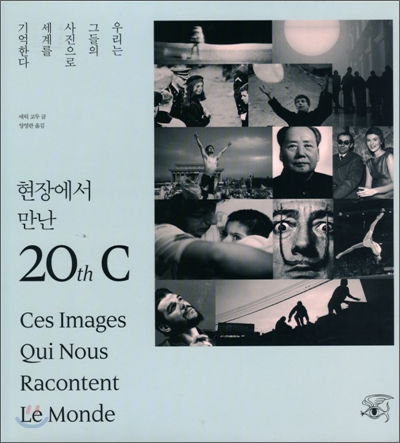
20thC met on site
 |
Description
Book Introduction
A photo book about the 20th century captured through the lenses of “Magnum,” the legendary photography group founded by Henri Cartier-Bresson, Robert Capa, and others.
The Korean edition of this book, which was jointly planned and simultaneously published in 23 countries around the world, has been released in limited quantities.
Magnum is an organization that targets photographers from all over the world and was founded under the leadership of Robert Capa by famous photographers such as Henri Cartier-Bresson and Georges Luhr to ensure autonomy in their work and to reflect their individuality in their photographs.
This book contains moments of history captured by these 'magnums'.
Magnum's first task was to photograph the world in pieces.
David photographed Europe, Henri photographed India and the Far East, George photographed Africa, and Capa photographed the Soviet Union.
The independence and autonomy of Magnum Agency, which they maintained, continues to this day, celebrating its 60th anniversary.
Since then, it has emerged as an influential group in the photography world, producing stellar artists such as Josef Koudelka, Gilles Perez, Alex Webb, Martin Parr, and Eugene Smith.
A scene from the Nuremberg war crimes trials after World War II, a striking photo of Salvador Dali's beard, the profile of Che Guevara with thick cigar smoke rising, the Chernobyl disaster, children dying of starvation in Somalia, the World Trade Center in New York collapsing as if by magic, the flames of the Iraq War… Their lenses capture every historical moment, from natural landscapes to human figures amidst war, industrialization, and urbanization.
"The 20th Century Encountered in the Field" was jointly planned and published simultaneously in the United States, France, Germany, Italy, Switzerland, Greece, the Netherlands, Japan, and other countries around the world.
A selection of 300 images from 60 years of work by Magnum photographers was compiled in a fast-paced manner, reenacting the historical context of world photography and the situations in each country.
This book is significant in that it is the first opportunity to view photographs by all 60 Magnum agency photographers.
This is because in our country, no personal photo albums other than Cartier-Bresson's have been published.
This book is of great significance in that it commemorates the 60th anniversary and presents the works of all 60 affiliated authors.
The Korean edition of this book, which was jointly planned and simultaneously published in 23 countries around the world, has been released in limited quantities.
Magnum is an organization that targets photographers from all over the world and was founded under the leadership of Robert Capa by famous photographers such as Henri Cartier-Bresson and Georges Luhr to ensure autonomy in their work and to reflect their individuality in their photographs.
This book contains moments of history captured by these 'magnums'.
Magnum's first task was to photograph the world in pieces.
David photographed Europe, Henri photographed India and the Far East, George photographed Africa, and Capa photographed the Soviet Union.
The independence and autonomy of Magnum Agency, which they maintained, continues to this day, celebrating its 60th anniversary.
Since then, it has emerged as an influential group in the photography world, producing stellar artists such as Josef Koudelka, Gilles Perez, Alex Webb, Martin Parr, and Eugene Smith.
A scene from the Nuremberg war crimes trials after World War II, a striking photo of Salvador Dali's beard, the profile of Che Guevara with thick cigar smoke rising, the Chernobyl disaster, children dying of starvation in Somalia, the World Trade Center in New York collapsing as if by magic, the flames of the Iraq War… Their lenses capture every historical moment, from natural landscapes to human figures amidst war, industrialization, and urbanization.
"The 20th Century Encountered in the Field" was jointly planned and published simultaneously in the United States, France, Germany, Italy, Switzerland, Greece, the Netherlands, Japan, and other countries around the world.
A selection of 300 images from 60 years of work by Magnum photographers was compiled in a fast-paced manner, reenacting the historical context of world photography and the situations in each country.
This book is significant in that it is the first opportunity to view photographs by all 60 Magnum agency photographers.
This is because in our country, no personal photo albums other than Cartier-Bresson's have been published.
This book is of great significance in that it commemorates the 60th anniversary and presents the works of all 60 affiliated authors.
- You can preview some of the book's contents.
Preview
index
Before entering
1950s
1960s
1970s
1980s
1990s
2000s
About Magnum's artists
Find a photo
Search
About copyright
1950s
1960s
1970s
1980s
1990s
2000s
About Magnum's artists
Find a photo
Search
About copyright
Publisher's Review
“If your photos aren't good enough, you're not close enough to your subject.
“Physically and emotionally.”: Robert Capa
After the end of World War II, photographers returning from the war were left with a feeling of utter helplessness.
As people around the world had to adapt to the political divisions of the Cold War, photographers lost the confidence that photography could be a means of preserving freedom.
In this period of loss of freedom and peace, Henri Cartier-Bresson, George Rodger, and David Seymour, under the leadership of Robert Capa, founded the agency “Magnum” to represent photographers from all over the world in order to secure autonomy for photography and guarantee freedom of reporting.
“Magnum” was a marriage of journalism and art, reality and surrealism, poetry and prose.
“We must awaken to the situation, to the truth.
This is a poem about the reality of life.”_ Henri Cartier-Bresson
In order to convey the scene as it was, Robert Capa, the only war correspondent who accompanied Company B of the 6th Infantry Division of the US Army during the Normandy Landing Operation in June 1944, did not hesitate to go to the line of fire. Magnum Agency, a group of photojournalistic photographers founded in 1947 with Henri Cartier-Bresson, George Moore, and David Seymour, considered 'being on the scene' to be the most important virtue.
Magnum's first task after its founding was to photograph the world in sections.
David photographed Europe, Henri photographed India and the Far East, George photographed Africa, and Capa photographed the Soviet Union.
The independence and autonomy of Magnum Agency, which they maintained, continues to this day, celebrating its 60th anniversary.
Since then, it has become a unique presence in the photography world, producing stellar artists such as Josef Koudelka, Gilles Perez, Alex Webb, Martin Parr, and Eugene Smith.
If Magnum has become a legend in the world of photography, it is entirely because they have been present at the scenes of history and centuries.
It would be no exaggeration to say that our perspective on the past history of the 20th century was formed through the lens of Magnum's artists, whose images mold our memories.
What would it look like if the past 60 years were summarized solely through Magnum photographs? The answer to this question is "The 20th Century on the Scene."
But this book is not just a simple Magnum photo book.
Published simultaneously in 23 countries around the world, "The 20th Century in Action" aims to recreate the heart-pounding moments of the past century, evoke the atmosphere of an era, and accurately convey the defining events and situations.
Nothing could be more appropriate to fulfill this purpose than the photographs of the Magnum Agency.
Therefore, this book is a history of the 20th century seen through the lens of Magnum.
Therefore, it is far from a book written by a historian who strives to be fair and objective in his academic writing.
While historians' writings usually attempt to maintain an objective distance, "The 20th Century in the Field" eliminates this distance and plunges headfirst into the field and events.
In “The Work of Art in the Age of Mechanical Reproduction,” one of the most brilliant essays on the new aesthetic possibilities of photography, Walter Benjamin said that if painters are sorcerers, photographers are surgeons.
If the traditional painter is a shaman who always maintains an appropriate distance from the patient, then the photographer's work always begins the moment he enters the scene and opens the aperture of the lens, just like cutting open the patient's stomach and inserting a scalpel inside.
That is why 『The 20th Century in the Field』, composed solely of Magnum photographs, conveys to us the 20th century that is still alive and breathing within the photographs.
Brief descriptive captions, contemporary slogans, and quotes from important figures for each photo help place the photographs in their historical context, and a detailed chronology is included on each page to help readers easily navigate important years and dates.
Another of the most interesting parts of this book are the photographer's notes inserted throughout the book.
The photographer's commentary is very brief, but it is a vivid testimony to the times and events and encapsulates the spirit of the Magnum Agency.
Some of the most representative ones are as follows:
Geoje Island, Korea (page 24)
“Everything was manipulated in Geojedo.
Instructions were given to everyone, and only those who looked good were allowed to pass in front of us taking pictures.
These people posed for a 'press photo'.
I couldn't help but constantly ask myself if this was truly camp life.
”_ Werner Bischoff
-Khrushchev's visit to the United States (page 39)
“…The important thing to remember about this shoot was not to show Khrushchev, but to show what he sees.
“How would he react to the incredible wealth America has created? It was because of this thought that I ended up taking a picture of his head from the back.” _ Burt Glynn
Intellectuals Dragged to Construction Sites (Page 73)
“In 1965, Chinese university students and intellectuals, like artists, were dragged into the fields.
Just wearing glasses could put you at risk.
…the professor in the photo had never handled a pickaxe before.
Wielding a pickaxe required a sense of balance and rhythm that had been developed for thousands of years.
“Like other professors… you will have to live in the countryside for at least the next few years to become proficient.” _ Marc Riboud
-Prague Spring (page 82)
“Prague in 1968 ended in tragedy, of course, but I am still grateful to have been a witness to that tragedy.
I never dreamed that such solidarity could exist among people.
It was truly a miracle.
The appearance against Soviet tanks was consistent.
Communists, intellectuals, young and old, all became one.
Even the thieves swore never to steal again.
Because the police had a lot of work to do besides catching thieves.
“It was a first for me, such an intense moment.” _ Josef Koudelka
-Spring in Beijing (p. 163)
“I was one of two or three people who took pictures of the men who resisted the tanks in the early days of the suppression.
This happened because most journalists moved to a hotel three kilometers away from Tiananmen Square.
The reason was that the food there was more delicious.
Honestly, I could have eaten a better hamburger there.
I resisted the temptation of some comfort and remained at the scene of the incident.
So I'd like to think that it wasn't luck that got me to take this photo, but rather a result of my thorough professionalism.
_ Stuart Franklin
This book was not published in the simple collaborative way common in art or photo collections, where only the text is translated and replaced.
Led by the French publisher Alvin-Michel, editors from 23 countries around the world provided input on a selection of some 300 photographs from Magnum's treasure trove.
We exchanged express mail several times to select photos and text, and discussed the composition through many rounds of discussion.
Above all, we took great care to ensure that the history of the Third Reich, which has often been overlooked despite its central role in world affairs, was not overlooked. We also organized the year-by-year explanations into monthly units to demonstrate the plausibility of how a single photograph could influence different times and spaces.
Still, picking just one photo from dozens of photos, each shot with a different feel, proved far more difficult than choosing a subject, and it took longer than expected for editors from 23 countries with different histories to reach a consensus.
But unfortunately, there weren't many Magnum photographers who captured our last century.
There is the Prague Spring, but no Gwangju Democratization Movement, and this is why we have no field experience other than photos of the Geoje Island POW camp during the Korean War.
This book, completed after a long and arduous journey, may not satisfy the circumstances and perspectives of all countries, but it will certainly capture the outlines of the past century.
“Physically and emotionally.”: Robert Capa
After the end of World War II, photographers returning from the war were left with a feeling of utter helplessness.
As people around the world had to adapt to the political divisions of the Cold War, photographers lost the confidence that photography could be a means of preserving freedom.
In this period of loss of freedom and peace, Henri Cartier-Bresson, George Rodger, and David Seymour, under the leadership of Robert Capa, founded the agency “Magnum” to represent photographers from all over the world in order to secure autonomy for photography and guarantee freedom of reporting.
“Magnum” was a marriage of journalism and art, reality and surrealism, poetry and prose.
“We must awaken to the situation, to the truth.
This is a poem about the reality of life.”_ Henri Cartier-Bresson
In order to convey the scene as it was, Robert Capa, the only war correspondent who accompanied Company B of the 6th Infantry Division of the US Army during the Normandy Landing Operation in June 1944, did not hesitate to go to the line of fire. Magnum Agency, a group of photojournalistic photographers founded in 1947 with Henri Cartier-Bresson, George Moore, and David Seymour, considered 'being on the scene' to be the most important virtue.
Magnum's first task after its founding was to photograph the world in sections.
David photographed Europe, Henri photographed India and the Far East, George photographed Africa, and Capa photographed the Soviet Union.
The independence and autonomy of Magnum Agency, which they maintained, continues to this day, celebrating its 60th anniversary.
Since then, it has become a unique presence in the photography world, producing stellar artists such as Josef Koudelka, Gilles Perez, Alex Webb, Martin Parr, and Eugene Smith.
If Magnum has become a legend in the world of photography, it is entirely because they have been present at the scenes of history and centuries.
It would be no exaggeration to say that our perspective on the past history of the 20th century was formed through the lens of Magnum's artists, whose images mold our memories.
What would it look like if the past 60 years were summarized solely through Magnum photographs? The answer to this question is "The 20th Century on the Scene."
But this book is not just a simple Magnum photo book.
Published simultaneously in 23 countries around the world, "The 20th Century in Action" aims to recreate the heart-pounding moments of the past century, evoke the atmosphere of an era, and accurately convey the defining events and situations.
Nothing could be more appropriate to fulfill this purpose than the photographs of the Magnum Agency.
Therefore, this book is a history of the 20th century seen through the lens of Magnum.
Therefore, it is far from a book written by a historian who strives to be fair and objective in his academic writing.
While historians' writings usually attempt to maintain an objective distance, "The 20th Century in the Field" eliminates this distance and plunges headfirst into the field and events.
In “The Work of Art in the Age of Mechanical Reproduction,” one of the most brilliant essays on the new aesthetic possibilities of photography, Walter Benjamin said that if painters are sorcerers, photographers are surgeons.
If the traditional painter is a shaman who always maintains an appropriate distance from the patient, then the photographer's work always begins the moment he enters the scene and opens the aperture of the lens, just like cutting open the patient's stomach and inserting a scalpel inside.
That is why 『The 20th Century in the Field』, composed solely of Magnum photographs, conveys to us the 20th century that is still alive and breathing within the photographs.
Brief descriptive captions, contemporary slogans, and quotes from important figures for each photo help place the photographs in their historical context, and a detailed chronology is included on each page to help readers easily navigate important years and dates.
Another of the most interesting parts of this book are the photographer's notes inserted throughout the book.
The photographer's commentary is very brief, but it is a vivid testimony to the times and events and encapsulates the spirit of the Magnum Agency.
Some of the most representative ones are as follows:
Geoje Island, Korea (page 24)
“Everything was manipulated in Geojedo.
Instructions were given to everyone, and only those who looked good were allowed to pass in front of us taking pictures.
These people posed for a 'press photo'.
I couldn't help but constantly ask myself if this was truly camp life.
”_ Werner Bischoff
-Khrushchev's visit to the United States (page 39)
“…The important thing to remember about this shoot was not to show Khrushchev, but to show what he sees.
“How would he react to the incredible wealth America has created? It was because of this thought that I ended up taking a picture of his head from the back.” _ Burt Glynn
Intellectuals Dragged to Construction Sites (Page 73)
“In 1965, Chinese university students and intellectuals, like artists, were dragged into the fields.
Just wearing glasses could put you at risk.
…the professor in the photo had never handled a pickaxe before.
Wielding a pickaxe required a sense of balance and rhythm that had been developed for thousands of years.
“Like other professors… you will have to live in the countryside for at least the next few years to become proficient.” _ Marc Riboud
-Prague Spring (page 82)
“Prague in 1968 ended in tragedy, of course, but I am still grateful to have been a witness to that tragedy.
I never dreamed that such solidarity could exist among people.
It was truly a miracle.
The appearance against Soviet tanks was consistent.
Communists, intellectuals, young and old, all became one.
Even the thieves swore never to steal again.
Because the police had a lot of work to do besides catching thieves.
“It was a first for me, such an intense moment.” _ Josef Koudelka
-Spring in Beijing (p. 163)
“I was one of two or three people who took pictures of the men who resisted the tanks in the early days of the suppression.
This happened because most journalists moved to a hotel three kilometers away from Tiananmen Square.
The reason was that the food there was more delicious.
Honestly, I could have eaten a better hamburger there.
I resisted the temptation of some comfort and remained at the scene of the incident.
So I'd like to think that it wasn't luck that got me to take this photo, but rather a result of my thorough professionalism.
_ Stuart Franklin
This book was not published in the simple collaborative way common in art or photo collections, where only the text is translated and replaced.
Led by the French publisher Alvin-Michel, editors from 23 countries around the world provided input on a selection of some 300 photographs from Magnum's treasure trove.
We exchanged express mail several times to select photos and text, and discussed the composition through many rounds of discussion.
Above all, we took great care to ensure that the history of the Third Reich, which has often been overlooked despite its central role in world affairs, was not overlooked. We also organized the year-by-year explanations into monthly units to demonstrate the plausibility of how a single photograph could influence different times and spaces.
Still, picking just one photo from dozens of photos, each shot with a different feel, proved far more difficult than choosing a subject, and it took longer than expected for editors from 23 countries with different histories to reach a consensus.
But unfortunately, there weren't many Magnum photographers who captured our last century.
There is the Prague Spring, but no Gwangju Democratization Movement, and this is why we have no field experience other than photos of the Geoje Island POW camp during the Korean War.
This book, completed after a long and arduous journey, may not satisfy the circumstances and perspectives of all countries, but it will certainly capture the outlines of the past century.
GOODS SPECIFICS
- Date of issue: October 5, 2007
- Page count, weight, size: 256 pages | 1,198g | 148*210*20mm
- ISBN13: 9788992053136
- ISBN10: 8992053134
You may also like
카테고리
korean


korean

![GQ KOREA Mark (Monthly): December [2025]](http://librairie.coreenne.fr/cdn/shop/files/8ef265dbbfbf186523ed75ba7319009d.jpg?v=1765340328&width=3840)


