

Our Body Chronicles
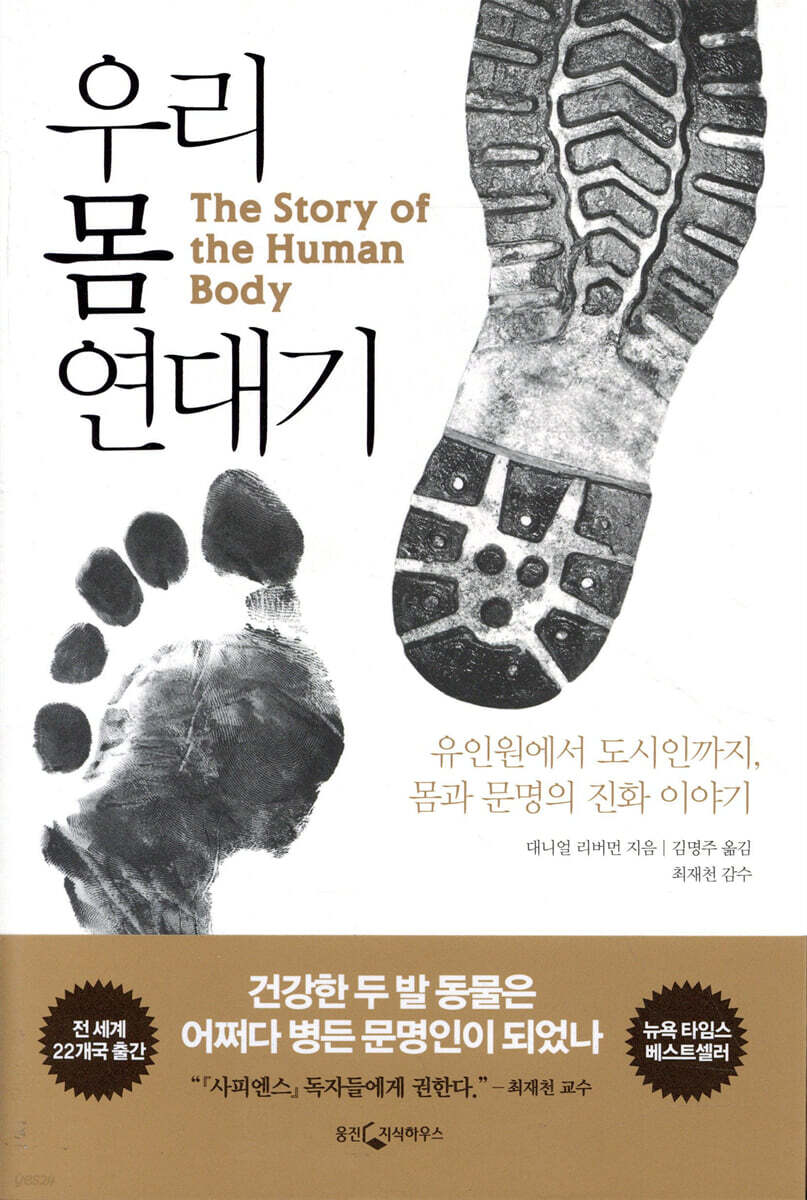 |
Description
Book Introduction
How did healthy bipeds become sick, civilized people?
A world-renowned work that examines the relationship between the human body and civilization through the lens of evolution.
"The Chronicles of Our Body" is a book that broadly explores from an evolutionary perspective why modern humans, who have reached the pinnacle of evolution, suffer from various chronic diseases and functional disorders, and how the human body and civilization have influenced each other.
The author, Professor Daniel Lieberman of Harvard University, is a world-renowned evolutionary biologist who studies why and how the structure and function of the human body evolved.
In this fascinating book, he reveals that the health problems we face are a product of evolution, a maladaptation of our bodies, adapted to survive and reproduce in harsh environments, to the affluent and comfortable conditions of modern civilization.
Drawing on concrete, substantive data from anthropological, biological, and genetic research, along with scientifically rigorous arguments, this book describes the coevolution of the human body and civilization. It offers a fresh perspective on human history and reliable advice for a healthy and happy life.
A world-renowned work that examines the relationship between the human body and civilization through the lens of evolution.
"The Chronicles of Our Body" is a book that broadly explores from an evolutionary perspective why modern humans, who have reached the pinnacle of evolution, suffer from various chronic diseases and functional disorders, and how the human body and civilization have influenced each other.
The author, Professor Daniel Lieberman of Harvard University, is a world-renowned evolutionary biologist who studies why and how the structure and function of the human body evolved.
In this fascinating book, he reveals that the health problems we face are a product of evolution, a maladaptation of our bodies, adapted to survive and reproduce in harsh environments, to the affluent and comfortable conditions of modern civilization.
Drawing on concrete, substantive data from anthropological, biological, and genetic research, along with scientifically rigorous arguments, this book describes the coevolution of the human body and civilization. It offers a fresh perspective on human history and reliable advice for a healthy and happy life.
- You can preview some of the book's contents.
Preview
index
Recommendation
preface
Introduction: What are humans adapted to?
Part 1: Apes and Humans
Chapter 1: Upright Apes: How We Became Bipedal
Chapter 2: It's All About the Food: How Australopithecus Evolved from Fruit
Chapter 3: The First Hunter-Gatherers: How Hominins Evolved into Modern Humans
Chapter 4: Energy of the Ice Age: Big Brains, Plump Bodies, and Long Maturity
Chapter 5: A Highly Cultural Species: How Modern Humans Conquered the World
Part 2: Agriculture and the Industrial Revolution
Chapter 6: Progress, Dissonance, and Devolution: Living in the Post-Paleolithic World
Chapter 7 Paradise Lost?: The Pros and Cons of Farming
Chapter 8 Modernity and Our Bodies: The Health Paradox of the Industrial Age
Part 3: Present and Future
Chapter 9: The Vicious Cycle of Excess: Too Much Energy Makes You Sick
Chapter 10: The Disease of Disuse: Too Little Use and Stimulation Accelerate Decline
Chapter 11: The Invisible Dangers of Novelty and Comfort: Why Everyday Innovations Are Harmful
Chapter 12: Survival of the Fittest: Does Evolutionary Logic Help Us Build Healthier Bodies?
Acknowledgements
annotation
preface
Introduction: What are humans adapted to?
Part 1: Apes and Humans
Chapter 1: Upright Apes: How We Became Bipedal
Chapter 2: It's All About the Food: How Australopithecus Evolved from Fruit
Chapter 3: The First Hunter-Gatherers: How Hominins Evolved into Modern Humans
Chapter 4: Energy of the Ice Age: Big Brains, Plump Bodies, and Long Maturity
Chapter 5: A Highly Cultural Species: How Modern Humans Conquered the World
Part 2: Agriculture and the Industrial Revolution
Chapter 6: Progress, Dissonance, and Devolution: Living in the Post-Paleolithic World
Chapter 7 Paradise Lost?: The Pros and Cons of Farming
Chapter 8 Modernity and Our Bodies: The Health Paradox of the Industrial Age
Part 3: Present and Future
Chapter 9: The Vicious Cycle of Excess: Too Much Energy Makes You Sick
Chapter 10: The Disease of Disuse: Too Little Use and Stimulation Accelerate Decline
Chapter 11: The Invisible Dangers of Novelty and Comfort: Why Everyday Innovations Are Harmful
Chapter 12: Survival of the Fittest: Does Evolutionary Logic Help Us Build Healthier Bodies?
Acknowledgements
annotation
Into the book
The biggest reason many people talk about (and examine) the human body is to uncover why we exist the way we do.
Why do we have such unusual features as large brains, long legs, and prominent belly buttons? Why do we walk on two legs and communicate verbally? Why do we cooperate and cook? Another urgent and practical reason to examine how the human body evolved is to understand who our species is and what we are adapted to, thereby uncovering why we get sick.
To prevent and treat disease, we need to understand why our species gets sick.
--- p.35
Your body is full of traits that evolved through hundreds of thousands of years of cultural and biological interactions.
Some of them existed before the origin of modern humans.
For example, the invention of stone tools and projectile weapons led to natural selection for the dexterity of making sophisticated tools and the ability to throw accurately and powerfully.
Since the invention of stone tools in the Early Paleolithic era, natural selection has been taking place for smaller teeth.
Since cooking became widespread, our digestive systems have changed so much that we cannot live without cooking.
While some argue that human biology has changed little since Homo sapiens emerged 200,000 years ago, it is clear that our constant drive to innovate has driven natural selection on our bodies.
--- p.219
While our species' recent successes owe much to our remarkable ability to think, learn, communicate, collaborate, and innovate, I believe it is not only inaccurate but dangerous to view modern human evolution solely as a triumph of the brain over the body.
The Paleolithic Revolution and other cultural innovations enabled modern humans to dominate the planet and outcompete other cousin species, but that didn't mean we no longer had to be hunter-gatherers, nor did it mean we no longer had to use our bodies to survive.
As we have seen, hunter-gatherers are fundamentally physically adept people who must move their bodies diligently to make a living.
--- p.223
Our body's adaptations evolved long ago simply because they helped our ancestors have many children.
So the reason we sometimes get sick is because natural selection generally prioritizes reproduction over health.
We did not evolve to be healthy.
--- p.242
Just as this world is not the best of all possible worlds, our bodies are not the best of all possible bodies.
But it's the only body we have, and so we should enjoy it, care for it, and protect it.
Our bodies' past was shaped by the process of survival of the fittest, but their future depends on how we use them.
--- p.511
Publisher's Review
A 6-million-year epic that integrates human history and the history of civilization, revealing the origins and limitations of our species.
Human history has generally been understood as a history of progress from barbarism to civilization.
Six million years ago, apes came down from the trees in the African forest and began walking upright, evolving into Homo sapiens.
The Sapiens horde spread across the globe, demonstrating its cultural ability to communicate, cooperate, think, and innovate, becoming the ultimate survivors of competition with other human species.
Afterwards, they successively developed stone age civilization, agricultural civilization, and industrial civilization, and built villages, cities, countries, and empires, becoming the rulers of the Earth.
But from the perspective of our bodies, this narrative of the evolutionary and cultural success of Homo sapiens becomes questionable.
Infectious diseases, famine, and malnutrition that once threatened life have largely been resolved through scientific and technological innovations, infant mortality rates have decreased, and human life expectancy has increased. However, the number of people suffering from non-communicable chronic diseases that were previously rare or non-existent is increasing exponentially.
There are also significant patterns of dysfunction, such as allergies, myopia, insomnia, and flat feet, and one study estimates that by 2050, 5 billion people, or about half the world's population, will be myopic.
However, we cannot ignore ethical issues and technological limitations when pinning our hopes on the rosy prospect of humanity being liberated from disease and suffering thanks to information technology and biotechnology such as artificial intelligence, big data, and CRISPR scissors.
How can we overcome this crisis?
The Story of the Human Body is a comprehensive, evolutionary exploration of why non-communicable chronic diseases and dysfunctions are so prevalent worldwide today.
The author, Daniel Lieberman, a professor at Harvard University, is a world-renowned evolutionary biologist who studies why and how the structure and function of the human body evolved by directly touching the bones of ancient humans.
In this fascinating book, he reveals that the health problems we face are a product of evolution, a maladaptation of our bodies, adapted to survive and reproduce in harsh environments, to the affluent and comfortable conditions of modern civilization.
Rather than using flowery rhetoric and esoteric concepts, this book, based on concrete, practical data from anthropological, biological, and genetic research, and scientifically rigorous arguments, describes the co-evolution of the human body and civilization. It offers a new perspective on human history and reliable advice for a healthy and happy life.
What has our body adapted to?
The complex and multifaceted nature of evolution, dispelling misconceptions about progress.
"Our Body Chronicles" argues that today's prevalent non-communicable chronic diseases and dysfunctions originated in Paleolithic bodies that were not adequately adapted to specific modern behaviors and conditions.
So, could a return to the hunter-gatherer lifestyle of our Paleolithic ancestors be the solution? Indeed, in this context, things like the Paleolithic diet and barefoot running once gained popularity and became a hot topic.
However, the author points out that the environments our ancestors adapted to, from Arctic tundra to tropical rainforests and deserts, are so diverse that it is difficult to generalize.
Could these diseases have become more common due to specific genes, population growth, or aging? Indeed, several studies have shown that genes, population size, and age are strongly correlated with disease.
However, the reason type 2 diabetes is spreading faster in Asia than in the United States is more likely the result of Western lifestyles interacting with older genes that previously had no negative impact, rather than changes in gene frequencies.
In addition, we must not overlook the fact that the rate of spread and the scale of chronic diseases are increasing much faster than the rate of population growth, and that their incidence is soaring not only among the elderly but also among the young and middle-aged.
Therefore, in order to wisely deal with the paradoxical situation of modern people suffering from illnesses that match their extended lifespans, we must begin with a deep understanding of what our bodies are adapted to and why they have become what they are today, and closely examine the dynamic interaction between the human body and civilization.
Rather than dwelling on specific dates and terminology, the author rewrites six million years of human history, highlighting seven key evolutionary events that shaped the human body.
According to the authors, our bodies evolved over millions of years to efficiently move long distances on two feet, consume a variety of healthy foods found in nature, and store fat to provide the energy needed for a large brain and child rearing, all to gain the advantage of reproduction and survival in an environment where rainfall, temperature, and food constantly change.
These bodies provided an excellent biological foundation for cultural capabilities and led to the success of Homo sapiens, but at the same time, they created a disharmony with the environment created by that cultural power, leading to unfortunate consequences such as famine and disease.
Moreover, with the advancement of science and medicine, treatments, drugs, and assistive devices that effectively alleviate symptoms have become widespread, and we have expanded and reproduced the mechanism of 'dysevolution' that passes on to future generations the environmental conditions and behaviors that promote evolutionary mismatch diseases.
The story of the evolution of our bodies and civilization sometimes reveals new facts that contradict conventional wisdom and common sense.
For example, natural selection does not create organisms that live long and healthy lives, but rather organisms that survive fiercely in the struggle for survival and reproduce vigorously.
Civilization is humanity's greatest creation, but it is also another evolutionary driving force, rapidly transforming our environment and causing fundamental changes in our bodies.
Ultimately, we can understand that the reason humans get sick is because of the origins and limitations of our species.
So how can we break the vicious cycle of de-evolution and improve our living conditions?
Insights from the Rising Field of Evolutionary Medicine and the Problem of De-Evolution
『Our Body Chronicles』 is based on the academic foundation of 'evolutionary medicine', which applies an evolutionary perspective to health and disease issues.
Unlike modern clinical medicine, which diagnoses and prescribes based on physiology and anatomy, or biology, which analyzes the causal mechanisms of diseases at the level of genes, cells, and molecules, evolutionary medicine is an academic discipline that studies why humans get sick from a historical perspective. It was founded in the early 1990s by Randolph Nesse, a professor at the University of Michigan Medical School, and world-renowned evolutionary biologist George Williams.
As the world's population grows and ages, preventing and managing chronic diseases has become more important than ever for both individuals and nations, leading to a growing interest in evolutionary medicine.
Evolutionary medicine offers new explanations and alternatives for the causes of common chronic diseases today, such as type 2 diabetes, heart disease, and reproductive cancers, as well as functional disorders like impacted wisdom teeth, myopia, flat feet, osteoporosis, and back pain, and how to treat and prevent them.
For example, someone with type 2 diabetes might take medication for the rest of their life to improve insulin sensitivity or block glucose absorption, but they might also choose to increase physical activity or avoid processed foods like soda and candy, understanding that our bodies, which evolved over millions of years to store excess energy, are not well adapted to the rapid absorption of large amounts of sugar.
Moreover, since we mainly eat food that has been ground, mashed, and softened today, there is little stimulation to chew, and as a result, the jaws do not grow large enough to accommodate all the teeth, leading to problems such as impacted wisdom teeth and malocclusion.
Of course, you can still get dental treatment after death, but by understanding this evolutionary mechanism, you can supplement the stimulation your bones lack by chewing gum during the bone growth period.
Also, although we inherited the feet of our ancestors who walked barefoot, we have become more accustomed to wearing shoes with cushioning, which has weakened the muscles that support the arch of the foot, which can lead to problems such as flat feet or plantar fasciitis. This makes us reconsider the idea that comfortable shoes are good and leads us to wear shoes with minimal functionality.
Evolutionary medicine, which approaches our bodies, civilization, health, and disease from an evolutionary perspective, provides practical assistance in cultivating a healthy life.
By changing our environmental conditions and behavior patterns based on the insights of evolutionary medicine, which overturns the existing health and disease paradigm, and thereby breaking the vicious cycle of de-evolution, we will be able to lead healthy and happy lives, create a sustainable civilization, and be reborn as a truly "wise species."
Human history has generally been understood as a history of progress from barbarism to civilization.
Six million years ago, apes came down from the trees in the African forest and began walking upright, evolving into Homo sapiens.
The Sapiens horde spread across the globe, demonstrating its cultural ability to communicate, cooperate, think, and innovate, becoming the ultimate survivors of competition with other human species.
Afterwards, they successively developed stone age civilization, agricultural civilization, and industrial civilization, and built villages, cities, countries, and empires, becoming the rulers of the Earth.
But from the perspective of our bodies, this narrative of the evolutionary and cultural success of Homo sapiens becomes questionable.
Infectious diseases, famine, and malnutrition that once threatened life have largely been resolved through scientific and technological innovations, infant mortality rates have decreased, and human life expectancy has increased. However, the number of people suffering from non-communicable chronic diseases that were previously rare or non-existent is increasing exponentially.
There are also significant patterns of dysfunction, such as allergies, myopia, insomnia, and flat feet, and one study estimates that by 2050, 5 billion people, or about half the world's population, will be myopic.
However, we cannot ignore ethical issues and technological limitations when pinning our hopes on the rosy prospect of humanity being liberated from disease and suffering thanks to information technology and biotechnology such as artificial intelligence, big data, and CRISPR scissors.
How can we overcome this crisis?
The Story of the Human Body is a comprehensive, evolutionary exploration of why non-communicable chronic diseases and dysfunctions are so prevalent worldwide today.
The author, Daniel Lieberman, a professor at Harvard University, is a world-renowned evolutionary biologist who studies why and how the structure and function of the human body evolved by directly touching the bones of ancient humans.
In this fascinating book, he reveals that the health problems we face are a product of evolution, a maladaptation of our bodies, adapted to survive and reproduce in harsh environments, to the affluent and comfortable conditions of modern civilization.
Rather than using flowery rhetoric and esoteric concepts, this book, based on concrete, practical data from anthropological, biological, and genetic research, and scientifically rigorous arguments, describes the co-evolution of the human body and civilization. It offers a new perspective on human history and reliable advice for a healthy and happy life.
What has our body adapted to?
The complex and multifaceted nature of evolution, dispelling misconceptions about progress.
"Our Body Chronicles" argues that today's prevalent non-communicable chronic diseases and dysfunctions originated in Paleolithic bodies that were not adequately adapted to specific modern behaviors and conditions.
So, could a return to the hunter-gatherer lifestyle of our Paleolithic ancestors be the solution? Indeed, in this context, things like the Paleolithic diet and barefoot running once gained popularity and became a hot topic.
However, the author points out that the environments our ancestors adapted to, from Arctic tundra to tropical rainforests and deserts, are so diverse that it is difficult to generalize.
Could these diseases have become more common due to specific genes, population growth, or aging? Indeed, several studies have shown that genes, population size, and age are strongly correlated with disease.
However, the reason type 2 diabetes is spreading faster in Asia than in the United States is more likely the result of Western lifestyles interacting with older genes that previously had no negative impact, rather than changes in gene frequencies.
In addition, we must not overlook the fact that the rate of spread and the scale of chronic diseases are increasing much faster than the rate of population growth, and that their incidence is soaring not only among the elderly but also among the young and middle-aged.
Therefore, in order to wisely deal with the paradoxical situation of modern people suffering from illnesses that match their extended lifespans, we must begin with a deep understanding of what our bodies are adapted to and why they have become what they are today, and closely examine the dynamic interaction between the human body and civilization.
Rather than dwelling on specific dates and terminology, the author rewrites six million years of human history, highlighting seven key evolutionary events that shaped the human body.
According to the authors, our bodies evolved over millions of years to efficiently move long distances on two feet, consume a variety of healthy foods found in nature, and store fat to provide the energy needed for a large brain and child rearing, all to gain the advantage of reproduction and survival in an environment where rainfall, temperature, and food constantly change.
These bodies provided an excellent biological foundation for cultural capabilities and led to the success of Homo sapiens, but at the same time, they created a disharmony with the environment created by that cultural power, leading to unfortunate consequences such as famine and disease.
Moreover, with the advancement of science and medicine, treatments, drugs, and assistive devices that effectively alleviate symptoms have become widespread, and we have expanded and reproduced the mechanism of 'dysevolution' that passes on to future generations the environmental conditions and behaviors that promote evolutionary mismatch diseases.
The story of the evolution of our bodies and civilization sometimes reveals new facts that contradict conventional wisdom and common sense.
For example, natural selection does not create organisms that live long and healthy lives, but rather organisms that survive fiercely in the struggle for survival and reproduce vigorously.
Civilization is humanity's greatest creation, but it is also another evolutionary driving force, rapidly transforming our environment and causing fundamental changes in our bodies.
Ultimately, we can understand that the reason humans get sick is because of the origins and limitations of our species.
So how can we break the vicious cycle of de-evolution and improve our living conditions?
Insights from the Rising Field of Evolutionary Medicine and the Problem of De-Evolution
『Our Body Chronicles』 is based on the academic foundation of 'evolutionary medicine', which applies an evolutionary perspective to health and disease issues.
Unlike modern clinical medicine, which diagnoses and prescribes based on physiology and anatomy, or biology, which analyzes the causal mechanisms of diseases at the level of genes, cells, and molecules, evolutionary medicine is an academic discipline that studies why humans get sick from a historical perspective. It was founded in the early 1990s by Randolph Nesse, a professor at the University of Michigan Medical School, and world-renowned evolutionary biologist George Williams.
As the world's population grows and ages, preventing and managing chronic diseases has become more important than ever for both individuals and nations, leading to a growing interest in evolutionary medicine.
Evolutionary medicine offers new explanations and alternatives for the causes of common chronic diseases today, such as type 2 diabetes, heart disease, and reproductive cancers, as well as functional disorders like impacted wisdom teeth, myopia, flat feet, osteoporosis, and back pain, and how to treat and prevent them.
For example, someone with type 2 diabetes might take medication for the rest of their life to improve insulin sensitivity or block glucose absorption, but they might also choose to increase physical activity or avoid processed foods like soda and candy, understanding that our bodies, which evolved over millions of years to store excess energy, are not well adapted to the rapid absorption of large amounts of sugar.
Moreover, since we mainly eat food that has been ground, mashed, and softened today, there is little stimulation to chew, and as a result, the jaws do not grow large enough to accommodate all the teeth, leading to problems such as impacted wisdom teeth and malocclusion.
Of course, you can still get dental treatment after death, but by understanding this evolutionary mechanism, you can supplement the stimulation your bones lack by chewing gum during the bone growth period.
Also, although we inherited the feet of our ancestors who walked barefoot, we have become more accustomed to wearing shoes with cushioning, which has weakened the muscles that support the arch of the foot, which can lead to problems such as flat feet or plantar fasciitis. This makes us reconsider the idea that comfortable shoes are good and leads us to wear shoes with minimal functionality.
Evolutionary medicine, which approaches our bodies, civilization, health, and disease from an evolutionary perspective, provides practical assistance in cultivating a healthy life.
By changing our environmental conditions and behavior patterns based on the insights of evolutionary medicine, which overturns the existing health and disease paradigm, and thereby breaking the vicious cycle of de-evolution, we will be able to lead healthy and happy lives, create a sustainable civilization, and be reborn as a truly "wise species."
GOODS SPECIFICS
- Date of issue: May 25, 2018
- Page count, weight, size: 592 pages | 740g | 140*210*35mm
- ISBN13: 9788901224954
- ISBN10: 890122495X
You may also like
카테고리
korean


korean

![ELLE 엘르 스페셜 에디션 A형 : 12월 [2025]](http://librairie.coreenne.fr/cdn/shop/files/b8e27a3de6c9538896439686c6b0e8fb.jpg?v=1766436872&width=3840)


