

The basement of a museum
 |
Description
Book Introduction
An exciting story that unfolds when the protagonist, Le Volumour, and his assistant, Leonard, are entrusted with the task of surveying and appraising a huge, unnamed museum on a day in which the setting is not set, whether past, future, or present.
It uses the modern medium of comics to discuss art, artists, and other topics related to museums.
This is the second book in the Louvre collection.
It uses the modern medium of comics to discuss art, artists, and other topics related to museums.
This is the second book in the Louvre collection.
- You can preview some of the book's contents.
Preview
index
Anagrams of Comics and Art - Translator's Note
Translator's note
The basement of a museum
Day 1: Preservation Room
Day Three: Laying the Groundwork for the Summit
Day 33: Machine Hallway
Day 46: The Submerged Gallery
Day Two Hundred and Twelfth: Mold Vault
Day 651: The Room of Fragments
Day 916: Restoration Room
The 13th Day: The Cloning Room
Day 3850: The Picture Archive
Day 5,809: Archives
Day 9727: The Old Connoisseur
10,000th Day: Picture Frame Warehouse
Day 1,894: Antiquary
The 14,507th day: Dosang
Day 6,600: A Very Big Plan
The Eighteen Thousand and Thirty-Fourth Day: The Final Chapter
List of Cited Works
The Louvre, from castle to museum
Translator's note
The basement of a museum
Day 1: Preservation Room
Day Three: Laying the Groundwork for the Summit
Day 33: Machine Hallway
Day 46: The Submerged Gallery
Day Two Hundred and Twelfth: Mold Vault
Day 651: The Room of Fragments
Day 916: Restoration Room
The 13th Day: The Cloning Room
Day 3850: The Picture Archive
Day 5,809: Archives
Day 9727: The Old Connoisseur
10,000th Day: Picture Frame Warehouse
Day 1,894: Antiquary
The 14,507th day: Dosang
Day 6,600: A Very Big Plan
The Eighteen Thousand and Thirty-Fourth Day: The Final Chapter
List of Cited Works
The Louvre, from castle to museum
Publisher's Review
The Louvre Comics Collection, a project of the Louvre Museum and the French comics publisher Futuropolis, has begun to be presented at Yeolhwadang. Following the first volume, Nicolas de Crécy's "The Ice Age," the second volume, Marc-Antoiane Mathieu's "The Basement of a Museum," is now being published.
This series, which began with the Louvre Museum, which houses the most classic works of art, joining hands with the most modern art medium, comics, was planned with the intention of presenting various discourses on art in a fresh, witty, and popular way by leaving the subject matter of art, artists, and works of art, which had been viewed through a stereotypical and fixed perspective, to the free imagination of cartoonists, with the museum as the background.
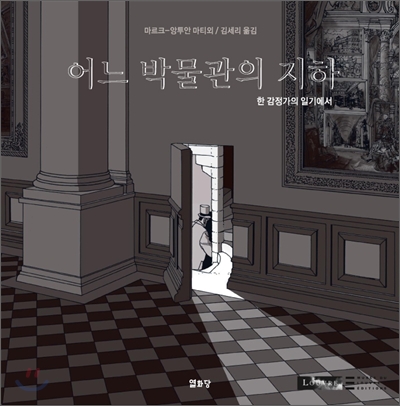
If Crecy's "The Ice Age" showed the future Louvre with a delightful imagination, Mathieu's book "The Basement of a Museum" raises questions about the essence of art with a background that feels a little eerie, an outstanding imagination based on deep thought and reflection, and simple yet powerful duotone drawings that fit the story.
Discover hidden spaces in the Louvre you never imagined possible.
One day, in a time period that is not set in the past, future, or present, the protagonist, Le Volumour, and his assistant, Leonard, are entrusted with the task of measuring and appraising a huge museum that does not even have a specific name.
The names of this museum, such as 'Museum of the Expired (Mus?e du R?volu)', 'The Excessively Demanded', 'The Work of the Mute (L崍uvre du Musel?)', and 'The Flexibility of Only Dreams', are none other than anagrams of the 'Louvre Museum'.
Just like these awkward names, which hint at the museum's interior, which has lost its original meaning and is filled with only remnants, the measurement and appraisal of the museum entrusted to the protagonists are also endless, ongoing tasks about a reality that no one has fully grasped.
In this setting, rather than focusing on the artworks hanging in the exhibition hall, the author draws attention to the vast hidden space.
Investigating the museum's vast basement—including its old galleries, repositories of molds and fragments, restoration rooms, reproduction rooms, and frame warehouses—Cartoonist Mathieu's reflections on the origins of art, the problems of copying and restoration, and the secrets surrounding masterpieces unfold poetic imagination and philosophy that overturn common sense and conventional wisdom about art, presenting readers with questions about the "essence of art" that have never been considered before.
For example, the ironic history of restoration that the protagonists who visit the restoration room hear about, which states that the work should not be completely restored but rather that traces of damage caused by time should be left behind; the truth of copies that surpass the original; and especially the astonishing secret that the Mona Lisa, the most beloved painting in the museum, was originally produced in several different versions and in fact, each version was exhibited alternately. The imagination that the author displays seems all the more special because it is unrealistic based on reality.
The protagonist, Le Volumour, spends 49 years and 49 days here until his death, and only then does he discover that his name, Eudes le Volumeur, is also an anagram of the Louvre Museum.
His name, meaning 'the one who records', suggests that he was a human being formed on the basis of the accumulated ancient civilization, and that his encounter with the Louvre was inevitable.
The surveying and appraisal that the protagonist has been doing has been done by countless people since ancient times, and like the previous appraiser who left after handing over his old records, he too hands over his records to another new appraiser.
This constant transmission of knowledge and history, this deep interest in its invisible hand, is an expression of the reverence for the classics.
Ultimately, what Volumour felt was a huge museum that encapsulated the long history and thoughts surrounding art, that is, a museum as a work of art.
He ends his life without ever appreciating this work, but only realizing that although the essence of art is unknown, there is a path to it.
This series, which began with the Louvre Museum, which houses the most classic works of art, joining hands with the most modern art medium, comics, was planned with the intention of presenting various discourses on art in a fresh, witty, and popular way by leaving the subject matter of art, artists, and works of art, which had been viewed through a stereotypical and fixed perspective, to the free imagination of cartoonists, with the museum as the background.
If Crecy's "The Ice Age" showed the future Louvre with a delightful imagination, Mathieu's book "The Basement of a Museum" raises questions about the essence of art with a background that feels a little eerie, an outstanding imagination based on deep thought and reflection, and simple yet powerful duotone drawings that fit the story.
Discover hidden spaces in the Louvre you never imagined possible.
One day, in a time period that is not set in the past, future, or present, the protagonist, Le Volumour, and his assistant, Leonard, are entrusted with the task of measuring and appraising a huge museum that does not even have a specific name.
The names of this museum, such as 'Museum of the Expired (Mus?e du R?volu)', 'The Excessively Demanded', 'The Work of the Mute (L崍uvre du Musel?)', and 'The Flexibility of Only Dreams', are none other than anagrams of the 'Louvre Museum'.
Just like these awkward names, which hint at the museum's interior, which has lost its original meaning and is filled with only remnants, the measurement and appraisal of the museum entrusted to the protagonists are also endless, ongoing tasks about a reality that no one has fully grasped.
In this setting, rather than focusing on the artworks hanging in the exhibition hall, the author draws attention to the vast hidden space.
Investigating the museum's vast basement—including its old galleries, repositories of molds and fragments, restoration rooms, reproduction rooms, and frame warehouses—Cartoonist Mathieu's reflections on the origins of art, the problems of copying and restoration, and the secrets surrounding masterpieces unfold poetic imagination and philosophy that overturn common sense and conventional wisdom about art, presenting readers with questions about the "essence of art" that have never been considered before.
For example, the ironic history of restoration that the protagonists who visit the restoration room hear about, which states that the work should not be completely restored but rather that traces of damage caused by time should be left behind; the truth of copies that surpass the original; and especially the astonishing secret that the Mona Lisa, the most beloved painting in the museum, was originally produced in several different versions and in fact, each version was exhibited alternately. The imagination that the author displays seems all the more special because it is unrealistic based on reality.
The protagonist, Le Volumour, spends 49 years and 49 days here until his death, and only then does he discover that his name, Eudes le Volumeur, is also an anagram of the Louvre Museum.
His name, meaning 'the one who records', suggests that he was a human being formed on the basis of the accumulated ancient civilization, and that his encounter with the Louvre was inevitable.
The surveying and appraisal that the protagonist has been doing has been done by countless people since ancient times, and like the previous appraiser who left after handing over his old records, he too hands over his records to another new appraiser.
This constant transmission of knowledge and history, this deep interest in its invisible hand, is an expression of the reverence for the classics.
Ultimately, what Volumour felt was a huge museum that encapsulated the long history and thoughts surrounding art, that is, a museum as a work of art.
He ends his life without ever appreciating this work, but only realizing that although the essence of art is unknown, there is a path to it.
GOODS SPECIFICS
- Date of issue: August 10, 2007
- Page count, weight, size: 68 pages | 188*257*15mm
- ISBN13: 9788930102810
- ISBN10: 8930102816
You may also like
카테고리
korean


korean

![GQ KOREA Mark (Monthly): December [2025]](http://librairie.coreenne.fr/cdn/shop/files/8ef265dbbfbf186523ed75ba7319009d.jpg?v=1765340328&width=3840)


