

Tank Book
 |
Description
Book Introduction
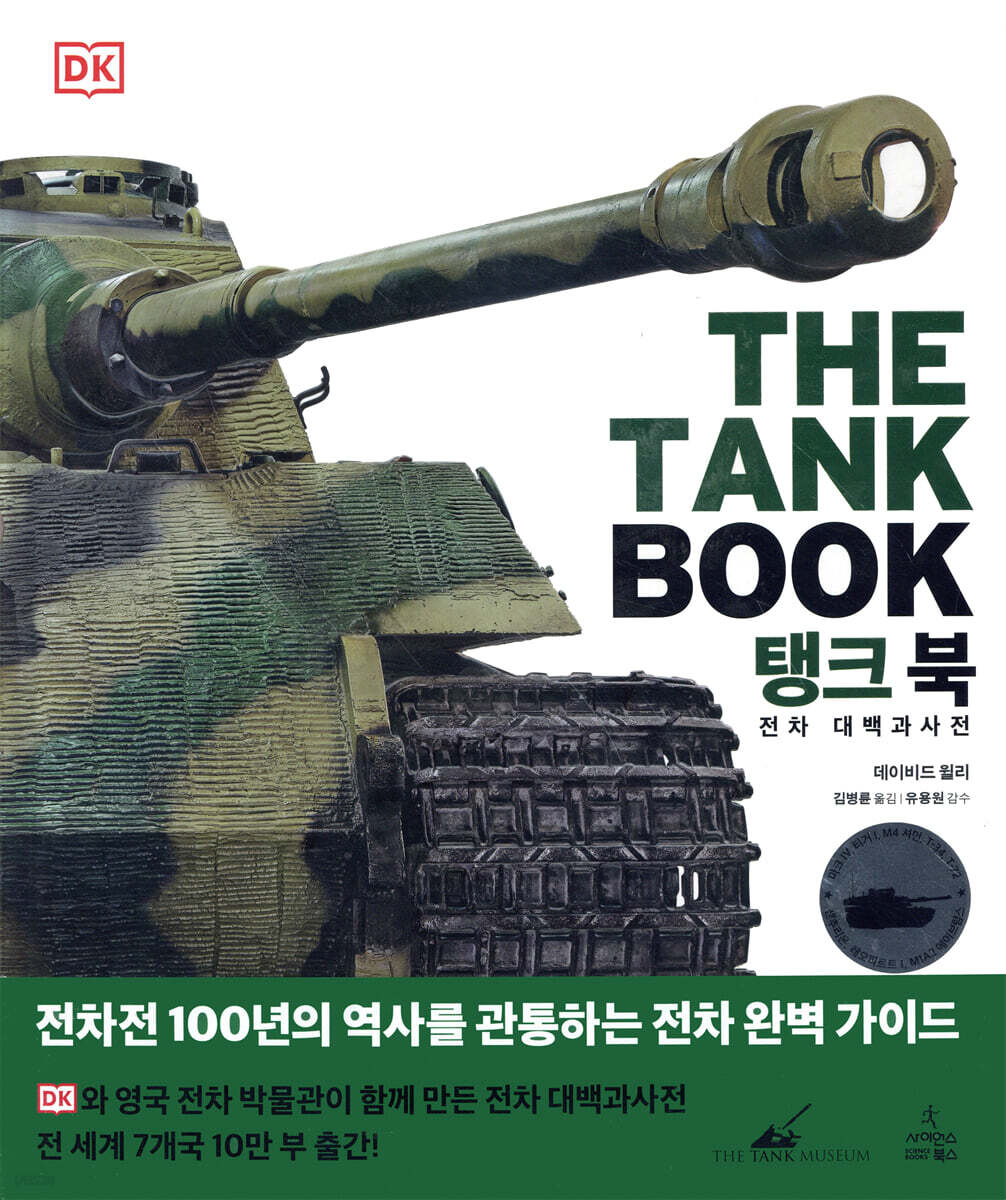
A complete guide to tanks spanning 100 years of tank warfare!
A tank encyclopedia created jointly by DK and the Bovington Tank Museum in the UK.
Meet the 400 most powerful tanks on earth with the best photos and information!
“There are two types of tanks.
“A dangerous and deadly being, and a being that gives freedom.”
- Robert Fisk (journalist)
This year marks the 68th anniversary of the outbreak of the Korean War.
At the beginning of the war, the South Korean army was repeatedly pushed back by the overwhelming power of the North Korean army, and the difference in military power and war preparation between the North and the South was shown by the (former) Soviet Union's T-34 tank.
At that time, the South Korean army did not have a single tank, but the North Korean army had 242 tanks.
The shock this gave left a trauma in the Korean military.
As of 2016, the number of tanks possessed by the South Korean military reached 2,400 (ranked 14th in the world), and of these, more than 1,600 are the latest third-generation tanks (ranked 3rd in the world after the US and Russia), which is likely a result of the experience of being overwhelmed by tanks in the early stages of the Korean War.
Since its birth as a new weapon that brought an end to the meaningless trench warfare in the latter half of World War I, the tank has reigned as the king of ground weapons and a symbol of a nation's army power for over 100 years. However, its status is gradually being shaken by changes in the nature of war, such as the war on terrorism and the emergence of unmanned weapons such as drones and robot tanks.
However, the United States, Russia, France, Germany and others are focusing on developing new tanks.
Soon we will see digital networks, artificial intelligence, and highly mobile, advanced tanks armed with laser cannons and railguns, teaming up with drones and robotic tanks to wage counter-terrorism wars.
The Tank Book: The Definitive Visual History of Armored Vehicles, published by Science Books, is a book that contains everything about tanks, which have been the main characters of ground warfare in the history of war since the dawn of September 15, 1916, when the British MK series was first deployed.
This book, published as one volume in the "DK Encyclopedia" series planned by Dorling Kindersley (DK), a prestigious British publisher famous for its picture guide and encyclopedia series, and translated and published by Science Books, Inc., is a "tank encyclopedia" that shows the entire form of 400 tanks that have served on all fronts around the world over the past 100 years of tank history based on completely new photos taken specifically for this book.
Featuring top-notch photography and detailed specifications for each tank, along with relevant information that provides a quick overview of the technical, tactical, and historical context, this book is sure to capture the interest of both beginners and military enthusiasts interested in war history, tank technology, and armored tactics.
A tank encyclopedia created jointly by DK and the Bovington Tank Museum in the UK.
Meet the 400 most powerful tanks on earth with the best photos and information!
“There are two types of tanks.
“A dangerous and deadly being, and a being that gives freedom.”
- Robert Fisk (journalist)
This year marks the 68th anniversary of the outbreak of the Korean War.
At the beginning of the war, the South Korean army was repeatedly pushed back by the overwhelming power of the North Korean army, and the difference in military power and war preparation between the North and the South was shown by the (former) Soviet Union's T-34 tank.
At that time, the South Korean army did not have a single tank, but the North Korean army had 242 tanks.
The shock this gave left a trauma in the Korean military.
As of 2016, the number of tanks possessed by the South Korean military reached 2,400 (ranked 14th in the world), and of these, more than 1,600 are the latest third-generation tanks (ranked 3rd in the world after the US and Russia), which is likely a result of the experience of being overwhelmed by tanks in the early stages of the Korean War.
Since its birth as a new weapon that brought an end to the meaningless trench warfare in the latter half of World War I, the tank has reigned as the king of ground weapons and a symbol of a nation's army power for over 100 years. However, its status is gradually being shaken by changes in the nature of war, such as the war on terrorism and the emergence of unmanned weapons such as drones and robot tanks.
However, the United States, Russia, France, Germany and others are focusing on developing new tanks.
Soon we will see digital networks, artificial intelligence, and highly mobile, advanced tanks armed with laser cannons and railguns, teaming up with drones and robotic tanks to wage counter-terrorism wars.
The Tank Book: The Definitive Visual History of Armored Vehicles, published by Science Books, is a book that contains everything about tanks, which have been the main characters of ground warfare in the history of war since the dawn of September 15, 1916, when the British MK series was first deployed.
This book, published as one volume in the "DK Encyclopedia" series planned by Dorling Kindersley (DK), a prestigious British publisher famous for its picture guide and encyclopedia series, and translated and published by Science Books, Inc., is a "tank encyclopedia" that shows the entire form of 400 tanks that have served on all fronts around the world over the past 100 years of tank history based on completely new photos taken specifically for this book.
Featuring top-notch photography and detailed specifications for each tank, along with relevant information that provides a quick overview of the technical, tactical, and historical context, this book is sure to capture the interest of both beginners and military enthusiasts interested in war history, tank technology, and armored tactics.
- You can preview some of the book's contents.
Preview
index
The first tanks: until 1918
Overview 12/Early Experiments 14/Leonardo da Vinci's 'Tank' 16/Mark IV 18/Tanks of World War I 22/Renault FT-17 24/Great Designers: Triton and Wilson 28/The First Tanks in Combat 30/Wartime Experiments 32/Early Armored Vehicles 34
Interwar period: 1918–1939
Overview 38/Interwar Experiments 40/New Types of Cavalry 42/Armored Cars 44/Light Tanks and Tankettes 46/Mark VIB Light Tank 48/The Great Designer: John Walter Christie 52/Vickers Creates World-Class Tanks 54/Medium and Heavy Tanks 56/Vickers Medium Tank Mark II 58
World War II: 1939–1945
Overview 64/German tanks: 1939–1940 66/German tanks on the eve of war 68/Allied tanks: 1939–1940 70/Axis tanks: 1941–1945 72/Tiger I 74/Flying tanks on D-Day 78/M3 Stuart 80/American tanks: 1941–1945 84/M4 Sherman 86/Engine replacement behind the lines 90/Tanks of Britain and the Commonwealth 92/Soviet tanks: 1941–1945 96/T-34/85 98/Great designers: Mikhail Koshkin 98/Preparing for battle 104/German tank destroyers 106/Allied tank destroyers 110/M18 Hellcat 112/Engineering and special vehicles 116/Test vehicles 118/Tanks in War and Peace 120/Armored Carriers and Personnel Carriers 122
Cold War: 1945–1991
Overview 128/Tanks of the Communist Bloc 130/T-72 134/Berlin Crisis 138/Key Manufacturers: General Dynamics 140/Centurion 142/Tanks of NATO Allies 146/Leopard 1 150/Tanks of the Non-Aligned Bloc 154/Tank Destroyer 158/Cougar 162/Flamethrower Tank 166/Reconnaissance Armored Carrier 168/Tracked Armored Personnel Carrier 170/Soviet Endgame 174/Tracked Infantry Fighting Vehicle 176/Wheeled Personnel Carrier 180/Anti-Tank Defense 184/Engineering and Special Vehicles 186/CVR(T) Series Vehicles 188/Armor on Wheels 190/Scorpion Tracked Combat Reconnaissance Vehicle 192
The Post-Cold War Era: Since 1991
Overview 198/Counterinsurgency Vehicles 200/Wuffel 204/Tank Deployment Logistics 208/Tracked Personnel Carriers 210/Wheeled Personnel Carriers 212/Tracks in the Field 216/Post-Cold War Tanks 218/M1A2 Abrams 222/Key Manufacturers: BAE Systems 226/Army Competition 228
Note
Tank Evolution 230/Tank Engine 232/Tracks and Suspension 234/Firepower 236/Protection 238/Anti-Tank Weapons 240/Uniforms and Protective Clothing 242/Glossary 244/Index 248/Image Copyright 254/Recommendations 256
Overview 12/Early Experiments 14/Leonardo da Vinci's 'Tank' 16/Mark IV 18/Tanks of World War I 22/Renault FT-17 24/Great Designers: Triton and Wilson 28/The First Tanks in Combat 30/Wartime Experiments 32/Early Armored Vehicles 34
Interwar period: 1918–1939
Overview 38/Interwar Experiments 40/New Types of Cavalry 42/Armored Cars 44/Light Tanks and Tankettes 46/Mark VIB Light Tank 48/The Great Designer: John Walter Christie 52/Vickers Creates World-Class Tanks 54/Medium and Heavy Tanks 56/Vickers Medium Tank Mark II 58
World War II: 1939–1945
Overview 64/German tanks: 1939–1940 66/German tanks on the eve of war 68/Allied tanks: 1939–1940 70/Axis tanks: 1941–1945 72/Tiger I 74/Flying tanks on D-Day 78/M3 Stuart 80/American tanks: 1941–1945 84/M4 Sherman 86/Engine replacement behind the lines 90/Tanks of Britain and the Commonwealth 92/Soviet tanks: 1941–1945 96/T-34/85 98/Great designers: Mikhail Koshkin 98/Preparing for battle 104/German tank destroyers 106/Allied tank destroyers 110/M18 Hellcat 112/Engineering and special vehicles 116/Test vehicles 118/Tanks in War and Peace 120/Armored Carriers and Personnel Carriers 122
Cold War: 1945–1991
Overview 128/Tanks of the Communist Bloc 130/T-72 134/Berlin Crisis 138/Key Manufacturers: General Dynamics 140/Centurion 142/Tanks of NATO Allies 146/Leopard 1 150/Tanks of the Non-Aligned Bloc 154/Tank Destroyer 158/Cougar 162/Flamethrower Tank 166/Reconnaissance Armored Carrier 168/Tracked Armored Personnel Carrier 170/Soviet Endgame 174/Tracked Infantry Fighting Vehicle 176/Wheeled Personnel Carrier 180/Anti-Tank Defense 184/Engineering and Special Vehicles 186/CVR(T) Series Vehicles 188/Armor on Wheels 190/Scorpion Tracked Combat Reconnaissance Vehicle 192
The Post-Cold War Era: Since 1991
Overview 198/Counterinsurgency Vehicles 200/Wuffel 204/Tank Deployment Logistics 208/Tracked Personnel Carriers 210/Wheeled Personnel Carriers 212/Tracks in the Field 216/Post-Cold War Tanks 218/M1A2 Abrams 222/Key Manufacturers: BAE Systems 226/Army Competition 228
Note
Tank Evolution 230/Tank Engine 232/Tracks and Suspension 234/Firepower 236/Protection 238/Anti-Tank Weapons 240/Uniforms and Protective Clothing 242/Glossary 244/Index 248/Image Copyright 254/Recommendations 256
Detailed image
Publisher's Review
A museum within a book that condenses the world's best tank museums into one volume!
“Wherever the tanks advanced, we won; wherever the tanks failed, we failed.”
- Douglas Haig (British Field Marshal)
World-renowned museums, including The Tank Museum in Bovington, England, the Norfolk Tank Museum, and the Saumur Villendi Tank Museum in France, collaborated to produce the Tank Book.
Among them, the history of the tank museum representing the UK is also intertwined with the history of tanks.
Bovington, Dorset, which served as a tank training headquarters during World War I, continued to be used as a decommissioning facility for tanks and as a training center for tankers after the war. In 1923, Nobel Prize winner for literature Joseph Rudyard Kipling (1865-1936) visited the site and suggested that the tanks be preserved, which led to the establishment of a museum.
The Tank Museum's collection of tanks and combat vehicles is one of the largest and finest in the world.
In its first year of opening in 1947, 2,500 people visited, and the number of visitors per year now reaches 200,000.
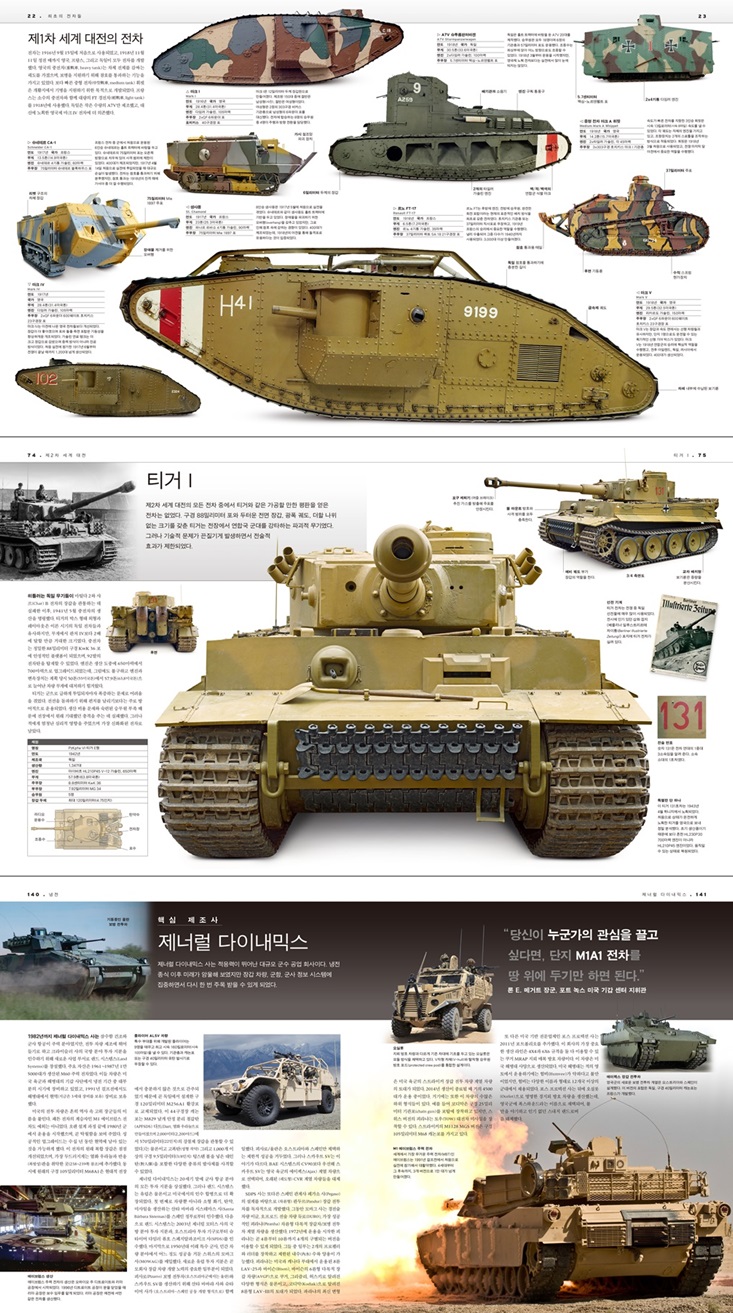
The Tank Museum is also famous for having the world's only operational Tiger tank, and on Tiger Day (April 28th), which commemorates the capture of a German Tiger 131 tank during World War I, a live demonstration of the tank is open to the public.
The Tiger tank was once again brought to the spotlight by its appearance in the film Fury, with Brad Pitt, Logan Lerman, and Jon Bernthal visiting the tank museum during a press screening in 2014.
The Sherman tank they rode in appears on page 85 of Tank Book with the word "Fury" written on the barrel.
David Willey, author of "Tank Book," who has worked as a curator since 2000, has also been fascinated by tanks and the Tank Museum since his first visit in 1969.
He guides museums and writes books for anyone interested in tanks, including military historians and researchers, as well as designers, filmmakers, game creators, and future tank enthusiasts.
Additionally, to introduce 『Tank Book』 to Korea, Kim Byeong-ryun, a researcher specializing in Korean military history, and Yoo Yong-won, a military journalist, participated in the translation and editing, respectively, to enhance the quality of the translated version for Korean readers.
Translator Kim Byeong-ryun worked as a reporter for the Defense Daily and then earned a master's degree in Korean history from the Academy of Korean Studies. He has appeared in various documentaries, including "History Journal That Day," and is actively involved in advisory work related to Korean military history.
The website 'Yoo Yong-won's Military World', run by Yoo Yong-won, a political reporter for the Chosun Ilbo, is also the largest military-specialized website in Korea, with a cumulative total of 370 million visitors.
This book, which condenses the collections of the world's best tank museums into a single volume, was planned, written, published, and translated by the world's best tank museums and military experts.
This book will serve as a valuable reference book for both modern warfare researchers and military enthusiasts.
From Leonardo da Vinci's war chariots to anti-terrorist armored vehicles,
A must-read for military and history buffs
“Three huge mechanical monsters, the likes of which I had never seen before, came descending the slope toward us.”
- Burt Cheney (British soldier, 1916)
This book basically follows the 100-year history of tanks and introduces everything about them.
The history of the chariot is divided into five eras.
Each chapter, "The First Tanks: Up to 1918," "The Interwar Period: 1918–1939," "World War II: 1939–1945," "The Cold War: 1945–1991," and "The Post-Cold War Era: Since 1991," consists of an explanatory page that outlines the technological and tactical context of the period, a catalog page that accurately and precisely shows the shapes of the tanks developed and used in that period, a detailed specifications page that selects the most important tanks of that period and introduces them with close-up photos of the interior and exterior as if seeing them firsthand, and a page introducing the tank designers and engineers whose innovative designs and bold ideas changed the history of war.
Included among the newly taken tank photos specifically for this book are valuable photos showing the tanks throughout history, providing a three-dimensional look at the various aspects of the tanks.
"The First Tanks: Up to 1918" The various historical precursors of the tank led to the first operational models.
A surprising variety of machines with different functions were being developed or manufactured by the end of World War I.
This chapter traces the explosive evolution of tanks on both the Entente and Central Powers, from Leonardo da Vinci's "war car" to the first series of modern tank marks.
The first tank battles and the first armored vehicles also appeared during this period.
"Interwar Period: 1918–1939" This chapter shows the process by which each country's army was reorganized into mechanized units.
In the Spanish Civil War in 1936, tanks were first used in blitzkrieg mode.
The most influential tank designer of the interwar period was John Walter Christie, and you can also learn about the development of the Christie suspension system and other developments.
Additionally, various tanks that benefit from advancements in automobile technology appear, including tractors, amphibious light tanks, tankettes, and Rolls-Royce armored cars.
You can also see detailed specifications of the Vickers medium tank Mark II, which was the backbone of the British Mechanized Experimental Unit.
World War II: 1939–1945 World War II was the catalyst that fully demonstrated the potential of tanks.
Tens of thousands of armored vehicles were produced and used as key weapons around the globe, and they also became symbols of each nation's military power.
In this chapter, you will find detailed specifications of the M3 Stuart, M4 Sherman, T-34, T-85, and M18 Hellcat tanks, as well as the infamous Tiger I, one of the many tanks that appeared during the full-scale tank warfare of World War II.
This chapter contains vivid historical accounts, including a Locust light tank transported on a Hamilcar glider for D-Day in 1944, the streets of Normandy immediately after the landings, and scenes of a tank engine being replaced.
"Cold War: 1945–1991" The superpowers of the East and the West, on the one hand, accumulated nuclear and biochemical weapons, while on the other, they produced the latest main battle tanks on a massive scale in preparation for a possible conventional war.
However, the Cold War never turned into a hot war, and some of those tanks were used in smaller conflicts.
You can see tanks that were built with a focus on mobility rather than armor during the Korean War, the Vietnam War, and the Afghanistan War.
It also shows the history of General Dynamics, a major tank manufacturer.
Meanwhile, this chapter vividly records the 16-hour standoff between M48s and T-55s at Checkpoint Charlie in Berlin, a never-ending battlefield during the Cold War, on October 27, 1961.
"The Post-Cold War Era: 1991 and Beyond" As world politics adapted to the end of the Cold War, a new generation of light vehicles was designed for asymmetric warfare and counterinsurgency purposes.
However, as tanks continued to be used in conflicts around the volatile world, Cold War-era tanks were upgraded to extend their service life, and new designs began to be developed.
In particular, the times began to demand a more specialized tank function, such as mediating conflicts occurring around the world, such as the conflict in the former Yugoslavia, suppressing riots, and clearing landmines.
This chapter focuses on counterinsurgency vehicles and troop transport vehicles.
You can also check the detailed specifications of the M1A2 Abrams, which is considered the strongest main battle tank in existence.
It details the history of BAE Systems, one of the world's largest defense companies, starting from British Aerospace.
At the end of the book, infographics are used to explain the design concept of the tank, its internal structure, equipment such as the engine and caterpillar tracks, and how the firearms and protection systems are constructed and operated.
Protective equipment for crew members and support personnel on board the tank has also been strengthened.
As the armament and armor mounted on tanks continued to develop by incorporating the latest technology, anti-tank weapons were bound to become more powerful.
Tanks often capture attention with their overwhelming visuals and commanding presence, not only in popular films but also in news and press photos.
"Tank Book: The Encyclopedia of Tanks" goes beyond simply analyzing the dazzling appearance and firepower of 400 tanks. It also delves into the background of each tank's birth and exploits, delivering vivid knowledge and entertainment.
The most advanced tactics and technologies are incorporated into each and every tank.
preface
Although the history of the tank is only a little over 100 years old, the concept it embodies has been the goal and fervent desire of combatants for hundreds of years.
Protection from enemy weapons, mobility across the battlefield, and the means to attack the enemy using firepower were common themes for all who had to engage in combat.
The tank was the answer to a specific military problem of World War I: how to transform the static battlefield of the Western Front into a mobile one.
While many nations sought to use mechanical means to restore mobility and create breakthroughs on the battlefield, it was the British who first used tanks as "tracked battering rams" in September 1916 to traverse rough terrain, destroy barbed wire, and fire on enemy positions to allow infantry to advance.
By the end of World War I, tanks had been developed in various forms, but after the war, some high-ranking military officials wanted to eliminate them, seeing them as an exceptional, disposable weapon needed only in the unique conflicts of the Western Front.
The interwar period was a time of tank experimentation and development.
From a military perspective, the best way to use tanks as weapons was explored.
Some have seen the tank as playing a key role in the transition from a traditional infantry- and horse-based army to a fully mechanized force.
Other armored vehicles were also created to operate alongside the tanks in combat.
Engineer vehicles, armored personnel carriers, and armored personnel carriers are also featured in this book.
The potential of the tank as a new weapon was demonstrated in several small-scale conflicts during the interwar period, with different powers reaching different conclusions.
Armor became thicker and guns larger, but it was not until the astonishing success of German tank armament in 1939–1940 that the potential of the tank became clear to all.
Despite the early successes of German tanks in large-scale encirclements and the prominence of small-scale production of expensive, large, and technologically advanced designs, the massive efforts of the United States and Russia (formerly the Soviet Union) to produce simpler, more serviceable vehicles tipped the balance of World War II tank warfare.
The end of World War II brought yet another round of doubts about the continued usefulness of tanks.
If portable shaped-charge anti-tank weapons like the bazooka or the Panzerfaust were mass-produced, would they really be so vulnerable that a single soldier could disable a tank with a single shot? Similar concerns have arisen over the use of anti-tank guided missiles in the 1973 Yom Kippur War and the potential for anti-tank attack helicopters during the Cold War.
In the early 2000s, top attack weapons and tandem warheads further exposed tank vulnerabilities.
However, tanks adapted to new threats through technology and tactics.
New types of armor, such as laminated armor, increased firepower using kinetic energy penetrators (high-density metal cores), gas turbine or supercharged diesel engines for increased mobility, and defensive support sets to intercept and destroy incoming projectiles have extended the tank's useful life.
The future will see advancements in miniaturization and unmanned vehicles, and while new generations of tanks are being planned or entering production, many older tanks are also being upgraded to find their place on the front lines.
The tank's adaptability and powerful presence mean it can continue to find its way onto any battlefield today.
As "Tank Book" demonstrates, tanks have always existed in various forms, influenced by practical technology, combat experience, anticipated combat developments, and the often-overlooked fundamental capacity to build complex armored vehicles and the funding available to do so. As the key points revealed between each chapter of "Tank Book" reveal, readers will recognize that the most crucial factor in the success or failure of tank warfare is the crew.
- David Willey (Tank Museum Curator)
Translator's Note
Is it a tank or a chariot?
Terms like 'tank' and 'chariot' have their own history and national customs.
In English-speaking countries, the word 'tank' originally meant a tank for storing liquid or gas.
However, during World War I, Britain used the disguise term "tank" to hide the existence of new weapons equipped with tracks, armor, and guns, and the term "tank" also came to refer to a type of weapon.
Even among Northeast Asian countries that originally used Chinese characters, the translation of terms varies.
The Korean military mainly uses the term tank.
The same goes for Japan.
Chariot is originally the name of a weapon from the era of ancient China when people fought on horse-drawn carriages.
If you look at the meaning of the Chinese character itself, it means a combat vehicle, so it was reused as a modern weapon.
However, in the civilian sector of Korea, the term 'tank' is more commonly used.
In China, it is sometimes written as 'tank' (戰車), but the pronunciation 'tank' (坦克) is more commonly used in both the military and civilian sectors.
The term 'tank', which is mainly used in North Korea, is derived from the Russian pronunciation of tank (танк).
In East Asia, which is part of the same Chinese character cultural sphere, there is still a clear conflict between the two terms: the chariot series, which emphasizes meaning, and the tank-tank-tank series, which emphasizes pronunciation.
Sometimes the terminology changes due to pronunciation.
Although the distinction is relatively vague today, during World War II, tanks were more strictly categorized into 'heavy tanks', 'medium tanks', and 'light tanks' based on size, weight, and purpose.
The problem is heavy and medium tanks.
In China and Japan, 'heavy tank' is often translated as '重戰車' and 'medium tank' is often translated as '中戰車'.
In Japanese kanji reading, '中' is pronounced as 'ちゅう' and '重' is pronounced as 'じゅう'. In Chinese, the tones are slightly different as 'zh?ng' and 'zhong', so there is no problem in distinguishing them.
However, in Korea, the Chinese character for '中' is '중' and the Chinese character for '重' is also '중'.
If it were a period like the 1940s to 1980s when Korean and Chinese characters were used interchangeably, it wouldn't matter, but in today's era where Chinese characters are rarely used in the text and Hangul is the only language, the distinction becomes ambiguous.
In this book, they are categorized as heavy tanks and medium tanks, and in some parts, Chinese characters are even used to make the distinction more clear.
However, there may be readers who are unfamiliar with this notation.
The numerous weapon names in this book are also the product of this complex power struggle.
I must confess that while translating this book, I often struggled with the differences between actual pronunciation, notation principles, and notation familiar to readers.
In the case of names of people, places, and things in non-English speaking countries, the scope of concern was greater because there were four aspects to consider: the difference between the original spelling and the Anglicized spelling, the application of Korea's foreign word spelling system, and the spelling system familiar to readers.
Terms with historical roots are also a source of concern.
Although it is not a term that appears in this book, the U.S. Army Chief of Staff is called the 'Chief of Staff of the Army' and the U.S. Navy Chief of Staff is called the 'Chief of Naval Operations', so the terminology is structured differently.
Is it correct to translate 'Chief of Naval Operations' as 'Chief of Naval Operations' to preserve the dictionary meaning and historical context of the term, or is it correct to translate it as 'Chief of Naval Operations' to match the corresponding position in Korea?
There are also differences in terminology used by the military and in the automotive or mechanical engineering industries, not only in terms of parts related to track-related equipment but also across the entire powertrain sector.
Especially in the automotive and mechanical engineering industries, poor Korean translations are seen as causing confusion, so it is common to use terms that are simply Koreanized pronunciations of internationalized English terms.
These terms have a wide popular base.
When different groups use different terms for the same object, which term is best?
Whether to maintain the original notation of the caliber of some countries' tank guns in centimeters rather than millimeters, or to convert it to millimeters in accordance with Korean practice, was a minor but necessary choice.
The final choice was to preserve the original notation, but I feel uneasy thinking about some readers who might be surprised by the diameter notation in centimeters.
Of course, these various concerns could not be completely and perfectly reflected in the translation.
There are concerns that mistakes may have been made in the process of abbreviating sentences or reorganizing a rough translation that is close to a direct translation to improve readability due to the unique visual editing method of the British publisher DK, which makes it difficult to change the original book's format.
There may be some mistakes that are entirely due to the translator's lack of skill.
I already feel scared and sorry when I think about the fact that I can't satisfy all my readers.
Nevertheless, I would like to point out that I have been constantly struggling to find the right balance between familiar terminology and notation conventions for readers, the historicity of terminology, and the interchangeability of language.
- Kim Byeong-ryun (Korean military history researcher)
“Wherever the tanks advanced, we won; wherever the tanks failed, we failed.”
- Douglas Haig (British Field Marshal)
World-renowned museums, including The Tank Museum in Bovington, England, the Norfolk Tank Museum, and the Saumur Villendi Tank Museum in France, collaborated to produce the Tank Book.
Among them, the history of the tank museum representing the UK is also intertwined with the history of tanks.
Bovington, Dorset, which served as a tank training headquarters during World War I, continued to be used as a decommissioning facility for tanks and as a training center for tankers after the war. In 1923, Nobel Prize winner for literature Joseph Rudyard Kipling (1865-1936) visited the site and suggested that the tanks be preserved, which led to the establishment of a museum.
The Tank Museum's collection of tanks and combat vehicles is one of the largest and finest in the world.
In its first year of opening in 1947, 2,500 people visited, and the number of visitors per year now reaches 200,000.
The Tank Museum is also famous for having the world's only operational Tiger tank, and on Tiger Day (April 28th), which commemorates the capture of a German Tiger 131 tank during World War I, a live demonstration of the tank is open to the public.
The Tiger tank was once again brought to the spotlight by its appearance in the film Fury, with Brad Pitt, Logan Lerman, and Jon Bernthal visiting the tank museum during a press screening in 2014.
The Sherman tank they rode in appears on page 85 of Tank Book with the word "Fury" written on the barrel.
David Willey, author of "Tank Book," who has worked as a curator since 2000, has also been fascinated by tanks and the Tank Museum since his first visit in 1969.
He guides museums and writes books for anyone interested in tanks, including military historians and researchers, as well as designers, filmmakers, game creators, and future tank enthusiasts.
Additionally, to introduce 『Tank Book』 to Korea, Kim Byeong-ryun, a researcher specializing in Korean military history, and Yoo Yong-won, a military journalist, participated in the translation and editing, respectively, to enhance the quality of the translated version for Korean readers.
Translator Kim Byeong-ryun worked as a reporter for the Defense Daily and then earned a master's degree in Korean history from the Academy of Korean Studies. He has appeared in various documentaries, including "History Journal That Day," and is actively involved in advisory work related to Korean military history.
The website 'Yoo Yong-won's Military World', run by Yoo Yong-won, a political reporter for the Chosun Ilbo, is also the largest military-specialized website in Korea, with a cumulative total of 370 million visitors.
This book, which condenses the collections of the world's best tank museums into a single volume, was planned, written, published, and translated by the world's best tank museums and military experts.
This book will serve as a valuable reference book for both modern warfare researchers and military enthusiasts.
From Leonardo da Vinci's war chariots to anti-terrorist armored vehicles,
A must-read for military and history buffs
“Three huge mechanical monsters, the likes of which I had never seen before, came descending the slope toward us.”
- Burt Cheney (British soldier, 1916)
This book basically follows the 100-year history of tanks and introduces everything about them.
The history of the chariot is divided into five eras.
Each chapter, "The First Tanks: Up to 1918," "The Interwar Period: 1918–1939," "World War II: 1939–1945," "The Cold War: 1945–1991," and "The Post-Cold War Era: Since 1991," consists of an explanatory page that outlines the technological and tactical context of the period, a catalog page that accurately and precisely shows the shapes of the tanks developed and used in that period, a detailed specifications page that selects the most important tanks of that period and introduces them with close-up photos of the interior and exterior as if seeing them firsthand, and a page introducing the tank designers and engineers whose innovative designs and bold ideas changed the history of war.
Included among the newly taken tank photos specifically for this book are valuable photos showing the tanks throughout history, providing a three-dimensional look at the various aspects of the tanks.
"The First Tanks: Up to 1918" The various historical precursors of the tank led to the first operational models.
A surprising variety of machines with different functions were being developed or manufactured by the end of World War I.
This chapter traces the explosive evolution of tanks on both the Entente and Central Powers, from Leonardo da Vinci's "war car" to the first series of modern tank marks.
The first tank battles and the first armored vehicles also appeared during this period.
"Interwar Period: 1918–1939" This chapter shows the process by which each country's army was reorganized into mechanized units.
In the Spanish Civil War in 1936, tanks were first used in blitzkrieg mode.
The most influential tank designer of the interwar period was John Walter Christie, and you can also learn about the development of the Christie suspension system and other developments.
Additionally, various tanks that benefit from advancements in automobile technology appear, including tractors, amphibious light tanks, tankettes, and Rolls-Royce armored cars.
You can also see detailed specifications of the Vickers medium tank Mark II, which was the backbone of the British Mechanized Experimental Unit.
World War II: 1939–1945 World War II was the catalyst that fully demonstrated the potential of tanks.
Tens of thousands of armored vehicles were produced and used as key weapons around the globe, and they also became symbols of each nation's military power.
In this chapter, you will find detailed specifications of the M3 Stuart, M4 Sherman, T-34, T-85, and M18 Hellcat tanks, as well as the infamous Tiger I, one of the many tanks that appeared during the full-scale tank warfare of World War II.
This chapter contains vivid historical accounts, including a Locust light tank transported on a Hamilcar glider for D-Day in 1944, the streets of Normandy immediately after the landings, and scenes of a tank engine being replaced.
"Cold War: 1945–1991" The superpowers of the East and the West, on the one hand, accumulated nuclear and biochemical weapons, while on the other, they produced the latest main battle tanks on a massive scale in preparation for a possible conventional war.
However, the Cold War never turned into a hot war, and some of those tanks were used in smaller conflicts.
You can see tanks that were built with a focus on mobility rather than armor during the Korean War, the Vietnam War, and the Afghanistan War.
It also shows the history of General Dynamics, a major tank manufacturer.
Meanwhile, this chapter vividly records the 16-hour standoff between M48s and T-55s at Checkpoint Charlie in Berlin, a never-ending battlefield during the Cold War, on October 27, 1961.
"The Post-Cold War Era: 1991 and Beyond" As world politics adapted to the end of the Cold War, a new generation of light vehicles was designed for asymmetric warfare and counterinsurgency purposes.
However, as tanks continued to be used in conflicts around the volatile world, Cold War-era tanks were upgraded to extend their service life, and new designs began to be developed.
In particular, the times began to demand a more specialized tank function, such as mediating conflicts occurring around the world, such as the conflict in the former Yugoslavia, suppressing riots, and clearing landmines.
This chapter focuses on counterinsurgency vehicles and troop transport vehicles.
You can also check the detailed specifications of the M1A2 Abrams, which is considered the strongest main battle tank in existence.
It details the history of BAE Systems, one of the world's largest defense companies, starting from British Aerospace.
At the end of the book, infographics are used to explain the design concept of the tank, its internal structure, equipment such as the engine and caterpillar tracks, and how the firearms and protection systems are constructed and operated.
Protective equipment for crew members and support personnel on board the tank has also been strengthened.
As the armament and armor mounted on tanks continued to develop by incorporating the latest technology, anti-tank weapons were bound to become more powerful.
Tanks often capture attention with their overwhelming visuals and commanding presence, not only in popular films but also in news and press photos.
"Tank Book: The Encyclopedia of Tanks" goes beyond simply analyzing the dazzling appearance and firepower of 400 tanks. It also delves into the background of each tank's birth and exploits, delivering vivid knowledge and entertainment.
The most advanced tactics and technologies are incorporated into each and every tank.
preface
Although the history of the tank is only a little over 100 years old, the concept it embodies has been the goal and fervent desire of combatants for hundreds of years.
Protection from enemy weapons, mobility across the battlefield, and the means to attack the enemy using firepower were common themes for all who had to engage in combat.
The tank was the answer to a specific military problem of World War I: how to transform the static battlefield of the Western Front into a mobile one.
While many nations sought to use mechanical means to restore mobility and create breakthroughs on the battlefield, it was the British who first used tanks as "tracked battering rams" in September 1916 to traverse rough terrain, destroy barbed wire, and fire on enemy positions to allow infantry to advance.
By the end of World War I, tanks had been developed in various forms, but after the war, some high-ranking military officials wanted to eliminate them, seeing them as an exceptional, disposable weapon needed only in the unique conflicts of the Western Front.
The interwar period was a time of tank experimentation and development.
From a military perspective, the best way to use tanks as weapons was explored.
Some have seen the tank as playing a key role in the transition from a traditional infantry- and horse-based army to a fully mechanized force.
Other armored vehicles were also created to operate alongside the tanks in combat.
Engineer vehicles, armored personnel carriers, and armored personnel carriers are also featured in this book.
The potential of the tank as a new weapon was demonstrated in several small-scale conflicts during the interwar period, with different powers reaching different conclusions.
Armor became thicker and guns larger, but it was not until the astonishing success of German tank armament in 1939–1940 that the potential of the tank became clear to all.
Despite the early successes of German tanks in large-scale encirclements and the prominence of small-scale production of expensive, large, and technologically advanced designs, the massive efforts of the United States and Russia (formerly the Soviet Union) to produce simpler, more serviceable vehicles tipped the balance of World War II tank warfare.
The end of World War II brought yet another round of doubts about the continued usefulness of tanks.
If portable shaped-charge anti-tank weapons like the bazooka or the Panzerfaust were mass-produced, would they really be so vulnerable that a single soldier could disable a tank with a single shot? Similar concerns have arisen over the use of anti-tank guided missiles in the 1973 Yom Kippur War and the potential for anti-tank attack helicopters during the Cold War.
In the early 2000s, top attack weapons and tandem warheads further exposed tank vulnerabilities.
However, tanks adapted to new threats through technology and tactics.
New types of armor, such as laminated armor, increased firepower using kinetic energy penetrators (high-density metal cores), gas turbine or supercharged diesel engines for increased mobility, and defensive support sets to intercept and destroy incoming projectiles have extended the tank's useful life.
The future will see advancements in miniaturization and unmanned vehicles, and while new generations of tanks are being planned or entering production, many older tanks are also being upgraded to find their place on the front lines.
The tank's adaptability and powerful presence mean it can continue to find its way onto any battlefield today.
As "Tank Book" demonstrates, tanks have always existed in various forms, influenced by practical technology, combat experience, anticipated combat developments, and the often-overlooked fundamental capacity to build complex armored vehicles and the funding available to do so. As the key points revealed between each chapter of "Tank Book" reveal, readers will recognize that the most crucial factor in the success or failure of tank warfare is the crew.
- David Willey (Tank Museum Curator)
Translator's Note
Is it a tank or a chariot?
Terms like 'tank' and 'chariot' have their own history and national customs.
In English-speaking countries, the word 'tank' originally meant a tank for storing liquid or gas.
However, during World War I, Britain used the disguise term "tank" to hide the existence of new weapons equipped with tracks, armor, and guns, and the term "tank" also came to refer to a type of weapon.
Even among Northeast Asian countries that originally used Chinese characters, the translation of terms varies.
The Korean military mainly uses the term tank.
The same goes for Japan.
Chariot is originally the name of a weapon from the era of ancient China when people fought on horse-drawn carriages.
If you look at the meaning of the Chinese character itself, it means a combat vehicle, so it was reused as a modern weapon.
However, in the civilian sector of Korea, the term 'tank' is more commonly used.
In China, it is sometimes written as 'tank' (戰車), but the pronunciation 'tank' (坦克) is more commonly used in both the military and civilian sectors.
The term 'tank', which is mainly used in North Korea, is derived from the Russian pronunciation of tank (танк).
In East Asia, which is part of the same Chinese character cultural sphere, there is still a clear conflict between the two terms: the chariot series, which emphasizes meaning, and the tank-tank-tank series, which emphasizes pronunciation.
Sometimes the terminology changes due to pronunciation.
Although the distinction is relatively vague today, during World War II, tanks were more strictly categorized into 'heavy tanks', 'medium tanks', and 'light tanks' based on size, weight, and purpose.
The problem is heavy and medium tanks.
In China and Japan, 'heavy tank' is often translated as '重戰車' and 'medium tank' is often translated as '中戰車'.
In Japanese kanji reading, '中' is pronounced as 'ちゅう' and '重' is pronounced as 'じゅう'. In Chinese, the tones are slightly different as 'zh?ng' and 'zhong', so there is no problem in distinguishing them.
However, in Korea, the Chinese character for '中' is '중' and the Chinese character for '重' is also '중'.
If it were a period like the 1940s to 1980s when Korean and Chinese characters were used interchangeably, it wouldn't matter, but in today's era where Chinese characters are rarely used in the text and Hangul is the only language, the distinction becomes ambiguous.
In this book, they are categorized as heavy tanks and medium tanks, and in some parts, Chinese characters are even used to make the distinction more clear.
However, there may be readers who are unfamiliar with this notation.
The numerous weapon names in this book are also the product of this complex power struggle.
I must confess that while translating this book, I often struggled with the differences between actual pronunciation, notation principles, and notation familiar to readers.
In the case of names of people, places, and things in non-English speaking countries, the scope of concern was greater because there were four aspects to consider: the difference between the original spelling and the Anglicized spelling, the application of Korea's foreign word spelling system, and the spelling system familiar to readers.
Terms with historical roots are also a source of concern.
Although it is not a term that appears in this book, the U.S. Army Chief of Staff is called the 'Chief of Staff of the Army' and the U.S. Navy Chief of Staff is called the 'Chief of Naval Operations', so the terminology is structured differently.
Is it correct to translate 'Chief of Naval Operations' as 'Chief of Naval Operations' to preserve the dictionary meaning and historical context of the term, or is it correct to translate it as 'Chief of Naval Operations' to match the corresponding position in Korea?
There are also differences in terminology used by the military and in the automotive or mechanical engineering industries, not only in terms of parts related to track-related equipment but also across the entire powertrain sector.
Especially in the automotive and mechanical engineering industries, poor Korean translations are seen as causing confusion, so it is common to use terms that are simply Koreanized pronunciations of internationalized English terms.
These terms have a wide popular base.
When different groups use different terms for the same object, which term is best?
Whether to maintain the original notation of the caliber of some countries' tank guns in centimeters rather than millimeters, or to convert it to millimeters in accordance with Korean practice, was a minor but necessary choice.
The final choice was to preserve the original notation, but I feel uneasy thinking about some readers who might be surprised by the diameter notation in centimeters.
Of course, these various concerns could not be completely and perfectly reflected in the translation.
There are concerns that mistakes may have been made in the process of abbreviating sentences or reorganizing a rough translation that is close to a direct translation to improve readability due to the unique visual editing method of the British publisher DK, which makes it difficult to change the original book's format.
There may be some mistakes that are entirely due to the translator's lack of skill.
I already feel scared and sorry when I think about the fact that I can't satisfy all my readers.
Nevertheless, I would like to point out that I have been constantly struggling to find the right balance between familiar terminology and notation conventions for readers, the historicity of terminology, and the interchangeability of language.
- Kim Byeong-ryun (Korean military history researcher)
GOODS SPECIFICS
- Date of issue: May 30, 2018
- Format: Hardcover book binding method guide
- Page count, weight, size: 256 pages | 1,674g | 250*300*20mm
- ISBN13: 9788983718808
- ISBN10: 8983718803
You may also like
카테고리
korean


korean

![GQ KOREA Mark (Monthly): December [2025]](http://librairie.coreenne.fr/cdn/shop/files/8ef265dbbfbf186523ed75ba7319009d.jpg?v=1765340328&width=3840)


