

A very clear evolution theory lesson
 |
Description
Book Introduction
After biology comes evolution!
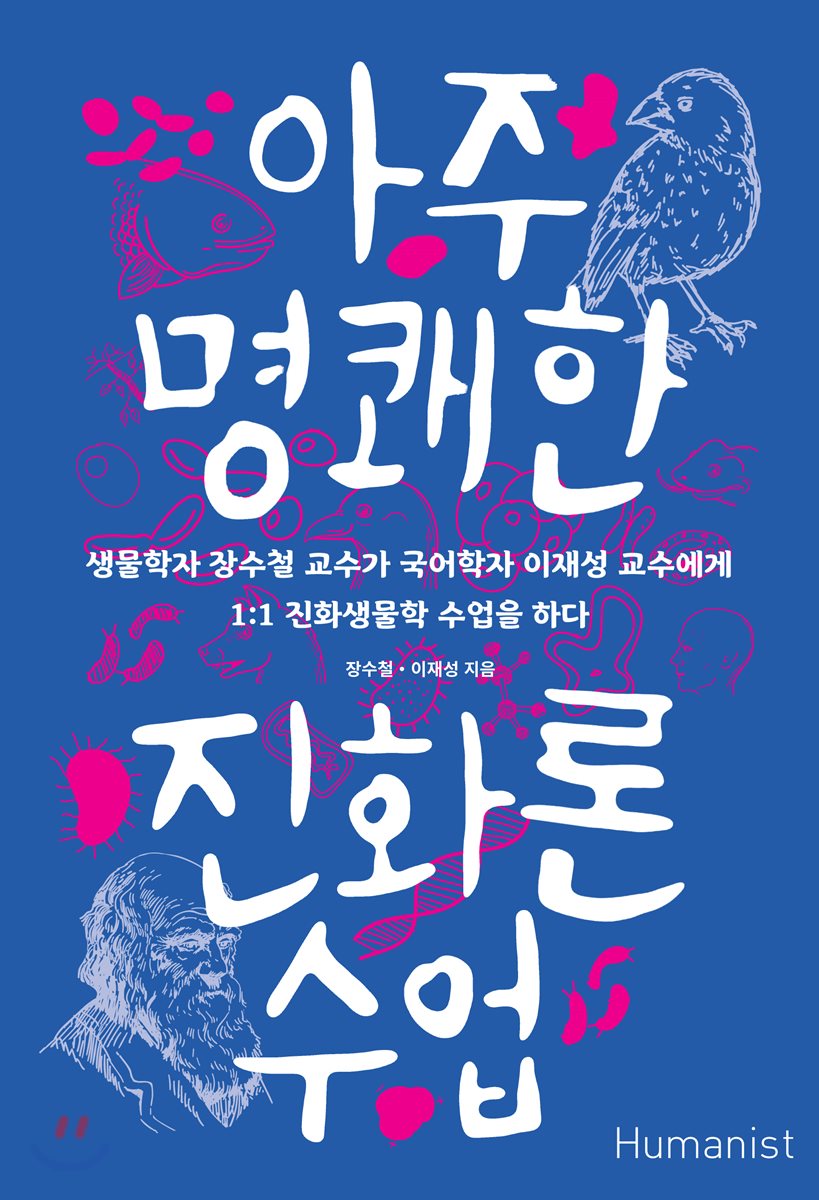
A very clear evolution theory lesson unfolds as two cheerful uncles meet.
"A Very Special Biology Class," which tells the story of a biologist who is afraid of writing and a linguist who asks questions without hesitation, meeting and completing the basics of biology, was published in 2015 and was loved by over 10,000 readers, from students to older men.
The concept of 'evolution' was too broad to cover in detail in biology class.
So, for the readers' benefit, the two men have reunited to understand the origins and evolution of living things.
Professor Jang Su-cheol, who teaches biology at a university, has long struggled to explain the accurate theory of evolution to the public.
And with that solution, 『A Very Clear Evolutionary Theory Class』 began.
Professor Lee Jae-seong, representing the position of an ordinary man, asked questions that were truly curious and even very basic.
From the simple question, "Why don't monkeys evolve into humans?" to the easily fallible error, "Survival of the fittest means only the strongest survive."
Through the clear and pleasant one-on-one lessons of these two gentlemen, who overcome prejudices and misunderstandings about evolution, we will come to understand the theory of evolution as a science.
A very clear evolution theory lesson unfolds as two cheerful uncles meet.
"A Very Special Biology Class," which tells the story of a biologist who is afraid of writing and a linguist who asks questions without hesitation, meeting and completing the basics of biology, was published in 2015 and was loved by over 10,000 readers, from students to older men.
The concept of 'evolution' was too broad to cover in detail in biology class.
So, for the readers' benefit, the two men have reunited to understand the origins and evolution of living things.
Professor Jang Su-cheol, who teaches biology at a university, has long struggled to explain the accurate theory of evolution to the public.
And with that solution, 『A Very Clear Evolutionary Theory Class』 began.
Professor Lee Jae-seong, representing the position of an ordinary man, asked questions that were truly curious and even very basic.
From the simple question, "Why don't monkeys evolve into humans?" to the easily fallible error, "Survival of the fittest means only the strongest survive."
Through the clear and pleasant one-on-one lessons of these two gentlemen, who overcome prejudices and misunderstandings about evolution, we will come to understand the theory of evolution as a science.
- You can preview some of the book's contents.
Preview
index
Before starting class
First Lesson: In Search of the Origin of Species: The Birth of Evolution
Before Darwin: Living Things Don't Change | The Beginning of Change: Living Things Change | Charles Darwin | Embarking on a Voyage | Living Things, Do They Think They Will Change? |
After class
Can you confirm the second lesson of evolution?: Evidence for evolution
Is Evolution Just Increasing Complexity? | Where Does Evolution Come From? | Evolution Happening Before Our Eyes | Five Evidences of Evolution |
After class
Third Class Bug? Mutation Occurs!: The Beginning of Evolution
Hardy-Weinberg Law | Conditions for the High-Weinberg Law | Evolution by Natural Selection | Artificial Selection | Sexual Selection | Fitness | Adaptation | Evolution of Complex Traits and Behaviors | After Class
Lesson Four: Selected Mutations: Genes and Environment
Mutations: DNA Errors | Mutations and Evolution | Genetic Diversity | After Class
Lesson 5: Reproductive Barriers: Species Differentiation
Emergence of new species | Reproductive barriers | Difficulties in classifying hybridized species | Allopatric speciation | Symptomatic speciation | Speciation in hybrid zones | Models of speciation | After class
Lesson Six: The Birth of Life: Between Inanimate and Living Things
The environment of the primitive Earth | Conditions for the birth of life | The primordial soup hypothesis | The extraterrestrial influx hypothesis | The hydrothermal vent hypothesis | The RNA world hypothesis |
After class
Lesson 7: Forensic Investigation with Fossil Evidence: The History of Evolution 1
The Fossil Record | The Oxygen Revolution | Endosymbiosis | Multicellular Life and Neurons | The Cambrian Explosion | Expansion of Land | After Class
Lesson 8: Extinction, Turning the Tables: A Brief History of Evolution 2
Mass Extinction | Adaptive Radiation | Genes That Cause Mutations | Evolution Tailored to the Characteristics of Living Things | The Purpose of Evolution? The Trend of Evolution! |
After class
Lesson 9: The Tree of Life: How to Read a Phylogenetic Tree
History and Phylogenetic Classification of Organisms | Shared Ancestral Characters and Shared Derived Characters | Simplest or Most Likely Criteria | Homologous Genes |
After class
At the end of class
Scholars featured in this book
Image source
Search
First Lesson: In Search of the Origin of Species: The Birth of Evolution
Before Darwin: Living Things Don't Change | The Beginning of Change: Living Things Change | Charles Darwin | Embarking on a Voyage | Living Things, Do They Think They Will Change? |
After class
Can you confirm the second lesson of evolution?: Evidence for evolution
Is Evolution Just Increasing Complexity? | Where Does Evolution Come From? | Evolution Happening Before Our Eyes | Five Evidences of Evolution |
After class
Third Class Bug? Mutation Occurs!: The Beginning of Evolution
Hardy-Weinberg Law | Conditions for the High-Weinberg Law | Evolution by Natural Selection | Artificial Selection | Sexual Selection | Fitness | Adaptation | Evolution of Complex Traits and Behaviors | After Class
Lesson Four: Selected Mutations: Genes and Environment
Mutations: DNA Errors | Mutations and Evolution | Genetic Diversity | After Class
Lesson 5: Reproductive Barriers: Species Differentiation
Emergence of new species | Reproductive barriers | Difficulties in classifying hybridized species | Allopatric speciation | Symptomatic speciation | Speciation in hybrid zones | Models of speciation | After class
Lesson Six: The Birth of Life: Between Inanimate and Living Things
The environment of the primitive Earth | Conditions for the birth of life | The primordial soup hypothesis | The extraterrestrial influx hypothesis | The hydrothermal vent hypothesis | The RNA world hypothesis |
After class
Lesson 7: Forensic Investigation with Fossil Evidence: The History of Evolution 1
The Fossil Record | The Oxygen Revolution | Endosymbiosis | Multicellular Life and Neurons | The Cambrian Explosion | Expansion of Land | After Class
Lesson 8: Extinction, Turning the Tables: A Brief History of Evolution 2
Mass Extinction | Adaptive Radiation | Genes That Cause Mutations | Evolution Tailored to the Characteristics of Living Things | The Purpose of Evolution? The Trend of Evolution! |
After class
Lesson 9: The Tree of Life: How to Read a Phylogenetic Tree
History and Phylogenetic Classification of Organisms | Shared Ancestral Characters and Shared Derived Characters | Simplest or Most Likely Criteria | Homologous Genes |
After class
At the end of class
Scholars featured in this book
Image source
Search
Detailed image

Publisher's Review
Evolution, do you really think you know everything?
All About Evolving Evolution
If you think of classics like Richard Dawkins' The Selfish Gene and Stephen Jay Gould's Full House, you might think "evolution" is too cliché a keyword to be getting much attention again.
But do we truly understand the most fundamental concepts of evolution, the very concepts necessary to understand what books on the subject discuss? From the scientific definition of evolution to the categories of biological change, how would we begin explaining the theory of evolution to someone else?
There was a time when every single living thing was perfect and it was unthinkable that living things could change.
In such an atmosphere, Charles Darwin introduced the concept of 'evolution by natural selection' to the world through 'The Origin of Species'.
In modern times, we can observe evolution before our eyes through experiments.
Because there are still scientists out there who have the patience to breed fruit flies for tens of thousands of generations to make such experiments possible.
In addition, this book contains stories that make it easy to understand and explain evolution, including mechanisms related to the emergence of new species, various scenarios for the creation of the first life forms, the Hardy-Weinberg law and genetic drift that cannot be left out when discussing evolution, the process by which creatures that went extinct became humans, and even a phylogenetic tree that traces the genealogy of each creature.
We think we know evolution well, but when we look at it one by one, there are not many concepts that we are familiar with.
But only when we synthesize each concept can we encounter the true evolutionary biology that biology speaks of.
Humans are not the most successful at evolution.
Evolutionary Myths: YES or NO?
Are humans the most evolved creatures on Earth?
“Although there is a tendency for the number of species to increase, evolution cannot be viewed as the emergence of complex organisms from simple ones.
This point is very important.
“All living creatures have successfully evolved to an equal level.”
―From the text [Second Lesson, Can Evolution Be Confirmed?] (page 39)
Survival of the fittest means only the strongest survive?
“The survival of the fittest that Darwin spoke of means that those with characteristics that adapt well to the environment survive, and those that do not adapt well to the environment die.
Survival of the fittest must be considered in conjunction with environmental factors.
Survival of the fittest is a concept introduced to explain evolution in the context of the interaction between organisms and their natural environment, not to explain competition between individuals of the same species.
They are not fighting among themselves.
Competition or struggle between members of the same species or species is only a small part of natural selection.
“So, we must be very careful when trying to explain social systems using the evolutionary concept of survival of the fittest.”
―From the text [Lesson 3: Bug? Mutation Occurrence!] (page 69)
One of the most common misconceptions about evolution is that evolution is directional and that humans are the most highly evolved of all living creatures.
Are humans truly the most evolved species? Well, from our perspective, it's entirely possible, given that we occupy the largest territory and enjoy the most resources.
But that is not the concept of evolution that biologists talk about.
Professor Jang Su-cheol says, “The very fact that we survived means that we have evolved successfully.”
So, what's the difference between "survival of the fittest" and "reproduction of the fittest"? When organisms evolve, where do they begin to be labeled as distinct species? Can an organism that has adapted to a given environment be considered perfect? The answers to all these questions are contained in "A Very Clear Lesson in Evolution."
Evolutionary theory for humans who are still evolving
Discover the beginning of evolution, the history of evolution, and the evidence of evolution.
Evolution never stops.
Even at this very moment, countless species are becoming extinct and new species are emerging.
A look at the history of life over the past 3.8 billion years.
And it is important to understand the diversity of life on Earth today and to predict future changes.
We must understand where humanity stands in the ever-changing nature.
It is also essential to have a proper understanding of the interactions between organisms and the relationship between organisms and their environment.
Because only then can we build a future where everyone can coexist.
This is not just the domain of experts.
A social consensus can only be created when individuals who understand biology and life come together.
So we still need evolution.
In "A Very Clear Class on Evolution," which allows you to understand a single theoretical system rather than light and fragmented knowledge, let's learn about the history of evolution that all living things have gone through since the birth of the theory of evolution, and all the evidence of evolution revealed through the development of science and technology.
All About Evolving Evolution
If you think of classics like Richard Dawkins' The Selfish Gene and Stephen Jay Gould's Full House, you might think "evolution" is too cliché a keyword to be getting much attention again.
But do we truly understand the most fundamental concepts of evolution, the very concepts necessary to understand what books on the subject discuss? From the scientific definition of evolution to the categories of biological change, how would we begin explaining the theory of evolution to someone else?
There was a time when every single living thing was perfect and it was unthinkable that living things could change.
In such an atmosphere, Charles Darwin introduced the concept of 'evolution by natural selection' to the world through 'The Origin of Species'.
In modern times, we can observe evolution before our eyes through experiments.
Because there are still scientists out there who have the patience to breed fruit flies for tens of thousands of generations to make such experiments possible.
In addition, this book contains stories that make it easy to understand and explain evolution, including mechanisms related to the emergence of new species, various scenarios for the creation of the first life forms, the Hardy-Weinberg law and genetic drift that cannot be left out when discussing evolution, the process by which creatures that went extinct became humans, and even a phylogenetic tree that traces the genealogy of each creature.
We think we know evolution well, but when we look at it one by one, there are not many concepts that we are familiar with.
But only when we synthesize each concept can we encounter the true evolutionary biology that biology speaks of.
Humans are not the most successful at evolution.
Evolutionary Myths: YES or NO?
Are humans the most evolved creatures on Earth?
“Although there is a tendency for the number of species to increase, evolution cannot be viewed as the emergence of complex organisms from simple ones.
This point is very important.
“All living creatures have successfully evolved to an equal level.”
―From the text [Second Lesson, Can Evolution Be Confirmed?] (page 39)
Survival of the fittest means only the strongest survive?
“The survival of the fittest that Darwin spoke of means that those with characteristics that adapt well to the environment survive, and those that do not adapt well to the environment die.
Survival of the fittest must be considered in conjunction with environmental factors.
Survival of the fittest is a concept introduced to explain evolution in the context of the interaction between organisms and their natural environment, not to explain competition between individuals of the same species.
They are not fighting among themselves.
Competition or struggle between members of the same species or species is only a small part of natural selection.
“So, we must be very careful when trying to explain social systems using the evolutionary concept of survival of the fittest.”
―From the text [Lesson 3: Bug? Mutation Occurrence!] (page 69)
One of the most common misconceptions about evolution is that evolution is directional and that humans are the most highly evolved of all living creatures.
Are humans truly the most evolved species? Well, from our perspective, it's entirely possible, given that we occupy the largest territory and enjoy the most resources.
But that is not the concept of evolution that biologists talk about.
Professor Jang Su-cheol says, “The very fact that we survived means that we have evolved successfully.”
So, what's the difference between "survival of the fittest" and "reproduction of the fittest"? When organisms evolve, where do they begin to be labeled as distinct species? Can an organism that has adapted to a given environment be considered perfect? The answers to all these questions are contained in "A Very Clear Lesson in Evolution."
Evolutionary theory for humans who are still evolving
Discover the beginning of evolution, the history of evolution, and the evidence of evolution.
Evolution never stops.
Even at this very moment, countless species are becoming extinct and new species are emerging.
A look at the history of life over the past 3.8 billion years.
And it is important to understand the diversity of life on Earth today and to predict future changes.
We must understand where humanity stands in the ever-changing nature.
It is also essential to have a proper understanding of the interactions between organisms and the relationship between organisms and their environment.
Because only then can we build a future where everyone can coexist.
This is not just the domain of experts.
A social consensus can only be created when individuals who understand biology and life come together.
So we still need evolution.
In "A Very Clear Class on Evolution," which allows you to understand a single theoretical system rather than light and fragmented knowledge, let's learn about the history of evolution that all living things have gone through since the birth of the theory of evolution, and all the evidence of evolution revealed through the development of science and technology.
GOODS SPECIFICS
- Date of issue: April 9, 2018
- Page count, weight, size: 240 pages | 428g | 150*220*20mm
- ISBN13: 9791160801293
- ISBN10: 1160801290
You may also like
카테고리
korean


korean

![ELLE 엘르 스페셜 에디션 A형 : 12월 [2025]](http://librairie.coreenne.fr/cdn/shop/files/b8e27a3de6c9538896439686c6b0e8fb.jpg?v=1766436872&width=3840)


