

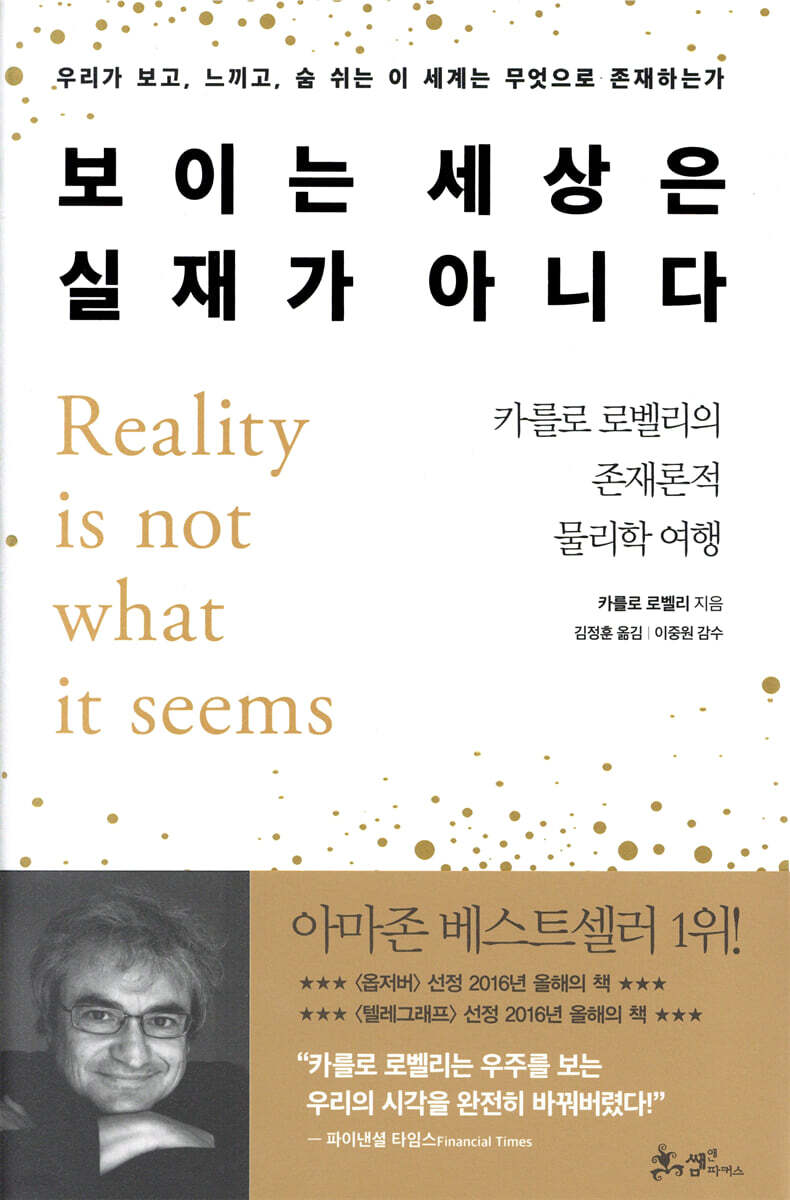
The world we see is not reality.
 |
Description
Book Introduction
“A physics adventure toward the ‘real world’ we live in!”
World-renowned physicist Carlo Rovelli says
All things that make up humans, space-time, and the universe
Observer Telegraph Book of the Year 2016 * LA Times Bestseller * Wired Editors' Pick
“A physics adventure toward the ‘real world’ we live in!”
Carlo Rovelli on Humans, Space-Time, and Everything That Makes Up the Universe
Another masterpiece by Carlo Rovelli, following the international bestseller "Physics of Every Moment."
From the core theories that revolutionized 20th-century physics to the most recent novel ideas, this book explores the vast universe and the reality of space-time that composes it from a fresh perspective that integrates general relativity and quantum theory.
Author Carlo Rovelli created a new concept called 'loop quantum gravity' that combines the theory of relativity and quantum mechanics, and has made significant progress in solving the mysteries of black holes and the universe, earning him the nickname 'the second Stephen Hawking' and 'the master of cosmology'.
By unpacking cutting-edge scientific theories in everyday language rather than flashy, complex jargon, he vividly conveys a breathtakingly beautiful "spectacle of reality" never before seen.
It helps us explore the beauty and mystery of the universe in which we live.
Published in Italy in 2014, "The World as We See It Is Not Real" has been a long-term bestseller in all of Europe, including the UK, France, and Spain, since its publication, and Carlo Rovelli's books have sold over 3 million copies worldwide, which is unusual for a science book.
Additionally, it was selected as the 'Book of the Year' by influential global media outlets such as The Guardian, The Telegraph, and The Observer, receiving recognition for both its popularity and artistic value, and establishing itself as a science million-seller.
World-renowned physicist Carlo Rovelli says
All things that make up humans, space-time, and the universe
Observer Telegraph Book of the Year 2016 * LA Times Bestseller * Wired Editors' Pick
“A physics adventure toward the ‘real world’ we live in!”
Carlo Rovelli on Humans, Space-Time, and Everything That Makes Up the Universe
Another masterpiece by Carlo Rovelli, following the international bestseller "Physics of Every Moment."
From the core theories that revolutionized 20th-century physics to the most recent novel ideas, this book explores the vast universe and the reality of space-time that composes it from a fresh perspective that integrates general relativity and quantum theory.
Author Carlo Rovelli created a new concept called 'loop quantum gravity' that combines the theory of relativity and quantum mechanics, and has made significant progress in solving the mysteries of black holes and the universe, earning him the nickname 'the second Stephen Hawking' and 'the master of cosmology'.
By unpacking cutting-edge scientific theories in everyday language rather than flashy, complex jargon, he vividly conveys a breathtakingly beautiful "spectacle of reality" never before seen.
It helps us explore the beauty and mystery of the universe in which we live.
Published in Italy in 2014, "The World as We See It Is Not Real" has been a long-term bestseller in all of Europe, including the UK, France, and Spain, since its publication, and Carlo Rovelli's books have sold over 3 million copies worldwide, which is unusual for a science book.
Additionally, it was selected as the 'Book of the Year' by influential global media outlets such as The Guardian, The Telegraph, and The Observer, receiving recognition for both its popularity and artistic value, and establishing itself as a science million-seller.
- You can preview some of the book's contents.
Preview
index
In search of the origins of the first lecture
01 Grains 02 Classics
The Second Lecture: The Beginning of a Revolution
03 Albert 04 Quantum
Lecture 3: On Time and Space
05 Space-time is quantum 06 Quantum of space 07 Time does not exist
Lecture Four: Beyond the World We See
08 Beyond the Big Bang 09 What Can Be Confirmed 10 The Heat of a Black Hole 11 The End of Infinity 12 Information, Undefined Thought 13 Mystery
01 Grains 02 Classics
The Second Lecture: The Beginning of a Revolution
03 Albert 04 Quantum
Lecture 3: On Time and Space
05 Space-time is quantum 06 Quantum of space 07 Time does not exist
Lecture Four: Beyond the World We See
08 Beyond the Big Bang 09 What Can Be Confirmed 10 The Heat of a Black Hole 11 The End of Infinity 12 Information, Undefined Thought 13 Mystery
Into the book
What we see through the window opened by physics always surprises us.
We have learned a great deal about the universe.
Over the centuries, we have come to realize how many misconceptions we have had.
We thought the Earth was flat, the unmoving center of the world.
I thought the universe was small and unchanging.
We used to believe that humans were a separate species, unrelated to other animals.
But now we know about quarks, black holes, particles of light, waves in space, and the unique molecular structure of every cell in our bodies.
Humanity is like a growing child who is surprised to discover that the world is not just about his bedroom and his playground.
I was amazed to discover that the world was so big, that there were thousands of things to discover, and that there were so many ideas that were so different from what I had initially known.
The universe is multifaceted and endless, and we continually encounter new aspects of it.
The more we learn about the world, the more we are amazed by its diversity, beauty, and simplicity.
p.9
The research covered in this book is in progress.
We talk about what we are learning, what we know, and what we are just beginning to understand about the fundamental properties of things.
This book begins by exploring the distant origins of some of the ideas that are key to our understanding of the world today.
Then, he explains the core of two great discoveries of the 20th century: Einstein's general theory of relativity and quantum mechanics.
And considering recent signals from nature, such as the Planck satellite's confirmation of the Standard Model of the Universe and CERN's failure to detect the much-anticipated supersymmetric particle, we discuss the current state of the world in quantum gravity research today.
We will further explore the granular structure of space, the disappearance of time at microscopic scales, the physics of the Big Bang, the origin of heat in black holes, and the role of information in the foundations of physics.
p.11
The book begins with a story from Miletus, 26 centuries ago.
Why does a book on quantum gravity begin with such an ancient event and the thoughts of ancient people? Readers interested in learning about the quantum nature of space should put aside such objections.
It's much easier to understand an idea if you start from the roots where it grew.
And many of the ideas that have proven effective in helping us understand the world originated more than two thousand years ago.
If we briefly examine its genesis, the ideas will become clearer, and the subsequent steps will become simpler and more natural to understand.
But there is another reason.
Because some questions first raised in ancient times are still crucial to our understanding of the world.
Some of the most recent ideas about spatial structure draw on concepts and arguments introduced then.
As I discuss these ideas from the distant past, I'll raise questions that will be central to quantum gravity.
This will allow us to distinguish between ideas that date back to the very origins of scientific thought and those that are radically new when dealing with quantum gravity.
As we will see, there is a surprisingly close connection between the questions posed by ancient scientists and the answers found by Einstein and quantum gravity.
p.18
So what did Leucippus and Democritus discover? The Milesians understood that the world could be understood through reason.
Convinced that various natural phenomena must originate from something simple, he tried to understand what this something might be.
I came up with a kind of fundamental substance that makes up all things.
Anaximenes of Miletus thought that this fundamental substance changed from one element to another, condensing or diluting itself to form the world.
It was the first time that physics had sprouted.
It was rough and rudimentary, but it was the right direction.
To grasp the hidden order of the world, a certain idea, a grand idea, a grand vision was needed.
Leucippus and Democritus came up with just such an idea.
p.24
General relativity and quantum mechanics, two jewels left to us by the 20th century, have been a rich gift for our understanding of the world and the development of modern technology.
Astrophysics and cosmology have developed from the study of gravitational waves and black holes.
The latter became the basis for atomic physics, nuclear physics, particle physics, condensed matter physics, and various other fields.
But there is a squeaky-squeaky gap between these two theories.
Since the two theories appear to contradict each other, they cannot both be correct, at least in their current form.
Gravitational fields are described without considering quantum mechanics, without considering the fact that fields are quantized.
And quantum mechanics is formulated without taking into account the fact that spacetime is curved and follows Einstein's equations.
A college student who takes a general relativity lecture in the morning and a quantum mechanics lecture in the afternoon might conclude that the professors are either idiots or haven't spoken to each other in at least a hundred years.
Because they are teaching two contradictory images of the world.
The world of the morning is a continuous, curved space-time.
The afternoon world is a flat spacetime where discrete quanta of energy leap and interact.
p.147-148
Thanks to general relativity, we know that space is not a rigid, fixed box, but rather something dynamic like an electromagnetic field.
The universe we live in is like a giant moving mollusk, being pressed and twisted.
Quantum mechanics teaches us that all such fields are made of quanta, that is, they have a delicate particle structure.
What follows from these two general findings about nature?
It immediately follows that physical space, being a field, is also 'made of quanta'.
The same particle structure that characterizes other quantum fields characterizes quantum gravity fields, and thus space.
Therefore, we expect space to be granular.
We expect that there are 'quanta of space', just as there are quanta of light, quanta of electromagnetic fields, and elementary particles as quanta of quantum fields.
But since space is a gravitational field, the quantum of the gravitational field is the 'quantum of space', that is, the particle-like constituent of space.
So the core prediction of loop theory is that space is not continuous, it is not infinitely divisible, and it is made up of 'atoms of space'.
It's really small.
It's smaller than one billionth of a billionth of the smallest atomic nucleus.
p.167
We should not think of time as if there were some great cosmic clock that dictates the life of the universe.
It's been over a century since we learned that we must think of time as local.
Every object in the universe has its own time flow, and that flow is determined by its local gravitational field.
But when we consider the quantum nature of gravitational fields, even this local time no longer works properly.
Quantum events cannot be ordered in time on very small scales.
In a sense, time no longer exists.
But what does it mean to say that time doesn't exist? p.178
Democritus defines 'man' strangely.
“People are something we all know.”2 This has been criticized as a silly statement with no substance, but it is not.
Salomon Luria, a leading scholar of Democritus, points out that Democritus is not telling a platitude.
The essence of a human being is not determined by the physical structure of his body, but by the network of personal, familial, and social interactions to which he belongs.
These are the very things that 'make' us and keep us.
As 'humans' we are made up of others' knowledge of us, our knowledge of ourselves, and our knowledge of others' knowledge of us.
We are complex knots in a rich network of interconnected information.
All of this is still theory.
It is the path we are taking in an effort to better understand our inner world.
There is still much to understand.
I want to talk about them in the last chapter.
p.252
We have learned a great deal about the universe.
Over the centuries, we have come to realize how many misconceptions we have had.
We thought the Earth was flat, the unmoving center of the world.
I thought the universe was small and unchanging.
We used to believe that humans were a separate species, unrelated to other animals.
But now we know about quarks, black holes, particles of light, waves in space, and the unique molecular structure of every cell in our bodies.
Humanity is like a growing child who is surprised to discover that the world is not just about his bedroom and his playground.
I was amazed to discover that the world was so big, that there were thousands of things to discover, and that there were so many ideas that were so different from what I had initially known.
The universe is multifaceted and endless, and we continually encounter new aspects of it.
The more we learn about the world, the more we are amazed by its diversity, beauty, and simplicity.
p.9
The research covered in this book is in progress.
We talk about what we are learning, what we know, and what we are just beginning to understand about the fundamental properties of things.
This book begins by exploring the distant origins of some of the ideas that are key to our understanding of the world today.
Then, he explains the core of two great discoveries of the 20th century: Einstein's general theory of relativity and quantum mechanics.
And considering recent signals from nature, such as the Planck satellite's confirmation of the Standard Model of the Universe and CERN's failure to detect the much-anticipated supersymmetric particle, we discuss the current state of the world in quantum gravity research today.
We will further explore the granular structure of space, the disappearance of time at microscopic scales, the physics of the Big Bang, the origin of heat in black holes, and the role of information in the foundations of physics.
p.11
The book begins with a story from Miletus, 26 centuries ago.
Why does a book on quantum gravity begin with such an ancient event and the thoughts of ancient people? Readers interested in learning about the quantum nature of space should put aside such objections.
It's much easier to understand an idea if you start from the roots where it grew.
And many of the ideas that have proven effective in helping us understand the world originated more than two thousand years ago.
If we briefly examine its genesis, the ideas will become clearer, and the subsequent steps will become simpler and more natural to understand.
But there is another reason.
Because some questions first raised in ancient times are still crucial to our understanding of the world.
Some of the most recent ideas about spatial structure draw on concepts and arguments introduced then.
As I discuss these ideas from the distant past, I'll raise questions that will be central to quantum gravity.
This will allow us to distinguish between ideas that date back to the very origins of scientific thought and those that are radically new when dealing with quantum gravity.
As we will see, there is a surprisingly close connection between the questions posed by ancient scientists and the answers found by Einstein and quantum gravity.
p.18
So what did Leucippus and Democritus discover? The Milesians understood that the world could be understood through reason.
Convinced that various natural phenomena must originate from something simple, he tried to understand what this something might be.
I came up with a kind of fundamental substance that makes up all things.
Anaximenes of Miletus thought that this fundamental substance changed from one element to another, condensing or diluting itself to form the world.
It was the first time that physics had sprouted.
It was rough and rudimentary, but it was the right direction.
To grasp the hidden order of the world, a certain idea, a grand idea, a grand vision was needed.
Leucippus and Democritus came up with just such an idea.
p.24
General relativity and quantum mechanics, two jewels left to us by the 20th century, have been a rich gift for our understanding of the world and the development of modern technology.
Astrophysics and cosmology have developed from the study of gravitational waves and black holes.
The latter became the basis for atomic physics, nuclear physics, particle physics, condensed matter physics, and various other fields.
But there is a squeaky-squeaky gap between these two theories.
Since the two theories appear to contradict each other, they cannot both be correct, at least in their current form.
Gravitational fields are described without considering quantum mechanics, without considering the fact that fields are quantized.
And quantum mechanics is formulated without taking into account the fact that spacetime is curved and follows Einstein's equations.
A college student who takes a general relativity lecture in the morning and a quantum mechanics lecture in the afternoon might conclude that the professors are either idiots or haven't spoken to each other in at least a hundred years.
Because they are teaching two contradictory images of the world.
The world of the morning is a continuous, curved space-time.
The afternoon world is a flat spacetime where discrete quanta of energy leap and interact.
p.147-148
Thanks to general relativity, we know that space is not a rigid, fixed box, but rather something dynamic like an electromagnetic field.
The universe we live in is like a giant moving mollusk, being pressed and twisted.
Quantum mechanics teaches us that all such fields are made of quanta, that is, they have a delicate particle structure.
What follows from these two general findings about nature?
It immediately follows that physical space, being a field, is also 'made of quanta'.
The same particle structure that characterizes other quantum fields characterizes quantum gravity fields, and thus space.
Therefore, we expect space to be granular.
We expect that there are 'quanta of space', just as there are quanta of light, quanta of electromagnetic fields, and elementary particles as quanta of quantum fields.
But since space is a gravitational field, the quantum of the gravitational field is the 'quantum of space', that is, the particle-like constituent of space.
So the core prediction of loop theory is that space is not continuous, it is not infinitely divisible, and it is made up of 'atoms of space'.
It's really small.
It's smaller than one billionth of a billionth of the smallest atomic nucleus.
p.167
We should not think of time as if there were some great cosmic clock that dictates the life of the universe.
It's been over a century since we learned that we must think of time as local.
Every object in the universe has its own time flow, and that flow is determined by its local gravitational field.
But when we consider the quantum nature of gravitational fields, even this local time no longer works properly.
Quantum events cannot be ordered in time on very small scales.
In a sense, time no longer exists.
But what does it mean to say that time doesn't exist? p.178
Democritus defines 'man' strangely.
“People are something we all know.”2 This has been criticized as a silly statement with no substance, but it is not.
Salomon Luria, a leading scholar of Democritus, points out that Democritus is not telling a platitude.
The essence of a human being is not determined by the physical structure of his body, but by the network of personal, familial, and social interactions to which he belongs.
These are the very things that 'make' us and keep us.
As 'humans' we are made up of others' knowledge of us, our knowledge of ourselves, and our knowledge of others' knowledge of us.
We are complex knots in a rich network of interconnected information.
All of this is still theory.
It is the path we are taking in an effort to better understand our inner world.
There is still much to understand.
I want to talk about them in the last chapter.
p.252
--- From the text
Publisher's Review
The world beyond the visible world
Leaving to know
The Adventures of Physics
What did Einstein and Stephen Hawking, two of humanity's greatest physicists since the 20th century, have in common? Was it their innate intellect or the exceptional mathematical ability that allowed them to create irrefutable equations? Carlo Rovelli answers without hesitation.
It is infinite 'imagination'.
They are the ones who truly enjoyed the open spirit of science, transcending the limitations of our prejudices.
Carlo Rovelli's new book, "The World as We See It Is Not Real," is perhaps a record of the journey of curiosity and imagination into unknown realms that great humankind has walked from ancient times to the present.
'Why do the sun and moon rise and set every day?', 'What exists in the world beyond the sky?', 'What are the indivisible particles?', 'How do we think and move?'... The two great pillars of physics that support human life today, general relativity and quantum mechanics, also originated from a very small curiosity of humans.
Isn't the pure spirit of science to be purely curious, to set aside prejudice, to explore reality, and to be willing to make and refute errors of imagination and move forward with new ideas?
This book is clearly a book containing physics theory.
It also deals with general relativity and quantum mechanics, which are difficult theories to explain and understand, surrounding the macro and micro worlds.
But the reason it's not considered a dry science book full of math and formulas is because it's a captivating narrative of curiosity that crosses science, literature, and philosophy.
The cutting-edge scientific theories that support humanity today did not fall from the sky or spring up from the ground by chance.
As the author confesses in the preface, it is a fascinating story of struggle that was achieved through the long process of 'adventure into the unknown universe' lasting 2,600 years, and the liberation of our curiosity that was bound by limited and narrow thinking about 'reality'.
What we see, feel, and breathe
This world
What does it exist as?
That journey of curiosity began 2,600 years ago in ancient Greece.
The author begins by tracing the roots of the thinking that gave rise to the ideas of quantum gravity and modern physics.
Many of the ideas that are effective in understanding 'this world' have been around for 2,000 years.
Carlo Rovelli examines the origins and birth of the physical thinking we stand on today, providing a clearer understanding of how those ideas became science.
Some questions first raised in ancient times still play a crucial role in our understanding of the world.
The most recent ideas about spatial structure utilize concepts and arguments introduced then.
As I discuss these ideas from the distant past, I'll raise questions that will be central to quantum gravity.
This will allow us to distinguish between ideas that date back to the very origins of scientific thought and those that are radically new when dealing with quantum gravity.
As we will see, there is a surprisingly close connection between the questions posed by ancient scientists and the answers found by Einstein and quantum gravity.
-From the text
This epic journey of physics leads through the darkness of the god-ruled Middle Ages and soon leads to an encounter with modern physics.
Newton and Maxwell devised classical physics, and Einstein, who got ideas from it, announced the theory of relativity, and Bohr announced quantum theory.
Through these countless, repetitive dialectical processes, we have been able to imagine the distant universe in concrete terms and have opened our eyes to the structure of things in the microscopic world that seemed so small.
Here, there was the realization that space-time, which was believed to be absolute, was not in fact absolute, and furthermore, that even human thought, which was believed to be infinite, could only exist within the invisible limits of physics.
This process is an opportunity to approach more deeply the reality of the world that is invisible to our eyes.
How can we create a conceptual framework that reconciles what we know about the world from general relativity and quantum mechanics? Understanding quantum space and quantum time requires a fundamental shift in how we think about things.
Like Anaximander, who understood that the Earth floats in space and that there is no "up" or "down" in the universe, like Einstein, who understood that space-time is squashed like a mollusk and that time flows differently in different places, we must once again change our ideas about reality to find a worldview that is consistent with what we have learned about the world so far.
-From the text
Daily life and art,
Containing both science and human spirit
The most beautiful science book in the world
Above all, the reason Carlo Rovelli was loved by readers around the world was not only because he was the first scholar to propose the concept of loop quantum gravity.
This is the most striking feature of this book, but his scientific thinking provides readers with a beautiful experience.
It explains the most complex and intricate recent physics theories, and goes beyond the boundaries of literature, architecture, and philosophy to explore the quantum universe.
The questions and thoughts of the ancient Greeks 2,600 years ago, the unwavering faith that compelled Galileo to cling to a planet called Earth, Dante's dedication to the invisible world, the universal spatial composition of the Florence Cathedral, and even Einstein's human agony all serve as excellent materials for explaining science.
Dante borrows from Aristotle's world to present his own grand vision of the medieval world.
It is a picture of a round Earth at the center surrounded by celestial spheres.
Dante goes on a fantastic journey with Beatrice, passing through each sphere until he reaches the outermost sphere.
Arriving there, he looks down and contemplates the universe, with the celestial spheres revolving around it, with the Earth at the far center.
But when he looked higher, what did he see? - From the text
He looks at physics through a clear, purified human gaze and breathes meaning into it.
For all of us who live our lives thinking, "I have nothing to do with physics," this is Carlo Rovelli's burning passion to help us understand the most cutting-edge physics theories and present a new perspective on the world.
Even if you don't know much about physics, this book will be a great joy for readers who are curious about what makes up this world we see, feel, and breathe, and what the "real world" beyond what we see is like.
I invite you to embark on a fascinating adventure to discover the universe, still full of unknowns, with this book that captures the horizons and depth of modern physics.
Leaving to know
The Adventures of Physics
What did Einstein and Stephen Hawking, two of humanity's greatest physicists since the 20th century, have in common? Was it their innate intellect or the exceptional mathematical ability that allowed them to create irrefutable equations? Carlo Rovelli answers without hesitation.
It is infinite 'imagination'.
They are the ones who truly enjoyed the open spirit of science, transcending the limitations of our prejudices.
Carlo Rovelli's new book, "The World as We See It Is Not Real," is perhaps a record of the journey of curiosity and imagination into unknown realms that great humankind has walked from ancient times to the present.
'Why do the sun and moon rise and set every day?', 'What exists in the world beyond the sky?', 'What are the indivisible particles?', 'How do we think and move?'... The two great pillars of physics that support human life today, general relativity and quantum mechanics, also originated from a very small curiosity of humans.
Isn't the pure spirit of science to be purely curious, to set aside prejudice, to explore reality, and to be willing to make and refute errors of imagination and move forward with new ideas?
This book is clearly a book containing physics theory.
It also deals with general relativity and quantum mechanics, which are difficult theories to explain and understand, surrounding the macro and micro worlds.
But the reason it's not considered a dry science book full of math and formulas is because it's a captivating narrative of curiosity that crosses science, literature, and philosophy.
The cutting-edge scientific theories that support humanity today did not fall from the sky or spring up from the ground by chance.
As the author confesses in the preface, it is a fascinating story of struggle that was achieved through the long process of 'adventure into the unknown universe' lasting 2,600 years, and the liberation of our curiosity that was bound by limited and narrow thinking about 'reality'.
What we see, feel, and breathe
This world
What does it exist as?
That journey of curiosity began 2,600 years ago in ancient Greece.
The author begins by tracing the roots of the thinking that gave rise to the ideas of quantum gravity and modern physics.
Many of the ideas that are effective in understanding 'this world' have been around for 2,000 years.
Carlo Rovelli examines the origins and birth of the physical thinking we stand on today, providing a clearer understanding of how those ideas became science.
Some questions first raised in ancient times still play a crucial role in our understanding of the world.
The most recent ideas about spatial structure utilize concepts and arguments introduced then.
As I discuss these ideas from the distant past, I'll raise questions that will be central to quantum gravity.
This will allow us to distinguish between ideas that date back to the very origins of scientific thought and those that are radically new when dealing with quantum gravity.
As we will see, there is a surprisingly close connection between the questions posed by ancient scientists and the answers found by Einstein and quantum gravity.
-From the text
This epic journey of physics leads through the darkness of the god-ruled Middle Ages and soon leads to an encounter with modern physics.
Newton and Maxwell devised classical physics, and Einstein, who got ideas from it, announced the theory of relativity, and Bohr announced quantum theory.
Through these countless, repetitive dialectical processes, we have been able to imagine the distant universe in concrete terms and have opened our eyes to the structure of things in the microscopic world that seemed so small.
Here, there was the realization that space-time, which was believed to be absolute, was not in fact absolute, and furthermore, that even human thought, which was believed to be infinite, could only exist within the invisible limits of physics.
This process is an opportunity to approach more deeply the reality of the world that is invisible to our eyes.
How can we create a conceptual framework that reconciles what we know about the world from general relativity and quantum mechanics? Understanding quantum space and quantum time requires a fundamental shift in how we think about things.
Like Anaximander, who understood that the Earth floats in space and that there is no "up" or "down" in the universe, like Einstein, who understood that space-time is squashed like a mollusk and that time flows differently in different places, we must once again change our ideas about reality to find a worldview that is consistent with what we have learned about the world so far.
-From the text
Daily life and art,
Containing both science and human spirit
The most beautiful science book in the world
Above all, the reason Carlo Rovelli was loved by readers around the world was not only because he was the first scholar to propose the concept of loop quantum gravity.
This is the most striking feature of this book, but his scientific thinking provides readers with a beautiful experience.
It explains the most complex and intricate recent physics theories, and goes beyond the boundaries of literature, architecture, and philosophy to explore the quantum universe.
The questions and thoughts of the ancient Greeks 2,600 years ago, the unwavering faith that compelled Galileo to cling to a planet called Earth, Dante's dedication to the invisible world, the universal spatial composition of the Florence Cathedral, and even Einstein's human agony all serve as excellent materials for explaining science.
Dante borrows from Aristotle's world to present his own grand vision of the medieval world.
It is a picture of a round Earth at the center surrounded by celestial spheres.
Dante goes on a fantastic journey with Beatrice, passing through each sphere until he reaches the outermost sphere.
Arriving there, he looks down and contemplates the universe, with the celestial spheres revolving around it, with the Earth at the far center.
But when he looked higher, what did he see? - From the text
He looks at physics through a clear, purified human gaze and breathes meaning into it.
For all of us who live our lives thinking, "I have nothing to do with physics," this is Carlo Rovelli's burning passion to help us understand the most cutting-edge physics theories and present a new perspective on the world.
Even if you don't know much about physics, this book will be a great joy for readers who are curious about what makes up this world we see, feel, and breathe, and what the "real world" beyond what we see is like.
I invite you to embark on a fascinating adventure to discover the universe, still full of unknowns, with this book that captures the horizons and depth of modern physics.
GOODS SPECIFICS
- Date of issue: April 9, 2018
- Page count, weight, size: 272 pages | 598g | 155*233*20mm
- ISBN13: 9788965706205
- ISBN10: 8965706203
You may also like
카테고리
korean


korean

![ELLE 엘르 스페셜 에디션 A형 : 12월 [2025]](http://librairie.coreenne.fr/cdn/shop/files/b8e27a3de6c9538896439686c6b0e8fb.jpg?v=1766436872&width=3840)


