

Russian Art, the Land of Snow and Blood
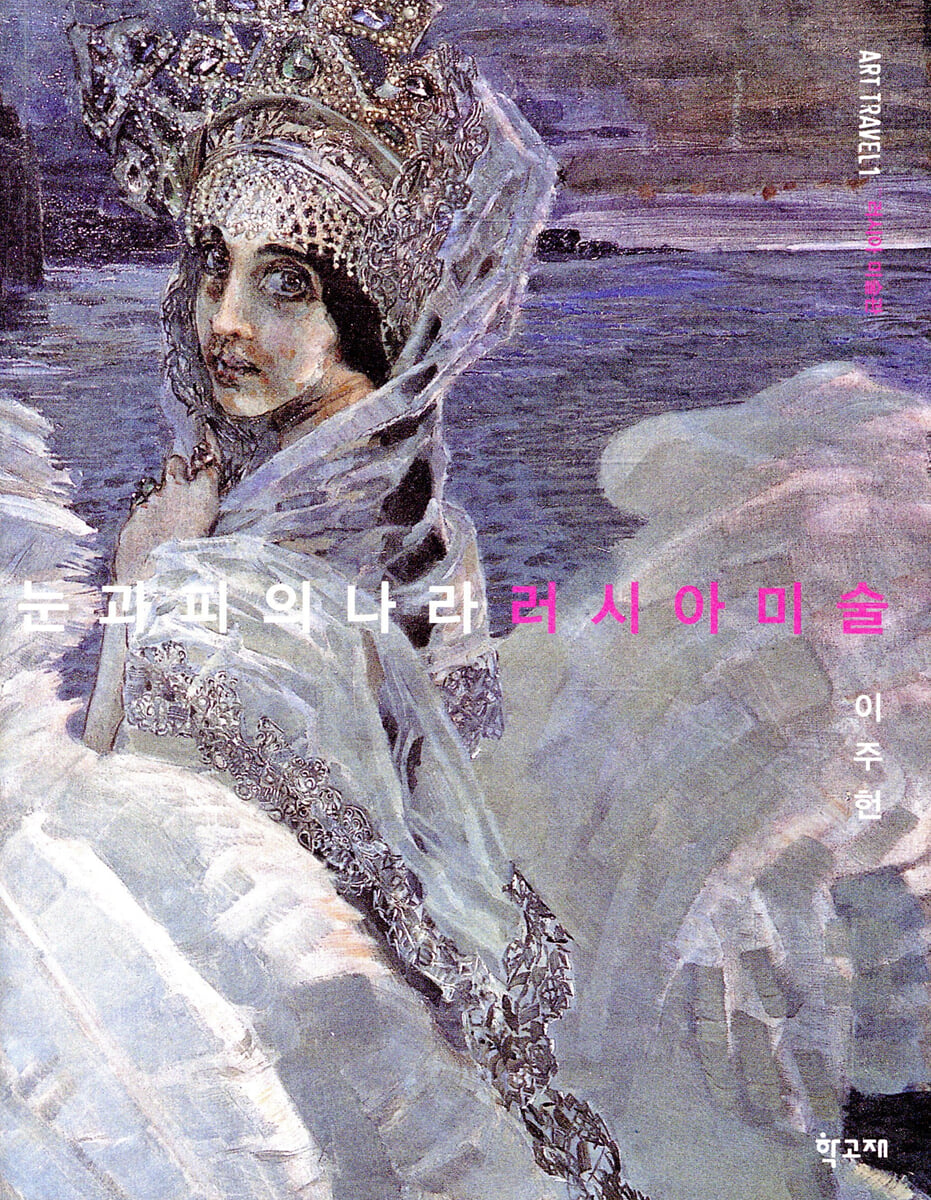 |
Description
Book Introduction
The first volume in the Art Travel series, which introduces unique and profound art from around the world through travel.
Among the great Russian arts, we focus on Russian art, which is relatively less known to us, focusing on art museums.
Through these paintings, which, while Western in style, convey an Eastern atmosphere, a sense of calm and revolutionary passion, and a history that endured long, cold winters and the oppression of the caste system, we will be guided into the unfamiliar yet fascinating world of Russian art.
It also serves as a comprehensive guide to Russian culture, providing a natural introduction to not only fantastic Russian art, but also the history and religion essential to understanding Russian art.
Among the great Russian arts, we focus on Russian art, which is relatively less known to us, focusing on art museums.
Through these paintings, which, while Western in style, convey an Eastern atmosphere, a sense of calm and revolutionary passion, and a history that endured long, cold winters and the oppression of the caste system, we will be guided into the unfamiliar yet fascinating world of Russian art.
It also serves as a comprehensive guide to Russian culture, providing a natural introduction to not only fantastic Russian art, but also the history and religion essential to understanding Russian art.
- You can preview some of the book's contents.
Preview
index
Entering
Tretyakov Gallery & Russian Museum
Christ Appears Before the Russian People
Holy prayers offered to God, icons
The tragedy of the Russian imperial family, brought about by desire and betrayal
Testimony of Russian history
The Unwavering Spirit of Resistance - Ilya Repin
Into the People, Genre Painting
One day, when I met a Russian artist
The Aesthetics of Humanity and Fantasy - Mikhail Vrubel
People who love Mother Nature
Tretyakov Gallery New Building
Hermitage Museum
Hermitage's Italian Painting Collection
Dutch and Flemish masterpieces
French Painting Collection
Spanish and other European collections
Pushkin Museum of Fine Arts
A Brief History of Russian Painting
About the author
Russian History Chronology
List of pictures
Tretyakov Gallery & Russian Museum
Christ Appears Before the Russian People
Holy prayers offered to God, icons
The tragedy of the Russian imperial family, brought about by desire and betrayal
Testimony of Russian history
The Unwavering Spirit of Resistance - Ilya Repin
Into the People, Genre Painting
One day, when I met a Russian artist
The Aesthetics of Humanity and Fantasy - Mikhail Vrubel
People who love Mother Nature
Tretyakov Gallery New Building
Hermitage Museum
Hermitage's Italian Painting Collection
Dutch and Flemish masterpieces
French Painting Collection
Spanish and other European collections
Pushkin Museum of Fine Arts
A Brief History of Russian Painting
About the author
Russian History Chronology
List of pictures
Into the book
It is said that the biggest reason Russia accepted Eastern Orthodoxy was because the churches and worship services were very beautiful.
According to the Primordial Chronicle, which contains the myth of Russia's founding, in 986, Prince Vladimir of Kievan Rus received envoys from neighboring countries who wanted to spread their religions on Russian soil and dispatched envoys to the strongholds of each religion.
After examining various religions, it is said that Muslims were frustrated by the fact that they could not drink alcohol, and Judaism lost hope after seeing the harsh fate of the Jews.
Also, I didn't get much inspiration from the Catholic Church, as I couldn't see any glory in the mass.
But the Eastern Orthodox Church was different.
The envoys who returned were filled with admiration.
… Impressed by the beauty of the liturgy, Vladimir was baptized in 988 and declared Eastern Orthodoxy the state religion.
The fact that beauty became the most important basis for choosing a religion makes us look back on the Russian people's sense of beauty.
According to the Primordial Chronicle, which contains the myth of Russia's founding, in 986, Prince Vladimir of Kievan Rus received envoys from neighboring countries who wanted to spread their religions on Russian soil and dispatched envoys to the strongholds of each religion.
After examining various religions, it is said that Muslims were frustrated by the fact that they could not drink alcohol, and Judaism lost hope after seeing the harsh fate of the Jews.
Also, I didn't get much inspiration from the Catholic Church, as I couldn't see any glory in the mass.
But the Eastern Orthodox Church was different.
The envoys who returned were filled with admiration.
… Impressed by the beauty of the liturgy, Vladimir was baptized in 988 and declared Eastern Orthodoxy the state religion.
The fact that beauty became the most important basis for choosing a religion makes us look back on the Russian people's sense of beauty.
--- pp.51-52
Dostoevsky, who dominated the Russian literary world of his time along with Tolstoy, was from the same low-class background as Kramskoy, unlike Tolstoy.
Tolstoy, who was born into an aristocratic family and tried to give up his property and copyrights, but was forced to live in an affluent environment until the end due to his wife's opposition, and Dostoevsky, who suffered from poverty, exile, and other hardships and for whom writing novels became a means of immediate survival, were bound to have different impressions and atmospheres as much as their origins and life trajectories.
…Dostoevsky is considered an outstanding writer in the analysis of consciousness and psychological description.
Behind it all is his life, which has been through many ups and downs.
He had many painful experiences that allowed him to empathize with various people, such as his father who was murdered by his serfs due to his tyrannical personality, the early death of his beloved mother, his experience of being sentenced to death for joining the 'Petrashevsky Club', a utopian socialist study group, but whose sentence was dramatically commuted and he was exiled to Siberia, epilepsy that he developed while in exile, and his life of constant debt due to gambling.
(See page 179) This is a masterpiece that vividly reveals that even this great novelist, who is considered to have best depicted the complex inner world of human beings among novelists, has an inner world no less complex than that of his protagonists.
Dostoevsky, who dominated the Russian literary world of his time along with Tolstoy, was from the same low-class background as Kramskoy, unlike Tolstoy.
Tolstoy, who was born into an aristocratic family and tried to give up his property and copyrights, but was forced to live in an affluent environment until the end due to his wife's opposition, and Dostoevsky, who suffered from poverty, exile, and other hardships and for whom writing novels became a means of immediate survival, were bound to have different impressions and atmospheres as much as their origins and life trajectories.
…Dostoevsky is considered an outstanding writer in the analysis of consciousness and psychological description.
Behind it all is his life, which has been through many ups and downs.
He had many painful experiences that allowed him to empathize with various people, such as his father who was murdered by his serfs due to his tyrannical personality, the early death of his beloved mother, his experience of being sentenced to death for joining the 'Petrashevsky Club', a utopian socialist study group, but whose sentence was dramatically commuted and he was exiled to Siberia, epilepsy that he developed while in exile, and his life of constant debt due to gambling.
(See page 179) This is a masterpiece that vividly reveals that even this great novelist, who is considered to have best depicted the complex inner world of human beings among novelists, has an inner world just as complex as that of his protagonists.
Tolstoy, who was born into an aristocratic family and tried to give up his property and copyrights, but was forced to live in an affluent environment until the end due to his wife's opposition, and Dostoevsky, who suffered from poverty, exile, and other hardships and for whom writing novels became a means of immediate survival, were bound to have different impressions and atmospheres as much as their origins and life trajectories.
…Dostoevsky is considered an outstanding writer in the analysis of consciousness and psychological description.
Behind it all is his life, which has been through many ups and downs.
He had many painful experiences that allowed him to empathize with various people, such as his father who was murdered by his serfs due to his tyrannical personality, the early death of his beloved mother, his experience of being sentenced to death for joining the 'Petrashevsky Club', a utopian socialist study group, but whose sentence was dramatically commuted and he was exiled to Siberia, epilepsy that he developed while in exile, and his life of constant debt due to gambling.
(See page 179) This is a masterpiece that vividly reveals that even this great novelist, who is considered to have best depicted the complex inner world of human beings among novelists, has an inner world no less complex than that of his protagonists.
Dostoevsky, who dominated the Russian literary world of his time along with Tolstoy, was from the same low-class background as Kramskoy, unlike Tolstoy.
Tolstoy, who was born into an aristocratic family and tried to give up his property and copyrights, but was forced to live in an affluent environment until the end due to his wife's opposition, and Dostoevsky, who suffered from poverty, exile, and other hardships and for whom writing novels became a means of immediate survival, were bound to have different impressions and atmospheres as much as their origins and life trajectories.
…Dostoevsky is considered an outstanding writer in the analysis of consciousness and psychological description.
Behind it all is his life, which has been through many ups and downs.
He had many painful experiences that allowed him to empathize with various people, such as his father who was murdered by his serfs due to his tyrannical personality, the early death of his beloved mother, his experience of being sentenced to death for joining the 'Petrashevsky Club', a utopian socialist study group, but whose sentence was dramatically commuted and he was exiled to Siberia, epilepsy that he developed while in exile, and his life of constant debt due to gambling.
(See page 179) This is a masterpiece that vividly reveals that even this great novelist, who is considered to have best depicted the complex inner world of human beings among novelists, has an inner world just as complex as that of his protagonists.
--- pp.77-78
Publisher's Review
“The works of Lee Ju-heon, the ‘art mentor’ of our time, encountered in Russia!
“Unlock the Russian painting, full of fantasy and fascination!”
Composition of 『Russian Art: The Land of Snow and Blood』
Chapter 1 focuses on Russian art and Russian artists, linking the Tretyakov Gallery and the Russian Museum together.
It consists of seven thematic sections, and between each section, three appendices are added to introduce representative Russian painters Ilya Repin and Mikhail Vrubel, and the new building of the Tretyakov Gallery, which houses Russian modern art.
Chapter 2 introduces the collection of the Hermitage Museum, Russia's largest state museum and home to masterpieces from Western Europe since the Middle Ages, including Russia, Italy, the Netherlands, Flanders, France, and England, as well as artifacts from the East, divided by country.
Chapter 3 introduces the Pushkin Museum of Fine Arts, which houses world-class art pieces ranging from ancient Egyptian sculptures to Gauguin and Matisse.
Compared to the Western European art introduced in Chapters 2 and 3, Chapter 1 focuses more on Russian art, allowing us to encounter Russian art that we do not normally encounter or have access to.
Additionally, to aid understanding of the content, representative Russian painters were grouped together and introduced in detail, a Russian chronology was added, and the history of Russian painting was summarized to narrow the gap in understanding between readers and Russian art.
Through the author's characteristically relaxed and sensitive prose and 125 color illustrations, you will vividly experience the level of Russian art and culture.
Introduction to the text of "Russian Art: The Land of Snow and Blood"
Chapter 1: Tretyakov Gallery & Russian Museum
Explore Russian art, history, religion, and landscapes through works from the Tretyakov Gallery in Moscow, founded by Pavel Tretyakov in 1856, and the Russian Museum in St. Petersburg, which opened to the public in 1898 from the royal collection.
From religious paintings represented by icons to genre and historical paintings depicting the lives of the people suffering under the Tsarist regime, to portraits of artists who brought great Russian art to fruition, and landscape paintings depicting the great nature that shaped the Russian people's temperament.
Works that demonstrate the formation, continuation, and emphasis of Russian art from the 11th century to the early 20th century are organized by subject in a clear and concise manner, allowing even readers new to Russian art to gain a broad understanding of Russian painting and history in a single volume.
Also, at the top of the new building of the Tretyakov Gallery, there was a brief introduction to the works of Russian modern art masters such as Chagall and Kandinsky.
Ilya Repin, who excelled in portraiture and was also a leader in realism, and Vrubel, who expressed his strong individuality by borrowing themes from mythology and literature, are introduced in more detail in appendices.
-(See page 44) is a painting depicting Jesus, who was sentenced to death, being led to the execution grounds with two other condemned criminals.
The pathos Jesus shows in this picture is even more poignant.
Jesus is gripped by fear and is in agony, clutching his head as the hand of the officer on the left points at him.
Although he has been preaching truth and justice, Jesus, as a human being, can never be free from the fear of death.
Just as Choi Min-soo, who played Park Tae-soo in the drama 'Sandglass', asked, "Am I shaking?", Jesus in the painting is shaking even more intensely.
In the midst of fear, Jesus again reveals himself as a weak and pitiful human being.
…but the artist says that Jesus is a man who deserves eternal respect because he was so weak yet held firm to his beliefs.
I say that the man who chose death and stood there because he knew fear, not because he was unaware of fear, is truly a great man.
43-45p
-As Shishkin's paintings suggest, the most typical Russian landscape image is a winter landscape covered in thick snow.
Russia is truly a winter empire.
In October, all the leaves have already fallen and a cold wind blows in the morning and evening.
The winter that began like this continues until mid-April of the following year.
It's not unusual to see snow in October or April.
During this long journey, people must either struggle to overcome the seasons or learn to enjoy them.
Or, like Shishkin, you must know how to converse with the seasons and meet your soul in deep contemplation or meditation.
This invitation to a deep meditative journey is one of the greatest charms of Russian landscape painting.
Looking at Russian landscapes is like having a meaningful conversation about myself and life.
It's like the birds eating the berries of the magnolia tree, just like in Doctor Zhivago.
The fruit of the meaning of life.
215p
Chapter 2: The Hermitage Museum
The Hermitage Museum, along with the Louvre and the British Museum, is considered a world-class collection that allows one to view the culture and art of mankind at a glance.
The museum's collection of over 2.7 million objects, ranging from Paleolithic artifacts to 20th-century cultural artifacts, symbolizes the power of Russian culture.
This chapter introduces Western European paintings from the Hermitage Museum's collection, divided by country: Italy, the Netherlands and Flanders, France, Spain, and other European countries.
It introduces the contents and artistic trends of the time, including Italian paintings represented by Da Vinci and Caravaggio, Dutch and Flemish paintings by Rembrandt and Rubens, French paintings by David, Gérôme, Denis, and Matisse, and Spanish, German, and British paintings.
-Rubens' masterpiece (pp. 250-251) in the Hermitage collection is in some ways a parallel to Rembrandt's work on the subject of fatherhood, as it deals with the theme of filial piety.
But above all, it is the shocking expression that first catches the audience's attention.
In both the East and the West, children have been taught since ancient times that they should be filial to their parents.
Simcheong, a devoted daughter, sold herself for three hundred seok of rice to restore her father's sight.
Princess Baridegi spares no effort to save her father who abandoned her.
We can also find examples of this kind of filial piety in old Western tales.
There was a young woman in ancient Rome named Pero.
She had a father named Simon, who was severely punished.
The punishment was to be imprisoned and starved to death.
Pero, who was wondering how he could save his beloved father, came up with a plan.
She decided to visit the prison every day and secretly breastfeed her father when the guards were not looking.
As if feeding a baby, Pero fed his father.
Thanks to that, my father was able to recover his strength instead of starving to death.
249-252p
-The Hermitage is a place that can be very proud of itself for housing many masterpieces by Matisse, the greatest painter of the 20th century.
These are not just masterpieces, but some of the best works Matisse painted in the early 20th century.
Among these, this is his representative 'trademark' that everyone has seen at least once.
… Shchukin, who bought this painting, said, “I like this painting very much, and regardless of what others think, I hang this nude on the staircase wall of my house,” and asked Matisse to paint another painting with a musical theme.
The collector's keen eye stands out, having recognized Matisse's greatness early on, creating magical joy out of simple colors.
What is unfortunate is that this kind of insight was not able to be reproduced further after the Russian Revolution and had to rapidly decline.
Considering the great collectors and artists who actively created works in the early 20th century, such as Kandinsky, Malevich, Tatlin, Jawlensky, and Chagall, if the trend had continued, Russia would have dominated one axis of 20th-century world art, along with the United States on the other.
276-277p
Chapter 3 Pushkin Museum of Fine Arts
The Pushkin Museum of Fine Arts is also a representative national art museum in Russia that boasts a high-quality collection of Western art.
As its original purpose was to educate art and humanities students, it contained many replicas of ancient and medieval sculptures and architectural structures.
However, after the Russian Revolution, public and private collections were concentrated, making it one of the leading art museums in Western Europe.
In this chapter, we will explore paintings by Monet, Boucher, Picasso, Matisse, Gauguin, Rousseau, and others housed here.
-Painters who express everyday images contained in interiors with a friendly gaze and intimate feelings are called antimists.
Bonnard, who enjoyed painting his wife bathing, is a representative antimist.
His wife, Marthe, was not fond of going out much and was a bathing fanatic who would bathe at home without warning.
Bonnard, who loved his wife dearly, enjoyed depicting her on canvas, and so he naturally became an antimist.
Pushkin's collection (see page 305) is also a work that clearly shows Bonnard's characteristics as an antimist.
… Looking back, it is often the small and ordinary things that are most precious.
At the moment, it passes by as if it were nothing, but the little things accumulate and life gains its true meaning.
Even though he had depicted his wife's daily life in such a way, it is said that Bonnard was very sad that he could no longer depict her daily life after Marthe died.
He locked her bedroom door tightly and never opened it again, which gives us an idea of how much his wife's room meant to him.
304-306p
A captivating journey, a profound art travel series
Publishing the 'Art Travel' series
Art is truly a 'lofty' art.
Performing arts are meant to be enjoyed while sitting.
Literary works can be read even while lying down.
But most works of art must be viewed standing up.
It physically tires the viewer to that extent.
Not only that, famous orchestras tour the world, and foreign literary works come to our homes.
But to see a work of art, you have to go to a country that has a museum that houses the work.
Of course, artworks do cross borders and travel to other countries, but important works rarely move, and even when they do, only one or two pieces are included in overseas exhibitions.
To truly appreciate a masterpiece, you have to go to the place where it is.
So, those who enjoy art appreciation naturally become travelers.
Flying, riding, and walking are common occurrences.
Even inside the art museum, he doesn't stay in one place and keeps moving around.
In a word, he is a moving spectator.
This is why a significant number of art-related essays and books contain, to a greater or lesser extent, travel impressions or memories of travel.
'Art Travel' is a series that takes into account these characteristics of art appreciation and guides you on a path of appreciation centered around famous art sites.
The focus of the planning is not on the flow, school, trend, or theme of art history, but on the space and location where the artwork is located.
For those who visit the spaces or places introduced in the book, this book will serve as a faithful guidebook, and for readers who do not plan to visit immediately, it will provide an indirect experience as if they were viewing the works on site.
Clearly experiencing the travel-like nature of art appreciation, viewing works of art and obtaining related information is a method of art appreciation that is clearly suited to this era.
The spaces and places that 'Art Travel' will cover will be centered around art museums, but it will also include art-related historical sites and travel courses in addition to art museums.
When introducing art museums, one book can focus on just one place, or there are cases where art museums from several countries are introduced together.
Art-related heritage sites and travel courses will be primarily based on art geography, such as grouping places around the birthplace of a particular art form or the traces of an artist's life.
“Unlock the Russian painting, full of fantasy and fascination!”
Composition of 『Russian Art: The Land of Snow and Blood』
Chapter 1 focuses on Russian art and Russian artists, linking the Tretyakov Gallery and the Russian Museum together.
It consists of seven thematic sections, and between each section, three appendices are added to introduce representative Russian painters Ilya Repin and Mikhail Vrubel, and the new building of the Tretyakov Gallery, which houses Russian modern art.
Chapter 2 introduces the collection of the Hermitage Museum, Russia's largest state museum and home to masterpieces from Western Europe since the Middle Ages, including Russia, Italy, the Netherlands, Flanders, France, and England, as well as artifacts from the East, divided by country.
Chapter 3 introduces the Pushkin Museum of Fine Arts, which houses world-class art pieces ranging from ancient Egyptian sculptures to Gauguin and Matisse.
Compared to the Western European art introduced in Chapters 2 and 3, Chapter 1 focuses more on Russian art, allowing us to encounter Russian art that we do not normally encounter or have access to.
Additionally, to aid understanding of the content, representative Russian painters were grouped together and introduced in detail, a Russian chronology was added, and the history of Russian painting was summarized to narrow the gap in understanding between readers and Russian art.
Through the author's characteristically relaxed and sensitive prose and 125 color illustrations, you will vividly experience the level of Russian art and culture.
Introduction to the text of "Russian Art: The Land of Snow and Blood"
Chapter 1: Tretyakov Gallery & Russian Museum
Explore Russian art, history, religion, and landscapes through works from the Tretyakov Gallery in Moscow, founded by Pavel Tretyakov in 1856, and the Russian Museum in St. Petersburg, which opened to the public in 1898 from the royal collection.
From religious paintings represented by icons to genre and historical paintings depicting the lives of the people suffering under the Tsarist regime, to portraits of artists who brought great Russian art to fruition, and landscape paintings depicting the great nature that shaped the Russian people's temperament.
Works that demonstrate the formation, continuation, and emphasis of Russian art from the 11th century to the early 20th century are organized by subject in a clear and concise manner, allowing even readers new to Russian art to gain a broad understanding of Russian painting and history in a single volume.
Also, at the top of the new building of the Tretyakov Gallery, there was a brief introduction to the works of Russian modern art masters such as Chagall and Kandinsky.
Ilya Repin, who excelled in portraiture and was also a leader in realism, and Vrubel, who expressed his strong individuality by borrowing themes from mythology and literature, are introduced in more detail in appendices.
-(See page 44) is a painting depicting Jesus, who was sentenced to death, being led to the execution grounds with two other condemned criminals.
The pathos Jesus shows in this picture is even more poignant.
Jesus is gripped by fear and is in agony, clutching his head as the hand of the officer on the left points at him.
Although he has been preaching truth and justice, Jesus, as a human being, can never be free from the fear of death.
Just as Choi Min-soo, who played Park Tae-soo in the drama 'Sandglass', asked, "Am I shaking?", Jesus in the painting is shaking even more intensely.
In the midst of fear, Jesus again reveals himself as a weak and pitiful human being.
…but the artist says that Jesus is a man who deserves eternal respect because he was so weak yet held firm to his beliefs.
I say that the man who chose death and stood there because he knew fear, not because he was unaware of fear, is truly a great man.
43-45p
-As Shishkin's paintings suggest, the most typical Russian landscape image is a winter landscape covered in thick snow.
Russia is truly a winter empire.
In October, all the leaves have already fallen and a cold wind blows in the morning and evening.
The winter that began like this continues until mid-April of the following year.
It's not unusual to see snow in October or April.
During this long journey, people must either struggle to overcome the seasons or learn to enjoy them.
Or, like Shishkin, you must know how to converse with the seasons and meet your soul in deep contemplation or meditation.
This invitation to a deep meditative journey is one of the greatest charms of Russian landscape painting.
Looking at Russian landscapes is like having a meaningful conversation about myself and life.
It's like the birds eating the berries of the magnolia tree, just like in Doctor Zhivago.
The fruit of the meaning of life.
215p
Chapter 2: The Hermitage Museum
The Hermitage Museum, along with the Louvre and the British Museum, is considered a world-class collection that allows one to view the culture and art of mankind at a glance.
The museum's collection of over 2.7 million objects, ranging from Paleolithic artifacts to 20th-century cultural artifacts, symbolizes the power of Russian culture.
This chapter introduces Western European paintings from the Hermitage Museum's collection, divided by country: Italy, the Netherlands and Flanders, France, Spain, and other European countries.
It introduces the contents and artistic trends of the time, including Italian paintings represented by Da Vinci and Caravaggio, Dutch and Flemish paintings by Rembrandt and Rubens, French paintings by David, Gérôme, Denis, and Matisse, and Spanish, German, and British paintings.
-Rubens' masterpiece (pp. 250-251) in the Hermitage collection is in some ways a parallel to Rembrandt's work on the subject of fatherhood, as it deals with the theme of filial piety.
But above all, it is the shocking expression that first catches the audience's attention.
In both the East and the West, children have been taught since ancient times that they should be filial to their parents.
Simcheong, a devoted daughter, sold herself for three hundred seok of rice to restore her father's sight.
Princess Baridegi spares no effort to save her father who abandoned her.
We can also find examples of this kind of filial piety in old Western tales.
There was a young woman in ancient Rome named Pero.
She had a father named Simon, who was severely punished.
The punishment was to be imprisoned and starved to death.
Pero, who was wondering how he could save his beloved father, came up with a plan.
She decided to visit the prison every day and secretly breastfeed her father when the guards were not looking.
As if feeding a baby, Pero fed his father.
Thanks to that, my father was able to recover his strength instead of starving to death.
249-252p
-The Hermitage is a place that can be very proud of itself for housing many masterpieces by Matisse, the greatest painter of the 20th century.
These are not just masterpieces, but some of the best works Matisse painted in the early 20th century.
Among these, this is his representative 'trademark' that everyone has seen at least once.
… Shchukin, who bought this painting, said, “I like this painting very much, and regardless of what others think, I hang this nude on the staircase wall of my house,” and asked Matisse to paint another painting with a musical theme.
The collector's keen eye stands out, having recognized Matisse's greatness early on, creating magical joy out of simple colors.
What is unfortunate is that this kind of insight was not able to be reproduced further after the Russian Revolution and had to rapidly decline.
Considering the great collectors and artists who actively created works in the early 20th century, such as Kandinsky, Malevich, Tatlin, Jawlensky, and Chagall, if the trend had continued, Russia would have dominated one axis of 20th-century world art, along with the United States on the other.
276-277p
Chapter 3 Pushkin Museum of Fine Arts
The Pushkin Museum of Fine Arts is also a representative national art museum in Russia that boasts a high-quality collection of Western art.
As its original purpose was to educate art and humanities students, it contained many replicas of ancient and medieval sculptures and architectural structures.
However, after the Russian Revolution, public and private collections were concentrated, making it one of the leading art museums in Western Europe.
In this chapter, we will explore paintings by Monet, Boucher, Picasso, Matisse, Gauguin, Rousseau, and others housed here.
-Painters who express everyday images contained in interiors with a friendly gaze and intimate feelings are called antimists.
Bonnard, who enjoyed painting his wife bathing, is a representative antimist.
His wife, Marthe, was not fond of going out much and was a bathing fanatic who would bathe at home without warning.
Bonnard, who loved his wife dearly, enjoyed depicting her on canvas, and so he naturally became an antimist.
Pushkin's collection (see page 305) is also a work that clearly shows Bonnard's characteristics as an antimist.
… Looking back, it is often the small and ordinary things that are most precious.
At the moment, it passes by as if it were nothing, but the little things accumulate and life gains its true meaning.
Even though he had depicted his wife's daily life in such a way, it is said that Bonnard was very sad that he could no longer depict her daily life after Marthe died.
He locked her bedroom door tightly and never opened it again, which gives us an idea of how much his wife's room meant to him.
304-306p
A captivating journey, a profound art travel series
Publishing the 'Art Travel' series
Art is truly a 'lofty' art.
Performing arts are meant to be enjoyed while sitting.
Literary works can be read even while lying down.
But most works of art must be viewed standing up.
It physically tires the viewer to that extent.
Not only that, famous orchestras tour the world, and foreign literary works come to our homes.
But to see a work of art, you have to go to a country that has a museum that houses the work.
Of course, artworks do cross borders and travel to other countries, but important works rarely move, and even when they do, only one or two pieces are included in overseas exhibitions.
To truly appreciate a masterpiece, you have to go to the place where it is.
So, those who enjoy art appreciation naturally become travelers.
Flying, riding, and walking are common occurrences.
Even inside the art museum, he doesn't stay in one place and keeps moving around.
In a word, he is a moving spectator.
This is why a significant number of art-related essays and books contain, to a greater or lesser extent, travel impressions or memories of travel.
'Art Travel' is a series that takes into account these characteristics of art appreciation and guides you on a path of appreciation centered around famous art sites.
The focus of the planning is not on the flow, school, trend, or theme of art history, but on the space and location where the artwork is located.
For those who visit the spaces or places introduced in the book, this book will serve as a faithful guidebook, and for readers who do not plan to visit immediately, it will provide an indirect experience as if they were viewing the works on site.
Clearly experiencing the travel-like nature of art appreciation, viewing works of art and obtaining related information is a method of art appreciation that is clearly suited to this era.
The spaces and places that 'Art Travel' will cover will be centered around art museums, but it will also include art-related historical sites and travel courses in addition to art museums.
When introducing art museums, one book can focus on just one place, or there are cases where art museums from several countries are introduced together.
Art-related heritage sites and travel courses will be primarily based on art geography, such as grouping places around the birthplace of a particular art form or the traces of an artist's life.
GOODS SPECIFICS
- Date of issue: December 18, 2006
- Page count, weight, size: 348 pages | 585g | 152*198*30mm
- ISBN13: 9788956250564
- ISBN10: 8956250561
You may also like
카테고리
korean


korean

![GQ KOREA Mark (Monthly): December [2025]](http://librairie.coreenne.fr/cdn/shop/files/8ef265dbbfbf186523ed75ba7319009d.jpg?v=1765340328&width=3840)


