

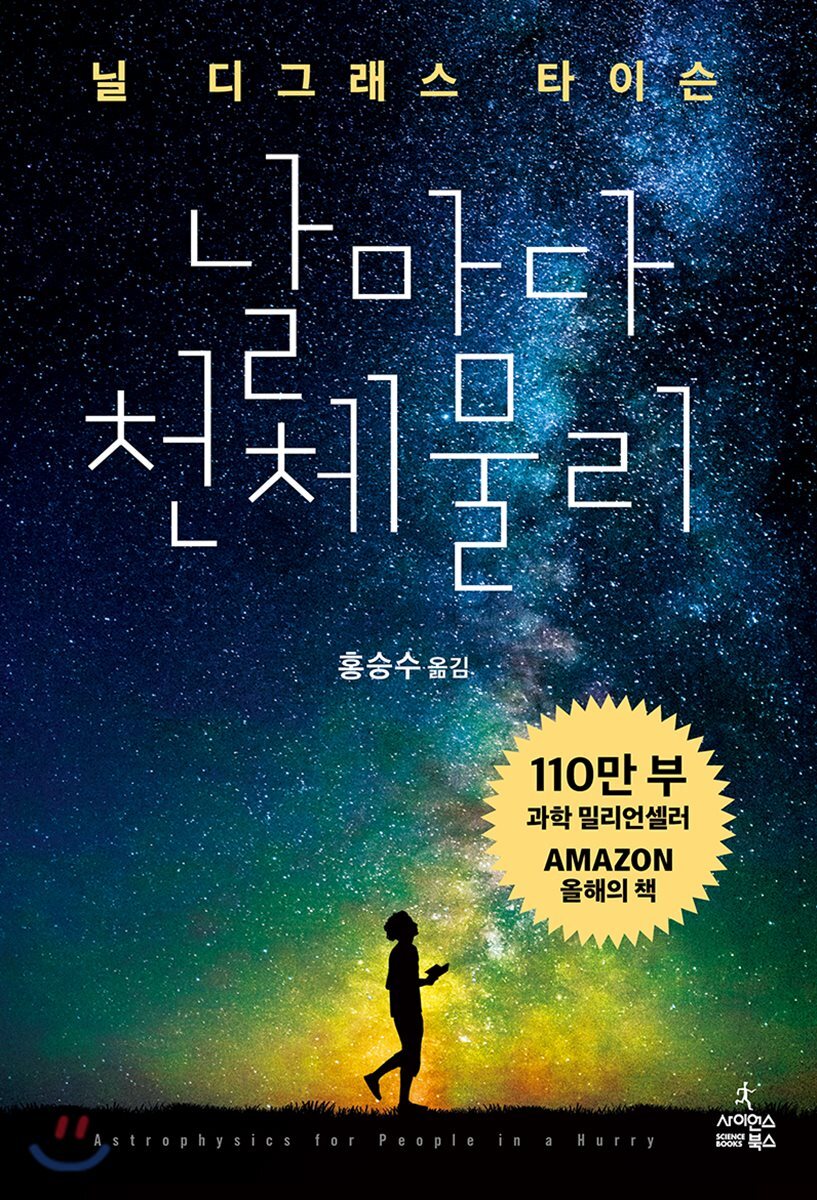
Astrophysics every day
 |
Description
Book Introduction
- A word from MD
-
A Short Astrophysics Lecture for Busy Modern PeopleThis book is perfect for readers who are curious about space but find it difficult to pick up a heavy book.
The author, who is considered the successor to Carl Sagan, provides fundamental knowledge of astrophysics through this book and, based on this, provides an opportunity to foster a greater desire for the universe.
March 9, 2018. Natural Science PD Park Hyung-wook
The long-awaited domestic release of the 21st century's first astronomy million-seller, which sold 1.1 million copies in just six months and was translated and published in 33 countries around the world!
2017 Amazon Book of the Year
Goodreads Readers' Choice Books of the Year 2017
New York Times bestseller for 30 consecutive weeks
Science books are a hot topic in our publishing world these days.
In addition to existing popular fields such as quantum mechanics, evolutionary biology, and neuroscience, many domestically produced books by authors from various scientific fields are being published, and the response from readers is not bad, so we often hear the term "science book renaissance."
It is encouraging to see that the "popularization of science and the popularization of science," which scientists have long talked about, is spreading, especially in the publishing industry.
This phenomenon is not limited to Korea.
It seems that the popularization of science and the scientificization of the public are rapidly progressing worldwide.
New phenomena such as the AlphaGo craze, the Fourth Industrial Revolution, and the popularization of genetic editing are simultaneously spreading and being consumed through networks connecting the entire world and all of humanity, raising global interest in science and technology in general.
Published in May 2017, Neil deGrasse Tyson's Astrophysics for People in a Hurry, the first astronomy million-seller of the 21st century, sold 1.1 million copies in just six months and was translated and published in 33 countries around the world, is also a book at the center of this trend.
This book, which introduces the core concepts of astrophysics, which has made remarkable progress in the 21st century, divided into 12 chapters, has maintained its position on the New York Times bestseller list since its publication, and has been receiving enthusiastic responses, including being selected as the 2017 Amazon Book of the Year and the 2017 Goodreads Readers' Choice Book of the Year in the Science category.
Even on the Amazon wish list, it ranked 4th, beating out Yuval Harari's Sapiens.
What is the reason for this popularity? It must be the longing for the universe and the thirst for knowledge inherent in human nature.
2017 Amazon Book of the Year
Goodreads Readers' Choice Books of the Year 2017
New York Times bestseller for 30 consecutive weeks
Science books are a hot topic in our publishing world these days.
In addition to existing popular fields such as quantum mechanics, evolutionary biology, and neuroscience, many domestically produced books by authors from various scientific fields are being published, and the response from readers is not bad, so we often hear the term "science book renaissance."
It is encouraging to see that the "popularization of science and the popularization of science," which scientists have long talked about, is spreading, especially in the publishing industry.
This phenomenon is not limited to Korea.
It seems that the popularization of science and the scientificization of the public are rapidly progressing worldwide.
New phenomena such as the AlphaGo craze, the Fourth Industrial Revolution, and the popularization of genetic editing are simultaneously spreading and being consumed through networks connecting the entire world and all of humanity, raising global interest in science and technology in general.
Published in May 2017, Neil deGrasse Tyson's Astrophysics for People in a Hurry, the first astronomy million-seller of the 21st century, sold 1.1 million copies in just six months and was translated and published in 33 countries around the world, is also a book at the center of this trend.
This book, which introduces the core concepts of astrophysics, which has made remarkable progress in the 21st century, divided into 12 chapters, has maintained its position on the New York Times bestseller list since its publication, and has been receiving enthusiastic responses, including being selected as the 2017 Amazon Book of the Year and the 2017 Goodreads Readers' Choice Book of the Year in the Science category.
Even on the Amazon wish list, it ranked 4th, beating out Yuval Harari's Sapiens.
What is the reason for this popularity? It must be the longing for the universe and the thirst for knowledge inherent in human nature.
- You can preview some of the book's contents.
Preview
index
Starting the book… … … 7
1 The greatest story in human history… … … 15
2 As in heaven, so on earth… … … 33
3 Let there be light… … … 48
4 Between galaxies and galaxies… … … 62
5 Dark Matter… … … 78
6 Dark Energy … … … 99
7 The Universe in the Periodic Table… … … 121
8 The Hidden Role of Gravity in Spherical Celestial Bodies… … … 140
9 Invisible Light … … … 155
10 Between the planets and the planets… … … 175
11 In search of Earth's twin... ... ... 190
12 See cosmically and think cosmically… … … 207
Acknowledgments … … … 226
Search … … … 227
1 The greatest story in human history… … … 15
2 As in heaven, so on earth… … … 33
3 Let there be light… … … 48
4 Between galaxies and galaxies… … … 62
5 Dark Matter… … … 78
6 Dark Energy … … … 99
7 The Universe in the Periodic Table… … … 121
8 The Hidden Role of Gravity in Spherical Celestial Bodies… … … 140
9 Invisible Light … … … 155
10 Between the planets and the planets… … … 175
11 In search of Earth's twin... ... ... 190
12 See cosmically and think cosmically… … … 207
Acknowledgments … … … 226
Search … … … 227
Publisher's Review
While almost every field of science is making tremendous progress today, astrophysics remains at the pinnacle of advancement.
I think I know why.
We all look up at the night sky sometimes and ask ourselves:
What does that dark sky imply? What are the principles and mechanisms of this world? What place do I occupy in the universe? These are questions that everyone asks about their own fundamental nature.
Your daily life is probably too busy to attend science lectures, study textbooks, or immerse yourself in science documentaries to fully understand the inner workings of the universe.
Even though you have to navigate each day under the pressure of time, you want to be informed about at least the essentials of what's happening in the field of cosmic exploration, namely, at the forefront of astrophysics.
This may be because we want to find meaningful answers to the questions raised above.
If so, I recommend you open this book, Astrophysics for People in a Hurry.
I wrote this short book to guide everyone living in the modern world to a fundamental understanding of the core ideas of astrophysics and the great discoveries made by humanity in recent years.
If my goal is successful, you will have acquired almost all the knowledge that an educated person needs to know in my field of expertise.
If I am truly successful, your yearning for the universe will become deeper and stronger after reading this book. - From the text
I'm too busy to read a thick book
For all modern people who always miss space
Carl Sagan's successor to Cosmos
Neil deGrasse Tyson's Gift
Astronomer with 12 million Twitter followers
Discover's "10 Most Influential Scientists"
People Magazine's "Sexiest Living Astronomer"
Star host of the Emmy Award-winning series Cosmos: A Spacetime Odyssey
Neil deGrasse Tyson
Recently, an article was reported that the James Webb Space Telescope, which will observe the cosmos from Lagrange point 2, 1.5 million kilometers above the ground, has entered the final assembly stage.
The generational change of space telescopes, represented by the Hubble Space Telescope, is in full swing.
Launched in 2019, this ultra-large space telescope, which will expand our observation range to deep space, 200 million years after the Big Bang, is expected to bring about revolutionary changes not only in astronomy but also in all natural sciences, including physics, biology, and chemistry, as well as in space technology.
It may even trigger a new 'Copernican Revolution', a new event that will once again shake up humanity's position in the cosmic perspective.
In this way, modern astronomy is at the forefront of modern science.
In particular, since the 2000s, the status of astronomy and astrophysics in the scientific community has been rising, with six Nobel Prizes in Physics being awarded in the field of astrophysics alone, which explains and predicts astronomical phenomena using physical theories.
However, it is true that there are not many books that introduce the core concepts and overall picture of modern astrophysics in an easy-to-understand manner for the general public.
Neil deGrasse Tyson's 『Everyday Astrophysics』, recently published by Science Books, will be a great gift for busy modern people who struggle to live each day, pushed by time, by satisfying this very intellectual thirst.
Neil deGrasse Tyson, who is famous among domestic readers as the narrator of the 2014 television documentary "Cosmos: A Spacetime Odyssey," is considered the most beloved astronomer in the United States after Carl Sagan.
He was named one of the "10 Most Influential Scientists" by Discover magazine and the "Sexiest Astronomer Alive" by People magazine, but his popularity is evidenced by his 11.7 million Twitter followers.
Neil Tyson, who has been active on Twitter since the early days of the platform, is a communicator and storyteller of science and knowledge, speaking out on a wide range of scientific issues, from astronomy to politics and social issues.
Translator of 『Cosmos』
Translated by Professor Hong Seung-su, a senior astronomer
The forefront of modern astronomy
This book is divided into 12 chapters.
Chapter 1, “The Greatest Story in Human History,” which outlines the history of the evolution of the universe since the Big Bang; Chapter 2, “On Earth as in Heaven,” which explains the universality of physical laws that Newtonian mechanics and the theory of relativity discovered on Earth, and quantum mechanics apply even to solitary celestial bodies billions of light-years away; Chapter 3, “Let There Be Light,” which explains the microwave cosmic background radiation, which can be considered a physiognomic map of the universe; Chapter 4, “Between Galaxies,” which explains the scientific significance of intergalactic space, which appears empty to our eyes; Chapter 5, “Dark Matter,” which deals with the mystery of invisible dark matter and dark energy that create cosmic structures such as galaxies and govern the speed of cosmic expansion; Chapter 6, “Dark Energy,” which explains the cosmic origin of chemical substances and the influence of gravity on celestial phenomena; Chapter 7, “The Universe in the Periodic Table,” which explains the cosmic origin of chemical substances and the influence of gravity on celestial phenomena; Chapter 8, “The Hidden Role of Gravity in Spherical Celestial Bodies,” and Chapter 9, “The Invisible,” which introduces various electromagnetic waves as a means of observation in astrophysics. Chapter 10 @Between Planets@@ and Chapter 11 @In Search of Earth's Twin@@ introduces the history and structure of the formation of the solar system, and the study of exoplanets outside the solar system, and the core concepts of modern astrophysics and current research achievements and tasks are comprehensively organized.
And finally, in Chapter 12 @See Cosmically and Think Cosmically@@, we explain the wisdom and inspiration that a cosmological perspective can give us.
This book is the alpha and omega of modern astronomy, told by the world's sexiest and most beloved astrophysicist.
It will be the ultimate guide to questions such as what is the nature of space and time, what is the meaning of our existence in the universe, what do we know and what will we know in the future?
In fact, in today's busy world, few of us have time to contemplate the cosmos.
That's why many people consider science, including astronomy, as something of the world that has nothing to do with us.
But Neil deGrasse Tyson brings the universe down to Earth.
Readers of this book, which weaves together lively sentences and clear information to create a world of astrophysics, can conveniently open to any chapter and read it anytime, anywhere.
Whether you're waiting for your morning coffee, waiting for a bus, train, or even a plane, you can read this book and imagine what the next space-related headline will be.
From the Big Bang to black holes, from quarks to quantum physics, and even the exploration of planets and life in the universe, a wealth of science is packed into this small book.
A cosmic perspective reminds us that all life on Earth is deeply intertwined with one another.
Moreover, it teaches us that the unknown life forms that will be discovered in the universe in the future could be our blood relatives, having the same chemical identity as us.
Ultimately, it makes us realize that the roots of humanity reach all the way to the universe. - From the text
I think I know why.
We all look up at the night sky sometimes and ask ourselves:
What does that dark sky imply? What are the principles and mechanisms of this world? What place do I occupy in the universe? These are questions that everyone asks about their own fundamental nature.
Your daily life is probably too busy to attend science lectures, study textbooks, or immerse yourself in science documentaries to fully understand the inner workings of the universe.
Even though you have to navigate each day under the pressure of time, you want to be informed about at least the essentials of what's happening in the field of cosmic exploration, namely, at the forefront of astrophysics.
This may be because we want to find meaningful answers to the questions raised above.
If so, I recommend you open this book, Astrophysics for People in a Hurry.
I wrote this short book to guide everyone living in the modern world to a fundamental understanding of the core ideas of astrophysics and the great discoveries made by humanity in recent years.
If my goal is successful, you will have acquired almost all the knowledge that an educated person needs to know in my field of expertise.
If I am truly successful, your yearning for the universe will become deeper and stronger after reading this book. - From the text
I'm too busy to read a thick book
For all modern people who always miss space
Carl Sagan's successor to Cosmos
Neil deGrasse Tyson's Gift
Astronomer with 12 million Twitter followers
Discover's "10 Most Influential Scientists"
People Magazine's "Sexiest Living Astronomer"
Star host of the Emmy Award-winning series Cosmos: A Spacetime Odyssey
Neil deGrasse Tyson
Recently, an article was reported that the James Webb Space Telescope, which will observe the cosmos from Lagrange point 2, 1.5 million kilometers above the ground, has entered the final assembly stage.
The generational change of space telescopes, represented by the Hubble Space Telescope, is in full swing.
Launched in 2019, this ultra-large space telescope, which will expand our observation range to deep space, 200 million years after the Big Bang, is expected to bring about revolutionary changes not only in astronomy but also in all natural sciences, including physics, biology, and chemistry, as well as in space technology.
It may even trigger a new 'Copernican Revolution', a new event that will once again shake up humanity's position in the cosmic perspective.
In this way, modern astronomy is at the forefront of modern science.
In particular, since the 2000s, the status of astronomy and astrophysics in the scientific community has been rising, with six Nobel Prizes in Physics being awarded in the field of astrophysics alone, which explains and predicts astronomical phenomena using physical theories.
However, it is true that there are not many books that introduce the core concepts and overall picture of modern astrophysics in an easy-to-understand manner for the general public.
Neil deGrasse Tyson's 『Everyday Astrophysics』, recently published by Science Books, will be a great gift for busy modern people who struggle to live each day, pushed by time, by satisfying this very intellectual thirst.
Neil deGrasse Tyson, who is famous among domestic readers as the narrator of the 2014 television documentary "Cosmos: A Spacetime Odyssey," is considered the most beloved astronomer in the United States after Carl Sagan.
He was named one of the "10 Most Influential Scientists" by Discover magazine and the "Sexiest Astronomer Alive" by People magazine, but his popularity is evidenced by his 11.7 million Twitter followers.
Neil Tyson, who has been active on Twitter since the early days of the platform, is a communicator and storyteller of science and knowledge, speaking out on a wide range of scientific issues, from astronomy to politics and social issues.
Translator of 『Cosmos』
Translated by Professor Hong Seung-su, a senior astronomer
The forefront of modern astronomy
This book is divided into 12 chapters.
Chapter 1, “The Greatest Story in Human History,” which outlines the history of the evolution of the universe since the Big Bang; Chapter 2, “On Earth as in Heaven,” which explains the universality of physical laws that Newtonian mechanics and the theory of relativity discovered on Earth, and quantum mechanics apply even to solitary celestial bodies billions of light-years away; Chapter 3, “Let There Be Light,” which explains the microwave cosmic background radiation, which can be considered a physiognomic map of the universe; Chapter 4, “Between Galaxies,” which explains the scientific significance of intergalactic space, which appears empty to our eyes; Chapter 5, “Dark Matter,” which deals with the mystery of invisible dark matter and dark energy that create cosmic structures such as galaxies and govern the speed of cosmic expansion; Chapter 6, “Dark Energy,” which explains the cosmic origin of chemical substances and the influence of gravity on celestial phenomena; Chapter 7, “The Universe in the Periodic Table,” which explains the cosmic origin of chemical substances and the influence of gravity on celestial phenomena; Chapter 8, “The Hidden Role of Gravity in Spherical Celestial Bodies,” and Chapter 9, “The Invisible,” which introduces various electromagnetic waves as a means of observation in astrophysics. Chapter 10 @Between Planets@@ and Chapter 11 @In Search of Earth's Twin@@ introduces the history and structure of the formation of the solar system, and the study of exoplanets outside the solar system, and the core concepts of modern astrophysics and current research achievements and tasks are comprehensively organized.
And finally, in Chapter 12 @See Cosmically and Think Cosmically@@, we explain the wisdom and inspiration that a cosmological perspective can give us.
This book is the alpha and omega of modern astronomy, told by the world's sexiest and most beloved astrophysicist.
It will be the ultimate guide to questions such as what is the nature of space and time, what is the meaning of our existence in the universe, what do we know and what will we know in the future?
In fact, in today's busy world, few of us have time to contemplate the cosmos.
That's why many people consider science, including astronomy, as something of the world that has nothing to do with us.
But Neil deGrasse Tyson brings the universe down to Earth.
Readers of this book, which weaves together lively sentences and clear information to create a world of astrophysics, can conveniently open to any chapter and read it anytime, anywhere.
Whether you're waiting for your morning coffee, waiting for a bus, train, or even a plane, you can read this book and imagine what the next space-related headline will be.
From the Big Bang to black holes, from quarks to quantum physics, and even the exploration of planets and life in the universe, a wealth of science is packed into this small book.
A cosmic perspective reminds us that all life on Earth is deeply intertwined with one another.
Moreover, it teaches us that the unknown life forms that will be discovered in the universe in the future could be our blood relatives, having the same chemical identity as us.
Ultimately, it makes us realize that the roots of humanity reach all the way to the universe. - From the text
GOODS SPECIFICS
- Date of publication: February 28, 2018
- Page count, weight, size: 232 pages | 310g | 130*188*20mm
- ISBN13: 9788983717771
- ISBN10: 8983717777
You may also like
카테고리
korean


korean

![GQ KOREA Mark (Monthly): December [2025]](http://librairie.coreenne.fr/cdn/shop/files/8ef265dbbfbf186523ed75ba7319009d.jpg?v=1765340328&width=3840)


