

comet
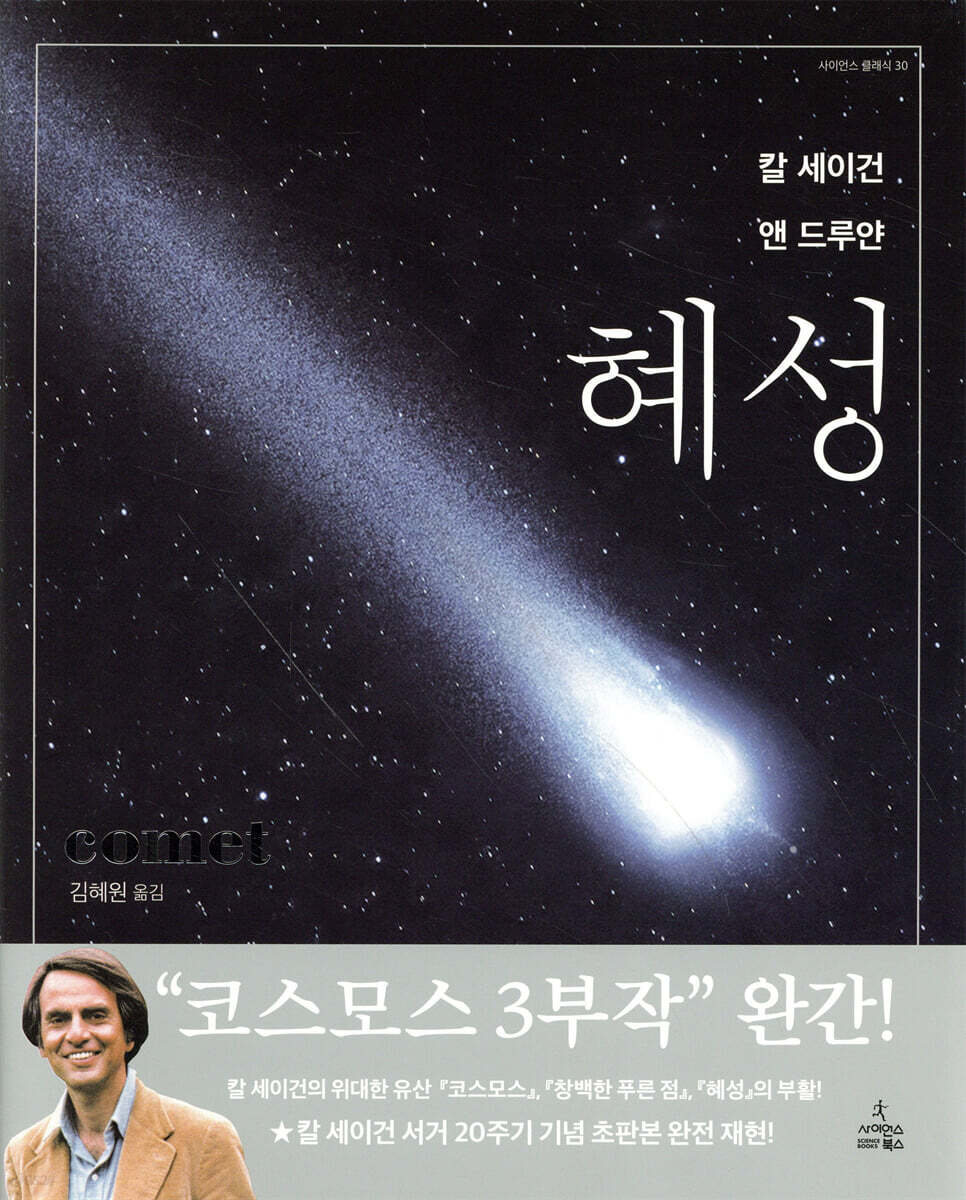 |
Description
Book Introduction
The wonders of the night sky revealed by the spirit of scientific inquiry
A complete reproduction of the first edition commemorating the 20th anniversary of Carl Sagan's death.
Comets are one of the greatest spectacles to be witnessed in the night sky in human history.
In the wake of the comet, fear and dread, myth and prophecy, poetry and painting, and curiosity and questions were left behind.
In particular, scientists highly value the scientific value of comets as living evidence of Newtonian mechanics, as fossils of the cosmos that preserve the original materials of the solar system, and as fairies that delivered the seeds of life to Earth.
Above all, comets remind us of the intimate connection between our tiny human existence on Earth and the vast cosmos.
The book "Comet" encompasses all scientific knowledge about comets, as well as history, humanities, art, and culture.
Written by Carl Sagan, author of the international bestseller Cosmos, with his wife, Ann Druyan, the renowned producer of the science documentary Cosmos (1980, 2014).
The recently published 『Comet』 is a new translation of the first edition published on December 20, 2016, to commemorate the 20th anniversary of Carl Sagan's death. It contains richer content and more color illustrations than the revised edition introduced in Korea in 2003.
If 『Cosmos』 is a map that outlines the entire universe, and 『Pale Blue Dot』 is a voyage record of the age of space exploration, 『Comet』 can be said to be an autobiography of humanity that overcame the age of superstition and blind faith, and the genesis of the universe revealed by the spirit of scientific inquiry.
In this book, "Comet," which forms part of Carl Sagan's "Cosmos Trilogy" along with "Cosmos" and "Pale Blue Dot," you can experience Carl Sagan's timeless imagination and deep insight in a beautiful and elegant style.
A complete reproduction of the first edition commemorating the 20th anniversary of Carl Sagan's death.
Comets are one of the greatest spectacles to be witnessed in the night sky in human history.
In the wake of the comet, fear and dread, myth and prophecy, poetry and painting, and curiosity and questions were left behind.
In particular, scientists highly value the scientific value of comets as living evidence of Newtonian mechanics, as fossils of the cosmos that preserve the original materials of the solar system, and as fairies that delivered the seeds of life to Earth.
Above all, comets remind us of the intimate connection between our tiny human existence on Earth and the vast cosmos.
The book "Comet" encompasses all scientific knowledge about comets, as well as history, humanities, art, and culture.
Written by Carl Sagan, author of the international bestseller Cosmos, with his wife, Ann Druyan, the renowned producer of the science documentary Cosmos (1980, 2014).
The recently published 『Comet』 is a new translation of the first edition published on December 20, 2016, to commemorate the 20th anniversary of Carl Sagan's death. It contains richer content and more color illustrations than the revised edition introduced in Korea in 2003.
If 『Cosmos』 is a map that outlines the entire universe, and 『Pale Blue Dot』 is a voyage record of the age of space exploration, 『Comet』 can be said to be an autobiography of humanity that overcame the age of superstition and blind faith, and the genesis of the universe revealed by the spirit of scientific inquiry.
In this book, "Comet," which forms part of Carl Sagan's "Cosmos Trilogy" along with "Cosmos" and "Pale Blue Dot," you can experience Carl Sagan's timeless imagination and deep insight in a beautiful and elegant style.
- You can preview some of the book's contents.
Preview
index
Introduction - Visitors from the Shining Sky 9
Part 1: The Nature of Comets
Chapter 1: Sitting on a Comet 17
Chapter 2: Ominous Signs 29
Chapter 3 Halley 57
Chapter 4: Time of Return 99
Chapter 5: Wandering Comets 125
Chapter 6 Ice 141
Chapter 7: Comet Structure 165
Chapter 8: Toxic Gases and Organic Substances 187
Chapter 9 Tail 207
Chapter 10: Comets Collection 227
Part 2: The Origin and Fate of Comets
Chapter 11: In the Heart of Countless Worlds 249
Chapter 12: Monuments of Creation 265
Chapter 13: Ghosts of Past Comets 287
Chapter 14: Scattered Fire and Shattered Worlds 311
Chapter 15: The Great Death 347
Chapter 16: Modern Mythology 371
Chapter 17: The World of Reasoning 391
Part 3: Comets and the Future
Chapter 18: The Appearance of the Flotilla 413
Chapter 19: The Stars of Great Captains 433
Chapter 20 A Handful of Dust 459
Appendix 471
Translator's Note - Comet Returns 475
Reference 477
Search 484
Part 1: The Nature of Comets
Chapter 1: Sitting on a Comet 17
Chapter 2: Ominous Signs 29
Chapter 3 Halley 57
Chapter 4: Time of Return 99
Chapter 5: Wandering Comets 125
Chapter 6 Ice 141
Chapter 7: Comet Structure 165
Chapter 8: Toxic Gases and Organic Substances 187
Chapter 9 Tail 207
Chapter 10: Comets Collection 227
Part 2: The Origin and Fate of Comets
Chapter 11: In the Heart of Countless Worlds 249
Chapter 12: Monuments of Creation 265
Chapter 13: Ghosts of Past Comets 287
Chapter 14: Scattered Fire and Shattered Worlds 311
Chapter 15: The Great Death 347
Chapter 16: Modern Mythology 371
Chapter 17: The World of Reasoning 391
Part 3: Comets and the Future
Chapter 18: The Appearance of the Flotilla 413
Chapter 19: The Stars of Great Captains 433
Chapter 20 A Handful of Dust 459
Appendix 471
Translator's Note - Comet Returns 475
Reference 477
Search 484
Detailed image
.jpg)
Publisher's Review
★The revival of Carl Sagan's great legacy: Cosmos, Pale Blue Dot, and Comet!
★ Complete reproduction of the first edition commemorating the 20th anniversary of Carl Sagan's death
★ Includes over 350 illustrations, including masterpieces by John Romberg, the artist behind "Cosmos."
A visitor shining in the darkness
A space journey with a comet
A classic work on comets, already a scientific classic - Byun Yong-ik | Professor, Department of Astronomy and Space Science, Yonsei University
The giant Comet Sagan-Druyan, which contains almost all the stories and science about comets, has arrived.
― Lee Myeong-hyeon | Astronomer and science writer
The story of life and death, frozen in a cold comet for 5 billion years, is captured in the authors' passion.
— Yoon Seong-cheol | Professor, Department of Physics and Astronomy, Seoul National University
『Comet』 is a book that excites me with all kinds of imagination.
— Seungwoo Son | Professor, Department of Applied Physics, Hanyang University
As we seek to understand the comet's journey, our own short journey will also be enriched.
― Jeong Se-rang | Science Fiction Writer
A book containing the diplomatic records of humanity and the comet, an envoy who arrives, meets the gaze, and departs, embracing the outer space. ― Kim Chang-gyu | Science Fiction Writer
The European Space Agency's (ESA) Rosetta spacecraft, which launched in 2004 carrying the Philae rover, officially ended its mission to Comet 67P/Churyumov-Gerasimenko on September 30, 2016.
Rosetta was the first cometary probe to land on the surface of a comet. Just as the Rosetta Stone provided crucial clues to deciphering Egyptian hieroglyphs, Rosetta's cometary exploration provided a wealth of scientific information about the evolution of the solar system and the origin of life.
Comets are one of the greatest spectacles to be witnessed in the night sky in human history.
In the wake of the comet, fear and dread, myth and prophecy, poetry and painting, and curiosity and questions were left behind.
In particular, scientists highly value the scientific value of comets as living evidence of Newtonian mechanics, as fossils of the cosmos that preserve the original materials of the solar system, and as fairies that delivered the seeds of life to Earth.
Above all, comets remind us of the intimate connection between our tiny human existence on Earth and the vast cosmos.
This book, 『Comet』, published by Science Books, covers all scientific knowledge about comets, as well as history, humanities, art, and culture.
Written by Carl Sagan, author of the international bestseller Cosmos, with his wife, Ann Druyan, the renowned producer of the science documentary Cosmos (1980, 2014).
The recently published 『Comet』 is a new translation of the first edition (Random House, 1985) to commemorate the 20th anniversary of Carl Sagan's death on December 20, 2016. It contains richer content and more color illustrations than the revised edition (Valentine Publishing, 1997) introduced in Korea in 2003.
If 『Cosmos』 is a map that outlines the entire universe, and 『Pale Blue Dot』 is a voyage record of the age of space exploration, 『Comet』 can be said to be an autobiography of humanity that overcame the age of superstition and blind faith, and the genesis of the universe revealed by the spirit of scientific inquiry.
In this book, "Comet," which forms part of Carl Sagan's "Cosmos Trilogy" along with "Cosmos" and "Pale Blue Dot," readers can encounter Carl Sagan's timeless imagination and profound insight in a beautiful and elegant style.
Comets: A Revelation from God or a Product of Natural Law?
The wonders of the night sky revealed by the spirit of scientific inquiry
For thousands of years, comets were viewed by the public as ominous omens, symbols, and demons, the preserve of mystics rather than as real entities.
But Halley completely shattered this monopoly by winning the game of prediction, which no scientist had ever done before.
― In the text
『Comet』 is largely divided into three parts.
Part 1, "The Nature of Comets," introduces the process by which comets, long objects of superstition and fear, became subjects of scientific inquiry through the efforts and passion of great scientists who were fascinated by comets, and the structure and components of comets that science revealed.
First, in Chapter 1, “Sitting on a Comet,” a virtual trip through the solar system with a comet unfolds like a drama.
Chapter 2, "Ominous Signs," describes how comets, which had been regarded as harbingers of fear, superstition, dread, and disaster in various cultures since ancient times, were incorporated into the realm of science through the research and insights of pioneers such as Democritus, Apollonius, and Seneca.
Chapter 3, "Halley," sheds new light on Edmond Halley, the British astronomer who not only led the publication of the Principia as Newton's assistant, but also discovered the existence of Halley's Comet and predicted its return by analyzing the orbits of comets using Newton's laws of motion.
Chapter 4, "The Time of Return," announces the triumph of science over superstition with Halley's Comet returning as predicted.
By Chapter 5, "Wandering Comets," humanity has come to understand, through scientific reasoning, that comets are not meteorological phenomena occurring in the Earth's atmosphere or celestial bodies ejected from Jupiter, but rather interstellar messengers visiting Earth from the outskirts of the solar system.
Chapter 6, "Ice," traces the roots of the idea that comets have solid icy cores.
Chapter 7, “Comet Structure,” then provides a detailed explanation of the anatomical structure of the comet’s nucleus, coma, and jets, based on the ice core model proven through modern astronomical observations.
Chapter 8, "Toxic Gases and Organic Matter," discusses the composition of comets as revealed by analysis of the spectra of their comas and tails.
An episode that adds to the fun is the absurd doomsday theory that terrified the entire world in the early 20th century due to cyanide discovered in a comet's tail.
Chapter 9, “Tails,” explains the characteristics of the two tails found in comets—the ion tail and the dust tail—and their scientific significance—the existence and activity of the solar wind.
Chapter 10, "Comet Collection," presents drawings of comets by astronomers from various periods and regions, and the natural history of comets inferred from ancient records and artifacts.
From the formation of the solar system to the birth of life
The Return of the Time Capsule That Will Unravel the Mysteries of the Universe
Comets are cosmic fairies that race through space, bringing the seeds of life to worlds in our solar system and countless other worlds.
― In the text
Part 2, “The Origin and Fate of Comets,” explains the creation and destruction of comets in relation to the evolution and mass extinction of the solar system, respectively.
First, Chapter 11, “In the Heart of Innumerable Worlds,” introduces the idea of the Oort cloud, a huge comet warehouse surrounding the outskirts of the solar system, and Chapter 12, “Monuments of Creation,” explains the birth of comets and the formation of the Oort cloud based on the Kant-Laplace hypothesis that the solar system was created from the condensation of the solar nebula.
Chapter 13, "Ghosts of Past Comets," suggests that collecting and analyzing debris particles from comets that appear as beautiful meteor showers in the stratosphere can provide clues about the composition of comets and the origins of the solar system.
Chapter 14, "Scattered Fires and Shattered Worlds," shows the fate of comets, which either collide with the Sun, planets, or satellites and disappear, or become non-volatile rocky asteroids through successive perihelion passes.
Chapter 15, "The Great Death," discusses the possibility that mass extinctions on Earth were linked to comet impacts, and Chapter 16, "Modern Myths," examines several hypotheses regarding the mechanisms underlying the "comet showers" that cause periodic mass extinctions.
Chapter 17, "The World of Inference," discusses the biological role of comets in delivering the building blocks of life.
Comets may act as creators, protectors, and destroyers of life on Earth.
… …that is, as the being that brought the material of life to Earth, as the being that created the oceans, as the mediator that eliminated competitors and made possible the success of our mammalian ancestors, as the forward base of a possible future for our species, and as the being that gives timely hints about large-scale explosions and the climate of Earth.
― In the text
Part 3, “Comets and the Future,” discusses the value, significance, and prospects of comets in the age of space exploration.
Chapter 18, "The Fleet Appears," introduces exploration plans for Halley's Comet, which was scheduled to return in 1985-1986.
Chapter 19, "The Stars of the Great Captains," explores the potential uses of comets, including destroying or redirecting comets that pose a threat to Earth, extracting resources from them, and using them as forward bases for space colonization.
Finally, Chapter 20, "A Handful of Dust," recognizes the preciousness of life on Earth and human civilization, born through a turbulent history, and urges us to take responsibility and a sense of mission for a sustainable future.
Although more than 30 years have passed since the first edition was published, the knowledge and value contained in this book remain relevant.
It's proof that the insights and imagination of Carl Sagan and Ann Druyan are grounded in solid science.
Readers will be able to enjoy a new perspective on the universe through this book, which will shed new light on comets.
Simply put, it's the best.
― The London Times
A fun and inspiring book.
― The Washington Post
Comets have brought humanity to science.
It's a beautiful and interesting book.
―International Joint Press
This is the work of a master.
A fusion of science, poetry, and imagination.
― Atlanta Journal and Constitution
★ Complete reproduction of the first edition commemorating the 20th anniversary of Carl Sagan's death
★ Includes over 350 illustrations, including masterpieces by John Romberg, the artist behind "Cosmos."
A visitor shining in the darkness
A space journey with a comet
A classic work on comets, already a scientific classic - Byun Yong-ik | Professor, Department of Astronomy and Space Science, Yonsei University
The giant Comet Sagan-Druyan, which contains almost all the stories and science about comets, has arrived.
― Lee Myeong-hyeon | Astronomer and science writer
The story of life and death, frozen in a cold comet for 5 billion years, is captured in the authors' passion.
— Yoon Seong-cheol | Professor, Department of Physics and Astronomy, Seoul National University
『Comet』 is a book that excites me with all kinds of imagination.
— Seungwoo Son | Professor, Department of Applied Physics, Hanyang University
As we seek to understand the comet's journey, our own short journey will also be enriched.
― Jeong Se-rang | Science Fiction Writer
A book containing the diplomatic records of humanity and the comet, an envoy who arrives, meets the gaze, and departs, embracing the outer space. ― Kim Chang-gyu | Science Fiction Writer
The European Space Agency's (ESA) Rosetta spacecraft, which launched in 2004 carrying the Philae rover, officially ended its mission to Comet 67P/Churyumov-Gerasimenko on September 30, 2016.
Rosetta was the first cometary probe to land on the surface of a comet. Just as the Rosetta Stone provided crucial clues to deciphering Egyptian hieroglyphs, Rosetta's cometary exploration provided a wealth of scientific information about the evolution of the solar system and the origin of life.
Comets are one of the greatest spectacles to be witnessed in the night sky in human history.
In the wake of the comet, fear and dread, myth and prophecy, poetry and painting, and curiosity and questions were left behind.
In particular, scientists highly value the scientific value of comets as living evidence of Newtonian mechanics, as fossils of the cosmos that preserve the original materials of the solar system, and as fairies that delivered the seeds of life to Earth.
Above all, comets remind us of the intimate connection between our tiny human existence on Earth and the vast cosmos.
This book, 『Comet』, published by Science Books, covers all scientific knowledge about comets, as well as history, humanities, art, and culture.
Written by Carl Sagan, author of the international bestseller Cosmos, with his wife, Ann Druyan, the renowned producer of the science documentary Cosmos (1980, 2014).
The recently published 『Comet』 is a new translation of the first edition (Random House, 1985) to commemorate the 20th anniversary of Carl Sagan's death on December 20, 2016. It contains richer content and more color illustrations than the revised edition (Valentine Publishing, 1997) introduced in Korea in 2003.
If 『Cosmos』 is a map that outlines the entire universe, and 『Pale Blue Dot』 is a voyage record of the age of space exploration, 『Comet』 can be said to be an autobiography of humanity that overcame the age of superstition and blind faith, and the genesis of the universe revealed by the spirit of scientific inquiry.
In this book, "Comet," which forms part of Carl Sagan's "Cosmos Trilogy" along with "Cosmos" and "Pale Blue Dot," readers can encounter Carl Sagan's timeless imagination and profound insight in a beautiful and elegant style.
Comets: A Revelation from God or a Product of Natural Law?
The wonders of the night sky revealed by the spirit of scientific inquiry
For thousands of years, comets were viewed by the public as ominous omens, symbols, and demons, the preserve of mystics rather than as real entities.
But Halley completely shattered this monopoly by winning the game of prediction, which no scientist had ever done before.
― In the text
『Comet』 is largely divided into three parts.
Part 1, "The Nature of Comets," introduces the process by which comets, long objects of superstition and fear, became subjects of scientific inquiry through the efforts and passion of great scientists who were fascinated by comets, and the structure and components of comets that science revealed.
First, in Chapter 1, “Sitting on a Comet,” a virtual trip through the solar system with a comet unfolds like a drama.
Chapter 2, "Ominous Signs," describes how comets, which had been regarded as harbingers of fear, superstition, dread, and disaster in various cultures since ancient times, were incorporated into the realm of science through the research and insights of pioneers such as Democritus, Apollonius, and Seneca.
Chapter 3, "Halley," sheds new light on Edmond Halley, the British astronomer who not only led the publication of the Principia as Newton's assistant, but also discovered the existence of Halley's Comet and predicted its return by analyzing the orbits of comets using Newton's laws of motion.
Chapter 4, "The Time of Return," announces the triumph of science over superstition with Halley's Comet returning as predicted.
By Chapter 5, "Wandering Comets," humanity has come to understand, through scientific reasoning, that comets are not meteorological phenomena occurring in the Earth's atmosphere or celestial bodies ejected from Jupiter, but rather interstellar messengers visiting Earth from the outskirts of the solar system.
Chapter 6, "Ice," traces the roots of the idea that comets have solid icy cores.
Chapter 7, “Comet Structure,” then provides a detailed explanation of the anatomical structure of the comet’s nucleus, coma, and jets, based on the ice core model proven through modern astronomical observations.
Chapter 8, "Toxic Gases and Organic Matter," discusses the composition of comets as revealed by analysis of the spectra of their comas and tails.
An episode that adds to the fun is the absurd doomsday theory that terrified the entire world in the early 20th century due to cyanide discovered in a comet's tail.
Chapter 9, “Tails,” explains the characteristics of the two tails found in comets—the ion tail and the dust tail—and their scientific significance—the existence and activity of the solar wind.
Chapter 10, "Comet Collection," presents drawings of comets by astronomers from various periods and regions, and the natural history of comets inferred from ancient records and artifacts.
From the formation of the solar system to the birth of life
The Return of the Time Capsule That Will Unravel the Mysteries of the Universe
Comets are cosmic fairies that race through space, bringing the seeds of life to worlds in our solar system and countless other worlds.
― In the text
Part 2, “The Origin and Fate of Comets,” explains the creation and destruction of comets in relation to the evolution and mass extinction of the solar system, respectively.
First, Chapter 11, “In the Heart of Innumerable Worlds,” introduces the idea of the Oort cloud, a huge comet warehouse surrounding the outskirts of the solar system, and Chapter 12, “Monuments of Creation,” explains the birth of comets and the formation of the Oort cloud based on the Kant-Laplace hypothesis that the solar system was created from the condensation of the solar nebula.
Chapter 13, "Ghosts of Past Comets," suggests that collecting and analyzing debris particles from comets that appear as beautiful meteor showers in the stratosphere can provide clues about the composition of comets and the origins of the solar system.
Chapter 14, "Scattered Fires and Shattered Worlds," shows the fate of comets, which either collide with the Sun, planets, or satellites and disappear, or become non-volatile rocky asteroids through successive perihelion passes.
Chapter 15, "The Great Death," discusses the possibility that mass extinctions on Earth were linked to comet impacts, and Chapter 16, "Modern Myths," examines several hypotheses regarding the mechanisms underlying the "comet showers" that cause periodic mass extinctions.
Chapter 17, "The World of Inference," discusses the biological role of comets in delivering the building blocks of life.
Comets may act as creators, protectors, and destroyers of life on Earth.
… …that is, as the being that brought the material of life to Earth, as the being that created the oceans, as the mediator that eliminated competitors and made possible the success of our mammalian ancestors, as the forward base of a possible future for our species, and as the being that gives timely hints about large-scale explosions and the climate of Earth.
― In the text
Part 3, “Comets and the Future,” discusses the value, significance, and prospects of comets in the age of space exploration.
Chapter 18, "The Fleet Appears," introduces exploration plans for Halley's Comet, which was scheduled to return in 1985-1986.
Chapter 19, "The Stars of the Great Captains," explores the potential uses of comets, including destroying or redirecting comets that pose a threat to Earth, extracting resources from them, and using them as forward bases for space colonization.
Finally, Chapter 20, "A Handful of Dust," recognizes the preciousness of life on Earth and human civilization, born through a turbulent history, and urges us to take responsibility and a sense of mission for a sustainable future.
Although more than 30 years have passed since the first edition was published, the knowledge and value contained in this book remain relevant.
It's proof that the insights and imagination of Carl Sagan and Ann Druyan are grounded in solid science.
Readers will be able to enjoy a new perspective on the universe through this book, which will shed new light on comets.
Simply put, it's the best.
― The London Times
A fun and inspiring book.
― The Washington Post
Comets have brought humanity to science.
It's a beautiful and interesting book.
―International Joint Press
This is the work of a master.
A fusion of science, poetry, and imagination.
― Atlanta Journal and Constitution
GOODS SPECIFICS
- Date of publication: December 20, 2016
- Format: Hardcover book binding method guide
- Page count, weight, size: 488 pages | 1,856g | 205*255*34mm
- ISBN13: 9788983718174
- ISBN10: 898371817X
You may also like
카테고리
korean


korean

![ELLE 엘르 스페셜 에디션 A형 : 12월 [2025]](http://librairie.coreenne.fr/cdn/shop/files/b8e27a3de6c9538896439686c6b0e8fb.jpg?v=1766436872&width=3840)


