

Schrödinger's cat
 |
Description
Book Introduction
A physics journey to discover the origin of all things
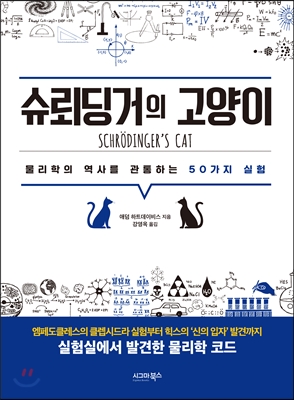
Following the publication of "Pavlov's Dog," which examined 50 experiments that have shaped the history of psychology, "Schrödinger's Cat," which covers the experiments of genius scientists who have illuminated physics for centuries, has been published.
Physics has a long history.
It is probably the oldest in the field of science.
People have always been curious about how all things work.
Unlike other fields, physics has been exploring the truth of the world through logic, reasoning, and especially experimentation.
These efforts by scientists are still ongoing even in modern times, when large-scale experiments are conducted at enormous cost.
Despite the enormous investment of money and manpower, there is no such thing as perfection in physics.
Even within facts that have already been verified through numerous experiments, new questions are always hidden.
Of course, even after finding the answer, another question will await.
Schrödinger's Cat, which reveals the secrets of everything that happens in the world, including space, time, black holes, the Big Bang, and existence, is a physics guidebook that allows you to learn about the achievements and theories of great scientists from classical to modern physics.
A collection of fascinating questions about the world and the answers they offer, as expressed by genius scientists representing the times.
From Empedocles' bucket experiment to Peter Higgs' discovery of the 'God particle', you can see the history of physics that spans the ages at a glance through 50 experiments organized by era.
Additionally, it makes the history of physics, which can easily feel boring, interesting through various illustrations and vivid anecdotes.
Following the publication of "Pavlov's Dog," which examined 50 experiments that have shaped the history of psychology, "Schrödinger's Cat," which covers the experiments of genius scientists who have illuminated physics for centuries, has been published.
Physics has a long history.
It is probably the oldest in the field of science.
People have always been curious about how all things work.
Unlike other fields, physics has been exploring the truth of the world through logic, reasoning, and especially experimentation.
These efforts by scientists are still ongoing even in modern times, when large-scale experiments are conducted at enormous cost.
Despite the enormous investment of money and manpower, there is no such thing as perfection in physics.
Even within facts that have already been verified through numerous experiments, new questions are always hidden.
Of course, even after finding the answer, another question will await.
Schrödinger's Cat, which reveals the secrets of everything that happens in the world, including space, time, black holes, the Big Bang, and existence, is a physics guidebook that allows you to learn about the achievements and theories of great scientists from classical to modern physics.
A collection of fascinating questions about the world and the answers they offer, as expressed by genius scientists representing the times.
From Empedocles' bucket experiment to Peter Higgs' discovery of the 'God particle', you can see the history of physics that spans the ages at a glance through 50 experiments organized by era.
Additionally, it makes the history of physics, which can easily feel boring, interesting through various illustrations and vivid anecdotes.
- You can preview some of the book's contents.
Preview
index
Entering
CHAPTER 1: Ancient Scientific Experiments: 430 BC–AD 1307
Is air a "substance"? - Empedocles, circa 430 BC
Why does water overflow from a bathtub? - Archimedes, circa 240 BC
How do we measure the circumference of the Earth? - Eratosthenes, circa 230 BC
1021 How does light move? - Alhazen
Why are rainbows so many colors? - Theodoric, circa 1307
CHAPTER 2 The Enlightenment: 1308–1760
1581 Where is magnetic north? - Robert Norman
1587 Which falls faster, a massive object or a small object? - Galileo Galilei
1648 Is the air thinner on the top of a mountain? - Blaise Pascal
1660 Why are tires filled with air? - Robert Boyle and Robert Hook
1672 Is 'white' also a color? - Isaac Newton
1676 Does light travel at a finite speed? - Ole Römer
Is the 1687 "Falling Apple" story true? - Isaac Newton
1760 Is Ice Hot? - Joseph Black
CHAPTER 3: The Dazzling Advances and Expansion of Science: 1761–1850
1774 Can the mass of the Earth be measured? - Neville Maskeline
1798 Can the mass of the Earth be measured without using mountains? - Henry Cavendish
What is not included in a 1799 battery? - Alessandro Volta
1803 What if the secret of light were revealed? - Thomas Young
1820 Can a magnet generate electricity? - Hans Christian Oersted and Michael Faraday
1842 Can Sound Be Expanded? - Christian Doppler
1843 How much energy is required to heat water? - James Joule
1850 Light travels faster in water? - Hippolyte Fizeau and Léon Foucault
CHAPTER 4 Light, Rays, and Atoms: 1851–1914
1887 What is Ether? - Albert Michelson, Edward Morley
How were X-rays discovered in 1895? - Wilhelm Röntgen and Henri Becquerel
1897 What is the inside of an atom like? - Joseph John Thomson
How was radium discovered in 1898? - Marie Curie and Pierre Curie
1899 Can electric energy travel through space? - Nikola Tesla
1905 Is the speed of light always constant? - Albert Einstein
1908-1913 Why is most of the world empty? - Ernest Rutherford et al.
1911 How do metals behave at absolute zero? - Heicker Kamerlingh Onnes
1911 Could studying clouds floating overhead win you a Nobel Prize? - Charles Thomson Rees Wilson
1913 Can the charge of a particle be measured? - Robert Millikan, Harvey Fletcher
1914: Is Quantum Mechanics Stranger Than Imagined? - James Frank and Gustav Hertz
CHAPTER 5 Dive Deeper into the Material World: 1915–1939
1915 What is the relationship between gravity and acceleration? - Albert Einstein
1919 Can Lead Be Turned into Gold? - Ernest Rutherford
1919: Was Einstein Proven Right? - Arthur Eddington et al.
1922 Do Particles Rotate? - Otto Stern, Walter Gerlach
1923-1927 Do Particles Have Wave Properties? - Clinton Davidson, Lester Germer
1927 Is Everything Uncertain? - Werner Heisenberg
1927-1929 Why is the universe expanding? - Alexander Friedman et al.
1932 Does Antimatter Exist? - Carl Anderson
1933 How does gravity connect galaxies? - Fritz Zwicky
1935 Is Schrödinger's Cat Alive or Dead? - Erwin Schrödinger
1939: Nuclear Physics Leading to the Development of the Atomic Bomb - Leo Szilard and Enrico Fermi
CHAPTER 6 Beyond the Universe: 1940–2009
1956 A Star Is Born? - Igor Tam et al.
1965 Echoes of the Big Bang - Arno Penzias, Robert Wilson
1967 Does a Green Dwarf Exist? - Jocelyn Bell
1998 Is the expansion of the universe accelerating? - Saul Perlmutter et al.
1999 Why Are We Here? - Martin Rees et al.
2007 Are We the Only Life Forms in the Universe? - Don Polacco et al.
2009 Will the Higgs Boson Be Discovered? - Peter Higgs et al.
Search
Glossary of Terms
Acknowledgements/References
CHAPTER 1: Ancient Scientific Experiments: 430 BC–AD 1307
Is air a "substance"? - Empedocles, circa 430 BC
Why does water overflow from a bathtub? - Archimedes, circa 240 BC
How do we measure the circumference of the Earth? - Eratosthenes, circa 230 BC
1021 How does light move? - Alhazen
Why are rainbows so many colors? - Theodoric, circa 1307
CHAPTER 2 The Enlightenment: 1308–1760
1581 Where is magnetic north? - Robert Norman
1587 Which falls faster, a massive object or a small object? - Galileo Galilei
1648 Is the air thinner on the top of a mountain? - Blaise Pascal
1660 Why are tires filled with air? - Robert Boyle and Robert Hook
1672 Is 'white' also a color? - Isaac Newton
1676 Does light travel at a finite speed? - Ole Römer
Is the 1687 "Falling Apple" story true? - Isaac Newton
1760 Is Ice Hot? - Joseph Black
CHAPTER 3: The Dazzling Advances and Expansion of Science: 1761–1850
1774 Can the mass of the Earth be measured? - Neville Maskeline
1798 Can the mass of the Earth be measured without using mountains? - Henry Cavendish
What is not included in a 1799 battery? - Alessandro Volta
1803 What if the secret of light were revealed? - Thomas Young
1820 Can a magnet generate electricity? - Hans Christian Oersted and Michael Faraday
1842 Can Sound Be Expanded? - Christian Doppler
1843 How much energy is required to heat water? - James Joule
1850 Light travels faster in water? - Hippolyte Fizeau and Léon Foucault
CHAPTER 4 Light, Rays, and Atoms: 1851–1914
1887 What is Ether? - Albert Michelson, Edward Morley
How were X-rays discovered in 1895? - Wilhelm Röntgen and Henri Becquerel
1897 What is the inside of an atom like? - Joseph John Thomson
How was radium discovered in 1898? - Marie Curie and Pierre Curie
1899 Can electric energy travel through space? - Nikola Tesla
1905 Is the speed of light always constant? - Albert Einstein
1908-1913 Why is most of the world empty? - Ernest Rutherford et al.
1911 How do metals behave at absolute zero? - Heicker Kamerlingh Onnes
1911 Could studying clouds floating overhead win you a Nobel Prize? - Charles Thomson Rees Wilson
1913 Can the charge of a particle be measured? - Robert Millikan, Harvey Fletcher
1914: Is Quantum Mechanics Stranger Than Imagined? - James Frank and Gustav Hertz
CHAPTER 5 Dive Deeper into the Material World: 1915–1939
1915 What is the relationship between gravity and acceleration? - Albert Einstein
1919 Can Lead Be Turned into Gold? - Ernest Rutherford
1919: Was Einstein Proven Right? - Arthur Eddington et al.
1922 Do Particles Rotate? - Otto Stern, Walter Gerlach
1923-1927 Do Particles Have Wave Properties? - Clinton Davidson, Lester Germer
1927 Is Everything Uncertain? - Werner Heisenberg
1927-1929 Why is the universe expanding? - Alexander Friedman et al.
1932 Does Antimatter Exist? - Carl Anderson
1933 How does gravity connect galaxies? - Fritz Zwicky
1935 Is Schrödinger's Cat Alive or Dead? - Erwin Schrödinger
1939: Nuclear Physics Leading to the Development of the Atomic Bomb - Leo Szilard and Enrico Fermi
CHAPTER 6 Beyond the Universe: 1940–2009
1956 A Star Is Born? - Igor Tam et al.
1965 Echoes of the Big Bang - Arno Penzias, Robert Wilson
1967 Does a Green Dwarf Exist? - Jocelyn Bell
1998 Is the expansion of the universe accelerating? - Saul Perlmutter et al.
1999 Why Are We Here? - Martin Rees et al.
2007 Are We the Only Life Forms in the Universe? - Don Polacco et al.
2009 Will the Higgs Boson Be Discovered? - Peter Higgs et al.
Search
Glossary of Terms
Acknowledgements/References
Detailed image

Publisher's Review
Where did the world we live in come from?
Sharp and clear answers from genius physicists on everything in the world!
Physics, the study of the principles of things, is a particularly old discipline in the field of science.
But the truth is that people's perception of physics is difficult and far removed from our lives.
A book has been published that will completely change this perception. "Schrödinger's Cat" offers a glimpse into the passion of scientists who sought to discover the origins of all things through 50 physical experiments spanning the history of physics, from Empedocles to Peter Higgs.
It covers a wide range of topics, from the small curiosities of everyday life to the secrets of the vast universe.
Also, to make it understandable even for those who do not know physics, we avoid using technical terms and use analogies that we encounter in our daily lives to explain things in a very easy-to-understand way, breaking the stereotype that 'physics is difficult'.
Empedocles, who discovered the mysterious reality of air through his klepsidra experiment; Archimedes, who discovered the relationship between the mass and volume of a substance while bathing; Robert Boyle, who proved the inverse relationship between volume and pressure through his air pump experiment; Einstein, who discussed the relativity of time through a thought experiment; Schrödinger, who revealed the paradox of quantum mechanics through his cat experiment; and Higgs, who caused a stir in the scientific community by first proposing the existence of the Higgs particle, also called the "God particle." Through 50 experiments that illuminated the world of physics, we will encounter major discoveries and theories that emerged in various fields of physics.
This book tells the story of physics concepts that have emerged over the centuries and the brilliant scientists who changed its history.
By explaining the background and results of groundbreaking experiments conducted by the world's leading scientists, as well as their modern significance, the book makes physics theories, which can be difficult for the general public, more accessible.
Now, let's turn the pages and examine the physics experiments of great scientists one by one, taking a journey through the history of physics and unraveling the secrets of all phenomena in the world.
Sharp and clear answers from genius physicists on everything in the world!
Physics, the study of the principles of things, is a particularly old discipline in the field of science.
But the truth is that people's perception of physics is difficult and far removed from our lives.
A book has been published that will completely change this perception. "Schrödinger's Cat" offers a glimpse into the passion of scientists who sought to discover the origins of all things through 50 physical experiments spanning the history of physics, from Empedocles to Peter Higgs.
It covers a wide range of topics, from the small curiosities of everyday life to the secrets of the vast universe.
Also, to make it understandable even for those who do not know physics, we avoid using technical terms and use analogies that we encounter in our daily lives to explain things in a very easy-to-understand way, breaking the stereotype that 'physics is difficult'.
Empedocles, who discovered the mysterious reality of air through his klepsidra experiment; Archimedes, who discovered the relationship between the mass and volume of a substance while bathing; Robert Boyle, who proved the inverse relationship between volume and pressure through his air pump experiment; Einstein, who discussed the relativity of time through a thought experiment; Schrödinger, who revealed the paradox of quantum mechanics through his cat experiment; and Higgs, who caused a stir in the scientific community by first proposing the existence of the Higgs particle, also called the "God particle." Through 50 experiments that illuminated the world of physics, we will encounter major discoveries and theories that emerged in various fields of physics.
This book tells the story of physics concepts that have emerged over the centuries and the brilliant scientists who changed its history.
By explaining the background and results of groundbreaking experiments conducted by the world's leading scientists, as well as their modern significance, the book makes physics theories, which can be difficult for the general public, more accessible.
Now, let's turn the pages and examine the physics experiments of great scientists one by one, taking a journey through the history of physics and unraveling the secrets of all phenomena in the world.
GOODS SPECIFICS
- Date of issue: January 2, 2017
- Page count, weight, size: 176 pages | 372g | 152*210*16mm
- ISBN13: 9788984458215
- ISBN10: 898445821X
You may also like
카테고리
korean


korean

![ELLE 엘르 스페셜 에디션 A형 : 12월 [2025]](http://librairie.coreenne.fr/cdn/shop/files/b8e27a3de6c9538896439686c6b0e8fb.jpg?v=1766436872&width=3840)


