

Science Village
 |
Description
Book Introduction
A high-quality popular science book written by a domestic author
It starts with a question and seeks an answer, but the answer is not the end, but rather raises new questions.
Family conversations that broaden imagination and deepen scientific thinking
The child is curious and curious.
But children who couldn't get clear answers gradually lost their questions.
Because they are told to memorize things at school because they won't be on the test, children are growing up without questions, suppressing their surging curiosity and ignoring their overflowing curiosity.
"Science Village" is a book that began with an adult's reflections on these children.
Author Kim Byeong-min wrote the book based on the questions his child asked and the conversations he had with his child when he was young.
The book features adults who enjoy conversation, encouraging children to think for themselves and answer questions honestly, and children who grow through curiosity, broadening their imaginations, and thinking more deeply.
An ordinary father who majored in science in college and graduate school struggled with his son's odd and persistent questions, and then, with his once-aspiring-to-be-a-painter skills, he posted the process on social media, where it gained huge popularity.
The father and son's constantly repeated, practical responses have made this book a dialogue that broadens the scope of imagination while fostering shared understanding, as Einstein said, "nothing is more important than imagination."
Moreover, this space for questioning and conversation is a landscape of our villages that can be found anywhere in Korea, so the scientific questions in the book are real things around us and the real-time curiosity of our children.
Because of this, the book gains universal appeal, and its rich and inspiring illustrations are scientifically very rigorous, demonstrating its high virtue as a science textbook for young people.
It starts with a question and seeks an answer, but the answer is not the end, but rather raises new questions.
Family conversations that broaden imagination and deepen scientific thinking
The child is curious and curious.
But children who couldn't get clear answers gradually lost their questions.
Because they are told to memorize things at school because they won't be on the test, children are growing up without questions, suppressing their surging curiosity and ignoring their overflowing curiosity.
"Science Village" is a book that began with an adult's reflections on these children.
Author Kim Byeong-min wrote the book based on the questions his child asked and the conversations he had with his child when he was young.
The book features adults who enjoy conversation, encouraging children to think for themselves and answer questions honestly, and children who grow through curiosity, broadening their imaginations, and thinking more deeply.
An ordinary father who majored in science in college and graduate school struggled with his son's odd and persistent questions, and then, with his once-aspiring-to-be-a-painter skills, he posted the process on social media, where it gained huge popularity.
The father and son's constantly repeated, practical responses have made this book a dialogue that broadens the scope of imagination while fostering shared understanding, as Einstein said, "nothing is more important than imagination."
Moreover, this space for questioning and conversation is a landscape of our villages that can be found anywhere in Korea, so the scientific questions in the book are real things around us and the real-time curiosity of our children.
Because of this, the book gains universal appeal, and its rich and inspiring illustrations are scientifically very rigorous, demonstrating its high virtue as a science textbook for young people.
- You can preview some of the book's contents.
Preview
index
Recommendation
Imagination is the beginning of everything new.
CHAPTER 1.
Why are car brake lights red?
CHAPTER 2.
Why are sunsets red and rainbows round?
CHAPTER 3.
The secret of green
CHAPTER 4.
The intense UV light emitted by toothbrush sterilizers
CHAPTER 5.
Glass is transparent but opaque to ultraviolet rays.
CHAPTER 6.
Beer has it, soju doesn't
CHAPTER 7.
The gum in my mouth is gone.
CHAPTER 8.
The father of the aircraft makes a strange invention
CHAPTER 9.
A dog without cavities and a fat bear without diabetes
CHAPTER 10.
Misconceptions and Truths about Fluorescent Materials
CHAPTER 11.
Acids and bases are always confused
CHAPTER 12.
The streets lit by bright neon lights are lonely!
CHAPTER 13. LED semiconductor diode light sources are not white.
CHAPTER 14. LED TVs don't really exist?
CHAPTER 15.
Why are laser pointers dangerous?
CHAPTER 16.
Infrared radiation that transmits heat is not red
CHAPTER 17.
Microwave ovens and lasers, born from radar
CHAPTER 18.
The light bulb is a crystallization of chemistry and physics.
CHAPTER 19.
Traces of fluorine
CHAPTER 20.
Why does the smell of a perm at a beauty salon smell so bad?
CHAPTER 21.
Celsius is a person's last name?
CHAPTER 22. Is there an aurora inside the TV?
CHAPTER 23.
Light, heat, and temperature
CHAPTER 24.
The Birth of Light
CHAPTER 25.
How does light progress and fill the world?
CHAPTER 26.
The frequency of radio waves is the 'invisible skyway'
Pictorial Terminology
Search
Imagination is the beginning of everything new.
CHAPTER 1.
Why are car brake lights red?
CHAPTER 2.
Why are sunsets red and rainbows round?
CHAPTER 3.
The secret of green
CHAPTER 4.
The intense UV light emitted by toothbrush sterilizers
CHAPTER 5.
Glass is transparent but opaque to ultraviolet rays.
CHAPTER 6.
Beer has it, soju doesn't
CHAPTER 7.
The gum in my mouth is gone.
CHAPTER 8.
The father of the aircraft makes a strange invention
CHAPTER 9.
A dog without cavities and a fat bear without diabetes
CHAPTER 10.
Misconceptions and Truths about Fluorescent Materials
CHAPTER 11.
Acids and bases are always confused
CHAPTER 12.
The streets lit by bright neon lights are lonely!
CHAPTER 13. LED semiconductor diode light sources are not white.
CHAPTER 14. LED TVs don't really exist?
CHAPTER 15.
Why are laser pointers dangerous?
CHAPTER 16.
Infrared radiation that transmits heat is not red
CHAPTER 17.
Microwave ovens and lasers, born from radar
CHAPTER 18.
The light bulb is a crystallization of chemistry and physics.
CHAPTER 19.
Traces of fluorine
CHAPTER 20.
Why does the smell of a perm at a beauty salon smell so bad?
CHAPTER 21.
Celsius is a person's last name?
CHAPTER 22. Is there an aurora inside the TV?
CHAPTER 23.
Light, heat, and temperature
CHAPTER 24.
The Birth of Light
CHAPTER 25.
How does light progress and fill the world?
CHAPTER 26.
The frequency of radio waves is the 'invisible skyway'
Pictorial Terminology
Search
Detailed image
Publisher's Review
Adults and children, parents and children,
A "Village of Science" where everyone imagines and questions
“Dad! Why are all the car brake lights red?”
“All beverage and beer bottles are brown, but why is soju green?”
“Dad! Why doesn’t the puppy brush his teeth?”
The child is curious and curious.
But children who couldn't get clear answers gradually lost their questions.
『Science Village』 is a book that started there.
It begins with an adult's reflection on children who grow up without questions, suppressing their surging curiosity and ignoring their overflowing curiosity because they were told to memorize things at school because they wouldn't be tested.
Kim Byeong-min, author of "Science Village," wrote the book based on the questions he asked his child and the conversations he had with him when he was young.
The book features adults who enjoy conversation, encouraging children to think for themselves and answer questions honestly, and children who grow through curiosity, broadening their imaginations, and thinking more deeply.
While watching a movie and eating popcorn, I had a strange experience where the gum I had been chewing was gradually disappearing ("The gum in my mouth disappeared").
The child, who had been telling his father to spit out his gum before eating popcorn but insisted on chewing it again later, is completely at a loss as the gum in his mouth gradually disappears.
After the movie ends, Dad explains that the gum dissolved in the popcorn grease and that each substance has its own unique properties.
The father waited for the child's stubbornness, and through this the child learned the polarity of matter.
In front of dozens of rolls of toilet paper, Mom spends a long time debating which one is best.
A child who likes cheap and white things gets annoyed and says, “Why does it take so long for Mom to choose toilet paper?” (“Misunderstandings and Truths about Fluorescent Materials”).
However, Dad convinces his child that he is choosing products that are harmless to the body, made with natural materials, and that use less bleach. At the same time, he explains what bleach and fluorescent dyes used in bleach are, why they are bad for the body, and how fluorescent dyes emit light.
A child who hated brushing his teeth wonders why his dog doesn't brush its teeth ("A Puppy Without Cavities and a Fat Bear Without Diabetes").
Dad helps his child figure out why he needs to brush his teeth, saying that it's because the oral environment of humans and dogs is different, and also because of the food humans eat.
As he explains, Dad chuckles, envious of the bear who is genetically predisposed to obesity.
In this way, 『Science Village』 transcends the boundaries of disciplines such as physics, chemistry, biology, and earth science, and brings together all things around us to question, learn, converse, imagine, and empathize.
They grow by wandering around every corner of their neighborhood, including their home, school, supermarket, and movie theater, questioning things and unraveling the principles within them.
A village with science.
Science Village is a place where adults and children, parents and children, can imagine and ask questions.
A highly complete popular science book written by a domestic author.
A book that is not as easy as you might think.
It's not an answer that you can easily find by reading alone.
A book that parents should read and discuss together.
You get an answer to the question, but the answer is not the end.
It raises new questions.
Although the work of domestic science writers has been remarkable in recent years, children's and young adult books are still dominated by translated works.
In addition to verbal text, children's books require comprehensive implementation with various visual media such as illustrations, images, and photographs. This is because other visual media suitable for implementing scientific texts are not proficient in scientific fields.
It was from this regret that the new book, “Science Village,” began.
An ordinary father who majored in science in college and graduate school struggled with his son's odd and persistent questions, and then, with his once-aspiring-to-be-a-painter skills, he posted the process on social media, where it gained huge popularity.
The father and son's constantly repeated, practical responses have made this book a dialogue that broadens the scope of imagination while fostering shared understanding, as Einstein said, "nothing is more important than imagination."
Moreover, this space for questioning and conversation is a landscape of our villages that can be found anywhere in Korea, so the scientific questions in the book are real things around us and the real-time curiosity of our children.
Because of this, the book gains universal appeal, and its rich and inspiring illustrations are scientifically very rigorous, demonstrating its high virtue as a science textbook for young people.
It's never easy.
A book for the whole family to read, talk about, and discuss together.
The science that Dad teaches in "Science Village" is by no means easy.
We talk about the theory of relativity ("The frequency of radio waves is an 'invisible path in the sky'"), understand the principles of the aurora, and learn about plasma ("Is there an aurora inside the TV?").
We delve into the periodic table ("Acids and bases are always confused") and look at the history of LED development ("LED semiconductor diode light sources are not white").
That's why this book is one that children and adults should read together.
This book is written in a way that allows readers to understand difficult content on their own, but it is also designed to be read together, with questions asked and discussions continued.
There have been many attempts to read science from the things around us, but they have generally limited themselves to conveying general and basic science.
What was needed was a general education book that bridged the gap between basic and advanced science, requiring a bit of patience but still providing intellectual pleasure.
Books are enough to deepen the knowledge and broaden the scientific perspective of both adults whose scientific knowledge was limited to entrance exam education in school and children who are stuck in memorization and problem-solving.
『Science Village』 leads the entire book with a story about ‘light.’
The father broadens the child's narrow view of 'light'.
Dad gradually awakens us to the existence of various types of light that are invisible to the eye, such as ultraviolet rays, infrared rays, and microwaves, in addition to visible light.
The child says this later in the book:
“Suddenly, the world seems filled with an invisible light.” (“How does light travel and fill the world?”) With a scientific perspective broadened through conversation and discussion, let’s open our eyes to a new world that is right before our eyes but invisible.
Accurate and beautiful scientific illustrations drawn by myself
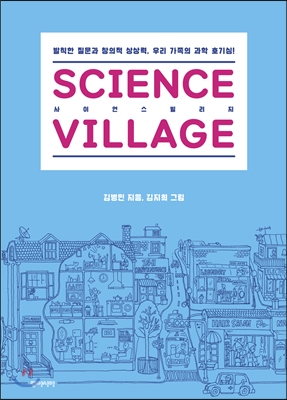
The book cover is a drawing by author Kim Byeong-min himself, expressing his feelings about traveling to the fictional space in the book where a father and child live, called ‘Science Village.’
An everyday space where cars stand at traffic lights with their red brake lights on, a beauty salon that is also a chemistry lab, a laundromat that does dry cleaning, a nail salon with lots of nail polish in clear glass bottles that don't let UV rays through, and a movie theater where people eat popcorn and watch 3D movies.
A place where the hazy sky of the industrial area in the distance spews out smoke that causes global warming, where airplanes fly in the stratosphere above, and where the sky is filled with a red sunset and a rainbow.
I personally drew a 'village' where I built up my curiosity by going around the neighborhood at each point in the book.
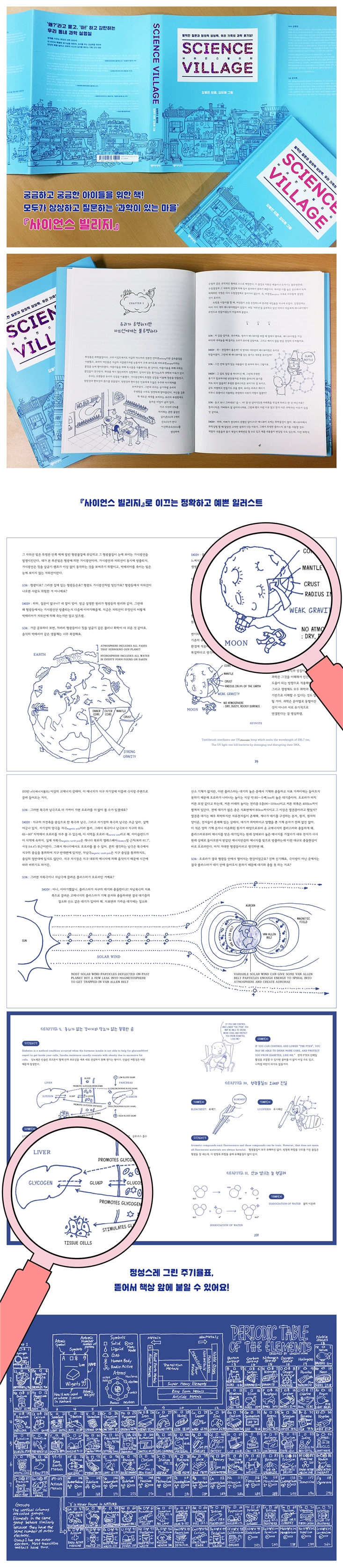
Not only that, the book is filled with never-before-seen scientific illustrations that are both easy to understand and beautiful.
A close-up look at the structure of hair, the difference in gravity between Earth and the Moon, how salt and sugar dissolve in water, and even the aurora, a ray of light sent from the Sun, primary and secondary rainbows, and the bending of light by gravity.
The International System of Units (SI) table has been organized at a glance, and a completely new periodic table has been drawn this year, with 118 elements.
This is a beautiful science book that overcomes the limitations of previous drawings that were pretty but inaccurate, or accurate but not pretty.
It helps understanding by re-creating scientific principles that are already well understood in an easy-to-understand way.
Illustrator Jihee Kim, who worked with me on the painting, is also currently a research professor in the Department of Physics at Sungkyunkwan University and is a scientist.
With his fairytale-like imagination added, 『Science Village』 even feels like a ‘science fantasy.’
A "Village of Science" where everyone imagines and questions
“Dad! Why are all the car brake lights red?”
“All beverage and beer bottles are brown, but why is soju green?”
“Dad! Why doesn’t the puppy brush his teeth?”
The child is curious and curious.
But children who couldn't get clear answers gradually lost their questions.
『Science Village』 is a book that started there.
It begins with an adult's reflection on children who grow up without questions, suppressing their surging curiosity and ignoring their overflowing curiosity because they were told to memorize things at school because they wouldn't be tested.
Kim Byeong-min, author of "Science Village," wrote the book based on the questions he asked his child and the conversations he had with him when he was young.
The book features adults who enjoy conversation, encouraging children to think for themselves and answer questions honestly, and children who grow through curiosity, broadening their imaginations, and thinking more deeply.
While watching a movie and eating popcorn, I had a strange experience where the gum I had been chewing was gradually disappearing ("The gum in my mouth disappeared").
The child, who had been telling his father to spit out his gum before eating popcorn but insisted on chewing it again later, is completely at a loss as the gum in his mouth gradually disappears.
After the movie ends, Dad explains that the gum dissolved in the popcorn grease and that each substance has its own unique properties.
The father waited for the child's stubbornness, and through this the child learned the polarity of matter.
In front of dozens of rolls of toilet paper, Mom spends a long time debating which one is best.
A child who likes cheap and white things gets annoyed and says, “Why does it take so long for Mom to choose toilet paper?” (“Misunderstandings and Truths about Fluorescent Materials”).
However, Dad convinces his child that he is choosing products that are harmless to the body, made with natural materials, and that use less bleach. At the same time, he explains what bleach and fluorescent dyes used in bleach are, why they are bad for the body, and how fluorescent dyes emit light.
A child who hated brushing his teeth wonders why his dog doesn't brush its teeth ("A Puppy Without Cavities and a Fat Bear Without Diabetes").
Dad helps his child figure out why he needs to brush his teeth, saying that it's because the oral environment of humans and dogs is different, and also because of the food humans eat.
As he explains, Dad chuckles, envious of the bear who is genetically predisposed to obesity.
In this way, 『Science Village』 transcends the boundaries of disciplines such as physics, chemistry, biology, and earth science, and brings together all things around us to question, learn, converse, imagine, and empathize.
They grow by wandering around every corner of their neighborhood, including their home, school, supermarket, and movie theater, questioning things and unraveling the principles within them.
A village with science.
Science Village is a place where adults and children, parents and children, can imagine and ask questions.
A highly complete popular science book written by a domestic author.
A book that is not as easy as you might think.
It's not an answer that you can easily find by reading alone.
A book that parents should read and discuss together.
You get an answer to the question, but the answer is not the end.
It raises new questions.
Although the work of domestic science writers has been remarkable in recent years, children's and young adult books are still dominated by translated works.
In addition to verbal text, children's books require comprehensive implementation with various visual media such as illustrations, images, and photographs. This is because other visual media suitable for implementing scientific texts are not proficient in scientific fields.
It was from this regret that the new book, “Science Village,” began.
An ordinary father who majored in science in college and graduate school struggled with his son's odd and persistent questions, and then, with his once-aspiring-to-be-a-painter skills, he posted the process on social media, where it gained huge popularity.
The father and son's constantly repeated, practical responses have made this book a dialogue that broadens the scope of imagination while fostering shared understanding, as Einstein said, "nothing is more important than imagination."
Moreover, this space for questioning and conversation is a landscape of our villages that can be found anywhere in Korea, so the scientific questions in the book are real things around us and the real-time curiosity of our children.
Because of this, the book gains universal appeal, and its rich and inspiring illustrations are scientifically very rigorous, demonstrating its high virtue as a science textbook for young people.
It's never easy.
A book for the whole family to read, talk about, and discuss together.
The science that Dad teaches in "Science Village" is by no means easy.
We talk about the theory of relativity ("The frequency of radio waves is an 'invisible path in the sky'"), understand the principles of the aurora, and learn about plasma ("Is there an aurora inside the TV?").
We delve into the periodic table ("Acids and bases are always confused") and look at the history of LED development ("LED semiconductor diode light sources are not white").
That's why this book is one that children and adults should read together.
This book is written in a way that allows readers to understand difficult content on their own, but it is also designed to be read together, with questions asked and discussions continued.
There have been many attempts to read science from the things around us, but they have generally limited themselves to conveying general and basic science.
What was needed was a general education book that bridged the gap between basic and advanced science, requiring a bit of patience but still providing intellectual pleasure.
Books are enough to deepen the knowledge and broaden the scientific perspective of both adults whose scientific knowledge was limited to entrance exam education in school and children who are stuck in memorization and problem-solving.
『Science Village』 leads the entire book with a story about ‘light.’
The father broadens the child's narrow view of 'light'.
Dad gradually awakens us to the existence of various types of light that are invisible to the eye, such as ultraviolet rays, infrared rays, and microwaves, in addition to visible light.
The child says this later in the book:
“Suddenly, the world seems filled with an invisible light.” (“How does light travel and fill the world?”) With a scientific perspective broadened through conversation and discussion, let’s open our eyes to a new world that is right before our eyes but invisible.
Accurate and beautiful scientific illustrations drawn by myself
The book cover is a drawing by author Kim Byeong-min himself, expressing his feelings about traveling to the fictional space in the book where a father and child live, called ‘Science Village.’
An everyday space where cars stand at traffic lights with their red brake lights on, a beauty salon that is also a chemistry lab, a laundromat that does dry cleaning, a nail salon with lots of nail polish in clear glass bottles that don't let UV rays through, and a movie theater where people eat popcorn and watch 3D movies.
A place where the hazy sky of the industrial area in the distance spews out smoke that causes global warming, where airplanes fly in the stratosphere above, and where the sky is filled with a red sunset and a rainbow.
I personally drew a 'village' where I built up my curiosity by going around the neighborhood at each point in the book.
Not only that, the book is filled with never-before-seen scientific illustrations that are both easy to understand and beautiful.
A close-up look at the structure of hair, the difference in gravity between Earth and the Moon, how salt and sugar dissolve in water, and even the aurora, a ray of light sent from the Sun, primary and secondary rainbows, and the bending of light by gravity.
The International System of Units (SI) table has been organized at a glance, and a completely new periodic table has been drawn this year, with 118 elements.
This is a beautiful science book that overcomes the limitations of previous drawings that were pretty but inaccurate, or accurate but not pretty.
It helps understanding by re-creating scientific principles that are already well understood in an easy-to-understand way.
Illustrator Jihee Kim, who worked with me on the painting, is also currently a research professor in the Department of Physics at Sungkyunkwan University and is a scientist.
With his fairytale-like imagination added, 『Science Village』 even feels like a ‘science fantasy.’
GOODS SPECIFICS
- Date of publication: December 14, 2016
- Format: Hardcover book binding method guide
- Page count, weight, size: 260 pages | 1,296g | 220*305*24mm
- ISBN13: 9788962621679
- ISBN10: 8962621673
You may also like
카테고리
korean


korean

![ELLE 엘르 스페셜 에디션 A형 : 12월 [2025]](http://librairie.coreenne.fr/cdn/shop/files/b8e27a3de6c9538896439686c6b0e8fb.jpg?v=1766436872&width=3840)


