

About immunity
 |
Description
Book Introduction
Everything You Need to Know About Immunity
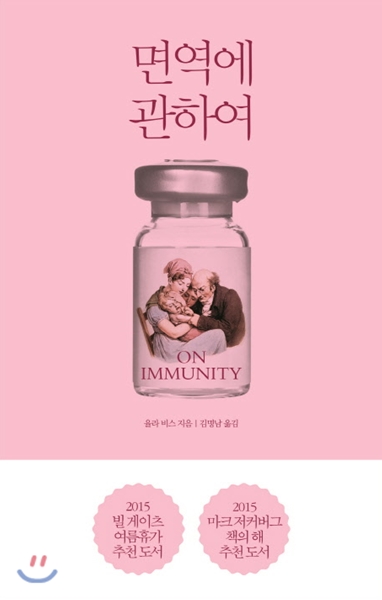
"On Immunity" is the third book by promising American nonfiction writer Eula Biss.
As the translator says, “On the one hand, it is science, on the other, poetry, and above all, dense thought,” this book beautifully and coolly describes the difficult science of immunology using poetic metaphors.
As Vis confronts the fears she faced after giving birth—the fear that vaccines could harm her child—she uncovers how vaccines and immunizations are actually saving children's lives and ours.
By examining mythology, history, and literature, it illuminates the true nature of our inner fears and expands our perspective on disease and immunity through powerful metaphors.
We believe that if we live a righteous and clean life and avoid contact with unclean and polluted things, we and our children will be protected from disease and all kinds of vices.
The author points out that this is an “illusion.”
We believe and pursue something clean, good, strong and immortal, but Bis tells us that we are not such beings in the first place.
From the moment we are born, our bodies are filled with chemicals, microbes, pathogens, and other people's blood and flesh.
In this book, Bis examines our fears and anxieties about them, and awakens us to the fact that it is impossible to banish them from this garden.
The only way we can choose is to make this garden (immunity) that we must nurture and live in together healthier.
"On Immunity" is the third book by promising American nonfiction writer Eula Biss.
As the translator says, “On the one hand, it is science, on the other, poetry, and above all, dense thought,” this book beautifully and coolly describes the difficult science of immunology using poetic metaphors.
As Vis confronts the fears she faced after giving birth—the fear that vaccines could harm her child—she uncovers how vaccines and immunizations are actually saving children's lives and ours.
By examining mythology, history, and literature, it illuminates the true nature of our inner fears and expands our perspective on disease and immunity through powerful metaphors.
We believe that if we live a righteous and clean life and avoid contact with unclean and polluted things, we and our children will be protected from disease and all kinds of vices.
The author points out that this is an “illusion.”
We believe and pursue something clean, good, strong and immortal, but Bis tells us that we are not such beings in the first place.
From the moment we are born, our bodies are filled with chemicals, microbes, pathogens, and other people's blood and flesh.
In this book, Bis examines our fears and anxieties about them, and awakens us to the fact that it is impossible to banish them from this garden.
The only way we can choose is to make this garden (immunity) that we must nurture and live in together healthier.
- You can preview some of the book's contents.
Preview
index
1.
The Myth of Immunity
2.
Fear of the flu vaccine
3.
Our bodies determine our metaphors
4.
herd immunity
5.
Hepatitis B Vaccine and the Hierarchy of Public Health Measures
6.
We need germs
7.
fear of contamination
8.
The common belief that nature is good and Silent Spring
9.
Is it a question of “my side” or “your side”?
10.
Smallpox vaccination
11.
The Immune System and Its Metaphors
12.
If I were your mother a hundred years ago
13.
Female therapists and criticized mothers
14.
We are all polluted beings
15.
Age of Vampires
16.
Vaccines as Weapons
17.
Confusion Surrounding Mercury in Vaccines
18.
Capitalism and Vaccines
19.
Paternalism vs. Consumerism
20.
Personal Cord Blood Banking and Vaccine Centricism
21.
Too much and too early?
22.
Chickenpox party
23.
Conscientious Objection and Moral Issues
24.
Natural body and political body
25.
The immune system at risk in a hostile world
26.
The dichotomy of health and disease
27.
How should we interpret scientific information?
28.
The fear of the unknown
29.
Medical caution and social bias
30.
Immunity is a garden we cultivate together.
main
Acknowledgements
References
Translator's Note
The Myth of Immunity
2.
Fear of the flu vaccine
3.
Our bodies determine our metaphors
4.
herd immunity
5.
Hepatitis B Vaccine and the Hierarchy of Public Health Measures
6.
We need germs
7.
fear of contamination
8.
The common belief that nature is good and Silent Spring
9.
Is it a question of “my side” or “your side”?
10.
Smallpox vaccination
11.
The Immune System and Its Metaphors
12.
If I were your mother a hundred years ago
13.
Female therapists and criticized mothers
14.
We are all polluted beings
15.
Age of Vampires
16.
Vaccines as Weapons
17.
Confusion Surrounding Mercury in Vaccines
18.
Capitalism and Vaccines
19.
Paternalism vs. Consumerism
20.
Personal Cord Blood Banking and Vaccine Centricism
21.
Too much and too early?
22.
Chickenpox party
23.
Conscientious Objection and Moral Issues
24.
Natural body and political body
25.
The immune system at risk in a hostile world
26.
The dichotomy of health and disease
27.
How should we interpret scientific information?
28.
The fear of the unknown
29.
Medical caution and social bias
30.
Immunity is a garden we cultivate together.
main
Acknowledgements
References
Translator's Note
Into the book
The preservative thimerosal, a mercury compound, was completely removed from all childhood vaccines except multidose flu vaccines by 2002.
But even now, more than a decade later, fears about mercury in vaccines remain.
--- p.20
Serious side effects from vaccines are rare.
But it's difficult to quantify exactly how rare they are, in part because vaccine-related complications are often complications that occur naturally from the infections the vaccine is intended to prevent.
--- p.55
Silent Spring begins by telling a story of "a fable of the future."
… … This is a horror novel in which the creations of mankind, the monsters created by mankind, betray humanity.
… … However, while the monster in ‘Dracula’ originated from ancient times, in ‘Silent Spring’ modern life was the evil.
--- p.72
The debate surrounding vaccines tends to be described as what philosopher Donna Haraway calls “disturbing dualisms.”
These dualisms oppose science and nature, public and private, truth and imagination, self and other, thought and emotion, man and woman.
--- p.77
Fear of toxicity seems to be an old anxiety given a new name.
While in the past the word "filth" had a moralistic connotation and condemned the evils of the flesh, today the word "toxin" condemns the chemical evils of industrial society.
--- p.114
Purity, especially physical purity, may seem like a harmless concept at first glance, but it was actually the idea behind many of the most nefarious social practices of the past century.
The passion for physical purity was the motivation behind the eugenics movement, which sterilized blind, black, and poor women.
--- p.115
We are all polluted beings.
We have more microorganisms in our intestines than the number of cells in our body.
We are creatures teeming with germs and filled with chemicals.
In short, we are connected to everything that exists on earth.
Of course, and especially, with other people.
--- p.116
Vaccines containing thimerosal are currently used in 120 countries and are estimated to save 1.4 million lives each year.
Thimerosal is an essential component of multi-dose vaccines, which cost much less to produce, store, and transport than single-dose vaccines.
… … There are places in the world, especially in poor countries, where a ban on thimerosal is effectively equivalent to a ban on vaccines against diphtheria, pertussis, hepatitis B, and tetanus.
--- p.137
The fact that it was difficult to imagine that a platform based on the essential values of life could be a force powerful enough to compete with capitalism shows how successful capitalism has been in limiting our imagination.
--- p.143
The modern belief that we live solely in a single body, contained within the confines of our own skin, arose from the Enlightenment's ideology, which celebrated the individual in both mental and physical terms.
However, how to define an individual was still a somewhat ambiguous issue.
--- p.187
AIDS education taught us that we must protect our bodies from contact with other bodies, and this teaching seems to have led to another kind of isolation: the obsession with a perfect personal immune system.
Building, strengthening, and replenishing our own immune systems has become a cultural obsession of our time.
--- p.206
When we look at scientific evidence, we must consider the entirety of the information.
The entire water area must be surveyed.
And if it is massive, it becomes impossible for one person to do.
… … We cannot know it alone.
--- p.216
The spread of antibiotic-resistant bacteria and the emergence of new diseases rank among the top public health threats of the 21st century.
One of these is a threat from within us, and the other is a consequence of modern medicine.
Another is a threat from outside, an outcome that our medicine cannot anticipate.
Both tap into our most primal fears.
--- p.226
Avoiding outsiders, immigrants, people with no limbs, and people with facial markings is an age-old disease prevention tactic.
And naturally, this further fuels the long-held belief that disease is something created by those we define as the Other.
As Sontag wrote, “Syphilis was the ‘French rash’ to the English, the ‘German disease’ to the Parisians, the Neapolitan disease to the Florentines, and the Chinese disease to the Japanese.”
--- p.239
We can't prevent prejudice with a vaccine or wash it away like washing our hands.
There will always be diseases from which we cannot protect ourselves, and such diseases will always tempt us to project our fears onto others.
But still, I believe there are reasons for vaccination that go beyond medicine.
--- p.241
If we extend the garden metaphor to our social body, we can imagine ourselves as a garden within a garden.
The outer garden at this time is not Eden, nor is it a comfortable rose garden.
That garden is a strange and diverse place, no less than the inner garden of our bodies, where we harbor both good and bad fungi, viruses, and bacteria.
The garden has no boundaries, is unkempt, and bears both fruit and thorns.
Maybe we should call it wild.
Or perhaps the word community will suffice.
Whatever we choose to think of our social bodies as, we are always one another's environment.
Immunity is a shared space.
This is a garden we cultivate together.
But even now, more than a decade later, fears about mercury in vaccines remain.
--- p.20
Serious side effects from vaccines are rare.
But it's difficult to quantify exactly how rare they are, in part because vaccine-related complications are often complications that occur naturally from the infections the vaccine is intended to prevent.
--- p.55
Silent Spring begins by telling a story of "a fable of the future."
… … This is a horror novel in which the creations of mankind, the monsters created by mankind, betray humanity.
… … However, while the monster in ‘Dracula’ originated from ancient times, in ‘Silent Spring’ modern life was the evil.
--- p.72
The debate surrounding vaccines tends to be described as what philosopher Donna Haraway calls “disturbing dualisms.”
These dualisms oppose science and nature, public and private, truth and imagination, self and other, thought and emotion, man and woman.
--- p.77
Fear of toxicity seems to be an old anxiety given a new name.
While in the past the word "filth" had a moralistic connotation and condemned the evils of the flesh, today the word "toxin" condemns the chemical evils of industrial society.
--- p.114
Purity, especially physical purity, may seem like a harmless concept at first glance, but it was actually the idea behind many of the most nefarious social practices of the past century.
The passion for physical purity was the motivation behind the eugenics movement, which sterilized blind, black, and poor women.
--- p.115
We are all polluted beings.
We have more microorganisms in our intestines than the number of cells in our body.
We are creatures teeming with germs and filled with chemicals.
In short, we are connected to everything that exists on earth.
Of course, and especially, with other people.
--- p.116
Vaccines containing thimerosal are currently used in 120 countries and are estimated to save 1.4 million lives each year.
Thimerosal is an essential component of multi-dose vaccines, which cost much less to produce, store, and transport than single-dose vaccines.
… … There are places in the world, especially in poor countries, where a ban on thimerosal is effectively equivalent to a ban on vaccines against diphtheria, pertussis, hepatitis B, and tetanus.
--- p.137
The fact that it was difficult to imagine that a platform based on the essential values of life could be a force powerful enough to compete with capitalism shows how successful capitalism has been in limiting our imagination.
--- p.143
The modern belief that we live solely in a single body, contained within the confines of our own skin, arose from the Enlightenment's ideology, which celebrated the individual in both mental and physical terms.
However, how to define an individual was still a somewhat ambiguous issue.
--- p.187
AIDS education taught us that we must protect our bodies from contact with other bodies, and this teaching seems to have led to another kind of isolation: the obsession with a perfect personal immune system.
Building, strengthening, and replenishing our own immune systems has become a cultural obsession of our time.
--- p.206
When we look at scientific evidence, we must consider the entirety of the information.
The entire water area must be surveyed.
And if it is massive, it becomes impossible for one person to do.
… … We cannot know it alone.
--- p.216
The spread of antibiotic-resistant bacteria and the emergence of new diseases rank among the top public health threats of the 21st century.
One of these is a threat from within us, and the other is a consequence of modern medicine.
Another is a threat from outside, an outcome that our medicine cannot anticipate.
Both tap into our most primal fears.
--- p.226
Avoiding outsiders, immigrants, people with no limbs, and people with facial markings is an age-old disease prevention tactic.
And naturally, this further fuels the long-held belief that disease is something created by those we define as the Other.
As Sontag wrote, “Syphilis was the ‘French rash’ to the English, the ‘German disease’ to the Parisians, the Neapolitan disease to the Florentines, and the Chinese disease to the Japanese.”
--- p.239
We can't prevent prejudice with a vaccine or wash it away like washing our hands.
There will always be diseases from which we cannot protect ourselves, and such diseases will always tempt us to project our fears onto others.
But still, I believe there are reasons for vaccination that go beyond medicine.
--- p.241
If we extend the garden metaphor to our social body, we can imagine ourselves as a garden within a garden.
The outer garden at this time is not Eden, nor is it a comfortable rose garden.
That garden is a strange and diverse place, no less than the inner garden of our bodies, where we harbor both good and bad fungi, viruses, and bacteria.
The garden has no boundaries, is unkempt, and bears both fruit and thorns.
Maybe we should call it wild.
Or perhaps the word community will suffice.
Whatever we choose to think of our social bodies as, we are always one another's environment.
Immunity is a shared space.
This is a garden we cultivate together.
--- p.249
Publisher's Review
I had no idea how enjoyable and informative reading this book would be.
Even for someone like me who has supported and studied vaccine research for years.
- Bill Gates
New York Times bestseller
2014 National Society of Film Critics Award Finalist
Bill Gates' 2015 Summer Vacation Book Recommendations
2015 Mark Zuckerberg Book Year Recommendations
Selected as a 2014 Book of the Year by The New York Times, Chicago Tribune, Publisher's Weekly, Los Angeles Times, Kirkus Reviews, Newsday, Slate…
Everything You Need to Know About Immunity
On Immunity is the third book by promising American nonfiction writer Eula Biss. It became a New York Times bestseller immediately after its publication in 2014, was a finalist for the National Book Critics Circle Award that year, and was selected as a Book of the Year by various media outlets.
It also became a hot topic as it was selected as one of Bill Gates' "TED Conference Recommended Books" and "Summer Vacation Recommended Books" in 2015, and as the fourth book in the "Zuckerberg Book Club" that Facebook CEO Mark Zuckerberg suggested reading together.
As the translator says, “On the one hand, it is science, on the other, poetry, and above all, dense thought,” this book beautifully and coolly describes the difficult science of immunology using poetic metaphors.
As Vis confronts the fears she faced after giving birth—the fear that vaccines could harm her child—she uncovers how vaccines and immunizations are actually saving children's lives and ours.
By examining mythology, history, and literature, it illuminates the true nature of our inner fears and expands our perspective on disease and immunity through powerful metaphors.
The book was embraced by the medical community and scientists as a model of scientific writing, and was praised by authors as a brilliant work of literature that demonstrated the powerful power of metaphor.
As one media outlet commented, "On Immunity" is "an interesting and useful book for anyone interested in learning about vaccines and the complex science of immunology."
In particular, “A must-read for all vaccine skeptics.”
The fear of the unknown
Bis opens the book with the myth of Achilles.
Achilles, or many other heroes in mythology, became immortal thanks to the sacrifice of their mothers.
But even they have one weakness, and that weakness ultimately kills them.
What the author is saying through these myths is one thing.
No one can have perfect immunity.
Therefore, any parent who has given birth and raised a child knows the same fear that Bis felt.
Although infant mortality rates are not as high today as they were in the Middle Ages or the 18th century, there are still many risks that can kill infants, including diseases.
Parents worry and fear that everything from food to clothes and toys might harm their children.
However, as we can see from the recent humidifier disinfectant incident, taking measures to protect a child's health can actually kill the child.
As Bis emphasizes, this is the fundamental fear of modern times.
Parents try to protect their children, but they don't know what is harming them.
Bis calls this “the fear of the unknown.”
And vaccines, vaccinations, are something we don't know about.
At first glance, vaccines don't seem all that different from germs.
Jenner's vaccination method literally transmitted weakened germs, sometimes making people very sick.
“Snake venom, blood, intestines, and excrement from rats, bats, toads, and suckling puppies” were the ingredients people in the 19th century thought went into vaccines.
These days, vaccines are sterile if everything goes right.
So what we're worried about now is things like "terrible mercury, ether, aluminum, antifreeze."
Intuitive Toxicology
Bis, citing psychologist Paul Slovic, calls our perspective on the dangers of modern society “intuitive toxicology.”
We consider any substance that is toxic to be dangerous, even if only slightly.
However, scholars say, "the dose determines the poison."
In other words, even if it is a harmful substance, it is not harmful if it is below a certain amount.
And even substances that are generally harmless, such as water, can become toxic in excess.
It's true that vaccines contain chemicals we worry about.
For example, there are vaccines that contain mercury, aluminum, and formaldehyde.
However, the flu vaccines we use on a daily basis or the vaccines we give our children contain no such ingredients or only a very small amount.
Suspicions that vaccines can cause autism, cancer, or brain damage are largely unfounded, but they are highly contagious.
Meanwhile, we must be aware that mercury, formaldehyde, and aluminum are present in the foods we eat on a daily basis, and even in the breast milk our children drink.
Bis quotes journalist Florence Williams as saying, "If human milk were sold at your local Piggly Wiggly, some of it would be subject to federal food safety standards for DDT and PCB (polychlorinated biphenyl) residues."
We have lived with germs, viruses, and toxins, and we are destined to continue to live with them.
There is no way for anyone to deny this.
The common belief that nature is good
Like modern society, modern medicine has its drawbacks.
The image of modern medicine, which is dominated by mechanical and chemical treatments, is violent and sinister.
And it's imperfect.
Vaccines embody the anxieties and fears that permeate modern medicine.
Alternative medicine exploits these gaps in modern medicine.
When we feel polluted, alternative medicine offers “purification.”
When we feel inadequate and lacking, alternative medicine provides “supplements.”
If we fear toxins, alternative medicine offers detoxification.
When we worry that our bodies are rusting and oxidizing as we age, alternative medicine offers reassurance with “antioxidants.”
The most powerful tonic that alternative medicine offers is the word “natural.”
This word implies a medicine that is not subject to human limitations, a medicine that is entirely provided by nature, God, or some other intelligent design.
The word natural in the context of medicine has come to mean purity, safety, and harmlessness.
The view that “nature is good” expands to the recognition that natural things are safer and superior to artificial things.
The so-called "chickenpox party" (intentionally gathering children at the home of a child with chickenpox to play), which has recently become popular in Korea, is an extremely dangerous practice that stems from the belief that naturally acquired immunity is superior to immunity acquired through a vaccine.
There is a fundamental difference between getting chickenpox and getting the chickenpox vaccine.
Chickenpox is generally not dangerous, but it can cause life-threatening skin infections, pneumonia, encephalitis, and sometimes even death in children.
Alternative vaccination
There is skepticism about vaccines even within the medical community.
Robert Sears, aka "Dr. Bob," is one of America's most popular pediatricians when it comes to vaccinations.
Sears offered two clear action strategies for parents concerned about both vaccines and infectious diseases.
One is "Mr. Bob's Optional Vaccination Schedule," which involves administering only the vaccines he deems most important, while skipping the hepatitis B, polio, and MMR (measles, mumps, rubella) vaccines.
Another is Mr. Bob's Complete Alternative Vaccination Schedule, which involves giving your child all the vaccines they would normally receive by the end of their second year of life, but spread them out over eight years.
Hepatitis B, polio, and MMR vaccines are representative vaccines suspected of being harmful to children.
Sears argues that individuals do not need to take the risks of getting these vaccines.
He explained that children are at little risk of contracting these diseases, relying on "herd immunity" that develops as many other children are vaccinated.
However, one of his patients famously passed measles on to several children in another pediatrician's office.
It is also a well-known fact that such claims have actually seriously reduced vaccination rates and threaten to undermine herd immunity.
herd immunity
Bis places particular emphasis on the concept of “herd immunity.”
Any vaccine may fail to create immunity in a particular individual.
Some vaccines, such as the influenza vaccine, are less effective than others.
However, even if a vaccine is relatively ineffective, if enough people are vaccinated, it becomes difficult for the virus to move from host to host, so transmission stops, and everyone, including those who have not been vaccinated and those who have been vaccinated but have not developed immunity, avoids infection.
The unvaccinated are protected by the bodies around them, bodies that cannot spread disease.
On the other hand, vaccinated people surrounded by bodies harboring diseases are vulnerable to the possibility that the vaccine may not be effective or that their immunity may have waned.
“We are more protected from what lies beyond our skin than from our own.” At this point, the boundaries between bodies begin to crumble.
Blood and organ donations go from one body to another, crossing bodies.
The same goes for immunity.
Immunity is both a private account and a public trust.
Anyone who relies on herd immunity owes a debt of health to their neighbors.
This is why public health is important.
Immunity is a garden we cultivate together!
We believe that if we live a righteous and clean life and avoid contact with unclean and polluted things, we and our children will be protected from disease and all kinds of vices.
Bis points out that this is an “illusion.”
We believe in and pursue something clean, good, strong and immortal, but Bis tells us that we are not such beings in the first place.
From the moment we are born, our bodies are filled with chemicals, microbes, pathogens, and other people's blood and flesh.
As this book repeatedly points out, we have never existed in isolation.
Bis sees in our obsession with “purity” and “perfect individuality” a chilling aversion and denial of all non-self.
We consider dirt and disease as stories of “them,” stories that are different from our own.
We believe that we can protect our purity by isolating and eradicating them.
But we share what they eat, the air they breathe, and sometimes the blood that flows through their bodies.
If they are dirty, if they suffer from disease, we too cannot be free from that condition.
According to Bis, their bodies are also part of the garden we cultivate together.
In this book, Bis examines our fears and anxieties about them, and awakens us to the fact that it is impossible to banish them from this garden.
The only path we can take is to make this garden, which we must nurture and live in together, healthier.
As Visga clearly demonstrates in this book, vaccination is the safest and most effective weapon for this purpose.
Sharp and eloquent.
Sontag said she wrote her book, Illness as Metaphor, to “calm the imagination and soften the agitation.”
"On Immunity" also seeks calm and comfort.
But if Son Taek was overbearing, Bis was subtle.
She advances in all directions like a chess player.
It uses science, superstition, and literature to force us to a single logical conclusion.
- The New York Times Book Review
A brilliant and passionate exploration into the vaccine war.
This is an interesting and useful book for parents and anyone interested in learning about vaccines and the complexities of immunology.
A must-read for all vaccine skeptics.
- American Scholar
The Achilles myth provides a compelling starting point for the anti-vaccine movement.
She unfolds her argument for vaccination, drawing on literature, history, science, and none other than the questions and fears she had when deciding to vaccinate her own child.
She adds a cool, informed, and humane voice to this often heated debate.
- The New Yorker
A classy paper that shows how science, storytelling, and fear can be combined in the context of public health.
This book sometimes vacillates between the worlds of literature, philosophy, and scientific research, even within a single sentence.
Clarity is achieved not in spite of it, but precisely by doing so.
Beyond vaccination, this book engages in debate, synthesizing the informational waste that now prevents clear thinking on almost any topic, and especially on this one, with a deft and poetic spirit.
This book speaks to the impossibility of perfect and certain knowledge, and instead the need to pursue a balanced understanding.
- The New Republic
The ultimate cultural history of disease and immunity.
Like Susan Sontag, who is quoted several times in this book, Biss is interested in the way we talk about infectious phenomena and how that shapes our understanding of illness and ourselves.
The scope of Vis's discussions and her elegant writing style make this book timeless.
- McLean
Here is the biggest shift.
"On Immunity" is not actually a story about vaccination.
This is a very philosophical book.
It's a book about the fundamental fear that we can never protect our children from the world, rather than pure science.
Truly, Bis believes that no one can or should acquire immunity from others.
By exploring the anxieties that lie dormant in flu shots, the air, and ourselves, she drives home the lesson that we all depend on one another.
"On Immunity" will make you rethink your stereotypes from the ground up.
Want to read a book about vaccinations? If anyone can convince you to do so, it's Vis.
- Entertainment Weekly
It's so rational, intellectual, thoughtful and philosophical.
- Los Angeles Book Review
Building on the flawless and precise intellect displayed in his previous work, Bis reminds us of our destiny: that we are more interdependent than we previously imagined.
- Harper's
Through a thorough survey spanning centuries, continents, and cultures, Biss ultimately asks:
How do we deal with fears about government, others, disease, and our own bodies? Through poignant language, she leaves readers in a place where individuals end and communities begin.
- The Kansas City Star
Even for someone like me who has supported and studied vaccine research for years.
- Bill Gates
New York Times bestseller
2014 National Society of Film Critics Award Finalist
Bill Gates' 2015 Summer Vacation Book Recommendations
2015 Mark Zuckerberg Book Year Recommendations
Selected as a 2014 Book of the Year by The New York Times, Chicago Tribune, Publisher's Weekly, Los Angeles Times, Kirkus Reviews, Newsday, Slate…
Everything You Need to Know About Immunity
On Immunity is the third book by promising American nonfiction writer Eula Biss. It became a New York Times bestseller immediately after its publication in 2014, was a finalist for the National Book Critics Circle Award that year, and was selected as a Book of the Year by various media outlets.
It also became a hot topic as it was selected as one of Bill Gates' "TED Conference Recommended Books" and "Summer Vacation Recommended Books" in 2015, and as the fourth book in the "Zuckerberg Book Club" that Facebook CEO Mark Zuckerberg suggested reading together.
As the translator says, “On the one hand, it is science, on the other, poetry, and above all, dense thought,” this book beautifully and coolly describes the difficult science of immunology using poetic metaphors.
As Vis confronts the fears she faced after giving birth—the fear that vaccines could harm her child—she uncovers how vaccines and immunizations are actually saving children's lives and ours.
By examining mythology, history, and literature, it illuminates the true nature of our inner fears and expands our perspective on disease and immunity through powerful metaphors.
The book was embraced by the medical community and scientists as a model of scientific writing, and was praised by authors as a brilliant work of literature that demonstrated the powerful power of metaphor.
As one media outlet commented, "On Immunity" is "an interesting and useful book for anyone interested in learning about vaccines and the complex science of immunology."
In particular, “A must-read for all vaccine skeptics.”
The fear of the unknown
Bis opens the book with the myth of Achilles.
Achilles, or many other heroes in mythology, became immortal thanks to the sacrifice of their mothers.
But even they have one weakness, and that weakness ultimately kills them.
What the author is saying through these myths is one thing.
No one can have perfect immunity.
Therefore, any parent who has given birth and raised a child knows the same fear that Bis felt.
Although infant mortality rates are not as high today as they were in the Middle Ages or the 18th century, there are still many risks that can kill infants, including diseases.
Parents worry and fear that everything from food to clothes and toys might harm their children.
However, as we can see from the recent humidifier disinfectant incident, taking measures to protect a child's health can actually kill the child.
As Bis emphasizes, this is the fundamental fear of modern times.
Parents try to protect their children, but they don't know what is harming them.
Bis calls this “the fear of the unknown.”
And vaccines, vaccinations, are something we don't know about.
At first glance, vaccines don't seem all that different from germs.
Jenner's vaccination method literally transmitted weakened germs, sometimes making people very sick.
“Snake venom, blood, intestines, and excrement from rats, bats, toads, and suckling puppies” were the ingredients people in the 19th century thought went into vaccines.
These days, vaccines are sterile if everything goes right.
So what we're worried about now is things like "terrible mercury, ether, aluminum, antifreeze."
Intuitive Toxicology
Bis, citing psychologist Paul Slovic, calls our perspective on the dangers of modern society “intuitive toxicology.”
We consider any substance that is toxic to be dangerous, even if only slightly.
However, scholars say, "the dose determines the poison."
In other words, even if it is a harmful substance, it is not harmful if it is below a certain amount.
And even substances that are generally harmless, such as water, can become toxic in excess.
It's true that vaccines contain chemicals we worry about.
For example, there are vaccines that contain mercury, aluminum, and formaldehyde.
However, the flu vaccines we use on a daily basis or the vaccines we give our children contain no such ingredients or only a very small amount.
Suspicions that vaccines can cause autism, cancer, or brain damage are largely unfounded, but they are highly contagious.
Meanwhile, we must be aware that mercury, formaldehyde, and aluminum are present in the foods we eat on a daily basis, and even in the breast milk our children drink.
Bis quotes journalist Florence Williams as saying, "If human milk were sold at your local Piggly Wiggly, some of it would be subject to federal food safety standards for DDT and PCB (polychlorinated biphenyl) residues."
We have lived with germs, viruses, and toxins, and we are destined to continue to live with them.
There is no way for anyone to deny this.
The common belief that nature is good
Like modern society, modern medicine has its drawbacks.
The image of modern medicine, which is dominated by mechanical and chemical treatments, is violent and sinister.
And it's imperfect.
Vaccines embody the anxieties and fears that permeate modern medicine.
Alternative medicine exploits these gaps in modern medicine.
When we feel polluted, alternative medicine offers “purification.”
When we feel inadequate and lacking, alternative medicine provides “supplements.”
If we fear toxins, alternative medicine offers detoxification.
When we worry that our bodies are rusting and oxidizing as we age, alternative medicine offers reassurance with “antioxidants.”
The most powerful tonic that alternative medicine offers is the word “natural.”
This word implies a medicine that is not subject to human limitations, a medicine that is entirely provided by nature, God, or some other intelligent design.
The word natural in the context of medicine has come to mean purity, safety, and harmlessness.
The view that “nature is good” expands to the recognition that natural things are safer and superior to artificial things.
The so-called "chickenpox party" (intentionally gathering children at the home of a child with chickenpox to play), which has recently become popular in Korea, is an extremely dangerous practice that stems from the belief that naturally acquired immunity is superior to immunity acquired through a vaccine.
There is a fundamental difference between getting chickenpox and getting the chickenpox vaccine.
Chickenpox is generally not dangerous, but it can cause life-threatening skin infections, pneumonia, encephalitis, and sometimes even death in children.
Alternative vaccination
There is skepticism about vaccines even within the medical community.
Robert Sears, aka "Dr. Bob," is one of America's most popular pediatricians when it comes to vaccinations.
Sears offered two clear action strategies for parents concerned about both vaccines and infectious diseases.
One is "Mr. Bob's Optional Vaccination Schedule," which involves administering only the vaccines he deems most important, while skipping the hepatitis B, polio, and MMR (measles, mumps, rubella) vaccines.
Another is Mr. Bob's Complete Alternative Vaccination Schedule, which involves giving your child all the vaccines they would normally receive by the end of their second year of life, but spread them out over eight years.
Hepatitis B, polio, and MMR vaccines are representative vaccines suspected of being harmful to children.
Sears argues that individuals do not need to take the risks of getting these vaccines.
He explained that children are at little risk of contracting these diseases, relying on "herd immunity" that develops as many other children are vaccinated.
However, one of his patients famously passed measles on to several children in another pediatrician's office.
It is also a well-known fact that such claims have actually seriously reduced vaccination rates and threaten to undermine herd immunity.
herd immunity
Bis places particular emphasis on the concept of “herd immunity.”
Any vaccine may fail to create immunity in a particular individual.
Some vaccines, such as the influenza vaccine, are less effective than others.
However, even if a vaccine is relatively ineffective, if enough people are vaccinated, it becomes difficult for the virus to move from host to host, so transmission stops, and everyone, including those who have not been vaccinated and those who have been vaccinated but have not developed immunity, avoids infection.
The unvaccinated are protected by the bodies around them, bodies that cannot spread disease.
On the other hand, vaccinated people surrounded by bodies harboring diseases are vulnerable to the possibility that the vaccine may not be effective or that their immunity may have waned.
“We are more protected from what lies beyond our skin than from our own.” At this point, the boundaries between bodies begin to crumble.
Blood and organ donations go from one body to another, crossing bodies.
The same goes for immunity.
Immunity is both a private account and a public trust.
Anyone who relies on herd immunity owes a debt of health to their neighbors.
This is why public health is important.
Immunity is a garden we cultivate together!
We believe that if we live a righteous and clean life and avoid contact with unclean and polluted things, we and our children will be protected from disease and all kinds of vices.
Bis points out that this is an “illusion.”
We believe in and pursue something clean, good, strong and immortal, but Bis tells us that we are not such beings in the first place.
From the moment we are born, our bodies are filled with chemicals, microbes, pathogens, and other people's blood and flesh.
As this book repeatedly points out, we have never existed in isolation.
Bis sees in our obsession with “purity” and “perfect individuality” a chilling aversion and denial of all non-self.
We consider dirt and disease as stories of “them,” stories that are different from our own.
We believe that we can protect our purity by isolating and eradicating them.
But we share what they eat, the air they breathe, and sometimes the blood that flows through their bodies.
If they are dirty, if they suffer from disease, we too cannot be free from that condition.
According to Bis, their bodies are also part of the garden we cultivate together.
In this book, Bis examines our fears and anxieties about them, and awakens us to the fact that it is impossible to banish them from this garden.
The only path we can take is to make this garden, which we must nurture and live in together, healthier.
As Visga clearly demonstrates in this book, vaccination is the safest and most effective weapon for this purpose.
Sharp and eloquent.
Sontag said she wrote her book, Illness as Metaphor, to “calm the imagination and soften the agitation.”
"On Immunity" also seeks calm and comfort.
But if Son Taek was overbearing, Bis was subtle.
She advances in all directions like a chess player.
It uses science, superstition, and literature to force us to a single logical conclusion.
- The New York Times Book Review
A brilliant and passionate exploration into the vaccine war.
This is an interesting and useful book for parents and anyone interested in learning about vaccines and the complexities of immunology.
A must-read for all vaccine skeptics.
- American Scholar
The Achilles myth provides a compelling starting point for the anti-vaccine movement.
She unfolds her argument for vaccination, drawing on literature, history, science, and none other than the questions and fears she had when deciding to vaccinate her own child.
She adds a cool, informed, and humane voice to this often heated debate.
- The New Yorker
A classy paper that shows how science, storytelling, and fear can be combined in the context of public health.
This book sometimes vacillates between the worlds of literature, philosophy, and scientific research, even within a single sentence.
Clarity is achieved not in spite of it, but precisely by doing so.
Beyond vaccination, this book engages in debate, synthesizing the informational waste that now prevents clear thinking on almost any topic, and especially on this one, with a deft and poetic spirit.
This book speaks to the impossibility of perfect and certain knowledge, and instead the need to pursue a balanced understanding.
- The New Republic
The ultimate cultural history of disease and immunity.
Like Susan Sontag, who is quoted several times in this book, Biss is interested in the way we talk about infectious phenomena and how that shapes our understanding of illness and ourselves.
The scope of Vis's discussions and her elegant writing style make this book timeless.
- McLean
Here is the biggest shift.
"On Immunity" is not actually a story about vaccination.
This is a very philosophical book.
It's a book about the fundamental fear that we can never protect our children from the world, rather than pure science.
Truly, Bis believes that no one can or should acquire immunity from others.
By exploring the anxieties that lie dormant in flu shots, the air, and ourselves, she drives home the lesson that we all depend on one another.
"On Immunity" will make you rethink your stereotypes from the ground up.
Want to read a book about vaccinations? If anyone can convince you to do so, it's Vis.
- Entertainment Weekly
It's so rational, intellectual, thoughtful and philosophical.
- Los Angeles Book Review
Building on the flawless and precise intellect displayed in his previous work, Bis reminds us of our destiny: that we are more interdependent than we previously imagined.
- Harper's
Through a thorough survey spanning centuries, continents, and cultures, Biss ultimately asks:
How do we deal with fears about government, others, disease, and our own bodies? Through poignant language, she leaves readers in a place where individuals end and communities begin.
- The Kansas City Star
GOODS SPECIFICS
- Date of publication: November 25, 2016
- Format: Hardcover book binding method guide
- Page count, weight, size: 312 pages | 468g | 130*194*24mm
- ISBN13: 9788932918105
- ISBN10: 8932918104
You may also like
카테고리
korean


korean

![ELLE 엘르 스페셜 에디션 A형 : 12월 [2025]](http://librairie.coreenne.fr/cdn/shop/files/b8e27a3de6c9538896439686c6b0e8fb.jpg?v=1766436872&width=3840)


