

Kim Sang-wook's Science Study
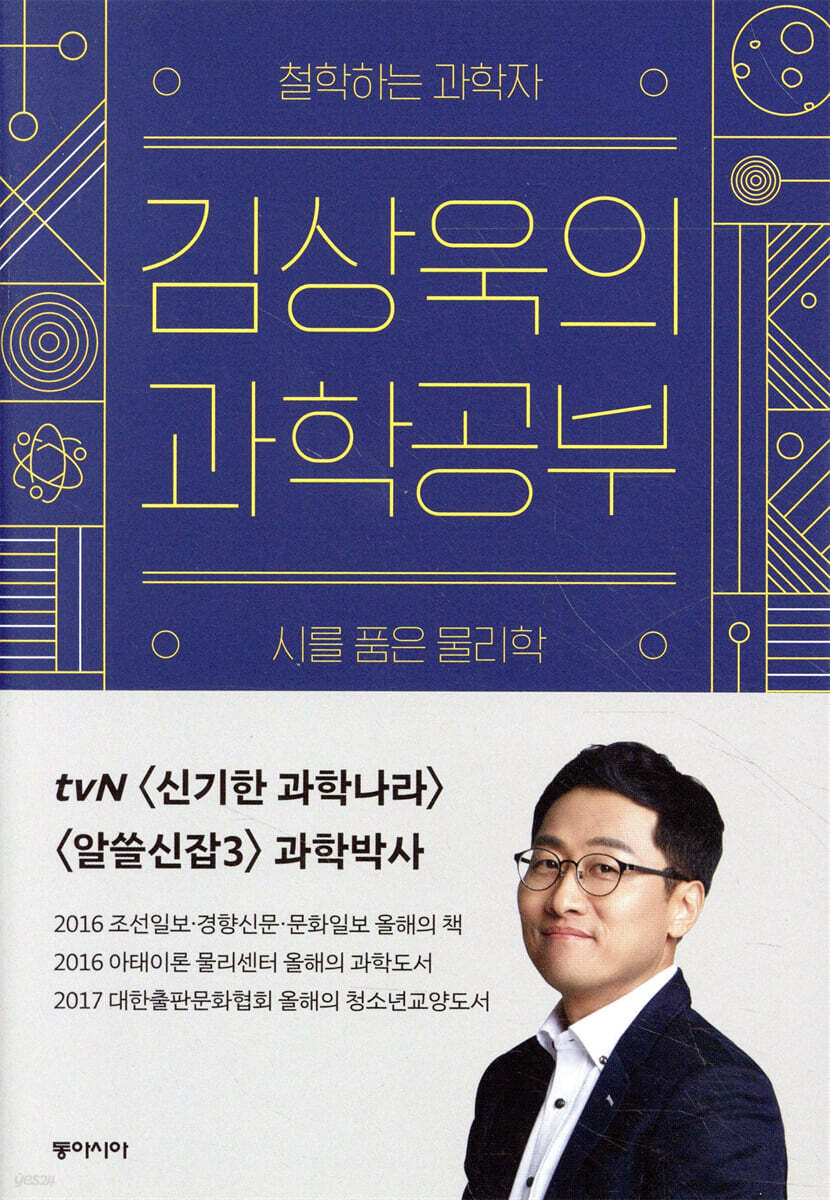 |
Description
Book Introduction
Philosophical scientist, quantum mechanics poet
Professor Kim Sang-wook's "Science Humanities"
The intersection of scientific thinking and humanistic insight
Science is now humanities!
In the 21st century, why is science called liberal arts?
If the discourse on 'humans and the world' was handled by philosophy and literature until the mid-20th century, and by social sciences in the latter half of the 20th century, then in the 21st century, science became the most 'meaningful framework' and foundation of insight.
This is a promise to think systematically through precise analysis and verification based on rational thinking.
Therefore, it is also a change in perception to view humanity and the world with a methodological attitude, along with the knowledge of science and technology that is developing at an unimaginable speed.
In an age where science is considered a liberal art, we study how to view the world rationally through the writings of scientists with the most outstanding knowledge.
Professor Kim Sang-wook seeks to blur the lines between science and humanities.
Kim Sang-wook, who faces life with the passion of a cool-headed scientist, is the first guide of the coming era of 'science humanities.'
This is because, in addition to having a deep understanding of both, he possesses the temperament of both a diligent scholar who learns new things and a teacher who teaches what he has learned.
As per the definition of 'physics' as 'the law of all things', 'physicist' Kim Sang-wook delves into all things of the world, including literature, society, history, politics, and ethics, with a meticulous perspective.
As I read the book, I fulfill my role as a member of society who ponders the question, “What kind of philosophy should we have and what kind of world should we live in?” and as a guide who guides the journey toward finding the answer.
The title, “Kim Sang-wook’s Science Study,” was born from this question.
Let's study science in a fun, sometimes in-depth way.
Professor Kim Sang-wook's "Science Humanities"
The intersection of scientific thinking and humanistic insight
Science is now humanities!
In the 21st century, why is science called liberal arts?
If the discourse on 'humans and the world' was handled by philosophy and literature until the mid-20th century, and by social sciences in the latter half of the 20th century, then in the 21st century, science became the most 'meaningful framework' and foundation of insight.
This is a promise to think systematically through precise analysis and verification based on rational thinking.
Therefore, it is also a change in perception to view humanity and the world with a methodological attitude, along with the knowledge of science and technology that is developing at an unimaginable speed.
In an age where science is considered a liberal art, we study how to view the world rationally through the writings of scientists with the most outstanding knowledge.
Professor Kim Sang-wook seeks to blur the lines between science and humanities.
Kim Sang-wook, who faces life with the passion of a cool-headed scientist, is the first guide of the coming era of 'science humanities.'
This is because, in addition to having a deep understanding of both, he possesses the temperament of both a diligent scholar who learns new things and a teacher who teaches what he has learned.
As per the definition of 'physics' as 'the law of all things', 'physicist' Kim Sang-wook delves into all things of the world, including literature, society, history, politics, and ethics, with a meticulous perspective.
As I read the book, I fulfill my role as a member of society who ponders the question, “What kind of philosophy should we have and what kind of world should we live in?” and as a guide who guides the journey toward finding the answer.
The title, “Kim Sang-wook’s Science Study,” was born from this question.
Let's study science in a fun, sometimes in-depth way.
- You can preview some of the book's contents.
Preview
index
Recommendation
Are science and humanities equal before liberal arts?
Chapter 1.
Making it strange with science
day
Grant us surplus
A life like a peacock's gorgeous tail
How the world came into being
Smartphones and the Big Bang
For whom is history learned?
The silence of the universe
The future of machines
Law of Conservation of Happiness Index
The purpose of education is not happiness.
Philosophy of Differentiation
1990, that female student
The moon is falling
Tiger's Den in the Sewer
Chapter 2.
South Korea equation
Death of the Canary
Tower of Babel on the Ivory Tower
God of Study
A gun loaded with live ammunition
Gatekeeper's paradise
No conclusion without evidence
When abstraction starts killing us
Nectarines and poisonous mushrooms
A crisis without heroes
Science hates nationalization
The Physics of Apples
The reality of absence
Chapter 3.
I am a scientist
I am a scientist
Quantum mechanics? What is that?
How to start exercising
Mackerel and the Nobel Prize
1/137
very small
The nature of time
How much of a joke is "Quarantine"?
God rolls the dice
The binary choice of quantum mechanics
Chapter 4.
Humanities of Physics
Imagination will save us
Understanding Kandinsky
The Beauty of Chaos
Entropy in Les Misérables
Dance, exercise, relativity, quantum mechanics
The joys and sorrows of light
Poetry of the Universe
The day the machine refuses
The Physics of Free Will
Imagine the imagination
Reviews
Are science and humanities equal before liberal arts?
Chapter 1.
Making it strange with science
day
Grant us surplus
A life like a peacock's gorgeous tail
How the world came into being
Smartphones and the Big Bang
For whom is history learned?
The silence of the universe
The future of machines
Law of Conservation of Happiness Index
The purpose of education is not happiness.
Philosophy of Differentiation
1990, that female student
The moon is falling
Tiger's Den in the Sewer
Chapter 2.
South Korea equation
Death of the Canary
Tower of Babel on the Ivory Tower
God of Study
A gun loaded with live ammunition
Gatekeeper's paradise
No conclusion without evidence
When abstraction starts killing us
Nectarines and poisonous mushrooms
A crisis without heroes
Science hates nationalization
The Physics of Apples
The reality of absence
Chapter 3.
I am a scientist
I am a scientist
Quantum mechanics? What is that?
How to start exercising
Mackerel and the Nobel Prize
1/137
very small
The nature of time
How much of a joke is "Quarantine"?
God rolls the dice
The binary choice of quantum mechanics
Chapter 4.
Humanities of Physics
Imagination will save us
Understanding Kandinsky
The Beauty of Chaos
Entropy in Les Misérables
Dance, exercise, relativity, quantum mechanics
The joys and sorrows of light
Poetry of the Universe
The day the machine refuses
The Physics of Free Will
Imagine the imagination
Reviews
Into the book
The history of life on Earth spans 3.5 billion years, but the history of modern humans is only 200,000 years.
In just 5,000 years since the invention of writing, we have acquired enough technology to destroy ourselves.
Is it true that civilizations arise in an instant and then self-destruct? No one knows what form that destruction will take.
It could be the war of Armageddon, or it could be a deadly virus created in a laboratory.
However, it is certain that the moment the Earth's environment changes to the point where we cannot survive, the human species will become extinct without a trace.
As we efficiently (!) overuse the Earth's finite resources and irreversibly destroy the environment, aren't we hastening the extinction of our species? Or at the very least, aren't we making life more difficult for future generations?
As far as we know, we are alone in this vast universe.
It is the cosmic reason why we must love one another and pool our wisdom.
--- pp.54-55
The demand for reproducibility in science is also in line with the demand for predictability.
Therefore, no matter how famous a scientist's theory is, if the experimental results are different from what was predicted, his theory is discarded.
Newton is called the father of physics, but his theory makes incorrect predictions when an object moves at high speed.
Even if he's a low-level clerk at the patent office, if his theory produces reproducible predictions, he's right.
It's Einstein.
Perhaps that's why physicists are allergic to authoritarianism.
If the theory is correct, all that is needed is to show reproducible evidence.
When the evidence is insufficient, the scientific attitude is to say we don't know and reserve judgment.
--- pp.126-127
Humans are not perfectly rational.
Moreover, humans believe in imaginations that do not exist.
Most of the things we think are valuable are imaginary and do not actually exist.
Although artificial intelligence can change the world as it exists, it cannot change the imagination of something that does not exist.
The important values that humans think of are themselves imaginary, so we must protect them with our imagination.
Without humanistic consideration of the non-scientific subject of human happiness, humans would become unhappy.
This is an era that requires not only scientific but also humanistic imagination.
--- pp.229-230
The light from Alpha Centauri left about four years ago.
In other words, what we see now is what it was like four years ago.
In fact, Alpha Centauri may not exist anymore.
If Alpha Centauri exploded and disappeared for some reason, we wouldn't know about it until four years later.
The story is that the stars we see now are what they looked like in the past.
If so, you can time travel just by sitting still and looking at the sky.
To look at the sky like this is to see both space and time.
In fact, even if you dig the ground, it is still like time travel.
Because you can travel back in time across the strata.
Ultimately, space is time.
--- pp.276-277
The universe moves forward step by step, thinking only of the relationships right in front of it, without needing to know the distant past or the distant future.
The universe doesn't even distinguish between front and back.
Just think about the relationship between yourself and two points that are temporally adjacent to you.
Two adjacent points are places that are different from me, but infinitely close.
The universe simply thinks sincerely, or perhaps foolishly, only of its relationships with its neighbors, and as a result, it creates everything that exists in the world.
Isn't it the same for people?
When we confirm and strengthen our relationships with those we interact with, one by one, and when we take a precise step toward the right path, following the laws of the universe, not toward the distant future or the past, we are living in the way of the universe.
In just 5,000 years since the invention of writing, we have acquired enough technology to destroy ourselves.
Is it true that civilizations arise in an instant and then self-destruct? No one knows what form that destruction will take.
It could be the war of Armageddon, or it could be a deadly virus created in a laboratory.
However, it is certain that the moment the Earth's environment changes to the point where we cannot survive, the human species will become extinct without a trace.
As we efficiently (!) overuse the Earth's finite resources and irreversibly destroy the environment, aren't we hastening the extinction of our species? Or at the very least, aren't we making life more difficult for future generations?
As far as we know, we are alone in this vast universe.
It is the cosmic reason why we must love one another and pool our wisdom.
--- pp.54-55
The demand for reproducibility in science is also in line with the demand for predictability.
Therefore, no matter how famous a scientist's theory is, if the experimental results are different from what was predicted, his theory is discarded.
Newton is called the father of physics, but his theory makes incorrect predictions when an object moves at high speed.
Even if he's a low-level clerk at the patent office, if his theory produces reproducible predictions, he's right.
It's Einstein.
Perhaps that's why physicists are allergic to authoritarianism.
If the theory is correct, all that is needed is to show reproducible evidence.
When the evidence is insufficient, the scientific attitude is to say we don't know and reserve judgment.
--- pp.126-127
Humans are not perfectly rational.
Moreover, humans believe in imaginations that do not exist.
Most of the things we think are valuable are imaginary and do not actually exist.
Although artificial intelligence can change the world as it exists, it cannot change the imagination of something that does not exist.
The important values that humans think of are themselves imaginary, so we must protect them with our imagination.
Without humanistic consideration of the non-scientific subject of human happiness, humans would become unhappy.
This is an era that requires not only scientific but also humanistic imagination.
--- pp.229-230
The light from Alpha Centauri left about four years ago.
In other words, what we see now is what it was like four years ago.
In fact, Alpha Centauri may not exist anymore.
If Alpha Centauri exploded and disappeared for some reason, we wouldn't know about it until four years later.
The story is that the stars we see now are what they looked like in the past.
If so, you can time travel just by sitting still and looking at the sky.
To look at the sky like this is to see both space and time.
In fact, even if you dig the ground, it is still like time travel.
Because you can travel back in time across the strata.
Ultimately, space is time.
--- pp.276-277
The universe moves forward step by step, thinking only of the relationships right in front of it, without needing to know the distant past or the distant future.
The universe doesn't even distinguish between front and back.
Just think about the relationship between yourself and two points that are temporally adjacent to you.
Two adjacent points are places that are different from me, but infinitely close.
The universe simply thinks sincerely, or perhaps foolishly, only of its relationships with its neighbors, and as a result, it creates everything that exists in the world.
Isn't it the same for people?
When we confirm and strengthen our relationships with those we interact with, one by one, and when we take a precise step toward the right path, following the laws of the universe, not toward the distant future or the past, we are living in the way of the universe.
--- p.294
Publisher's Review
Recently, 107 Nobel laureates sent an open letter to Greenpeace, which is campaigning against genetically modified organisms (GMOs), and this became a hot topic.
Greenpeace's logic that "if GMOs spread into nature, they could contaminate the existing environment where genetically modified species did not exist, and leave future generations with an unpredictable and uncontrollable situation" seems very valid, so why do scientists who study 'nature' raise objections?
First of all, scientists are of the opinion that there is still a lack of research to verify and explain the 'hazardous' hypothesis.
In other words, the argument is that it is merely a hypothesis, not a proof through scientific thinking, but rather an intuitive experience and common sense that we have acquired over a long period of time.
Moreover, the history of science, that is, the evolution of life, is a history of constant genetic modification, and it cannot be determined that this is an 'unnatural' event.
In this way, the advancement of science and technology in the 21st century is beyond imagination, and this requires a great change in our perception of humanity and the world.
However, the perception of science and technology has become a very unfamiliar situation for us, who have long had a humanities-centered attitude.
First of all, it is because I have insufficient knowledge of science and technology and have never practiced reasoning through it.
For example, the Cheonan sinking, mad cow disease, MERS, humidifier disinfectant, Sewol ferry, nuclear power plants, and the Four Major Rivers Project are issues that swept through our society.
These were issues that went beyond simple social problems and required objective and scientific knowledge, analysis, and solutions.
However, we have often seen citizens, as well as public officials who are supposed to command the control tower, being swayed by political and social forces due to a lack of scientific knowledge, and becoming perpetrators and victims of incidents without objective evidence.
Issues related to artificial intelligence, questions of bioethics, and controversies over environmental destruction also suggest that it is impossible to exclude scientific thinking in the 21st century.
In short, science has already become common sense.
Studying science is studying philosophy! Knowledge is a bonus, but questions remain at the end.
A scientific book written in words, not in formulas, is the foundation of the humanities.
The book was written with this intention and purpose.
Rather than having to take out textbooks again and memorize 'formulas' and 'laws' to acquire scientific knowledge in depth, we need to comprehensively understand the 'system' called science, that is, the 'scientific way of thinking'.
And the 'scientific way of thinking' is philosophy and humanities.
Philosopher Deleuze said that philosophy is “creating the image of a free human being.”
The natural world simply moves according to laws.
What makes people unfree and unhappy are myths and fears created through imagination.
In the same vein, scientific explanations sometimes clash with the wisdom of religion and empirical common sense.
We call this understanding of the world as it is, stripping away myths and fears, and understanding nature science.
If we recall Deleuze again, this is how philosophy becomes science and science becomes philosophy.
'Thinking scientifically' becomes 'philosophizing' in that it rejects fabricated myths and fears and reveals the free human form.
If you want to learn science, look at other books,
If you want to gain insight through science, you must read this book.
The science study that the book talks about is an attitude and a method.
Science is ultimately about looking into humans and the world.
Therefore, the ‘scientific’ is ‘human’, and the ‘unscientific’ is ‘inhuman’.
Science is no longer limited to knowledge.
Science is a rational way of looking at the world, and finding clues to solving all the world's problems within it.
This is the scientific way of thinking that Kim Sang-wook talks about, very concise and clear.
If we view science only in its technical aspects, science cannot become a way of thinking, and it cannot go together with the humanities.
When science and technology are applied to the real world, the humanities often pose problems and serve as a solution.
Likewise, science must be able to engage with the problems of politics, society, and culture as a solution.
When science and humanities are placed on the same starting line, they can coexist.
Drawing philosophical insights from scientific inspiration and finding answers to life in science.
Getting closer to science that is intertwined with the world we live in.
Science and humanities communicate.
This will be the humanities of the future, and true humanities that include science.
A Physicist's Cry for a Common-Sense Society
Think scientifically!
'Understanding' means adding new knowledge to what we already know.
That's why science that runs counter to common sense, such as the theory of relativity or quantum mechanics, is bound to be difficult for the general public to understand.
Moreover, human imagination, emotions, and ignorance prevent us from seeing the world clearly.
In Chapter 1 of 『Kim Sang-wook's Science Study』, "Making the World Unfamiliar with Science," we train ourselves to see the world in a strange and different way, and take our first steps toward a scientific way of thinking.
Chapter 2, “The Equation of the Republic of Korea,” explores the myths and fears that exist in Korean society.
As I said before, 'unscientific' is 'inhumane'.
If science turns a blind eye to these inhuman facts, it is no longer philosophy.
We think that 'darkness' exists, but in fact, darkness is just the absence of light.
Just as the absence of light becomes the reality of darkness, remaining silent and not doing righteous deeds toward society also becomes the reality of injustice.
So how do scientists view the world through a scientific mindset? Chapter 3, "I am a scientist," is a declaration made by a scientist, rejecting the temptations of politics, power, and economics.
Constantly asking yourself, “Am I a scientist?” and guarding yourself against falling into unscientific logic, you resemble a philosopher with conviction.
How does physics answer the questions of the humanities? As an inquiry into humanity, about humanity, and for humanity, science has always had a connection with the humanities.
In Chapter 4, “Humanities of Physics,” physicist Sangwook Kim answers humanity’s fundamental question, “How should we live?” with “the universe.”
Newton's equations of motion (F=ma), which describe all motion in the universe, are a cosmic poem composed of just four letters.
The universe does not look into the distant past or the distant future, but only considers the relationships immediately before it and moves forward according to its laws.
And in doing so, it creates everything that exists in the world.
Isn't it true that people live according to the laws of the universe when they take one precise step toward the task in front of them?
Critical intelligence rooted in a solid liberal arts education.
What is the study of science by Professor Sang-wook Kim, a physicist leading the era of 'science humanities'?
Intellectual curiosity and humanistic insight, with high-quality humor and clear prose.
Writing science in easy-to-understand terms is the foundation of the humanities.
Because it breaks down the wall between science and humanities.
Professor Kim Sang-wook is known as 'the person who explains quantum mechanics most easily.'
Looking at his previous works, we can see that he was able to explain scientific knowledge, which could be difficult, in a very concise and organized way.
Even Richard Feynman said that quantum mechanics, which “no one fully understands,” is easily explained, and the world is dissected with a clear perspective.
In this way, there is philosophy and humanities in his writings based solely on science and with the eyes of a scientist.
Professor Kim Sang-wook says in his book that he has “never even properly read the original texts of philosophy,” but the desire to understand humanity and the world is the intersection of scientists and philosophers.
That is why the writings of Professor Sangwook Kim, who does science 'properly' and loves science, are filled with affection for humanity and the world, and naturally contain humanistic insights.
There are many good scientists and many good writers, but few people can do both.
Moreover, those who can easily and deeply convey insights from both science and humanities are even more valuable.
In an age where science is considered a liberal art, we study how to view the world rationally through the writings of scientists with the most outstanding knowledge.
Professor Kim Sang-wook seeks to blur the lines between science and humanities.
Kim Sang-wook, who faces life with the passion of a cool-headed scientist, is the first guide of the coming era of 'science humanities.'
This is because, in addition to having a deep understanding of both, he possesses the temperament of both a diligent scholar who learns new things and a teacher who teaches what he has learned.
As per the definition of 'physics' as 'the law of all things', 'physicist' Kim Sang-wook delves into all things of the world, including literature, society, history, politics, and ethics, with a meticulous perspective.
As I read the book, I fulfill my role as a member of society who ponders the question, “What kind of philosophy should we have and what kind of world should we live in?” and as a guide who guides the journey toward finding the answer.
The title, “Kim Sang-wook’s Science Study,” was born from this question.
Let's study science in a fun, sometimes in-depth way.
Greenpeace's logic that "if GMOs spread into nature, they could contaminate the existing environment where genetically modified species did not exist, and leave future generations with an unpredictable and uncontrollable situation" seems very valid, so why do scientists who study 'nature' raise objections?
First of all, scientists are of the opinion that there is still a lack of research to verify and explain the 'hazardous' hypothesis.
In other words, the argument is that it is merely a hypothesis, not a proof through scientific thinking, but rather an intuitive experience and common sense that we have acquired over a long period of time.
Moreover, the history of science, that is, the evolution of life, is a history of constant genetic modification, and it cannot be determined that this is an 'unnatural' event.
In this way, the advancement of science and technology in the 21st century is beyond imagination, and this requires a great change in our perception of humanity and the world.
However, the perception of science and technology has become a very unfamiliar situation for us, who have long had a humanities-centered attitude.
First of all, it is because I have insufficient knowledge of science and technology and have never practiced reasoning through it.
For example, the Cheonan sinking, mad cow disease, MERS, humidifier disinfectant, Sewol ferry, nuclear power plants, and the Four Major Rivers Project are issues that swept through our society.
These were issues that went beyond simple social problems and required objective and scientific knowledge, analysis, and solutions.
However, we have often seen citizens, as well as public officials who are supposed to command the control tower, being swayed by political and social forces due to a lack of scientific knowledge, and becoming perpetrators and victims of incidents without objective evidence.
Issues related to artificial intelligence, questions of bioethics, and controversies over environmental destruction also suggest that it is impossible to exclude scientific thinking in the 21st century.
In short, science has already become common sense.
Studying science is studying philosophy! Knowledge is a bonus, but questions remain at the end.
A scientific book written in words, not in formulas, is the foundation of the humanities.
The book was written with this intention and purpose.
Rather than having to take out textbooks again and memorize 'formulas' and 'laws' to acquire scientific knowledge in depth, we need to comprehensively understand the 'system' called science, that is, the 'scientific way of thinking'.
And the 'scientific way of thinking' is philosophy and humanities.
Philosopher Deleuze said that philosophy is “creating the image of a free human being.”
The natural world simply moves according to laws.
What makes people unfree and unhappy are myths and fears created through imagination.
In the same vein, scientific explanations sometimes clash with the wisdom of religion and empirical common sense.
We call this understanding of the world as it is, stripping away myths and fears, and understanding nature science.
If we recall Deleuze again, this is how philosophy becomes science and science becomes philosophy.
'Thinking scientifically' becomes 'philosophizing' in that it rejects fabricated myths and fears and reveals the free human form.
If you want to learn science, look at other books,
If you want to gain insight through science, you must read this book.
The science study that the book talks about is an attitude and a method.
Science is ultimately about looking into humans and the world.
Therefore, the ‘scientific’ is ‘human’, and the ‘unscientific’ is ‘inhuman’.
Science is no longer limited to knowledge.
Science is a rational way of looking at the world, and finding clues to solving all the world's problems within it.
This is the scientific way of thinking that Kim Sang-wook talks about, very concise and clear.
If we view science only in its technical aspects, science cannot become a way of thinking, and it cannot go together with the humanities.
When science and technology are applied to the real world, the humanities often pose problems and serve as a solution.
Likewise, science must be able to engage with the problems of politics, society, and culture as a solution.
When science and humanities are placed on the same starting line, they can coexist.
Drawing philosophical insights from scientific inspiration and finding answers to life in science.
Getting closer to science that is intertwined with the world we live in.
Science and humanities communicate.
This will be the humanities of the future, and true humanities that include science.
A Physicist's Cry for a Common-Sense Society
Think scientifically!
'Understanding' means adding new knowledge to what we already know.
That's why science that runs counter to common sense, such as the theory of relativity or quantum mechanics, is bound to be difficult for the general public to understand.
Moreover, human imagination, emotions, and ignorance prevent us from seeing the world clearly.
In Chapter 1 of 『Kim Sang-wook's Science Study』, "Making the World Unfamiliar with Science," we train ourselves to see the world in a strange and different way, and take our first steps toward a scientific way of thinking.
Chapter 2, “The Equation of the Republic of Korea,” explores the myths and fears that exist in Korean society.
As I said before, 'unscientific' is 'inhumane'.
If science turns a blind eye to these inhuman facts, it is no longer philosophy.
We think that 'darkness' exists, but in fact, darkness is just the absence of light.
Just as the absence of light becomes the reality of darkness, remaining silent and not doing righteous deeds toward society also becomes the reality of injustice.
So how do scientists view the world through a scientific mindset? Chapter 3, "I am a scientist," is a declaration made by a scientist, rejecting the temptations of politics, power, and economics.
Constantly asking yourself, “Am I a scientist?” and guarding yourself against falling into unscientific logic, you resemble a philosopher with conviction.
How does physics answer the questions of the humanities? As an inquiry into humanity, about humanity, and for humanity, science has always had a connection with the humanities.
In Chapter 4, “Humanities of Physics,” physicist Sangwook Kim answers humanity’s fundamental question, “How should we live?” with “the universe.”
Newton's equations of motion (F=ma), which describe all motion in the universe, are a cosmic poem composed of just four letters.
The universe does not look into the distant past or the distant future, but only considers the relationships immediately before it and moves forward according to its laws.
And in doing so, it creates everything that exists in the world.
Isn't it true that people live according to the laws of the universe when they take one precise step toward the task in front of them?
Critical intelligence rooted in a solid liberal arts education.
What is the study of science by Professor Sang-wook Kim, a physicist leading the era of 'science humanities'?
Intellectual curiosity and humanistic insight, with high-quality humor and clear prose.
Writing science in easy-to-understand terms is the foundation of the humanities.
Because it breaks down the wall between science and humanities.
Professor Kim Sang-wook is known as 'the person who explains quantum mechanics most easily.'
Looking at his previous works, we can see that he was able to explain scientific knowledge, which could be difficult, in a very concise and organized way.
Even Richard Feynman said that quantum mechanics, which “no one fully understands,” is easily explained, and the world is dissected with a clear perspective.
In this way, there is philosophy and humanities in his writings based solely on science and with the eyes of a scientist.
Professor Kim Sang-wook says in his book that he has “never even properly read the original texts of philosophy,” but the desire to understand humanity and the world is the intersection of scientists and philosophers.
That is why the writings of Professor Sangwook Kim, who does science 'properly' and loves science, are filled with affection for humanity and the world, and naturally contain humanistic insights.
There are many good scientists and many good writers, but few people can do both.
Moreover, those who can easily and deeply convey insights from both science and humanities are even more valuable.
In an age where science is considered a liberal art, we study how to view the world rationally through the writings of scientists with the most outstanding knowledge.
Professor Kim Sang-wook seeks to blur the lines between science and humanities.
Kim Sang-wook, who faces life with the passion of a cool-headed scientist, is the first guide of the coming era of 'science humanities.'
This is because, in addition to having a deep understanding of both, he possesses the temperament of both a diligent scholar who learns new things and a teacher who teaches what he has learned.
As per the definition of 'physics' as 'the law of all things', 'physicist' Kim Sang-wook delves into all things of the world, including literature, society, history, politics, and ethics, with a meticulous perspective.
As I read the book, I fulfill my role as a member of society who ponders the question, “What kind of philosophy should we have and what kind of world should we live in?” and as a guide who guides the journey toward finding the answer.
The title, “Kim Sang-wook’s Science Study,” was born from this question.
Let's study science in a fun, sometimes in-depth way.
GOODS SPECIFICS
- Date of issue: July 6, 2016
- Page count, weight, size: 336 pages | 470g | 130*190*20mm
- ISBN13: 9788962621488
- ISBN10: 8962621487
You may also like
카테고리
korean


korean

![ELLE 엘르 스페셜 에디션 A형 : 12월 [2025]](http://librairie.coreenne.fr/cdn/shop/files/b8e27a3de6c9538896439686c6b0e8fb.jpg?v=1766436872&width=3840)


