

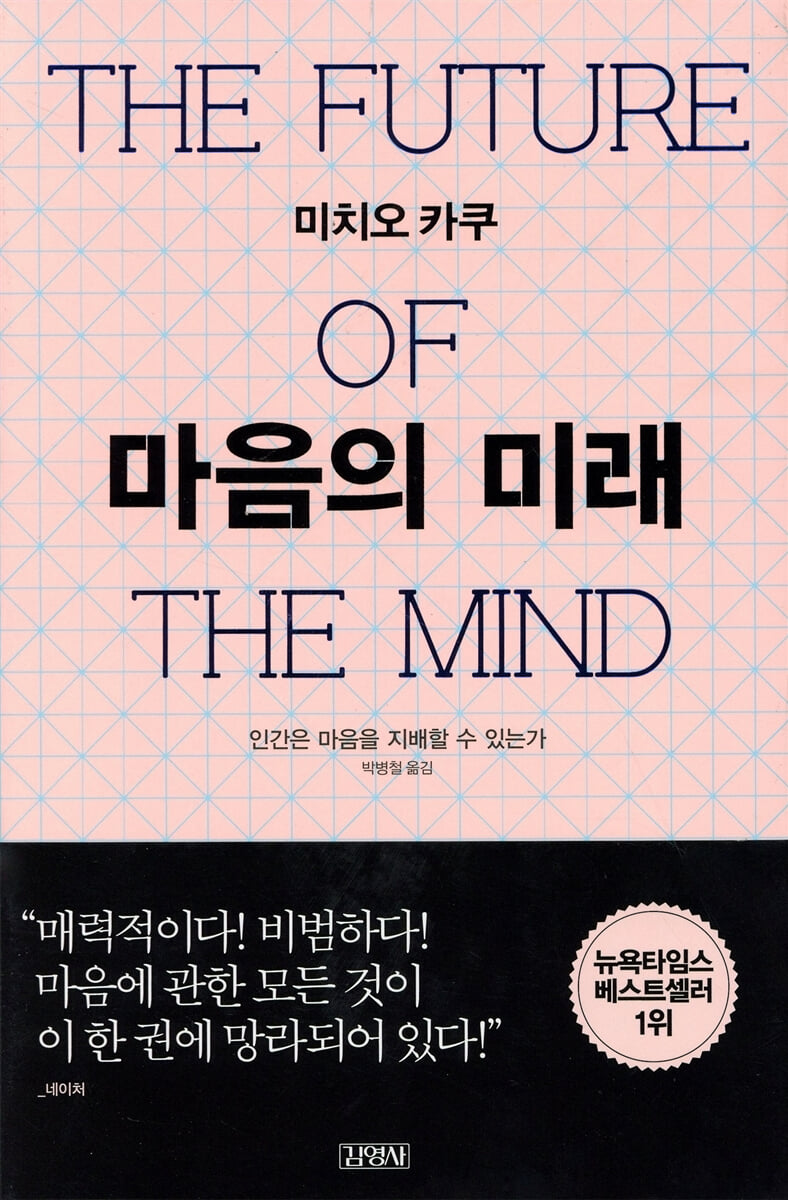
The future of the mind
 |
Description
Book Introduction
The deepest secrets of the conscious world are being revealed.
The future of humanity will be beyond imagination!
#1 New York Times Bestseller! Michio Kaku's latest work, "Parallel Universes"!
A world-renowned theoretical physicist, ultimate futurist, and science entertainer, Michio Kaku, reveals the universe's greatest mystery: an unparalleled exploration of the human mind and brain.
From brain scans to telepathy, psychokinesis, memory storage, dreams, and even alien brains, the secrets of the mental world revealed through the convergence of modern physics and neuroscience.
Various research and great discoveries that will shake up the future world are revealed.
Can humans truly control their minds?
The future of humanity will be beyond imagination!
#1 New York Times Bestseller! Michio Kaku's latest work, "Parallel Universes"!
A world-renowned theoretical physicist, ultimate futurist, and science entertainer, Michio Kaku, reveals the universe's greatest mystery: an unparalleled exploration of the human mind and brain.
From brain scans to telepathy, psychokinesis, memory storage, dreams, and even alien brains, the secrets of the mental world revealed through the convergence of modern physics and neuroscience.
Various research and great discoveries that will shake up the future world are revealed.
Can humans truly control their minds?
- You can preview some of the book's contents.
Preview
index
introduction
[Part 1: Mind and Consciousness]
Chapter 1: Decoding the Mind
Broca's Brain / Brain Map / The Evolving Brain / MRI: A Window into the Brain / EEG Scan / PET Scan / Magnetic Fields in the Brain / Deep Brain Stimulation / Optogenetics: Illuminating the Brain / The Transparent Brain / The Four Fundamental Forces / A New Brain Model / Is the 'Reality' We Perceive Really Real? / The Split-Brain Paradox / Who is Ultimately in Charge?
Chapter 2: Consciousness: A Physical Perspective
How do physicists understand the universe? / Defining consciousness / Stage 3 consciousness: predicting the future / What is humor? Why do we have emotions? / Why do humans like gossip and games? / Stage 1: Stream of consciousness / Stage 2: Finding your place in the group / Stage 3: Simulating the future / The mystery of self-awareness / Where is 'me'?
[Part 2: Overcoming the Body with the Mind]
Chapter 3 Telepathy: What Are You Thinking About So Deeply?
Mind Movies / Mind Reading / Mind Typing / Telepathic Dictation / Telepathic Helmets / MRIs in Cell Phones / DARPA and Human Enhancement / Personal Issues / Telepathy Using Nanoprobes / Legal Issues
Chapter 4: Telekinesis: Manipulating Objects with Your Mind
Treatment for spinal cord injury patients / Revolution in prosthetics / Psychokinesis in everyday life / Smart hands and thought sharing devices / Total immersion entertainment / Building a brain net / Brain net and civilization / “Humans will become part of the operating system” / Artificial exoskeletons / Avatars and surrogates / The future / The power of God / Ethical issues / Changing ‘me’: Modifying memory and intelligence
Chapter 5: Custom-Made Thoughts and Memories
What is memory? / Storing memories / Artificial hippocampus / Research methods / Vision and memory / Remembering the future / Artificial cortex / Artificial cerebellum / Alzheimer's disease: Memory being destroyed / Smart mice / Smart flies and amnesia mice / Smart pills / Can we erase memories? / Drugs that erase memories / Are there any side effects? / Social and legal issues / The soul library / The other side of advanced technology
Chapter 6: Einstein's Brain: Boosting Intelligence
Can genius be learned? / How to measure intelligence? / Successful living and delayed gratification / A new way to measure intelligence / Raising intelligence / Savant: Supergenius? / Asperger's syndrome and Silicon Valley / Savant brain scan data / Can we also become savants? / Forgetting forgetting: Photographic memory / Stem cells for the brain / Genetics of intelligence / Monkeys, genes, and genius / The origins of intelligence / The future of evolution / Separate thoughts
[Part 3: Transformed Consciousness]
Chapter 7 In a Dream
The Nature of Dreams / Scanning Dreams / How Are Dreams Made? / Capturing Dreams / Lucid Dreams / Entering Dreams
Chapter 8: Controlling the Mind
The Cold War and Mind Control / The CIA's Mind Control Experiments / You're Feeling Drowsy Right Now... / 'Mind-Changing Drugs' and 'Truth Drugs' / How Do Drugs Change Your Mind? / Brain Exploration Using Optogenetics / The Future of Mind Control
Chapter 9: Changed Consciousness
Mental illness / Hallucinations / Delusions / Bipolar disorder / Theory of consciousness and mental illness / Deep brain stimulation / Waking up from a coma / Are mental illnesses inherited? / Future prospects
Chapter 10: Artificial Mind and Silicon Consciousness
Media PR: Robots are coming! / The turbulent history of artificial intelligence / Shape recognition and common sense / Is the brain a computer? / Do robots have consciousness? / The stumbling block of quantum mechanics / The valley of unfavorability / Silicon consciousness / Robots with feelings / Emotions: Who decides what's important? / The menu of emotions / Programming emotions / Can robots lie? / Can robots feel pain? / Ethical robots / Can robots understand or feel anything? / Robots with self-awareness / Can robots surpass humans? / Friendly AI / "I am a machine" / Becoming one with robots?
Chapter 11: Reverse Engineering the Brain
Building a Brain / Three Approaches to the Brain / Building a Brain / Is It Really a Brain? / The Scrapbook Approach / The Human Connectome Project / The Allen Brain Map / Objections to Reverse Engineering / The Future
Chapter 12: The Future: Spirit Beyond Matter
Out-of-body experiences / Near-death experiences / Can consciousness leave the body? / Eternal life / Mental illness and eternal life / The cave man principle / Cave men and neuroscience / Slowly becoming robots / What is aging? / Nanobots: Reality or fantasy?
Chapter 13: Consciousness as Pure Energy
Beings floating in the form of energy / Faster than light?
Chapter 14: The Mind of an Alien
First Contact of the Century / SETI and Extraterrestrial Civilizations / Alien Hunters / Drake's Equation / Why Don't Aliens Visit Earth? / First Contact / Animal Consciousness / Smart Bees? / What Do Aliens Look Like? / The Post-Biological Era / What Do They Want? / Encounters with Alien Astronauts
Chapter 15 Conclusion
Reactions from various quarters to Bill Joy's writing / The implications of "Future Spirit" / Debates on wisdom and democracy / Philosophical questions / Philosophy and neuroscience / The miracle of consciousness
Appendix: Quantum Consciousness
Acknowledgements
Translator's Note
Huzhou
References
Search
[Part 1: Mind and Consciousness]
Chapter 1: Decoding the Mind
Broca's Brain / Brain Map / The Evolving Brain / MRI: A Window into the Brain / EEG Scan / PET Scan / Magnetic Fields in the Brain / Deep Brain Stimulation / Optogenetics: Illuminating the Brain / The Transparent Brain / The Four Fundamental Forces / A New Brain Model / Is the 'Reality' We Perceive Really Real? / The Split-Brain Paradox / Who is Ultimately in Charge?
Chapter 2: Consciousness: A Physical Perspective
How do physicists understand the universe? / Defining consciousness / Stage 3 consciousness: predicting the future / What is humor? Why do we have emotions? / Why do humans like gossip and games? / Stage 1: Stream of consciousness / Stage 2: Finding your place in the group / Stage 3: Simulating the future / The mystery of self-awareness / Where is 'me'?
[Part 2: Overcoming the Body with the Mind]
Chapter 3 Telepathy: What Are You Thinking About So Deeply?
Mind Movies / Mind Reading / Mind Typing / Telepathic Dictation / Telepathic Helmets / MRIs in Cell Phones / DARPA and Human Enhancement / Personal Issues / Telepathy Using Nanoprobes / Legal Issues
Chapter 4: Telekinesis: Manipulating Objects with Your Mind
Treatment for spinal cord injury patients / Revolution in prosthetics / Psychokinesis in everyday life / Smart hands and thought sharing devices / Total immersion entertainment / Building a brain net / Brain net and civilization / “Humans will become part of the operating system” / Artificial exoskeletons / Avatars and surrogates / The future / The power of God / Ethical issues / Changing ‘me’: Modifying memory and intelligence
Chapter 5: Custom-Made Thoughts and Memories
What is memory? / Storing memories / Artificial hippocampus / Research methods / Vision and memory / Remembering the future / Artificial cortex / Artificial cerebellum / Alzheimer's disease: Memory being destroyed / Smart mice / Smart flies and amnesia mice / Smart pills / Can we erase memories? / Drugs that erase memories / Are there any side effects? / Social and legal issues / The soul library / The other side of advanced technology
Chapter 6: Einstein's Brain: Boosting Intelligence
Can genius be learned? / How to measure intelligence? / Successful living and delayed gratification / A new way to measure intelligence / Raising intelligence / Savant: Supergenius? / Asperger's syndrome and Silicon Valley / Savant brain scan data / Can we also become savants? / Forgetting forgetting: Photographic memory / Stem cells for the brain / Genetics of intelligence / Monkeys, genes, and genius / The origins of intelligence / The future of evolution / Separate thoughts
[Part 3: Transformed Consciousness]
Chapter 7 In a Dream
The Nature of Dreams / Scanning Dreams / How Are Dreams Made? / Capturing Dreams / Lucid Dreams / Entering Dreams
Chapter 8: Controlling the Mind
The Cold War and Mind Control / The CIA's Mind Control Experiments / You're Feeling Drowsy Right Now... / 'Mind-Changing Drugs' and 'Truth Drugs' / How Do Drugs Change Your Mind? / Brain Exploration Using Optogenetics / The Future of Mind Control
Chapter 9: Changed Consciousness
Mental illness / Hallucinations / Delusions / Bipolar disorder / Theory of consciousness and mental illness / Deep brain stimulation / Waking up from a coma / Are mental illnesses inherited? / Future prospects
Chapter 10: Artificial Mind and Silicon Consciousness
Media PR: Robots are coming! / The turbulent history of artificial intelligence / Shape recognition and common sense / Is the brain a computer? / Do robots have consciousness? / The stumbling block of quantum mechanics / The valley of unfavorability / Silicon consciousness / Robots with feelings / Emotions: Who decides what's important? / The menu of emotions / Programming emotions / Can robots lie? / Can robots feel pain? / Ethical robots / Can robots understand or feel anything? / Robots with self-awareness / Can robots surpass humans? / Friendly AI / "I am a machine" / Becoming one with robots?
Chapter 11: Reverse Engineering the Brain
Building a Brain / Three Approaches to the Brain / Building a Brain / Is It Really a Brain? / The Scrapbook Approach / The Human Connectome Project / The Allen Brain Map / Objections to Reverse Engineering / The Future
Chapter 12: The Future: Spirit Beyond Matter
Out-of-body experiences / Near-death experiences / Can consciousness leave the body? / Eternal life / Mental illness and eternal life / The cave man principle / Cave men and neuroscience / Slowly becoming robots / What is aging? / Nanobots: Reality or fantasy?
Chapter 13: Consciousness as Pure Energy
Beings floating in the form of energy / Faster than light?
Chapter 14: The Mind of an Alien
First Contact of the Century / SETI and Extraterrestrial Civilizations / Alien Hunters / Drake's Equation / Why Don't Aliens Visit Earth? / First Contact / Animal Consciousness / Smart Bees? / What Do Aliens Look Like? / The Post-Biological Era / What Do They Want? / Encounters with Alien Astronauts
Chapter 15 Conclusion
Reactions from various quarters to Bill Joy's writing / The implications of "Future Spirit" / Debates on wisdom and democracy / Philosophical questions / Philosophy and neuroscience / The miracle of consciousness
Appendix: Quantum Consciousness
Acknowledgements
Translator's Note
Huzhou
References
Search
Into the book
Robots can turn into harmful beings to humans at any time.
The Predator drone currently in use boasts a high accuracy rate, but it is still controlled by a joystick from thousands of kilometers away.
According to an article in the New York Times, the person who ultimately approves the firing of the Predator is the President of the United States.
However, if the Predator were to gain facial recognition capabilities in the future, it could be programmed to fire without authorization if the target is more than 99% identical to the target to be eliminated.
Because of the cumbersome approval process, you may miss important enemies right in front of your nose.
If human intervention is eliminated in this way, the Predator will try to kill anyone who matches the data.
Moreover, if the facial recognition software malfunctions, the Predator becomes an uncontrollable killing machine.
And that's not all.
Let's assume that these robots form a swarm and receive orders from a central control center.
If a single transistor in the central computer malfunctions, the robot army will turn into a murderous mob.
Even if the robot operates perfectly without any errors, we cannot be at ease.
Even one small but fatal error in a program can become a threat at any time.
While protecting oneself is important for robots, helping people is equally important.
When these two goals conflict, really serious problems arise.
_ From page 381 of 'Can robots surpass humans?'
Despite facing multiple extinction crises, humanity's survival is nothing short of a miracle.
Even if life exists on other planets, only a very small fraction of them will be conscious.
Therefore, our 'consciousness' is a very valuable entity in itself.
This is perhaps the most complex and rarest entity in the universe.
When I think about the future of humanity, the worst-case scenario of our own self-destruction sometimes comes to mind.
Volcanic eruptions and earthquakes could spell the end of humanity, but the most terrifying apocalypse would be one brought about by humans themselves, such as nuclear war or the spread of artificial bacteria.
If this happens, humanity will disappear from the Earth.
No, (probably) the only conscious life form in our galaxy will disappear.
This is not just our tragedy, it is a universal tragedy.
We take consciousness for granted, but we know little about the long and arduous biological journey that life underwent to become one.
Psychologist Steven Pinker said:
“Every moment of consciousness is an invaluable and fragile gift.
Knowing this, I don't think there's any need to worry about the purpose of life.
Because just existing can be a great purpose.”
_From the text, p. 510, 'Philosophy and Neuroscience'
Some people complain that every time science figures something out, the mystery disappears.
When the secrets hidden in the heart are revealed, the human spirit, which was once considered noble, becomes a trivial everyday matter.
But the more I learn about the brain, the more amazed I become.
As far as we know, the brain is the most complex object in the universe.
Dr. David Eagleman says:
“The brain is a wondrous masterpiece created by nature.
And we are truly fortunate to live in an age where brain analysis technology exists and where we are interested in the brain.
The brain is the most amazing structure we have discovered in the universe, and it is we ourselves.” The more we learn about the brain, the more its mystery grows, not diminishes.
Socrates said this over two thousand years ago:
“Wisdom begins with knowing yourself.” We are on a long journey to fulfill this calling.
_ From the text, page 511, 'The Miracle of Consciousness'
The Predator drone currently in use boasts a high accuracy rate, but it is still controlled by a joystick from thousands of kilometers away.
According to an article in the New York Times, the person who ultimately approves the firing of the Predator is the President of the United States.
However, if the Predator were to gain facial recognition capabilities in the future, it could be programmed to fire without authorization if the target is more than 99% identical to the target to be eliminated.
Because of the cumbersome approval process, you may miss important enemies right in front of your nose.
If human intervention is eliminated in this way, the Predator will try to kill anyone who matches the data.
Moreover, if the facial recognition software malfunctions, the Predator becomes an uncontrollable killing machine.
And that's not all.
Let's assume that these robots form a swarm and receive orders from a central control center.
If a single transistor in the central computer malfunctions, the robot army will turn into a murderous mob.
Even if the robot operates perfectly without any errors, we cannot be at ease.
Even one small but fatal error in a program can become a threat at any time.
While protecting oneself is important for robots, helping people is equally important.
When these two goals conflict, really serious problems arise.
_ From page 381 of 'Can robots surpass humans?'
Despite facing multiple extinction crises, humanity's survival is nothing short of a miracle.
Even if life exists on other planets, only a very small fraction of them will be conscious.
Therefore, our 'consciousness' is a very valuable entity in itself.
This is perhaps the most complex and rarest entity in the universe.
When I think about the future of humanity, the worst-case scenario of our own self-destruction sometimes comes to mind.
Volcanic eruptions and earthquakes could spell the end of humanity, but the most terrifying apocalypse would be one brought about by humans themselves, such as nuclear war or the spread of artificial bacteria.
If this happens, humanity will disappear from the Earth.
No, (probably) the only conscious life form in our galaxy will disappear.
This is not just our tragedy, it is a universal tragedy.
We take consciousness for granted, but we know little about the long and arduous biological journey that life underwent to become one.
Psychologist Steven Pinker said:
“Every moment of consciousness is an invaluable and fragile gift.
Knowing this, I don't think there's any need to worry about the purpose of life.
Because just existing can be a great purpose.”
_From the text, p. 510, 'Philosophy and Neuroscience'
Some people complain that every time science figures something out, the mystery disappears.
When the secrets hidden in the heart are revealed, the human spirit, which was once considered noble, becomes a trivial everyday matter.
But the more I learn about the brain, the more amazed I become.
As far as we know, the brain is the most complex object in the universe.
Dr. David Eagleman says:
“The brain is a wondrous masterpiece created by nature.
And we are truly fortunate to live in an age where brain analysis technology exists and where we are interested in the brain.
The brain is the most amazing structure we have discovered in the universe, and it is we ourselves.” The more we learn about the brain, the more its mystery grows, not diminishes.
Socrates said this over two thousand years ago:
“Wisdom begins with knowing yourself.” We are on a long journey to fulfill this calling.
_ From the text, page 511, 'The Miracle of Consciousness'
--- From the text
Publisher's Review
#1 New York Times Bestseller! #1 Amazon Bestseller!
≪Parallel Universe≫ ≪Future Physics≫ Michio Kaku's latest work!
Michio Kaku, a world-renowned theoretical physicist and science entertainer who published "Parallel Worlds," which completely overturned existing common sense about the universe and heralded the beginning of the space age, and "Physics of the Future," which looked into the wondrous challenges of science that will dominate the future world, now uncovers the secrets of human consciousness.
Michio Kaku has spent a lot of time trying to answer these two questions: “What are the fundamental laws of physics, and how do they work to create the universe we know today?” and “How will science shape the future of humanity?”
And to share with many people the joy he felt while exploring the ultimate laws of physics, he wrote “Hyperspace,” “Beyond Einstein,” and “Parallel Universe,” and to organize his views on the future, he published “Vision,” “Nothing is Impossible,” and “Physics of the Future.”
But while writing these books, the thought kept running through my head: “The human mind is the greatest and most mysterious force in the universe.”
“What is the reality of the mind and how does it work?” and “Who am I and where am I now?”
≪The Future of the Mind≫, which immediately rose to the top of the New York Times bestseller list upon its publication and received significant media attention, is a work in which Michio Kaku met with world-renowned experts in the fields of brain science and neurology to hear about current research trends and prospects, and demonstrated his characteristically meticulous information gathering and sharp analytical skills to intensively explore the world of human consciousness.
From brain scans to telepathy, psychokinesis, memory storage, dreams, and even alien brains, the secrets of the world of consciousness revealed through the convergence of modern physics and neuroscience, along with various research studies and great discoveries that will shake up the future world, are revealed.
The human mind and brain, still largely unknown, are one of the most mysterious and fascinating fields of science, and pose the most important challenges we face.
Intellectuals who are curious about the future of society will be able to establish their own vision for the future through this book.
The deepest secrets of the conscious world are being revealed.
The future of humanity will be beyond imagination!
Between the 1990s and 2000s, with the development of various brain-scanning devices, including magnetic resonance imaging (MRI), the secrets of the "living brain" began to be revealed little by little.
This device has allowed scientists to take clear pictures of the living brain, and the amount of new knowledge about the brain in the past 15 years is far greater than what we've gained in thousands of years.
Eric Kandel, a German Nobel Prize winner in Physiology or Medicine, wrote in his book:
“In recent years, we have learned a great deal about the human mind.
But the source of new knowledge was not philosophy, psychology, or psychoanalysis, but brain biology.”
Neuroscience is currently one of the fields where the world's two most powerful camps are fiercely competing across the Atlantic.
In 2013, US President Barack Obama (Obama Brain Project) and the European Union (Human Brain Project) announced that they would invest billions of dollars in human brain research.
The main goal is to completely decipher the brain's code down to the neuron level.
Scientists predict that if this research is successful, it will not only open the way to overcoming mental illness, but also reveal the deepest secrets of the world of consciousness to the world.
In "The Future of the Mind," Michio Kaku presents a new theory that explains human consciousness and transforms the "vague future" into a "realistic reality."
According to him, it has become possible to store human memories, communicate telepathically, record dreams, and operate prosthetics with just thoughts, to some extent.
In the future, we may see the rise of the "internet of the mind" or "brain-net," where we can enhance our mental abilities with a single "smart pill," upload all the contents of our brains to a computer at the neuron level, and exchange thoughts and emotions with everyone in the world through electrical signals.
'Brain-mail', which records dreams as videos and transmits them in real time over the Internet, may appear.
Like in the movie [The Matrix], one day we may be able to download specific memories or skills into the human brain via computers.
We could even send our consciousness to the other side of the universe, and store human memories and consciousness in computers and robots, making us immortal.
In this book, Michio Kaku vividly presents the latest research findings from neuroscience and physics in a field-oriented manner.
In the introduction, after explaining in detail how the brain works, we make specific predictions about how current brain science will change our lives in the future.
Part 1 focuses on the greatest mystery in the universe, the human mind and consciousness, from the perspective of brain science, while Part 2 examines the human mind, which transcends the physical body and exerts powers beyond imagination, such as telepathy, psychokinesis, memory storage, and intelligence enhancement.
Part 3 explores the world of altered consciousness from various angles, including dreams, mind control, mental illness, robots, reverse-engineering the brain, near-death experiences, and alien consciousness.
Am I the master of my mind?
Or is my mind my master?
In 2000, a heated debate erupted among scientists.
It all started with an article contributed to the magazine [Wired] by Bill Joy, one of the founders of Sun Computer.
He argued that the development of cutting-edge technology in the 21st century poses a serious threat to humanity.
In this article, he said, “In the future, robots will push out humans and take the top spot in the food chain, and humans who are pushed out by robots will remain as small notes on a page of evolutionary notes.”
After this article was published, people once again asked the fundamental question, “Where did we come from and who are we?”
And at the heart of that question lies the fundamental question of ‘consciousness.’
Once a scientific definition of consciousness is established in the future, it will become possible to study the consciousness of non-human objects such as robots, animals, and aliens.
Many scientists have expressed both positive and negative opinions on whether robots will be able to have emotions and whether robots will become a threat to humans.
It is also noteworthy that Michio Kaku raised the provocative and bold question of what scientific advancement and research on human consciousness will mean for humanity.
≪The Future of the Mind≫ HOT TOPIC!
Will it be possible to communicate with people all over the world through our hearts?
According to Dr. Nicolelis of Duke University, using a brain-to-brain interface (BTBI) that connects brains to brains, we can build a brainnet, also called the “internet of the mind.”
He envisions a "future social network" where people around the world connect through their "hearts" rather than their keyboards.
As this technology develops, it will be possible to exchange 'non-verbal messages' over the Internet.
You can email your friends about the thrill of dancing the tango, bungee jumping, or skydiving.
Can memories be erased?
Could it become possible for humans to selectively erase memories? Scientists are currently developing special drugs for people suffering from long-term post-traumatic stress disorder.
Dutch scientist Dr. Merel Kindt and his research team announced that 'propranolol', one of the sympathomimetic drugs, could be a 'miracle drug' that erases painful memories.
Dr. Kindt prescribed this solution to patients suffering from stress disorders and had very positive results.
While this is welcome news for veterans, victims of sexual abuse, and those who have suffered horrific accidents, some ethicists, while recognizing the drug's effectiveness, are skeptical of the very idea of artificially erasing memories.
Is it possible to implant superhuman abilities in humans?
There are often cases where ordinary people develop superhuman abilities after suffering damage to certain parts of the brain.
Scientists believe that this mysterious ability can be manifested through electromagnetic fields.
Transcranial magnetic stimulation (TMS) can be used to slow down activity in specific areas of the brain, causing other areas of the brain to experience a corresponding surge in performance.
Dr. Alan Snyder of the University of Sydney gave subjects TMS to their left prefrontal cortex, and found that their ability to proofread manuscripts and find duplicate words improved significantly.
Could genetic modification enhance human intelligence and vitality?
According to biologists, human genes are 98.5% identical to those of chimpanzees.
However, humans live about twice as long as chimpanzees, and over the past millions of years, we have developed intelligence that is incomparably greater than that of chimpanzees.
Scientists expect to be able to completely identify all the genes that are unique to humans (the remaining 1.5% that differentiate us from chimpanzees) within the next few years.
Once this work is completed, genes related to human lifespan and intelligence will naturally be revealed.
Enter the dream!
Scientists have already succeeded in recording dream videos.
In the future, it will also be possible to enter someone's dream.
To enter someone else's dream, one would create a contact lens that would project images onto the dreamer's retina and place it on the dreamer's eye.
If observer A wants to enter subject B's dream, he first films A in a studio.
After that, when B is dreaming, if A's image is projected onto the contact lenses that B is wearing, B can see A in his dream.
A can look into B's dream through contact lenses and communicate with B as well as other people who appear in his dream.
In the future, we may be able to go even further and directly connect the brains of two sleeping people to share their dreams.
The Future of Mind Control
Could it become possible to control the behavior of others through drugs or hypnosis? Astronomer Carl Sagan once suggested a terrifying scenario that could actually happen.
A world could come where dictators could implant electrodes into children's "pain centers" and "pleasure centers," connect them to computers, and control them with the push of a button.
Not only that, you can insert a probe into someone's head and make them do things they don't want to do.
In the future, we may be able to control our actions with the flick of a switch.
Imagine your body being hijacked by someone else, conscious and physically intact, yet being forced to move against your will! Could this horrific scenario ever come to fruition? Shouldn't humans devise ways to control it to prevent its abuse?
self-aware robots
Let's use a little imagination and imagine that self-aware robots are living among us.
There is no problem if the purpose pursued by the robot is the same as the purpose pursued by humans.
However, if the goals of robots and humans conflict, humans may become slaves to robots.
Such robots will be far more capable than humans at simulating the future, so they will be able to predict every scenario and completely outperform humans.
To prevent such a horrific situation, robots must be designed from the beginning to have benevolent purposes for humans.
If a robot's purpose were to protect itself, wouldn't it reject any attempt to cut off its power? If the purpose of simulation isn't clearly instilled in robot design, humanity's future will be horrific beyond imagination.
Can consciousness leave the body?
Some scientists believe that in the future, when technology is sufficiently advanced, consciousness may be able to exist outside the body.
Let's say you bring your dead father back to life.
First, once the secrets of about 2,300 genes are revealed, the blueprint needed to create a single person will be secured.
Once this is done, the DNA can be cultured to create cloned humans.
However, although the cloned human is genetically identical to the original, he or she has no memories of the past.
In such cases, interviews with people around you, credit card usage history, schedules, diaries, etc. are collected to reconstruct as many memories as possible.
Then, by putting this into one file and inserting electrodes into the hippocampus to implant memories, we can very accurately recreate his personality and memories.
≪Parallel Universe≫ ≪Future Physics≫ Michio Kaku's latest work!
Michio Kaku, a world-renowned theoretical physicist and science entertainer who published "Parallel Worlds," which completely overturned existing common sense about the universe and heralded the beginning of the space age, and "Physics of the Future," which looked into the wondrous challenges of science that will dominate the future world, now uncovers the secrets of human consciousness.
Michio Kaku has spent a lot of time trying to answer these two questions: “What are the fundamental laws of physics, and how do they work to create the universe we know today?” and “How will science shape the future of humanity?”
And to share with many people the joy he felt while exploring the ultimate laws of physics, he wrote “Hyperspace,” “Beyond Einstein,” and “Parallel Universe,” and to organize his views on the future, he published “Vision,” “Nothing is Impossible,” and “Physics of the Future.”
But while writing these books, the thought kept running through my head: “The human mind is the greatest and most mysterious force in the universe.”
“What is the reality of the mind and how does it work?” and “Who am I and where am I now?”
≪The Future of the Mind≫, which immediately rose to the top of the New York Times bestseller list upon its publication and received significant media attention, is a work in which Michio Kaku met with world-renowned experts in the fields of brain science and neurology to hear about current research trends and prospects, and demonstrated his characteristically meticulous information gathering and sharp analytical skills to intensively explore the world of human consciousness.
From brain scans to telepathy, psychokinesis, memory storage, dreams, and even alien brains, the secrets of the world of consciousness revealed through the convergence of modern physics and neuroscience, along with various research studies and great discoveries that will shake up the future world, are revealed.
The human mind and brain, still largely unknown, are one of the most mysterious and fascinating fields of science, and pose the most important challenges we face.
Intellectuals who are curious about the future of society will be able to establish their own vision for the future through this book.
The deepest secrets of the conscious world are being revealed.
The future of humanity will be beyond imagination!
Between the 1990s and 2000s, with the development of various brain-scanning devices, including magnetic resonance imaging (MRI), the secrets of the "living brain" began to be revealed little by little.
This device has allowed scientists to take clear pictures of the living brain, and the amount of new knowledge about the brain in the past 15 years is far greater than what we've gained in thousands of years.
Eric Kandel, a German Nobel Prize winner in Physiology or Medicine, wrote in his book:
“In recent years, we have learned a great deal about the human mind.
But the source of new knowledge was not philosophy, psychology, or psychoanalysis, but brain biology.”
Neuroscience is currently one of the fields where the world's two most powerful camps are fiercely competing across the Atlantic.
In 2013, US President Barack Obama (Obama Brain Project) and the European Union (Human Brain Project) announced that they would invest billions of dollars in human brain research.
The main goal is to completely decipher the brain's code down to the neuron level.
Scientists predict that if this research is successful, it will not only open the way to overcoming mental illness, but also reveal the deepest secrets of the world of consciousness to the world.
In "The Future of the Mind," Michio Kaku presents a new theory that explains human consciousness and transforms the "vague future" into a "realistic reality."
According to him, it has become possible to store human memories, communicate telepathically, record dreams, and operate prosthetics with just thoughts, to some extent.
In the future, we may see the rise of the "internet of the mind" or "brain-net," where we can enhance our mental abilities with a single "smart pill," upload all the contents of our brains to a computer at the neuron level, and exchange thoughts and emotions with everyone in the world through electrical signals.
'Brain-mail', which records dreams as videos and transmits them in real time over the Internet, may appear.
Like in the movie [The Matrix], one day we may be able to download specific memories or skills into the human brain via computers.
We could even send our consciousness to the other side of the universe, and store human memories and consciousness in computers and robots, making us immortal.
In this book, Michio Kaku vividly presents the latest research findings from neuroscience and physics in a field-oriented manner.
In the introduction, after explaining in detail how the brain works, we make specific predictions about how current brain science will change our lives in the future.
Part 1 focuses on the greatest mystery in the universe, the human mind and consciousness, from the perspective of brain science, while Part 2 examines the human mind, which transcends the physical body and exerts powers beyond imagination, such as telepathy, psychokinesis, memory storage, and intelligence enhancement.
Part 3 explores the world of altered consciousness from various angles, including dreams, mind control, mental illness, robots, reverse-engineering the brain, near-death experiences, and alien consciousness.
Am I the master of my mind?
Or is my mind my master?
In 2000, a heated debate erupted among scientists.
It all started with an article contributed to the magazine [Wired] by Bill Joy, one of the founders of Sun Computer.
He argued that the development of cutting-edge technology in the 21st century poses a serious threat to humanity.
In this article, he said, “In the future, robots will push out humans and take the top spot in the food chain, and humans who are pushed out by robots will remain as small notes on a page of evolutionary notes.”
After this article was published, people once again asked the fundamental question, “Where did we come from and who are we?”
And at the heart of that question lies the fundamental question of ‘consciousness.’
Once a scientific definition of consciousness is established in the future, it will become possible to study the consciousness of non-human objects such as robots, animals, and aliens.
Many scientists have expressed both positive and negative opinions on whether robots will be able to have emotions and whether robots will become a threat to humans.
It is also noteworthy that Michio Kaku raised the provocative and bold question of what scientific advancement and research on human consciousness will mean for humanity.
≪The Future of the Mind≫ HOT TOPIC!
Will it be possible to communicate with people all over the world through our hearts?
According to Dr. Nicolelis of Duke University, using a brain-to-brain interface (BTBI) that connects brains to brains, we can build a brainnet, also called the “internet of the mind.”
He envisions a "future social network" where people around the world connect through their "hearts" rather than their keyboards.
As this technology develops, it will be possible to exchange 'non-verbal messages' over the Internet.
You can email your friends about the thrill of dancing the tango, bungee jumping, or skydiving.
Can memories be erased?
Could it become possible for humans to selectively erase memories? Scientists are currently developing special drugs for people suffering from long-term post-traumatic stress disorder.
Dutch scientist Dr. Merel Kindt and his research team announced that 'propranolol', one of the sympathomimetic drugs, could be a 'miracle drug' that erases painful memories.
Dr. Kindt prescribed this solution to patients suffering from stress disorders and had very positive results.
While this is welcome news for veterans, victims of sexual abuse, and those who have suffered horrific accidents, some ethicists, while recognizing the drug's effectiveness, are skeptical of the very idea of artificially erasing memories.
Is it possible to implant superhuman abilities in humans?
There are often cases where ordinary people develop superhuman abilities after suffering damage to certain parts of the brain.
Scientists believe that this mysterious ability can be manifested through electromagnetic fields.
Transcranial magnetic stimulation (TMS) can be used to slow down activity in specific areas of the brain, causing other areas of the brain to experience a corresponding surge in performance.
Dr. Alan Snyder of the University of Sydney gave subjects TMS to their left prefrontal cortex, and found that their ability to proofread manuscripts and find duplicate words improved significantly.
Could genetic modification enhance human intelligence and vitality?
According to biologists, human genes are 98.5% identical to those of chimpanzees.
However, humans live about twice as long as chimpanzees, and over the past millions of years, we have developed intelligence that is incomparably greater than that of chimpanzees.
Scientists expect to be able to completely identify all the genes that are unique to humans (the remaining 1.5% that differentiate us from chimpanzees) within the next few years.
Once this work is completed, genes related to human lifespan and intelligence will naturally be revealed.
Enter the dream!
Scientists have already succeeded in recording dream videos.
In the future, it will also be possible to enter someone's dream.
To enter someone else's dream, one would create a contact lens that would project images onto the dreamer's retina and place it on the dreamer's eye.
If observer A wants to enter subject B's dream, he first films A in a studio.
After that, when B is dreaming, if A's image is projected onto the contact lenses that B is wearing, B can see A in his dream.
A can look into B's dream through contact lenses and communicate with B as well as other people who appear in his dream.
In the future, we may be able to go even further and directly connect the brains of two sleeping people to share their dreams.
The Future of Mind Control
Could it become possible to control the behavior of others through drugs or hypnosis? Astronomer Carl Sagan once suggested a terrifying scenario that could actually happen.
A world could come where dictators could implant electrodes into children's "pain centers" and "pleasure centers," connect them to computers, and control them with the push of a button.
Not only that, you can insert a probe into someone's head and make them do things they don't want to do.
In the future, we may be able to control our actions with the flick of a switch.
Imagine your body being hijacked by someone else, conscious and physically intact, yet being forced to move against your will! Could this horrific scenario ever come to fruition? Shouldn't humans devise ways to control it to prevent its abuse?
self-aware robots
Let's use a little imagination and imagine that self-aware robots are living among us.
There is no problem if the purpose pursued by the robot is the same as the purpose pursued by humans.
However, if the goals of robots and humans conflict, humans may become slaves to robots.
Such robots will be far more capable than humans at simulating the future, so they will be able to predict every scenario and completely outperform humans.
To prevent such a horrific situation, robots must be designed from the beginning to have benevolent purposes for humans.
If a robot's purpose were to protect itself, wouldn't it reject any attempt to cut off its power? If the purpose of simulation isn't clearly instilled in robot design, humanity's future will be horrific beyond imagination.
Can consciousness leave the body?
Some scientists believe that in the future, when technology is sufficiently advanced, consciousness may be able to exist outside the body.
Let's say you bring your dead father back to life.
First, once the secrets of about 2,300 genes are revealed, the blueprint needed to create a single person will be secured.
Once this is done, the DNA can be cultured to create cloned humans.
However, although the cloned human is genetically identical to the original, he or she has no memories of the past.
In such cases, interviews with people around you, credit card usage history, schedules, diaries, etc. are collected to reconstruct as many memories as possible.
Then, by putting this into one file and inserting electrodes into the hippocampus to implant memories, we can very accurately recreate his personality and memories.
GOODS SPECIFICS
- Date of issue: April 14, 2015
- Format: Hardcover book binding method guide
- Page count, weight, size: 580 pages | 994g | 153*224*38mm
- ISBN13: 9788934970576
- ISBN10: 893497057X
You may also like
카테고리
korean


korean

![GQ KOREA Mark (Monthly): December [2025]](http://librairie.coreenne.fr/cdn/shop/files/8ef265dbbfbf186523ed75ba7319009d.jpg?v=1765340328&width=3840)


