

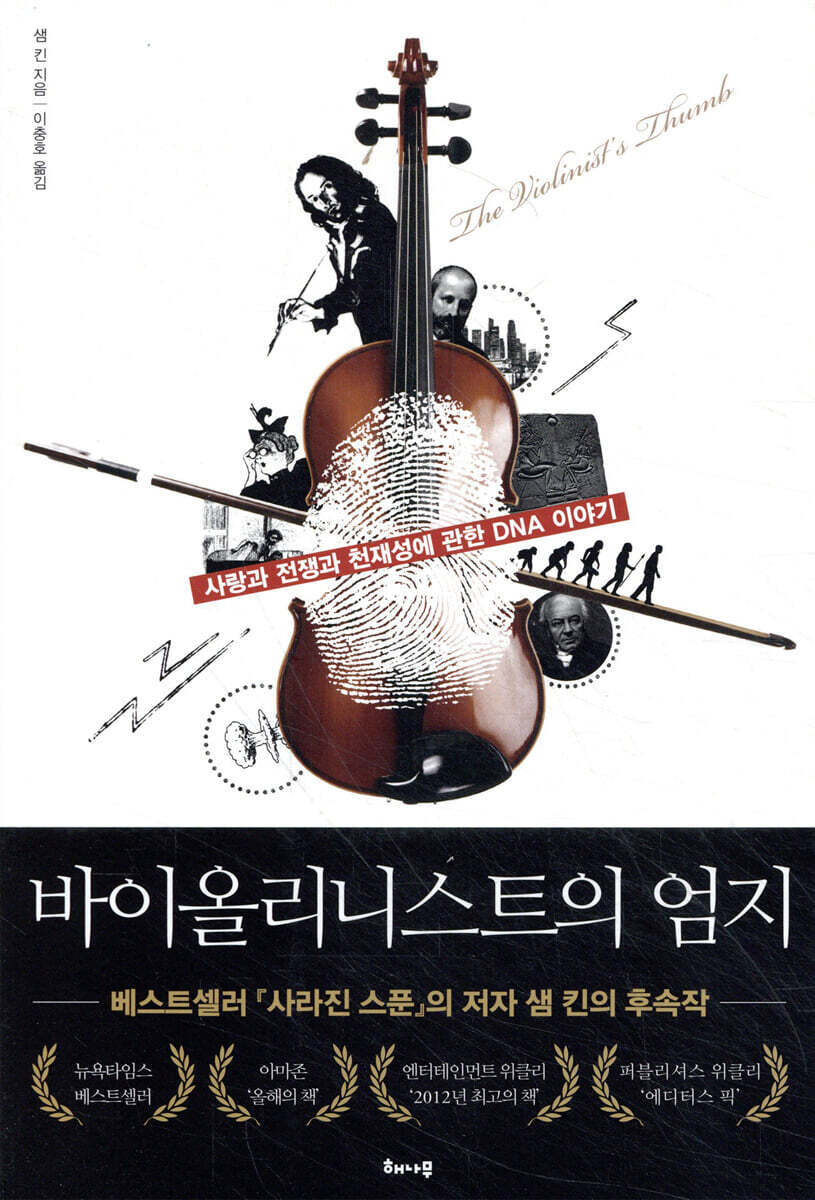
violinist's thumb
 |
Description
Book Introduction
The Violinist's Thumb is a fascinating, thrilling, and tragic DNA story told by gifted storyteller Sam Kean.
The story of how humanity almost went extinct, the story of violinist Paganini who was rumored to have sold his soul to the devil, the genetic disorder of a child born with a tail, John F.
It is rich with fascinating and bizarre DNA stories, including the secret behind Kennedy's bronzed skin.
We hear surprising stories about projects to create human-chimpanzee hybrids, about how translating Chopin's Nocturnes into DNA reveals a surprisingly similar base sequence to certain genes, and about parasites manipulating animal behavior.
Beyond unraveling historical mysteries, the book also portrays the scientific community, brimming with slander, intrigue, conflict, and debate, with a tense and suspenseful narrative, reminiscent of a historical novel. The author's masterful writing style, which manages to craft a compelling narrative around the complex subject of DNA, is a hallmark of the book.
This book, which garnered a passionate response from overseas readers as soon as it was published, was selected as a [New York Times] bestseller, [Entertainment Weekly] 'Best Book of 2012', US Amazon 'Book of the Year' (2012), and [Publisher's Weekly] 'Editor's Pick'.
The story of how humanity almost went extinct, the story of violinist Paganini who was rumored to have sold his soul to the devil, the genetic disorder of a child born with a tail, John F.
It is rich with fascinating and bizarre DNA stories, including the secret behind Kennedy's bronzed skin.
We hear surprising stories about projects to create human-chimpanzee hybrids, about how translating Chopin's Nocturnes into DNA reveals a surprisingly similar base sequence to certain genes, and about parasites manipulating animal behavior.
Beyond unraveling historical mysteries, the book also portrays the scientific community, brimming with slander, intrigue, conflict, and debate, with a tense and suspenseful narrative, reminiscent of a historical novel. The author's masterful writing style, which manages to craft a compelling narrative around the complex subject of DNA, is a hallmark of the book.
This book, which garnered a passionate response from overseas readers as soon as it was published, was selected as a [New York Times] bestseller, [Entertainment Weekly] 'Best Book of 2012', US Amazon 'Book of the Year' (2012), and [Publisher's Weekly] 'Editor's Pick'.
- You can preview some of the book's contents.
Preview
Into the book
“When two scientists, instead of making music out of DNA, tried the other way around, translating a Chopin nocturne into DNA, something much more interesting happened.
They found a sequence that was “strikingly similar” to part of the gene that makes RNA polymerase.
This polymerase, a protein that appears universally in all living things, plays a crucial role in the process of making RNA from DNA.
This means that, if we look closely, the complete cycle of life is actually encoded in the nocturne.
Think about it.
Polymerases use DNA to make RNA.
And RNA makes complex proteins.
Proteins make cells, and cells make people like Chopin.
And Chopin composed harmonious music.
In doing so, Chopin completed the circle of life by encoding the DNA that creates polymerase into music.” (p.
104)
“It’s hard to accept that microbes can manipulate our emotions and inner mental lives.
But Toxoplasma gondii can.
Over a long period of co-evolution with mammals, Toxoplasma stole the dopamine-producing gene, and that gene has since proven remarkably effective in influencing the animals' behavior—by increasing the pleasurable feeling of being around cats and alleviating their natural fear of them.
There is also anecdotal evidence that Toxoplasma gondii can also alter other fear signals in the brain (signs unrelated to cats) and transform such stimuli into blissful pleasure” (p. 195).
“The truth is that no matter where they lived or what group they belonged to, people enjoyed love with other ancient human groups (such as Neanderthals) whenever they had the chance.
These DNA memories lie deeper than our id, and the heroic tales of humanity's spread across the globe remind us that they require personal, intimate, and all-too-human correction and commentary.
Such corrections and annotations would include stories of encounters with other species here and there, of eye contact and flight, of genetic mixing almost everywhere.” (p. 283)
“Our efforts to find the roots of diseases like Darwin's disease in DNA sequences may one day seem like a bizarre endeavor.
In any case, these efforts overlook a more important point about Darwin and others.
It is the fact that they persevered with an indomitable spirit despite their painful illness.
We tend to treat DNA as our earthly soul, the chemical essence that makes us who we are.
But even if we could completely decode a person's DNA, we would only know a fraction of the whole.” (p.368)
“But over the past few decades, a reversal has occurred.
Today, scientists view heredity as more fluid, and the barriers between genes and environment are porous.
That is, genes are not everything, and gene expression, that is, turning specific genes on or off, is also important.
Cells usually turn genes off by attaching tiny nodules called methyl groups, and turn them on by using acetyl groups to unwind DNA from protein loops.
And scientists have discovered that each time a cell divides, it passes on this exact pattern of methyl and acetyl groups to its daughter cells—a kind of 'cellular memory' you might call it.” (p.402)
“DNA has revealed countless stories about our past that we thought were lost forever, and it has given us a brain and curiosity strong enough to keep digging where those stories lie for hundreds of years to come.
And despite the push-and-pull struggle, the ambivalence—on the one hand, the desire to possess it, and on the other, the unwillingness to accept it—the more we learn, the more tempted we become to change our DNA, even to the point of deeming it desirable. DNA has given us the power of imagination, and now we imagine ourselves freeing ourselves from the burdensome and heartbreaking shackles it has placed on life.
We imagine ourselves remaking our own chemical nature, and remaking life as we know it.” (p. 445-446)
They found a sequence that was “strikingly similar” to part of the gene that makes RNA polymerase.
This polymerase, a protein that appears universally in all living things, plays a crucial role in the process of making RNA from DNA.
This means that, if we look closely, the complete cycle of life is actually encoded in the nocturne.
Think about it.
Polymerases use DNA to make RNA.
And RNA makes complex proteins.
Proteins make cells, and cells make people like Chopin.
And Chopin composed harmonious music.
In doing so, Chopin completed the circle of life by encoding the DNA that creates polymerase into music.” (p.
104)
“It’s hard to accept that microbes can manipulate our emotions and inner mental lives.
But Toxoplasma gondii can.
Over a long period of co-evolution with mammals, Toxoplasma stole the dopamine-producing gene, and that gene has since proven remarkably effective in influencing the animals' behavior—by increasing the pleasurable feeling of being around cats and alleviating their natural fear of them.
There is also anecdotal evidence that Toxoplasma gondii can also alter other fear signals in the brain (signs unrelated to cats) and transform such stimuli into blissful pleasure” (p. 195).
“The truth is that no matter where they lived or what group they belonged to, people enjoyed love with other ancient human groups (such as Neanderthals) whenever they had the chance.
These DNA memories lie deeper than our id, and the heroic tales of humanity's spread across the globe remind us that they require personal, intimate, and all-too-human correction and commentary.
Such corrections and annotations would include stories of encounters with other species here and there, of eye contact and flight, of genetic mixing almost everywhere.” (p. 283)
“Our efforts to find the roots of diseases like Darwin's disease in DNA sequences may one day seem like a bizarre endeavor.
In any case, these efforts overlook a more important point about Darwin and others.
It is the fact that they persevered with an indomitable spirit despite their painful illness.
We tend to treat DNA as our earthly soul, the chemical essence that makes us who we are.
But even if we could completely decode a person's DNA, we would only know a fraction of the whole.” (p.368)
“But over the past few decades, a reversal has occurred.
Today, scientists view heredity as more fluid, and the barriers between genes and environment are porous.
That is, genes are not everything, and gene expression, that is, turning specific genes on or off, is also important.
Cells usually turn genes off by attaching tiny nodules called methyl groups, and turn them on by using acetyl groups to unwind DNA from protein loops.
And scientists have discovered that each time a cell divides, it passes on this exact pattern of methyl and acetyl groups to its daughter cells—a kind of 'cellular memory' you might call it.” (p.402)
“DNA has revealed countless stories about our past that we thought were lost forever, and it has given us a brain and curiosity strong enough to keep digging where those stories lie for hundreds of years to come.
And despite the push-and-pull struggle, the ambivalence—on the one hand, the desire to possess it, and on the other, the unwillingness to accept it—the more we learn, the more tempted we become to change our DNA, even to the point of deeming it desirable. DNA has given us the power of imagination, and now we imagine ourselves freeing ourselves from the burdensome and heartbreaking shackles it has placed on life.
We imagine ourselves remaking our own chemical nature, and remaking life as we know it.” (p. 445-446)
--- From the text
Publisher's Review
Music, love, madness, genius, and world history entangled in DNA
Why do cat owners, often calling themselves "cat butlers," become so obsessed with their felines? How did Tsutomu Yamaguchi, twice hit by atomic bombs, live to be 93? Sam Kean's "The Violinist's Thumb: And other tales of Love, War, and Genius, as written by our Genetic Code" is a captivating and colorful tale of DNA told with eloquence.
When storyteller and author Sam Kean tackles DNA, the once-hard-edged scientific subject reveals buried stories from all sorts of contexts, including history, music, linguistics, archaeology, and sociology.
The author was born to father Gene and mother Jean, and from a young age, he was often teased by his friends, saying, "It's all about the genes." As a result, he instinctively felt fear of genetics. Fortunately, his curiosity about DNA shook him more strongly and clearly.
This book covers a wide range of continents and eras, from primitive humans to the Egyptian pharaohs of the 14th century BC, to the European Age of Exploration in the 16th century, to modern society in the 20th century, encompassing not only the life of an individual governed by DNA, but also the history of apes spanning tens of thousands of years.
From Sam Keen's deeply personal experiences to the universal genetic story shared by all of humanity, each anecdote is characterized by a vivid story.
Examples include:
One of the reasons cat owners become obsessed with their cat colonies is because they are infected with a parasite called Toxoplasma gondii.
Cat owners often become infected with Toxoplasma gondii through their skin when handling cat feces. Once inside the body, the parasite swims straight to the brain, where it creates tiny cysts.
And this Toxoplasma parasite influences human behavior, such as making us think of the smell of cat urine as a pleasant smell by causing the brain to release dopamine.
There are also many strange and creepy anecdotes.
In the 1920s, a Russian biologist named Ilya Ivanovich Ivanov conducted a horrifying experiment in which he attempted to create a "humange" by combining human genes with chimpanzee genes.
Moreover, the Soviet government, believing that if this experiment was successful, it could be used to secure a labor force, funded the research, which would be equivalent to about $130,000 today.
If the chimpanzee he was raising hadn't died, if Ivanov hadn't suffered a stroke, the terrifying birth of a human might have happened on Earth.
The following is a sad and tragic story.
The most dangerous animal for Willem Barents and his crew as they sailed up the frozen Russian north was the polar bear, which they routinely attacked until one day they captured one.
That's when the misfortune began.
The sailors, determined to fill their bellies with bear meat, cooked and ate everything from the bear's cartilage, bone marrow, heart, kidneys, brains, and liver.
But there was a problem with the liver.
Polar bear liver was highly concentrated in vitamin A, and all sailors who ate it suffered excruciating pain, with their skin peeling off from head to toe.
In the case of polar bears, they have evolved to withstand the toxicity of vitamin A over a long period of time, so they have no problem surviving.
Speaking of tragic stories, we cannot leave out the story of the double bomb victims.
Mr. Tsutomu Yamaguchi happened to go on a business trip to Hiroshima and was hit by the atomic bomb once there, and then again in Nagasaki upon returning home.
He is the only survivor (acknowledged by the Japanese government) of double exposure.
Incredibly, Yamaguchi lived to be 93 years old, and while scientists cannot definitively explain why he survived, they suspect one reason was that he possessed a gene that allows his body to quickly and efficiently repair damaged DNA.
In addition to this, this book also contains the story of the genetic disease suffered by the genius violinist Paganini, who was called the devil's pianist, the story of Chopin's Nocturnes, which have a surprisingly similar base sequence to a certain gene when translated into DNA, and the stories of Charles Darwin, Abraham Lincoln, and John F.
It is filled with fascinating stories, including the genetic diseases that plagued Kennedy, the story of cancer cells passing through the placenta to the fetus, the story of Einstein's brain being stolen and the secrets of his genius, and the intrigues and war of nerves within the scientific community surrounding the Human Genome Project.
DNA is a very important substance that helps us understand where we came from and how our bodies and minds work.
Following Sam Keen's DNA stories makes us realize that DNA is not just a story from a stiff biology textbook, but rather the story of ourselves living and breathing right here, the grand history of all living creatures, and a vast narrative that continues to influence us and unfold.
When storyteller and author Sam Kean tackles DNA, the once-hard-edged scientific subject reveals buried stories from all sorts of contexts, including history, music, linguistics, archaeology, and sociology.
The author was born to father Gene and mother Jean, and from a young age, he was often teased by his friends, saying, "It's all about the genes." As a result, he instinctively felt fear of genetics. Fortunately, his curiosity about DNA shook him more strongly and clearly.
This book covers a wide range of continents and eras, from primitive humans to the Egyptian pharaohs of the 14th century BC, to the European Age of Exploration in the 16th century, to modern society in the 20th century, encompassing not only the life of an individual governed by DNA, but also the history of apes spanning tens of thousands of years.
From Sam Keen's deeply personal experiences to the universal genetic story shared by all of humanity, each anecdote is characterized by a vivid story.
Examples include:
One of the reasons cat owners become obsessed with their cat colonies is because they are infected with a parasite called Toxoplasma gondii.
Cat owners often become infected with Toxoplasma gondii through their skin when handling cat feces. Once inside the body, the parasite swims straight to the brain, where it creates tiny cysts.
And this Toxoplasma parasite influences human behavior, such as making us think of the smell of cat urine as a pleasant smell by causing the brain to release dopamine.
There are also many strange and creepy anecdotes.
In the 1920s, a Russian biologist named Ilya Ivanovich Ivanov conducted a horrifying experiment in which he attempted to create a "humange" by combining human genes with chimpanzee genes.
Moreover, the Soviet government, believing that if this experiment was successful, it could be used to secure a labor force, funded the research, which would be equivalent to about $130,000 today.
If the chimpanzee he was raising hadn't died, if Ivanov hadn't suffered a stroke, the terrifying birth of a human might have happened on Earth.
The following is a sad and tragic story.
The most dangerous animal for Willem Barents and his crew as they sailed up the frozen Russian north was the polar bear, which they routinely attacked until one day they captured one.
That's when the misfortune began.
The sailors, determined to fill their bellies with bear meat, cooked and ate everything from the bear's cartilage, bone marrow, heart, kidneys, brains, and liver.
But there was a problem with the liver.
Polar bear liver was highly concentrated in vitamin A, and all sailors who ate it suffered excruciating pain, with their skin peeling off from head to toe.
In the case of polar bears, they have evolved to withstand the toxicity of vitamin A over a long period of time, so they have no problem surviving.
Speaking of tragic stories, we cannot leave out the story of the double bomb victims.
Mr. Tsutomu Yamaguchi happened to go on a business trip to Hiroshima and was hit by the atomic bomb once there, and then again in Nagasaki upon returning home.
He is the only survivor (acknowledged by the Japanese government) of double exposure.
Incredibly, Yamaguchi lived to be 93 years old, and while scientists cannot definitively explain why he survived, they suspect one reason was that he possessed a gene that allows his body to quickly and efficiently repair damaged DNA.
In addition to this, this book also contains the story of the genetic disease suffered by the genius violinist Paganini, who was called the devil's pianist, the story of Chopin's Nocturnes, which have a surprisingly similar base sequence to a certain gene when translated into DNA, and the stories of Charles Darwin, Abraham Lincoln, and John F.
It is filled with fascinating stories, including the genetic diseases that plagued Kennedy, the story of cancer cells passing through the placenta to the fetus, the story of Einstein's brain being stolen and the secrets of his genius, and the intrigues and war of nerves within the scientific community surrounding the Human Genome Project.
DNA is a very important substance that helps us understand where we came from and how our bodies and minds work.
Following Sam Keen's DNA stories makes us realize that DNA is not just a story from a stiff biology textbook, but rather the story of ourselves living and breathing right here, the grand history of all living creatures, and a vast narrative that continues to influence us and unfold.
GOODS SPECIFICS
- Date of publication: June 10, 2014
- Page count, weight, size: 507 pages | 729g | 153*224*35mm
- ISBN13: 9788956057507
- ISBN10: 8956057508
You may also like
카테고리
korean


korean

![ELLE 엘르 스페셜 에디션 A형 : 12월 [2025]](http://librairie.coreenne.fr/cdn/shop/files/b8e27a3de6c9538896439686c6b0e8fb.jpg?v=1766436872&width=3840)


