

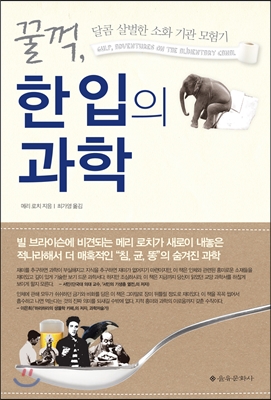
Gulp, a bite of science
 |
Description
Book Introduction
It unravels the process of food passing through the mouth and into the esophagus as a journey, and introduces various human chemical phenomena, nutrient distribution, scientific experiments, and statistics that occur at each stage in an interesting way.
Here are some interesting or impressive facts revealed in this book: Is it wrong to eat intestines, liver, tendons, blood, and insects? Unsightly intestines and liver are said to be high-protein, nutritious foods and excellent vegetable substitutes.
If you chew and swallow roughly, will it really be indigestible? If you chew and swallow roughly, any food will be processed by the small intestine.
It is said that the human digestive tract is designed to squeeze as much out of food as possible, so there is no need to be picky.
The greatest irony is that all life began in the digestive tract.
They say that the brain grew out of necessity to find food, and hands and feet grew out of necessity to pick up food.
As the body grew larger, a circulatory system was needed to supply energy fuel to every corner of the limbs, and in this way, the human body structure became more and more complex.
The part that reveals that “traces of this evolution still remain in the human digestive system” is impressive.
He also says that the signals the body sends are the crystallization of wisdom acquired by all living things on Earth over millions of years of evolution, and that while the human mind detests excrement as dirty, the human body has no understanding whatsoever of why excrement is dirty.
Here are some interesting or impressive facts revealed in this book: Is it wrong to eat intestines, liver, tendons, blood, and insects? Unsightly intestines and liver are said to be high-protein, nutritious foods and excellent vegetable substitutes.
If you chew and swallow roughly, will it really be indigestible? If you chew and swallow roughly, any food will be processed by the small intestine.
It is said that the human digestive tract is designed to squeeze as much out of food as possible, so there is no need to be picky.
The greatest irony is that all life began in the digestive tract.
They say that the brain grew out of necessity to find food, and hands and feet grew out of necessity to pick up food.
As the body grew larger, a circulatory system was needed to supply energy fuel to every corner of the limbs, and in this way, the human body structure became more and more complex.
The part that reveals that “traces of this evolution still remain in the human digestive system” is impressive.
He also says that the signals the body sends are the crystallization of wisdom acquired by all living things on Earth over millions of years of evolution, and that while the human mind detests excrement as dirty, the human body has no understanding whatsoever of why excrement is dirty.
- You can preview some of the book's contents.
Preview
index
Introduction
1 If you look closely, it's all done by the nose.
2 Master, I will taste rotten meat.
Pride and Prejudice Surrounding the 3rd Liver
4. If you chew thoroughly and eat slowly, you can even pay off the national debt.
5th place, stomach acid and the love and hate of two men
6 Dirty spit, scary spit, good spit
I'm happy because I can eat with my mouth.
8 How to Survive Being Eaten by a Whale
9 The Counterattack of the Feed
10 People Who Died From Eating Too Much
11 The smuggler's most reliable companion, the digestive tract
12 Warning! May explode
13 People die and leave behind intestinal gas.
14. Is foul-smelling intestinal gas really that bad?
15 Can't you go in through the exit door?
16 Elvis Presley, died of constipation!?
17 I'll fix it perfectly, if you just endure the disgusting things
Acknowledgements
References
Translator's Note
Search
1 If you look closely, it's all done by the nose.
2 Master, I will taste rotten meat.
Pride and Prejudice Surrounding the 3rd Liver
4. If you chew thoroughly and eat slowly, you can even pay off the national debt.
5th place, stomach acid and the love and hate of two men
6 Dirty spit, scary spit, good spit
I'm happy because I can eat with my mouth.
8 How to Survive Being Eaten by a Whale
9 The Counterattack of the Feed
10 People Who Died From Eating Too Much
11 The smuggler's most reliable companion, the digestive tract
12 Warning! May explode
13 People die and leave behind intestinal gas.
14. Is foul-smelling intestinal gas really that bad?
15 Can't you go in through the exit door?
16 Elvis Presley, died of constipation!?
17 I'll fix it perfectly, if you just endure the disgusting things
Acknowledgements
References
Translator's Note
Search
Into the book
What are the main ingredients in dog food flavor enhancers? This time, Moeller explains.
“It’s the liver.
It is used mixed with other internal organs.
“The first thing wild animals eat from their prey is the liver and stomach, that is, the gastrointestinal tract.” It is undeniable that animal intestines are the best source of nutrition on earth.
A single serving of sheep spleen contains as much vitamin C as a tangerine, and a single serving of cow lung contains more than half the recommended daily amount of vitamin C.
The stomach is even more special because of the contents inside it.
Predators get a bonus of the plant nutrients contained in the stomach of their prey.
-From the text
Because humans are omnivores, they need to consume a variety of vitamins, minerals, and calcium, just like dogs.
In that context, our ancestors never threw away the most nutritious internal organs from a corpse.
So when did offal become so despised? In 2009, the United States exported 438,000 tons of frozen animal offal.
If you line them up one by one, it is enough to surround the Earth.
Strictly speaking, it is not wrong to say that the intestines went around the Earth.
Egyptians and Russians enjoy eating liver imported from the United States, while brains and lips are popular in Mexico.
The heart belongs to the Filipino people.
-From the text
The figure said that high-quality laundry detergents contain at least three types of digestive enzymes.
Amylase is said to remove carbohydrate stains, protease to remove proteins, and lipase to remove grease stains.
Here, oil refers to body oils such as sebum, not dietary fat.
So, in a word, laundry detergent is like a digestive system in a box.
It can be said that the protease and lipase in the detergent eat up the food that our digestive system has not been able to process.
The first person to come up with the novel idea of using digestive enzymes as detergents was Otto Röhm, a chemist and window glass inventor.
-From the text
The reason saliva is so sticky is because of a substance called mucin.
Without mucin, a structure made up of long chains of amino acids entangled in all directions like a spider's web, saliva would not be so disgustingly sticky and viscous.
But mucin isn't necessarily a bad thing.
Saliva containing mucin surrounds the tooth surface and acts as a protective film.
Then, the protein components in saliva bind to the calcium and phosphoric acid in the teeth, strengthening the enamel.
The mucin network also serves to capture bacteria.
If you swallow saliva like this, the bacteria will be destroyed by stomach acid and die, and this function is very important because there are countless bacteria living in our mouths.
When we eat food or suck our fingers, bacteria also enter our mouths.
-From the text
Vanderbilt has been studying the chewing movement for 25 years… Vanderbilt's research topic is, simply put, explaining the chewing movement in terms of nerves and muscles.
What Vanderbilt marvels at, he says, is not the destructive power of the jaw muscles, but their sophisticated defensive instincts.… The human mouth has evolved an automatic braking system that crushes food without damaging the precious teeth, and this system is much faster and more sophisticated than the brakes in a Lexus.… Human teeth can detect not only a grain of rice but also a grain of sand that is only 10 microns in diameter.
-From the text
Hydrogen sulfide in farts is not an absolute evil.
Although it is dangerous in large quantities and has a terrible odor, it is an essential substance for physiological functions, like sodium chloride.
Hydrogen sulfide is constantly being produced in all body tissues, even at this very moment.
Some may disagree, but it doesn't really affect the dinner menu.
Olson assessed the value of this gas:
“Hydrogen sulfide is a molecule that acts as a universal mediator in the gastrointestinal tract, so its potential as a disease treatment agent is limitless.
“It is currently the most popular research topic in biomedical science.”
-From the text
The human digestive tract is like a metropolitan railroad that runs from Seattle to Los Angeles.
It takes about 30 hours to complete one run, and by the time you reach the final destination, the scenery outside the window becomes incredibly monotonous.
-From the text
Mouthwash manufacturers' claims that they kill 99 percent of oral bacteria are exaggerated.
According to Siletti, about half of the bacteria in your mouth cannot be cultured in a laboratory.
These bacteria survive only by staying in the mouth or parasitizing other bacteria.
-From the text
In 1973, a curious research team at the University of Virginia School of Medicine was studying the common cold and looking at what they called "the frequency of finger contact with the nasal mucosa during normal times."
Simply put, it's a survey of how often people usually pick their noses.
The researcher sat in the front row of a stepped auditorium for 30 to 50 minutes on seven occasions during the inpatient case review sessions, pretending to take notes while secretly observing those around him.
As a result, 124 doctors and medical students had their noses pierced a total of 29 times.
Meanwhile, this frequency was slightly lower during Sunday youth Bible study, which the research team attributed not to the church members being more polite than medical students, but to the fact that chairs were arranged in a circle so that people faced each other.
-From the text
“It’s the liver.
It is used mixed with other internal organs.
“The first thing wild animals eat from their prey is the liver and stomach, that is, the gastrointestinal tract.” It is undeniable that animal intestines are the best source of nutrition on earth.
A single serving of sheep spleen contains as much vitamin C as a tangerine, and a single serving of cow lung contains more than half the recommended daily amount of vitamin C.
The stomach is even more special because of the contents inside it.
Predators get a bonus of the plant nutrients contained in the stomach of their prey.
-From the text
Because humans are omnivores, they need to consume a variety of vitamins, minerals, and calcium, just like dogs.
In that context, our ancestors never threw away the most nutritious internal organs from a corpse.
So when did offal become so despised? In 2009, the United States exported 438,000 tons of frozen animal offal.
If you line them up one by one, it is enough to surround the Earth.
Strictly speaking, it is not wrong to say that the intestines went around the Earth.
Egyptians and Russians enjoy eating liver imported from the United States, while brains and lips are popular in Mexico.
The heart belongs to the Filipino people.
-From the text
The figure said that high-quality laundry detergents contain at least three types of digestive enzymes.
Amylase is said to remove carbohydrate stains, protease to remove proteins, and lipase to remove grease stains.
Here, oil refers to body oils such as sebum, not dietary fat.
So, in a word, laundry detergent is like a digestive system in a box.
It can be said that the protease and lipase in the detergent eat up the food that our digestive system has not been able to process.
The first person to come up with the novel idea of using digestive enzymes as detergents was Otto Röhm, a chemist and window glass inventor.
-From the text
The reason saliva is so sticky is because of a substance called mucin.
Without mucin, a structure made up of long chains of amino acids entangled in all directions like a spider's web, saliva would not be so disgustingly sticky and viscous.
But mucin isn't necessarily a bad thing.
Saliva containing mucin surrounds the tooth surface and acts as a protective film.
Then, the protein components in saliva bind to the calcium and phosphoric acid in the teeth, strengthening the enamel.
The mucin network also serves to capture bacteria.
If you swallow saliva like this, the bacteria will be destroyed by stomach acid and die, and this function is very important because there are countless bacteria living in our mouths.
When we eat food or suck our fingers, bacteria also enter our mouths.
-From the text
Vanderbilt has been studying the chewing movement for 25 years… Vanderbilt's research topic is, simply put, explaining the chewing movement in terms of nerves and muscles.
What Vanderbilt marvels at, he says, is not the destructive power of the jaw muscles, but their sophisticated defensive instincts.… The human mouth has evolved an automatic braking system that crushes food without damaging the precious teeth, and this system is much faster and more sophisticated than the brakes in a Lexus.… Human teeth can detect not only a grain of rice but also a grain of sand that is only 10 microns in diameter.
-From the text
Hydrogen sulfide in farts is not an absolute evil.
Although it is dangerous in large quantities and has a terrible odor, it is an essential substance for physiological functions, like sodium chloride.
Hydrogen sulfide is constantly being produced in all body tissues, even at this very moment.
Some may disagree, but it doesn't really affect the dinner menu.
Olson assessed the value of this gas:
“Hydrogen sulfide is a molecule that acts as a universal mediator in the gastrointestinal tract, so its potential as a disease treatment agent is limitless.
“It is currently the most popular research topic in biomedical science.”
-From the text
The human digestive tract is like a metropolitan railroad that runs from Seattle to Los Angeles.
It takes about 30 hours to complete one run, and by the time you reach the final destination, the scenery outside the window becomes incredibly monotonous.
-From the text
Mouthwash manufacturers' claims that they kill 99 percent of oral bacteria are exaggerated.
According to Siletti, about half of the bacteria in your mouth cannot be cultured in a laboratory.
These bacteria survive only by staying in the mouth or parasitizing other bacteria.
-From the text
In 1973, a curious research team at the University of Virginia School of Medicine was studying the common cold and looking at what they called "the frequency of finger contact with the nasal mucosa during normal times."
Simply put, it's a survey of how often people usually pick their noses.
The researcher sat in the front row of a stepped auditorium for 30 to 50 minutes on seven occasions during the inpatient case review sessions, pretending to take notes while secretly observing those around him.
As a result, 124 doctors and medical students had their noses pierced a total of 29 times.
Meanwhile, this frequency was slightly lower during Sunday youth Bible study, which the research team attributed not to the church members being more polite than medical students, but to the fact that chairs were arranged in a circle so that people faced each other.
-From the text
---From the text
Publisher's Review
From nose to intestinal gas, "Made in the body's factory"
The great human affairs of ingestion, decomposition, absorption, and excretion
If you think about it, it's all done by the nose!?|Pride and prejudice surrounding the internal organs|Dirty spit, scary spit, good spit|Can't I go in through the exit door?|My mouth has an automatic brake|I'll lend you my toilet.
It unravels the process of food passing through the mouth and into the esophagus as a journey, and introduces various human chemical phenomena, nutrient distribution, scientific experiments, and statistics that occur at each stage in an interesting way.
Interesting topics such as the hidden workings of the nose and the relativity of taste, the story of the liver and intestines, which are so-called disgusting foods, the health benefits of prolonged chewing, the history of stomach anatomy and the mystery of gastric acid function, the medicinal effects of saliva, the function of mastication (chewing) of the mouth and the physics of food, the truth about intestinal gas, the misconceptions about constipation, stool as a barometer of health, the interrelationship between bacteria and the large intestine, and the miracle of small intestinal villi are constantly pouring out.
Roach deftly treads the line between irreverence and suspense, creating tension while simultaneously evoking awe at the dignity and sophistication of the human body.
How can a wine taster tell the difference between a $10 bottle and a $100 bottle? Can chewing your food thoroughly help pay off the national debt? Saliva is teeming with bacteria, so why do animals lick their wounds? Why don't suicide bombers hide their bombs in their anuses? Why is the stomach intact, even though it breaks down food? Why do crunchy foods taste so delicious? Can people die from constipation? Did Elvis Presley really die from it? How much can we eat before our stomachs burst? Why aren't human stomachs as big as cows'? Why do dogs eat their own feces?
To provide clear answers to these questions, the author visits the laboratories of a pet food manufacturer, a Dutch saliva lab, and an Arctic Eskimo village where they enjoy eating intestines and liver. He also explains the somewhat shocking-sounding fecal (colon bacteria) transplant surgery—changing the gut flora is far more effective than changing the diet to prevent and cure disease—and even uses an endoscope to capture the fate of food in the stomach, vividly describing the process.
Sometimes, through outlandish topics like enema nutrition and autophagy, it subtly reveals scientific truths that we may not otherwise be aware of, such as the nutrient absorption rate of the colon and rectum or the nutritional value of stool.
We pursue the hard-chewing truth of the so-called 'Fletcher Theory', acknowledged by Henry James and Franz Kafka.
As you travel the world with Roach, you'll meet murderers, mad scientists, Eskimos, and rabbis.
You might be startled to see an exorcist performing a ritual on a person's stomach, or perhaps you might be relieved to learn that terrorists, for practical reasons, cannot hide a bomb in the digestive tract.
Let's just taste a few of the interesting or impressive facts revealed in this book.
Is it wrong to eat intestines, liver, tendons, blood, and insects? Unsightly intestines and liver are said to be high in protein and a nutritious food source and an excellent substitute for vegetables.
This may be proof that Korean food culture is valid or excellent.
If you chew and swallow roughly, will it really be indigestible? If you chew and swallow roughly, any food will be processed by the small intestine.
It is said that the human digestive tract is designed to squeeze as much out of food as possible, so there is no need to be picky.
Could the human mouth possess a braking system far more rapid and sophisticated than the brakes found in a Lexus? More astonishing than the well-known strength of our jaw muscles is our sophisticated defensive instinct.
It's amazing how it works before we even realize we need to be careful.
“People are surrounded by little accessories.
“You’ll be amazed to learn that it’s a huge pipe.”
“I just can't understand.
“How can an idol singer be more precious than my body?”
“The greatest irony is that all life began in the digestive tract.
They say that the brain grew out of necessity to find food, and hands and feet grew out of necessity to pick up food.
As the body grew larger, a circulatory system was needed to supply energy fuel to every corner of the limbs, and in this way, the human body structure became more and more complex.
The part that reveals that “traces of this evolution still remain in the human digestive system” is impressive.
“Gorillas spend all day digesting leaves.
You sit down, chew it, and then it cooks in your stomach.
So how can you afford to use your brain for higher-level thinking?” “What you eat is important.
But a person's humanity is determined by how they eat it.
We should be grateful for all the miracles that make us human, including digestive juices, enzymes, intestinal villi, the discovery of fire, and the development of cooking techniques. … Take gorillas, our close relatives. Although gorillas are primates like us, they have been relegated to the second place in the hierarchy because their digestive tracts are less developed and therefore less efficient at producing calories.
Gorillas eat a huge amount of uncooked grass every day, just like cows.
I can relate to the part where he says, “This is how we live each day with the energy that is created through fermentation in our bodies.”
“We humans are blinded by ignorance, pride, and immediate gain.
So, I rashly believed as true the baseless speculations I had come up with myself or heard from someone else.
All while completely ignoring the truth that the body shows.
However, the signals the body sends are the crystallization of wisdom acquired by all life on Earth over millions of years of evolution.
“The human mind detests excrement as dirty, but the human body has no understanding of why excrement is dirty.”
The great human affairs of ingestion, decomposition, absorption, and excretion
If you think about it, it's all done by the nose!?|Pride and prejudice surrounding the internal organs|Dirty spit, scary spit, good spit|Can't I go in through the exit door?|My mouth has an automatic brake|I'll lend you my toilet.
It unravels the process of food passing through the mouth and into the esophagus as a journey, and introduces various human chemical phenomena, nutrient distribution, scientific experiments, and statistics that occur at each stage in an interesting way.
Interesting topics such as the hidden workings of the nose and the relativity of taste, the story of the liver and intestines, which are so-called disgusting foods, the health benefits of prolonged chewing, the history of stomach anatomy and the mystery of gastric acid function, the medicinal effects of saliva, the function of mastication (chewing) of the mouth and the physics of food, the truth about intestinal gas, the misconceptions about constipation, stool as a barometer of health, the interrelationship between bacteria and the large intestine, and the miracle of small intestinal villi are constantly pouring out.
Roach deftly treads the line between irreverence and suspense, creating tension while simultaneously evoking awe at the dignity and sophistication of the human body.
How can a wine taster tell the difference between a $10 bottle and a $100 bottle? Can chewing your food thoroughly help pay off the national debt? Saliva is teeming with bacteria, so why do animals lick their wounds? Why don't suicide bombers hide their bombs in their anuses? Why is the stomach intact, even though it breaks down food? Why do crunchy foods taste so delicious? Can people die from constipation? Did Elvis Presley really die from it? How much can we eat before our stomachs burst? Why aren't human stomachs as big as cows'? Why do dogs eat their own feces?
To provide clear answers to these questions, the author visits the laboratories of a pet food manufacturer, a Dutch saliva lab, and an Arctic Eskimo village where they enjoy eating intestines and liver. He also explains the somewhat shocking-sounding fecal (colon bacteria) transplant surgery—changing the gut flora is far more effective than changing the diet to prevent and cure disease—and even uses an endoscope to capture the fate of food in the stomach, vividly describing the process.
Sometimes, through outlandish topics like enema nutrition and autophagy, it subtly reveals scientific truths that we may not otherwise be aware of, such as the nutrient absorption rate of the colon and rectum or the nutritional value of stool.
We pursue the hard-chewing truth of the so-called 'Fletcher Theory', acknowledged by Henry James and Franz Kafka.
As you travel the world with Roach, you'll meet murderers, mad scientists, Eskimos, and rabbis.
You might be startled to see an exorcist performing a ritual on a person's stomach, or perhaps you might be relieved to learn that terrorists, for practical reasons, cannot hide a bomb in the digestive tract.
Let's just taste a few of the interesting or impressive facts revealed in this book.
Is it wrong to eat intestines, liver, tendons, blood, and insects? Unsightly intestines and liver are said to be high in protein and a nutritious food source and an excellent substitute for vegetables.
This may be proof that Korean food culture is valid or excellent.
If you chew and swallow roughly, will it really be indigestible? If you chew and swallow roughly, any food will be processed by the small intestine.
It is said that the human digestive tract is designed to squeeze as much out of food as possible, so there is no need to be picky.
Could the human mouth possess a braking system far more rapid and sophisticated than the brakes found in a Lexus? More astonishing than the well-known strength of our jaw muscles is our sophisticated defensive instinct.
It's amazing how it works before we even realize we need to be careful.
“People are surrounded by little accessories.
“You’ll be amazed to learn that it’s a huge pipe.”
“I just can't understand.
“How can an idol singer be more precious than my body?”
“The greatest irony is that all life began in the digestive tract.
They say that the brain grew out of necessity to find food, and hands and feet grew out of necessity to pick up food.
As the body grew larger, a circulatory system was needed to supply energy fuel to every corner of the limbs, and in this way, the human body structure became more and more complex.
The part that reveals that “traces of this evolution still remain in the human digestive system” is impressive.
“Gorillas spend all day digesting leaves.
You sit down, chew it, and then it cooks in your stomach.
So how can you afford to use your brain for higher-level thinking?” “What you eat is important.
But a person's humanity is determined by how they eat it.
We should be grateful for all the miracles that make us human, including digestive juices, enzymes, intestinal villi, the discovery of fire, and the development of cooking techniques. … Take gorillas, our close relatives. Although gorillas are primates like us, they have been relegated to the second place in the hierarchy because their digestive tracts are less developed and therefore less efficient at producing calories.
Gorillas eat a huge amount of uncooked grass every day, just like cows.
I can relate to the part where he says, “This is how we live each day with the energy that is created through fermentation in our bodies.”
“We humans are blinded by ignorance, pride, and immediate gain.
So, I rashly believed as true the baseless speculations I had come up with myself or heard from someone else.
All while completely ignoring the truth that the body shows.
However, the signals the body sends are the crystallization of wisdom acquired by all life on Earth over millions of years of evolution.
“The human mind detests excrement as dirty, but the human body has no understanding of why excrement is dirty.”
GOODS SPECIFICS
- Date of issue: March 20, 2014
- Page count, weight, size: 368 pages | 549g | 153*224*30mm
- ISBN13: 9788932472287
- ISBN10: 8932472289
You may also like
카테고리
korean


korean

![ELLE 엘르 스페셜 에디션 A형 : 12월 [2025]](http://librairie.coreenne.fr/cdn/shop/files/b8e27a3de6c9538896439686c6b0e8fb.jpg?v=1766436872&width=3840)


