

Chaos
 |
Description
Book Introduction
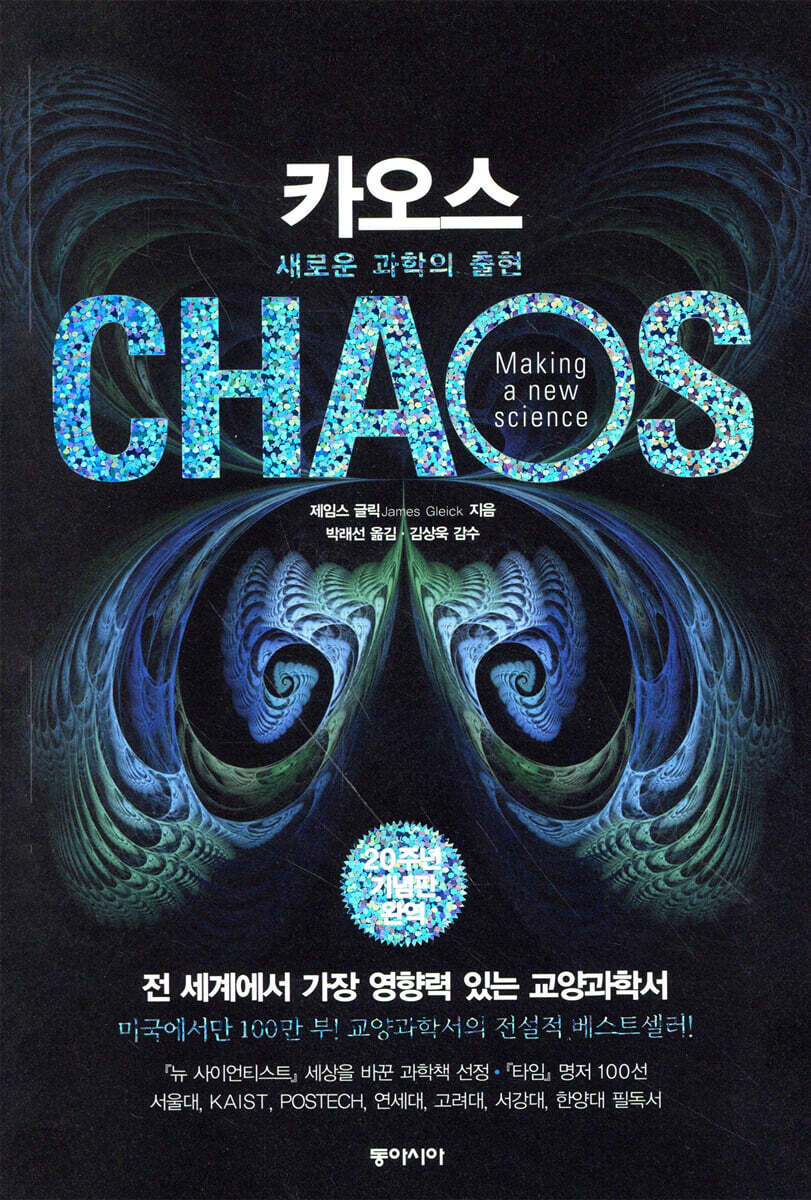
A complete translation of the 20th-anniversary edition of "Chaos," which inspired the "butterfly effect" around the world.
The scientific community's backlash against reductionism and the scientific revolution that brought science down to earth.
Chaos in one word is ‘order within disorder.’
In other words, there is chaos within the order we find, and there is order within the chaos.
Convection, pendulum motion, and turbulence are considered almost completely understood and are no longer studied.
But chaos researchers are discovering that even in the simplest motions, like a pendulum or the rolling motion of a convection current, there is unpredictable disorder.
There are phenomena that cannot be explained or predicted by science limited to so-called linearity.
The concepts they devised, such as the butterfly effect, fractals, strange attractors, and bifurcation, best represent this order in chaos, unpredictability, and nonlinear science.
Those who led the chaos revolution came from the fringes of science.
To borrow Thomas Kuhn's expression, these were not people who simply solved problems of existing science within the framework of normal science.
The book dramatically illustrates how people on the fringes of the scientific community sowed ideological seeds, how established science responded, and how they brought about a new revolution in the scientific community.
Moreover, chaos theory has influenced countless fields since its emergence.
It introduces the core concepts of chaos theory, which have now become commonplace among the public, in the clearest and most popular way.
The regret I felt about the existing Korean translation of this book, which sold hundreds of thousands of copies in Korea, was indescribable.
This is because the book, which depicts the overall history of science until the emergence of chaos science, and the lives and science of chaos researchers in a novel-like, exciting manner, was lacking in many ways.
No, the taste of the writing was secondary, but there were many regrets due to inaccurate and inconsistent terminology translations, omissions from the original text, and mistranslations.
In that sense, this book will be an opportunity for readers to understand chaos theory more comfortably through the meticulous review of a chaos specialist who has studied chaos for over 20 years and the translation that preserves the author's flowing and exciting writing style.
The scientific community's backlash against reductionism and the scientific revolution that brought science down to earth.
Chaos in one word is ‘order within disorder.’
In other words, there is chaos within the order we find, and there is order within the chaos.
Convection, pendulum motion, and turbulence are considered almost completely understood and are no longer studied.
But chaos researchers are discovering that even in the simplest motions, like a pendulum or the rolling motion of a convection current, there is unpredictable disorder.
There are phenomena that cannot be explained or predicted by science limited to so-called linearity.
The concepts they devised, such as the butterfly effect, fractals, strange attractors, and bifurcation, best represent this order in chaos, unpredictability, and nonlinear science.
Those who led the chaos revolution came from the fringes of science.
To borrow Thomas Kuhn's expression, these were not people who simply solved problems of existing science within the framework of normal science.
The book dramatically illustrates how people on the fringes of the scientific community sowed ideological seeds, how established science responded, and how they brought about a new revolution in the scientific community.
Moreover, chaos theory has influenced countless fields since its emergence.
It introduces the core concepts of chaos theory, which have now become commonplace among the public, in the clearest and most popular way.
The regret I felt about the existing Korean translation of this book, which sold hundreds of thousands of copies in Korea, was indescribable.
This is because the book, which depicts the overall history of science until the emergence of chaos science, and the lives and science of chaos researchers in a novel-like, exciting manner, was lacking in many ways.
No, the taste of the writing was secondary, but there were many regrets due to inaccurate and inconsistent terminology translations, omissions from the original text, and mistranslations.
In that sense, this book will be an opportunity for readers to understand chaos theory more comfortably through the meticulous review of a chaos specialist who has studied chaos for over 20 years and the translation that preserves the author's flowing and exciting writing style.
- You can preview some of the book's contents.
Preview
index
20th Anniversary Edition Preface / Prologue
Chapter 1: The Butterfly Effect
Edward Lorenz and the Weather Model | Computer Anomaly? | Long-Term Forecasting Is Doomed to Fail | Order Disguised as Randomness | The World of Nonlinearity | “We Had It All Wrong.”
Chapter 2 Revolution
Revolution Changes the Way We See | Pendulum Clocks, Space Balls, and Swings | Smail's Socks | The Mystery of Jupiter's Great Red Spot Unraveled
Chapter 3: The Prosperity and Decline of Living Things
Modeling Wild Animal Populations | The Nature of Nature Is Nonlinear | The Rake Branch | Meeting a Soviet Scientist | A Film Made of Chaos and a Messianic Thesis
Chapter 4: The Geometry of Nature
The Fluctuations of Cotton Prices | Mandelbrot the Refugee | Transmission Errors and Jagged Coastlines | A New Dimension | The Weirdness of Fractal Geometry | Earthquakes and Fractals on the Earth's Surface | From Clouds to Veins | Theorists and Naturalists | 'Seeing the World in a Grain of Sand.'
Chapter 5: The Strange Attractor
I want to ask God | Theoretical and experimental physicists | Flow between rotating cylinders | David Ruelle's thoughts on turbulence | Rings in phase space | Rösler's sausage | Astronomers' thoughts | Chaos in the galaxy
Chapter 6 Universality
A New Beginning at Los Alamos | Renormalization Group Theory | Unraveling the Secrets of Color | The Emergence of Numerical Experiments | Feigenbaum's Breakthrough | Universality Theory | Rejection Letters | The Como Conference | Clouds and Paintings
Chapter 7 Experimental Physicists
Helium in a Small Box | 'The Gentle Rise of the Solid' | Flow and Form in Nature | A Peek into Libchaber's Nature | Experiment and Theory Meet | From One Dimension to Multidimensionality
Chapter 8: The Forms of Chaos
The Complex Plane | The Surprise of Newton's Law | The Mandelbrot Set: Sprouts and Vines | Where Art, Commerce, and Science Meet | The Boundary of Fractal Basins | The Chaos Game
Chapter 9: Dynamical Groups
Santa Cruz and the 1960s | Analog Computers | Is This Science? | Outsiders in Science | Measuring Unpredictability | Information Theory | From Micro to Macro | A Drop in the Faucet | From Rebel to Physicist | The End of an Era
Chapter 10: Inner Rhythm
Misconceptions about models | The complex body | The dynamic heart | Recalibrating the biological clock | Deadly arrhythmias | Chick heart tissue and abnormal rhythms | Chaos as health
Chapter 11: Chaos and Beyond
New Beliefs, New Definitions | The Second Law of Thermodynamics, the Snowflake Puzzle, and God's Dice Game | Chance and Necessity
Sources and Further Reading / Acknowledgements / Reviewer's Note / References / Index
Chapter 1: The Butterfly Effect
Edward Lorenz and the Weather Model | Computer Anomaly? | Long-Term Forecasting Is Doomed to Fail | Order Disguised as Randomness | The World of Nonlinearity | “We Had It All Wrong.”
Chapter 2 Revolution
Revolution Changes the Way We See | Pendulum Clocks, Space Balls, and Swings | Smail's Socks | The Mystery of Jupiter's Great Red Spot Unraveled
Chapter 3: The Prosperity and Decline of Living Things
Modeling Wild Animal Populations | The Nature of Nature Is Nonlinear | The Rake Branch | Meeting a Soviet Scientist | A Film Made of Chaos and a Messianic Thesis
Chapter 4: The Geometry of Nature
The Fluctuations of Cotton Prices | Mandelbrot the Refugee | Transmission Errors and Jagged Coastlines | A New Dimension | The Weirdness of Fractal Geometry | Earthquakes and Fractals on the Earth's Surface | From Clouds to Veins | Theorists and Naturalists | 'Seeing the World in a Grain of Sand.'
Chapter 5: The Strange Attractor
I want to ask God | Theoretical and experimental physicists | Flow between rotating cylinders | David Ruelle's thoughts on turbulence | Rings in phase space | Rösler's sausage | Astronomers' thoughts | Chaos in the galaxy
Chapter 6 Universality
A New Beginning at Los Alamos | Renormalization Group Theory | Unraveling the Secrets of Color | The Emergence of Numerical Experiments | Feigenbaum's Breakthrough | Universality Theory | Rejection Letters | The Como Conference | Clouds and Paintings
Chapter 7 Experimental Physicists
Helium in a Small Box | 'The Gentle Rise of the Solid' | Flow and Form in Nature | A Peek into Libchaber's Nature | Experiment and Theory Meet | From One Dimension to Multidimensionality
Chapter 8: The Forms of Chaos
The Complex Plane | The Surprise of Newton's Law | The Mandelbrot Set: Sprouts and Vines | Where Art, Commerce, and Science Meet | The Boundary of Fractal Basins | The Chaos Game
Chapter 9: Dynamical Groups
Santa Cruz and the 1960s | Analog Computers | Is This Science? | Outsiders in Science | Measuring Unpredictability | Information Theory | From Micro to Macro | A Drop in the Faucet | From Rebel to Physicist | The End of an Era
Chapter 10: Inner Rhythm
Misconceptions about models | The complex body | The dynamic heart | Recalibrating the biological clock | Deadly arrhythmias | Chick heart tissue and abnormal rhythms | Chaos as health
Chapter 11: Chaos and Beyond
New Beliefs, New Definitions | The Second Law of Thermodynamics, the Snowflake Puzzle, and God's Dice Game | Chance and Necessity
Sources and Further Reading / Acknowledgements / Reviewer's Note / References / Index
Into the book
Nowadays, there are probably few people who have not heard of chaos at least once or twice.
The actress who played Laura Dern in the 1993 film Jurassic Park says:
“I still don’t quite understand chaos,” says the actor who plays Jeff Goldblum, a self-proclaimed chaos expert.
“Chaos simply deals with unpredictability in complex systems.
(……) a butterfly
“If you flap your wings in Beijing, it could rain instead of sunny in New York’s Central Park.” Since then, the butterfly effect has become a cliche in popular culture.
It has inspired at least two films, an entry in Bartlett's Quotations, a music video, and has been circulated on thousands of websites and blogs.
Different aspects of chaos—often different aspects—have been embraced by modern management theorists on the one hand, and by surrealist literary theorists on the other.
Both sides used phrases like “ordered chaos,” which were particularly popular as paper titles.
Powerful literary figures like Shakespeare's Cleopatra seemed like 'strange attractors'.
The same goes for chart patterns in the financial markets.
Meanwhile, sculptors and painters alike have been inspired by the terms and images of fractal geometry.
… … In the early days of chaos's triumphant rise, scientists described it as the third revolution in the natural sciences of the 20th century, following relativity and quantum mechanics.
What has now become clear is that chaos is 'inextricably linked' to relativity and quantum mechanics.
There is only one physics.
(From the preface to the 20th anniversary edition)
Like the story of discovery that goes back to Archimedes' bathhouse, Lorenz's discovery was accidental.
Of course, Lorenz was never the type to shout "Eureka!"
This unexpected discovery only served as an opportunity to reaffirm what he had been exploring.
He began to explore the consequences of his discovery by elucidating what the butterfly effect meant for the flow of all fluids.
If Lorenz had stopped at discovering the butterfly effect, which transforms predictability into pure randomness, he would have simply created another headache.
But Lorenz saw beyond the randomness embedded in his weather model.
I saw elaborate geometric structures, order masquerading as randomness.
A mathematician in meteorologist's clothes, he now begins to lead a double life.
I wrote a purely meteorological paper, but I also wrote a purely mathematical paper with a somewhat misleading introduction about weather.
Eventually, even that introduction completely disappeared.
(Page 49 of Chapter 1, The Butterfly Effect)
Clouds are not spheres.
This is a saying that Mandelbrot liked.
Mountains are not cones, and lightning does not strike in straight lines.
The universe reflected by the new geometry is not round but bumpy, not smooth but rough.
It is a geometry of things that are porous, sunken, cut, twisted, and tangled.
To understand the complexity of nature, it was necessary to suspect that complexity was not merely random or accidental.
For example, it requires the belief that the interesting feature of a lightning strike's path is not its direction but its zigzag distribution.
Mandelbrot proposed that these strange shapes in the world have meaning.
The fine lines and tangled shapes are more than just distorted scratches typical of Euclidean geometry.
This kind of shape often becomes the key to the essence of things.
For example, what is the essence of a coastline? Mandelbrot asked this question in a paper that became a turning point in his thinking.
“How long is the coastline of England?” (Chapter 4, Geometry of Nature, p. 146)
The actress who played Laura Dern in the 1993 film Jurassic Park says:
“I still don’t quite understand chaos,” says the actor who plays Jeff Goldblum, a self-proclaimed chaos expert.
“Chaos simply deals with unpredictability in complex systems.
(……) a butterfly
“If you flap your wings in Beijing, it could rain instead of sunny in New York’s Central Park.” Since then, the butterfly effect has become a cliche in popular culture.
It has inspired at least two films, an entry in Bartlett's Quotations, a music video, and has been circulated on thousands of websites and blogs.
Different aspects of chaos—often different aspects—have been embraced by modern management theorists on the one hand, and by surrealist literary theorists on the other.
Both sides used phrases like “ordered chaos,” which were particularly popular as paper titles.
Powerful literary figures like Shakespeare's Cleopatra seemed like 'strange attractors'.
The same goes for chart patterns in the financial markets.
Meanwhile, sculptors and painters alike have been inspired by the terms and images of fractal geometry.
… … In the early days of chaos's triumphant rise, scientists described it as the third revolution in the natural sciences of the 20th century, following relativity and quantum mechanics.
What has now become clear is that chaos is 'inextricably linked' to relativity and quantum mechanics.
There is only one physics.
(From the preface to the 20th anniversary edition)
Like the story of discovery that goes back to Archimedes' bathhouse, Lorenz's discovery was accidental.
Of course, Lorenz was never the type to shout "Eureka!"
This unexpected discovery only served as an opportunity to reaffirm what he had been exploring.
He began to explore the consequences of his discovery by elucidating what the butterfly effect meant for the flow of all fluids.
If Lorenz had stopped at discovering the butterfly effect, which transforms predictability into pure randomness, he would have simply created another headache.
But Lorenz saw beyond the randomness embedded in his weather model.
I saw elaborate geometric structures, order masquerading as randomness.
A mathematician in meteorologist's clothes, he now begins to lead a double life.
I wrote a purely meteorological paper, but I also wrote a purely mathematical paper with a somewhat misleading introduction about weather.
Eventually, even that introduction completely disappeared.
(Page 49 of Chapter 1, The Butterfly Effect)
Clouds are not spheres.
This is a saying that Mandelbrot liked.
Mountains are not cones, and lightning does not strike in straight lines.
The universe reflected by the new geometry is not round but bumpy, not smooth but rough.
It is a geometry of things that are porous, sunken, cut, twisted, and tangled.
To understand the complexity of nature, it was necessary to suspect that complexity was not merely random or accidental.
For example, it requires the belief that the interesting feature of a lightning strike's path is not its direction but its zigzag distribution.
Mandelbrot proposed that these strange shapes in the world have meaning.
The fine lines and tangled shapes are more than just distorted scratches typical of Euclidean geometry.
This kind of shape often becomes the key to the essence of things.
For example, what is the essence of a coastline? Mandelbrot asked this question in a paper that became a turning point in his thinking.
“How long is the coastline of England?” (Chapter 4, Geometry of Nature, p. 146)
---From the text
Publisher's Review
A complete translation of the 20th anniversary edition of "Chaos," which inspired the "butterfly effect" around the world!
A legendary bestseller in popular science books, selling over 1 million copies in the United States alone!
New Scientist selected the science books that changed the world, and Time named it one of the 100 best books.
Required reading for Seoul National University, KAIST, POSTECH, Yonsei University, Korea University, Sogang University, and Hanyang University
The ultimate liberal arts science book, the first to address "chaos," which has sparked a tremendous ideological storm across cutting-edge science, including complex systems, economics, management, information theory, networks, ecology, medicine, the humanities, and social sciences, and even the arts!
A complete translation of the 20th-anniversary edition of "Chaos," which inspired the "butterfly effect" worldwide.
'If a butterfly flaps its wings in Beijing, a storm will hit New York a month later.' Few words made as much of an impression in the second half of the 20th century as this short sentence, which explains the butterfly effect in chaos theory.
The 20th anniversary edition of 『Chaos』, which popularized the concept of the butterfly effect, has been fully translated.
The regret over the existing Korean translation of this book, which sold over a million copies in the United States alone and was translated and introduced in over 20 countries around the world, and sold hundreds of thousands of copies in Korea, was indescribable.
This is because the book, which depicts the overall history of science until the emergence of chaos science, and the lives and science of chaos researchers in a novel-like, exciting manner, was lacking in many ways.
No, the taste of the writing was secondary, but there were many regrets due to inaccurate and inconsistent terminology translations, omissions from the original text, and mistranslations.
In that sense, this book will be an opportunity for readers to understand chaos theory more comfortably through the meticulous review of a chaos specialist who has studied chaos for over 20 years and the translation that preserves the author's flowing and exciting writing style.
The scientific community's backlash against reductionism and the scientific revolution that brought science down to earth.
Chaos was a reaction against the reductionist tendencies prevalent in the scientific community and a scientific revolution that 'brought science down to earth.'
The 20th century's scientific research style, often called the era of megascience, involved investing massive research facilities such as particle accelerators, enormous funds, and countless scientific personnel to study things that were not only invisible to the human eye but also far removed from reality, such as quarks and gluons.
Chaos theorists, who appeared as if to mock this trend, did not study abstract objects like elementary particles, but rather objects that could be easily observed in the natural environment around them, and studied them using simple computer equipment.
From weather and cloud patterns to river flow, leaf shape, coastline, turbulence, highway traffic flow, economic phenomena such as stock market fluctuations and income distribution, water droplets and colors from a faucet, swinging pendulums, the flickering of fireflies, and body organs such as blood vessels and the heart, these are phenomena that people can encounter everywhere in real life. These phenomena were studied by creating programs on a PC that anyone can easily use.
Therefore, the Chaos Revolution can be described as science brought to earth.
Order in Disorder
Chaos in one word is ‘order within disorder.’
In other words, there is chaos within the order we find, and there is order within the chaos.
Things that chaos researchers were particularly interested in, such as convection, swinging pendulums, and turbulence, were so obvious in physics that they were no longer studied.
I thought I understood almost everything about convection, pendulum motion, and turbulence.
But chaos researchers are discovering that even in the simplest motions, like a pendulum or the rolling motion of a convection current, there is unpredictable disorder.
There are phenomena that cannot be explained or predicted by science limited to so-called linearity.
The concepts they devised, such as the butterfly effect, fractals, strange attractors, and bifurcation, best represent this order in chaos, unpredictability, and nonlinear science.
The Rebellion of Outsider Scientists
Those who led the chaos revolution came from the fringes of science.
Benoit Mandelbrot, who was said to not even be able to memorize the multiplication table properly, proposed fractal geometry that surpassed Euclidean geometry, which had dominated the paradigm of geometry for 2,000 years. Meteorologist Edward Lorenz opened the floodgates to chaos science with his 'Lorenz attractor' in weather forecasting, which was considered a matter of experience or intuition rather than science. Mitchell Feigenbaum, who created the theory of universality, was not a person who was content to solve orthodox problems within the framework of orthodox science.
To borrow Thomas Kuhn's expression, these were not people who simply solved problems of existing science within the framework of normal science.
The book dramatically illustrates how people on the fringes of the scientific community sowed ideological seeds, how established science responded, and how they brought about a new revolution in the scientific community.
A tremendous ideological storm that has spread to complex systems, economics, networks, ecology, medicine, the humanities, and social sciences, and even the arts.
Chaos theory has influenced countless fields since its emergence.
In science, it has led to a rewriting of mechanics textbooks dealing with the motion of pendulums and the flow of fluids, and has had a strong influence on the cutting-edge science of complex systems research.
Moreover, there is no field that has not been baptized with concepts such as order in disorder, fractals, sensitivity to initial conditions, butterfly effect, strange attractor, nonlinearity, and Smale's bias of chaos theory, including economics, management, decision-making, stock markets, information theory, network theory, medicine, humanities, and even the arts.
It introduces the core concepts of chaos theory, which have now become commonplace among the public, in the clearest and most popular way.
A legendary bestseller in popular science books, selling over 1 million copies in the United States alone!
New Scientist selected the science books that changed the world, and Time named it one of the 100 best books.
Required reading for Seoul National University, KAIST, POSTECH, Yonsei University, Korea University, Sogang University, and Hanyang University
The ultimate liberal arts science book, the first to address "chaos," which has sparked a tremendous ideological storm across cutting-edge science, including complex systems, economics, management, information theory, networks, ecology, medicine, the humanities, and social sciences, and even the arts!
A complete translation of the 20th-anniversary edition of "Chaos," which inspired the "butterfly effect" worldwide.
'If a butterfly flaps its wings in Beijing, a storm will hit New York a month later.' Few words made as much of an impression in the second half of the 20th century as this short sentence, which explains the butterfly effect in chaos theory.
The 20th anniversary edition of 『Chaos』, which popularized the concept of the butterfly effect, has been fully translated.
The regret over the existing Korean translation of this book, which sold over a million copies in the United States alone and was translated and introduced in over 20 countries around the world, and sold hundreds of thousands of copies in Korea, was indescribable.
This is because the book, which depicts the overall history of science until the emergence of chaos science, and the lives and science of chaos researchers in a novel-like, exciting manner, was lacking in many ways.
No, the taste of the writing was secondary, but there were many regrets due to inaccurate and inconsistent terminology translations, omissions from the original text, and mistranslations.
In that sense, this book will be an opportunity for readers to understand chaos theory more comfortably through the meticulous review of a chaos specialist who has studied chaos for over 20 years and the translation that preserves the author's flowing and exciting writing style.
The scientific community's backlash against reductionism and the scientific revolution that brought science down to earth.
Chaos was a reaction against the reductionist tendencies prevalent in the scientific community and a scientific revolution that 'brought science down to earth.'
The 20th century's scientific research style, often called the era of megascience, involved investing massive research facilities such as particle accelerators, enormous funds, and countless scientific personnel to study things that were not only invisible to the human eye but also far removed from reality, such as quarks and gluons.
Chaos theorists, who appeared as if to mock this trend, did not study abstract objects like elementary particles, but rather objects that could be easily observed in the natural environment around them, and studied them using simple computer equipment.
From weather and cloud patterns to river flow, leaf shape, coastline, turbulence, highway traffic flow, economic phenomena such as stock market fluctuations and income distribution, water droplets and colors from a faucet, swinging pendulums, the flickering of fireflies, and body organs such as blood vessels and the heart, these are phenomena that people can encounter everywhere in real life. These phenomena were studied by creating programs on a PC that anyone can easily use.
Therefore, the Chaos Revolution can be described as science brought to earth.
Order in Disorder
Chaos in one word is ‘order within disorder.’
In other words, there is chaos within the order we find, and there is order within the chaos.
Things that chaos researchers were particularly interested in, such as convection, swinging pendulums, and turbulence, were so obvious in physics that they were no longer studied.
I thought I understood almost everything about convection, pendulum motion, and turbulence.
But chaos researchers are discovering that even in the simplest motions, like a pendulum or the rolling motion of a convection current, there is unpredictable disorder.
There are phenomena that cannot be explained or predicted by science limited to so-called linearity.
The concepts they devised, such as the butterfly effect, fractals, strange attractors, and bifurcation, best represent this order in chaos, unpredictability, and nonlinear science.
The Rebellion of Outsider Scientists
Those who led the chaos revolution came from the fringes of science.
Benoit Mandelbrot, who was said to not even be able to memorize the multiplication table properly, proposed fractal geometry that surpassed Euclidean geometry, which had dominated the paradigm of geometry for 2,000 years. Meteorologist Edward Lorenz opened the floodgates to chaos science with his 'Lorenz attractor' in weather forecasting, which was considered a matter of experience or intuition rather than science. Mitchell Feigenbaum, who created the theory of universality, was not a person who was content to solve orthodox problems within the framework of orthodox science.
To borrow Thomas Kuhn's expression, these were not people who simply solved problems of existing science within the framework of normal science.
The book dramatically illustrates how people on the fringes of the scientific community sowed ideological seeds, how established science responded, and how they brought about a new revolution in the scientific community.
A tremendous ideological storm that has spread to complex systems, economics, networks, ecology, medicine, the humanities, and social sciences, and even the arts.
Chaos theory has influenced countless fields since its emergence.
In science, it has led to a rewriting of mechanics textbooks dealing with the motion of pendulums and the flow of fluids, and has had a strong influence on the cutting-edge science of complex systems research.
Moreover, there is no field that has not been baptized with concepts such as order in disorder, fractals, sensitivity to initial conditions, butterfly effect, strange attractor, nonlinearity, and Smale's bias of chaos theory, including economics, management, decision-making, stock markets, information theory, network theory, medicine, humanities, and even the arts.
It introduces the core concepts of chaos theory, which have now become commonplace among the public, in the clearest and most popular way.
GOODS SPECIFICS
- Date of publication: June 10, 2013
- Page count, weight, size: 496 pages | 743g | 153*224*30mm
- ISBN13: 9788962620696
- ISBN10: 8962620693
You may also like
카테고리
korean


korean

![ELLE 엘르 스페셜 에디션 A형 : 12월 [2025]](http://librairie.coreenne.fr/cdn/shop/files/b8e27a3de6c9538896439686c6b0e8fb.jpg?v=1766436872&width=3840)


