

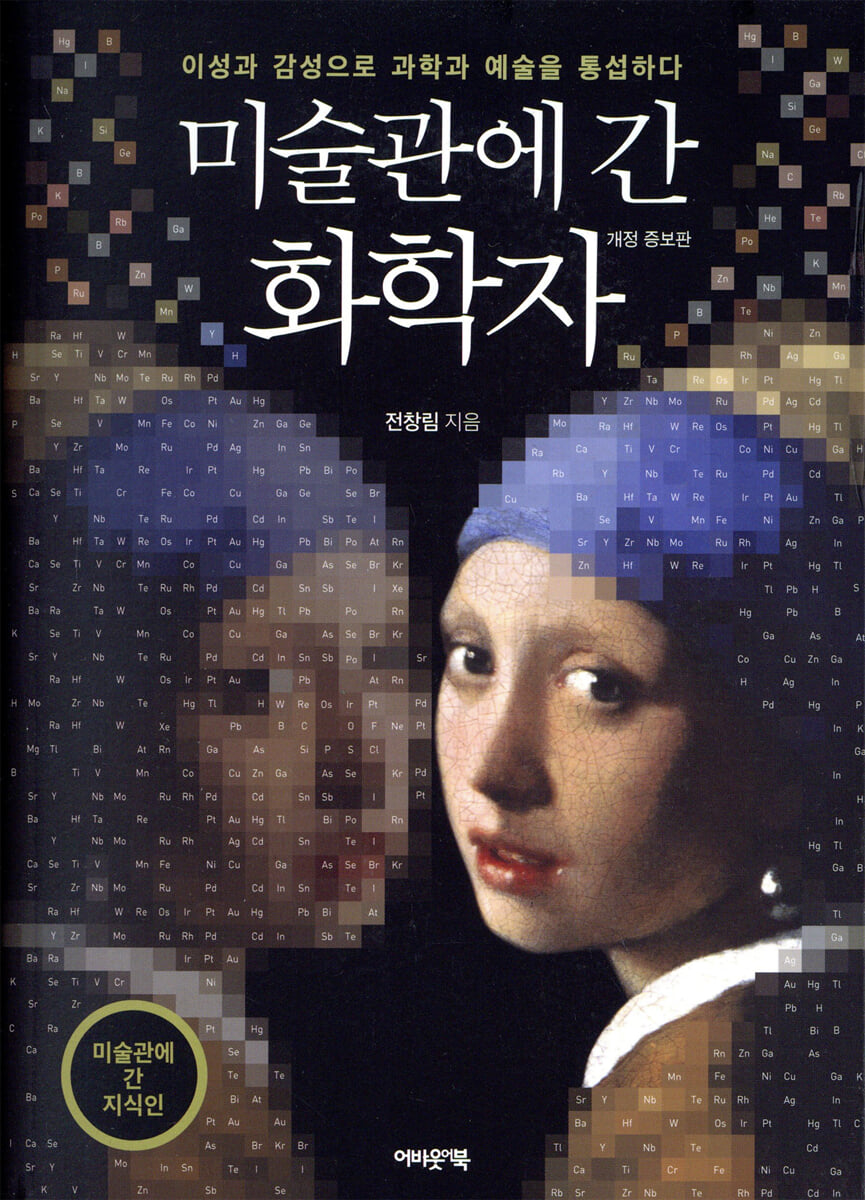
The chemist who went to the art museum
 |
Description
Book Introduction
Selected by experts from various fields including science, education, and art
The best science and art textbook of our time!
"The Chemist Who Went to the Art Museum," which has received rave reviews from authoritative experts from all walks of life, has been reborn with expanded content.
This revised and expanded edition highlights not only masters not covered in the first edition, such as Michelangelo, Ghiberti, Bruegel, and Tintoretto, but also Korean painters such as Kim Hong-do, Shin Yun-bok, and Jang Seung-eop.
In particular, the 'Science Talk at the Art Museum' corner was newly established to make the science stories in art more interesting and informative.
While covering Ghiberti's 'Gates of Paradise', the evolution of bronze was approached from a scientific historical perspective, and in the section 'The White Paint That Killed the Painter', a cultural-historical episode related to lead, the raw material for white paint, was introduced.
In addition, we have updated the fascinating scientific stories from famous paintings, such as the discovery of oxygen, the principle of mirror reflection, quantum mechanics, and the tunneling effect.
According to the author, who is a chemist, art is an art that is born from chemistry and lives off chemistry.
This is because paint, the main material of art, is a chemical substance.
The fading or discoloration of paint on canvas over time is also caused by chemical reactions.
A masterpiece is projected through a prism in the hands of a chemist, revealing its fascinating inner workings that had previously remained hidden from everyone.
For a chemist, a painting is as fascinating a subject of study as a crystal structure under a microscope.
This is precisely why the author, a chemist, has been running around the laboratory and art museum, meticulously observing famous paintings.
The best science and art textbook of our time!
"The Chemist Who Went to the Art Museum," which has received rave reviews from authoritative experts from all walks of life, has been reborn with expanded content.
This revised and expanded edition highlights not only masters not covered in the first edition, such as Michelangelo, Ghiberti, Bruegel, and Tintoretto, but also Korean painters such as Kim Hong-do, Shin Yun-bok, and Jang Seung-eop.
In particular, the 'Science Talk at the Art Museum' corner was newly established to make the science stories in art more interesting and informative.
While covering Ghiberti's 'Gates of Paradise', the evolution of bronze was approached from a scientific historical perspective, and in the section 'The White Paint That Killed the Painter', a cultural-historical episode related to lead, the raw material for white paint, was introduced.
In addition, we have updated the fascinating scientific stories from famous paintings, such as the discovery of oxygen, the principle of mirror reflection, quantum mechanics, and the tunneling effect.
According to the author, who is a chemist, art is an art that is born from chemistry and lives off chemistry.
This is because paint, the main material of art, is a chemical substance.
The fading or discoloration of paint on canvas over time is also caused by chemical reactions.
A masterpiece is projected through a prism in the hands of a chemist, revealing its fascinating inner workings that had previously remained hidden from everyone.
For a chemist, a painting is as fascinating a subject of study as a crystal structure under a microscope.
This is precisely why the author, a chemist, has been running around the laboratory and art museum, meticulously observing famous paintings.
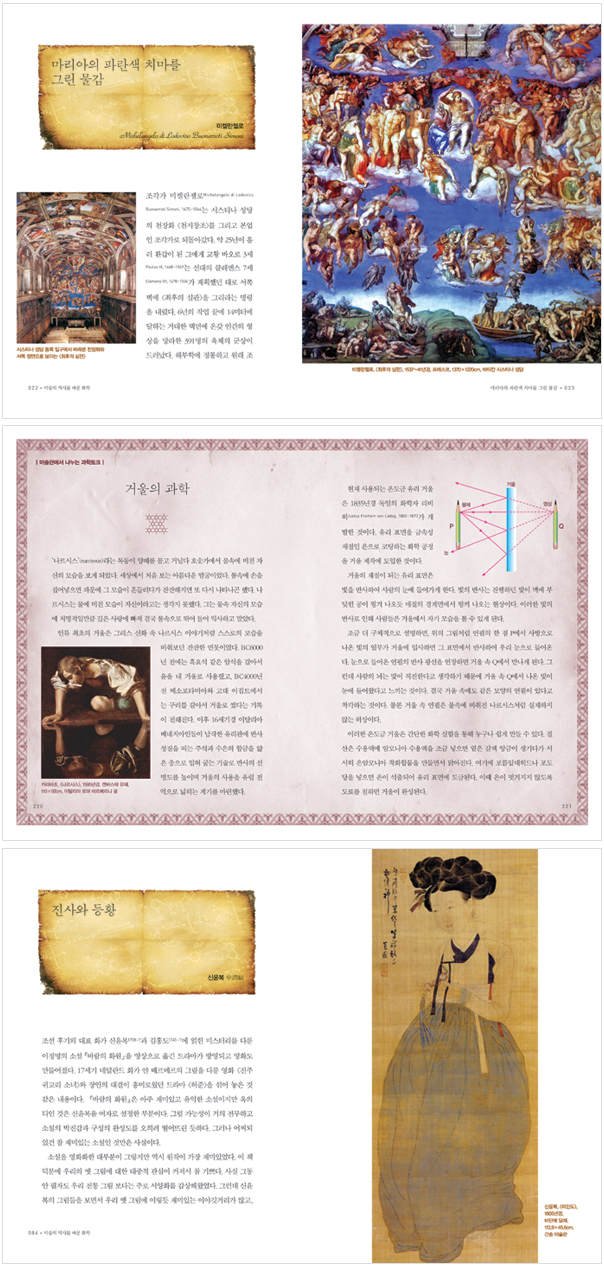
- You can preview some of the book's contents.
Preview
index
Preface to the Revised and Expanded Edition: Famous Paintings Contain Scientific Creativity
Preface to the First Edition: Art Seen Through the Eyes of Science Is Even More Beautiful
chapter1.
Chemistry that changed the history of art
ㆍPainting of Mary's blue skirt _ Michelangelo
ㆍPositivism in 3D _ Giotto
ㆍWaiting for Halley's Comet to Return in 2061 _ Science Talk at the Art Museum
ㆍUnsaturated fatty acids that changed the history of art _Ake
The unsaturated fatty acids that changed the history of art are also transforming our bodies! _Science Talk at the Art Museum
Da Vinci, a genius artist who was ignorant of chemistry
ㆍTitle of a painting changed by chemical reaction _ Rembrandt
The White Paint That Killed the Painter _ Whistler
ㆍThe Cultural History of Lead _ Science Talk at the Art Museum
Poster color derived from the wall posters of entertainment establishments _Lautrec
ㆍJinsa and Denghwang _Shin Yun-bok
ㆍThe Science of Food and Hanji _ Jang Seung-eop
The Difference Between Western Watercolor and Eastern Korean Painting _ Science Talk at the Art Museum
Chapter 2.
Drawing chemical elements and chemists
ㆍ'Gates of Paradise' made of bronze and brass _ Ghiberti
The Evolution of Bronze _ Science Talk at the Art Museum
The Death of Alchemy _ Cosimo
The Alchemist Who Discovered Humanity _ Science Talk at the Art Museum
The Density of Air and the Mystery of the Mona Lisa _ Da Vinci
The origin of the universe expressed in the four chemical elements _Dürer
Beeswax and Mercury _ Bruegel
ㆍThe painter who drew oxygen _ Wright
The Three Chemists Who Discovered Oxygen _ Science Talk at the Art Museum
ㆍA tribute to the mother of modern chemistry _ David
ㆍThe propaganda that sent the great chemist to the guillotine _David
ㆍStereoisomers in Kim Hong-do's genre paintings _Kim Hong-do
Stereoisomers: Identical but Different _ Science Talk at the Art Museum
Chapter 3.
Optics and color science enter the canvas.
ㆍRefractive index that separates life and death _Holbein
ㆍThe Reflection Effect of a Camera Obscura _ Vermeer
ㆍThe Parabola of Infinity and Absolute _ Friedrich
ㆍMirror effect expressing the inner self _ Manet
The Science of Mirrors _ Science Talk at the Art Museum
ㆍCoexistence of dynamics and statics _ Degas
ㆍPeriodic law of color _ Matisse
Expressing three-dimensional shapes using only color _ Matisse
Chapter 4.
Impressionism born from spectral spectroscopy
ㆍSpectrum projected on canvas _ Monet
ㆍSpectroscopy: Discovering the Color of Light _ Science Talk at the Art Museum
ㆍScientific definition of color by the artist _Seora
Art that bloomed amidst extreme pain _ Van Gogh
Dancing Spectrum _ Van Gogh
ㆍScientific Report on Light and Color _ Monet
ㆍThe painter who painted warm sunlight_Renoir
Chapter 5.
Amazing scientific imagination
Turbulence, the energy of the birth of Venus _ Botticelli
ㆍBizarre SF from 500 years ago _ Bosch
Drawing the tunneling effect _ Michelangelo
Tunneling Effect and Josephson Effect _ Science Talk at the Art Museum
Dissecting the Shadow of Death _ Rembrandt
Science Lighted by a Candle
ㆍEve, Newton, and Cézanne's Apples _Cézanne
ㆍThe Amazing Inventions of Science _ Delaunay
ㆍSymbol of Medicine _Tintoretto
ㆍFind works
ㆍFind a person's name
Preface to the First Edition: Art Seen Through the Eyes of Science Is Even More Beautiful
chapter1.
Chemistry that changed the history of art
ㆍPainting of Mary's blue skirt _ Michelangelo
ㆍPositivism in 3D _ Giotto
ㆍWaiting for Halley's Comet to Return in 2061 _ Science Talk at the Art Museum
ㆍUnsaturated fatty acids that changed the history of art _Ake
The unsaturated fatty acids that changed the history of art are also transforming our bodies! _Science Talk at the Art Museum
Da Vinci, a genius artist who was ignorant of chemistry
ㆍTitle of a painting changed by chemical reaction _ Rembrandt
The White Paint That Killed the Painter _ Whistler
ㆍThe Cultural History of Lead _ Science Talk at the Art Museum
Poster color derived from the wall posters of entertainment establishments _Lautrec
ㆍJinsa and Denghwang _Shin Yun-bok
ㆍThe Science of Food and Hanji _ Jang Seung-eop
The Difference Between Western Watercolor and Eastern Korean Painting _ Science Talk at the Art Museum
Chapter 2.
Drawing chemical elements and chemists
ㆍ'Gates of Paradise' made of bronze and brass _ Ghiberti
The Evolution of Bronze _ Science Talk at the Art Museum
The Death of Alchemy _ Cosimo
The Alchemist Who Discovered Humanity _ Science Talk at the Art Museum
The Density of Air and the Mystery of the Mona Lisa _ Da Vinci
The origin of the universe expressed in the four chemical elements _Dürer
Beeswax and Mercury _ Bruegel
ㆍThe painter who drew oxygen _ Wright
The Three Chemists Who Discovered Oxygen _ Science Talk at the Art Museum
ㆍA tribute to the mother of modern chemistry _ David
ㆍThe propaganda that sent the great chemist to the guillotine _David
ㆍStereoisomers in Kim Hong-do's genre paintings _Kim Hong-do
Stereoisomers: Identical but Different _ Science Talk at the Art Museum
Chapter 3.
Optics and color science enter the canvas.
ㆍRefractive index that separates life and death _Holbein
ㆍThe Reflection Effect of a Camera Obscura _ Vermeer
ㆍThe Parabola of Infinity and Absolute _ Friedrich
ㆍMirror effect expressing the inner self _ Manet
The Science of Mirrors _ Science Talk at the Art Museum
ㆍCoexistence of dynamics and statics _ Degas
ㆍPeriodic law of color _ Matisse
Expressing three-dimensional shapes using only color _ Matisse
Chapter 4.
Impressionism born from spectral spectroscopy
ㆍSpectrum projected on canvas _ Monet
ㆍSpectroscopy: Discovering the Color of Light _ Science Talk at the Art Museum
ㆍScientific definition of color by the artist _Seora
Art that bloomed amidst extreme pain _ Van Gogh
Dancing Spectrum _ Van Gogh
ㆍScientific Report on Light and Color _ Monet
ㆍThe painter who painted warm sunlight_Renoir
Chapter 5.
Amazing scientific imagination
Turbulence, the energy of the birth of Venus _ Botticelli
ㆍBizarre SF from 500 years ago _ Bosch
Drawing the tunneling effect _ Michelangelo
Tunneling Effect and Josephson Effect _ Science Talk at the Art Museum
Dissecting the Shadow of Death _ Rembrandt
Science Lighted by a Candle
ㆍEve, Newton, and Cézanne's Apples _Cézanne
ㆍThe Amazing Inventions of Science _ Delaunay
ㆍSymbol of Medicine _Tintoretto
ㆍFind works
ㆍFind a person's name
Detailed image
Publisher's Review
Why did the chemist go to the art museum?
To borrow the words of the author, a chemist, art is an art that is born from chemistry and lives off chemistry.
This is because paint, the main material of art, is a chemical substance.
The fading or discoloration of paint on canvas over time is also caused by chemical reactions.
A masterpiece is projected through a prism in the hands of a chemist, revealing its fascinating inner workings that had previously remained hidden from everyone.
For a chemist, a painting is as fascinating a subject of study as a crystal structure under a microscope.
This is precisely why the author, a chemist, has been running around the laboratory and art museum, meticulously observing famous paintings.
Science and art combined with reason and emotion
The best science and art textbook of our time!
When the first edition of "The Chemist Who Went to the Art Museum" was published in October 2007, it received numerous praises from the media as the best book that ideally combined science and art.
There have been countless popular science books published that advocate consilience, meaning the integration of knowledge from different fields, but few books have truly embodied the essence of consilience, the harmonious integration of knowledge, as well as "The Chemist Who Went to the Art Museum."
Above all, 『The Chemist Who Went to the Art Museum』 is the first book to trace the origins of art in chemistry.
No one had ever considered the basic common sense that the entire process of creating, using, and preserving paint, which is the medium of art, is actually a product of chemistry.
That is, no world-renowned art critic, nor any popular science book on the intersection of art and science, has ever found the origin of art in chemistry.
As fun as a detective novel solving a mystery
The Story of Chemistry Hidden in Famous Paintings
The works of artists who have graced the history of art are full of fascinating stories that support the author's claim that "art is born from chemistry and lives off chemistry."
One media outlet even said, “This book, which tells the exciting story of chemistry in famous paintings, is as entertaining as a detective novel that solves a mystery” (Dong-A Ilbo, November 3, 2007).
Here is an excerpt from this book, which chemically unravels the mysteries of famous paintings as exciting as detective novels.
◆Who was the first artist to reproduce 3D on canvas using the chemical texture of paint?
This book argues that the reason Giotto di Bondone, a painter active in the early 14th century, is called the father of modern painting is because of the paints he used.
In the Adoration of the Magi introduced in this book, Giotto achieved a realistic and three-dimensional effect that had never been seen in existing art by applying fresco and tempera.
The sky in the background of the painting is painted with fresco, and the clothes of the main character, Mary, are painted with tempera to give the painting a sense of perspective (page 37).
Giotto's use of pigments laid the foundation for da Vinci to create masterpieces such as the Mona Lisa and the Last Supper using a new method he later called 'aerial perspective' (p. 58).
◆The unsaturated fatty acids contained in mackerel created emulsification?
There is a reason why the Arnolfini Marriage by Flemish painter Eyck is a regular feature in art history books.
This painting is incredibly detailed, making it hard to believe it was painted in the 15th century.
For this reason, many art historians consider The Arnolfini Marriage to be the starting point of oil painting.
However, no one knew that the secret to Aijkman's delicate brushstrokes was in the pigment called linseed oil, which contains unsaturated fatty acids.
Unsaturated fatty acids contain unsaturated groups in the fatty acid chain, so they have a low melting point and are liquid at room temperature, but over time, the unsaturated groups cross-link and harden to form a hard film.
Eik took advantage of these very properties in his oil paints.
It is the polyunsaturated fatty acids, chemicals that give gloss, that create the oil (page 42).
◆What chemical darkened the paintings of Rembrandt and Millet?
Rembrandt's "Night Watch" was not originally a painting of a night scene, but of broad daylight.
The title 'Night Watch' was given to the painting over a hundred years after it was painted, in the 18th century, when the military and police were conducting night patrols, and the darkened appearance of the painting was conjectured.
Rembrandt used pigments from the lotus family and vermilion, a bright red pigment, in this painting, and chemical analysis of these pigments reveals the presence of lead and sulfur.
However, when lead and sulfur combine, it becomes lead sulfide (PbS), which causes a blackening phenomenon in the air.
The phenomenon of blackening also appears in Millet's "The Angelus," painted in 1857.
At that time, all of Europe was suffering from the black smoke emitted by factories that had sprung up even in the countryside as a result of the Industrial Revolution.
At that time, the paint contained a component that turned black when reacted with sulfur dioxide, the main culprit of pollution.
When looking at Millet's "The Angelus," the dark twilight comes to mind, and the main culprit behind Rembrandt's painting of broad daylight being titled "Night Watch" is none other than the chemicals lead and sulfur (p. 62).
◆Uncovering the mysterious death of a painter who enjoyed using white paint throughout his life.
Meanwhile, the impact of lead on the painting went beyond a simple incident and resulted in an indelible tragedy.
American painter Whistler died suddenly from lead poisoning after using excessive amounts of white paint containing a large amount of lead.
In the 1860s, when Whistler was active, white was popular not only in art but in all fields.
White was the mainstream color for clothes, bags, shoes, and cosmetics.
However, it was an open secret that the white was full of lead.
Lead gave birth to a terrible disease called lead poisoning, which took many lives.
The adverse effects of lead also shook the art world.
The allure of lead white, which has a peculiar charm among white paints, has made many painters forget the dangers of lead poisoning.
When I look at the woman in the white dress that appears in the work of Whistler, who was a whiteholic painter, I cannot help but feel a sense of sorrow (p. 68).
Certified by experts in various fields including science, education, and culture
A must-read for the integrated science essay!
The book "The Chemist Who Went to the Art Museum" has consistently ranked among the best-selling natural science books for the past five years, receiving much love from readers thanks in part to rave reviews from experts in various fields, including science, education, and art.
In particular, 『The Chemist Who Went to the Art Museum』 became the number one book recommended to students by middle and high school teachers who are on the front lines of education.
As a result, 『The Chemist Who Went to the Art Museum』 has naturally become a must-read for integrated scientific writing, contrary to the author's original intention.
Meanwhile, Professor Jeon Chang-rim (Department of Biochemical Engineering, Hongik University), the author of this book, was invited to various science high schools across the country to give lectures to young people on the intersection of science and art, which received a great response.
The results of the selection of "The Chemist Who Went to the Art Museum" by authoritative scientific, educational, and cultural institutions (organizations, media) are as follows.
- Selected as an 'Outstanding Science Book' by the Ministry of Education, Science and Technology
- Selected as a 'Book of the Month' by the Korea Publication Industry Promotion Agency
- Recommended Books Selected by Happy Morning Reading Association
- Selected as Naver's 'Book of the Day'
Revised and expanded edition published with even richer content
The revised and expanded edition highlights not only masters not covered in the first edition, such as Michelangelo, Ghiberti, Bruegel, and Tintoretto, but also Korean painters such as Kim Hong-do, Shin Yun-bok, and Jang Seung-eop.
In particular, the 'Science Talk at the Art Museum' corner was newly established to make the science stories in art more interesting and informative.
While covering Ghiberti's 'Gates of Paradise', the evolution of bronze was approached from a scientific historical perspective, and in the section 'The White Paint That Killed the Painter', a cultural-historical episode related to lead, the raw material for white paint, was introduced.
In addition, we have updated the fascinating scientific stories from famous paintings, such as the discovery of oxygen, the principle of mirror reflection, quantum mechanics, and the tunneling effect.
◆New topics in the revised and expanded edition
- Watercolor painting of Mary's blue skirt _ Michelangelo
- Drawing the tunneling effect _ Michelangelo
- The Gates of Paradise, made of bronze and brass _ Ghiberti
- Beeswax and Mercury _ Bruegel
- Symbol of Medicine _Tintoretto
- Jinsa and Denghwang _ Shin Yun-bok
- The Science of Food and Hanji _ Jang Seung-eop
- Stereoisomers in Kim Hong-do's genre paintings _Kim Hong-do
New Corner: "Science Talk at the Art Museum"
- Waiting for Halley's Comet to return in 2061
- Unsaturated fatty acids, which changed the history of art, also change our bodies!
- The cultural history of 'lead'
- The difference between Western watercolor and Eastern Korean painting
- The evolution of bronze
- The alchemist who discovered 'in'
- The three chemists who discovered oxygen
- Stereoisomers that are identical but different
- The Science of Mirrors
- Spectroscopy, discovering the color of light
- Tunneling effect and Josephson effect
A word from the author
“Impressionism, one of the most beloved and highly regarded art movements in history, is a science in itself.
Since art is a visual art, coloring materials are necessarily used.
The colors of paint are limited, but the colors the artist wants to express are very subtle.
Impressionist painters wanted to express the mysterious and ever-changing nature that was created from moment to moment, leaving the studio behind.
However, the more you mix paints, the darker they become.
It was impossible to express the brilliant image in sunlight with materials that had been darkened by mixing paints.
The Impressionist painters brought the science of the spectrum into their art.
By juxtaposing bright colored pieces without mixing them on the palette, I came up with a color combination that doesn't get darker.
“When chemistry and art, and more broadly, science and art, find a point of intersection, we are enriched by wonders as wondrous as Impressionism, which projected the colors of light onto canvas.”
To borrow the words of the author, a chemist, art is an art that is born from chemistry and lives off chemistry.
This is because paint, the main material of art, is a chemical substance.
The fading or discoloration of paint on canvas over time is also caused by chemical reactions.
A masterpiece is projected through a prism in the hands of a chemist, revealing its fascinating inner workings that had previously remained hidden from everyone.
For a chemist, a painting is as fascinating a subject of study as a crystal structure under a microscope.
This is precisely why the author, a chemist, has been running around the laboratory and art museum, meticulously observing famous paintings.
Science and art combined with reason and emotion
The best science and art textbook of our time!
When the first edition of "The Chemist Who Went to the Art Museum" was published in October 2007, it received numerous praises from the media as the best book that ideally combined science and art.
There have been countless popular science books published that advocate consilience, meaning the integration of knowledge from different fields, but few books have truly embodied the essence of consilience, the harmonious integration of knowledge, as well as "The Chemist Who Went to the Art Museum."
Above all, 『The Chemist Who Went to the Art Museum』 is the first book to trace the origins of art in chemistry.
No one had ever considered the basic common sense that the entire process of creating, using, and preserving paint, which is the medium of art, is actually a product of chemistry.
That is, no world-renowned art critic, nor any popular science book on the intersection of art and science, has ever found the origin of art in chemistry.
As fun as a detective novel solving a mystery
The Story of Chemistry Hidden in Famous Paintings
The works of artists who have graced the history of art are full of fascinating stories that support the author's claim that "art is born from chemistry and lives off chemistry."
One media outlet even said, “This book, which tells the exciting story of chemistry in famous paintings, is as entertaining as a detective novel that solves a mystery” (Dong-A Ilbo, November 3, 2007).
Here is an excerpt from this book, which chemically unravels the mysteries of famous paintings as exciting as detective novels.
◆Who was the first artist to reproduce 3D on canvas using the chemical texture of paint?
This book argues that the reason Giotto di Bondone, a painter active in the early 14th century, is called the father of modern painting is because of the paints he used.
In the Adoration of the Magi introduced in this book, Giotto achieved a realistic and three-dimensional effect that had never been seen in existing art by applying fresco and tempera.
The sky in the background of the painting is painted with fresco, and the clothes of the main character, Mary, are painted with tempera to give the painting a sense of perspective (page 37).
Giotto's use of pigments laid the foundation for da Vinci to create masterpieces such as the Mona Lisa and the Last Supper using a new method he later called 'aerial perspective' (p. 58).
◆The unsaturated fatty acids contained in mackerel created emulsification?
There is a reason why the Arnolfini Marriage by Flemish painter Eyck is a regular feature in art history books.
This painting is incredibly detailed, making it hard to believe it was painted in the 15th century.
For this reason, many art historians consider The Arnolfini Marriage to be the starting point of oil painting.
However, no one knew that the secret to Aijkman's delicate brushstrokes was in the pigment called linseed oil, which contains unsaturated fatty acids.
Unsaturated fatty acids contain unsaturated groups in the fatty acid chain, so they have a low melting point and are liquid at room temperature, but over time, the unsaturated groups cross-link and harden to form a hard film.
Eik took advantage of these very properties in his oil paints.
It is the polyunsaturated fatty acids, chemicals that give gloss, that create the oil (page 42).
◆What chemical darkened the paintings of Rembrandt and Millet?
Rembrandt's "Night Watch" was not originally a painting of a night scene, but of broad daylight.
The title 'Night Watch' was given to the painting over a hundred years after it was painted, in the 18th century, when the military and police were conducting night patrols, and the darkened appearance of the painting was conjectured.
Rembrandt used pigments from the lotus family and vermilion, a bright red pigment, in this painting, and chemical analysis of these pigments reveals the presence of lead and sulfur.
However, when lead and sulfur combine, it becomes lead sulfide (PbS), which causes a blackening phenomenon in the air.
The phenomenon of blackening also appears in Millet's "The Angelus," painted in 1857.
At that time, all of Europe was suffering from the black smoke emitted by factories that had sprung up even in the countryside as a result of the Industrial Revolution.
At that time, the paint contained a component that turned black when reacted with sulfur dioxide, the main culprit of pollution.
When looking at Millet's "The Angelus," the dark twilight comes to mind, and the main culprit behind Rembrandt's painting of broad daylight being titled "Night Watch" is none other than the chemicals lead and sulfur (p. 62).
◆Uncovering the mysterious death of a painter who enjoyed using white paint throughout his life.
Meanwhile, the impact of lead on the painting went beyond a simple incident and resulted in an indelible tragedy.
American painter Whistler died suddenly from lead poisoning after using excessive amounts of white paint containing a large amount of lead.
In the 1860s, when Whistler was active, white was popular not only in art but in all fields.
White was the mainstream color for clothes, bags, shoes, and cosmetics.
However, it was an open secret that the white was full of lead.
Lead gave birth to a terrible disease called lead poisoning, which took many lives.
The adverse effects of lead also shook the art world.
The allure of lead white, which has a peculiar charm among white paints, has made many painters forget the dangers of lead poisoning.
When I look at the woman in the white dress that appears in the work of Whistler, who was a whiteholic painter, I cannot help but feel a sense of sorrow (p. 68).
Certified by experts in various fields including science, education, and culture
A must-read for the integrated science essay!
The book "The Chemist Who Went to the Art Museum" has consistently ranked among the best-selling natural science books for the past five years, receiving much love from readers thanks in part to rave reviews from experts in various fields, including science, education, and art.
In particular, 『The Chemist Who Went to the Art Museum』 became the number one book recommended to students by middle and high school teachers who are on the front lines of education.
As a result, 『The Chemist Who Went to the Art Museum』 has naturally become a must-read for integrated scientific writing, contrary to the author's original intention.
Meanwhile, Professor Jeon Chang-rim (Department of Biochemical Engineering, Hongik University), the author of this book, was invited to various science high schools across the country to give lectures to young people on the intersection of science and art, which received a great response.
The results of the selection of "The Chemist Who Went to the Art Museum" by authoritative scientific, educational, and cultural institutions (organizations, media) are as follows.
- Selected as an 'Outstanding Science Book' by the Ministry of Education, Science and Technology
- Selected as a 'Book of the Month' by the Korea Publication Industry Promotion Agency
- Recommended Books Selected by Happy Morning Reading Association
- Selected as Naver's 'Book of the Day'
Revised and expanded edition published with even richer content
The revised and expanded edition highlights not only masters not covered in the first edition, such as Michelangelo, Ghiberti, Bruegel, and Tintoretto, but also Korean painters such as Kim Hong-do, Shin Yun-bok, and Jang Seung-eop.
In particular, the 'Science Talk at the Art Museum' corner was newly established to make the science stories in art more interesting and informative.
While covering Ghiberti's 'Gates of Paradise', the evolution of bronze was approached from a scientific historical perspective, and in the section 'The White Paint That Killed the Painter', a cultural-historical episode related to lead, the raw material for white paint, was introduced.
In addition, we have updated the fascinating scientific stories from famous paintings, such as the discovery of oxygen, the principle of mirror reflection, quantum mechanics, and the tunneling effect.
◆New topics in the revised and expanded edition
- Watercolor painting of Mary's blue skirt _ Michelangelo
- Drawing the tunneling effect _ Michelangelo
- The Gates of Paradise, made of bronze and brass _ Ghiberti
- Beeswax and Mercury _ Bruegel
- Symbol of Medicine _Tintoretto
- Jinsa and Denghwang _ Shin Yun-bok
- The Science of Food and Hanji _ Jang Seung-eop
- Stereoisomers in Kim Hong-do's genre paintings _Kim Hong-do
New Corner: "Science Talk at the Art Museum"
- Waiting for Halley's Comet to return in 2061
- Unsaturated fatty acids, which changed the history of art, also change our bodies!
- The cultural history of 'lead'
- The difference between Western watercolor and Eastern Korean painting
- The evolution of bronze
- The alchemist who discovered 'in'
- The three chemists who discovered oxygen
- Stereoisomers that are identical but different
- The Science of Mirrors
- Spectroscopy, discovering the color of light
- Tunneling effect and Josephson effect
A word from the author
“Impressionism, one of the most beloved and highly regarded art movements in history, is a science in itself.
Since art is a visual art, coloring materials are necessarily used.
The colors of paint are limited, but the colors the artist wants to express are very subtle.
Impressionist painters wanted to express the mysterious and ever-changing nature that was created from moment to moment, leaving the studio behind.
However, the more you mix paints, the darker they become.
It was impossible to express the brilliant image in sunlight with materials that had been darkened by mixing paints.
The Impressionist painters brought the science of the spectrum into their art.
By juxtaposing bright colored pieces without mixing them on the palette, I came up with a color combination that doesn't get darker.
“When chemistry and art, and more broadly, science and art, find a point of intersection, we are enriched by wonders as wondrous as Impressionism, which projected the colors of light onto canvas.”
GOODS SPECIFICS
- Date of publication: February 28, 2013
- Page count, weight, size: 376 pages | 650g | 153*212*30mm
- ISBN13: 9788997382163
- ISBN10: 8997382160
You may also like
카테고리
korean


korean

![GQ KOREA Mark (Monthly): December [2025]](http://librairie.coreenne.fr/cdn/shop/files/8ef265dbbfbf186523ed75ba7319009d.jpg?v=1765340328&width=3840)


