

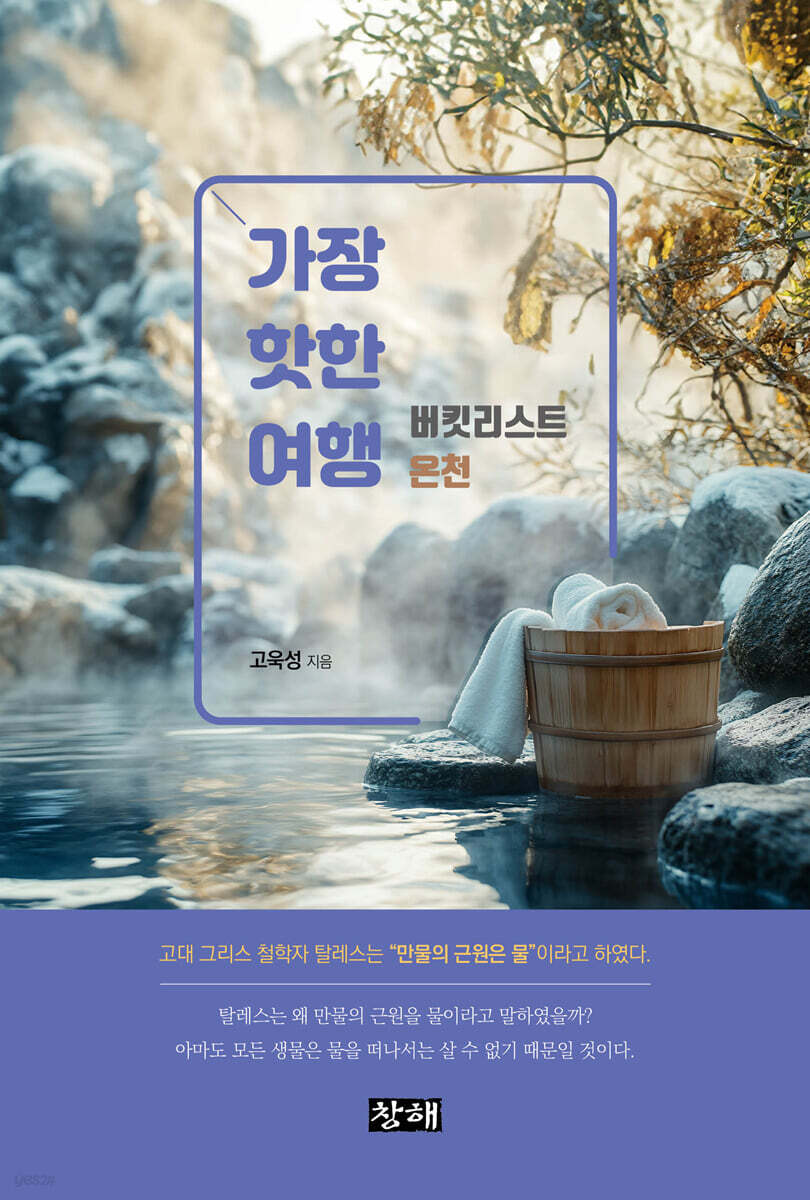
Hottest Trip: Bucket List Hot Springs
 |
Description
Book Introduction
50 Korean hot springs you must visit before you die!
Korea's first book on hot spring travel, "The Hottest Trip - Bucket List Hot Springs"
I will introduce the hot springs that I have bathed in, focusing on the hot springs that are representative of Korea!
“I like taking baths.
I especially like hot spring bathing.
So, whenever I visit a place, whether on business or vacation, I always check to see if there are any hot springs nearby, and if there are, I don't hesitate to soak in them.
Of course, if there is no hot spring, you can find a regular bathhouse near your accommodation and use it in the early morning or during your free time.
In this book, I first introduce the hot springs I experienced in Korea, focusing on the hot springs I visited, and then I introduce the hot spring facilities with photos.
However, since photos inside hot spring facilities cannot be taken without permission, we used the information provided by the hot spring website or local government, and in the case of integrated water parks that use hot spring water, we mainly introduced public baths.” - From the 〈Introduction〉
Korea's first book on hot spring travel, "The Hottest Trip - Bucket List Hot Springs"
I will introduce the hot springs that I have bathed in, focusing on the hot springs that are representative of Korea!
“I like taking baths.
I especially like hot spring bathing.
So, whenever I visit a place, whether on business or vacation, I always check to see if there are any hot springs nearby, and if there are, I don't hesitate to soak in them.
Of course, if there is no hot spring, you can find a regular bathhouse near your accommodation and use it in the early morning or during your free time.
In this book, I first introduce the hot springs I experienced in Korea, focusing on the hot springs I visited, and then I introduce the hot spring facilities with photos.
However, since photos inside hot spring facilities cannot be taken without permission, we used the information provided by the hot spring website or local government, and in the case of integrated water parks that use hot spring water, we mainly introduced public baths.” - From the 〈Introduction〉
- You can preview some of the book's contents.
Preview
index
preface
1.
Korean hot springs you must visit before you die
▶Gyeonggi, Incheon, and Seoul area
- Pocheon area
- Mars Fist
- Icheon and Yeoju area
- Ganghwa, Gimpo, and Goyang areas
▶Gangwon region
-East Coast
-Cheorwon-Inje area
▶Chungcheong region
- Chungju and Cheongju areas
- Daejeon, Asan, Gongju, and Yesan areas
▶Gyeongsang region
-Gyeongbuk region
-Busan and Gyeongnam area
▶Honam and Jeju regions
-Honam region
-Jeju area
2.
Hot Springs and Bathing Stories
.
The truth of water
.
Hot spring myths and common sense
.
The meaning of hot springs
.
Korea's hot spring resources
.
Types of hot spring water
.
To fully experience the benefits of hot spring bathing
.
The body needs water, but it should not be too much or too little.
.
Bathing in a bathtub is good for raising body temperature and kidney function.
.
Salty fun
.
History of Bathing
.
public bathhouse
.
Jeju Island open-air bathhouse
.
Soap and shampoo
.
Italian towel
.
Time scrubber and bathhouse manager
.
References
1.
Korean hot springs you must visit before you die
▶Gyeonggi, Incheon, and Seoul area
- Pocheon area
- Mars Fist
- Icheon and Yeoju area
- Ganghwa, Gimpo, and Goyang areas
▶Gangwon region
-East Coast
-Cheorwon-Inje area
▶Chungcheong region
- Chungju and Cheongju areas
- Daejeon, Asan, Gongju, and Yesan areas
▶Gyeongsang region
-Gyeongbuk region
-Busan and Gyeongnam area
▶Honam and Jeju regions
-Honam region
-Jeju area
2.
Hot Springs and Bathing Stories
.
The truth of water
.
Hot spring myths and common sense
.
The meaning of hot springs
.
Korea's hot spring resources
.
Types of hot spring water
.
To fully experience the benefits of hot spring bathing
.
The body needs water, but it should not be too much or too little.
.
Bathing in a bathtub is good for raising body temperature and kidney function.
.
Salty fun
.
History of Bathing
.
public bathhouse
.
Jeju Island open-air bathhouse
.
Soap and shampoo
.
Italian towel
.
Time scrubber and bathhouse manager
.
References
Detailed image

Into the book
Seokmodo Mineral Hot Springs is a place where you can enjoy hot springs while watching the sunset over the West Sea. The sea breeze and sunlight are felt directly on your body, making it a great place to find peace of mind and body.
The hot spring water is 51℃ high-temperature mineral hot spring water that flows from 460m granite, etc., and is used as raw water without artificial disinfection or purification, and is rich in calcium, potassium, magnesium, sodium chloride, etc.
The various mineral components of hot spring water are known to not only help improve skin conditions such as atopic dermatitis and dryness, but are also easily absorbed into the skin, helping with beauty, moisturizing, and blood circulation, and are also known to be excellent for arthritis and muscle pain.
--- From "Seokmodo Mineral Hot Springs"
Cheorwon Hot Springs, also known as volcanic hot springs, are the only volcanic hot springs in Korea.
The hot spring water is directly supplied from basalt bedrock 1,080 meters underground, and the hot spring water contains minerals such as germanium, calcium, sodium, fluorine, magnesium, and potassium, which are said to have various effects such as removing waste products and regenerating the skin.
The hot spring facilities are divided into old and new baths, and are operated flexibly depending on the season and the number of guests.
When I visited, the bathhouse was in operation. The bathhouse had hot water, warm water, cold water, and a wet sauna. The overall size was not as large as a regular bathhouse, but rather cozy.
The hot spring water was smooth enough to feel smooth, and perhaps because it was a volcanic hot spring, when I dried my hair after bathing in it, it felt a little stiff and seemed to have strength.
--- From "Cheorwon Hot Springs"
The water quality of Suanbo Hot Springs is simple sulfur radium spring, and its components are high in fluorine and silicic acid. The hydrogen ion concentration (pH) ranges from 8.4 to 8.7, and the water temperature is 53℃.
It has been known to be effective for neuralgia, rheumatism, skin diseases, gastrointestinal diseases, and gynecological diseases for a long time, and it also prevents tooth decay because it contains fluoride.
Suanbo Hot Springs is the only hot springs ...
In short, this means that the hot spring water in the Suanbo area has the same water quality, although the facilities are different.
Currently, there are many public baths operated by hotels.
The hot spring facilities at Suanbo Park Hotel and Suanbo Sangnok Hotel are relatively clean and good.
There are several public bathhouses, but the high spa run by the Suanbo Regional Bathing Association is currently closed.
--- From "Suanbo Hot Springs"
Deokgu Hot Springs is the only naturally occurring hot spring in South Korea.
This is very different from other hot springs where groundwater is drilled and hot spring water is extracted.
About 4,000 tons of hot spring water flows out per day, and the temperature of the hot spring water is about 41.8℃, and the hydrogen ion concentration (pH) is 8.9 to 9.0, making it an alkaline hot spring. The main components are sodium bicarbonate and fluorine, making it a simple hot spring (fluoride hot spring).
It has a similar composition to Baekam Hot Springs located in the southern part of Uljin County, but unlike Baekam Hot Springs, hydrogen sulfide components are not detected.
In addition, it contains potassium, calcium, iron, chlorine, sodium bicarbonate, magnesium, radium, sulfate, carbonic acid, and silica.
Deokgu Hot Springs is known to be effective for neuralgia, rheumatism, skin diseases, muscle pain, chronic dermatitis, stroke, diabetes, etc., and is especially known to be effective for muscle paralysis caused by exercise, mountain climbing, etc., and for women's skin beauty.
--- From "Deokgu Hot Springs"
Cheongdo Lava Hot Springs is a natural mineral spring with a temperature of 43.7℃ that flows from 1,008m underground and is effective in recovering from chronic fatigue, boosting immunity, treating nervous system diseases, and removing waste products.
This hot spring is equipped with a state-of-the-art bathing pool with hot spring water, a large hot spring bath constructed entirely of natural jade, filled with the energy of jade, aqua therapy directly imported from the United States, and various themed baths.
--- From "Lava Hot Springs"
Haeundae Hot Springs has such a high salinity that soap bubbles don't form well.
This is due to the chemical reaction of andesite, the bedrock of Jangsan's volcanic terrain, and the influence of the nearby seawater of Haeundae.
Although the salinity is strong, after bathing in the hot spring, your body feels light and your skin becomes smooth, so it is loved by citizens and tourists all year round.
Haeundae Hot Springs is colorless and transparent and alkaline, containing large amounts of sodium (Na) and chlorine (Cl).
In particular, it is said to be effective in promoting hormone secretion and preventing aging because it contains an appropriate amount of radium, and is effective in treating rheumatism, high blood pressure, gastrointestinal diseases, gynecological diseases, and skin diseases.
--- From "Haeundae Hot Springs"
Bugok Hot Springs has been called Bugok since ancient times because it resembles a cauldron, and when rumors spread throughout the country that there was a well in the village (Onjeong-ri) that gushed out hot water called Omsaem, patients with scabies, leprosy, and other skin diseases flocked to receive treatment, so it can be inferred that the water quality of Bugok Hot Springs was superior to that of other hot springs.
The exact year of creation of Bugok Hot Springs is unknown, but there is a record in the “Yeongsanhyeonjo” of the “Dongguk Yeoji Seungram” that “The hot springs were located 17 li to the southeast of the county, but they are now abandoned,” so we know that there have been hot springs in Bugok for a long time. In addition, “Yeongsan Onjeong” is also recorded in the “Goryeogi” of the “Dongguk Tonggam,” so it is said that it has been naturally erupting since before the Goryeo Dynasty and has continued to this day.
The development of the current hot spring began in June 1972 when the late Mr. Shin Hyeon-taek heard a rumor that there was a spring in Geomun-ri, Bugok-myeon that melted the winter snow and the water was warm enough to do laundry even in the middle of winter. He began excavating the spring, and on December 28, 1972, hot spring water began to gush out from 63 meters underground.
--- From "Bugok Hot Springs"
Jirisan Hot Springs is located on Jirisan Hot Springs Road in Sandong-myeon, Gurye-gun, Jeollanam-do, and is a place where you can enjoy hot springs while looking out at Jirisan Manbokdae and Nogodan.
Jirisan hot spring water is known to be effective against adult diseases such as skin diseases, neuralgia, arthritis, and diabetes as it contains a large amount of germanium and sodium carbonate. It is said that as pure natural hot spring water, it contains a large amount of germanium.
Jirisan Hot Springs Land is famous for its hot spring water flowing from the famous mountain Jirisan, but the view from the open-air bath is by far the best.
The open-air bath, surrounded by a waterfall made of natural stone and bizarre rock formations, boasts a magnificent view.
Because the facility is old, some of the aging facilities must be tolerated.
In addition to Jirisan Hot Springs Land, there are also public baths at The K Jirisan Family Hotel and Royal Tourist Hotel.
--- From "Jirisan Hot Springs"
There is a reason why Sanbangsan Mountain's carbonated hot springs are called Gumyeongsu (鳩鳴水).
It is said that a long time ago, although it is not known when, a strange disease was spreading in this area. When the magistrate of Daejeong County was worried about how to treat it, an old man with white hair appeared in his dream and told him that there was a miracle cure in the feathers of a bat.
The magistrate, who had been searching for the bat, finally saw a bat flying red in the sunset, and the shape of Dansan Mountain before his eyes was that of a bat.
The story goes that as soon as he said, “This is the place,” and stuck his sword in, water gushed out from the ground, and when the residents drank the water and bathed in it, their long-standing illnesses disappeared as if washed away.
Sanbangsan Carbonated Hot Springs contain five times more carbonic acid, bicarbonate ions, and sodium than other hot springs in Korea.
Bathing in this carbonated hot spring helps beautify your skin and relieves fatigue, making it the perfect way to relieve the fatigue accumulated during your trip to Jeju.
There is an indoor bath with a glass interior and an outdoor bath, so you can enjoy bathing while looking out at Sanbangsan Mountain and the blue sea of Jeju.
There are lukewarm baths, warm baths, hot baths, event baths, carbonated baths, and saunas inside, and it is very spacious, but it can be crowded on holidays.
--- From "Sanbangsan Carbonated Hot Springs"
First of all, many people think that the hotter the hot spring water, the better, but that is not true.
In reality, it is common to lower the temperature of high-temperature hot spring water of 50~80℃ in a bathhouse or dilute it with cooled hot spring water, and low-temperature hot spring water of around 20℃ is also supplied after being heated.
The temperature of the spring and the supply temperature when it gushes from underground are bound to be different.
Therefore, it is best not to worry about whether the effects of hot springs will be reduced if the hot spring water is heated or cooled.
This is because the amount of ingredients contained in hot springs is more important than the water temperature.
Experts speculate that the perception that hot water is good may have originated from a custom from the past when heating devices were not common and hot water from hot springs or bathhouses was rare.
Generally, the optimal bathing temperature is known to be around 40-42℃.
--- From "Hot Springs' Popular Knowledge and Common Sense"
Most women believe that not removing makeup thoroughly will cause blemishes and pimples, so they thoroughly double and triple-wash their faces.
However, washing your face too thoroughly often makes your skin suffer.
This is because the skin on your face is not thick enough to handle such thorough washing.
The skin surface can be considered to be covered with a natural cream that maintains an appropriate level of oiliness and moisture.
Therefore, to avoid drying out your skin by putting a strain on it, you should wash your face without removing these natural ingredients.
This is why you should use a mild soap or foam cleanser that maintains the skin's protective barrier.
Some people enter the sauna room with a cold, wet towel to help them endure the heat, but this is not a good idea.
Because of the high temperature, the cold towel quickly turns into a hot towel.
It is better to protect your face and head by covering them with a dry towel instead of a cold wet towel.
The air contained in the dry towel acts as excellent insulation, allowing you to enjoy a comfortable sauna without feeling suffocated.
You should be careful not to go into the sauna after washing your hair, as this is a bad thing, like boiling your hair in water.
--- From "The body needs water, but it should not be too much or too little"
It is recommended to take a bath once a day to warm up your body.
The saying goes that it is good for your health to deal with the cold of the day on the same day.
A bath in warm water is better than a shower because it raises your body temperature.
The temperature of the bath water should be slightly warm, around 38 to 41 degrees Celsius.
When the temperature exceeds 42℃, which feels too hot, the blood vessels constrict, hindering blood circulation.
And the sympathetic nerves are stimulated, making the body excited.
Conversely, if the water temperature is too low, it will do nothing to warm your body.
If you want to warm up your body, a half-body bath is better than a full-body bath.
Full body bathing causes a rapid increase in body temperature, which consumes a lot of physical strength, and the water pressure applied to the body is great, putting pressure on the blood vessels and lymphatic vessels.
Taking a half-body bath slowly raises your body temperature and applies water pressure only to your lower body, which helps to send blood from your feet back to your heart without burden.
If you are physically weak, even a half-body bath can be burdensome, so a foot bath that only soaks your ankles is better.
For foot baths, it is recommended to fill the water to 15 to 20 cm above the ankle bone.
For health reasons, it is recommended that bath time not exceed 20 minutes.
A 10-minute bath is enough to raise body temperature by 1℃.
However, foot baths take longer to warm up the body, so it is recommended to soak your feet for 20 minutes.
--- From "Bathtub bathing is good for raising body temperature and kidney function"
It is generally known that a good cosmetic soap should be firm and foam well, and it is said that even in those days, daily newspapers presented selection criteria that said that a good cosmetic soap should be firm and foam well.
There are many types of cosmetic soaps, including popo soap, mink soap, coty 1000 soap, silk soap, cream soap, honey soap, Ippuni soap, and banana soap.
Although expensive, American cosmetic soaps such as Dial, Kamei, Lux, and Dove were also said to be popular among women.
Nowadays, various types of cosmetic soaps, including handmade soaps made by individuals, are manufactured, distributed, and used, but there seems to be no disagreement that the standard for selecting soap that does not change is that it must be a solid product that produces a lot of foam.
The hot spring water is 51℃ high-temperature mineral hot spring water that flows from 460m granite, etc., and is used as raw water without artificial disinfection or purification, and is rich in calcium, potassium, magnesium, sodium chloride, etc.
The various mineral components of hot spring water are known to not only help improve skin conditions such as atopic dermatitis and dryness, but are also easily absorbed into the skin, helping with beauty, moisturizing, and blood circulation, and are also known to be excellent for arthritis and muscle pain.
--- From "Seokmodo Mineral Hot Springs"
Cheorwon Hot Springs, also known as volcanic hot springs, are the only volcanic hot springs in Korea.
The hot spring water is directly supplied from basalt bedrock 1,080 meters underground, and the hot spring water contains minerals such as germanium, calcium, sodium, fluorine, magnesium, and potassium, which are said to have various effects such as removing waste products and regenerating the skin.
The hot spring facilities are divided into old and new baths, and are operated flexibly depending on the season and the number of guests.
When I visited, the bathhouse was in operation. The bathhouse had hot water, warm water, cold water, and a wet sauna. The overall size was not as large as a regular bathhouse, but rather cozy.
The hot spring water was smooth enough to feel smooth, and perhaps because it was a volcanic hot spring, when I dried my hair after bathing in it, it felt a little stiff and seemed to have strength.
--- From "Cheorwon Hot Springs"
The water quality of Suanbo Hot Springs is simple sulfur radium spring, and its components are high in fluorine and silicic acid. The hydrogen ion concentration (pH) ranges from 8.4 to 8.7, and the water temperature is 53℃.
It has been known to be effective for neuralgia, rheumatism, skin diseases, gastrointestinal diseases, and gynecological diseases for a long time, and it also prevents tooth decay because it contains fluoride.
Suanbo Hot Springs is the only hot springs ...
In short, this means that the hot spring water in the Suanbo area has the same water quality, although the facilities are different.
Currently, there are many public baths operated by hotels.
The hot spring facilities at Suanbo Park Hotel and Suanbo Sangnok Hotel are relatively clean and good.
There are several public bathhouses, but the high spa run by the Suanbo Regional Bathing Association is currently closed.
--- From "Suanbo Hot Springs"
Deokgu Hot Springs is the only naturally occurring hot spring in South Korea.
This is very different from other hot springs where groundwater is drilled and hot spring water is extracted.
About 4,000 tons of hot spring water flows out per day, and the temperature of the hot spring water is about 41.8℃, and the hydrogen ion concentration (pH) is 8.9 to 9.0, making it an alkaline hot spring. The main components are sodium bicarbonate and fluorine, making it a simple hot spring (fluoride hot spring).
It has a similar composition to Baekam Hot Springs located in the southern part of Uljin County, but unlike Baekam Hot Springs, hydrogen sulfide components are not detected.
In addition, it contains potassium, calcium, iron, chlorine, sodium bicarbonate, magnesium, radium, sulfate, carbonic acid, and silica.
Deokgu Hot Springs is known to be effective for neuralgia, rheumatism, skin diseases, muscle pain, chronic dermatitis, stroke, diabetes, etc., and is especially known to be effective for muscle paralysis caused by exercise, mountain climbing, etc., and for women's skin beauty.
--- From "Deokgu Hot Springs"
Cheongdo Lava Hot Springs is a natural mineral spring with a temperature of 43.7℃ that flows from 1,008m underground and is effective in recovering from chronic fatigue, boosting immunity, treating nervous system diseases, and removing waste products.
This hot spring is equipped with a state-of-the-art bathing pool with hot spring water, a large hot spring bath constructed entirely of natural jade, filled with the energy of jade, aqua therapy directly imported from the United States, and various themed baths.
--- From "Lava Hot Springs"
Haeundae Hot Springs has such a high salinity that soap bubbles don't form well.
This is due to the chemical reaction of andesite, the bedrock of Jangsan's volcanic terrain, and the influence of the nearby seawater of Haeundae.
Although the salinity is strong, after bathing in the hot spring, your body feels light and your skin becomes smooth, so it is loved by citizens and tourists all year round.
Haeundae Hot Springs is colorless and transparent and alkaline, containing large amounts of sodium (Na) and chlorine (Cl).
In particular, it is said to be effective in promoting hormone secretion and preventing aging because it contains an appropriate amount of radium, and is effective in treating rheumatism, high blood pressure, gastrointestinal diseases, gynecological diseases, and skin diseases.
--- From "Haeundae Hot Springs"
Bugok Hot Springs has been called Bugok since ancient times because it resembles a cauldron, and when rumors spread throughout the country that there was a well in the village (Onjeong-ri) that gushed out hot water called Omsaem, patients with scabies, leprosy, and other skin diseases flocked to receive treatment, so it can be inferred that the water quality of Bugok Hot Springs was superior to that of other hot springs.
The exact year of creation of Bugok Hot Springs is unknown, but there is a record in the “Yeongsanhyeonjo” of the “Dongguk Yeoji Seungram” that “The hot springs were located 17 li to the southeast of the county, but they are now abandoned,” so we know that there have been hot springs in Bugok for a long time. In addition, “Yeongsan Onjeong” is also recorded in the “Goryeogi” of the “Dongguk Tonggam,” so it is said that it has been naturally erupting since before the Goryeo Dynasty and has continued to this day.
The development of the current hot spring began in June 1972 when the late Mr. Shin Hyeon-taek heard a rumor that there was a spring in Geomun-ri, Bugok-myeon that melted the winter snow and the water was warm enough to do laundry even in the middle of winter. He began excavating the spring, and on December 28, 1972, hot spring water began to gush out from 63 meters underground.
--- From "Bugok Hot Springs"
Jirisan Hot Springs is located on Jirisan Hot Springs Road in Sandong-myeon, Gurye-gun, Jeollanam-do, and is a place where you can enjoy hot springs while looking out at Jirisan Manbokdae and Nogodan.
Jirisan hot spring water is known to be effective against adult diseases such as skin diseases, neuralgia, arthritis, and diabetes as it contains a large amount of germanium and sodium carbonate. It is said that as pure natural hot spring water, it contains a large amount of germanium.
Jirisan Hot Springs Land is famous for its hot spring water flowing from the famous mountain Jirisan, but the view from the open-air bath is by far the best.
The open-air bath, surrounded by a waterfall made of natural stone and bizarre rock formations, boasts a magnificent view.
Because the facility is old, some of the aging facilities must be tolerated.
In addition to Jirisan Hot Springs Land, there are also public baths at The K Jirisan Family Hotel and Royal Tourist Hotel.
--- From "Jirisan Hot Springs"
There is a reason why Sanbangsan Mountain's carbonated hot springs are called Gumyeongsu (鳩鳴水).
It is said that a long time ago, although it is not known when, a strange disease was spreading in this area. When the magistrate of Daejeong County was worried about how to treat it, an old man with white hair appeared in his dream and told him that there was a miracle cure in the feathers of a bat.
The magistrate, who had been searching for the bat, finally saw a bat flying red in the sunset, and the shape of Dansan Mountain before his eyes was that of a bat.
The story goes that as soon as he said, “This is the place,” and stuck his sword in, water gushed out from the ground, and when the residents drank the water and bathed in it, their long-standing illnesses disappeared as if washed away.
Sanbangsan Carbonated Hot Springs contain five times more carbonic acid, bicarbonate ions, and sodium than other hot springs in Korea.
Bathing in this carbonated hot spring helps beautify your skin and relieves fatigue, making it the perfect way to relieve the fatigue accumulated during your trip to Jeju.
There is an indoor bath with a glass interior and an outdoor bath, so you can enjoy bathing while looking out at Sanbangsan Mountain and the blue sea of Jeju.
There are lukewarm baths, warm baths, hot baths, event baths, carbonated baths, and saunas inside, and it is very spacious, but it can be crowded on holidays.
--- From "Sanbangsan Carbonated Hot Springs"
First of all, many people think that the hotter the hot spring water, the better, but that is not true.
In reality, it is common to lower the temperature of high-temperature hot spring water of 50~80℃ in a bathhouse or dilute it with cooled hot spring water, and low-temperature hot spring water of around 20℃ is also supplied after being heated.
The temperature of the spring and the supply temperature when it gushes from underground are bound to be different.
Therefore, it is best not to worry about whether the effects of hot springs will be reduced if the hot spring water is heated or cooled.
This is because the amount of ingredients contained in hot springs is more important than the water temperature.
Experts speculate that the perception that hot water is good may have originated from a custom from the past when heating devices were not common and hot water from hot springs or bathhouses was rare.
Generally, the optimal bathing temperature is known to be around 40-42℃.
--- From "Hot Springs' Popular Knowledge and Common Sense"
Most women believe that not removing makeup thoroughly will cause blemishes and pimples, so they thoroughly double and triple-wash their faces.
However, washing your face too thoroughly often makes your skin suffer.
This is because the skin on your face is not thick enough to handle such thorough washing.
The skin surface can be considered to be covered with a natural cream that maintains an appropriate level of oiliness and moisture.
Therefore, to avoid drying out your skin by putting a strain on it, you should wash your face without removing these natural ingredients.
This is why you should use a mild soap or foam cleanser that maintains the skin's protective barrier.
Some people enter the sauna room with a cold, wet towel to help them endure the heat, but this is not a good idea.
Because of the high temperature, the cold towel quickly turns into a hot towel.
It is better to protect your face and head by covering them with a dry towel instead of a cold wet towel.
The air contained in the dry towel acts as excellent insulation, allowing you to enjoy a comfortable sauna without feeling suffocated.
You should be careful not to go into the sauna after washing your hair, as this is a bad thing, like boiling your hair in water.
--- From "The body needs water, but it should not be too much or too little"
It is recommended to take a bath once a day to warm up your body.
The saying goes that it is good for your health to deal with the cold of the day on the same day.
A bath in warm water is better than a shower because it raises your body temperature.
The temperature of the bath water should be slightly warm, around 38 to 41 degrees Celsius.
When the temperature exceeds 42℃, which feels too hot, the blood vessels constrict, hindering blood circulation.
And the sympathetic nerves are stimulated, making the body excited.
Conversely, if the water temperature is too low, it will do nothing to warm your body.
If you want to warm up your body, a half-body bath is better than a full-body bath.
Full body bathing causes a rapid increase in body temperature, which consumes a lot of physical strength, and the water pressure applied to the body is great, putting pressure on the blood vessels and lymphatic vessels.
Taking a half-body bath slowly raises your body temperature and applies water pressure only to your lower body, which helps to send blood from your feet back to your heart without burden.
If you are physically weak, even a half-body bath can be burdensome, so a foot bath that only soaks your ankles is better.
For foot baths, it is recommended to fill the water to 15 to 20 cm above the ankle bone.
For health reasons, it is recommended that bath time not exceed 20 minutes.
A 10-minute bath is enough to raise body temperature by 1℃.
However, foot baths take longer to warm up the body, so it is recommended to soak your feet for 20 minutes.
--- From "Bathtub bathing is good for raising body temperature and kidney function"
It is generally known that a good cosmetic soap should be firm and foam well, and it is said that even in those days, daily newspapers presented selection criteria that said that a good cosmetic soap should be firm and foam well.
There are many types of cosmetic soaps, including popo soap, mink soap, coty 1000 soap, silk soap, cream soap, honey soap, Ippuni soap, and banana soap.
Although expensive, American cosmetic soaps such as Dial, Kamei, Lux, and Dove were also said to be popular among women.
Nowadays, various types of cosmetic soaps, including handmade soaps made by individuals, are manufactured, distributed, and used, but there seems to be no disagreement that the standard for selecting soap that does not change is that it must be a solid product that produces a lot of foam.
--- From "Soap and Shampoo"
Publisher's Review
■ Among the hot springs in Korea that I have personally visited and experienced,
A book written with a bucket list of must-visit hot springs!
Korea's first book on hot spring travel, "The Hottest Trip - Bucket List Hot Springs," has been published.
Author Go Wook-seong wrote a book based on a bucket list of must-visit hot springs in Korea that he personally visited and experienced.
Part 1 of the book introduces around 50 must-visit hot springs in Korea before you die, categorized by region: the metropolitan area, Gangwon-do, Chungcheong-do, Gyeongbuk-do, Busan-Gyeongnam-do, and Honam-Jeju-do. Part 2 introduces interesting stories related to water, hot springs, and bathing, such as how to bathe, public bathhouses, soap and shampoo, Italian towels, and bathhouse managers, in the form of humanistic essays.
It also includes “Hot Springs and Beneficial Bathing Stories” for added fun and value!
The author has compiled into a book the results of his experiences of visiting hot springs for over ten years, taking photos and bathing in hot springs, as well as various materials he has collected about bathing and hot springs.
Although academic books on hot spring-related ingredient analysis have been published, this is the first book to be published specifically on hot spring travel and hot spring-related stories, making it very significant.
In particular, the author says that as the domestic hot spring industry is aging and bathing culture is fading due to things like apartment living, he hopes that the domestic hot spring industry will develop into a pillar of the tourism industry, like the case in Japan, and that this will be an opportunity to look back on the domestic hot spring industry.
A book written with a bucket list of must-visit hot springs!
Korea's first book on hot spring travel, "The Hottest Trip - Bucket List Hot Springs," has been published.
Author Go Wook-seong wrote a book based on a bucket list of must-visit hot springs in Korea that he personally visited and experienced.
Part 1 of the book introduces around 50 must-visit hot springs in Korea before you die, categorized by region: the metropolitan area, Gangwon-do, Chungcheong-do, Gyeongbuk-do, Busan-Gyeongnam-do, and Honam-Jeju-do. Part 2 introduces interesting stories related to water, hot springs, and bathing, such as how to bathe, public bathhouses, soap and shampoo, Italian towels, and bathhouse managers, in the form of humanistic essays.
It also includes “Hot Springs and Beneficial Bathing Stories” for added fun and value!
The author has compiled into a book the results of his experiences of visiting hot springs for over ten years, taking photos and bathing in hot springs, as well as various materials he has collected about bathing and hot springs.
Although academic books on hot spring-related ingredient analysis have been published, this is the first book to be published specifically on hot spring travel and hot spring-related stories, making it very significant.
In particular, the author says that as the domestic hot spring industry is aging and bathing culture is fading due to things like apartment living, he hopes that the domestic hot spring industry will develop into a pillar of the tourism industry, like the case in Japan, and that this will be an opportunity to look back on the domestic hot spring industry.
GOODS SPECIFICS
- Date of issue: February 24, 2025
- Page count, weight, size: 208 pages | 394g | 153*224*13mm
- ISBN13: 9791171740321
- ISBN10: 1171740328
You may also like
카테고리
korean


korean

![ELLE 엘르 스페셜 에디션 A형 : 12월 [2025]](http://librairie.coreenne.fr/cdn/shop/files/b8e27a3de6c9538896439686c6b0e8fb.jpg?v=1766436872&width=3840)


