

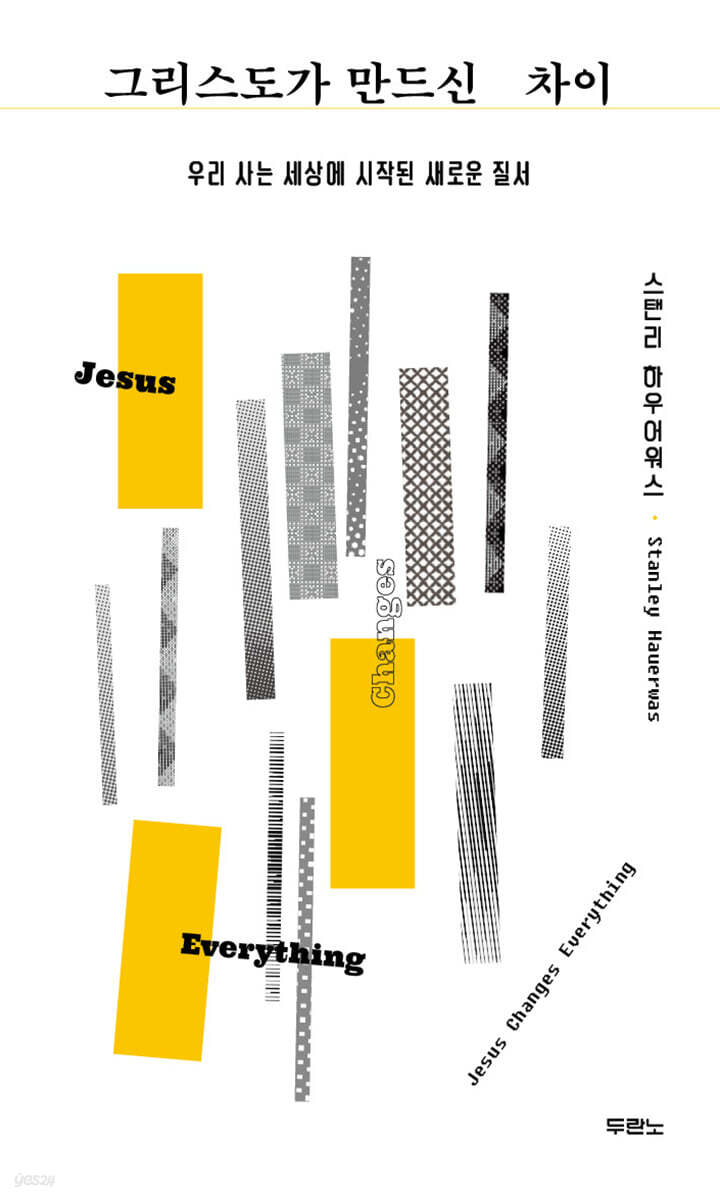
The Difference Christ Made
 |
Description
Book Introduction
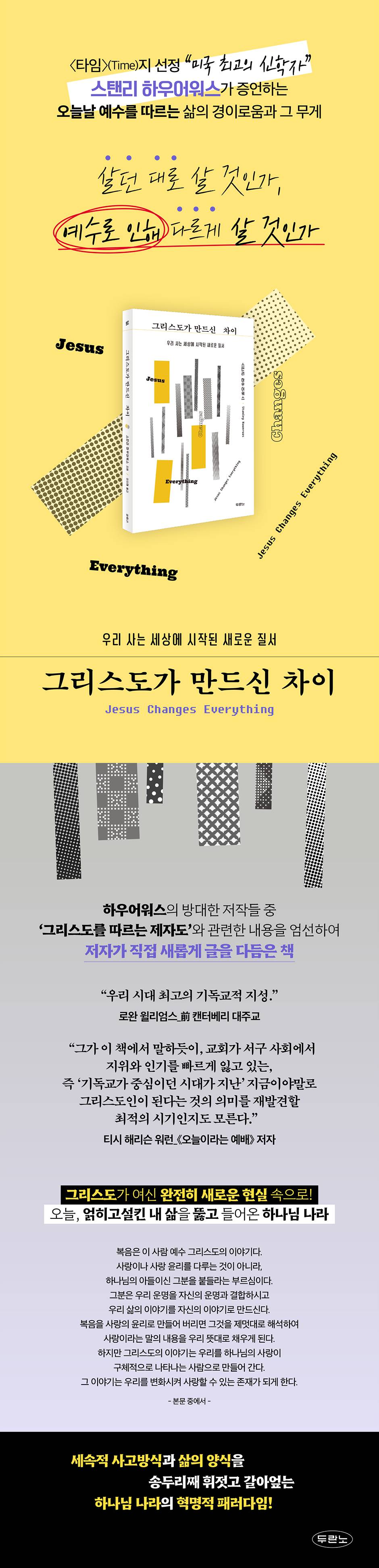
Time magazine named him "America's Best Theologian"
Stanley Hauerwas testifies
The Wonder and Weight of Following Jesus Today
“The greatest Christian intellectual of our time.”
Rowan Williams, former Archbishop of Canterbury
This book is a compilation of key passages related to 'discipleship in Christ' selected from the extensive works of Stanley Hauerwas, a world-renowned theologian and ethicist.
This is not a simple excerpt; the author personally revised the entire text for this book.
For decades, Hauerwas has consistently argued that choosing to follow Jesus makes a crucial difference in every area of life, from the personal to the social.
In this book, he sharply diagnoses today's 'post-Christendom' world and says that we should not stop at lamenting the tragedy of the fact that Christians are no longer at the center of culture and politics.
Rather, it emphasizes that this very situation of being pushed to the margins is the optimal opportunity for us to embrace the alternative way of life that Jesus has provided.
Today, in this chaotic world, for those who live confessing Jesus as 'Christ,' this book will become a prophetic voice proclaiming a new order.
Stanley Hauerwas testifies
The Wonder and Weight of Following Jesus Today
“The greatest Christian intellectual of our time.”
Rowan Williams, former Archbishop of Canterbury
This book is a compilation of key passages related to 'discipleship in Christ' selected from the extensive works of Stanley Hauerwas, a world-renowned theologian and ethicist.
This is not a simple excerpt; the author personally revised the entire text for this book.
For decades, Hauerwas has consistently argued that choosing to follow Jesus makes a crucial difference in every area of life, from the personal to the social.
In this book, he sharply diagnoses today's 'post-Christendom' world and says that we should not stop at lamenting the tragedy of the fact that Christians are no longer at the center of culture and politics.
Rather, it emphasizes that this very situation of being pushed to the margins is the optimal opportunity for us to embrace the alternative way of life that Jesus has provided.
Today, in this chaotic world, for those who live confessing Jesus as 'Christ,' this book will become a prophetic voice proclaiming a new order.
- You can preview some of the book's contents.
Preview
index
Foreword by Tish Harrison Warren: A Prophetic Voice in a Post-Christian Age
Editor's Note _ Reading Stanley Hauerwas
Part 1.
Following Jesus
- Today's disciples need new eyes and ears.
01.
Into the transformative work of God
02.
Sometimes it's like walking on water in a storm
03.
Jesus is the kingdom of God
04.
Join the story of Christ
05.
A path where human love alone is not enough
Part 2.
The Gospel of the Kingdom of God
- The new order opened to us in Christ
06.
The impossible made possible by God
07.
The Beatitudes, Promises Showing Life in the Kingdom of God
08.
When we look at the 'perfection' that has already come among us,
09.
The righteousness of the kingdom of God that overturns the existing order
Part 3.
Church in the World
- The church community as God's alternative society
10.
Church, God's New Language
11.
Speaking truthfully, living truthfully
12.
A community that practices charity
13.
A family reborn in the church
Part 4.
The Economy of the Kingdom of God
- How to live with sharing and trust
14.
A Biblical Perspective on Wealth and the Rich
15.
In an unjust and unfair reality
16.
Our responsibility to the needs of our neighbors
17.
A church with the poor
Part 5.
Peace through the Cross
- Sowing the seeds of reconciliation in a world of violence
18.
The courage to break the false peace
19.
Carry a cross instead of a sword
20.
The Path of Nonviolence: A Risky Adventure
21.
Liberation of Imagination, a World Without War
Part 6.
The politics of testimony
- A church that brings the kingdom of God to life in the world
22.
The Church's First Task: Becoming the Church
23.
Jesus' Kingship Transcending the Secular Political Order
24.
Christian Politics in a Post-Christian World
25.
The Difference Christ Made
source
References
Editor's Note _ Reading Stanley Hauerwas
Part 1.
Following Jesus
- Today's disciples need new eyes and ears.
01.
Into the transformative work of God
02.
Sometimes it's like walking on water in a storm
03.
Jesus is the kingdom of God
04.
Join the story of Christ
05.
A path where human love alone is not enough
Part 2.
The Gospel of the Kingdom of God
- The new order opened to us in Christ
06.
The impossible made possible by God
07.
The Beatitudes, Promises Showing Life in the Kingdom of God
08.
When we look at the 'perfection' that has already come among us,
09.
The righteousness of the kingdom of God that overturns the existing order
Part 3.
Church in the World
- The church community as God's alternative society
10.
Church, God's New Language
11.
Speaking truthfully, living truthfully
12.
A community that practices charity
13.
A family reborn in the church
Part 4.
The Economy of the Kingdom of God
- How to live with sharing and trust
14.
A Biblical Perspective on Wealth and the Rich
15.
In an unjust and unfair reality
16.
Our responsibility to the needs of our neighbors
17.
A church with the poor
Part 5.
Peace through the Cross
- Sowing the seeds of reconciliation in a world of violence
18.
The courage to break the false peace
19.
Carry a cross instead of a sword
20.
The Path of Nonviolence: A Risky Adventure
21.
Liberation of Imagination, a World Without War
Part 6.
The politics of testimony
- A church that brings the kingdom of God to life in the world
22.
The Church's First Task: Becoming the Church
23.
Jesus' Kingship Transcending the Secular Political Order
24.
Christian Politics in a Post-Christian World
25.
The Difference Christ Made
source
References
Detailed image
Into the book
Hauerwas also reminds me that it is always (and still is) possible for the church to repent and be born again.
In fact, as he argues in this book, this post-Christian era, in which the church is rapidly losing its status and popularity in Western society, may be the perfect time to rediscover what it means to be a Christian.
My husband and I often describe our society today as “post-Christendom and pre-Christian.”
This suggests hope that people might hear the gospel anew.
This means that God is still seeking our hearts, our neighbors, our friends, and other church members.
In today's world, where the illusion of a "Christian Western society" has vanished and more and more people are claiming to be agnostic to religion, Jesus' disciples can strive to proclaim and practice the gospel, free from the traps of face, power, political subordination, and nationalism that have long defined and distorted it.
This is a massive project worth sacrificing our lives for.
And in this project, Stanley Hauerwas continues to be a vital voice in leading us to find the way of Jesus and to become the church he established and loves.
--- From p.24-25, “From the Preface by Tish Harrison Warren”
Jesus is the kingdom of God.
He makes God's eschatological reality present and gives rise to a new social possibility called the church.
At the cross the rulers and powers of this world were disarmed.
The cross testifies that we do not need to fix the world or follow the dictates of prosperity and power.
God, incarnate on the cross, refused to save the world by force.
So we shouldn't be like that either.
By enduring suffering, God opened a new way for us to live in the world without having to kill those who want to kill us.
Therefore, the difference between the world and the church is not simply a difference in values or means.
Simply put, the difference is 'Jesus'.
So the church's top priority is to become the church, that is, to become a people who testify in their lives to God's new creation in Christ.
This is a political movement, not a doctrinal one.
“Politics is essential because Christians cannot kill people.” But this is not just ordinary politics.
It is a politics that welcomes strangers and strangers, a politics that tolerates and endures enemies, a politics that cares for the wounded and oppressed, a politics of true peace.
--- From p.34-35 "From the editor's notes"
Becoming a disciple of Jesus is not a matter of gaining a new or different understanding of oneself, nor is it a matter of becoming a spiritual being or attending church.
It is to confirm through one's own life that Jesus is the Messiah of God, the Son of God, the Lord.
This means becoming part of a community that reflects the High Priest and King to whom we confess and to whom we give our allegiance.
To live such a life is to experience a fundamental change (2 Corinthians 5:16-17), to be transformed and to walk in the light of the new age that Jesus has inaugurated.
This is the gospel.
The incarnate God, Jesus Christ, invites us into God's history.
Its history shakes our world, while at the same time showing how God is reconciling with the world.
The life story of Jesus is not simply about showing us his life and reminding us of his teachings.
These stories show us that God's new world began through Jesus, and they teach and train us how our lives should be connected to Him.
--- p.45
The gospel is the story of this man, Jesus Christ.
It is not a matter of love or love ethics, but a call to cling to Him who is the Son of God.
He combines our destiny with His own and makes the story of our lives His own.
If we make the gospel into an ethic of love, we will interpret it arbitrarily and fill the meaning of the word love according to our own will.
But the story of Christ makes us into people in whom God's love is made concrete.
The story changes us and makes us capable of loving.
--- p.62
His commands are not legal provisions from which we can draw any conclusions, but symbolic metaphors designed to stir our imagination.
This allows us to look at our lives in a fundamentally new way.
Jesus' demands push us to our limits, not simply because they urge us to moral action, but because they force us to see something so new and different from what we have always heard that we can no longer rely on old images of right and wrong.
--- p.90
The unity of humanity exemplified by Pentecost is not just any unity, but a unity made possible by the eschatological ministry of Jesus of Nazareth.
This unity breaks down boundaries, brings people together, and brings about new understanding.
However, this does not create an artificial language like Esperanto, which denies the existence of other languages.
The attempt to build a community by creating a single language, let alone a single political or technological system, is not an attempt to find the unity brought about by the Holy Spirit by understanding others as others.
Rather, it is an attempt to make us forget our history and differences.
At Pentecost, God created a new language.
But it is not a language of words, but a language of care embodied in words.
It is a baptism of fire, and through this baptism we enter into a community where the memory of the Savior creates a miracle, a community of people where differences contribute to unity and love.
We call this new creation 'the church.'
--- p.101-102
Through Christian marriage, couples can remain faithful throughout their lives and look back on their married life and call it love.
As we go through marriage, we realize that the person we thought was our soulmate wasn't really like that.
This is because we are sinners before we are saints.
But the adventure of marriage is learning to love the person you marry.
You don't get married because you fall in love.
It is after you get married that you learn what true love is.
We don't marry for love, but through marriage we learn how much sacrifice love is an adventure that demands.
--- p.125
Although there are passages in the Gospels that seem to imply nonviolence, such as "forgive your enemies" or "turn the other cheek to the one who strikes you," nowhere in the New Testament is there a direct command to be a thoroughgoing pacifist.
Some may find this problematic, but it serves as a reminder that Christians do not hold nonviolence as a principle or ultimate goal.
For those who follow Christ, nonviolence is not simply a strategy.
When nonviolence is used as a strategy, like Gandhi or Martin Luther King Jr., it becomes another form of coercion.
Those who follow Christ are called to a non-violent life.
This is because they live worthy of a different story (narrative) and follow in the footsteps of Christ (1 John 2:6).
Too often, explanations of nonviolence fail to acknowledge how dangerous nonviolent living is.
A non-violent life is never boring.
Those who follow Christ suffer for a reason, because discipleship is literally a matter of life and death.
For those who seek to follow Jesus' example, this is no surprise.
“When he was reviled, he did not revile in return; when he suffered, he did not threaten, but entrusted himself to him who judges righteously” (1 Peter 2:23).
Following Jesus' example means being prepared to die for yourself, not to take someone else's life.
Jesus disarmed Peter in the Garden of Gethsemane.
He disarms all who bear the cross.
--- p.173-174
If there is one political solution we Christians have to offer this troubled society that is most interesting and creative, it is not new laws, advice to policymakers, or funding for social programs.
Of course, sometimes you can support in this way.
The most creative social strategy we have to offer is to become a church.
Here we show the world a way of life that can never be achieved through social coercion or government action.
We serve the world by showing it a place other than the world, a place where God makes family out of strangers.
--- p.191
People often rightly complain that conservative Christians' political agendas seem too similar to those of secular conservatives, and that progressive Christians support the same social positions as secular progressives.
In the process of trying to exist 'in the world' and to attract attention without losing its relevance, the church has become an entity 'belonging to the world.'
The church has now become a boring purveyor of conventional political views with only a vague religious overtone.
Political theology, whether left or right, generally maintains the existing social order, and within it the church sometimes complains, but ultimately
It justifies itself as a beneficial prop that helps the country.
Rather than offering alternatives, the church sees God's vision of advancing the kingdom of God on earth as dependent on the established powers that be.
The decline of the Christian world here is beneficial to the Church.
While many today lament the disappearance of Christianity from the public square, it is actually an opportunity to regain the freedom to proclaim and demonstrate the truth of the Gospel in ways that were impossible when we were serving the nation as one of its many props.
When Christians lose status and power in the wider society, that loss can be liberating.
Because we have nothing left to lose, we can willingly live the life Jesus wants for us.
You don't have to be tempted to try to control or use control measures.
In fact, as he argues in this book, this post-Christian era, in which the church is rapidly losing its status and popularity in Western society, may be the perfect time to rediscover what it means to be a Christian.
My husband and I often describe our society today as “post-Christendom and pre-Christian.”
This suggests hope that people might hear the gospel anew.
This means that God is still seeking our hearts, our neighbors, our friends, and other church members.
In today's world, where the illusion of a "Christian Western society" has vanished and more and more people are claiming to be agnostic to religion, Jesus' disciples can strive to proclaim and practice the gospel, free from the traps of face, power, political subordination, and nationalism that have long defined and distorted it.
This is a massive project worth sacrificing our lives for.
And in this project, Stanley Hauerwas continues to be a vital voice in leading us to find the way of Jesus and to become the church he established and loves.
--- From p.24-25, “From the Preface by Tish Harrison Warren”
Jesus is the kingdom of God.
He makes God's eschatological reality present and gives rise to a new social possibility called the church.
At the cross the rulers and powers of this world were disarmed.
The cross testifies that we do not need to fix the world or follow the dictates of prosperity and power.
God, incarnate on the cross, refused to save the world by force.
So we shouldn't be like that either.
By enduring suffering, God opened a new way for us to live in the world without having to kill those who want to kill us.
Therefore, the difference between the world and the church is not simply a difference in values or means.
Simply put, the difference is 'Jesus'.
So the church's top priority is to become the church, that is, to become a people who testify in their lives to God's new creation in Christ.
This is a political movement, not a doctrinal one.
“Politics is essential because Christians cannot kill people.” But this is not just ordinary politics.
It is a politics that welcomes strangers and strangers, a politics that tolerates and endures enemies, a politics that cares for the wounded and oppressed, a politics of true peace.
--- From p.34-35 "From the editor's notes"
Becoming a disciple of Jesus is not a matter of gaining a new or different understanding of oneself, nor is it a matter of becoming a spiritual being or attending church.
It is to confirm through one's own life that Jesus is the Messiah of God, the Son of God, the Lord.
This means becoming part of a community that reflects the High Priest and King to whom we confess and to whom we give our allegiance.
To live such a life is to experience a fundamental change (2 Corinthians 5:16-17), to be transformed and to walk in the light of the new age that Jesus has inaugurated.
This is the gospel.
The incarnate God, Jesus Christ, invites us into God's history.
Its history shakes our world, while at the same time showing how God is reconciling with the world.
The life story of Jesus is not simply about showing us his life and reminding us of his teachings.
These stories show us that God's new world began through Jesus, and they teach and train us how our lives should be connected to Him.
--- p.45
The gospel is the story of this man, Jesus Christ.
It is not a matter of love or love ethics, but a call to cling to Him who is the Son of God.
He combines our destiny with His own and makes the story of our lives His own.
If we make the gospel into an ethic of love, we will interpret it arbitrarily and fill the meaning of the word love according to our own will.
But the story of Christ makes us into people in whom God's love is made concrete.
The story changes us and makes us capable of loving.
--- p.62
His commands are not legal provisions from which we can draw any conclusions, but symbolic metaphors designed to stir our imagination.
This allows us to look at our lives in a fundamentally new way.
Jesus' demands push us to our limits, not simply because they urge us to moral action, but because they force us to see something so new and different from what we have always heard that we can no longer rely on old images of right and wrong.
--- p.90
The unity of humanity exemplified by Pentecost is not just any unity, but a unity made possible by the eschatological ministry of Jesus of Nazareth.
This unity breaks down boundaries, brings people together, and brings about new understanding.
However, this does not create an artificial language like Esperanto, which denies the existence of other languages.
The attempt to build a community by creating a single language, let alone a single political or technological system, is not an attempt to find the unity brought about by the Holy Spirit by understanding others as others.
Rather, it is an attempt to make us forget our history and differences.
At Pentecost, God created a new language.
But it is not a language of words, but a language of care embodied in words.
It is a baptism of fire, and through this baptism we enter into a community where the memory of the Savior creates a miracle, a community of people where differences contribute to unity and love.
We call this new creation 'the church.'
--- p.101-102
Through Christian marriage, couples can remain faithful throughout their lives and look back on their married life and call it love.
As we go through marriage, we realize that the person we thought was our soulmate wasn't really like that.
This is because we are sinners before we are saints.
But the adventure of marriage is learning to love the person you marry.
You don't get married because you fall in love.
It is after you get married that you learn what true love is.
We don't marry for love, but through marriage we learn how much sacrifice love is an adventure that demands.
--- p.125
Although there are passages in the Gospels that seem to imply nonviolence, such as "forgive your enemies" or "turn the other cheek to the one who strikes you," nowhere in the New Testament is there a direct command to be a thoroughgoing pacifist.
Some may find this problematic, but it serves as a reminder that Christians do not hold nonviolence as a principle or ultimate goal.
For those who follow Christ, nonviolence is not simply a strategy.
When nonviolence is used as a strategy, like Gandhi or Martin Luther King Jr., it becomes another form of coercion.
Those who follow Christ are called to a non-violent life.
This is because they live worthy of a different story (narrative) and follow in the footsteps of Christ (1 John 2:6).
Too often, explanations of nonviolence fail to acknowledge how dangerous nonviolent living is.
A non-violent life is never boring.
Those who follow Christ suffer for a reason, because discipleship is literally a matter of life and death.
For those who seek to follow Jesus' example, this is no surprise.
“When he was reviled, he did not revile in return; when he suffered, he did not threaten, but entrusted himself to him who judges righteously” (1 Peter 2:23).
Following Jesus' example means being prepared to die for yourself, not to take someone else's life.
Jesus disarmed Peter in the Garden of Gethsemane.
He disarms all who bear the cross.
--- p.173-174
If there is one political solution we Christians have to offer this troubled society that is most interesting and creative, it is not new laws, advice to policymakers, or funding for social programs.
Of course, sometimes you can support in this way.
The most creative social strategy we have to offer is to become a church.
Here we show the world a way of life that can never be achieved through social coercion or government action.
We serve the world by showing it a place other than the world, a place where God makes family out of strangers.
--- p.191
People often rightly complain that conservative Christians' political agendas seem too similar to those of secular conservatives, and that progressive Christians support the same social positions as secular progressives.
In the process of trying to exist 'in the world' and to attract attention without losing its relevance, the church has become an entity 'belonging to the world.'
The church has now become a boring purveyor of conventional political views with only a vague religious overtone.
Political theology, whether left or right, generally maintains the existing social order, and within it the church sometimes complains, but ultimately
It justifies itself as a beneficial prop that helps the country.
Rather than offering alternatives, the church sees God's vision of advancing the kingdom of God on earth as dependent on the established powers that be.
The decline of the Christian world here is beneficial to the Church.
While many today lament the disappearance of Christianity from the public square, it is actually an opportunity to regain the freedom to proclaim and demonstrate the truth of the Gospel in ways that were impossible when we were serving the nation as one of its many props.
When Christians lose status and power in the wider society, that loss can be liberating.
Because we have nothing left to lose, we can willingly live the life Jesus wants for us.
You don't have to be tempted to try to control or use control measures.
--- p.202-203
Publisher's Review
Into a completely new reality opened by Christ!
Today, the kingdom of God has broken through my tangled life.
Hauerwas invites us into the revolutionary paradigm of the kingdom of God, which shakes up and overturns secular ways of thinking and living.
Will you live the way you always lived, or will you live differently because of Jesus?
To be a Christian is to live a life that experiences the fundamental difference called 'Jesus', that is, to live a life from the perspective of 'the difference made by Christ'.
Jesus is the beginning of the kingdom of God that has come to this earth.
In this new order, made possible for us thanks to Jesus, we live as a new family community called to be brothers and sisters, the church, an alternative to the world.
This is, in effect, a radical challenge to the order and power of this world.
On this path of being transformed by Jesus and living in the kingdom of God, suffering and persecution may follow, but you will experience true freedom and the reality of the kingdom of God that transcend all of that.
Today, the kingdom of God has broken through my tangled life.
Hauerwas invites us into the revolutionary paradigm of the kingdom of God, which shakes up and overturns secular ways of thinking and living.
Will you live the way you always lived, or will you live differently because of Jesus?
To be a Christian is to live a life that experiences the fundamental difference called 'Jesus', that is, to live a life from the perspective of 'the difference made by Christ'.
Jesus is the beginning of the kingdom of God that has come to this earth.
In this new order, made possible for us thanks to Jesus, we live as a new family community called to be brothers and sisters, the church, an alternative to the world.
This is, in effect, a radical challenge to the order and power of this world.
On this path of being transformed by Jesus and living in the kingdom of God, suffering and persecution may follow, but you will experience true freedom and the reality of the kingdom of God that transcend all of that.
GOODS SPECIFICS
- Date of issue: October 22, 2025
- Page count, weight, size: 216 pages | 240g | 120*200*13mm
- ISBN13: 9788953151741
- ISBN10: 8953151740
You may also like
카테고리
korean


korean

![GQ KOREA Mark (Monthly): December [2025]](http://librairie.coreenne.fr/cdn/shop/files/8ef265dbbfbf186523ed75ba7319009d.jpg?v=1765340328&width=3840)


