

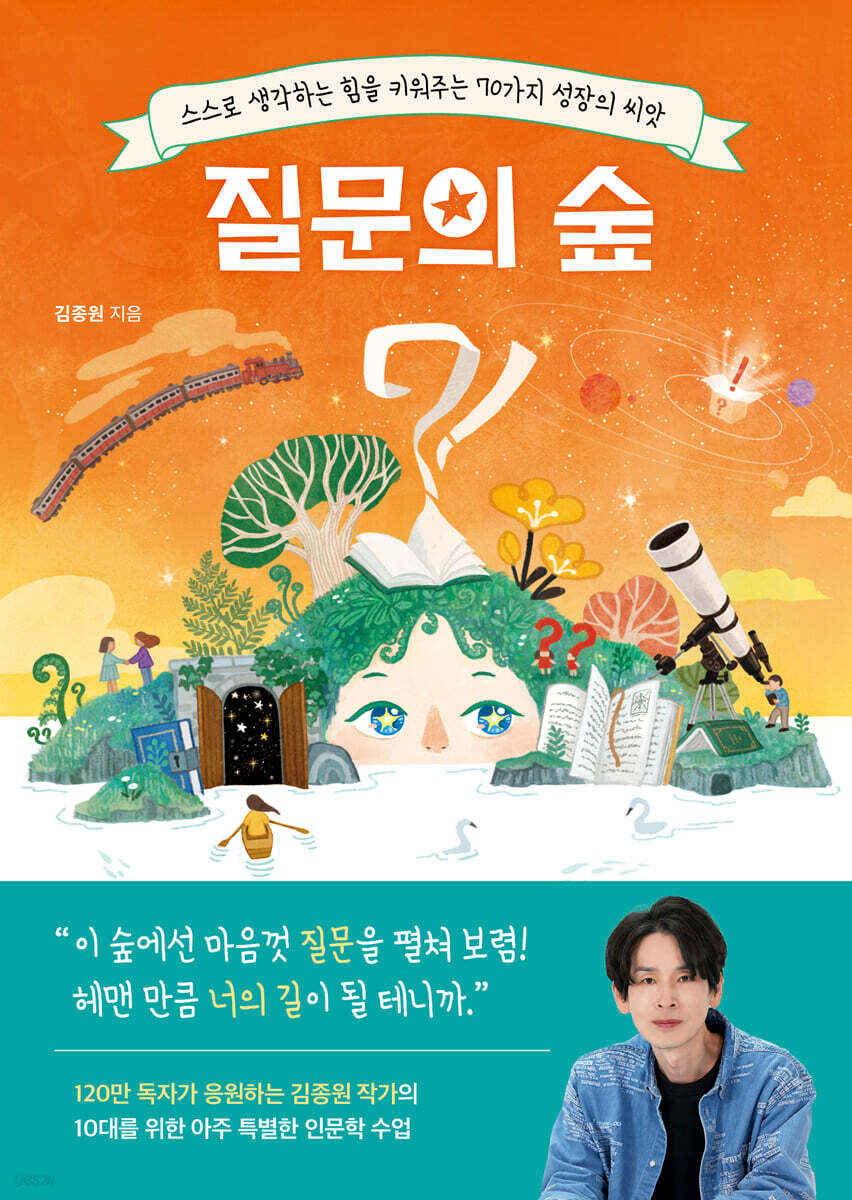
Forest of Questions
 |
Description
Book Introduction
★Cumulative sales: 150,000 copies
★The longest-running best-selling series in the youth category for five consecutive years
A must-read for young people in the AI era, a book 1.2 million parents have been waiting for.
“In this forest, feel free to ask questions!
“As much as you wander, your path will become yours.”
Author Kim Jong-won, supported by 1.2 million readers
A very special humanities class for teenagers
We always try not to deviate from the 'correct answer'.
Now, with just a few finger gestures from your seat, AI can easily answer most questions.
The future that children will live in will be one in which AI will take over far more tasks than it does now.
The more this happens, the weaker your ability to think for yourself will become.
However, life is not something that can be lived for you.
This is why you have to find your own path, not a set answer.
"Forest of Questions" is the fifth book in the long-term bestselling "Forest Series" (Forest of Philosophy, Forest of Classics, Forest of Myth, Forest of Logic) for young adults. It is a book written with meticulous care by author Kim Jong-won, a humanities mentor trusted by 1.2 million readers, for troubled and wavering teenagers.
From small everyday concerns like “What is the difference between worry and anxiety?” and “Why do I often fight with people close to me?” to big questions about life like “Is happiness always attainable through hardship?” and “Why does unhappiness happen?”, it awakens the seeds of questions that sleep within us.
What we need now is not a set answer, but a 'good question' that leads to a better life.
By asking questions, children begin to understand their surroundings, the world, and themselves more deeply.
70 questions about life, including writing, relationships, emotions, attitudes, and choices, will help children grow into strong and flexible questioners.
★The longest-running best-selling series in the youth category for five consecutive years
A must-read for young people in the AI era, a book 1.2 million parents have been waiting for.
“In this forest, feel free to ask questions!
“As much as you wander, your path will become yours.”
Author Kim Jong-won, supported by 1.2 million readers
A very special humanities class for teenagers
We always try not to deviate from the 'correct answer'.
Now, with just a few finger gestures from your seat, AI can easily answer most questions.
The future that children will live in will be one in which AI will take over far more tasks than it does now.
The more this happens, the weaker your ability to think for yourself will become.
However, life is not something that can be lived for you.
This is why you have to find your own path, not a set answer.
"Forest of Questions" is the fifth book in the long-term bestselling "Forest Series" (Forest of Philosophy, Forest of Classics, Forest of Myth, Forest of Logic) for young adults. It is a book written with meticulous care by author Kim Jong-won, a humanities mentor trusted by 1.2 million readers, for troubled and wavering teenagers.
From small everyday concerns like “What is the difference between worry and anxiety?” and “Why do I often fight with people close to me?” to big questions about life like “Is happiness always attainable through hardship?” and “Why does unhappiness happen?”, it awakens the seeds of questions that sleep within us.
What we need now is not a set answer, but a 'good question' that leads to a better life.
By asking questions, children begin to understand their surroundings, the world, and themselves more deeply.
70 questions about life, including writing, relationships, emotions, attitudes, and choices, will help children grow into strong and flexible questioners.
- You can preview some of the book's contents.
Preview
index
preface
As the level of your questions increases, so does the level of your life.
The first forest.
Questions that create attitudes that become the fertilizer of life
Why is studying while you're a student the best thing to do?
Why should someone who is just beginning to learn be wary of humility?
Why should we be polite?
What's the best way to improve my quality of life?
Why is hope important to humans?
Do I really have to be loved by everyone?
What is different about people who grow steadily?
Why is it wrong to tease people about their appearance?
If life feels like hell, why don't you try to escape?
Why is it important to want to help?
Who decides my future?
Why do we sometimes have to express difficult emotions?
The second forest.
A question that holds me steady when I'm wavering
If you start something, why should you have the courage to be criticized?
Why do I get nervous when I stand in front of people?
Is a person who is alone a lonely person?
How does BTS' RM manage to write consistently despite his busy schedule?
Why is it so hard to achieve your dreams?
My friends have a lot of followers, but why isn't mine growing?
Is it a good choice to try so hard that I exhaust myself?
How can I accomplish something that feels overwhelming?
What is the difference between worry and concern?
Why are we afraid when doing something?
Why does holding in anger only lead to greater anger later?
Is my goal greed or a beautiful desire?
The third forest.
Questions that protect me when I'm struggling with relationships
How should I react when I am gossiped about?
If a friend calls, do I have to go no matter what?
Why should we follow etiquette?
Who is my best friend?
Why do I often fight with people close to me?
What should I say when my friend talks bad about me behind my back?
Is using social media a waste of life?
Is it wrong to make fun of a friend who lies?
Why should I be careful with every word I say?
Why should we greet each other?
Why do I feel bad when you speak to me as if you are ordering me around?
Where does inferiority complex begin?
The fourth forest.
Questions that make every day richer
Why should I read the same book over and over again?
Why should I do what I like?
Why is it important to recognize a person's strengths?
Who is the happiest person?
Why should we start small and work our way up?
What if I can't find what I love to do?
Can we expect others to practice morality and justice?
Why is literacy necessary to preserve human dignity?
Why is comfort delivered with sincerity so precious?
Is happiness something that can only be achieved through hardship?
Why are reading, studying, and writing so painful?
The fifth forest.
Questions that cultivate a perspective that correctly understands the world
Why has being able to say hello become such a valuable talent?
Why is brushing your teeth and washing your face so bothersome?
Why do people get addicted to YouTube or games?
What should I do when life is boring and dull?
What makes true listening different?
Why is it so hard to choose one?
What makes successful content creators different?
How should we survive in the AI era?
Is it true that failure is the mother of success?
Is it necessary to regret past decisions?
Why do people have to die?
The sixth forest.
Questions to raise a child with a strong inner self
Who has a strong inner self?
Why is it bad to think that this is the end?
How does taking everything for granted shape your life?
What kind of day would a person have if their mood wasn't right?
Why don't wise people get angry easily?
Why is it important to think that I could be wrong?
How can we best utilize jealousy?
Why do we do things we regret?
What makes a person with his or her own philosophy different?
Why do misfortunes occur?
What will happen tomorrow if I put off what I absolutely must do today?
What makes a person different from others who go all the way without getting tired?
As the level of your questions increases, so does the level of your life.
The first forest.
Questions that create attitudes that become the fertilizer of life
Why is studying while you're a student the best thing to do?
Why should someone who is just beginning to learn be wary of humility?
Why should we be polite?
What's the best way to improve my quality of life?
Why is hope important to humans?
Do I really have to be loved by everyone?
What is different about people who grow steadily?
Why is it wrong to tease people about their appearance?
If life feels like hell, why don't you try to escape?
Why is it important to want to help?
Who decides my future?
Why do we sometimes have to express difficult emotions?
The second forest.
A question that holds me steady when I'm wavering
If you start something, why should you have the courage to be criticized?
Why do I get nervous when I stand in front of people?
Is a person who is alone a lonely person?
How does BTS' RM manage to write consistently despite his busy schedule?
Why is it so hard to achieve your dreams?
My friends have a lot of followers, but why isn't mine growing?
Is it a good choice to try so hard that I exhaust myself?
How can I accomplish something that feels overwhelming?
What is the difference between worry and concern?
Why are we afraid when doing something?
Why does holding in anger only lead to greater anger later?
Is my goal greed or a beautiful desire?
The third forest.
Questions that protect me when I'm struggling with relationships
How should I react when I am gossiped about?
If a friend calls, do I have to go no matter what?
Why should we follow etiquette?
Who is my best friend?
Why do I often fight with people close to me?
What should I say when my friend talks bad about me behind my back?
Is using social media a waste of life?
Is it wrong to make fun of a friend who lies?
Why should I be careful with every word I say?
Why should we greet each other?
Why do I feel bad when you speak to me as if you are ordering me around?
Where does inferiority complex begin?
The fourth forest.
Questions that make every day richer
Why should I read the same book over and over again?
Why should I do what I like?
Why is it important to recognize a person's strengths?
Who is the happiest person?
Why should we start small and work our way up?
What if I can't find what I love to do?
Can we expect others to practice morality and justice?
Why is literacy necessary to preserve human dignity?
Why is comfort delivered with sincerity so precious?
Is happiness something that can only be achieved through hardship?
Why are reading, studying, and writing so painful?
The fifth forest.
Questions that cultivate a perspective that correctly understands the world
Why has being able to say hello become such a valuable talent?
Why is brushing your teeth and washing your face so bothersome?
Why do people get addicted to YouTube or games?
What should I do when life is boring and dull?
What makes true listening different?
Why is it so hard to choose one?
What makes successful content creators different?
How should we survive in the AI era?
Is it true that failure is the mother of success?
Is it necessary to regret past decisions?
Why do people have to die?
The sixth forest.
Questions to raise a child with a strong inner self
Who has a strong inner self?
Why is it bad to think that this is the end?
How does taking everything for granted shape your life?
What kind of day would a person have if their mood wasn't right?
Why don't wise people get angry easily?
Why is it important to think that I could be wrong?
How can we best utilize jealousy?
Why do we do things we regret?
What makes a person with his or her own philosophy different?
Why do misfortunes occur?
What will happen tomorrow if I put off what I absolutely must do today?
What makes a person different from others who go all the way without getting tired?
Detailed image

Into the book
No matter how difficult or challenging the situation, a person who has a question in his heart that can help him solve it is not easily discouraged.
Rather, I enjoy that kind of situation.
Because I have a strong confidence within me that I can solve anything through asking questions.
--- p.6
I need to be able to clearly articulate and articulate what I'm good at and what results I've achieved.
Clumsy humility is worse than forced exaggeration.
It's better to exaggerate.
So I always think like this and try to grasp the present properly.
'I'm not yet great enough to be humble.
Even if you boast about everything you have, it's still not enough.'
--- p.22
In the end, we can only meet the future we have called ourselves.
Positive people and negative people look for completely opposite things in the same environment and situation.
What does this fact mean?
It means the wonderful fact that there is always hope in any negative situation.
There has never been a time without hope.
It was the same in any era, in any country.
My future is my own to decide.
You can always make excuses and do nothing, or you can keep challenging yourself to the end, thinking that you can do it.
The choice is mine.
I can be something, or I can be nothing.
--- p.53
The loneliest people in the world are not those who are alone, but those who cannot be alone.
A person who cannot be alone will be lonely no matter how many people he is with.
Rather, the more people there are, the more loneliness there becomes.
Anyone who knows that unpleasant feeling of being forced into a group will sympathize.
--- p.70
The hearts of those who invite me are beautiful.
But you have to have your own principles and standards for life.
The fact that I don't easily give up my time is proof that I have my own clear standards for living in the world.
If I want to live my life, not someone else's, I must value my time more than anyone else's.
--- p.109
Comparing what I'm worst at with what others are best at is like committing violence against myself.
It's making it impossible for you to live.
Of course, it is very good to have an attitude of seeing the other person's strengths.
However, to prevent such a good attitude from becoming an inferiority complex, you must find your own strengths every day, just as you would find the strengths of others.
That's fair.
141
Don't be in too much of a hurry to be happy.
And don't keep putting off your present happiness because you think you have to suffer to be happy.
Happiness is not an outcome that can only be found at the end, like saving money, but rather an emotion that can be found in the small, trivial moments of everyday life.
--- p.177
Ultimately, we can say that life is my own world created by the choices I make every day.
The choice is not difficult.
If you find it difficult to make choices, it is rather proof that your principles in life are too vague.
The clearer your principles become, the more decisive and clear your choices become.
--- p.203
Yes, it's the same for everyone.
It wasn't given to me for granted, but I gave it to you by giving up a part of myself.
There is a big difference between living knowing that and living not knowing that.
If you take everything for granted, you will become ungrateful.
It's like living without knowing more than half of the joys that humans can enjoy.
232
The fact that regrets creep in is proof that I did my best in that matter.
If I hadn't tried my best, I wouldn't have regretted it.
Because the beginning and the process of the work would not have remained in my memory.
Only those who have a beautiful desire to improve can meet the 'land of regret'.
Rather, I enjoy that kind of situation.
Because I have a strong confidence within me that I can solve anything through asking questions.
--- p.6
I need to be able to clearly articulate and articulate what I'm good at and what results I've achieved.
Clumsy humility is worse than forced exaggeration.
It's better to exaggerate.
So I always think like this and try to grasp the present properly.
'I'm not yet great enough to be humble.
Even if you boast about everything you have, it's still not enough.'
--- p.22
In the end, we can only meet the future we have called ourselves.
Positive people and negative people look for completely opposite things in the same environment and situation.
What does this fact mean?
It means the wonderful fact that there is always hope in any negative situation.
There has never been a time without hope.
It was the same in any era, in any country.
My future is my own to decide.
You can always make excuses and do nothing, or you can keep challenging yourself to the end, thinking that you can do it.
The choice is mine.
I can be something, or I can be nothing.
--- p.53
The loneliest people in the world are not those who are alone, but those who cannot be alone.
A person who cannot be alone will be lonely no matter how many people he is with.
Rather, the more people there are, the more loneliness there becomes.
Anyone who knows that unpleasant feeling of being forced into a group will sympathize.
--- p.70
The hearts of those who invite me are beautiful.
But you have to have your own principles and standards for life.
The fact that I don't easily give up my time is proof that I have my own clear standards for living in the world.
If I want to live my life, not someone else's, I must value my time more than anyone else's.
--- p.109
Comparing what I'm worst at with what others are best at is like committing violence against myself.
It's making it impossible for you to live.
Of course, it is very good to have an attitude of seeing the other person's strengths.
However, to prevent such a good attitude from becoming an inferiority complex, you must find your own strengths every day, just as you would find the strengths of others.
That's fair.
141
Don't be in too much of a hurry to be happy.
And don't keep putting off your present happiness because you think you have to suffer to be happy.
Happiness is not an outcome that can only be found at the end, like saving money, but rather an emotion that can be found in the small, trivial moments of everyday life.
--- p.177
Ultimately, we can say that life is my own world created by the choices I make every day.
The choice is not difficult.
If you find it difficult to make choices, it is rather proof that your principles in life are too vague.
The clearer your principles become, the more decisive and clear your choices become.
--- p.203
Yes, it's the same for everyone.
It wasn't given to me for granted, but I gave it to you by giving up a part of myself.
There is a big difference between living knowing that and living not knowing that.
If you take everything for granted, you will become ungrateful.
It's like living without knowing more than half of the joys that humans can enjoy.
232
The fact that regrets creep in is proof that I did my best in that matter.
If I hadn't tried my best, I wouldn't have regretted it.
Because the beginning and the process of the work would not have remained in my memory.
Only those who have a beautiful desire to improve can meet the 'land of regret'.
--- p.247
Publisher's Review
“As the quality of your questions increases, so does your quality of life.”
In an age where we've lost the power to think for ourselves, what we need now is the ability to ask questions.
Why do we need a book that emphasizes the importance of "questions" rather than "answers" now? Recent research suggests that younger generations, those who frequently use AI, have lower cognitive abilities.
In particular, those in their 10s and 20s, who are highly dependent on AI, tend to have a lower ability to think for themselves.
The human brain continues to develop until the mid-20s.
Continuing to rely on AI during this period could have a negative impact on brain development.
The habit of outsourcing thinking is detrimental to literacy, creativity, problem-solving skills, and even self-esteem and the development of a self-directed life.
So, the most important thing to prioritize during adolescence is to develop the ability to think for oneself.
Questions can only be asked by humans.
In the inevitable era of AI, we must not stop at just finding answers, but also consider what questions to ask and how to ask them.
Only then can we avoid being overwhelmed by AI, and instead use it as a tool to find our own path.
For young people who are not accustomed to asking questions, the author guides them through six forest paths.
Questions that strengthen the roots of life, questions that support a mind shaken by worries and anxieties, questions that teach us how to build wise relationships without losing our individuality, questions that enrich our daily lives by finding new values and meanings, questions that cultivate a perspective that sees through essence rather than appearances, and even questions that establish a center of mind that will not easily crumble in the face of any difficulty.
In the 『Forest of Questions』, you can ask questions to your heart's content without worrying about what others think.
Because the more you wander, the longer it will be.
“If you push a wall, it becomes a door. If you lie it down, it becomes a bridge.”
The power of questions that enables different methods, different approaches, and different thoughts
“If today were the last day of my life, would I want to do what I am about to do today?”
There is a man who has been asking himself this question in front of the mirror every day for 30 years.
He always reflected on the finiteness of life and was not afraid of change, and eventually became an innovator who changed the world.
This is the story of Apple founder Steve Jobs.
The power that allowed him to endlessly open new paths was in ‘questions.’
And that's not all.
Francis Bacon, a world-renowned philosopher and Supreme Court Justice, said, “Careful questioning is half the wisdom,” and Einstein, the greatest physicist in human history, said, “The important thing is not to stop questioning.”
Behind every great achievement, whether in the humanities, arts, or science, there has always been the power of questioning.
The question is not a heavy or difficult philosophy.
It's a tool that anyone can use, and the more you use it, the more you understand the world and get to know yourself.
Author Kim Jong-won, a mentor to 1.2 million humanities readers, shows how questions can become a driving force for thinking and a life skill through a variety of stories, from the small doubts that young people often have in their daily lives to the big questions about life.
Just as the saying goes that if you push a wall, it becomes a door, and if you lay it down, it becomes a bridge, things that seem completely blocked if you just chase the answer can become doors or bridges the moment you ask a question.
Questions are the surest key to opening the future, enabling new ways of thinking and new ways of thinking.
"The Value of Questions to Read, Write, and Take to Heart"
A time of reflection on myself through questions
This book doesn't stop at simply reading the questions.
We have provided a 'Mind Writing' corner at the end of each chapter so that you can directly embody it with your body and mind.
By reading extended questions and writing down the thoughts that come to mind, we help young people explore their inner selves and organize their thoughts.
Through the process of recording and reflecting, children discover their true feelings that they were not aware of.
As you continue to ask questions and write down your own answers, your thinking skills will become stronger and your perspective will broaden.
"Forest of Questions" is a training ground for wavering youth to develop their own language and perspectives, and a companion for growth that guides them to live deeper and more colorful lives by prioritizing questions over answers.
In an age where we've lost the power to think for ourselves, what we need now is the ability to ask questions.
Why do we need a book that emphasizes the importance of "questions" rather than "answers" now? Recent research suggests that younger generations, those who frequently use AI, have lower cognitive abilities.
In particular, those in their 10s and 20s, who are highly dependent on AI, tend to have a lower ability to think for themselves.
The human brain continues to develop until the mid-20s.
Continuing to rely on AI during this period could have a negative impact on brain development.
The habit of outsourcing thinking is detrimental to literacy, creativity, problem-solving skills, and even self-esteem and the development of a self-directed life.
So, the most important thing to prioritize during adolescence is to develop the ability to think for oneself.
Questions can only be asked by humans.
In the inevitable era of AI, we must not stop at just finding answers, but also consider what questions to ask and how to ask them.
Only then can we avoid being overwhelmed by AI, and instead use it as a tool to find our own path.
For young people who are not accustomed to asking questions, the author guides them through six forest paths.
Questions that strengthen the roots of life, questions that support a mind shaken by worries and anxieties, questions that teach us how to build wise relationships without losing our individuality, questions that enrich our daily lives by finding new values and meanings, questions that cultivate a perspective that sees through essence rather than appearances, and even questions that establish a center of mind that will not easily crumble in the face of any difficulty.
In the 『Forest of Questions』, you can ask questions to your heart's content without worrying about what others think.
Because the more you wander, the longer it will be.
“If you push a wall, it becomes a door. If you lie it down, it becomes a bridge.”
The power of questions that enables different methods, different approaches, and different thoughts
“If today were the last day of my life, would I want to do what I am about to do today?”
There is a man who has been asking himself this question in front of the mirror every day for 30 years.
He always reflected on the finiteness of life and was not afraid of change, and eventually became an innovator who changed the world.
This is the story of Apple founder Steve Jobs.
The power that allowed him to endlessly open new paths was in ‘questions.’
And that's not all.
Francis Bacon, a world-renowned philosopher and Supreme Court Justice, said, “Careful questioning is half the wisdom,” and Einstein, the greatest physicist in human history, said, “The important thing is not to stop questioning.”
Behind every great achievement, whether in the humanities, arts, or science, there has always been the power of questioning.
The question is not a heavy or difficult philosophy.
It's a tool that anyone can use, and the more you use it, the more you understand the world and get to know yourself.
Author Kim Jong-won, a mentor to 1.2 million humanities readers, shows how questions can become a driving force for thinking and a life skill through a variety of stories, from the small doubts that young people often have in their daily lives to the big questions about life.
Just as the saying goes that if you push a wall, it becomes a door, and if you lay it down, it becomes a bridge, things that seem completely blocked if you just chase the answer can become doors or bridges the moment you ask a question.
Questions are the surest key to opening the future, enabling new ways of thinking and new ways of thinking.
"The Value of Questions to Read, Write, and Take to Heart"
A time of reflection on myself through questions
This book doesn't stop at simply reading the questions.
We have provided a 'Mind Writing' corner at the end of each chapter so that you can directly embody it with your body and mind.
By reading extended questions and writing down the thoughts that come to mind, we help young people explore their inner selves and organize their thoughts.
Through the process of recording and reflecting, children discover their true feelings that they were not aware of.
As you continue to ask questions and write down your own answers, your thinking skills will become stronger and your perspective will broaden.
"Forest of Questions" is a training ground for wavering youth to develop their own language and perspectives, and a companion for growth that guides them to live deeper and more colorful lives by prioritizing questions over answers.
GOODS SPECIFICS
- Date of issue: September 10, 2025
- Page count, weight, size: 264 pages | 152*214*20mm
- ISBN13: 9791194530633
- ISBN10: 119453063X
You may also like
카테고리
korean


korean

![GQ KOREA Mark (Monthly): December [2025]](http://librairie.coreenne.fr/cdn/shop/files/8ef265dbbfbf186523ed75ba7319009d.jpg?v=1765340328&width=3840)


