

The Cruel Bible Translator
 |
Description
Book Introduction
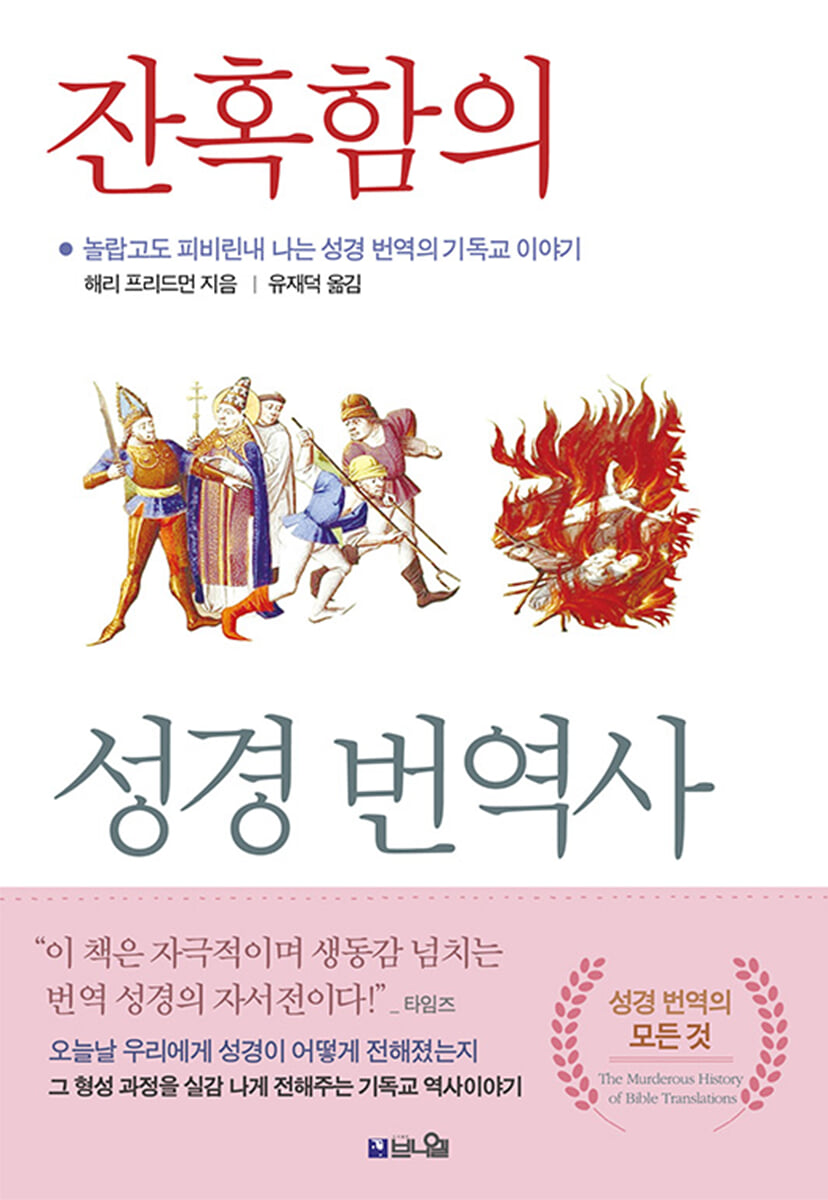
This book tells the surprising and bloody story of the history of Christianity, told by those dedicated to bringing to the public the Bible, “so old yet so new and attractive,” as Augustine put it.
To this end, author Harry Friedman examines the history of translated Bibles, from the Septuagint, believed to have been produced in ancient Egypt, to the intense conflicts surrounding medieval translated Bibles, and the background to the emergence of modern translated Bibles.
As a writer and scholar who earned his PhD in Aramaic from the University of London, Friedman offers a compelling account of the struggles for legitimacy and authority in a time when secular power was subordinated to divine authority, and when the ideal of a "Bible for all" required the sacrifice of time, comfort, and even life.
If we follow Friedman, the author of this book, and look back over a long history of approximately 2,300 years, we can truly understand the process of how the Bible came to be handed down to us today.
In that sense, this book could be called an autobiography of the translated Bible.
To this end, author Harry Friedman examines the history of translated Bibles, from the Septuagint, believed to have been produced in ancient Egypt, to the intense conflicts surrounding medieval translated Bibles, and the background to the emergence of modern translated Bibles.
As a writer and scholar who earned his PhD in Aramaic from the University of London, Friedman offers a compelling account of the struggles for legitimacy and authority in a time when secular power was subordinated to divine authority, and when the ideal of a "Bible for all" required the sacrifice of time, comfort, and even life.
If we follow Friedman, the author of this book, and look back over a long history of approximately 2,300 years, we can truly understand the process of how the Bible came to be handed down to us today.
In that sense, this book could be called an autobiography of the translated Bible.
- You can preview some of the book's contents.
Preview
index
Translator's Preface _ Until the Bible Comes into Our Hands
Prologue _ For the Bible of All People
Part 1.
Before violence
Chapter 1.
The Legacy of Alexandria
- The Legend of the Septuagint
- Septuagint controversy
- Challenge to the Septuagint
- The first biblical criticism
Chapter 2.
wandering Aramean
- Old Testament Peshitta
- Targum
Chapter 3.
Old sayings, new dialects
- Language of the New Testament
- New Testament Peshitta
- Jerome and the Vulgate
- Little Wolf and Mesrop
Chapter 4.
The Sublime Bible
- Hunayn ibn Ishaq
- Saadia Gaon
- A sword in one hand, a Bible in the other
Part 2.
The beginning of violence
Chapter 5.
medieval conflicts
-Moses' horn
- Cathar Bible
- The Beguinage and the Begard Order
- The Morning Star of the Reformation
- Czech heretic
- Language problem
- German translation of Martin Luther
Chapter 6.
Tindle's Murderer
- A person who had no place to stand
- Risk in Germany
- Betrayal
- Aftershock
Chapter 7.
Let their strife be scattered.
- Catholic Bible in the native language
- Change in perception
- Spanish Inquisition
- Yiddish New Testament
- Jan of Leiden and the Münster Rebellion
Chapter 8.
King James Bible
- New king
- Abolition of the Geneva Bible
- Production of the King James Bible
- Errors and disappointments
Part 3.
illumination
Chapter 9.
new role
- Restoration of the Honor of the King James Bible
- Teaching German to Jews
- Discord
Chapter 10.
Early American Bibles
- Bay Psalm
- Early American Bibles
- Noah Webster's deleted translation
- The first female translator
Chapter 11.
In search of meaning
- Pressure for revision
- Religion and politics in Russia
- Repeated Bible burning
- Jewish Bible
- Jerusalem Bible
Chapter 12.
Reconstruction of the Bible
- Sexist language and gender politics
- Queen James Bible
- A Strange Christian Jewish Translation
- The Bible business is a huge business.
Chapter 13.
The Future of the Translated Bible
References
index
Prologue _ For the Bible of All People
Part 1.
Before violence
Chapter 1.
The Legacy of Alexandria
- The Legend of the Septuagint
- Septuagint controversy
- Challenge to the Septuagint
- The first biblical criticism
Chapter 2.
wandering Aramean
- Old Testament Peshitta
- Targum
Chapter 3.
Old sayings, new dialects
- Language of the New Testament
- New Testament Peshitta
- Jerome and the Vulgate
- Little Wolf and Mesrop
Chapter 4.
The Sublime Bible
- Hunayn ibn Ishaq
- Saadia Gaon
- A sword in one hand, a Bible in the other
Part 2.
The beginning of violence
Chapter 5.
medieval conflicts
-Moses' horn
- Cathar Bible
- The Beguinage and the Begard Order
- The Morning Star of the Reformation
- Czech heretic
- Language problem
- German translation of Martin Luther
Chapter 6.
Tindle's Murderer
- A person who had no place to stand
- Risk in Germany
- Betrayal
- Aftershock
Chapter 7.
Let their strife be scattered.
- Catholic Bible in the native language
- Change in perception
- Spanish Inquisition
- Yiddish New Testament
- Jan of Leiden and the Münster Rebellion
Chapter 8.
King James Bible
- New king
- Abolition of the Geneva Bible
- Production of the King James Bible
- Errors and disappointments
Part 3.
illumination
Chapter 9.
new role
- Restoration of the Honor of the King James Bible
- Teaching German to Jews
- Discord
Chapter 10.
Early American Bibles
- Bay Psalm
- Early American Bibles
- Noah Webster's deleted translation
- The first female translator
Chapter 11.
In search of meaning
- Pressure for revision
- Religion and politics in Russia
- Repeated Bible burning
- Jewish Bible
- Jerusalem Bible
Chapter 12.
Reconstruction of the Bible
- Sexist language and gender politics
- Queen James Bible
- A Strange Christian Jewish Translation
- The Bible business is a huge business.
Chapter 13.
The Future of the Translated Bible
References
index
Publisher's Review
“This book is stimulating and vibrant
“It is the autobiography of the translated Bible!” _ The Times literary review
Looking back on 2,300 years of history
How the Bible came to us today
The history of Bible translation that vividly conveys its formation process!
What those who tried to translate the word of God had to go through
A surprising and bloody story of Christian history!
“A fascinating and refreshingly compelling account of the history of Bible translation and the complexities of human motivation.” _ George Leonard Carey (former Archbishop of Canterbury)
In the past, the Bible was a very precious and special book.
Especially in the medieval West, it was nearly impossible for an ordinary person to own a manuscript Bible, even if he or she saved for decades.
Even if one had the financial resources to do so, the sheer size of the manuscript Bible made it difficult to even store it.
Later, thanks to the invention of the printing press by Gutenberg, access to the Bible greatly expanded, but if you couldn't read Latin, it was just a decoration.
So the public had to be content with hearing the Bible without owning or reading it themselves.
In this social environment, it was the Reformation led by Martin Luther that truly sparked interest in the Bible.
Martin Luther, who emphasized the Bible in the native language rather than Latin, found the authority of the church in the Bible rather than in its institutions.
Thanks to the firm principle of the Reformation, “Scripture alone” (sola scriptura), European Protestant countries and churches put considerable effort into securing Bibles in their native languages.
In the late 19th and early 20th centuries, a strong desire for the Bible erupted again.
As someone put it, the golden age of the Bible has arrived.
Historically, the expansion of trade between the East and the West since the Age of Exploration, which began in the mid-15th century, the resulting cultural exchanges, and the emergence of new missionary destinations have had a decisive impact on the popularization and dissemination of the Bible, along with the Reformation.
Whenever Christianity first entered the New World, such as America, India, and various Asian countries including China, translated Bibles were essential for evangelizing.
Since the mid-20th century, a significant number of translated Bibles have appeared in response to rapidly changing cultural needs.
Even in economics, it has become so popular that an unfamiliar term, “Bible Industry,” has been coined to describe the Bible as a source of wealth.
As time passed, the status of the Bible also changed.
The days when the Bible guaranteed intelligence or wealth are long gone.
These days, Bibles line the shelves of bookstores, and they have become so commonplace that every Christian household owns as many Bibles as there are family members, or even more.
Moreover, thanks to digital media such as smartphones, opportunities to access the Bible have increased significantly in recent years.
And now, the Bible is no longer dominated by one type, and the church is also becoming more and more inclined to not insist on a specific Bible as it did in the past.
There are now more than 15 complete Korean Bible translations published, and dozens of English Bibles are available, allowing readers to choose a version that best suits their denomination, preferred language, or even personal taste.
Despite these external changes, the Bible's influence remains.
Western thought, armed with rationality, questioned the objectivity and authenticity of the Bible, and the Marxist-Leninists of the former Soviet Union and Eastern Europe, as well as the revised socialists of China and North Korea, strongly prohibited the publication, distribution, and reading of the Bible, and some still maintain such policies today, but their influence has not changed.
The Bible still comforts those in despair and is a source of endless inspiration, hope, and courage to all who willingly engage with it.
Moreover, it offers a new path of wonder to spiritual seekers who seek the ultimate mystery of transcendence, a mystery that simultaneously arouses fear and fascination.
Only those biblicalists and nominal Christians who tout the Bible but do not actually acknowledge it as the Word of God overlook the “dynamite” power of the Bible (as Mahatma Gandhi said).
“It is the autobiography of the translated Bible!” _ The Times literary review
Looking back on 2,300 years of history
How the Bible came to us today
The history of Bible translation that vividly conveys its formation process!
What those who tried to translate the word of God had to go through
A surprising and bloody story of Christian history!
“A fascinating and refreshingly compelling account of the history of Bible translation and the complexities of human motivation.” _ George Leonard Carey (former Archbishop of Canterbury)
In the past, the Bible was a very precious and special book.
Especially in the medieval West, it was nearly impossible for an ordinary person to own a manuscript Bible, even if he or she saved for decades.
Even if one had the financial resources to do so, the sheer size of the manuscript Bible made it difficult to even store it.
Later, thanks to the invention of the printing press by Gutenberg, access to the Bible greatly expanded, but if you couldn't read Latin, it was just a decoration.
So the public had to be content with hearing the Bible without owning or reading it themselves.
In this social environment, it was the Reformation led by Martin Luther that truly sparked interest in the Bible.
Martin Luther, who emphasized the Bible in the native language rather than Latin, found the authority of the church in the Bible rather than in its institutions.
Thanks to the firm principle of the Reformation, “Scripture alone” (sola scriptura), European Protestant countries and churches put considerable effort into securing Bibles in their native languages.
In the late 19th and early 20th centuries, a strong desire for the Bible erupted again.
As someone put it, the golden age of the Bible has arrived.
Historically, the expansion of trade between the East and the West since the Age of Exploration, which began in the mid-15th century, the resulting cultural exchanges, and the emergence of new missionary destinations have had a decisive impact on the popularization and dissemination of the Bible, along with the Reformation.
Whenever Christianity first entered the New World, such as America, India, and various Asian countries including China, translated Bibles were essential for evangelizing.
Since the mid-20th century, a significant number of translated Bibles have appeared in response to rapidly changing cultural needs.
Even in economics, it has become so popular that an unfamiliar term, “Bible Industry,” has been coined to describe the Bible as a source of wealth.
As time passed, the status of the Bible also changed.
The days when the Bible guaranteed intelligence or wealth are long gone.
These days, Bibles line the shelves of bookstores, and they have become so commonplace that every Christian household owns as many Bibles as there are family members, or even more.
Moreover, thanks to digital media such as smartphones, opportunities to access the Bible have increased significantly in recent years.
And now, the Bible is no longer dominated by one type, and the church is also becoming more and more inclined to not insist on a specific Bible as it did in the past.
There are now more than 15 complete Korean Bible translations published, and dozens of English Bibles are available, allowing readers to choose a version that best suits their denomination, preferred language, or even personal taste.
Despite these external changes, the Bible's influence remains.
Western thought, armed with rationality, questioned the objectivity and authenticity of the Bible, and the Marxist-Leninists of the former Soviet Union and Eastern Europe, as well as the revised socialists of China and North Korea, strongly prohibited the publication, distribution, and reading of the Bible, and some still maintain such policies today, but their influence has not changed.
The Bible still comforts those in despair and is a source of endless inspiration, hope, and courage to all who willingly engage with it.
Moreover, it offers a new path of wonder to spiritual seekers who seek the ultimate mystery of transcendence, a mystery that simultaneously arouses fear and fascination.
Only those biblicalists and nominal Christians who tout the Bible but do not actually acknowledge it as the Word of God overlook the “dynamite” power of the Bible (as Mahatma Gandhi said).
GOODS SPECIFICS
- Date of issue: September 18, 2025
- Page count, weight, size: 368 pages | 446g | 147*210*20mm
- ISBN13: 9791193092477
- ISBN10: 1193092477
You may also like
카테고리
korean


korean

![GQ KOREA Mark (Monthly): December [2025]](http://librairie.coreenne.fr/cdn/shop/files/8ef265dbbfbf186523ed75ba7319009d.jpg?v=1765340328&width=3840)


