

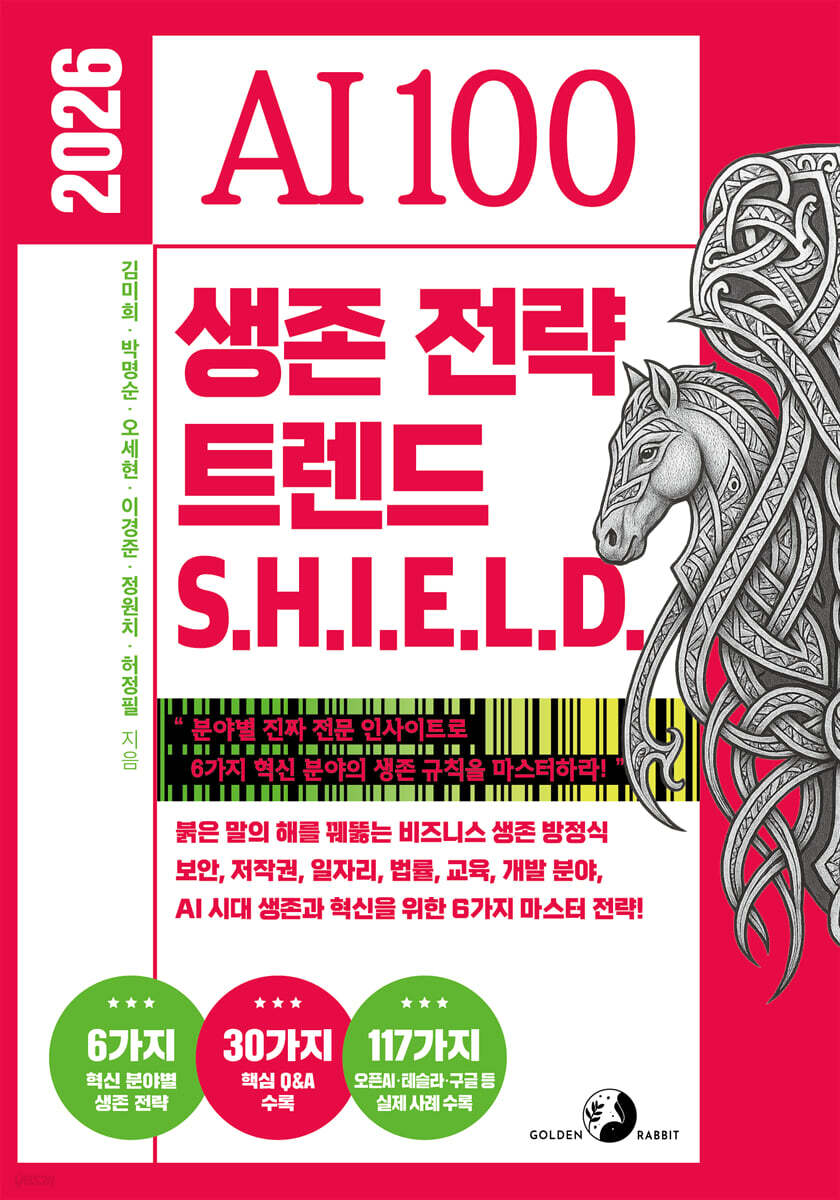
2026 AI 100 Survival Strategy Trend SHIELD
 |
Description
Book Introduction
★ In the AI era, if you stay still, you'll be pushed out. You have to run to stay in place!
★ Those who go ahead have already finished preparing!
★ 6 Keys to Success! Secure SHIELD now!
In the age of AI, where even predictions are meaningless! The world is moving at a rapid pace.
To get ahead of others, you have to run twice as fast as them.
Artificial intelligence is having a huge impact, closer than we think.
We stand at the center of a massive transformation that is fundamentally altering our daily lives and the social order.
By 2026, AI will fundamentally transform industries and our daily lives.
In a rapidly changing world, how can we keep pace and move forward? If we do move forward, where should we go? Direction is as important as speed.
This book provides the right direction for us to move forward in the AI era, which has already become a reality.
'Real' experts in six areas - Security, Horizon of Authority, Industry, Education, Law, and Development - guide you through the essence of AI innovation and response strategies.
It is structured around case studies and practical guidelines that can be easily understood even without technical background knowledge.
You will encounter a whopping 117 real-world examples, including Tesla, OpenAI, and Google.
Prepare for the future with Code Shield, a guide from experts.
Seize the opportunity now with these six strategies!
★ Those who go ahead have already finished preparing!
★ 6 Keys to Success! Secure SHIELD now!
In the age of AI, where even predictions are meaningless! The world is moving at a rapid pace.
To get ahead of others, you have to run twice as fast as them.
Artificial intelligence is having a huge impact, closer than we think.
We stand at the center of a massive transformation that is fundamentally altering our daily lives and the social order.
By 2026, AI will fundamentally transform industries and our daily lives.
In a rapidly changing world, how can we keep pace and move forward? If we do move forward, where should we go? Direction is as important as speed.
This book provides the right direction for us to move forward in the AI era, which has already become a reality.
'Real' experts in six areas - Security, Horizon of Authority, Industry, Education, Law, and Development - guide you through the essence of AI innovation and response strategies.
It is structured around case studies and practical guidelines that can be easily understood even without technical background knowledge.
You will encounter a whopping 117 real-world examples, including Tesla, OpenAI, and Google.
Prepare for the future with Code Shield, a guide from experts.
Seize the opportunity now with these six strategies!
- You can preview some of the book's contents.
Preview
index
Chapter 1.
The first AI I encountered, and the AI I see now
_AI Odyssey, the first AI story
_The People Who Designed the World, Silicon Valley Leaders
A Peek into the Latest Technology Trends and AI Paradoxes
How Can Companies Survive in the Age of AI Crisis?
Chapter 2. AI Security: For a Utopian AI Era
AI's Betrayal: The Threats That Undermine AI Systems
___Tackling AI's optical illusions
___Protect the AI Supply Chain
Hacking AI's Mindset: An Adversarial Prompt Attack
___Indiscriminate training data is dangerous
Weaponization of AI, Intelligence and Expansion of Attacks
The combination of AI and malware is leading to the popularization of hacking.
___Attacking the Truth with Deepfakes and DeepVoice
___Invisible War, AI-Driven National Cyber Warfare
Beyond the Dilemma: AI Risk Management Strategies
___National AI Competitiveness Enhancement Plans to Secure National Competitiveness
___A sustainable growth strategy through trustworthy AI
Business Survival Strategies Using AI
___Setting Strategic Priorities When Implementing AI
___Building a data-driven decision-making system
Understanding Your Organization's Business Lifecycle to Strengthen Your AI Security Supply Chain
___Securing AI-tailored talent and transforming organizational culture
Building Customer Trust and Implementing Ethical AI
Building a Sustainable AI Business Ecosystem
Chapter 3.
Horizons of Authorship: New Horizons for AI-Created Copyright
The era of AI-powered content creation
___Creative Status Using Generative AI
___Integrating AI Creation and the Value Chain
_Strategies for utilizing works that embody the essence of creation
___Establishing Standards Using the Idea/Expression Dichotomy
___AI product lawsuits continue
___Have you contributed to AI works?
___See more other arguments about AI creations
_Developing a technical survival strategy for AI creations
The Survival Equation in the Age of AI and Collaboration
___Engine: Adopting More Transparent AI
___Control: Injecting Direction
___Apply: Monetize your AI creations
_Riding the wave of fundamental shifts in the creative paradigm
Chapter 4.
Industry AX: The Beginning of AX and the Equation for Success
_The AI era has brought changes to the workplace.
___Will AI replace all human jobs?
___What should we prepare for in the AI era?
_AX's success formula, DOING
Practice AX by ___DOING
___Analyzing industry-specific cases with DOING
Business Survival Strategies in the AI Industry
Chapter 5.
Education with AI: A Major Shift in the Education Paradigm in the AI Era
_Customized, personalized learning using generative AI
Generative AI is transforming the education paradigm.
___Evolve into personalized, individualized learning
___Ethical Issues in the Use of Generative AI
___AI Ethics Education and Utilization Guidelines Case Study
How to Effectively Use Generative AI in Education
___Five Values of Generative AI as an Educational Tool
___Discover AI tools suitable for education
___Developing a strategy for educational use of AI tools
___AI usage regulations still vary widely
___Introducing AI as an evaluation partner
Business Survival Strategies Using AI
___Switch to a personalized learning service
___Expanding the Teacher-AI Collaboration Model
___Creating new revenue models and expanding markets
___Finding differentiation based on ethics and trust
_Suggestions for the future of education
Chapter 6.
Law, Policy and AI - The K-AI Basic Law, the world's first to be implemented
_It's late, but the implementation should be swift and swift, the Republic of Korea's Basic Act on Artificial Intelligence
Discussions on the ___〈K-AI Basic Act〉
___Check the amendments to the K-AI Basic Act
___Analyzing the K-AI Special Act
_A Review of Existing Laws and the K-AI Basic Act
___Coping with the Regulatory Flood
___Preview of the direction of enactment of the subordinate enforcement ordinance of the K-AI Framework Act
___A look at the main contents of the draft enforcement ordinance of the K-AI Framework Act
_Adhering to AI Ethical Principles
___Establishing an Ethics Charter and Common Principles for the Intelligent Information Society
___A Look at the Human-Centered "AI Ethics Standards"
___Checklist for Using Generative AI Wisely
___Checklist for Safely Using Physical AI
_AI Basic Law and Corporate Survival Strategies
Chapter 7.
Development with AI - The Era of AI-Driven Development
_Innovative changes in software development
IDE as a facilitator
___Copilot, the birth of AI pair programming
___Evolution from Homo searchens to Homo promptus
___AI meets MCP and gains execution authority
___AI Becomes the Development Environment Itself
_A Reversal in AI Development and Management
___Creating a prototype with Vibe Coding
___Beware of the side effects of vibe coding
___Using AI within the development lifecycle
Business Survival Strategies Using AI
Avoiding the Debt Trap of AI Development
___Establishing an AI-based engineering process
Embracing the magic of AI development
[Appendix] DOING Evaluation Elements
The first AI I encountered, and the AI I see now
_AI Odyssey, the first AI story
_The People Who Designed the World, Silicon Valley Leaders
A Peek into the Latest Technology Trends and AI Paradoxes
How Can Companies Survive in the Age of AI Crisis?
Chapter 2. AI Security: For a Utopian AI Era
AI's Betrayal: The Threats That Undermine AI Systems
___Tackling AI's optical illusions
___Protect the AI Supply Chain
Hacking AI's Mindset: An Adversarial Prompt Attack
___Indiscriminate training data is dangerous
Weaponization of AI, Intelligence and Expansion of Attacks
The combination of AI and malware is leading to the popularization of hacking.
___Attacking the Truth with Deepfakes and DeepVoice
___Invisible War, AI-Driven National Cyber Warfare
Beyond the Dilemma: AI Risk Management Strategies
___National AI Competitiveness Enhancement Plans to Secure National Competitiveness
___A sustainable growth strategy through trustworthy AI
Business Survival Strategies Using AI
___Setting Strategic Priorities When Implementing AI
___Building a data-driven decision-making system
Understanding Your Organization's Business Lifecycle to Strengthen Your AI Security Supply Chain
___Securing AI-tailored talent and transforming organizational culture
Building Customer Trust and Implementing Ethical AI
Building a Sustainable AI Business Ecosystem
Chapter 3.
Horizons of Authorship: New Horizons for AI-Created Copyright
The era of AI-powered content creation
___Creative Status Using Generative AI
___Integrating AI Creation and the Value Chain
_Strategies for utilizing works that embody the essence of creation
___Establishing Standards Using the Idea/Expression Dichotomy
___AI product lawsuits continue
___Have you contributed to AI works?
___See more other arguments about AI creations
_Developing a technical survival strategy for AI creations
The Survival Equation in the Age of AI and Collaboration
___Engine: Adopting More Transparent AI
___Control: Injecting Direction
___Apply: Monetize your AI creations
_Riding the wave of fundamental shifts in the creative paradigm
Chapter 4.
Industry AX: The Beginning of AX and the Equation for Success
_The AI era has brought changes to the workplace.
___Will AI replace all human jobs?
___What should we prepare for in the AI era?
_AX's success formula, DOING
Practice AX by ___DOING
___Analyzing industry-specific cases with DOING
Business Survival Strategies in the AI Industry
Chapter 5.
Education with AI: A Major Shift in the Education Paradigm in the AI Era
_Customized, personalized learning using generative AI
Generative AI is transforming the education paradigm.
___Evolve into personalized, individualized learning
___Ethical Issues in the Use of Generative AI
___AI Ethics Education and Utilization Guidelines Case Study
How to Effectively Use Generative AI in Education
___Five Values of Generative AI as an Educational Tool
___Discover AI tools suitable for education
___Developing a strategy for educational use of AI tools
___AI usage regulations still vary widely
___Introducing AI as an evaluation partner
Business Survival Strategies Using AI
___Switch to a personalized learning service
___Expanding the Teacher-AI Collaboration Model
___Creating new revenue models and expanding markets
___Finding differentiation based on ethics and trust
_Suggestions for the future of education
Chapter 6.
Law, Policy and AI - The K-AI Basic Law, the world's first to be implemented
_It's late, but the implementation should be swift and swift, the Republic of Korea's Basic Act on Artificial Intelligence
Discussions on the ___〈K-AI Basic Act〉
___Check the amendments to the K-AI Basic Act
___Analyzing the K-AI Special Act
_A Review of Existing Laws and the K-AI Basic Act
___Coping with the Regulatory Flood
___Preview of the direction of enactment of the subordinate enforcement ordinance of the K-AI Framework Act
___A look at the main contents of the draft enforcement ordinance of the K-AI Framework Act
_Adhering to AI Ethical Principles
___Establishing an Ethics Charter and Common Principles for the Intelligent Information Society
___A Look at the Human-Centered "AI Ethics Standards"
___Checklist for Using Generative AI Wisely
___Checklist for Safely Using Physical AI
_AI Basic Law and Corporate Survival Strategies
Chapter 7.
Development with AI - The Era of AI-Driven Development
_Innovative changes in software development
IDE as a facilitator
___Copilot, the birth of AI pair programming
___Evolution from Homo searchens to Homo promptus
___AI meets MCP and gains execution authority
___AI Becomes the Development Environment Itself
_A Reversal in AI Development and Management
___Creating a prototype with Vibe Coding
___Beware of the side effects of vibe coding
___Using AI within the development lifecycle
Business Survival Strategies Using AI
Avoiding the Debt Trap of AI Development
___Establishing an AI-based engineering process
Embracing the magic of AI development
[Appendix] DOING Evaluation Elements
Detailed image

Into the book
“You have to run at least twice as fast.”
“Here, you have to run as fast as you can without stopping to stay in the same place.
If you want to go somewhere else, you have to run at least twice as fast.” _The Red Queen from Through the Looking Glass
The 'Red Queen's Country' in Lewis Carroll's novel 'Through the Looking Glass' is a place where you are pushed back if you stay still.
The world moves so fast that just staying put requires constant effort, and moving forward requires running even faster.
The Red Queen's Country is not just a fairy tale.
We are in the midst of this unrealistic acceleration through AI.
The pace of change we are experiencing is surpassing all previous technological advances, making even predictions meaningless.
Artificial intelligence isn't simply a technological advancement. Professor Geoffrey Hinton, known as the godfather of AI and winner of the 2024 Nobel Prize in Physics, likened today's AI to a tiger cub, warning, "If you can't be sure it won't grow up to kill you, you should be worried."
Physicist Stephen Hawking also warned that “the development of full artificial intelligence could spell the end of the human race,” and Tesla CEO Elon Musk said, “AI is more dangerous than nuclear weapons.”
“We summon demons with AI,” he said.
What they all have in common is that the rapid development of AI could lead to unexpected disasters beyond human control.
Today's acceleration into the age of artificial intelligence is widening the digital divide between nations and creating new polarization among individuals, businesses, and nations.
According to research from Oxford University,1 more than half of AI data centers are located in the United States, China, and the European Union, and only a small number of countries worldwide possess computing power.
The AI gap, especially with the US and China dominating the data center market, signals a new Cold War for AI supremacy.
Professor Billy Redonvirta of Oxford University stated that “the oil of the AI era is computing power,” and that securing computing resources is the future of a nation.
Ultimately, it suggests that national hegemony begins with AI hegemony.
The Red Queen's country demands a national response that goes beyond individuals and businesses.
The advancement of artificial intelligence is accelerating at an unmanageable pace, urging us to join the race for AI supremacy.
As a result, digital transformation (DX) and AI transformation (AX), which are being touted in the media, have become essential rather than optional.
Ultimately, we are at a turning point in a new generational shift surrounding AI leadership.
This wave of generational change is directly impacting not only the national level but also the lives of individuals and organizations.
Middle managers who make decisions based on decades of experience are being replaced by junior employees with data analysis skills, and individuals and organizations that cannot keep up with the pace of change in the age of artificial intelligence face the terrifying reality of being eliminated.
We now live in a world where we must compete on productivity, leveraging artificial intelligence, rather than on age and experience.
It has become the Red Queen's country where it is impossible to even stay in place without running.
To solve the various problems found in the land of artificial intelligence and not get lost in the waves of great change, we must each find answers in our own place.
Experts from various fields gathered together to engage in in-depth discussions in this changing environment, covering topics ranging from security issues to blocking new threats created by artificial intelligence, the direction education should take in growth through the redefinition of knowledge, and legal elements to address issues arising at the crossroads of creation and imitation.
Although each of us had different perspectives based on our respective areas of expertise, we ultimately realized that we were each finding our own way out of the vast maze known as the generational shift driven by artificial intelligence.
Ultimately, we learned that we had to graft various methods to find the exit in order to escape.
In Greek mythology, Prometheus stole fire from the gods and gave it to humans.
Thanks to this, humanity gained the freedom to develop civilization by escaping from the cold and darkness, but it also left us with the responsibility of constant management and control.
Artificial intelligence, like Promethean fire, has opened up unprecedented innovation and possibilities for humanity, but it also leaves behind enormous challenges.
“Here, you have to run as fast as you can without stopping to stay in the same place.
If you want to go somewhere else, you have to run at least twice as fast.” _The Red Queen from Through the Looking Glass
The 'Red Queen's Country' in Lewis Carroll's novel 'Through the Looking Glass' is a place where you are pushed back if you stay still.
The world moves so fast that just staying put requires constant effort, and moving forward requires running even faster.
The Red Queen's Country is not just a fairy tale.
We are in the midst of this unrealistic acceleration through AI.
The pace of change we are experiencing is surpassing all previous technological advances, making even predictions meaningless.
Artificial intelligence isn't simply a technological advancement. Professor Geoffrey Hinton, known as the godfather of AI and winner of the 2024 Nobel Prize in Physics, likened today's AI to a tiger cub, warning, "If you can't be sure it won't grow up to kill you, you should be worried."
Physicist Stephen Hawking also warned that “the development of full artificial intelligence could spell the end of the human race,” and Tesla CEO Elon Musk said, “AI is more dangerous than nuclear weapons.”
“We summon demons with AI,” he said.
What they all have in common is that the rapid development of AI could lead to unexpected disasters beyond human control.
Today's acceleration into the age of artificial intelligence is widening the digital divide between nations and creating new polarization among individuals, businesses, and nations.
According to research from Oxford University,1 more than half of AI data centers are located in the United States, China, and the European Union, and only a small number of countries worldwide possess computing power.
The AI gap, especially with the US and China dominating the data center market, signals a new Cold War for AI supremacy.
Professor Billy Redonvirta of Oxford University stated that “the oil of the AI era is computing power,” and that securing computing resources is the future of a nation.
Ultimately, it suggests that national hegemony begins with AI hegemony.
The Red Queen's country demands a national response that goes beyond individuals and businesses.
The advancement of artificial intelligence is accelerating at an unmanageable pace, urging us to join the race for AI supremacy.
As a result, digital transformation (DX) and AI transformation (AX), which are being touted in the media, have become essential rather than optional.
Ultimately, we are at a turning point in a new generational shift surrounding AI leadership.
This wave of generational change is directly impacting not only the national level but also the lives of individuals and organizations.
Middle managers who make decisions based on decades of experience are being replaced by junior employees with data analysis skills, and individuals and organizations that cannot keep up with the pace of change in the age of artificial intelligence face the terrifying reality of being eliminated.
We now live in a world where we must compete on productivity, leveraging artificial intelligence, rather than on age and experience.
It has become the Red Queen's country where it is impossible to even stay in place without running.
To solve the various problems found in the land of artificial intelligence and not get lost in the waves of great change, we must each find answers in our own place.
Experts from various fields gathered together to engage in in-depth discussions in this changing environment, covering topics ranging from security issues to blocking new threats created by artificial intelligence, the direction education should take in growth through the redefinition of knowledge, and legal elements to address issues arising at the crossroads of creation and imitation.
Although each of us had different perspectives based on our respective areas of expertise, we ultimately realized that we were each finding our own way out of the vast maze known as the generational shift driven by artificial intelligence.
Ultimately, we learned that we had to graft various methods to find the exit in order to escape.
In Greek mythology, Prometheus stole fire from the gods and gave it to humans.
Thanks to this, humanity gained the freedom to develop civilization by escaping from the cold and darkness, but it also left us with the responsibility of constant management and control.
Artificial intelligence, like Promethean fire, has opened up unprecedented innovation and possibilities for humanity, but it also leaves behind enormous challenges.
--- From the text
Publisher's Review
★ The AI transition is an inevitable and massive trend of the times!
★ We need a survival strategy that allows us to collaborate and coexist with AI!
★ A practical compass that provides direction and answers!
The world currently faces the powerful current of the Fifth Industrial Revolution. It's time to rapidly transform to keep pace with the rapid advancements in AI.
If you can't adapt, you won't survive.
Some say, “Our society is not ready to accept AI yet.”
But just because you're not prepared doesn't mean it won't come.
"Will using AI like ChatGPT lead to a personal information leak?", "What are the risks of synthesizing the faces and voices of celebrities (entertainers and politicians)? Are parodies safe?", "Is AI transformation (AX) possible for small and medium-sized businesses? It seems like a lot of money, but can you start with a small investment?" The book provides answers to these murky questions, along with strategies for adapting to change.
We must find ways to collaborate and coexist with AI to survive.
The problem is that it is not clear what direction collaboration and coexistence should take.
There aren't many good textbooks that can serve as a reference for people living in a world of change.
Finding practical guidance for action among vague or abstract messages is no longer easy.
This book was written amidst such concerns.
≪AI 100 Survival Strategy Trend Shield≫ will serve as a philosophical guide and practical guide for navigating the era of civilizational transformation driven by artificial intelligence.
Technology has developed faster than society's perception. What values should humans uphold in this era? This insightful look into the fundamental questions facing us as we navigate the coming era.
Additionally, experts in each field suggest new ways to live in the future.
It will serve as a compass for readers who are lost, providing insight into this era.
★ Security experts, content industry professionals, corporate executives, educators, and corporate legal staff
★ Anyone who is thinking about survival strategies and direction in the AI era
★ You must read this book!
- Planners, marketers, and office workers who plan and execute businesses in the AI era
IT executives seeking ways to secure competitiveness and collaborate in the era of AI-driven development.
- Information security experts exploring new security threats and realistic defense strategies in the AI era.
- Content industry professionals interested in the concept of copyright in AI products and the changing role of creators
- Corporate executives seeking a practical formula for success in an AI-driven future society.
- Education professionals who understand the great shift in the educational paradigm
- Corporate legal staff seeking to understand AI-related laws and policy trends, including the K-AI Basic Act.
It provides vivid insights and practical response strategies to all those contemplating survival strategies and direction in the AI era.
★ SHIELD: The Six Great Strategic Plans of the AI Era
★ Security, copyright, industry, education, law, development,
★ Master survival strategies guided by top experts in each field.
The core axis of this new path is SHIELD. These are the six key areas experiencing the most explosive changes and conflicts due to AI advancements.
Real experts in six fields - Security, Horizon of Authority, Industry, Education, Law, and Development - have written practical implementation strategies.
Beyond mere trends, it offers comprehensive solutions that cover human-centered directions, legal, and humanistic fields.
This book explores the direction we should take through six axes that seek a human-centered direction in the new order created by AI.
- S stands for Security. We explore practical security strategies and ethical measures to defend against AI threats. We develop practical solutions, such as establishing an AI governance framework, strengthening supply chain security, and human-centered governance principles.
- H stands for Horizon of Authority. It restores the value of human creators in the AI era and suggests a new direction for the copyright creative environment, co-created by humans and machines.
- I is Industry.
It presents specific action plans for how organizations can change and what preparations we must make. Following the DOING practice standards will further clarify the path.
- E is for Education.
We propose an educational direction that considers not only the effectiveness of personalized, individualized education using generative AI, but also ethical safeguards.
We can prepare for an era in which future generations and AI can effectively coexist.
- L is for Law.
We seek a human-centered direction in a new order centered on the “K-AI Basic Law.”
It suggests a more proactive approach to implementing enforcement regulations or detailed policies.
The final "D" stands for "Development." It fundamentally reflects on the changing role of developers in the era of AI-driven development. It presents specific survival strategies for companies and developers, along with directions for leveraging AI to secure competitiveness.
At the end of each topic, a total of 30 questions and answers are provided to help alleviate the confusion and confusion about coexistence with AI.
"Can personal information be leaked when using AI like ChatGPT?", "What are the risks of synthesizing the faces and voices of celebrities (entertainers and politicians)? Are parodies safe?", "Is AI transformation (AX) possible for small and medium-sized businesses? It seems like a lot of money, but can you start with a small investment?" These questions accurately address common questions in our daily lives.
It is a guidebook for the future and a commentary for our society today.
★ Clear direction and practical strategies for living in the AI era
★ He who knows where to go gets ahead faster.
★ SHIELD, a powerful shield of survival that will protect you!
By following the path SHILED suggests, we can gain clear direction and practical survival strategies even in uncertain times.
Only those who clearly know the path ahead can reach the future faster.
When the course of action becomes clear, the shield becomes a sturdy shield protecting us from the fierce waves of the new era.
The stories covered in each chapter are as follows:
_★ AI Security
_★ For a Utopian AI Era (Chapter 2)
This chapter contains survival strategies for AI security, based on the extensive experience of author Kim Mi-hee, who has worked at the forefront of information security as a breach analysis and security consulting expert.
We directly respond to complex security breaches across various industries, including public, financial, manufacturing, and healthcare, provide security consulting services for key national organizations, and present practical, hands-on expertise gained through direct experience in the field, addressing new security threats and presenting realistic defense strategies for the AI era.
AI is no longer the exclusive domain of specific technologies or companies, but is now playing a key role in all industries, including manufacturing, finance, healthcare, and distribution. It is deeply embedded in our daily lives, transforming our way of life, even when we are not aware of it, through AI assistants, personalized streaming services, and autonomous driving.
In particular, as it has become established as a pivotal technology for improving the stability and efficiency of social infrastructure such as urban operations, energy management, and transportation, it has become a threat to safety and trust.
To this end, we must explore practical security strategies and ethical measures to defend against the threats posed by AI, which is becoming increasingly weaponized and intelligent, at the crossroads of AI-induced utopia and dystopia. AI threatens the safety and trust of society as a whole, potentially leading to devastating consequences that impact national security.
Therefore, we aim to understand the potential threats posed by AI, strengthen the supply chain security of the AI ecosystem by establishing an AI governance framework, and develop practical solutions based on human-centered governance principles.
_★Horizons of Authorship
_★New Horizons for AI Creation Copyright (Chapter 3)
This chapter was written by Dr. Myung-soon Park, who earned her Ph.D. in Policy Studies for her research on AI product transparency norms.
He has experience in creating sound environments for theme parks at Samsung Group, taking charge of everything from media content production to copyright management, and has experience in developing new businesses such as AI at Hyundai Motor Group, which has led to the creation of generative AI technology and new changes in the content industry.
This book discusses the impact of technological advancements on human creative activities and the concept of copyright.
Recent AI creations have advanced to a point where they are difficult to compare with human creations.
This paper presents survival strategies for how human creative activities and the concept of copyright will change in response to such developments and how to respond.
In particular, it raises fundamental questions such as, “What is the scope of human contribution within creative works?” and “Are humans the subject of creation?” and examines whether the core copyright requirements of humanity and creativity remain valid in the AI era.
As AI-generated creations gain artistic value and social influence, policy and legal discussions are needed on how to evaluate them and how to protect the human domain.
Therefore, rather than simply interpreting legal precedents, we reexamine the essence of creative works and their copyrightability in the policy, humanities, and technological fields.
It also explores the relationship between creative works across the two axes of originality and similarity, and examines how copyright legal judgments and technical standards can interact.
Furthermore, we aim to reveal technological and policy implications by connecting real-world cases and academic research arising from copyright disputes over AI products.
In conclusion, this paper presents a direction for how to restore the value of human creators in the AI era and design a new copyright creation environment where humans and machines work together as a tool.
_★Industry AX
_★AX's Beginning and the Success Formula (Chapter 4)
This chapter was written by expert advisor Oh Se-hyun, who has over 25 years of consulting and planning experience in various industries, including finance, the private sector, and startups. From a practical perspective, it presents the changes each industry will face in an AI-driven future society and the goals and capabilities current and future generations should set and develop.
It addresses the fundamental question, "Why must we act immediately, right now?" and conveys the meaning of action. AI technology is already transforming our lives and industrial environments, and simply observing this change will inevitably lead to a situation where we fall behind in competitiveness.
Even at this moment, structured data (documents, articles, blogs) as well as unstructured data (videos, audio, photos, etc.) are continuously being accumulated and learned.
That's why we shouldn't stay in the present or just make plans.
In particular, we guide you through the application of “DOING,” five core practice criteria that can be judged in real-world situations, through industry-specific examples.
Through this, we must identify specific action plans to address the question, “How will the organization change, and what preparations should I and the company make?”
Through analysis of successful and failed AI adoption cases in each industry, readers will be able to clearly understand what needs to be done to achieve success.
Finally, we focused on the capabilities that individuals and organizations must possess in the AI era, and we once again encouraged readers to take action, conveying the message that they should no longer fear AI and start taking small steps immediately.
_★ Education with AI
_★ The AI Era: A Major Shift in the Education Paradigm (Chapter 5)
This chapter, written by Professor Heo Jeong-pil of Ulsan University, who holds a doctorate in 'Educational Technology', 'Curriculum Pedagogy', and 'Mathematics', received the Minister of Education Award for his research on generative AI and innovative teaching methods, and has given special lectures at over 100 universities nationwide, deals with the educational innovation of generative AI.
The first is that it enables personalized learning that reflects each student's level, learning speed, and interests.
This will open a new path to reducing learning gaps and strengthening learning autonomy, transcending the limitations of existing classroom instruction that unilaterally taught students with diverse learning gaps at the same level.
Second, generative AI can provide innovative support for teachers in lesson design and operation, and provide immediate and specific feedback to learners.
This will bring about a change that goes beyond simple efficiency and allows both teachers and students to experience more creative and in-depth education.
Third, generative AI is also driving significant changes in assessment and learning management in education.
By moving away from simple, repetitive administrative assessments through tests to a new assessment paradigm that tracks learning processes and supports growth, assessments that reflect students' capabilities in greater depth are possible.
Additionally, learners will have broader learning opportunities through self-reflection and interaction with AI.
In addition, we explore education-related business strategies utilizing AI and present specific measures to enhance market competitiveness.
In summary, this chapter presents an educational direction that reflects the innovative potential of AI while preserving the essential value of education, while also considering ethical safeguards as well as technical efficiency.
This will effectively prepare future generations for an era in which they will coexist with AI.
_★Law, Policy and AI
_★The K-AI Basic Law, the first of its kind in the world, is about to be implemented (Chapter 6)
Professor Lee Kyung-jun, who holds a doctorate in international technology and policy studies, will examine the amendments to the K-AI Framework Act and the enactment of special laws based on his expertise accumulated while working with information strategy and development departments in a wide range of fields, including national defense, finance, manufacturing, national core technologies, defense industry technologies, and life sciences technologies, while performing information system management and supervision duties.
Afterwards, we will examine the laws that existed before the enactment of the K-AI Basic Act and the direction of enactment of subordinate statutes under the K-AI Basic Act.
Various AI services can be viewed as one of the information systems or as sub-functions.
Therefore, you will realize that to strengthen the positive functions of information utilization and control the negative functions, you must comply with existing laws and K-AI ethical principles.
It also proposes ways for businesses to more proactively voice their opinions in line with the enactment of enforcement regulations, publication of guides, and implementation of detailed policies.
Furthermore, we look back on why the AI Basic Act was enacted and why AI ethics principles were established, while emphasizing that they are a key agenda for sustainable management.
_★Development with AI
_★The Era of AI-Driven Development (Chapter 7)
This chapter was written by Professor Jeong Won-chi of the Department of Data Analysis at Korea Polytechnic University.
He is a field-oriented expert with diverse IT work and project experience, having worked as a platform developer and information security officer at large corporations and public corporations.
He is currently serving as a director of the Korean Information Education Society and the Convergence Science and Social Technology Research Institute, and continues his academic activities.
Professor Jeongwonchi has personally experienced the rapid changes in the software development paradigm.
Based on these experiences, we provide guidance on what capabilities future talents need to acquire to remain competitive in the ever-changing software industry.
Additionally, it will provide insights into how IT-using executives should respond to and develop strategies for their businesses' increasing dependence on IT as a result of technological changes.
This chapter poses important questions to developers at a time of paradigm shift in software development.
"Is AI a competitor threatening developers' jobs?" Or is it a powerful collaborative partner, like an Iron Man suit that turns imagination into reality? How developers answer and prepare for this question will determine their future value.
This goes beyond simply being a question of code writing skills; it demands a fundamental reflection on the role and identity of developers.
Therefore, this chapter examines the flow from the innovation process of past development environments to the emergence of current AI native development tools.
It also sheds light on the shadows of AI-powered development, such as technical debt and capacity debt, and finally, presents specific survival strategies for developers and companies in a rapidly changing environment.
[Author's Note]
The Basic Act on Artificial Intelligence, which will take effect on January 22, 2026, presents a new starting point for our society.
Now is the time for proactive action, not waiting.
Security must ensure the safety of AI, humanity and creativity must guide AI's direction, and industry must evolve based on the criteria that it is a valuable profession and a foundation for our livelihood.
And education must move toward a path where humans and AI collaborate collaboratively through personalized learning, ethical use, and innovation in evaluation.
The law also protects AI from negative impacts, such as misuse or abuse.
Laws can also change, but they should be revised based on AI ethics standards that have developed through social consensus to ensure sustainable development.
In this environment, software development, in particular, must build reliable systems using vibe coding, agent coding, and future-oriented architecture.
You can't move forward just by making predictions and making plans.
With a clear purpose, we must clearly define the path we must take amidst the various information and data pouring in even at this very moment in the face of this new technology called AI.
This book presents guidelines through confirmed cases and strategies in the six areas introduced above.
This will serve as a guideline for our own actions in answering the question, “How should we prepare for the AI era?”
We must keep in mind that the answer we determine lies not in some grand future, but in the small choices and actions we each make in our respective positions now.
Now we will begin that journey together.
If you're ready, remember this:
The future does not belong to prophets, but to those who create it from now on.
★ We need a survival strategy that allows us to collaborate and coexist with AI!
★ A practical compass that provides direction and answers!
The world currently faces the powerful current of the Fifth Industrial Revolution. It's time to rapidly transform to keep pace with the rapid advancements in AI.
If you can't adapt, you won't survive.
Some say, “Our society is not ready to accept AI yet.”
But just because you're not prepared doesn't mean it won't come.
"Will using AI like ChatGPT lead to a personal information leak?", "What are the risks of synthesizing the faces and voices of celebrities (entertainers and politicians)? Are parodies safe?", "Is AI transformation (AX) possible for small and medium-sized businesses? It seems like a lot of money, but can you start with a small investment?" The book provides answers to these murky questions, along with strategies for adapting to change.
We must find ways to collaborate and coexist with AI to survive.
The problem is that it is not clear what direction collaboration and coexistence should take.
There aren't many good textbooks that can serve as a reference for people living in a world of change.
Finding practical guidance for action among vague or abstract messages is no longer easy.
This book was written amidst such concerns.
≪AI 100 Survival Strategy Trend Shield≫ will serve as a philosophical guide and practical guide for navigating the era of civilizational transformation driven by artificial intelligence.
Technology has developed faster than society's perception. What values should humans uphold in this era? This insightful look into the fundamental questions facing us as we navigate the coming era.
Additionally, experts in each field suggest new ways to live in the future.
It will serve as a compass for readers who are lost, providing insight into this era.
★ Security experts, content industry professionals, corporate executives, educators, and corporate legal staff
★ Anyone who is thinking about survival strategies and direction in the AI era
★ You must read this book!
- Planners, marketers, and office workers who plan and execute businesses in the AI era
IT executives seeking ways to secure competitiveness and collaborate in the era of AI-driven development.
- Information security experts exploring new security threats and realistic defense strategies in the AI era.
- Content industry professionals interested in the concept of copyright in AI products and the changing role of creators
- Corporate executives seeking a practical formula for success in an AI-driven future society.
- Education professionals who understand the great shift in the educational paradigm
- Corporate legal staff seeking to understand AI-related laws and policy trends, including the K-AI Basic Act.
It provides vivid insights and practical response strategies to all those contemplating survival strategies and direction in the AI era.
★ SHIELD: The Six Great Strategic Plans of the AI Era
★ Security, copyright, industry, education, law, development,
★ Master survival strategies guided by top experts in each field.
The core axis of this new path is SHIELD. These are the six key areas experiencing the most explosive changes and conflicts due to AI advancements.
Real experts in six fields - Security, Horizon of Authority, Industry, Education, Law, and Development - have written practical implementation strategies.
Beyond mere trends, it offers comprehensive solutions that cover human-centered directions, legal, and humanistic fields.
This book explores the direction we should take through six axes that seek a human-centered direction in the new order created by AI.
- S stands for Security. We explore practical security strategies and ethical measures to defend against AI threats. We develop practical solutions, such as establishing an AI governance framework, strengthening supply chain security, and human-centered governance principles.
- H stands for Horizon of Authority. It restores the value of human creators in the AI era and suggests a new direction for the copyright creative environment, co-created by humans and machines.
- I is Industry.
It presents specific action plans for how organizations can change and what preparations we must make. Following the DOING practice standards will further clarify the path.
- E is for Education.
We propose an educational direction that considers not only the effectiveness of personalized, individualized education using generative AI, but also ethical safeguards.
We can prepare for an era in which future generations and AI can effectively coexist.
- L is for Law.
We seek a human-centered direction in a new order centered on the “K-AI Basic Law.”
It suggests a more proactive approach to implementing enforcement regulations or detailed policies.
The final "D" stands for "Development." It fundamentally reflects on the changing role of developers in the era of AI-driven development. It presents specific survival strategies for companies and developers, along with directions for leveraging AI to secure competitiveness.
At the end of each topic, a total of 30 questions and answers are provided to help alleviate the confusion and confusion about coexistence with AI.
"Can personal information be leaked when using AI like ChatGPT?", "What are the risks of synthesizing the faces and voices of celebrities (entertainers and politicians)? Are parodies safe?", "Is AI transformation (AX) possible for small and medium-sized businesses? It seems like a lot of money, but can you start with a small investment?" These questions accurately address common questions in our daily lives.
It is a guidebook for the future and a commentary for our society today.
★ Clear direction and practical strategies for living in the AI era
★ He who knows where to go gets ahead faster.
★ SHIELD, a powerful shield of survival that will protect you!
By following the path SHILED suggests, we can gain clear direction and practical survival strategies even in uncertain times.
Only those who clearly know the path ahead can reach the future faster.
When the course of action becomes clear, the shield becomes a sturdy shield protecting us from the fierce waves of the new era.
The stories covered in each chapter are as follows:
_★ AI Security
_★ For a Utopian AI Era (Chapter 2)
This chapter contains survival strategies for AI security, based on the extensive experience of author Kim Mi-hee, who has worked at the forefront of information security as a breach analysis and security consulting expert.
We directly respond to complex security breaches across various industries, including public, financial, manufacturing, and healthcare, provide security consulting services for key national organizations, and present practical, hands-on expertise gained through direct experience in the field, addressing new security threats and presenting realistic defense strategies for the AI era.
AI is no longer the exclusive domain of specific technologies or companies, but is now playing a key role in all industries, including manufacturing, finance, healthcare, and distribution. It is deeply embedded in our daily lives, transforming our way of life, even when we are not aware of it, through AI assistants, personalized streaming services, and autonomous driving.
In particular, as it has become established as a pivotal technology for improving the stability and efficiency of social infrastructure such as urban operations, energy management, and transportation, it has become a threat to safety and trust.
To this end, we must explore practical security strategies and ethical measures to defend against the threats posed by AI, which is becoming increasingly weaponized and intelligent, at the crossroads of AI-induced utopia and dystopia. AI threatens the safety and trust of society as a whole, potentially leading to devastating consequences that impact national security.
Therefore, we aim to understand the potential threats posed by AI, strengthen the supply chain security of the AI ecosystem by establishing an AI governance framework, and develop practical solutions based on human-centered governance principles.
_★Horizons of Authorship
_★New Horizons for AI Creation Copyright (Chapter 3)
This chapter was written by Dr. Myung-soon Park, who earned her Ph.D. in Policy Studies for her research on AI product transparency norms.
He has experience in creating sound environments for theme parks at Samsung Group, taking charge of everything from media content production to copyright management, and has experience in developing new businesses such as AI at Hyundai Motor Group, which has led to the creation of generative AI technology and new changes in the content industry.
This book discusses the impact of technological advancements on human creative activities and the concept of copyright.
Recent AI creations have advanced to a point where they are difficult to compare with human creations.
This paper presents survival strategies for how human creative activities and the concept of copyright will change in response to such developments and how to respond.
In particular, it raises fundamental questions such as, “What is the scope of human contribution within creative works?” and “Are humans the subject of creation?” and examines whether the core copyright requirements of humanity and creativity remain valid in the AI era.
As AI-generated creations gain artistic value and social influence, policy and legal discussions are needed on how to evaluate them and how to protect the human domain.
Therefore, rather than simply interpreting legal precedents, we reexamine the essence of creative works and their copyrightability in the policy, humanities, and technological fields.
It also explores the relationship between creative works across the two axes of originality and similarity, and examines how copyright legal judgments and technical standards can interact.
Furthermore, we aim to reveal technological and policy implications by connecting real-world cases and academic research arising from copyright disputes over AI products.
In conclusion, this paper presents a direction for how to restore the value of human creators in the AI era and design a new copyright creation environment where humans and machines work together as a tool.
_★Industry AX
_★AX's Beginning and the Success Formula (Chapter 4)
This chapter was written by expert advisor Oh Se-hyun, who has over 25 years of consulting and planning experience in various industries, including finance, the private sector, and startups. From a practical perspective, it presents the changes each industry will face in an AI-driven future society and the goals and capabilities current and future generations should set and develop.
It addresses the fundamental question, "Why must we act immediately, right now?" and conveys the meaning of action. AI technology is already transforming our lives and industrial environments, and simply observing this change will inevitably lead to a situation where we fall behind in competitiveness.
Even at this moment, structured data (documents, articles, blogs) as well as unstructured data (videos, audio, photos, etc.) are continuously being accumulated and learned.
That's why we shouldn't stay in the present or just make plans.
In particular, we guide you through the application of “DOING,” five core practice criteria that can be judged in real-world situations, through industry-specific examples.
Through this, we must identify specific action plans to address the question, “How will the organization change, and what preparations should I and the company make?”
Through analysis of successful and failed AI adoption cases in each industry, readers will be able to clearly understand what needs to be done to achieve success.
Finally, we focused on the capabilities that individuals and organizations must possess in the AI era, and we once again encouraged readers to take action, conveying the message that they should no longer fear AI and start taking small steps immediately.
_★ Education with AI
_★ The AI Era: A Major Shift in the Education Paradigm (Chapter 5)
This chapter, written by Professor Heo Jeong-pil of Ulsan University, who holds a doctorate in 'Educational Technology', 'Curriculum Pedagogy', and 'Mathematics', received the Minister of Education Award for his research on generative AI and innovative teaching methods, and has given special lectures at over 100 universities nationwide, deals with the educational innovation of generative AI.
The first is that it enables personalized learning that reflects each student's level, learning speed, and interests.
This will open a new path to reducing learning gaps and strengthening learning autonomy, transcending the limitations of existing classroom instruction that unilaterally taught students with diverse learning gaps at the same level.
Second, generative AI can provide innovative support for teachers in lesson design and operation, and provide immediate and specific feedback to learners.
This will bring about a change that goes beyond simple efficiency and allows both teachers and students to experience more creative and in-depth education.
Third, generative AI is also driving significant changes in assessment and learning management in education.
By moving away from simple, repetitive administrative assessments through tests to a new assessment paradigm that tracks learning processes and supports growth, assessments that reflect students' capabilities in greater depth are possible.
Additionally, learners will have broader learning opportunities through self-reflection and interaction with AI.
In addition, we explore education-related business strategies utilizing AI and present specific measures to enhance market competitiveness.
In summary, this chapter presents an educational direction that reflects the innovative potential of AI while preserving the essential value of education, while also considering ethical safeguards as well as technical efficiency.
This will effectively prepare future generations for an era in which they will coexist with AI.
_★Law, Policy and AI
_★The K-AI Basic Law, the first of its kind in the world, is about to be implemented (Chapter 6)
Professor Lee Kyung-jun, who holds a doctorate in international technology and policy studies, will examine the amendments to the K-AI Framework Act and the enactment of special laws based on his expertise accumulated while working with information strategy and development departments in a wide range of fields, including national defense, finance, manufacturing, national core technologies, defense industry technologies, and life sciences technologies, while performing information system management and supervision duties.
Afterwards, we will examine the laws that existed before the enactment of the K-AI Basic Act and the direction of enactment of subordinate statutes under the K-AI Basic Act.
Various AI services can be viewed as one of the information systems or as sub-functions.
Therefore, you will realize that to strengthen the positive functions of information utilization and control the negative functions, you must comply with existing laws and K-AI ethical principles.
It also proposes ways for businesses to more proactively voice their opinions in line with the enactment of enforcement regulations, publication of guides, and implementation of detailed policies.
Furthermore, we look back on why the AI Basic Act was enacted and why AI ethics principles were established, while emphasizing that they are a key agenda for sustainable management.
_★Development with AI
_★The Era of AI-Driven Development (Chapter 7)
This chapter was written by Professor Jeong Won-chi of the Department of Data Analysis at Korea Polytechnic University.
He is a field-oriented expert with diverse IT work and project experience, having worked as a platform developer and information security officer at large corporations and public corporations.
He is currently serving as a director of the Korean Information Education Society and the Convergence Science and Social Technology Research Institute, and continues his academic activities.
Professor Jeongwonchi has personally experienced the rapid changes in the software development paradigm.
Based on these experiences, we provide guidance on what capabilities future talents need to acquire to remain competitive in the ever-changing software industry.
Additionally, it will provide insights into how IT-using executives should respond to and develop strategies for their businesses' increasing dependence on IT as a result of technological changes.
This chapter poses important questions to developers at a time of paradigm shift in software development.
"Is AI a competitor threatening developers' jobs?" Or is it a powerful collaborative partner, like an Iron Man suit that turns imagination into reality? How developers answer and prepare for this question will determine their future value.
This goes beyond simply being a question of code writing skills; it demands a fundamental reflection on the role and identity of developers.
Therefore, this chapter examines the flow from the innovation process of past development environments to the emergence of current AI native development tools.
It also sheds light on the shadows of AI-powered development, such as technical debt and capacity debt, and finally, presents specific survival strategies for developers and companies in a rapidly changing environment.
[Author's Note]
The Basic Act on Artificial Intelligence, which will take effect on January 22, 2026, presents a new starting point for our society.
Now is the time for proactive action, not waiting.
Security must ensure the safety of AI, humanity and creativity must guide AI's direction, and industry must evolve based on the criteria that it is a valuable profession and a foundation for our livelihood.
And education must move toward a path where humans and AI collaborate collaboratively through personalized learning, ethical use, and innovation in evaluation.
The law also protects AI from negative impacts, such as misuse or abuse.
Laws can also change, but they should be revised based on AI ethics standards that have developed through social consensus to ensure sustainable development.
In this environment, software development, in particular, must build reliable systems using vibe coding, agent coding, and future-oriented architecture.
You can't move forward just by making predictions and making plans.
With a clear purpose, we must clearly define the path we must take amidst the various information and data pouring in even at this very moment in the face of this new technology called AI.
This book presents guidelines through confirmed cases and strategies in the six areas introduced above.
This will serve as a guideline for our own actions in answering the question, “How should we prepare for the AI era?”
We must keep in mind that the answer we determine lies not in some grand future, but in the small choices and actions we each make in our respective positions now.
Now we will begin that journey together.
If you're ready, remember this:
The future does not belong to prophets, but to those who create it from now on.
GOODS SPECIFICS
- Date of issue: November 14, 2025
- Page count, weight, size: 352 pages | 147*210*18mm
- ISBN13: 9791194383550
You may also like
카테고리
korean


korean

![GQ KOREA Mark (Monthly): December [2025]](http://librairie.coreenne.fr/cdn/shop/files/8ef265dbbfbf186523ed75ba7319009d.jpg?v=1765340328&width=3840)


