

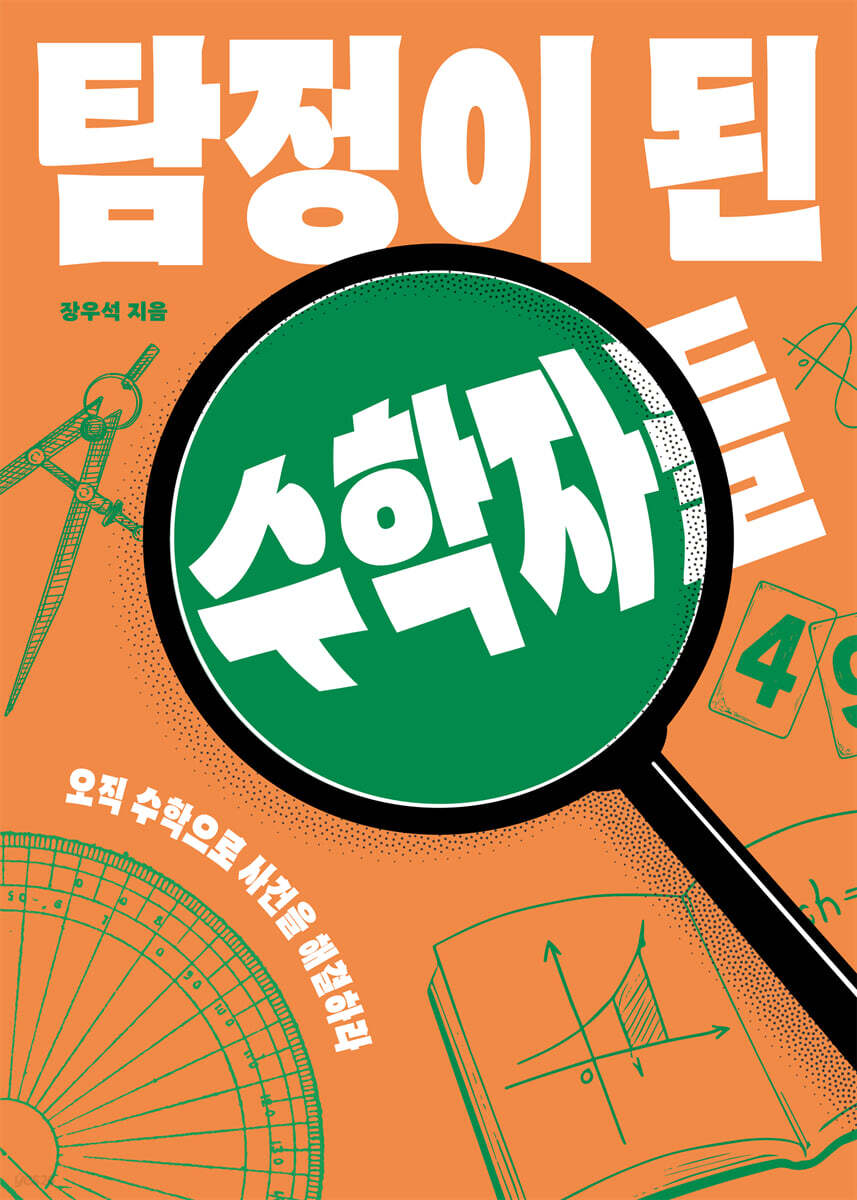
Mathematicians Who Became Detectives
 |
Description
Book Introduction
“Humans commit crimes, and mathematics solves them!”
A full-fledged mathematical mystery unfolded by great mathematicians!
"Mathematicians Who Became Detectives" is a full-fledged mathematical mystery written by a math teacher and mystery novelist, and features mathematicians from history such as Euclid, Archimedes, Galileo, Descartes, Fermat, Gauss, and Cantor as main characters.
While the events are fictional, the mathematical concepts applied to problem solving are exactly like those found in actual textbooks! While engaging and engaging like a mystery novel, you'll naturally learn important mathematical concepts like definitions, axioms, center of gravity, falling motion, coordinates, probability, mean and variance, and infinity.
This book is perfect for students who want to learn the principles of mathematics in a fun way, teachers who want to use it in their discussion classes, and readers who love detective novels.
A full-fledged mathematical mystery unfolded by great mathematicians!
"Mathematicians Who Became Detectives" is a full-fledged mathematical mystery written by a math teacher and mystery novelist, and features mathematicians from history such as Euclid, Archimedes, Galileo, Descartes, Fermat, Gauss, and Cantor as main characters.
While the events are fictional, the mathematical concepts applied to problem solving are exactly like those found in actual textbooks! While engaging and engaging like a mystery novel, you'll naturally learn important mathematical concepts like definitions, axioms, center of gravity, falling motion, coordinates, probability, mean and variance, and infinity.
This book is perfect for students who want to learn the principles of mathematics in a fun way, teachers who want to use it in their discussion classes, and readers who love detective novels.
- You can preview some of the book's contents.
Preview
index
- Prologue - Plato Seeks His Teacher
- Introducing the Math Detective
Chapter 1 [Detective Euclid] Catch the Library Thief
The Great Library of Museion, where all knowledge gathers - Justice and axioms - Things that can be thought of in the head but do not exist in reality - What is the use of learning mathematics? - Truth is equal to everyone.
+ Prove only by logic, Euclid
Chapter 2 [Detective Archimedes] Find the War Spy
The Benevolent Influence of Mathematics - In Search of the Absolute Principle of the Center of Gravity - Mathematics as a Weapon of War - The Treasure of the Nation, the Sinner of Mankind - A Roman Spy Lurks - A Truth Drew in the Sand
+ Mathematics applied to real life, Archimedes
Chapter 3 [Detective Galileo] Stop the Witch Hunt
Between Inference and Experiment - Is It a Witch or Not? - One Thing Galileo Couldn't Resolve
+ Textbook plus truth that does not support power, Galileo
Chapter 4 [Detective Descartes] Find the Missing Children
If God has light, then reason is more important to humans - What's more important than a genius mathematician - The identity of the child kidnapper - A formula invented thanks to a fly - All places are equal before numbers
+ Finding the coordinates of free thought by adding textbooks, Descartes
Chapter 5 [Detective Fermat] Obtain the Murderer's Confession
Suicide or Murder? - Math with Letters - Can You Calculate Probability? - Probability vs. Probability - Beyond 'All'
+ Fermat, the mathematical letter that inspired geniuses in addition to the curriculum
Chapter 6 [Detective Gauss] Stop the Spread of the Plague
The Earth is not a flat sheet of paper - From the funeral home to the classroom - If you graph 'chance' - This curve is strange.
+ Gauss, the eye of mathematics that found patterns in chaos
Chapter 7 [Detective Cantor] Escape from the Asylum
There are levels to infinity - A guest on a rainy night - He may not be a patient
+ Cantor, the infinite logic that turns imagination into reality
- Introducing the Math Detective
Chapter 1 [Detective Euclid] Catch the Library Thief
The Great Library of Museion, where all knowledge gathers - Justice and axioms - Things that can be thought of in the head but do not exist in reality - What is the use of learning mathematics? - Truth is equal to everyone.
+ Prove only by logic, Euclid
Chapter 2 [Detective Archimedes] Find the War Spy
The Benevolent Influence of Mathematics - In Search of the Absolute Principle of the Center of Gravity - Mathematics as a Weapon of War - The Treasure of the Nation, the Sinner of Mankind - A Roman Spy Lurks - A Truth Drew in the Sand
+ Mathematics applied to real life, Archimedes
Chapter 3 [Detective Galileo] Stop the Witch Hunt
Between Inference and Experiment - Is It a Witch or Not? - One Thing Galileo Couldn't Resolve
+ Textbook plus truth that does not support power, Galileo
Chapter 4 [Detective Descartes] Find the Missing Children
If God has light, then reason is more important to humans - What's more important than a genius mathematician - The identity of the child kidnapper - A formula invented thanks to a fly - All places are equal before numbers
+ Finding the coordinates of free thought by adding textbooks, Descartes
Chapter 5 [Detective Fermat] Obtain the Murderer's Confession
Suicide or Murder? - Math with Letters - Can You Calculate Probability? - Probability vs. Probability - Beyond 'All'
+ Fermat, the mathematical letter that inspired geniuses in addition to the curriculum
Chapter 6 [Detective Gauss] Stop the Spread of the Plague
The Earth is not a flat sheet of paper - From the funeral home to the classroom - If you graph 'chance' - This curve is strange.
+ Gauss, the eye of mathematics that found patterns in chaos
Chapter 7 [Detective Cantor] Escape from the Asylum
There are levels to infinity - A guest on a rainy night - He may not be a patient
+ Cantor, the infinite logic that turns imagination into reality
Detailed image
.jpg)
Into the book
Socrates applauded his disciple's discovery and said:
“Excellent.
It is a conclusion reached by relying on logic and reason, not on the imperfect senses of humans.
A truth that transcends time and space.
As you have shown, we all have the power of logic and reason.
Truth does not create new things.
“It is seeing something that exists but has not been seen before.”
Socrates continued speaking slowly, his voice lowering slightly.
“But what’s more important is this.
“We must never stop at mathematics.”
--- p.14~15
"You asked what use learning math is? You, the one who asked the question, are the ones who gave the answer."
The man looked puzzled.
“Mathematics is a truth so useful in life that it can be used to catch thieves.”
After finishing speaking, Euclid opened the drawer under the desk.
“As a reward for helping me with my classes, I won’t turn you over to the authorities.”
The man ran out of Museion, wearing a torn toga and clutching a few coins in his hand.
--- p.40~41
I already knew that the trajectory was a 'parabola'.
Because at that time, the parabolic principle had just been proven.
Isn't fate truly ironic?
If I hadn't studied parabolas, I wouldn't have invented the catapult that kills people with stones.
Things are progressing as if they were preparing for this war in advance.
I couldn't help but wonder if there really was such a thing as an unavoidable fate.
--- p.54~55
“That’s not evidence.
“It’s a disguise technique commonly used by witches.”
“As evidence….
"Then how about this? Try it yourself."
The moment he heard the word experiment, Torricelli realized his master's plan.
Galileo pointed with his finger to the leaning tower in the distance.
“I’m dropping her from the top of that tower.
A witch who flies around every night on a broomstick wouldn't just fall down, would it? If she were to reveal her identity and fly away, everyone here would just shoot her down with flaming arrows.
If she falls down like that, it will be proof that she is not a witch.
“Can there be a more certain verification than this?”
--- p.72
“I couldn’t see outside because I was lying down and hiding inside the carriage.
but…"
Spino said, tapping the top of his left palm.
“I used the method the director taught me last time.
I measured the time with a pulse watch.
The carriage ride took thirty minutes.
The carriage traveled at a normal speed, so if we multiply this by the carriage's average speed of 9 kilometers per hour, the distance traveled would be 4.5 kilometers.
So the white building is within a 4.5 kilometer radius of where I got on the carriage.”
“Please continue speaking.”
“After I got out from under the carriage, I immediately asked a passerby I met to confirm the time.
It was 9:20 at night.
When the carriage started, the church bell rang nine times, so my second carriage ride took a total of twenty minutes.
That is, the distance traveled is 3 kilometers.”
--- p.102~103
Fermat spoke in a low voice, clearly and distinctly.
“The possibility presented by the lawyer… For convenience, let’s call it probability.
The odds are that a woman who is assaulted by her husband will be murdered by her husband.
“Right?”
The defendant glared at the judge with a beast-like expression.
“But things are a little different now.
“The only meaningful probability here is that the cause of death of a woman who died after being beaten by her husband was the husband’s beating.”
A sneer escaped the lawyer's lips.
“Don’t play with words, Your Honor.
“What’s the difference?”
--- p.126~127
"professor.
When will this terrible disease leave us? Is it impossible to predict such a thing mathematically?”
It was a great mathematics that calculated the movement of stars and predicted the future, but it was useless against a devilish epidemic.
At least for now.
Gauss bit his lip as he looked at Tobias' empty seat.
There was an unbridgeable gap between understanding that a disease occurred according to a normal distribution and being able to eradicate that disease.
“There is no room to set foot in the hospital in my aunt’s village anymore.
It seemed like there were more patients than in our town.
It's been like that from the beginning.
Maybe my aunt….”
Something came to the old professor's mind as he watched his student swallowing his tears.
--- p.151
So, does this mean that the concept of 'all (infinite)' contains a contradiction?
Poincaré's words that set theory was a disease pierced Cantor's heart.
I believed that we could calculate infinity and reach the essence of numbers using the concept of sets… .
'If I don't solve this problem, my colleagues won't recognize me.
But… can I solve this problem? No, is this a problem anyone can solve? Or… could it be… that this is all a figment of my imagination?
--- p.171
Publisher's Review
“Humans commit crimes, and mathematics solves them!”
A full-fledged mathematical mystery unfolded by great mathematicians!
"Mathematicians Who Became Detectives" is a full-fledged mathematical mystery written by a math teacher and mystery novelist, featuring mathematicians from history such as Euclid, Archimedes, Galileo, Descartes, Fermat, Gauss, and Cantor as main characters.
While the events are fictional, the mathematical concepts applied to problem solving are exactly like those found in actual textbooks! While engaging and engaging like a mystery novel, you'll naturally learn important mathematical concepts like definitions, axioms, center of gravity, free fall, coordinates, probability, mean and variance, and infinity.
This book is perfect for students who want to learn the principles of mathematics in a fun way, teachers who want to use it in their discussion classes, and readers who love detective novels.
From book thieves to wife killers
Identify the culprit and solve the case, using only math!
In "Mathematicians Who Became Detectives," the achievements and struggles of each mathematician, transcending the historical context and limitations of their time, are vividly portrayed. Using mathematical concepts that actually appear in textbooks, readers can also participate in problem-solving.
For example, Euclid, who lectures in the Great Library of Alexandria, catches book thieves using definitions, axioms, and the construction of geometric figures.
Archimedes, who developed a catapult using the center of gravity and the parabolic principle to protect his homeland of Syracuse, uses the concepts of specific gravity and buoyancy to find a spy who damaged the catapult just before battle.
In a barbaric era when witch trials were rampant, where innocent people were accused of being witches and executed, Galileo used the principles of falling motion and uniformly accelerated motion to save a woman who had been falsely accused.
Descartes, who left his conservative homeland of France and continued his research in secret in the Netherlands, saw a fly sitting on the ceiling and invented the concept of equations for coordinates and shapes, using this to find the base of a child kidnapping ring.
Judge Fermat, who exchanged letters with the most brilliant mathematicians of his time and took mathematics as a 'hobby', proved the guilt of his wife's murderer using the concepts of probability and conditional probability.
During a time when many people were dying helplessly from an infectious disease as terrifying as the Black Death, Gauss, who was teaching students, used the concepts of average, margin of error, and normal distribution to identify the characteristics and causes of the infectious disease.
Cantor, who was obsessed with the concept of infinity and ended up in a mental hospital after losing his reputation, expands on the idea of infinite sets by solving a surreal theft case that occurred at the hospital.
The main character is a math teacher at a prestigious high school, and the sub-character is a mystery novelist?
What happens when math and literature combine?
The greatest strength of this book is its clear connection to the curriculum.
This is because it mainly covers middle school mathematics (geometric shapes, proportions, linear functions, quadratic functions, coordinate planes and graphs, probability, etc.), and also provides a taste of high school mathematics (geometric equations, conditional probability, normal distribution, sets and propositions, functions, etc.), and is connected to the concept of motion in science.
You can encounter this mathematics through 'stories' and 'detective reasoning' rather than through difficult formulas and problem solving, and it is structured so that you can organize it by including a textbook-related commentary at the end of each short story.
If you're a student tired of repetitive practice problems, this novel-like book will help you rediscover mathematical concepts.
Jang Woo-seok, the author of “To You Who Want to Give Up on Math,” “The Power of Math,” and “Mathematics, Crazy About Philosophy,” is a high school math teacher who has taught math for nearly 30 years and a mystery novelist who debuted by winning the Quarterly Mystery New Writer Award.
This unique combination of academic expertise and literary imagination makes this book even more special.
"Mathematicians Who Became Detectives" will delight not only young people who love math, but also those who are afraid of math but can't help but do it, teachers looking for teaching materials for classes and discussions, and fans of mystery novels.
Discover a new reading experience created by the combination of mathematics and reasoning!
A full-fledged mathematical mystery unfolded by great mathematicians!
"Mathematicians Who Became Detectives" is a full-fledged mathematical mystery written by a math teacher and mystery novelist, featuring mathematicians from history such as Euclid, Archimedes, Galileo, Descartes, Fermat, Gauss, and Cantor as main characters.
While the events are fictional, the mathematical concepts applied to problem solving are exactly like those found in actual textbooks! While engaging and engaging like a mystery novel, you'll naturally learn important mathematical concepts like definitions, axioms, center of gravity, free fall, coordinates, probability, mean and variance, and infinity.
This book is perfect for students who want to learn the principles of mathematics in a fun way, teachers who want to use it in their discussion classes, and readers who love detective novels.
From book thieves to wife killers
Identify the culprit and solve the case, using only math!
In "Mathematicians Who Became Detectives," the achievements and struggles of each mathematician, transcending the historical context and limitations of their time, are vividly portrayed. Using mathematical concepts that actually appear in textbooks, readers can also participate in problem-solving.
For example, Euclid, who lectures in the Great Library of Alexandria, catches book thieves using definitions, axioms, and the construction of geometric figures.
Archimedes, who developed a catapult using the center of gravity and the parabolic principle to protect his homeland of Syracuse, uses the concepts of specific gravity and buoyancy to find a spy who damaged the catapult just before battle.
In a barbaric era when witch trials were rampant, where innocent people were accused of being witches and executed, Galileo used the principles of falling motion and uniformly accelerated motion to save a woman who had been falsely accused.
Descartes, who left his conservative homeland of France and continued his research in secret in the Netherlands, saw a fly sitting on the ceiling and invented the concept of equations for coordinates and shapes, using this to find the base of a child kidnapping ring.
Judge Fermat, who exchanged letters with the most brilliant mathematicians of his time and took mathematics as a 'hobby', proved the guilt of his wife's murderer using the concepts of probability and conditional probability.
During a time when many people were dying helplessly from an infectious disease as terrifying as the Black Death, Gauss, who was teaching students, used the concepts of average, margin of error, and normal distribution to identify the characteristics and causes of the infectious disease.
Cantor, who was obsessed with the concept of infinity and ended up in a mental hospital after losing his reputation, expands on the idea of infinite sets by solving a surreal theft case that occurred at the hospital.
The main character is a math teacher at a prestigious high school, and the sub-character is a mystery novelist?
What happens when math and literature combine?
The greatest strength of this book is its clear connection to the curriculum.
This is because it mainly covers middle school mathematics (geometric shapes, proportions, linear functions, quadratic functions, coordinate planes and graphs, probability, etc.), and also provides a taste of high school mathematics (geometric equations, conditional probability, normal distribution, sets and propositions, functions, etc.), and is connected to the concept of motion in science.
You can encounter this mathematics through 'stories' and 'detective reasoning' rather than through difficult formulas and problem solving, and it is structured so that you can organize it by including a textbook-related commentary at the end of each short story.
If you're a student tired of repetitive practice problems, this novel-like book will help you rediscover mathematical concepts.
Jang Woo-seok, the author of “To You Who Want to Give Up on Math,” “The Power of Math,” and “Mathematics, Crazy About Philosophy,” is a high school math teacher who has taught math for nearly 30 years and a mystery novelist who debuted by winning the Quarterly Mystery New Writer Award.
This unique combination of academic expertise and literary imagination makes this book even more special.
"Mathematicians Who Became Detectives" will delight not only young people who love math, but also those who are afraid of math but can't help but do it, teachers looking for teaching materials for classes and discussions, and fans of mystery novels.
Discover a new reading experience created by the combination of mathematics and reasoning!
GOODS SPECIFICS
- Date of issue: September 5, 2025
- Format: Paperback book binding method guide
- Page count, weight, size: 184 pages | 308g | 152*210*10mm
- ISBN13: 9791156336990
You may also like
카테고리
korean


korean

![GQ KOREA Mark (Monthly): December [2025]](http://librairie.coreenne.fr/cdn/shop/files/8ef265dbbfbf186523ed75ba7319009d.jpg?v=1765340328&width=3840)


