

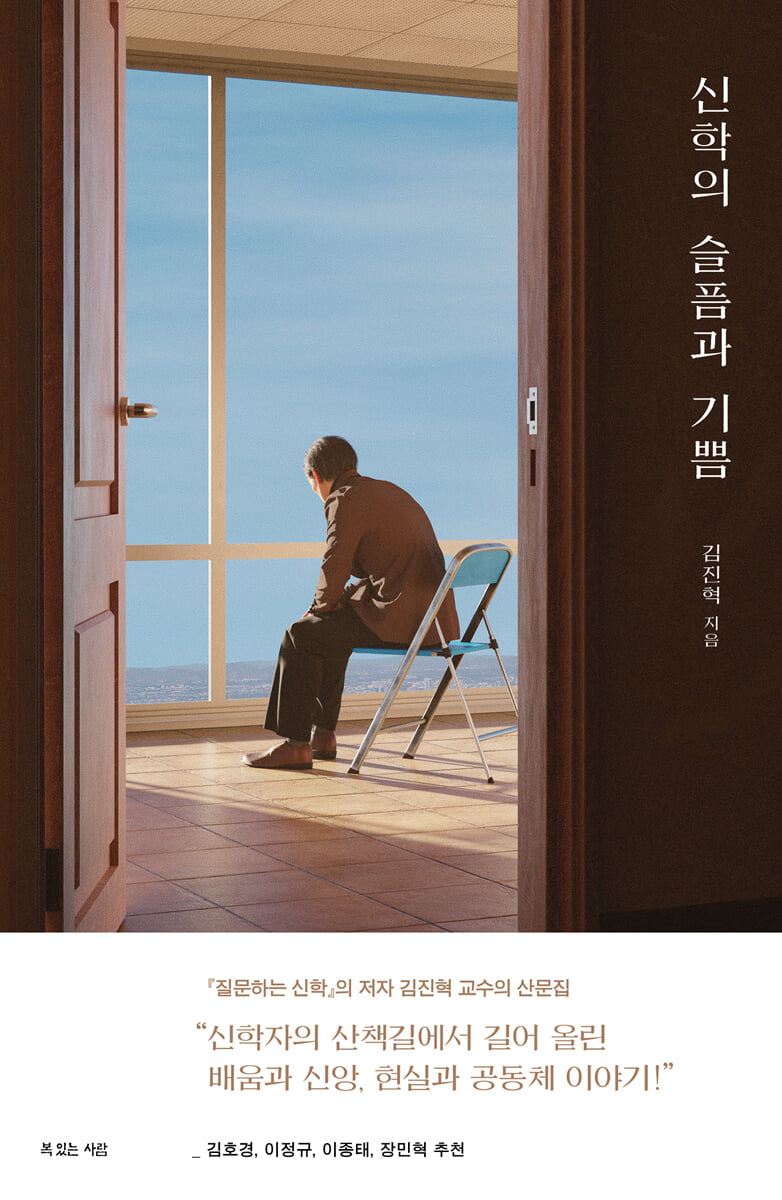
The Sorrow and Joy of Theology
 |
Description
Book Introduction
A collection of essays by Professor Jinhyeok Kim, author of "Questioning Theology"
“Stories of learning, faith, reality, and community gleaned from the theologian’s walks!”
- Recommended by Kim Ho-kyung, Lee Jeong-gyu, Lee Jong-tae, and Jang Min-hyeok
"The Sorrow and Joy of Theology" is a collection of essays written from the perspective of a theologian, reflecting the author's experiences and feelings from his daily life over the past four and a half years.
I sought to verbalize the shared emotions that arise when we look at life from the perspective of faith, and to give theological color to the wonders, joys, and sorrows of life that anyone can feel.
I approached theology from the perspective that learning is a task given to everyone, and I tried to find ways to empathize with the lives of others and read the flow of the times through theology.
Part 1 contains the sorrows and joys of theology encountered while going back and forth between the podium and daily life, as well as the inner landscapes of living as a professional and a person with a calling.
These are personal yet universal stories that allow us to feel both the weight and beauty of the discipline of theology.
Parts 2-5 cover the social realities of the COVID-19 pandemic era, the daily routine of learning and teaching, the rhythm of the seasons as Christians, and the meaning of living in community.
“Stories of learning, faith, reality, and community gleaned from the theologian’s walks!”
- Recommended by Kim Ho-kyung, Lee Jeong-gyu, Lee Jong-tae, and Jang Min-hyeok
"The Sorrow and Joy of Theology" is a collection of essays written from the perspective of a theologian, reflecting the author's experiences and feelings from his daily life over the past four and a half years.
I sought to verbalize the shared emotions that arise when we look at life from the perspective of faith, and to give theological color to the wonders, joys, and sorrows of life that anyone can feel.
I approached theology from the perspective that learning is a task given to everyone, and I tried to find ways to empathize with the lives of others and read the flow of the times through theology.
Part 1 contains the sorrows and joys of theology encountered while going back and forth between the podium and daily life, as well as the inner landscapes of living as a professional and a person with a calling.
These are personal yet universal stories that allow us to feel both the weight and beauty of the discipline of theology.
Parts 2-5 cover the social realities of the COVID-19 pandemic era, the daily routine of learning and teaching, the rhythm of the seasons as Christians, and the meaning of living in community.
- You can preview some of the book's contents.
Preview
index
prolog
Part 1 - Living as a Theologian
The Sorrows and Joys of Theology | The Theologian as a Vocation | The Pace of Theological Practice | Reading Books by Theologians | Reading Books by Theologians: Practical Edition | Between Vocation and Calling | Learning from Thielicke about Theological Practice
Part 2 - A Look into Reality and the Times
When you miss latte | Christ's footprints on the earth | It's the same whether you read it straight or backward | When a dream that had stopped begins again | When the language of faith becomes empty | A name that must not be forgotten | Why study the past | Sweat and national prestige | Oh Captain, my captain | A place where the spring breeze never stops | The stone pillar at Exit 1 of Itaewon Station | The right to post malicious comments | Loss of leisure | My life that (want to be) like a dog
Part 3 - Language for Learning and Wisdom
The Theory and Practice of Column Writing, or How to Deal with Life's Paradoxes | The 80-Year-Old Devil's Letter | G.
The Devil's Strategy Against K. Chesterton | The Sorrow and Joy of Grading | God, Noisy as a Newborn | Extreme Jobs | How Christians Use ChatGPT Wisely | How Christians Use ChatGPT Even Wiserly | How Christians Use ChatGPT Even Wiserly | An Apology for Unread Books | The Greatness and Danger of a Book | Reuniting with an Old Friend Called Dreams | The Awkwardness of the Injected Past
Part 4 - The Four Seasons: A Time to Restore the Rhythm of Faith
Just like learning a foreign language | Only as much as 'you've lived so far' | A mistranslated message | Let me read poetry in the fall | Hope is dangerous | How Christians live in December | Subtract 'more' in the new year | Are you on a diet? | An uneasy ending | Things you only see when you stop | A time of threshold
Part 5 - Community, a Space for Imagining Tomorrow
Why the world is still worth living in | The right to be a loser | The patriotism of a villain, the patriotism of a believer | Let's go to the moon | Between cruelty and surprise | Where is the center of the world | I see you | I can endure pain, but not humiliation | Longing for a fool | The politics of Lent | Busyness and corruption, or the sin of forgetting | Confidence in worship | The privilege of stepping aside in advance
Epilogue
Books and articles cited in the text
Part 1 - Living as a Theologian
The Sorrows and Joys of Theology | The Theologian as a Vocation | The Pace of Theological Practice | Reading Books by Theologians | Reading Books by Theologians: Practical Edition | Between Vocation and Calling | Learning from Thielicke about Theological Practice
Part 2 - A Look into Reality and the Times
When you miss latte | Christ's footprints on the earth | It's the same whether you read it straight or backward | When a dream that had stopped begins again | When the language of faith becomes empty | A name that must not be forgotten | Why study the past | Sweat and national prestige | Oh Captain, my captain | A place where the spring breeze never stops | The stone pillar at Exit 1 of Itaewon Station | The right to post malicious comments | Loss of leisure | My life that (want to be) like a dog
Part 3 - Language for Learning and Wisdom
The Theory and Practice of Column Writing, or How to Deal with Life's Paradoxes | The 80-Year-Old Devil's Letter | G.
The Devil's Strategy Against K. Chesterton | The Sorrow and Joy of Grading | God, Noisy as a Newborn | Extreme Jobs | How Christians Use ChatGPT Wisely | How Christians Use ChatGPT Even Wiserly | How Christians Use ChatGPT Even Wiserly | An Apology for Unread Books | The Greatness and Danger of a Book | Reuniting with an Old Friend Called Dreams | The Awkwardness of the Injected Past
Part 4 - The Four Seasons: A Time to Restore the Rhythm of Faith
Just like learning a foreign language | Only as much as 'you've lived so far' | A mistranslated message | Let me read poetry in the fall | Hope is dangerous | How Christians live in December | Subtract 'more' in the new year | Are you on a diet? | An uneasy ending | Things you only see when you stop | A time of threshold
Part 5 - Community, a Space for Imagining Tomorrow
Why the world is still worth living in | The right to be a loser | The patriotism of a villain, the patriotism of a believer | Let's go to the moon | Between cruelty and surprise | Where is the center of the world | I see you | I can endure pain, but not humiliation | Longing for a fool | The politics of Lent | Busyness and corruption, or the sin of forgetting | Confidence in worship | The privilege of stepping aside in advance
Epilogue
Books and articles cited in the text
Into the book
Theological books can be professionally classified as follows:
Very old books, old books, slightly old books, recent books, recently published books.
The history of theological books is as long as the history of theology itself, and the authors range from contemporaries of the Twelve Apostles to those living with us in the 21st century.
Therefore, when studying theology, whether as a major or a liberal arts subject, you must choose between old and new books to read.
It would be nice to try everything equally, but that's not as easy as it sounds.
Whether you read old or new books depends on your taste or your major.
For example, scholars studying patristic thought must be aware of the latest research trends, but they must also be well-versed in the patristic literature itself and its centuries-old interpretation, which inevitably means devoting considerable time and effort to older sources.
When it comes to how to worship in this era of non-face-to-face interaction, classic texts on the essence of worship are important, but we often turn to recent materials analyzing the lives of modern people.
--- p.75 From “Reading the Theologian’s Book: Practical Edition”
Still, if there's something people want to hear from theologians, it's specialized knowledge and experience rather than bread-and-butter techniques.
To become a theologian as a real profession, one must pass through several hurdles that test and verify one's expertise.
In the process, you will also develop a unique taste for feeling wonder and delight in trivial topics that are not really necessary for living in the world.
But the more I open my eyes to the world of academia, the more I feel a deep sadness that I am always inadequate as a scholar, that I am wasting my life on things that are neither popular nor practical, and that I am always falling behind the times.
According to "Science as a Vocation" by German sociologist Max Weber, those who pursue a career in science must learn to accept this sense of deficiency as their fate.
--- p.90 From “Between Occupation and Calling”
Some writers have used footprints as a key metaphor in their works.
Japanese novelist Shusaku Endo, who attempted an oriental interpretation of Christian doctrine, placed importance on the concept of sin, but found it difficult to explain the theory of sin.
The metaphor he used to overcome this difficulty was footprints.
In many of his works, he redefines sin as 'forgetting the footprints I have left on the lives of others.'
The meeting between you and me leaves each of our traces in the lives of others.
We become sinners when we fail to heed the footprints I have engraved in your life and close our eyes to the responsibility I have for you that those marks remind us of.
--- p.114 From “The Footprints of Christ on Earth”
Where there is hope, there is always the danger of hope, so the question, "How should we dream of the future?" is a challenge for all of humanity.
Hope can be dangerous when we try to achieve and possess something that is inherently unattainable through our own efforts.
On the other hand, when we experience hope as an unexpected gift even in the darkness of life, space is created in our hearts for courage and joy to dwell.
Rather than seeking hope as an abstract concept or goal, hope acts as a dynamic force within all that exists, becoming a source of joy, stability, and fulfillment for one another in our daily lives.
For this reason, I still pin my hopes on Betty Spear's one-word answer to the question of what is the secret to staying so healthy and happy even in old age.
--- p.225 From “Hope is Dangerous”
In a meritocratic society where achievement is the focus and excessive competition occurs, the word 'loser' is like a stigma that means that one is not worthy of being recognized as a human being with dignity and value.
But we do not qualify as human beings because we are well-adapted to society, efficient at work, and error-free.
We are human because we try hard and fail, we do ridiculous things and laugh awkwardly at each other, we feel hurt by repeated mistakes, and we may be embarrassed to ask for forgiveness.
In that sense, the virtue that is even more necessary in a meritocratic society is to see others as they are, not according to my personal desires or socially constructed standards.
This is difficult for humans who are accustomed to seeing the world in their own way.
Moral failures are largely due to our being caught up in our self-centered desires and our inability to see others or the world clearly.
Iris Murdoch even said, “Love is the recognition that something other than oneself exists.”
Very old books, old books, slightly old books, recent books, recently published books.
The history of theological books is as long as the history of theology itself, and the authors range from contemporaries of the Twelve Apostles to those living with us in the 21st century.
Therefore, when studying theology, whether as a major or a liberal arts subject, you must choose between old and new books to read.
It would be nice to try everything equally, but that's not as easy as it sounds.
Whether you read old or new books depends on your taste or your major.
For example, scholars studying patristic thought must be aware of the latest research trends, but they must also be well-versed in the patristic literature itself and its centuries-old interpretation, which inevitably means devoting considerable time and effort to older sources.
When it comes to how to worship in this era of non-face-to-face interaction, classic texts on the essence of worship are important, but we often turn to recent materials analyzing the lives of modern people.
--- p.75 From “Reading the Theologian’s Book: Practical Edition”
Still, if there's something people want to hear from theologians, it's specialized knowledge and experience rather than bread-and-butter techniques.
To become a theologian as a real profession, one must pass through several hurdles that test and verify one's expertise.
In the process, you will also develop a unique taste for feeling wonder and delight in trivial topics that are not really necessary for living in the world.
But the more I open my eyes to the world of academia, the more I feel a deep sadness that I am always inadequate as a scholar, that I am wasting my life on things that are neither popular nor practical, and that I am always falling behind the times.
According to "Science as a Vocation" by German sociologist Max Weber, those who pursue a career in science must learn to accept this sense of deficiency as their fate.
--- p.90 From “Between Occupation and Calling”
Some writers have used footprints as a key metaphor in their works.
Japanese novelist Shusaku Endo, who attempted an oriental interpretation of Christian doctrine, placed importance on the concept of sin, but found it difficult to explain the theory of sin.
The metaphor he used to overcome this difficulty was footprints.
In many of his works, he redefines sin as 'forgetting the footprints I have left on the lives of others.'
The meeting between you and me leaves each of our traces in the lives of others.
We become sinners when we fail to heed the footprints I have engraved in your life and close our eyes to the responsibility I have for you that those marks remind us of.
--- p.114 From “The Footprints of Christ on Earth”
Where there is hope, there is always the danger of hope, so the question, "How should we dream of the future?" is a challenge for all of humanity.
Hope can be dangerous when we try to achieve and possess something that is inherently unattainable through our own efforts.
On the other hand, when we experience hope as an unexpected gift even in the darkness of life, space is created in our hearts for courage and joy to dwell.
Rather than seeking hope as an abstract concept or goal, hope acts as a dynamic force within all that exists, becoming a source of joy, stability, and fulfillment for one another in our daily lives.
For this reason, I still pin my hopes on Betty Spear's one-word answer to the question of what is the secret to staying so healthy and happy even in old age.
--- p.225 From “Hope is Dangerous”
In a meritocratic society where achievement is the focus and excessive competition occurs, the word 'loser' is like a stigma that means that one is not worthy of being recognized as a human being with dignity and value.
But we do not qualify as human beings because we are well-adapted to society, efficient at work, and error-free.
We are human because we try hard and fail, we do ridiculous things and laugh awkwardly at each other, we feel hurt by repeated mistakes, and we may be embarrassed to ask for forgiveness.
In that sense, the virtue that is even more necessary in a meritocratic society is to see others as they are, not according to my personal desires or socially constructed standards.
This is difficult for humans who are accustomed to seeing the world in their own way.
Moral failures are largely due to our being caught up in our self-centered desires and our inability to see others or the world clearly.
Iris Murdoch even said, “Love is the recognition that something other than oneself exists.”
--- p.251 From “The Right to Be a Loser”
Publisher's Review
“This book deeply examines the pain and hope of life, awakening the strength and wisdom to live today.”
The stories you will encounter in this book contain my reflections on human existence, suffering, love, faith, and various questions of our time.
For those seeking their path in life, I hope this book offers new perspectives and insights, serving as a guide to thinking that helps them ask their own questions and find their own answers. For those contemplating the place of the church and theology, I hope it helps them reflect on the role of the church and the challenges of pastoral ministry while maintaining the essence of theology in this rapidly changing era.
Even amid the coronavirus pandemic, various disasters, wars, and climate crises, the world has proven itself to be a truly livable place.
I think the reason our hearts didn't darken during those difficult times was because the hope fostered by the Christian faith gently embraced our perspectives and language.
As long as we become books to one another, no matter how dark and harsh reality may seem, humanity remains beautiful, life remains dignified, and the world still holds hope.
The stories you will encounter in this book contain my reflections on human existence, suffering, love, faith, and various questions of our time.
For those seeking their path in life, I hope this book offers new perspectives and insights, serving as a guide to thinking that helps them ask their own questions and find their own answers. For those contemplating the place of the church and theology, I hope it helps them reflect on the role of the church and the challenges of pastoral ministry while maintaining the essence of theology in this rapidly changing era.
Even amid the coronavirus pandemic, various disasters, wars, and climate crises, the world has proven itself to be a truly livable place.
I think the reason our hearts didn't darken during those difficult times was because the hope fostered by the Christian faith gently embraced our perspectives and language.
As long as we become books to one another, no matter how dark and harsh reality may seem, humanity remains beautiful, life remains dignified, and the world still holds hope.
GOODS SPECIFICS
- Date of issue: September 3, 2025
- Page count, weight, size: 299 pages | 348g | 137*210*15mm
- ISBN13: 9791170832829
- ISBN10: 1170832822
You may also like
카테고리
korean


korean

![GQ KOREA Mark (Monthly): December [2025]](http://librairie.coreenne.fr/cdn/shop/files/8ef265dbbfbf186523ed75ba7319009d.jpg?v=1765340328&width=3840)


