

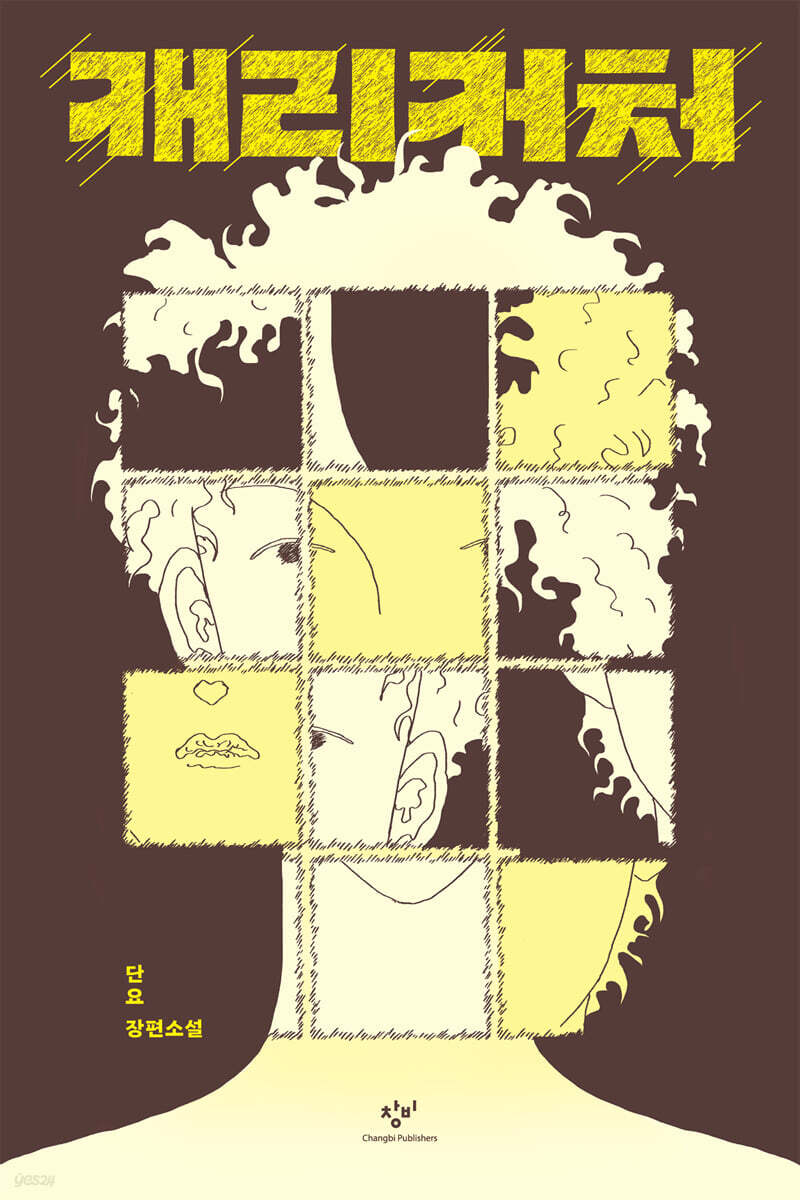
caricature
 |
Description
Book Introduction
- A word from MD
-
For those who live in fragmentsThere are people who cannot be understood unless they distort 'me'.
Danyo's latest work, "Caricature," points out the structural contradictions of Korean society through a sophisticated and sharp narrative of a minority, while vividly depicting the coming-of-age story of a youth from an immigrant background.
A voice needed right here, right now, in our society facing a new phase.
September 9, 2025. Youth PD Bae Seung-yeon
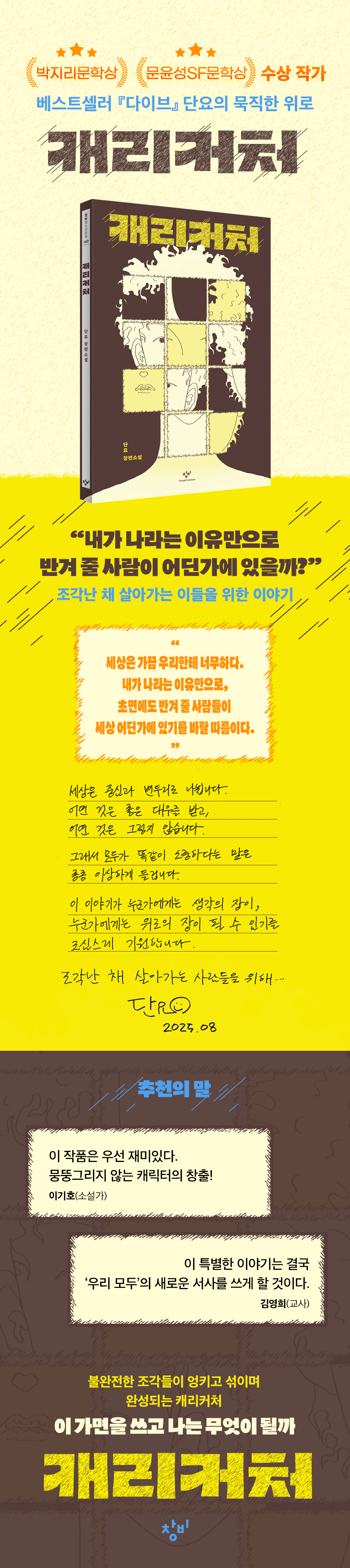
“Is there anyone out there who will welcome me just because I am me?”
A caricature made up of imperfect pieces that are tangled and mixed together.
What will I become when I wear this mask?
Danyo, who debuted in 2022 with the novel 『Dive』 and has been active in many fields, winning the Park Ji-ri Literary Award for 『This is How the World Changes』 in 2023 and the Moon Yun-seong SF Literary Award for 『The Dog's Designer』, has published her new full-length novel 『Caricature』 (Changbi Youth Literature 140).
This is the story of second-generation immigrant youth 'Joo-hyun', who experiences various human relationships and struggles with his own identity. It is an excellent depiction of a cross-section of Korean society, as if painted in detail.
Joo-Hyeon, who grew up with a Sri Lankan mother, is a high school student with strong self-esteem.
Thanks to his confident personality, he has lived a life far from bullying, but after his childhood friend Seungyoon returns from studying abroad in Australia, he begins to sense the subtle power dynamics within the school.
Joo-hyun gradually comes to realize that while 'Australia' and 'Canada' are not pronouns used to refer to someone, the term 'Southeast Asia' carries a nuance of contempt.
Where will Joo-hyun fit into Korean society? What kind of mask will he wear as he lives? "Caricature" is a masterful work that examines and diagnoses the current situation facing us as it is, adding weight to our concerns.
A caricature made up of imperfect pieces that are tangled and mixed together.
What will I become when I wear this mask?
Danyo, who debuted in 2022 with the novel 『Dive』 and has been active in many fields, winning the Park Ji-ri Literary Award for 『This is How the World Changes』 in 2023 and the Moon Yun-seong SF Literary Award for 『The Dog's Designer』, has published her new full-length novel 『Caricature』 (Changbi Youth Literature 140).
This is the story of second-generation immigrant youth 'Joo-hyun', who experiences various human relationships and struggles with his own identity. It is an excellent depiction of a cross-section of Korean society, as if painted in detail.
Joo-Hyeon, who grew up with a Sri Lankan mother, is a high school student with strong self-esteem.
Thanks to his confident personality, he has lived a life far from bullying, but after his childhood friend Seungyoon returns from studying abroad in Australia, he begins to sense the subtle power dynamics within the school.
Joo-hyun gradually comes to realize that while 'Australia' and 'Canada' are not pronouns used to refer to someone, the term 'Southeast Asia' carries a nuance of contempt.
Where will Joo-hyun fit into Korean society? What kind of mask will he wear as he lives? "Caricature" is a masterful work that examines and diagnoses the current situation facing us as it is, adding weight to our concerns.
- You can preview some of the book's contents.
Preview
index
caricature
Author's Note
Author's Note
Detailed image
Into the book
On the other hand, all the kids in this neighborhood are 'real' Korean, their dads all work in fancy offices, and their homes are always apartments.
As I thought that no matter how many times I came here, I would never get used to it, Seungyoon suddenly became a stranger.
But looking back, this unfamiliar feeling was inside me from the beginning.
--- p.17
Caring means not touching the wounds of others, and swearing is the opposite, so the more diligently a child received multicultural education, the better he or she knew how to touch the wounds of others most effectively.
--- p.22
But there is something that is particularly annoying, both then and now.
Southeast Asia and South Asia are different regions.
They are as different as the United States and Chile, or Russia and Italy.
Ms. Meena Kumaran is from Sri Lanka, so she is of South Asian descent and is now Korean.
Kim Joo-hyun was born in Korea.
But people say my mom is Southeast Asian, no matter where she actually comes from, and I hear that often.
--- p.36~37
But the truth is… I still want a real hometown.
I think it would be nice if I could stop by my country house every holiday.
It doesn't matter which country it is.
I just hope that somewhere in the world, there are people who will welcome me at first sight just because I am me.
--- p.64
I think to belong somewhere fully is to have the right not to be trapped in a caricature.
You know those humorous pictures you often see in amusement parks or unique cafes?
--- p.81
How many wounds are there that seemed like they would last a lifetime, only to suddenly vanish? Yet how many memories, seemingly insignificant yet tenacious, persist? There's no way to distinguish between the two at this point, and so what I need now is time.
--- p.125
Memory is a really strange thing.
This is because we look directly at the past with the eyes of the present and create the future again with what we see there.
Perhaps that's why I wanted to look back on this moment, leaping back through the long years, from a place I haven't yet reached.
--- p.160
There will be teenagers in the world who resemble Joohyun, Seungyoon, Yohan, and Noah, and teenagers who resemble none of them.
So, I hope this novel will also be a source of concern for those who read it.
There are two main ways to receive a novel.
One is to stand in the position of a judge who judges the characters.
Another way is to look at yourself, and by extension, the world, by asking yourself questions like, "If I were A, how would I have perceived that situation? What can I do about B? How should I respond to the wrongdoing of C? Who has the authority to determine and enforce the punishment?"
I always value the latter.
The novel has value as a fictional imitation of the real world, where the world exists not as an object of condemnation and judgment but as a dynamic of cause and effect.
Although causes do not absolve effects, nor do effects fully justify them, causality continues, weaving us all into the chain of existence.
Outside the chain, the willingness to jump into it rather than assigning points to each link is also how we understand and relate to the lives of others.
As I thought that no matter how many times I came here, I would never get used to it, Seungyoon suddenly became a stranger.
But looking back, this unfamiliar feeling was inside me from the beginning.
--- p.17
Caring means not touching the wounds of others, and swearing is the opposite, so the more diligently a child received multicultural education, the better he or she knew how to touch the wounds of others most effectively.
--- p.22
But there is something that is particularly annoying, both then and now.
Southeast Asia and South Asia are different regions.
They are as different as the United States and Chile, or Russia and Italy.
Ms. Meena Kumaran is from Sri Lanka, so she is of South Asian descent and is now Korean.
Kim Joo-hyun was born in Korea.
But people say my mom is Southeast Asian, no matter where she actually comes from, and I hear that often.
--- p.36~37
But the truth is… I still want a real hometown.
I think it would be nice if I could stop by my country house every holiday.
It doesn't matter which country it is.
I just hope that somewhere in the world, there are people who will welcome me at first sight just because I am me.
--- p.64
I think to belong somewhere fully is to have the right not to be trapped in a caricature.
You know those humorous pictures you often see in amusement parks or unique cafes?
--- p.81
How many wounds are there that seemed like they would last a lifetime, only to suddenly vanish? Yet how many memories, seemingly insignificant yet tenacious, persist? There's no way to distinguish between the two at this point, and so what I need now is time.
--- p.125
Memory is a really strange thing.
This is because we look directly at the past with the eyes of the present and create the future again with what we see there.
Perhaps that's why I wanted to look back on this moment, leaping back through the long years, from a place I haven't yet reached.
--- p.160
There will be teenagers in the world who resemble Joohyun, Seungyoon, Yohan, and Noah, and teenagers who resemble none of them.
So, I hope this novel will also be a source of concern for those who read it.
There are two main ways to receive a novel.
One is to stand in the position of a judge who judges the characters.
Another way is to look at yourself, and by extension, the world, by asking yourself questions like, "If I were A, how would I have perceived that situation? What can I do about B? How should I respond to the wrongdoing of C? Who has the authority to determine and enforce the punishment?"
I always value the latter.
The novel has value as a fictional imitation of the real world, where the world exists not as an object of condemnation and judgment but as a dynamic of cause and effect.
Although causes do not absolve effects, nor do effects fully justify them, causality continues, weaving us all into the chain of existence.
Outside the chain, the willingness to jump into it rather than assigning points to each link is also how we understand and relate to the lives of others.
--- From the main text, “Author’s Note”
Publisher's Review
“Is there anyone out there who will welcome me just because I am me?”
A caricature made up of imperfect pieces that are tangled and mixed together.
What will I become when I wear this mask?
Danyo, who debuted in 2022 with the novel 『Dive』 and has been active in many fields, winning the Park Ji-ri Literary Award for 『This is How the World Changes』 in 2023 and the Moon Yun-seong SF Literary Award for 『The Dog's Designer』, has published her new full-length novel 『Caricature』 (Changbi Youth Literature 140).
This is the story of second-generation immigrant youth 'Joo-hyun', who experiences various human relationships and struggles with his own identity. It is an excellent depiction of a cross-section of Korean society, as if painted in detail.
Joo-Hyeon, who grew up with a Sri Lankan mother, is a high school student with strong self-esteem.
Thanks to his confident personality, he has lived a life far from bullying, but after his childhood friend Seungyoon returns from studying abroad in Australia, he begins to sense the subtle power dynamics within the school.
Joo-hyun gradually comes to realize that while 'Australia' and 'Canada' are not pronouns used to refer to someone, the term 'Southeast Asia' carries a nuance of contempt.
Where will Joo-hyun fit into Korean society? What kind of mask will he wear as he lives? "Caricature" is a masterful work that examines and diagnoses the current situation facing us as it is, adding weight to our concerns.
First of all, this work is fun.
The creation of unconventional characters! I don't think I'll forget these protagonists created by Danyo for a long time.
Lee Ki-ho (novelist)
Through 『Caricature』, I first encountered a narrative for youth from a complete immigrant background, where no one is objectified.
This work, which deconstructs the structure of benefactor and beneficiary, is a delicate and sophisticated narrative of a minority.
Kim Young-hee (teacher)
All the kids in Daechi-dong are real Koreans.
What on earth is a 'real' Korean?
Recently, Joo-hyun has been attending weekend classes at the Daechi-dong academy thanks to Seung-yoon's parents' favor.
Joo-Hyeon, who went to the academy for the first time, was shocked because “the entire classroom was filled with only pure white kids” (page 14).
Most of the children who attend Daechi-dong academies live in apartments, and their parents work only in offices.
To borrow Joo-Hyeon’s words, “all the kids in this neighborhood look like ‘real’ Koreans” (p. 17).
They feel a sense of alienation towards Joo-Hyeon, but they do not approach him directly.
Meanwhile, unlike Daechi-dong, second-generation immigrant youth are often seen at Joo-hyun's school.
'Yohan', who is the same age as Joohyun, is one of them. Unlike Joohyun who has a bold personality, he has a small voice and is timid.
Joo-hyun, who is uncomfortable with Seung-yoon's attitude of calling Yohan "Southeast Asian" while taking care of him, protests, but all he gets is a reply telling her not to worry about it since it's none of her business.
Besides, now that I've tasted the privilege of teaching at Daechi-dong Academy, I can no longer express my dissatisfaction with Seungyoon.
“It’s not Southeast Asia, even though it has a good name.”
“What could be wrong?
Hey, so John is from Southeast Asia or Europe?
“Noah is just Jeong Noah.”
(…)
“Hey Inma, there must be a reason you call me that.
“Do you want to do South Asia too?” (pp. 42-43)
The reason Seungyoon treats Yohan so rudely is because there was some incident between them in the past.
But regardless of John's merits and demerits, why is it that among his numerous characteristics, the most easily attacked is his "existence"? Joo-hyun, whose mother is Sri Lankan, was born and raised in Korea and has never paid much attention to his own identity.
But I suddenly realize that the strange feeling triggered by John's problem has actually existed for a long time.
It was around the time when I was in elementary school when Seungyoon said, “When I stay still, do you really think I’m just like you?” (page 20).
Because I stay still
Do you think it's the same as you?
The uncomfortable questions become increasingly complicated as they intertwine with high school life, where one must decide on a career path.
Like any other parent, Mom wants Joo-hyun to go to medical school, but Joo-hyun can't imagine himself wearing a doctor's gown in Korea.
The future of graduating from an engineering college and getting a job at a large company is not clearly drawn.
It's not because of Joo-Hyeon's personality or grades, but because of her appearance, which seems different from that of 'real' Koreans, and her confusion about where she is from.
Even the feeling that I find it difficult to reconcile with Korea, with Koreans as individuals, and with the country itself, is part of my empty memory.
I always knew that empty hole was in me, but now I know that it is my core.
(Page 76)
Driven by a desire to know himself, Joo-Hyeon suggests the novel "The Seven Moons of Mali," which deals with the Sri Lankan civil war, as a subject for his literature assignment.
Friends who have read the novel praise Joo-Hyeon, comparing him to Prabhakaran, a commander in the Sri Lankan civil war, and calling him a "rebel commander."
Are the "Southeast Asia" that Yohan is obsessed with and the "rebel commander" that Joohyun is called essentially different? The more Joohyun receives playful, admiring glances, the more he realizes he's different from his friends.
Joohyun feels secretly happy but also ashamed.
Another thing that bothers Joo-Hyeon, who cannot define his own identity, is that Sri Lanka belongs to South Asia, not Southeast Asia.
You can't lump together Johan, who was raised by a Filipino mother and has relatives in the Philippines, Joohyun's mother, who was born in Sri Lanka but moved to Korea and has never looked back, and Joohyun, who has lived only in Korea.
However, their existence is roughly lumped together under the name of ‘immigrants’ in Korea.
Just as Seungyoon's stepfather encourages Joohyun, saying that immigrants from Southeast Asia will soon be active.
This is the role I am allowed to play
If this is the only line I can cross
What will I become… … .
A caricature is a general term for a painting depicting a face, but unlike ordinary paintings, certain parts of the face are humorously exaggerated.
When we describe a person's multiple identities, we say that they have different masks.
It is about living by changing masks depending on the community or relationship you belong to.
However, what was given to Joohyun and Yohan was not a mask, but a caricature.
Everyone lives their life explaining themselves.
But those who have caricatures rather than masks inevitably have to exaggerate or minimize something, and sometimes present themselves in a way that fits misunderstandings and prejudices, to be recognized.
Meanwhile, the ability to ponder what ‘my true self’ is becomes a luxury.
Danyo does not simply tell a story of breaking down prejudice through ‘Caricature’.
I'm just saying that there are definitely people in our society who have to live by changing caricatures.
Joohyun and Yohan are not simply victims, perpetrators, or beneficiaries.
We are humans who are constantly asked to provide 'proof of existence' that is unnecessary to some, but who have unique personalities like everyone else.
The path to the future begins with facing it head on.
Now, with facts we cannot ignore before us, "Caricature" opens the door to a noisy and complex debate.
So I believe that for the parties involved, we need a story that is more actively hateful and fearful.
(From the author's note)
A caricature made up of imperfect pieces that are tangled and mixed together.
What will I become when I wear this mask?
Danyo, who debuted in 2022 with the novel 『Dive』 and has been active in many fields, winning the Park Ji-ri Literary Award for 『This is How the World Changes』 in 2023 and the Moon Yun-seong SF Literary Award for 『The Dog's Designer』, has published her new full-length novel 『Caricature』 (Changbi Youth Literature 140).
This is the story of second-generation immigrant youth 'Joo-hyun', who experiences various human relationships and struggles with his own identity. It is an excellent depiction of a cross-section of Korean society, as if painted in detail.
Joo-Hyeon, who grew up with a Sri Lankan mother, is a high school student with strong self-esteem.
Thanks to his confident personality, he has lived a life far from bullying, but after his childhood friend Seungyoon returns from studying abroad in Australia, he begins to sense the subtle power dynamics within the school.
Joo-hyun gradually comes to realize that while 'Australia' and 'Canada' are not pronouns used to refer to someone, the term 'Southeast Asia' carries a nuance of contempt.
Where will Joo-hyun fit into Korean society? What kind of mask will he wear as he lives? "Caricature" is a masterful work that examines and diagnoses the current situation facing us as it is, adding weight to our concerns.
First of all, this work is fun.
The creation of unconventional characters! I don't think I'll forget these protagonists created by Danyo for a long time.
Lee Ki-ho (novelist)
Through 『Caricature』, I first encountered a narrative for youth from a complete immigrant background, where no one is objectified.
This work, which deconstructs the structure of benefactor and beneficiary, is a delicate and sophisticated narrative of a minority.
Kim Young-hee (teacher)
All the kids in Daechi-dong are real Koreans.
What on earth is a 'real' Korean?
Recently, Joo-hyun has been attending weekend classes at the Daechi-dong academy thanks to Seung-yoon's parents' favor.
Joo-Hyeon, who went to the academy for the first time, was shocked because “the entire classroom was filled with only pure white kids” (page 14).
Most of the children who attend Daechi-dong academies live in apartments, and their parents work only in offices.
To borrow Joo-Hyeon’s words, “all the kids in this neighborhood look like ‘real’ Koreans” (p. 17).
They feel a sense of alienation towards Joo-Hyeon, but they do not approach him directly.
Meanwhile, unlike Daechi-dong, second-generation immigrant youth are often seen at Joo-hyun's school.
'Yohan', who is the same age as Joohyun, is one of them. Unlike Joohyun who has a bold personality, he has a small voice and is timid.
Joo-hyun, who is uncomfortable with Seung-yoon's attitude of calling Yohan "Southeast Asian" while taking care of him, protests, but all he gets is a reply telling her not to worry about it since it's none of her business.
Besides, now that I've tasted the privilege of teaching at Daechi-dong Academy, I can no longer express my dissatisfaction with Seungyoon.
“It’s not Southeast Asia, even though it has a good name.”
“What could be wrong?
Hey, so John is from Southeast Asia or Europe?
“Noah is just Jeong Noah.”
(…)
“Hey Inma, there must be a reason you call me that.
“Do you want to do South Asia too?” (pp. 42-43)
The reason Seungyoon treats Yohan so rudely is because there was some incident between them in the past.
But regardless of John's merits and demerits, why is it that among his numerous characteristics, the most easily attacked is his "existence"? Joo-hyun, whose mother is Sri Lankan, was born and raised in Korea and has never paid much attention to his own identity.
But I suddenly realize that the strange feeling triggered by John's problem has actually existed for a long time.
It was around the time when I was in elementary school when Seungyoon said, “When I stay still, do you really think I’m just like you?” (page 20).
Because I stay still
Do you think it's the same as you?
The uncomfortable questions become increasingly complicated as they intertwine with high school life, where one must decide on a career path.
Like any other parent, Mom wants Joo-hyun to go to medical school, but Joo-hyun can't imagine himself wearing a doctor's gown in Korea.
The future of graduating from an engineering college and getting a job at a large company is not clearly drawn.
It's not because of Joo-Hyeon's personality or grades, but because of her appearance, which seems different from that of 'real' Koreans, and her confusion about where she is from.
Even the feeling that I find it difficult to reconcile with Korea, with Koreans as individuals, and with the country itself, is part of my empty memory.
I always knew that empty hole was in me, but now I know that it is my core.
(Page 76)
Driven by a desire to know himself, Joo-Hyeon suggests the novel "The Seven Moons of Mali," which deals with the Sri Lankan civil war, as a subject for his literature assignment.
Friends who have read the novel praise Joo-Hyeon, comparing him to Prabhakaran, a commander in the Sri Lankan civil war, and calling him a "rebel commander."
Are the "Southeast Asia" that Yohan is obsessed with and the "rebel commander" that Joohyun is called essentially different? The more Joohyun receives playful, admiring glances, the more he realizes he's different from his friends.
Joohyun feels secretly happy but also ashamed.
Another thing that bothers Joo-Hyeon, who cannot define his own identity, is that Sri Lanka belongs to South Asia, not Southeast Asia.
You can't lump together Johan, who was raised by a Filipino mother and has relatives in the Philippines, Joohyun's mother, who was born in Sri Lanka but moved to Korea and has never looked back, and Joohyun, who has lived only in Korea.
However, their existence is roughly lumped together under the name of ‘immigrants’ in Korea.
Just as Seungyoon's stepfather encourages Joohyun, saying that immigrants from Southeast Asia will soon be active.
This is the role I am allowed to play
If this is the only line I can cross
What will I become… … .
A caricature is a general term for a painting depicting a face, but unlike ordinary paintings, certain parts of the face are humorously exaggerated.
When we describe a person's multiple identities, we say that they have different masks.
It is about living by changing masks depending on the community or relationship you belong to.
However, what was given to Joohyun and Yohan was not a mask, but a caricature.
Everyone lives their life explaining themselves.
But those who have caricatures rather than masks inevitably have to exaggerate or minimize something, and sometimes present themselves in a way that fits misunderstandings and prejudices, to be recognized.
Meanwhile, the ability to ponder what ‘my true self’ is becomes a luxury.
Danyo does not simply tell a story of breaking down prejudice through ‘Caricature’.
I'm just saying that there are definitely people in our society who have to live by changing caricatures.
Joohyun and Yohan are not simply victims, perpetrators, or beneficiaries.
We are humans who are constantly asked to provide 'proof of existence' that is unnecessary to some, but who have unique personalities like everyone else.
The path to the future begins with facing it head on.
Now, with facts we cannot ignore before us, "Caricature" opens the door to a noisy and complex debate.
So I believe that for the parties involved, we need a story that is more actively hateful and fearful.
(From the author's note)
GOODS SPECIFICS
- Date of issue: August 29, 2025
- Format: Paperback book binding method guide
- Page count, weight, size: 168 pages | 267g | 140*210*10mm
- ISBN13: 9788936457402
You may also like
카테고리
korean


korean

![GQ KOREA Mark (Monthly): December [2025]](http://librairie.coreenne.fr/cdn/shop/files/8ef265dbbfbf186523ed75ba7319009d.jpg?v=1765340328&width=3840)


