

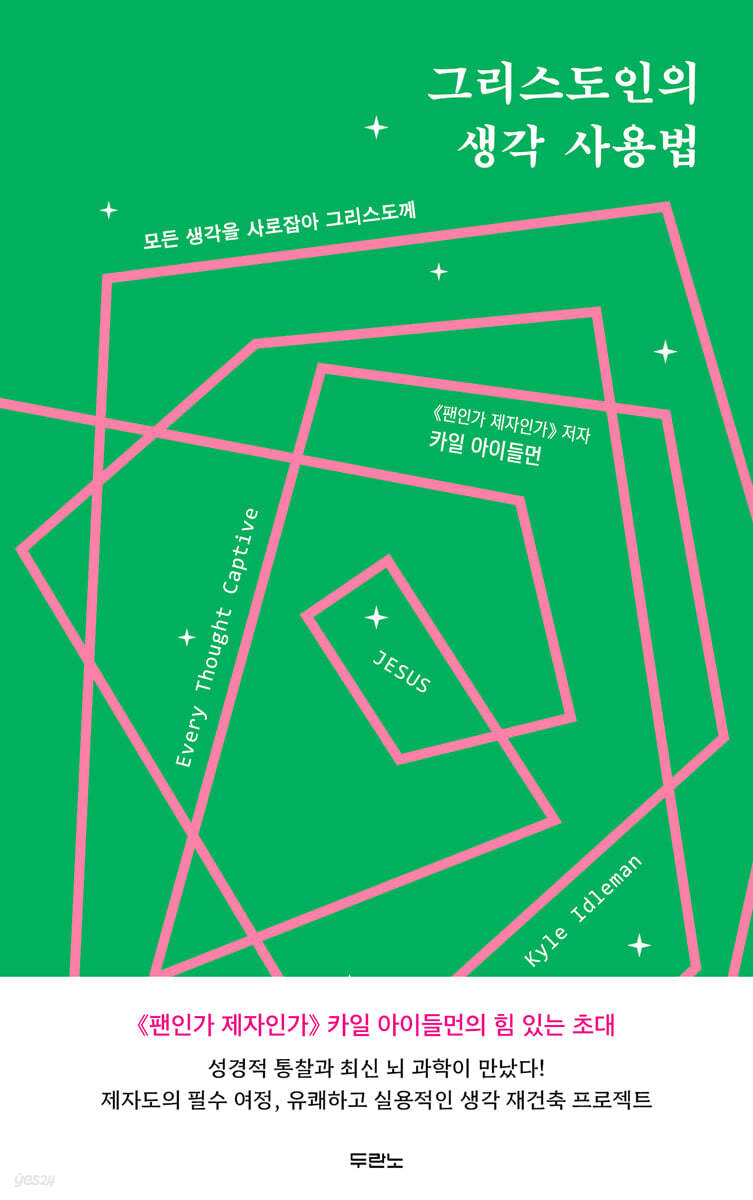
How to Use Christian Thought
 |
Description
Book Introduction
A Powerful Invitation from Kyle Idleman: "Fan or Disciple?"
Biblical insight meets cutting-edge brain science!
The Essential Journey of Discipleship: A Joyful and Practical Thinking Reconstruction Project
For those who want to break down the solid foundation within themselves
Powerful Thinking User Manual
Mental hardships like anxiety, distraction, and anger are holding modern people back and eating away at their lives.
Many people are at a loss as to what to do and fall into deeper and deeper confusion.
Moreover, even the church is helplessly watching as the world's framework dominates the believers' thoughts and shapes their lives.
How can we avoid being dragged into destructive thoughts that ruin our precious lives?
Kyle Idleman, senior pastor of Southeast Christian Church, one of America's largest churches, and best-selling author of "Fan or Disciple," has witnessed the power of "right thinking" to transform the lives of countless people, including himself.
So, I have put those precious experiences and insights into this book, How to Use the Christian Mind.
For believers who have lost and are discouraged in the battle of the mind, this book offers rich advice by brilliantly weaving together the living Bible with the latest brain science and psychology data.
Biblical insight meets cutting-edge brain science!
The Essential Journey of Discipleship: A Joyful and Practical Thinking Reconstruction Project
For those who want to break down the solid foundation within themselves
Powerful Thinking User Manual
Mental hardships like anxiety, distraction, and anger are holding modern people back and eating away at their lives.
Many people are at a loss as to what to do and fall into deeper and deeper confusion.
Moreover, even the church is helplessly watching as the world's framework dominates the believers' thoughts and shapes their lives.
How can we avoid being dragged into destructive thoughts that ruin our precious lives?
Kyle Idleman, senior pastor of Southeast Christian Church, one of America's largest churches, and best-selling author of "Fan or Disciple," has witnessed the power of "right thinking" to transform the lives of countless people, including himself.
So, I have put those precious experiences and insights into this book, How to Use the Christian Mind.
For believers who have lost and are discouraged in the battle of the mind, this book offers rich advice by brilliantly weaving together the living Bible with the latest brain science and psychology data.
- You can preview some of the book's contents.
Preview
index
prolog.
A wrestling match that everyone cannot avoid
Part 1.
The power of thought to direct life
― Life comes from the frame of your mind.
1.
Invisible frames still shape life.
2.
Building a solid foundation without knowing it
3.
What I see and hear often is powerful.
Part 2.
Five Thought Patterns That Shape Our Time
― The courage to break out of the mold the world has forced upon us.
4.
Breaking the Pattern of Anxiety
Silence the critic within you and be free in Christ.
5.
Breaking the Pattern of Distraction
Stop the hectic pace of life and rediscover the joy of focus.
6.
Breaking the Anger Pattern
Control your easily irritated mind and find peace through forgiveness.
7.
Breaking the Pattern of Pleasure
Abandon fleeting satisfaction and pursue eternal values.
8.
Breaking the Pattern of Despair
Breaking free from the shackles of distorted thinking and breaking through through prayer
Part 3.
How to Use Christian Thought
―Enrich your daily life with the help of the ‘Creator of the Heart’
9 Operation Name: Take Every Thought Captive to Christ
10 Clear Thinking Filters to Cultivate Heavenly Vision
11. Breaking the Lies Within Me Through the Proclamation of the Word
12 Lead the morning, set the direction for the day
13 Live every moment with eternity in mind
supplement.
How to write a thought journal
A wrestling match that everyone cannot avoid
Part 1.
The power of thought to direct life
― Life comes from the frame of your mind.
1.
Invisible frames still shape life.
2.
Building a solid foundation without knowing it
3.
What I see and hear often is powerful.
Part 2.
Five Thought Patterns That Shape Our Time
― The courage to break out of the mold the world has forced upon us.
4.
Breaking the Pattern of Anxiety
Silence the critic within you and be free in Christ.
5.
Breaking the Pattern of Distraction
Stop the hectic pace of life and rediscover the joy of focus.
6.
Breaking the Anger Pattern
Control your easily irritated mind and find peace through forgiveness.
7.
Breaking the Pattern of Pleasure
Abandon fleeting satisfaction and pursue eternal values.
8.
Breaking the Pattern of Despair
Breaking free from the shackles of distorted thinking and breaking through through prayer
Part 3.
How to Use Christian Thought
―Enrich your daily life with the help of the ‘Creator of the Heart’
9 Operation Name: Take Every Thought Captive to Christ
10 Clear Thinking Filters to Cultivate Heavenly Vision
11. Breaking the Lies Within Me Through the Proclamation of the Word
12 Lead the morning, set the direction for the day
13 Live every moment with eternity in mind
supplement.
How to write a thought journal
Detailed image
.jpg)
Into the book
A few years ago, my wife received a cookie cutter for Christmas.
It was a bit like a child who had just finished toilet training receiving diapers as a congratulatory gift, or a teenager who had just gotten their driver's license receiving a bicycle as a congratulatory gift.
We stored the Christmas cookie cutter we received on Christmas Day in a deep drawer where we kept our kitchen utensils and other odds and ends.
As Christmas approached the following year, we decided to get into the Christmas spirit and bake cookies for our neighbors and the elderly at the local senior center.
Then my wife remembered the cookie cutter and took it out of the drawer.
I have no doubt that the pretty shape of the leaves will really liven up the Christmas atmosphere.
As soon as I got home and saw the freshly baked cookie samples spread out on the table, I realized something important that my naive wife had missed.
Oh my! My wife made cannabis leaf-shaped cookies to celebrate the birth of our Savior.
I almost became the pastor who handed out marijuana-shaped Christmas cookies to celebrate the incarnation of Jesus.
A brief moment of dread washed over me as I checked to see if any of the marijuana-shaped cookies had made their way outside.
I imagined a news interview broadcast live in front of a local senior center.
Unconsciously, I prepared an excuse.
“We didn’t know! It wasn’t our intention at all.
“I just received a template that someone gave me!”
That's true, but regardless of our intentions or perceptions, the frame was 'clearly' shaped like a marijuana leaf.
And of course, the cookies came out exactly as they were molded.
That's exactly what a frame does.
There is power in the frame.
A mold creates what is put into it in its own shape.
The opposite never happens.
But, as with our couple's marijuana frame escapade, we're not really interested in the frames that shape our lives.
We don't really care that those frameworks ultimately shape our lives, guide our emotions, regulate our relationships, and determine our future.
--- p.23~24
A series of experiments have been conducted to see how wisely people can make decisions in a crisis.
In one experiment, participants were brought to a bathtub that was rapidly filling with water.
Their task was to empty the tub as quickly as possible, and the only tools available were teaspoons, tablespoons, and cups.
What would you do if you were a participant in this experiment?
- Scoop out the water with a teaspoon.
- Scoop out the water with a tablespoon.
- Scoop out the water into a cup.
The answer seems obvious.
In fact, most of them just picked up a cup and started frantically scooping water out of the tub.
But a few of the participants took stock of the situation, thought for a moment, and then turned off the faucet and opened the drain.
'Then' he picked up the cup and started scooping out the water.
When we're in a crisis, when life doesn't go our way, we usually reach for what seems best.
He just picks up the cup and starts scooping out the water.
But what if we're missing something that's right in front of us? What if the first step isn't changing the situation, but changing how we see it?
The wife wants a divorce because her husband cannot control his anger.
What do husbands usually do in such cases? They seek anger management counseling.
A couple is unable to pay their credit card bills.
What will this couple do? To raise some quick cash, they sell everything in the house that can be sold.
The man begins to feel chest pain.
Bad eating habits and stress eventually took their toll.
What will he do? He'll go on a diet again and cancel his gym membership.
None of these solutions are 'bad' by any means.
Rather, they are all good methods and effective in their own way.
The problem is that we focus only on behavior change.
But the problematic behavior didn't start out as an action.
Changing behavior alone will not solve the root of the problem.
--- p.74~75
It's easy to think that having more choices is always better, but constantly being overwhelmed by choices can lead you down unexpected mental paths.
Our minds become overwhelmed and distracted by the endless number of choices.
And in these situations, ‘cognitive biases’ come into play.
Cognitive biases are a type of mental shortcut our brains use to navigate complex choices.
Cognitive biases help us understand how distractions shape our thinking patterns, which in turn influence our emotions and decisions.
* Complexity bias: We prefer complex things.
Even if it is wrong or more harmful to us.
Sociologist Renata Salecl says:
“They say that the increase in choices allows us to perfectly customize our lives, but in fact, in developed countries, instead of creating more satisfaction, it increases anxiety and fosters feelings of inferiority and guilt.” Many studies have proven that having too many choices does not make our lives better, but rather makes them more confusing.
Barry Schwartz says in The Paradox of Choice:
“Choice no longer frees us, it debilitates us, even oppresses us,” said Neil Postman, adding that we are “playing ourselves to death.”
To borrow this expression, “We are so busy that we are dying.”
* Attention bias: This bias is how we filter out the many distractions placed before us.
We tend to focus on what we've been interested in in the past and ignore other options or perspectives.
* Negativity bias: We pay more attention to negative stimuli.
The distractions that capture our attention are usually those that generate worry and anxiety.
Let's take a closer look at some of the clickbait headlines that grab our attention.
It will usually have a title like this:
- 10 Everyday Foods That Are Slowly Killing You.
- Why Your Retirement Fund Could Disappear Overnight.
- Is your child hiding a dangerous secret?
* Bandwagon bias: This bias refers to our tendency to judge what to believe and value, and what to filter out, by the actions and thoughts of those around us.
--- p.122~123
Surprisingly, anger releases dopamine.
As you know, dopamine is a chemical released in the brain when we experience something pleasurable, making us feel good.
But why does anger release dopamine? The most likely explanation is that when we tell others about something that upsets us, we receive a social reward: compassion and attention.
When you get angry because someone did something unpleasant to you, your brain releases stress hormones like cortisol to respond to the threatening situation.
In the past, when everyday life was quite dangerous, this was certainly a good survival strategy.
Under the right circumstances, cortisol is an essential hormone.
This hormone helps us respond quickly and decisively, whether to fight or flee immediately.
But in non-emergency situations, even when the same chemicals are secreted, the story is different.
One side effect of cortisol is that it makes you feel 'good'.
So people can become addicted to cortisol secretion.
Some even deliberately jump into dangerous situations to secrete cortisol.
This is not the end.
Sharing your experiences with like-minded people strengthens your social bonds with them.
Then, oxytocin, called the 'love hormone', is secreted in the brain.
--- p.153~154
God cares for us, and He invites us to bring to Him anything that causes us despair.
There is power in naming it out loud.
Because this process can actually have measurable effects on our brain and emotional state.
Neuroscience research shows that putting emotions into words—a process called "affect labeling"—helps us regulate our emotional experiences.
This is similar to the process of entrusting our worries to the Lord when we pray.
This process of expressing emotions verbally activates the prefrontal cortex, which is involved in emotion regulation, while reducing activity in the amygdala.
In short, by naming our anxieties, we can shift brain activity from emotional centers to areas involved in thinking and language.
--- p.212
1.
Reconnaissance: Jack begins to pay attention to his own feelings.
You notice that you often get angry when you're stuck in traffic, when your kids are too noisy, or when your wife asks you to do housework after a hard day at work.
2.
Target Verification: Jack realizes that he often gets angry when he feels that someone is disrespecting him or is bothering him.
3.
The Stealthy Approach: The next time you're stuck in traffic and starting to get frustrated, instead of getting angry right away, Jack quietly asks:
'Where does this thought come from? How long have I been thinking this? How does this thought make me feel? When and under what circumstances does this thought most often appear?' Then, through observation, we discover these facts.
'When I get angry, I grip the steering wheel tightly.
'My jaw tightens.' When we observe a situation like this, the orbitofrontal cortex, which helps regulate emotions, is activated.
4.
Accurate Capture: Jack decides to focus on road rage.
He uses the following tools:
- Bible: Memorize Proverbs 14:29.
“He who is slow to anger has great understanding, but he who is hasty in spirit displays folly.”
- Prayer: Pray like this.
“God, I’m angry right now.
Help me to respond with patience instead of anger.”
- Truth: I try to see the situation clearly by repeating this.
'This traffic jam is not a personal attack on me.
Everyone else's schedule is also delayed.
'The car doesn't go any faster just because I'm angry.'
5.
Definitely Captivating and Redirecting: Jack changes his mind about anger.
'Those guys are holding me back!' is a chance to practice patience.
Change your mindset to 'I can use this time to pray or listen to praise'.
--- p.240~242
Jeremiah proclaims that God's mercies are new every morning.
This assurance of God's infinite and ever-new mercy is the way to lead the morning.
The word 'new' here does not mean the same kind of newness, but a completely different kind of newness.
For example, it's not like I had fried eggs yesterday morning and now I'm eating new fried eggs this morning.
I had fried eggs for breakfast yesterday, but today I'm more of a waffle person.
This is something new and different.
If you leave the cooking to God, He will never give you leftover food.
“God, what’s on the menu today?” We can wake up every morning with this anticipation.
Every day new mercies will come to us.
It's not enough to simply think about what you're saying to yourself.
You should think about what you say to yourself especially in the 'morning'.
You can say this in the morning.
'Another long and tiring day has begun.
There's so much to do, I'm sure I won't be able to finish it all.
'I know I'm going to disappoint people again.' Saying this primes your brain so that it actually unfolds that way.
If you look for something annoying, you'll find it.
Remember how confirmation bias works? When we form a belief, our brain searches for evidence to support it.
But we can begin our day by remembering God's new mercy and compassion.
Then our brains find ways to experience this kind of mercy and compassion throughout the day.
It was a bit like a child who had just finished toilet training receiving diapers as a congratulatory gift, or a teenager who had just gotten their driver's license receiving a bicycle as a congratulatory gift.
We stored the Christmas cookie cutter we received on Christmas Day in a deep drawer where we kept our kitchen utensils and other odds and ends.
As Christmas approached the following year, we decided to get into the Christmas spirit and bake cookies for our neighbors and the elderly at the local senior center.
Then my wife remembered the cookie cutter and took it out of the drawer.
I have no doubt that the pretty shape of the leaves will really liven up the Christmas atmosphere.
As soon as I got home and saw the freshly baked cookie samples spread out on the table, I realized something important that my naive wife had missed.
Oh my! My wife made cannabis leaf-shaped cookies to celebrate the birth of our Savior.
I almost became the pastor who handed out marijuana-shaped Christmas cookies to celebrate the incarnation of Jesus.
A brief moment of dread washed over me as I checked to see if any of the marijuana-shaped cookies had made their way outside.
I imagined a news interview broadcast live in front of a local senior center.
Unconsciously, I prepared an excuse.
“We didn’t know! It wasn’t our intention at all.
“I just received a template that someone gave me!”
That's true, but regardless of our intentions or perceptions, the frame was 'clearly' shaped like a marijuana leaf.
And of course, the cookies came out exactly as they were molded.
That's exactly what a frame does.
There is power in the frame.
A mold creates what is put into it in its own shape.
The opposite never happens.
But, as with our couple's marijuana frame escapade, we're not really interested in the frames that shape our lives.
We don't really care that those frameworks ultimately shape our lives, guide our emotions, regulate our relationships, and determine our future.
--- p.23~24
A series of experiments have been conducted to see how wisely people can make decisions in a crisis.
In one experiment, participants were brought to a bathtub that was rapidly filling with water.
Their task was to empty the tub as quickly as possible, and the only tools available were teaspoons, tablespoons, and cups.
What would you do if you were a participant in this experiment?
- Scoop out the water with a teaspoon.
- Scoop out the water with a tablespoon.
- Scoop out the water into a cup.
The answer seems obvious.
In fact, most of them just picked up a cup and started frantically scooping water out of the tub.
But a few of the participants took stock of the situation, thought for a moment, and then turned off the faucet and opened the drain.
'Then' he picked up the cup and started scooping out the water.
When we're in a crisis, when life doesn't go our way, we usually reach for what seems best.
He just picks up the cup and starts scooping out the water.
But what if we're missing something that's right in front of us? What if the first step isn't changing the situation, but changing how we see it?
The wife wants a divorce because her husband cannot control his anger.
What do husbands usually do in such cases? They seek anger management counseling.
A couple is unable to pay their credit card bills.
What will this couple do? To raise some quick cash, they sell everything in the house that can be sold.
The man begins to feel chest pain.
Bad eating habits and stress eventually took their toll.
What will he do? He'll go on a diet again and cancel his gym membership.
None of these solutions are 'bad' by any means.
Rather, they are all good methods and effective in their own way.
The problem is that we focus only on behavior change.
But the problematic behavior didn't start out as an action.
Changing behavior alone will not solve the root of the problem.
--- p.74~75
It's easy to think that having more choices is always better, but constantly being overwhelmed by choices can lead you down unexpected mental paths.
Our minds become overwhelmed and distracted by the endless number of choices.
And in these situations, ‘cognitive biases’ come into play.
Cognitive biases are a type of mental shortcut our brains use to navigate complex choices.
Cognitive biases help us understand how distractions shape our thinking patterns, which in turn influence our emotions and decisions.
* Complexity bias: We prefer complex things.
Even if it is wrong or more harmful to us.
Sociologist Renata Salecl says:
“They say that the increase in choices allows us to perfectly customize our lives, but in fact, in developed countries, instead of creating more satisfaction, it increases anxiety and fosters feelings of inferiority and guilt.” Many studies have proven that having too many choices does not make our lives better, but rather makes them more confusing.
Barry Schwartz says in The Paradox of Choice:
“Choice no longer frees us, it debilitates us, even oppresses us,” said Neil Postman, adding that we are “playing ourselves to death.”
To borrow this expression, “We are so busy that we are dying.”
* Attention bias: This bias is how we filter out the many distractions placed before us.
We tend to focus on what we've been interested in in the past and ignore other options or perspectives.
* Negativity bias: We pay more attention to negative stimuli.
The distractions that capture our attention are usually those that generate worry and anxiety.
Let's take a closer look at some of the clickbait headlines that grab our attention.
It will usually have a title like this:
- 10 Everyday Foods That Are Slowly Killing You.
- Why Your Retirement Fund Could Disappear Overnight.
- Is your child hiding a dangerous secret?
* Bandwagon bias: This bias refers to our tendency to judge what to believe and value, and what to filter out, by the actions and thoughts of those around us.
--- p.122~123
Surprisingly, anger releases dopamine.
As you know, dopamine is a chemical released in the brain when we experience something pleasurable, making us feel good.
But why does anger release dopamine? The most likely explanation is that when we tell others about something that upsets us, we receive a social reward: compassion and attention.
When you get angry because someone did something unpleasant to you, your brain releases stress hormones like cortisol to respond to the threatening situation.
In the past, when everyday life was quite dangerous, this was certainly a good survival strategy.
Under the right circumstances, cortisol is an essential hormone.
This hormone helps us respond quickly and decisively, whether to fight or flee immediately.
But in non-emergency situations, even when the same chemicals are secreted, the story is different.
One side effect of cortisol is that it makes you feel 'good'.
So people can become addicted to cortisol secretion.
Some even deliberately jump into dangerous situations to secrete cortisol.
This is not the end.
Sharing your experiences with like-minded people strengthens your social bonds with them.
Then, oxytocin, called the 'love hormone', is secreted in the brain.
--- p.153~154
God cares for us, and He invites us to bring to Him anything that causes us despair.
There is power in naming it out loud.
Because this process can actually have measurable effects on our brain and emotional state.
Neuroscience research shows that putting emotions into words—a process called "affect labeling"—helps us regulate our emotional experiences.
This is similar to the process of entrusting our worries to the Lord when we pray.
This process of expressing emotions verbally activates the prefrontal cortex, which is involved in emotion regulation, while reducing activity in the amygdala.
In short, by naming our anxieties, we can shift brain activity from emotional centers to areas involved in thinking and language.
--- p.212
1.
Reconnaissance: Jack begins to pay attention to his own feelings.
You notice that you often get angry when you're stuck in traffic, when your kids are too noisy, or when your wife asks you to do housework after a hard day at work.
2.
Target Verification: Jack realizes that he often gets angry when he feels that someone is disrespecting him or is bothering him.
3.
The Stealthy Approach: The next time you're stuck in traffic and starting to get frustrated, instead of getting angry right away, Jack quietly asks:
'Where does this thought come from? How long have I been thinking this? How does this thought make me feel? When and under what circumstances does this thought most often appear?' Then, through observation, we discover these facts.
'When I get angry, I grip the steering wheel tightly.
'My jaw tightens.' When we observe a situation like this, the orbitofrontal cortex, which helps regulate emotions, is activated.
4.
Accurate Capture: Jack decides to focus on road rage.
He uses the following tools:
- Bible: Memorize Proverbs 14:29.
“He who is slow to anger has great understanding, but he who is hasty in spirit displays folly.”
- Prayer: Pray like this.
“God, I’m angry right now.
Help me to respond with patience instead of anger.”
- Truth: I try to see the situation clearly by repeating this.
'This traffic jam is not a personal attack on me.
Everyone else's schedule is also delayed.
'The car doesn't go any faster just because I'm angry.'
5.
Definitely Captivating and Redirecting: Jack changes his mind about anger.
'Those guys are holding me back!' is a chance to practice patience.
Change your mindset to 'I can use this time to pray or listen to praise'.
--- p.240~242
Jeremiah proclaims that God's mercies are new every morning.
This assurance of God's infinite and ever-new mercy is the way to lead the morning.
The word 'new' here does not mean the same kind of newness, but a completely different kind of newness.
For example, it's not like I had fried eggs yesterday morning and now I'm eating new fried eggs this morning.
I had fried eggs for breakfast yesterday, but today I'm more of a waffle person.
This is something new and different.
If you leave the cooking to God, He will never give you leftover food.
“God, what’s on the menu today?” We can wake up every morning with this anticipation.
Every day new mercies will come to us.
It's not enough to simply think about what you're saying to yourself.
You should think about what you say to yourself especially in the 'morning'.
You can say this in the morning.
'Another long and tiring day has begun.
There's so much to do, I'm sure I won't be able to finish it all.
'I know I'm going to disappoint people again.' Saying this primes your brain so that it actually unfolds that way.
If you look for something annoying, you'll find it.
Remember how confirmation bias works? When we form a belief, our brain searches for evidence to support it.
But we can begin our day by remembering God's new mercy and compassion.
Then our brains find ways to experience this kind of mercy and compassion throughout the day.
--- p.329~330
Publisher's Review
If you don't capture the thought,
Thoughts will take hold of you.
Breaking the destructive thought patterns that have shaped our times
Biblical, neuroscientific, and emotional solutions!
Discern the material of thoughts that enter your mind every day,
Learn to think like the Kingdom of God.
“Do not conform to the pattern of this world, but be transformed by the renewing of your mind” (Romans 12:2).
The author closely analyzes five thought patterns that typify our times and introduces ways to break free from these worldly frameworks and change the way we think, empowered by the power of God who created our hearts.
Begin with this book the practice of surrendering all your thoughts to Christ, who is able to renew you.
Make full use of the brain's God-designed capabilities.
Rewire your brain's neural networks and open new paths of thought aligned with your values through proven practices suggested by the author, such as writing a thought journal and special operations to capture your thoughts.
Now, enter into the full and vibrant life you've been longing for!
Thoughts will take hold of you.
Breaking the destructive thought patterns that have shaped our times
Biblical, neuroscientific, and emotional solutions!
Discern the material of thoughts that enter your mind every day,
Learn to think like the Kingdom of God.
“Do not conform to the pattern of this world, but be transformed by the renewing of your mind” (Romans 12:2).
The author closely analyzes five thought patterns that typify our times and introduces ways to break free from these worldly frameworks and change the way we think, empowered by the power of God who created our hearts.
Begin with this book the practice of surrendering all your thoughts to Christ, who is able to renew you.
Make full use of the brain's God-designed capabilities.
Rewire your brain's neural networks and open new paths of thought aligned with your values through proven practices suggested by the author, such as writing a thought journal and special operations to capture your thoughts.
Now, enter into the full and vibrant life you've been longing for!
GOODS SPECIFICS
- Date of issue: August 13, 2025
- Page count, weight, size: 376 pages | 480g | 135*215*24mm
- ISBN13: 9788953151444
- ISBN10: 8953151449
You may also like
카테고리
korean


korean

![GQ KOREA Mark (Monthly): December [2025]](http://librairie.coreenne.fr/cdn/shop/files/8ef265dbbfbf186523ed75ba7319009d.jpg?v=1765340328&width=3840)


