

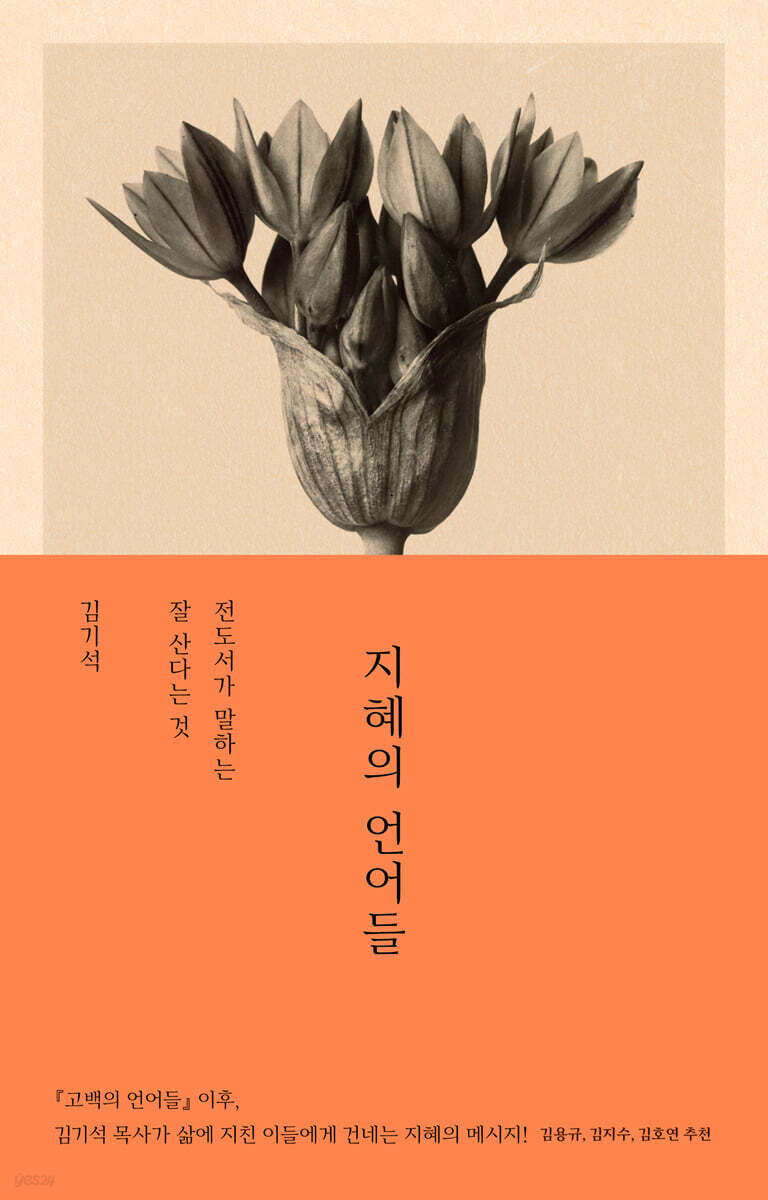
Languages of Wisdom
 |
Description
Book Introduction
After 『Languages of Confession』,
Pastor Kim Ki-seok's message of wisdom to those weary of life!
― Recommended by Kim Ho-yeon of "Inconvenient Convenience Store," Kim Ji-soo of "Interstellar," and philosopher Kim Yong-gyu
“The reason why we must read Ecclesiastes today is
It is to reflect on the reality of our lives.
Ecclesiastes is not depressing.
Rather, it is pleasant.
Because it sets us free.
Regardless of the world's evaluation, each person's life is precious.
Who is happy?
These are the people who discover the eternal brilliance embedded in everyday life.
Ecclesiastes invites us into that world.”
Church was a strange place to me.
I was gripped by an uncontrollable sense of futility, and I prayed that I could escape the river of futility by briefly immersing myself in the church's liveliness.
The phrase “positive thinking” was often heard in the pulpit.
Faith was always coupled with the slogan, "You can do it," and success and happiness seemed like goals that could be achieved at any time if you put your mind to it.
But I was strangely unable to get into that discourse.
It may be because I could not ignore the shadows or darkness that permeate the abyss of life.
Whenever I am struck by the futility of worldly affairs, whenever I meet people who judge others arbitrarily by the standards of their own convictions, I recite to myself the verse, “Vanity of vanities, all is vanity” (Ecclesiastes 1:2).
The word 'vain' has nothing to do with a cynical worldview.
Awareness of futility reminds us that nothing we cling to in this world is worthy of our complete attachment.
This is not to say that you should give up your desires.
Desire is the driving force of life.
But desire cannot be fulfilled.
The fruit of life that those who live a life of desire reap is hardship.
The reason we must read Ecclesiastes today is to reflect on the reality of our lives.
Ecclesiastes is not depressing.
Rather, it is pleasant.
Because it sets us free.
While we worship speed and efficiency and push ourselves to extreme competition to achieve results, our inner selves have become a silent field.
Time is not a commodity to be used to achieve life's goals, but a gift from heaven to be lived to the fullest.
When we perceive time as a gift, the colorless everyday life suddenly transforms into a world of wonder.
This book, "Languages of Wisdom," is a reorganization of the entire text of Ecclesiastes 1-12, which was taught at the CBS Bible School, focusing on twenty-four key words such as wisdom, time, relationships, and practice.
I hope this book will be a source of comfort and encouragement to those who are weary of life and those who blame themselves for being left behind in the competition.
Pastor Kim Ki-seok's message of wisdom to those weary of life!
― Recommended by Kim Ho-yeon of "Inconvenient Convenience Store," Kim Ji-soo of "Interstellar," and philosopher Kim Yong-gyu
“The reason why we must read Ecclesiastes today is
It is to reflect on the reality of our lives.
Ecclesiastes is not depressing.
Rather, it is pleasant.
Because it sets us free.
Regardless of the world's evaluation, each person's life is precious.
Who is happy?
These are the people who discover the eternal brilliance embedded in everyday life.
Ecclesiastes invites us into that world.”
Church was a strange place to me.
I was gripped by an uncontrollable sense of futility, and I prayed that I could escape the river of futility by briefly immersing myself in the church's liveliness.
The phrase “positive thinking” was often heard in the pulpit.
Faith was always coupled with the slogan, "You can do it," and success and happiness seemed like goals that could be achieved at any time if you put your mind to it.
But I was strangely unable to get into that discourse.
It may be because I could not ignore the shadows or darkness that permeate the abyss of life.
Whenever I am struck by the futility of worldly affairs, whenever I meet people who judge others arbitrarily by the standards of their own convictions, I recite to myself the verse, “Vanity of vanities, all is vanity” (Ecclesiastes 1:2).
The word 'vain' has nothing to do with a cynical worldview.
Awareness of futility reminds us that nothing we cling to in this world is worthy of our complete attachment.
This is not to say that you should give up your desires.
Desire is the driving force of life.
But desire cannot be fulfilled.
The fruit of life that those who live a life of desire reap is hardship.
The reason we must read Ecclesiastes today is to reflect on the reality of our lives.
Ecclesiastes is not depressing.
Rather, it is pleasant.
Because it sets us free.
While we worship speed and efficiency and push ourselves to extreme competition to achieve results, our inner selves have become a silent field.
Time is not a commodity to be used to achieve life's goals, but a gift from heaven to be lived to the fullest.
When we perceive time as a gift, the colorless everyday life suddenly transforms into a world of wonder.
This book, "Languages of Wisdom," is a reorganization of the entire text of Ecclesiastes 1-12, which was taught at the CBS Bible School, focusing on twenty-four key words such as wisdom, time, relationships, and practice.
I hope this book will be a source of comfort and encouragement to those who are weary of life and those who blame themselves for being left behind in the competition.
- You can preview some of the book's contents.
Preview
index
introduction
Part 1: Gazing into the Abyss of Nothingness
Lecture 1 [Question] Is Life Meaningless? | 1:1-7
Second Lecture [Wisdom] The More Wisdom You Have, the More Afflictions You Have | 1:8-18
Lecture 3 [Pleasure] Pleasure is Futile | 2:1-11
Lecture Four [Finite]: Facing the Limits of Death | 2:12-17
Lecture 5 [Purpose] What is the purpose of this effort? | 2:18-26
Part 2 Under the Shadow of Eternity
Lecture Six [Time] The Beauty of Living in Time | 3:1-8
Lecture Seven [Eternity] The Heart that Longs for Eternity | 3:9-15
Lecture Eight: [Existence] Humans and Beasts Are Common | 3:16-22
Lecture Nine [Relationships] Oppression, Toil, and Friendship | 4:1-12
Lecture Ten [Awe] Fear God | 4:13-5:7
Lecture Eleven [Enjoyment] Living in the Present | 5:8-20
Part 3: Wandering through the Maze of Wisdom
Lecture Twelfth [Deprivation] The Tragedy of a Life Unfulfilled | 6:1-9
Lecture 13 [Reflection] What is a Better Life? | 6:10-7:10
Lecture Fourteen [Trouble] Reflect on Difficult Days | 7:11-18
Lecture Fifteen [Loss] Losing Simplicity | 7:19-29
Lecture Sixteen [Discernment] Who is Wise? | 8:1-8
Part 4: Finding Providence in a Sea of Absurdity
Lecture Seventeen [Light and Shadow] The Wicked and the Righteous | 8:9-17
Lecture Eighteen [Providence] All Is in God's Hands | 9:1-10
Lecture 19 [Paradox] Facing the Absurdity of Life | 9:11-18
Lecture 20 [Difference] The Wise and the Foolish | 10:1-11
Lecture Twenty-First [Direction] Between Foolishness and Wisdom | 10:12-20
Part 5: Illuminating Life with the Light of Awe
Lecture Twenty-Second [Practice] Living Wisely | 11:1-8
Lecture Twenty-Third [Memory] Lessons for Youth | 11:9-12:8
Lecture Twenty-Four [Duty] Fear God | 12:9-14
Part 1: Gazing into the Abyss of Nothingness
Lecture 1 [Question] Is Life Meaningless? | 1:1-7
Second Lecture [Wisdom] The More Wisdom You Have, the More Afflictions You Have | 1:8-18
Lecture 3 [Pleasure] Pleasure is Futile | 2:1-11
Lecture Four [Finite]: Facing the Limits of Death | 2:12-17
Lecture 5 [Purpose] What is the purpose of this effort? | 2:18-26
Part 2 Under the Shadow of Eternity
Lecture Six [Time] The Beauty of Living in Time | 3:1-8
Lecture Seven [Eternity] The Heart that Longs for Eternity | 3:9-15
Lecture Eight: [Existence] Humans and Beasts Are Common | 3:16-22
Lecture Nine [Relationships] Oppression, Toil, and Friendship | 4:1-12
Lecture Ten [Awe] Fear God | 4:13-5:7
Lecture Eleven [Enjoyment] Living in the Present | 5:8-20
Part 3: Wandering through the Maze of Wisdom
Lecture Twelfth [Deprivation] The Tragedy of a Life Unfulfilled | 6:1-9
Lecture 13 [Reflection] What is a Better Life? | 6:10-7:10
Lecture Fourteen [Trouble] Reflect on Difficult Days | 7:11-18
Lecture Fifteen [Loss] Losing Simplicity | 7:19-29
Lecture Sixteen [Discernment] Who is Wise? | 8:1-8
Part 4: Finding Providence in a Sea of Absurdity
Lecture Seventeen [Light and Shadow] The Wicked and the Righteous | 8:9-17
Lecture Eighteen [Providence] All Is in God's Hands | 9:1-10
Lecture 19 [Paradox] Facing the Absurdity of Life | 9:11-18
Lecture 20 [Difference] The Wise and the Foolish | 10:1-11
Lecture Twenty-First [Direction] Between Foolishness and Wisdom | 10:12-20
Part 5: Illuminating Life with the Light of Awe
Lecture Twenty-Second [Practice] Living Wisely | 11:1-8
Lecture Twenty-Third [Memory] Lessons for Youth | 11:9-12:8
Lecture Twenty-Four [Duty] Fear God | 12:9-14
Detailed image

Into the book
Compared to the past, the world has become more materially abundant, but the space for the mind is shrinking.
Everyone pursues happiness, but not everyone enjoys it.
Obsession with happiness actually hinders happiness.
We've lost the quiet time to reflect on our lives as we try to adapt to a world that pushes us forward at an unmanageable pace.
Everyone is out of breath, floating in that short-lived illusion of information flashing.
There aren't many things that last.
I always think that happiness is somewhere in the future or somewhere other than here.
Because we are so focused on pursuing the mirage-like image of happiness, we are unable to live faithfully in the ‘here and now.’
The reason we must read Ecclesiastes today is to reflect on the reality of our lives.
Ecclesiastes is not depressing.
Rather, it is pleasant.
Because it sets us free.
While we worship speed and efficiency and push ourselves to extreme competition to achieve results, our inner selves have become a silent field.
Time is not a commodity to be used to achieve life's goals, but a gift from heaven to be lived to the fullest.
When we perceive time as a gift, the colorless everyday life suddenly transforms into a world of wonder.
--- From the "Preface"
Ecclesiastes 2 begins with the words, “I said to my heart” (Ecclesiastes 2:1).
A person is a being who relates to himself in this way.
'Self-relevance' is the essence of human nature.
Hannah Arendt says that humans have the ability to talk to themselves.
Even all reasoning is said to be 'a conversation between me and myself'.
Another way to say this is 'reflection'.
“Man shall not live by bread alone, but by every word that comes from the mouth of God” (Matthew 4:4) is one of the verses we often memorize.
The human act of eating rice or bread is for the flesh.
But for a human to become human, eating alone is not enough.
Only when we find ‘meaning’ or ‘reward’ do we become truly human.
In short, my life must be meaningful and I must find fulfillment in what I do.
For example, can we say, "I'll eat five bowls of rice today" and then actually do it, and still feel fulfilled? Reward and meaning arise when we become meaningful to someone, when we respond to someone's needs—in other words, in our relationships with others.
In my relationships with people, I find fulfillment and meaning when I help someone or respond to their needs.
That is how human nature is formed.
--- From "The Third Lecture [Pleasure] Pleasure is also vain"
“No one knows what will happen in the future. Who can teach them what will happen in the future?
“No one has authority over the wind to control it, or over the day of death; no one can escape the time of war; evil cannot deliver its inhabitants” (Ecclesiastes 8:7-8).
Humans are finite.
You can't predict the future.
Anything can happen.
No one can say that the misfortunes that are rampant in the world are unrelated to them.
Looking at how you live now can give you an idea of what you will be like in 5 or 10 years, but that's just a prediction.
There are many times when unexpected events intervene and change the course of our lives.
Humans only move forward little by little, leaning forward toward an unknown future.
I don't know what the end of that road is.
If life is like that, does that mean there's nothing we can control? No.
You can't just live your life carelessly just because you don't know.
We must live each day faithfully, one day connected to eternity.
In his poem “How to Walk in the Wind,” poet Lee Jeong-ha says that life would not be possible without the wind blowing.
He says that living is not about waiting for the wind to die down, but about pushing forward through the wind.
That is the courage of being.
--- From the sixteenth lecture [Discernment] Who is a wise person?
Danish philosopher Søren Kierkegaard said, “The sickness unto death is despair.”
A state of hopelessness is a disease that leads to death.
There is only one way for us to avoid such fatal despair.
It's about becoming someone who is needed by someone.
The existence of others is the basis of our humanity.
It seems foolish to say, “I need your help” to someone who is desperate and ready to die.
But those words are powerful.
As I said before, the best way to avoid despair is to be needed by someone.
I take the saying, "Cast your bread on the water," to mean, "Become someone who is needed."
When you do good deeds, there are times when your feelings get hurt.
There are quite a few people who do not genuinely accept the good intentions of others.
Although I didn't do it with the expectation of a reward, it's a bit unsettling to see people taking kindness for granted.
It may seem natural to feel that way, but in reality it is because our giving was not done in perfect love.
We need grace from above to be able to share beautiful things based on love, even when they treat us coldly.
Those who receive it are often hurt too.
The curious attitude of the giver, the sympathetic eyes, the proud faces of those who have done good deeds, leave a deep shadow on the souls of the receivers.
More effort is needed to give well.
--- From "Lecture 22 [Practice] A Wise Life"
When a difficult problem comes up, it might be a good idea to say something like this:
“Oh, this is a little heavy.
It's not easy to handle.
But I am much bigger than this problem.” Even if the path is not visible now, we must endure the times of despair while holding on to the hope that we will eventually find a way.
When you go from a bright place to a dark place, you can't see anything at first.
After a while, your eyes will gradually adjust and you will start to see something.
A problem that is difficult to solve on my own is placed before me like a rock.
I try to move it, but it doesn't budge.
Then most people just give up.
Is there really no way to move that rock? There is.
As you break the rock into small pieces and remove each small part, even the rock that seemed solid begins to shake.
Everyone pursues happiness, but not everyone enjoys it.
Obsession with happiness actually hinders happiness.
We've lost the quiet time to reflect on our lives as we try to adapt to a world that pushes us forward at an unmanageable pace.
Everyone is out of breath, floating in that short-lived illusion of information flashing.
There aren't many things that last.
I always think that happiness is somewhere in the future or somewhere other than here.
Because we are so focused on pursuing the mirage-like image of happiness, we are unable to live faithfully in the ‘here and now.’
The reason we must read Ecclesiastes today is to reflect on the reality of our lives.
Ecclesiastes is not depressing.
Rather, it is pleasant.
Because it sets us free.
While we worship speed and efficiency and push ourselves to extreme competition to achieve results, our inner selves have become a silent field.
Time is not a commodity to be used to achieve life's goals, but a gift from heaven to be lived to the fullest.
When we perceive time as a gift, the colorless everyday life suddenly transforms into a world of wonder.
--- From the "Preface"
Ecclesiastes 2 begins with the words, “I said to my heart” (Ecclesiastes 2:1).
A person is a being who relates to himself in this way.
'Self-relevance' is the essence of human nature.
Hannah Arendt says that humans have the ability to talk to themselves.
Even all reasoning is said to be 'a conversation between me and myself'.
Another way to say this is 'reflection'.
“Man shall not live by bread alone, but by every word that comes from the mouth of God” (Matthew 4:4) is one of the verses we often memorize.
The human act of eating rice or bread is for the flesh.
But for a human to become human, eating alone is not enough.
Only when we find ‘meaning’ or ‘reward’ do we become truly human.
In short, my life must be meaningful and I must find fulfillment in what I do.
For example, can we say, "I'll eat five bowls of rice today" and then actually do it, and still feel fulfilled? Reward and meaning arise when we become meaningful to someone, when we respond to someone's needs—in other words, in our relationships with others.
In my relationships with people, I find fulfillment and meaning when I help someone or respond to their needs.
That is how human nature is formed.
--- From "The Third Lecture [Pleasure] Pleasure is also vain"
“No one knows what will happen in the future. Who can teach them what will happen in the future?
“No one has authority over the wind to control it, or over the day of death; no one can escape the time of war; evil cannot deliver its inhabitants” (Ecclesiastes 8:7-8).
Humans are finite.
You can't predict the future.
Anything can happen.
No one can say that the misfortunes that are rampant in the world are unrelated to them.
Looking at how you live now can give you an idea of what you will be like in 5 or 10 years, but that's just a prediction.
There are many times when unexpected events intervene and change the course of our lives.
Humans only move forward little by little, leaning forward toward an unknown future.
I don't know what the end of that road is.
If life is like that, does that mean there's nothing we can control? No.
You can't just live your life carelessly just because you don't know.
We must live each day faithfully, one day connected to eternity.
In his poem “How to Walk in the Wind,” poet Lee Jeong-ha says that life would not be possible without the wind blowing.
He says that living is not about waiting for the wind to die down, but about pushing forward through the wind.
That is the courage of being.
--- From the sixteenth lecture [Discernment] Who is a wise person?
Danish philosopher Søren Kierkegaard said, “The sickness unto death is despair.”
A state of hopelessness is a disease that leads to death.
There is only one way for us to avoid such fatal despair.
It's about becoming someone who is needed by someone.
The existence of others is the basis of our humanity.
It seems foolish to say, “I need your help” to someone who is desperate and ready to die.
But those words are powerful.
As I said before, the best way to avoid despair is to be needed by someone.
I take the saying, "Cast your bread on the water," to mean, "Become someone who is needed."
When you do good deeds, there are times when your feelings get hurt.
There are quite a few people who do not genuinely accept the good intentions of others.
Although I didn't do it with the expectation of a reward, it's a bit unsettling to see people taking kindness for granted.
It may seem natural to feel that way, but in reality it is because our giving was not done in perfect love.
We need grace from above to be able to share beautiful things based on love, even when they treat us coldly.
Those who receive it are often hurt too.
The curious attitude of the giver, the sympathetic eyes, the proud faces of those who have done good deeds, leave a deep shadow on the souls of the receivers.
More effort is needed to give well.
--- From "Lecture 22 [Practice] A Wise Life"
When a difficult problem comes up, it might be a good idea to say something like this:
“Oh, this is a little heavy.
It's not easy to handle.
But I am much bigger than this problem.” Even if the path is not visible now, we must endure the times of despair while holding on to the hope that we will eventually find a way.
When you go from a bright place to a dark place, you can't see anything at first.
After a while, your eyes will gradually adjust and you will start to see something.
A problem that is difficult to solve on my own is placed before me like a rock.
I try to move it, but it doesn't budge.
Then most people just give up.
Is there really no way to move that rock? There is.
As you break the rock into small pieces and remove each small part, even the rock that seemed solid begins to shake.
--- From "Lesson 23 [Memory] Lessons for the Young"
GOODS SPECIFICS
- Date of issue: June 25, 2025
- Page count, weight, size: 355 pages | 137*214*30mm
- ISBN13: 9791170832713
- ISBN10: 1170832717
You may also like
카테고리
korean


korean

![GQ KOREA Mark (Monthly): December [2025]](http://librairie.coreenne.fr/cdn/shop/files/8ef265dbbfbf186523ed75ba7319009d.jpg?v=1765340328&width=3840)


