

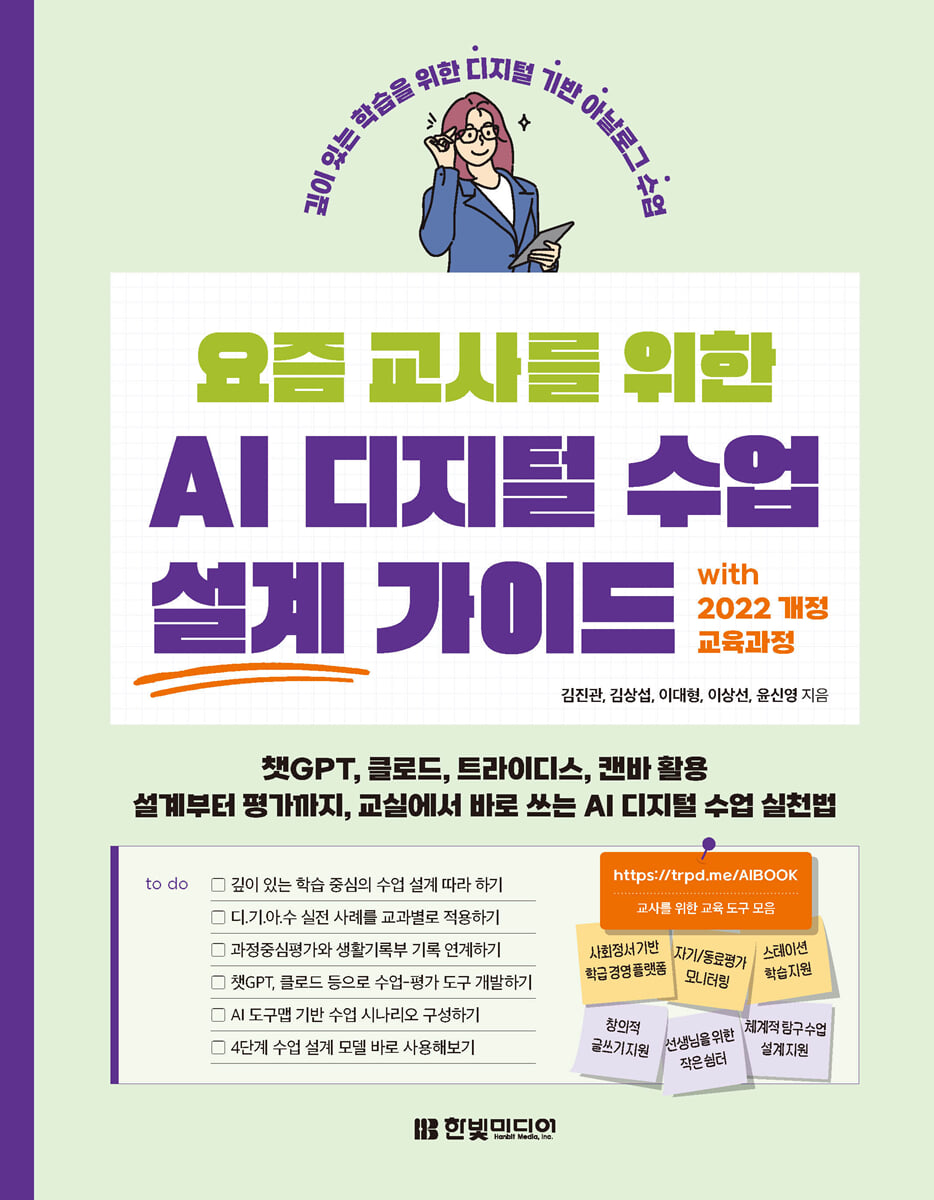
A Guide to Designing AI-Based Digital Classrooms for Today's Teachers with the 2022 Revised Curriculum
 |
Description
Book Introduction
Stop listing technologies. A guide to real lesson design where educational philosophy and AI meet.
Includes practical application know-how, including writing textbooks using generative AI and developing customized tools.
Self-developed lesson design templates, learning support tools, and assessment tool platform linkage (https://trpd.me/AIBOOK)
This book goes beyond a simple introduction to technology; it offers practical solutions for implementing the in-depth learning, concept-based inquiry-based learning, and process-centered assessment required by the 2022 revised curriculum in the classroom.
This book provides practical examples of integrating various generative AI and digital tools, such as ChatGPT, Claude, Trydis, Google Spreadsheets, and Canva, into the context of the class, for each subject, and also provides tools and platforms developed by the author himself (trpd.me/AIBOOK).
Even teachers unfamiliar with technology or vaguely familiar with AI will learn through this book that "AI is not changing the classroom, but rather how teachers can integrate AI into their classes."
Includes practical application know-how, including writing textbooks using generative AI and developing customized tools.
Self-developed lesson design templates, learning support tools, and assessment tool platform linkage (https://trpd.me/AIBOOK)
This book goes beyond a simple introduction to technology; it offers practical solutions for implementing the in-depth learning, concept-based inquiry-based learning, and process-centered assessment required by the 2022 revised curriculum in the classroom.
This book provides practical examples of integrating various generative AI and digital tools, such as ChatGPT, Claude, Trydis, Google Spreadsheets, and Canva, into the context of the class, for each subject, and also provides tools and platforms developed by the author himself (trpd.me/AIBOOK).
Even teachers unfamiliar with technology or vaguely familiar with AI will learn through this book that "AI is not changing the classroom, but rather how teachers can integrate AI into their classes."
- You can preview some of the book's contents.
Preview
index
Part 01: Understanding Digital-Based Education Innovation and the Future Curriculum
01.
Future-oriented curriculum, the 2022 revised curriculum
- Background and Major Changes of the 2022 Revised Curriculum
- In-depth learning and concept-based inquiry learning
02.
Why do analog classes need digital technology?
- Understanding digital-based education innovation policies
- The meaning and necessity of digital-based analog classes (D.G.I.A.S.)
Part 02 Understanding Digital-Based Analog Classes
01.
Understanding Digital-Based Analog Classes
- The direction of digital-based analog classes from a learning science perspective
- Correcting misconceptions about digital-based analog classes
- Establishing principles for digital-based analog classes
02.
How should we design digital-based analog classes?
- A framework for designing digital-based analog classes
- Follow the digital-based analog class design
Part 03: AI-Based Digital Class Design, Evaluation, and Recordkeeping
01. Customized class design and operation plan using AI digital tools
- What is the key to utilizing AI digital tools?
02.
Leveraging Math and AI Digital Tools - Personalized Learning and Process-Centric Assessment
Designing AI-based digital classes to empower learners
03.
Utilizing AI Digital Tools in the Korean Language Department - Customized Learning and Process-Centered Assessment
- Completing digital-based course design, AI-powered feedback, and process-centered evaluation.
04.
Leveraging Science and AI Digital Tools for Deep Learning and Process-Centric Assessment
- Sophisticated design meets digital tools, leading to knowledge transfer.
- The ultimate goal of learning: deep understanding
- Concept-based inquiry learning that involves questioning and discovery
- The four-stage learning flow: Exploration → Internalization → Utilization → Reflection
- Application of backward design principles starting from the goal
A Window into the Learning Process: Process-Centered Evaluation in Practice
- Leveraging AI digital tools to accelerate learning.
- Outline of specific lesson design
- Into the class
05.
Leveraging AI Digital Tools in Social Studies: In-Depth Learning and Process-Centric Assessment
- We are connected, thinking about a sustainable global village.
- Designing classes and assessments for in-depth learning
- Into the class
- Coming out of class
06. Recording Process-Centric Assessments Using AI Digital Tools
- Leveraging AI digital tools - Providing feedback for student growth
- Utilizing AI digital tools - Writing detailed academic skills and special skills in the student record book
Part 04: Developing AI-Based Teaching and Evaluation Tools
01.
Developing No-Code Classroom and Assessment Tools with Generative AI
- Examining ChatGPT's GPTs and Claude's Artifacts
- Developing a class-assessment tool using ChatGPT's GPTs.
- Developing a class-assessment tool using Claude's Artifact
02. Developing AI-powered teaching and assessment tools
- Coding Basics Using Generative AI (Chat GPT, Cloud) Chat Services
Development of a customized teaching and assessment tool using generative AI, Google Spreadsheets, and Google Apps Script (GAS).
- Develop and deploy a customized class-evaluation web app using generative AI APIs.
01.
Future-oriented curriculum, the 2022 revised curriculum
- Background and Major Changes of the 2022 Revised Curriculum
- In-depth learning and concept-based inquiry learning
02.
Why do analog classes need digital technology?
- Understanding digital-based education innovation policies
- The meaning and necessity of digital-based analog classes (D.G.I.A.S.)
Part 02 Understanding Digital-Based Analog Classes
01.
Understanding Digital-Based Analog Classes
- The direction of digital-based analog classes from a learning science perspective
- Correcting misconceptions about digital-based analog classes
- Establishing principles for digital-based analog classes
02.
How should we design digital-based analog classes?
- A framework for designing digital-based analog classes
- Follow the digital-based analog class design
Part 03: AI-Based Digital Class Design, Evaluation, and Recordkeeping
01. Customized class design and operation plan using AI digital tools
- What is the key to utilizing AI digital tools?
02.
Leveraging Math and AI Digital Tools - Personalized Learning and Process-Centric Assessment
Designing AI-based digital classes to empower learners
03.
Utilizing AI Digital Tools in the Korean Language Department - Customized Learning and Process-Centered Assessment
- Completing digital-based course design, AI-powered feedback, and process-centered evaluation.
04.
Leveraging Science and AI Digital Tools for Deep Learning and Process-Centric Assessment
- Sophisticated design meets digital tools, leading to knowledge transfer.
- The ultimate goal of learning: deep understanding
- Concept-based inquiry learning that involves questioning and discovery
- The four-stage learning flow: Exploration → Internalization → Utilization → Reflection
- Application of backward design principles starting from the goal
A Window into the Learning Process: Process-Centered Evaluation in Practice
- Leveraging AI digital tools to accelerate learning.
- Outline of specific lesson design
- Into the class
05.
Leveraging AI Digital Tools in Social Studies: In-Depth Learning and Process-Centric Assessment
- We are connected, thinking about a sustainable global village.
- Designing classes and assessments for in-depth learning
- Into the class
- Coming out of class
06. Recording Process-Centric Assessments Using AI Digital Tools
- Leveraging AI digital tools - Providing feedback for student growth
- Utilizing AI digital tools - Writing detailed academic skills and special skills in the student record book
Part 04: Developing AI-Based Teaching and Evaluation Tools
01.
Developing No-Code Classroom and Assessment Tools with Generative AI
- Examining ChatGPT's GPTs and Claude's Artifacts
- Developing a class-assessment tool using ChatGPT's GPTs.
- Developing a class-assessment tool using Claude's Artifact
02. Developing AI-powered teaching and assessment tools
- Coding Basics Using Generative AI (Chat GPT, Cloud) Chat Services
Development of a customized teaching and assessment tool using generative AI, Google Spreadsheets, and Google Apps Script (GAS).
- Develop and deploy a customized class-evaluation web app using generative AI APIs.
Detailed image

Publisher's Review
While maintaining the teacher's educational philosophy
A practical guide to strategically integrating AI tools into the entire teaching, assessment, and documentation process.
》One, expanding the design of real classes not found in textbooks with digital technology.
Based on the concept of 'D.I.G.A.S.U.', we present teaching strategies that reflect the teacher's educational philosophy and context, rather than simply using tools.
For each subject, we focused on practical applications to understand how AI tools and class flow are connected.
》Two, AI as a teacher's assistant, a way to utilize technology to preserve the essence of class.
We design our lessons based on principles of learning science (e.g., dual encoding, retrieval practice, cognitive load theory) to ensure that digital technology complements, rather than replaces, analog instruction.
》3. Integrated class operation that connects to evaluation and recording
We provide an integrated workflow that includes digital portfolios, drafting of special lecture notes using ChatGPT, and automated feedback tools, all leading to post-class evaluation and documentation.
》Net, a personalized teaching tool created by the teacher
Includes no-code hands-on training courses for creating teaching tools without coding, including GPTs, Artifacts, Google Spreadsheets + GAS, and API integration.
We guide you to develop your teaching skills as a ‘creator.’
A practical guide to strategically integrating AI tools into the entire teaching, assessment, and documentation process.
》One, expanding the design of real classes not found in textbooks with digital technology.
Based on the concept of 'D.I.G.A.S.U.', we present teaching strategies that reflect the teacher's educational philosophy and context, rather than simply using tools.
For each subject, we focused on practical applications to understand how AI tools and class flow are connected.
》Two, AI as a teacher's assistant, a way to utilize technology to preserve the essence of class.
We design our lessons based on principles of learning science (e.g., dual encoding, retrieval practice, cognitive load theory) to ensure that digital technology complements, rather than replaces, analog instruction.
》3. Integrated class operation that connects to evaluation and recording
We provide an integrated workflow that includes digital portfolios, drafting of special lecture notes using ChatGPT, and automated feedback tools, all leading to post-class evaluation and documentation.
》Net, a personalized teaching tool created by the teacher
Includes no-code hands-on training courses for creating teaching tools without coding, including GPTs, Artifacts, Google Spreadsheets + GAS, and API integration.
We guide you to develop your teaching skills as a ‘creator.’
GOODS SPECIFICS
- Date of issue: August 20, 2025
- Page count, weight, size: 296 pages | 183*235*12mm
- ISBN13: 9791169214216
- ISBN10: 1169214215
You may also like
카테고리
korean


korean

![GQ KOREA Mark (Monthly): December [2025]](http://librairie.coreenne.fr/cdn/shop/files/8ef265dbbfbf186523ed75ba7319009d.jpg?v=1765340328&width=3840)


