

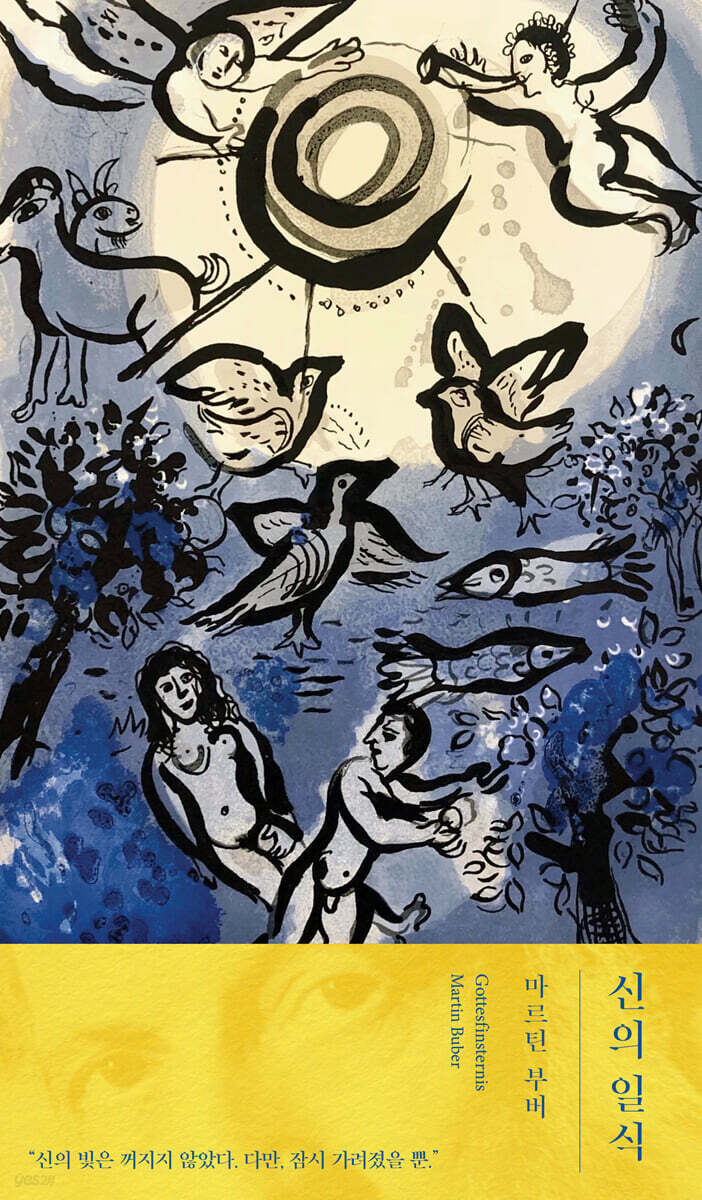
God's Eclipse
 |
Description
Book Introduction
"The light of God has not gone out.
However, it was only covered for a moment."
The most problematic word in all human languages, ‘God’,
Martin Buber throws himself into the struggle to reclaim that name.
We live in an age of God's absence.
Today, literature, philosophy, and even theology are all competing to call for humans to live without God and make their own decisions.
However, losing God, the foundation and reason for human existence, is the same as losing everything.
In the end, humans, who had lost everything, were reduced to the miserable state of wandering outside the door, following the god.
The title of this book, “Eclipse of God,” is a message in itself.
It is a meaningful message in an age that speaks of the absence of God.
“God is not non-existent, but invisible to our eyes.
“What stands between God and us?” Martin Buber diagnoses this era not as the ‘death of God’ but as the ‘eclipse of God.’
Just as the sun still burns, though its light is temporarily obscured by the moon, so God is still in heaven and we are on earth (Ecclesiastes 5:2).
The absence of God was the most powerful spiritual question for Jews who experienced the Holocaust as a national ordeal.
In this book, Buber wrestles with numerous philosophers and masters of thought, and in his own words testifies to the presence of God, whom we meet as “you.”
It illuminates the path for those wandering in the darkness of an age where God is hidden.
The light of God never fades, and we find hope in this beautiful and moving story from Buber that we can encounter it again.
However, it was only covered for a moment."
The most problematic word in all human languages, ‘God’,
Martin Buber throws himself into the struggle to reclaim that name.
We live in an age of God's absence.
Today, literature, philosophy, and even theology are all competing to call for humans to live without God and make their own decisions.
However, losing God, the foundation and reason for human existence, is the same as losing everything.
In the end, humans, who had lost everything, were reduced to the miserable state of wandering outside the door, following the god.
The title of this book, “Eclipse of God,” is a message in itself.
It is a meaningful message in an age that speaks of the absence of God.
“God is not non-existent, but invisible to our eyes.
“What stands between God and us?” Martin Buber diagnoses this era not as the ‘death of God’ but as the ‘eclipse of God.’
Just as the sun still burns, though its light is temporarily obscured by the moon, so God is still in heaven and we are on earth (Ecclesiastes 5:2).
The absence of God was the most powerful spiritual question for Jews who experienced the Holocaust as a national ordeal.
In this book, Buber wrestles with numerous philosophers and masters of thought, and in his own words testifies to the presence of God, whom we meet as “you.”
It illuminates the path for those wandering in the darkness of an age where God is hidden.
The light of God never fades, and we find hope in this beautiful and moving story from Buber that we can encounter it again.
- You can preview some of the book's contents.
Preview
index
Introduction ─ 07
Preface: Report on Two Conversations ─11
Religion and Reality ─23
Religion and Philosophy ─49
Love for God and the Idea of God ─87
Religion and Modern Thought ─113
Religion and Ethics ─157
On the Suspension of Ethics ─185
God and the Human Spirit ─197
Appendix: Response to Jung's Objections ─211
Week ─218
Translator's Note: The Eternal You, or Why God Is Invisible ─222
Preface: Report on Two Conversations ─11
Religion and Reality ─23
Religion and Philosophy ─49
Love for God and the Idea of God ─87
Religion and Modern Thought ─113
Religion and Ethics ─157
On the Suspension of Ethics ─185
God and the Human Spirit ─197
Appendix: Response to Jung's Objections ─211
Week ─218
Translator's Note: The Eternal You, or Why God Is Invisible ─222
Into the book
I'm going to tell you a story about two conversations.
One of them seemed to end naturally like any other conversation, but in fact it did not end properly.
Another one was a seemingly interrupted conversation, but it reached a level of completion that is hard to find in other conversations.
Both conversations were struggles over God, his concept, and his name.
But the method was quite different.
--- From "Preface: Report on Two Conversations"
The divine that humans actually encounter in their lives does not float above magic, but penetrates that magic.
Anyone who limits the existence of God to the function of producing something does not know the real world we live in today.
A world where contradictions burn everywhere, a world where salvation is yearned for everywhere.
The darkening of the sun in the sky, the eclipse of God, is a characteristic of the 'world time' (Weltstunde) in which we now live.
However, this is not a process that can be fully understood based on the various changes that have occurred in the human mind.
The fact that the sun is covered and darkened is something that happened between the sun and our eyes, not something that happened to the sun.
Philosophy does not believe that we are beings who cannot see God.
What philosophy points out is that, especially today, we lack a mental state that would make it possible for 'God and the gods' to reappear, for sublime images to resurface and pass by.
But if something happens between heaven and earth as it is now, and we insist on finding the ability to explain the mystery within our worldly thinking (Erdendenken), we will end up going wrong.
The transcendent reality, the vivid and vibrant reality, the being that confronts us, who does not try to endure it as such, is contributing to the eclipse phenomenon on the human side.
--- From "Religion and Reality"
All religious reality begins with what the religion of the Bible calls “the fear of God” (Gottesfurcht).
It is the existence between birth and death that becomes something terrifying and unfathomable.
All that is certain and safe is shaken by mystery.
The mystery is not a relative mystery.
It is not a mystery yet to be recognized, but an essential mystery that is in principle solvable, though it is simply beyond the grasp of human cognitive abilities.
It is a mystery whose essence is that it cannot be uncovered.
--- From "Religion and Philosophy"
Where people love the Absolute, there ideas are abolished.
Because the absolute there is not the 'absolute' that is the object of philosophical study.
The philosopher must realize this and confess it.
The Bible commands humans to love God with their emotions (Deut. 6:5, 10:12, 11:1).
Only in this context is it commanded to love the stranger who is my fellow traveler (Deut. 10:19).
If I love God, then through my love for God, I can love even those whom He loves.
As soon as I get to know Him, I can actually want to love that God.
--- From “Love for God and the Idea of God”
What if God is not the purest essence of the Other, but the absoluteness of that Other? What if the relationship between me and the Other is not primarily one of subject and object, but of "I" and "you"? Naturally, no empirical Other can be my "you," Du.
The empirical other becomes 'it' Es and becomes the object for me.
I do the same to him.
But this is not the case with the absolute Other, my absolute counterpart (Gegenuber), the indefinable and indefinable X, whom I call 'God'.
God can never be an object (Gegenstand) to me.
My relationship to Him can only be the relationship of 'me' to the eternal 'you'.
--- From "Religion and Modern Thought"
In all past ages, the image of the Absolute was built into the chamber of the human mind.
Sometimes faint, sometimes clear, often inaccurate, but nevertheless true, images that seemed fleeting, like images that appeared for a moment in a dream, yet that nevertheless bore the mark of eternity.
Although the presence of that image was not sufficient, as long as a person kept it concretely within himself and lived, he could rely solely on that presence to avoid being deceived by the deception of various voices.
--- From "On the Suspension of Ethics"
We say that God is being shrouded in darkness (Gottesfinsternis) right now. What does that mean? In using this metaphor, we presuppose the following terrifying truth.
The fact that we can look up to God with our 'eyes of the soul' (Geistesauge) (more precisely, with the eyes of our essence [Wesensauge]).
It's like we can look at the sun with our physical eyes.
It is also true that just as something can come between the earth and the sun, so too can something come between our existence and His existence.
We also assume that there exists a gaze that looks at the essence.
There is a gaze that is not tainted by any illusion, a gaze that presents no image, yet makes all images possible.
In this world, only faith has the status to discern such a gaze.
This is not something that can be proven, it can only be experienced.
Humans have experienced it.
But there is another thing, that is, the thing that gets caught in between, and that is what today's human beings are experiencing.
Since I became aware of it, I have been talking about the matter in as much detail as my knowledge allows.
However, the me in the 'I-it' relationship and the me in the 'I-you' relationship are not the same me.
There is a 'me' that regards the beings around us as objects of observation, objects of planning and use, and also objects of rescue and support.
On the other hand, there is the 'I' who devotes his whole being to facing another being and entering into an essential relationship with it.
The two 'I's' speak and act as different selves.
I exist as another me.
One of them seemed to end naturally like any other conversation, but in fact it did not end properly.
Another one was a seemingly interrupted conversation, but it reached a level of completion that is hard to find in other conversations.
Both conversations were struggles over God, his concept, and his name.
But the method was quite different.
--- From "Preface: Report on Two Conversations"
The divine that humans actually encounter in their lives does not float above magic, but penetrates that magic.
Anyone who limits the existence of God to the function of producing something does not know the real world we live in today.
A world where contradictions burn everywhere, a world where salvation is yearned for everywhere.
The darkening of the sun in the sky, the eclipse of God, is a characteristic of the 'world time' (Weltstunde) in which we now live.
However, this is not a process that can be fully understood based on the various changes that have occurred in the human mind.
The fact that the sun is covered and darkened is something that happened between the sun and our eyes, not something that happened to the sun.
Philosophy does not believe that we are beings who cannot see God.
What philosophy points out is that, especially today, we lack a mental state that would make it possible for 'God and the gods' to reappear, for sublime images to resurface and pass by.
But if something happens between heaven and earth as it is now, and we insist on finding the ability to explain the mystery within our worldly thinking (Erdendenken), we will end up going wrong.
The transcendent reality, the vivid and vibrant reality, the being that confronts us, who does not try to endure it as such, is contributing to the eclipse phenomenon on the human side.
--- From "Religion and Reality"
All religious reality begins with what the religion of the Bible calls “the fear of God” (Gottesfurcht).
It is the existence between birth and death that becomes something terrifying and unfathomable.
All that is certain and safe is shaken by mystery.
The mystery is not a relative mystery.
It is not a mystery yet to be recognized, but an essential mystery that is in principle solvable, though it is simply beyond the grasp of human cognitive abilities.
It is a mystery whose essence is that it cannot be uncovered.
--- From "Religion and Philosophy"
Where people love the Absolute, there ideas are abolished.
Because the absolute there is not the 'absolute' that is the object of philosophical study.
The philosopher must realize this and confess it.
The Bible commands humans to love God with their emotions (Deut. 6:5, 10:12, 11:1).
Only in this context is it commanded to love the stranger who is my fellow traveler (Deut. 10:19).
If I love God, then through my love for God, I can love even those whom He loves.
As soon as I get to know Him, I can actually want to love that God.
--- From “Love for God and the Idea of God”
What if God is not the purest essence of the Other, but the absoluteness of that Other? What if the relationship between me and the Other is not primarily one of subject and object, but of "I" and "you"? Naturally, no empirical Other can be my "you," Du.
The empirical other becomes 'it' Es and becomes the object for me.
I do the same to him.
But this is not the case with the absolute Other, my absolute counterpart (Gegenuber), the indefinable and indefinable X, whom I call 'God'.
God can never be an object (Gegenstand) to me.
My relationship to Him can only be the relationship of 'me' to the eternal 'you'.
--- From "Religion and Modern Thought"
In all past ages, the image of the Absolute was built into the chamber of the human mind.
Sometimes faint, sometimes clear, often inaccurate, but nevertheless true, images that seemed fleeting, like images that appeared for a moment in a dream, yet that nevertheless bore the mark of eternity.
Although the presence of that image was not sufficient, as long as a person kept it concretely within himself and lived, he could rely solely on that presence to avoid being deceived by the deception of various voices.
--- From "On the Suspension of Ethics"
We say that God is being shrouded in darkness (Gottesfinsternis) right now. What does that mean? In using this metaphor, we presuppose the following terrifying truth.
The fact that we can look up to God with our 'eyes of the soul' (Geistesauge) (more precisely, with the eyes of our essence [Wesensauge]).
It's like we can look at the sun with our physical eyes.
It is also true that just as something can come between the earth and the sun, so too can something come between our existence and His existence.
We also assume that there exists a gaze that looks at the essence.
There is a gaze that is not tainted by any illusion, a gaze that presents no image, yet makes all images possible.
In this world, only faith has the status to discern such a gaze.
This is not something that can be proven, it can only be experienced.
Humans have experienced it.
But there is another thing, that is, the thing that gets caught in between, and that is what today's human beings are experiencing.
Since I became aware of it, I have been talking about the matter in as much detail as my knowledge allows.
However, the me in the 'I-it' relationship and the me in the 'I-you' relationship are not the same me.
There is a 'me' that regards the beings around us as objects of observation, objects of planning and use, and also objects of rescue and support.
On the other hand, there is the 'I' who devotes his whole being to facing another being and entering into an essential relationship with it.
The two 'I's' speak and act as different selves.
I exist as another me.
--- From "God and the Human Spirit"
Publisher's Review
characteristic
- A book that summarizes Martin Buber's theology, philosophy, and thought after "I and Thou"
-In an age where God is conceptualized, we emphasize a personal encounter with God.
- A book that shows the direction of existence toward God, the true self, to modern people who are lost between philosophy and religion.
Target audience
- Pastors, seminarians, and readers of Christian humanities interested in a deep dialogue between faith and philosophy
-Christians who ponder existentially about the existence of God, their relationship with God, and the essence of faith.
- Those who are concerned about and wish to restore their faith in an age where the absence of God is felt.
- A book that summarizes Martin Buber's theology, philosophy, and thought after "I and Thou"
-In an age where God is conceptualized, we emphasize a personal encounter with God.
- A book that shows the direction of existence toward God, the true self, to modern people who are lost between philosophy and religion.
Target audience
- Pastors, seminarians, and readers of Christian humanities interested in a deep dialogue between faith and philosophy
-Christians who ponder existentially about the existence of God, their relationship with God, and the essence of faith.
- Those who are concerned about and wish to restore their faith in an age where the absence of God is felt.
GOODS SPECIFICS
- Date of issue: April 16, 2025
- Page count, weight, size: 240 pages | 120*205*20mm
- ISBN13: 9791170832560
- ISBN10: 1170832563
You may also like
카테고리
korean


korean

![GQ KOREA Mark (Monthly): December [2025]](http://librairie.coreenne.fr/cdn/shop/files/8ef265dbbfbf186523ed75ba7319009d.jpg?v=1765340328&width=3840)


