

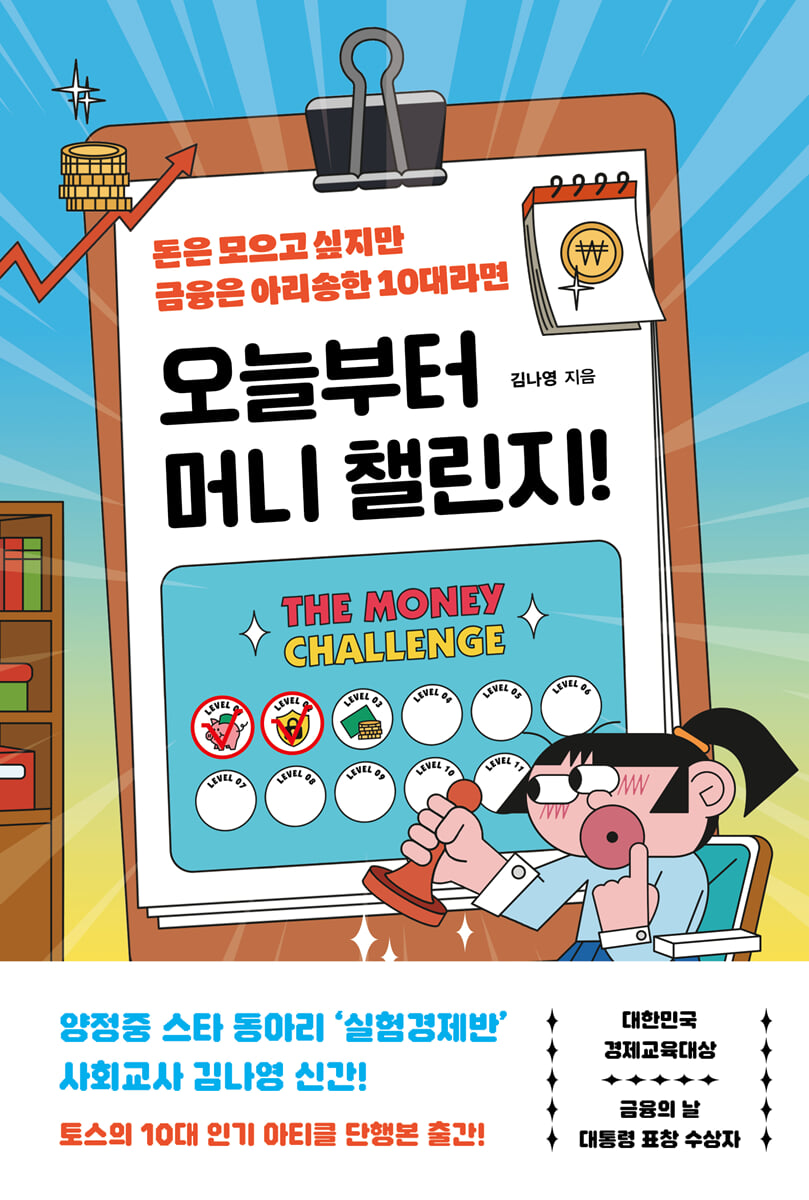
Money Challenge starts today!
 |
Description
Book Introduction
Second-hand trading, making extra money, getting your first part-time job, investing in stocks…
It's full of financial life tips that teenagers are 'really' curious about!
Republic of Korea Economic Education Award
Financial Day Presidential Citation Recipients
A new book by social studies teacher Kim Na-young of the Yang Jeong-jung Star Club's "Experimental Economics Class"!
“When you know the flow of money and have the right values about money,
“Money is on my side.”
The Ministry of Education has created a new subject called 'Finance and Economic Life' in the 2025 curriculum.
The goal is to strengthen financial capacity by fostering the financial knowledge and sound financial decision-making skills necessary for young people.
Young people live in a rapidly changing digital financial environment.
They actively use second-hand trading sites such as 'Carrot' and are interested in stocks in the entertainment industry such as SM and HYBE.
They also wonder how to save up their allowance to make more money, and what to look out for when looking for a part-time job.
Meanwhile, illegal gambling targeting youths by using the internet and smartphones as their main communication method and illegal social media loan sharking called "proxy deposit" are making headlines.
How can young people preparing for financial independence lead safe and rational financial lives? Author Kim Na-young, a middle school social studies teacher, has filled young people with vivid financial knowledge in "Money Challenge Starting Today!" to answer their questions.
From practical information like a checklist to avoid second-hand trading scams, how to manage your credit score, and things to watch out for when starting your first part-time job, to basic concepts that will help you understand economic news, such as interest rates, exchange rates, bonds, and diversified investments, it explains them in an easy and fun way.
It is full of valuable knowledge that young people need to know to grow into healthy economic players.
It's full of financial life tips that teenagers are 'really' curious about!
Republic of Korea Economic Education Award
Financial Day Presidential Citation Recipients
A new book by social studies teacher Kim Na-young of the Yang Jeong-jung Star Club's "Experimental Economics Class"!
“When you know the flow of money and have the right values about money,
“Money is on my side.”
The Ministry of Education has created a new subject called 'Finance and Economic Life' in the 2025 curriculum.
The goal is to strengthen financial capacity by fostering the financial knowledge and sound financial decision-making skills necessary for young people.
Young people live in a rapidly changing digital financial environment.
They actively use second-hand trading sites such as 'Carrot' and are interested in stocks in the entertainment industry such as SM and HYBE.
They also wonder how to save up their allowance to make more money, and what to look out for when looking for a part-time job.
Meanwhile, illegal gambling targeting youths by using the internet and smartphones as their main communication method and illegal social media loan sharking called "proxy deposit" are making headlines.
How can young people preparing for financial independence lead safe and rational financial lives? Author Kim Na-young, a middle school social studies teacher, has filled young people with vivid financial knowledge in "Money Challenge Starting Today!" to answer their questions.
From practical information like a checklist to avoid second-hand trading scams, how to manage your credit score, and things to watch out for when starting your first part-time job, to basic concepts that will help you understand economic news, such as interest rates, exchange rates, bonds, and diversified investments, it explains them in an easy and fun way.
It is full of valuable knowledge that young people need to know to grow into healthy economic players.
- You can preview some of the book's contents.
Preview
index
Level 01.
Are you saying that you have to write down the price of tteokbokki you made today to become rich?
Level 02.
What happens if my personal information is leaked?
Level 03.
When you want to save a lot of money, but the money you have is too small and precious
Level 04.
Things to know before starting your first part-time job
Level 05.
Will my credit score go down if I'm late on my cell phone bill?
Level 06.
8 Ways to Avoid Scams in Secondhand Shopping
Level 07.
11 Ways Your Financial Life Changes as You Become an Adult
Level 08.
Can I also invest in Hive, JYP, and SM?
Level 09.
All-in on Company A stock! Why not?
Level 10.
Prices just keep rising?
Level 11.
When interest rates change, asset prices also change?
Level 12.
The most frequently asked questions about money among teenagers
Are you saying that you have to write down the price of tteokbokki you made today to become rich?
Level 02.
What happens if my personal information is leaked?
Level 03.
When you want to save a lot of money, but the money you have is too small and precious
Level 04.
Things to know before starting your first part-time job
Level 05.
Will my credit score go down if I'm late on my cell phone bill?
Level 06.
8 Ways to Avoid Scams in Secondhand Shopping
Level 07.
11 Ways Your Financial Life Changes as You Become an Adult
Level 08.
Can I also invest in Hive, JYP, and SM?
Level 09.
All-in on Company A stock! Why not?
Level 10.
Prices just keep rising?
Level 11.
When interest rates change, asset prices also change?
Level 12.
The most frequently asked questions about money among teenagers
Detailed image
.jpg)
Into the book
It's a good idea to set a 'maximum amount you want to spend this week or month' for each item.
“I decide that I won’t spend more than 3,000 won on webtoons every week.”
What if you set a limit of 10,000 won per month for in-game items, but today you spend 9,900 won? You won't have any more money to spend on games this month.
At this time, you should not use money that has been divided into other items.
To successfully control your spending using a psychological account, you must keep track of the amount for each item.
If you write it down every time you use it, you can check how much you used for each item, right?
---From "You say you'll become rich if you write down the price of the tteokbokki you made today?"
Late fees, called late fees in proxy deposits, are usually around 2,000 won per hour, but they seem like small amounts, so it's easy to overlook the risks.
However, if you convert it to an annual interest rate, it means that you are paying interest of over 1,000%.
(…) When A borrowed money, the agent depositor asked for his student ID, phone number, and home address.
He threatened to use this to visit my house a week later, spread my personal information on the internet, and sue me for fraud.
Such acts constitute illegal debt collection prohibited by current law.
In times like these, you shouldn't try to solve it yourself.
Ask your parents, teachers, or school police officer for help, or call the Financial Supervisory Service's reporting center at 1332 for advice.
---From "What happens if your personal information is leaked?"
Who do you think has a higher credit score: A, with an annual salary of 100 million won and a history of frequent late payments, or B, with an annual salary of 30 million won and a history of never being late? Surprisingly, B's credit score may be higher.
This is because if A has a lot of income but does not know how to spend it systematically and has a lot of experience with late payments, he is considered an untrustworthy person.
(…) Here’s why you should start taking an interest in credit management from the time you’re in school.
It makes a big difference whether you live your life consciously knowing that keeping promises to others is ultimately for your own good or not.
---From "Will my credit score go down if I'm late on my cell phone bill?"
Warren Buffett, a famous investment expert, and his mentor Benjamin Graham are people who made a lot of money by analyzing companies, purchasing stocks of companies they judged to be good at low prices, and waiting for them to rise.
Warren Buffett especially said, “Buy stocks of good companies at a reasonable price, and don’t invest in companies you don’t know.”
I have to remember two things: picking a good company in a field I'm interested in, and determining whether that company's stock is "at a good price" when I'm thinking of buying it.
When buying stocks, you look at the company's financial health, its growth potential, and how consistently it can generate profits.
We also examine whether the stock price is overvalued compared to this.
One more thing, look at what the company values, not just its profitability or growth potential.
I would also like to consider what impact the products or services my company produces will have on the world.
---From "Can I also invest in Hive, JYP, and SM?"
What does higher US interest rates have to do with exchange rates? Capital, or money, flows across borders worldwide.
If the US raises its benchmark interest rate, deposit rates will also rise.
Let's say that if you deposit money in our country, you get 3% interest per year, but if you deposit money in the US, you get 5% interest per year.
So, you'd want to deposit money in the US, right? More people would buy dollars and deposit or invest in the US, which would increase demand for dollars and push up the exchange rate.
“I decide that I won’t spend more than 3,000 won on webtoons every week.”
What if you set a limit of 10,000 won per month for in-game items, but today you spend 9,900 won? You won't have any more money to spend on games this month.
At this time, you should not use money that has been divided into other items.
To successfully control your spending using a psychological account, you must keep track of the amount for each item.
If you write it down every time you use it, you can check how much you used for each item, right?
---From "You say you'll become rich if you write down the price of the tteokbokki you made today?"
Late fees, called late fees in proxy deposits, are usually around 2,000 won per hour, but they seem like small amounts, so it's easy to overlook the risks.
However, if you convert it to an annual interest rate, it means that you are paying interest of over 1,000%.
(…) When A borrowed money, the agent depositor asked for his student ID, phone number, and home address.
He threatened to use this to visit my house a week later, spread my personal information on the internet, and sue me for fraud.
Such acts constitute illegal debt collection prohibited by current law.
In times like these, you shouldn't try to solve it yourself.
Ask your parents, teachers, or school police officer for help, or call the Financial Supervisory Service's reporting center at 1332 for advice.
---From "What happens if your personal information is leaked?"
Who do you think has a higher credit score: A, with an annual salary of 100 million won and a history of frequent late payments, or B, with an annual salary of 30 million won and a history of never being late? Surprisingly, B's credit score may be higher.
This is because if A has a lot of income but does not know how to spend it systematically and has a lot of experience with late payments, he is considered an untrustworthy person.
(…) Here’s why you should start taking an interest in credit management from the time you’re in school.
It makes a big difference whether you live your life consciously knowing that keeping promises to others is ultimately for your own good or not.
---From "Will my credit score go down if I'm late on my cell phone bill?"
Warren Buffett, a famous investment expert, and his mentor Benjamin Graham are people who made a lot of money by analyzing companies, purchasing stocks of companies they judged to be good at low prices, and waiting for them to rise.
Warren Buffett especially said, “Buy stocks of good companies at a reasonable price, and don’t invest in companies you don’t know.”
I have to remember two things: picking a good company in a field I'm interested in, and determining whether that company's stock is "at a good price" when I'm thinking of buying it.
When buying stocks, you look at the company's financial health, its growth potential, and how consistently it can generate profits.
We also examine whether the stock price is overvalued compared to this.
One more thing, look at what the company values, not just its profitability or growth potential.
I would also like to consider what impact the products or services my company produces will have on the world.
---From "Can I also invest in Hive, JYP, and SM?"
What does higher US interest rates have to do with exchange rates? Capital, or money, flows across borders worldwide.
If the US raises its benchmark interest rate, deposit rates will also rise.
Let's say that if you deposit money in our country, you get 3% interest per year, but if you deposit money in the US, you get 5% interest per year.
So, you'd want to deposit money in the US, right? More people would buy dollars and deposit or invest in the US, which would increase demand for dollars and push up the exchange rate.
---From "When interest rates change, asset prices also change?"
Publisher's Review
Developing economic literacy by finding answers to "questions about money"
- Toss's 10 most popular serials published in single volume!
- When you complete 12 missions, your financial basics will increase.
In "Money Challenge Starting Today!", the author, a current teacher, interviewed her students to find out what teenagers most want to know about their financial lives, and reorganized the frequently asked questions from a survey of teenagers using the Toss app to create chapters from Level 1 to 12.
In addition to the popular articles serialized on Toss' content platform 'Toss Speed', the book also includes concepts and various cases essential for young people to understand economic trends.
Each chapter begins with questions from teenagers to Nayoung.
Anecdotes about wanting to go to a concert of one's favorite idol but having trouble saving up enough money, or wondering if it will affect one's parents' credit score if one buys small amounts of game items and falls behind on their phone bill, naturally resonate with young readers.
It is written in a Q&A format that answers vivid questions such as, "What is more advantageous if the interest rates on savings and deposits are the same?", "Why is proxy deposit dangerous?", "Why shouldn't I go all-in on the stocks of a company that is doing well now?", and "Why does the exchange rate rise when the US interest rate rises?", and it allows you to build your financial knowledge and feel a sense of accomplishment by completing missions and leveling up by earning a stamp at the end of each chapter.
The ability to make rational financial decisions starts in your teens!
- Studying money by building basic economic knowledge
- Insert a QR code to check and experience financial information
The author carefully explains how to spend, save, and grow your allowance wisely, what interest rates are and why they have such a big impact on stock and asset prices, what exchange rates are, and the characteristics of investment financial products such as stocks and bonds. He also provides specific guidance on cases of teenagers exposed to financial fraud, the methods used by fraudsters, and how to prevent fraud.
QR codes for various institutions where you can check and experience financial information, such as the National Police Agency's phishing simulation experience center, savings deposit interest rate calculator, and standard employment contract form, are inserted, making it easy to use as teaching materials and helping readers gain practical understanding.
Additionally, a separate chapter was created to discuss the financial changes that occur as young people become adults, helping them prepare for financial independence.
It's packed with valuable information, including things to keep in mind when using credit cards, how to sign a housing lease and receive a confirmation date, the types of student loans offered by the Korea Student Aid Foundation, and even information on working holidays offered by the Overseas Koreans Association.
The final chapter also introduces books and documentaries that are worth exploring to develop your economic knowledge.
From preventing financial fraud, managing income and expenses, to the basic principles of saving and investing, and even managing credit, if you're a teenager who wants to save money but is unfamiliar with finances, this book will be a great help in forming sound financial habits.
Let's start studying 'real' money now with "Money Challenge Starting Today!"
- Toss's 10 most popular serials published in single volume!
- When you complete 12 missions, your financial basics will increase.
In "Money Challenge Starting Today!", the author, a current teacher, interviewed her students to find out what teenagers most want to know about their financial lives, and reorganized the frequently asked questions from a survey of teenagers using the Toss app to create chapters from Level 1 to 12.
In addition to the popular articles serialized on Toss' content platform 'Toss Speed', the book also includes concepts and various cases essential for young people to understand economic trends.
Each chapter begins with questions from teenagers to Nayoung.
Anecdotes about wanting to go to a concert of one's favorite idol but having trouble saving up enough money, or wondering if it will affect one's parents' credit score if one buys small amounts of game items and falls behind on their phone bill, naturally resonate with young readers.
It is written in a Q&A format that answers vivid questions such as, "What is more advantageous if the interest rates on savings and deposits are the same?", "Why is proxy deposit dangerous?", "Why shouldn't I go all-in on the stocks of a company that is doing well now?", and "Why does the exchange rate rise when the US interest rate rises?", and it allows you to build your financial knowledge and feel a sense of accomplishment by completing missions and leveling up by earning a stamp at the end of each chapter.
The ability to make rational financial decisions starts in your teens!
- Studying money by building basic economic knowledge
- Insert a QR code to check and experience financial information
The author carefully explains how to spend, save, and grow your allowance wisely, what interest rates are and why they have such a big impact on stock and asset prices, what exchange rates are, and the characteristics of investment financial products such as stocks and bonds. He also provides specific guidance on cases of teenagers exposed to financial fraud, the methods used by fraudsters, and how to prevent fraud.
QR codes for various institutions where you can check and experience financial information, such as the National Police Agency's phishing simulation experience center, savings deposit interest rate calculator, and standard employment contract form, are inserted, making it easy to use as teaching materials and helping readers gain practical understanding.
Additionally, a separate chapter was created to discuss the financial changes that occur as young people become adults, helping them prepare for financial independence.
It's packed with valuable information, including things to keep in mind when using credit cards, how to sign a housing lease and receive a confirmation date, the types of student loans offered by the Korea Student Aid Foundation, and even information on working holidays offered by the Overseas Koreans Association.
The final chapter also introduces books and documentaries that are worth exploring to develop your economic knowledge.
From preventing financial fraud, managing income and expenses, to the basic principles of saving and investing, and even managing credit, if you're a teenager who wants to save money but is unfamiliar with finances, this book will be a great help in forming sound financial habits.
Let's start studying 'real' money now with "Money Challenge Starting Today!"
GOODS SPECIFICS
- Date of issue: June 23, 2025
- Page count, weight, size: 252 pages | 378g | 136*200*16mm
- ISBN13: 9791170873518
- ISBN10: 1170873510
- KC Certification: Certification Type: Conformity Confirmation
You may also like
카테고리
korean


korean

![GQ KOREA Mark (Monthly): December [2025]](http://librairie.coreenne.fr/cdn/shop/files/8ef265dbbfbf186523ed75ba7319009d.jpg?v=1765340328&width=3840)


