

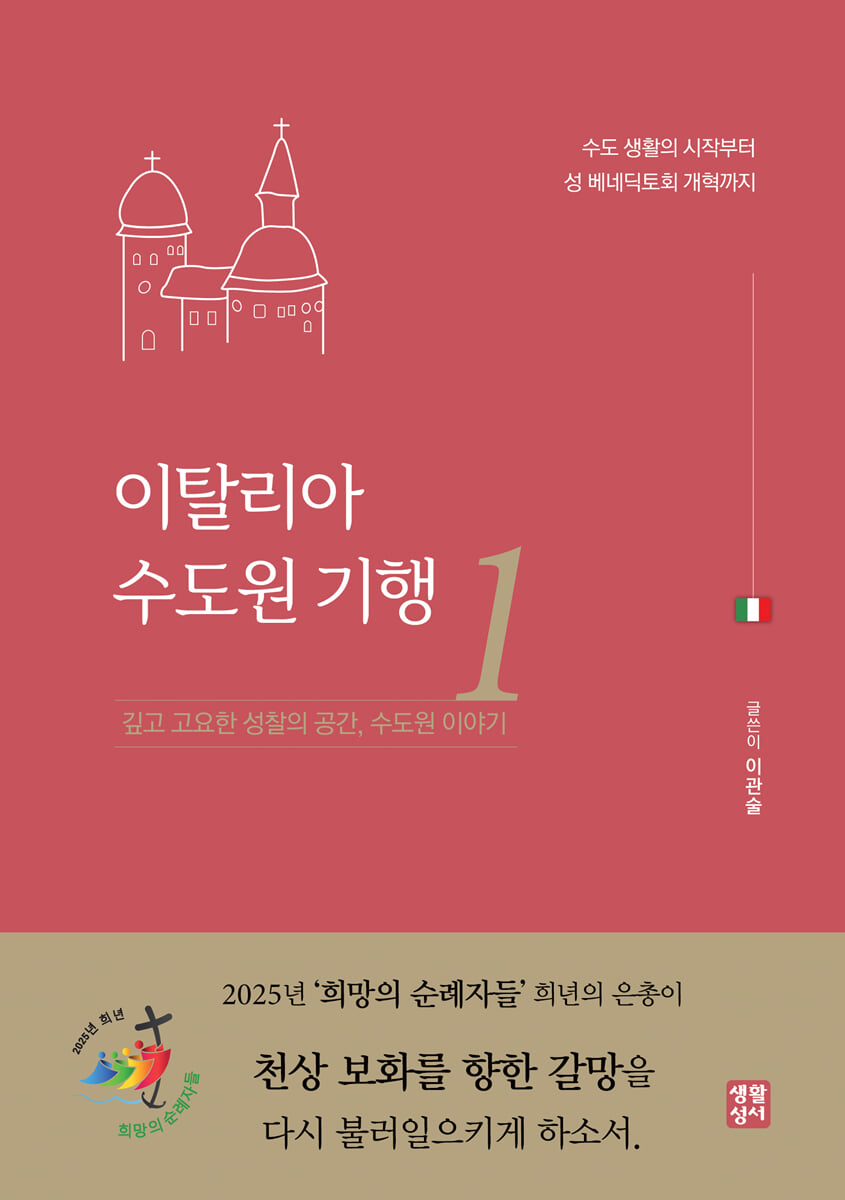
Italian Monastery Tour 1
 |
Description
Book Introduction
Experience God's time
A Mysterious Journey to Him
This book, which conveys the history and present of Italian monasteries, which serve as microscopes revealing the mysteries of God, through the author's eloquent explanations and vivid photos, a guide to Italian pilgrimage sites.
Volume 1 covers the history of monastic life, the rise and growth of the Benedictine Order, and the emergence of reformed monastic orders that resisted the secularization of monasticism.
“A little time of solitude and silence within the monastery provides modern people with a precious opportunity to reflect on inner peace and the meaning of life.
In this book, the author teaches us how to ‘see’ the monastery.
“The monastery is a place imbued with spirituality and wisdom, a special place where one can experience God’s time and reflect on one’s faith in silence.” - Recommendation from Abbot Park Hyeon-dong, Abbot of Waegwan, Benedictine Abbey
A Mysterious Journey to Him
This book, which conveys the history and present of Italian monasteries, which serve as microscopes revealing the mysteries of God, through the author's eloquent explanations and vivid photos, a guide to Italian pilgrimage sites.
Volume 1 covers the history of monastic life, the rise and growth of the Benedictine Order, and the emergence of reformed monastic orders that resisted the secularization of monasticism.
“A little time of solitude and silence within the monastery provides modern people with a precious opportunity to reflect on inner peace and the meaning of life.
In this book, the author teaches us how to ‘see’ the monastery.
“The monastery is a place imbued with spirituality and wisdom, a special place where one can experience God’s time and reflect on one’s faith in silence.” - Recommendation from Abbot Park Hyeon-dong, Abbot of Waegwan, Benedictine Abbey
- You can preview some of the book's contents.
Preview
index
Recommended Article by Park Hyun-dong Abbas (Benedictine Abbey of Waegwan) 4
Letter of Recommendation by Father Oh Hak-jun (Little Brothers) 8
Introduction 11
Part 1 Solomon's Knot
Chapter 1: Another Path to Martyrdom 18
The Beginning of Monastic Life: Obedience in Perfect Joy 19
Chapter 2: Pray and Work 28
From 'My God' to 'Our God': The Story of St. Benedict 29
The Holy Grotto Monastery of Subiaco, a miracle in itself 35
Chapter 3: Riding the Wind or Being Swept Away 68
Empire and Monasteries: The Development and Stagnation of the Benedictine Order 69
The Imperial Abbey of Our Lady of Parfa 73
Another Pathway for Humanity to God: The Abbey of St. Antimos 94
Part 2: The Mysterious Well
Chapter 1: Why We Have Two Lungs 128
The Divided Church: The Division of the Eastern and Western Churches 129
Another Liturgy, Same Faith: The Monastery of St. Nilo (Monastery of Our Lady of Grottaferrata) 135
Chapter 2: Not Loneliness, but Love of Reading 164
The Beginning of Monastic Reform: Away from Power and Focusing on Healing 165
Conversi Brothers, Religious of the New Order 170
The "Transient Architecture" of the Cistercian Monastery of the House of Mary, a turbulent time 176
Was there a monastic order of injustice? Fossanova Abbey 204
Chapter 3: Building a Picturesque House on the Mount of Olives 224
The Life of Saint Bruno 225
The Carthusian Monastery of Florence, the Holy Mountain above the City 231
Chapter 4: God's Wanderer 264
Sit in your cell as if it were heaven. The Life of Saint Romuald, Pioneer of the Hermitage, 265
The ideals of the Kamaldolli Society: reading, silence, prayer, and labor 275
The Water of Jesus, Fontebona Monastery 299
Note 310
Letter of Recommendation by Father Oh Hak-jun (Little Brothers) 8
Introduction 11
Part 1 Solomon's Knot
Chapter 1: Another Path to Martyrdom 18
The Beginning of Monastic Life: Obedience in Perfect Joy 19
Chapter 2: Pray and Work 28
From 'My God' to 'Our God': The Story of St. Benedict 29
The Holy Grotto Monastery of Subiaco, a miracle in itself 35
Chapter 3: Riding the Wind or Being Swept Away 68
Empire and Monasteries: The Development and Stagnation of the Benedictine Order 69
The Imperial Abbey of Our Lady of Parfa 73
Another Pathway for Humanity to God: The Abbey of St. Antimos 94
Part 2: The Mysterious Well
Chapter 1: Why We Have Two Lungs 128
The Divided Church: The Division of the Eastern and Western Churches 129
Another Liturgy, Same Faith: The Monastery of St. Nilo (Monastery of Our Lady of Grottaferrata) 135
Chapter 2: Not Loneliness, but Love of Reading 164
The Beginning of Monastic Reform: Away from Power and Focusing on Healing 165
Conversi Brothers, Religious of the New Order 170
The "Transient Architecture" of the Cistercian Monastery of the House of Mary, a turbulent time 176
Was there a monastic order of injustice? Fossanova Abbey 204
Chapter 3: Building a Picturesque House on the Mount of Olives 224
The Life of Saint Bruno 225
The Carthusian Monastery of Florence, the Holy Mountain above the City 231
Chapter 4: God's Wanderer 264
Sit in your cell as if it were heaven. The Life of Saint Romuald, Pioneer of the Hermitage, 265
The ideals of the Kamaldolli Society: reading, silence, prayer, and labor 275
The Water of Jesus, Fontebona Monastery 299
Note 310
Detailed image

Into the book
Italian monasteries are more than mere structures; they are spaces encapsulated by medieval faith, spirituality, and the deep human yearning for God.
The author, a pilgrimage guide and expert in pilgrimage studies, opens new eyes to monasteries through this book.
--- From "Park Hyun-dong's Father's Recommendation"
“It seems that there are many people who have accumulated blessings in our pilgrimage group.
“It is a blessing to be able to go on a pilgrimage, but it is an even greater blessing to meet a great guide.” These were the words I spoke to my fellow believers at the end of the pilgrimage.
--- From "Father Oh Hak-jun's Letter of Recommendation"
The story of the Italian monastery that I will show you below will serve as a microscope that will reveal the mystery of God.
We seek to find God in our time through the lives of monastics who actively waited for God's time in secular times, especially during the Middle Ages (6th-15th centuries) and before the Reformation.
--- From "Introductory Remarks"
Devout believers, who could no longer commit martyrdom due to religious freedom, came to believe that fasting, abstinence, and a moderate life were another path to martyrdom that could free them from the evil of human hearts and enable them to meet God.
This was the beginning of monastic life.
--- From "The Beginning of Capital Life"
Above the small entrance to the Monastery of the Holy Grottoes of Subiaco stands a 13th-century mosaic of the Cross.
As I entered through this narrow gate that could barely fit one person, I heard, “Enter through the narrow gate.
For the gate that leads to destruction is wide and the road is broad, and many enter through it.
It seems as if we hear the words of the Lord: “How narrow is the gate and hard is the way that leads to life, and only a few find it” (Matthew 7:13-14).
--- From "The Appearance Itself is a Miracle"
Emperor Charlemagne was not a man filled only with political ambitions.
The emperor, a deeply religious man, sought to spread the Christian faith in the territories he conquered, in keeping with the first value of the Roman Church: evangelization.
To do this, a unified script was needed to enable monks and priests to write and read with proper knowledge.
The Carolingian small letters he created are still used today as a typeface called 'Times New Roman'.
The question mark was also created at this time.
Previously, sentences had to end with the Latin letter 'Qo' (short for 'question') but this often led to confusion with different meanings and caused administrative problems.
--- From "Empire and Monastery"
Located in central Italy, the monastery is on the ridge of Mount Acuziano, between Rome and Norcia, the birthplace of Saint Benedict.
As you pass through hills and valleys covered in endless olive groves, you will come across monasteries and villages nestled in lush green forests.
It can be said to be a good example of an old medieval city that still retains the appearance of a village formed around a monastery.
--- From "The Emperor's Grand Monastery"
When the persecution of the Church ended, the Council of Constantinople was convened to resolve differences in doctrine among the local churches.
In today's church, the authority to convene a council lies with the Pope, but at that time, the authority of local bishops was equal, so even the Bishop of Rome did not have the authority to convene a council.
Moreover, at that time, there was no separation of church and state, to the extent that one of the important positions of the emperor was the high priest, Pontifex Maximus.
--- From "The Divided Church"
Most of the members of the early monasteries after St. Benedict were laymen.
The formation and admission of priests was only possible if there were special reasons for the liturgy or spirituality.
All the monks worked together in physical labor, and when there was a lot of work, they asked for help from outside.
However, from the 9th century onwards, monasteries began to grow in wealth as their holdings increased, and as the number of priests and monks increased, land management became difficult.
--- From "The Conversi Brothers"
The octagonal well with eight pillars symbolizes the presence of God, the center of the monks.
In the Church, the number 8 signifies the eighth day after the resurrection of Jesus, as the Church Fathers said, and the eighth day after the seven days in which God created the world, the beginning of a new day.
And when you lay down the number 8, it appears as a mathematical symbol for infinity (∞), signifying God's uninterrupted and continuous eternity.
--- From "Maria's House of Turbulent Times"
Until the 10th century, it was the era of dualism, which held that Jesus gave spiritual authority to the pope and temporal authority to the emperor.
The Vatican, which wanted to create the concept of 'the Pope is the sun and the Emperor is the moon that shines in its light', wanted to create a crusade uniting all Christians to recapture Jerusalem from the Muslim forces and stand above the Emperor, and the Cistercian infrastructure line made this possible.
The author, a pilgrimage guide and expert in pilgrimage studies, opens new eyes to monasteries through this book.
--- From "Park Hyun-dong's Father's Recommendation"
“It seems that there are many people who have accumulated blessings in our pilgrimage group.
“It is a blessing to be able to go on a pilgrimage, but it is an even greater blessing to meet a great guide.” These were the words I spoke to my fellow believers at the end of the pilgrimage.
--- From "Father Oh Hak-jun's Letter of Recommendation"
The story of the Italian monastery that I will show you below will serve as a microscope that will reveal the mystery of God.
We seek to find God in our time through the lives of monastics who actively waited for God's time in secular times, especially during the Middle Ages (6th-15th centuries) and before the Reformation.
--- From "Introductory Remarks"
Devout believers, who could no longer commit martyrdom due to religious freedom, came to believe that fasting, abstinence, and a moderate life were another path to martyrdom that could free them from the evil of human hearts and enable them to meet God.
This was the beginning of monastic life.
--- From "The Beginning of Capital Life"
Above the small entrance to the Monastery of the Holy Grottoes of Subiaco stands a 13th-century mosaic of the Cross.
As I entered through this narrow gate that could barely fit one person, I heard, “Enter through the narrow gate.
For the gate that leads to destruction is wide and the road is broad, and many enter through it.
It seems as if we hear the words of the Lord: “How narrow is the gate and hard is the way that leads to life, and only a few find it” (Matthew 7:13-14).
--- From "The Appearance Itself is a Miracle"
Emperor Charlemagne was not a man filled only with political ambitions.
The emperor, a deeply religious man, sought to spread the Christian faith in the territories he conquered, in keeping with the first value of the Roman Church: evangelization.
To do this, a unified script was needed to enable monks and priests to write and read with proper knowledge.
The Carolingian small letters he created are still used today as a typeface called 'Times New Roman'.
The question mark was also created at this time.
Previously, sentences had to end with the Latin letter 'Qo' (short for 'question') but this often led to confusion with different meanings and caused administrative problems.
--- From "Empire and Monastery"
Located in central Italy, the monastery is on the ridge of Mount Acuziano, between Rome and Norcia, the birthplace of Saint Benedict.
As you pass through hills and valleys covered in endless olive groves, you will come across monasteries and villages nestled in lush green forests.
It can be said to be a good example of an old medieval city that still retains the appearance of a village formed around a monastery.
--- From "The Emperor's Grand Monastery"
When the persecution of the Church ended, the Council of Constantinople was convened to resolve differences in doctrine among the local churches.
In today's church, the authority to convene a council lies with the Pope, but at that time, the authority of local bishops was equal, so even the Bishop of Rome did not have the authority to convene a council.
Moreover, at that time, there was no separation of church and state, to the extent that one of the important positions of the emperor was the high priest, Pontifex Maximus.
--- From "The Divided Church"
Most of the members of the early monasteries after St. Benedict were laymen.
The formation and admission of priests was only possible if there were special reasons for the liturgy or spirituality.
All the monks worked together in physical labor, and when there was a lot of work, they asked for help from outside.
However, from the 9th century onwards, monasteries began to grow in wealth as their holdings increased, and as the number of priests and monks increased, land management became difficult.
--- From "The Conversi Brothers"
The octagonal well with eight pillars symbolizes the presence of God, the center of the monks.
In the Church, the number 8 signifies the eighth day after the resurrection of Jesus, as the Church Fathers said, and the eighth day after the seven days in which God created the world, the beginning of a new day.
And when you lay down the number 8, it appears as a mathematical symbol for infinity (∞), signifying God's uninterrupted and continuous eternity.
--- From "Maria's House of Turbulent Times"
Until the 10th century, it was the era of dualism, which held that Jesus gave spiritual authority to the pope and temporal authority to the emperor.
The Vatican, which wanted to create the concept of 'the Pope is the sun and the Emperor is the moon that shines in its light', wanted to create a crusade uniting all Christians to recapture Jerusalem from the Muslim forces and stand above the Emperor, and the Cistercian infrastructure line made this possible.
--- From "Was there a monastery of injustice?"
Publisher's Review
★ As you slowly tour the monastery under his guidance, you will realize that this is not just a tourist attraction, but a mystical space.
- Abbot Park Hyeon-dong of the Benedictine Order
☆ Even if I receive guidance from the same person and visit the same course every time, I am still impressed.
There is such power in a pilgrimage with the author.
- Father Oh Hak-jun of the Little Brothers
The two words 'travel' excite people's hearts.
Regardless of where you decide to set that destination, the mere thought of leaving your current location and space and heading off to a new place is thrilling.
Moreover, even if the excitement stems from the unknown or fear of being away from everyday life, if appropriate compensation is provided, such as a beautiful view, delicacies from the mountains and sea, or comfortable rest, the fear will disappear as if it had never existed.
From that return journey, we gain the strength to live in the present.
From the beginning of capital life
Until the reform of the Benedictine Order
The first book to cover the vast subject of Italian monasteries, 『Travelogue of Italian Monasteries 1 - Stories of Monasteries, a Space for Deep and Quiet Reflection』, covers the beginnings of monastic life, the forerunner of monasticism, the story of St. Benedict, who founded the first monastic community, the growth and side effects of monasteries, and the story of monastic reforms that sought to overcome these side effects.
The author, a theologian and pilgrimage guide who has lived in Rome, Italy for over 30 years, has been walking the path toward God. He majored in theology at the Salesian University of Rome and pilgrimage studies at the Pontifical Lateran University.
While traditional tours of Italy's major cities are certainly valuable, a trip to a monastery with the author offers a valuable opportunity to see God's face even more clearly.
For those who live by faith, this pilgrimage journey offers an opportunity to draw closer to the Kingdom of God and for a foretaste of God's time. For non-believers, it offers the intellectual enrichment of the history and evolution of Italy's medieval monasteries, as well as the opportunity to discover hidden treasures boasting breathtaking scenery.
“The story of the Italian monastery that I will show you below will serve as a microscope that will reveal the mystery of God.
“We seek to find God in our time through the life of monasteries, which actively waited for God’s time in secular time, especially in the Middle Ages (6th-15th centuries) and before the Reformation.” - Introduction
Encountered on the way to the monastery
Medieval Church History and Vivid Materials
This book, which began with the theme of a pilgrimage to Italian monasteries, provides material not only on the history of monasteries but also on medieval and church history.
The history of Western civilization today, which began with the roots of ancient Greek and Roman culture, was able to progress through absolute monarchy and the Industrial Revolution to modern society because of the grand history of the Middle Ages that lasted a thousand years.
The medieval society and culture that had continued for such a long time were closely related to the church, and the point where they met was the monastic order.
In response to the economic and social changes brought about by the conflict between the Pope and the Emperor, the monastic orders experienced repeated decline and reform.
"Italian Monastery Journey 1 - Stories of Monasteries, Spaces of Deep and Quiet Reflection" provides vivid material that examines such changes.
Part 1 introduces the beginnings of monastic life and the important pilgrimage sites of the Benedictines: the Holy Grottoes of Subiaco, the Abbey of Our Lady of Farfa, and the Abbey of Sant'Antimo. Part 2 introduces the schism between the Eastern and Western Churches and the Abbey of Sant'Nillo, the monastic reform and the Cistercians, the Knights Templar and the Abbey of Fossanova, the Carthusians and the Florentine monasteries, the Camaldolii and the Abbey of Fontebona, etc. through vivid photographs and floor plans, illuminating the past and present of Italian monasteries through the lives of monks.
“I would like to share with readers the precious history of medieval monasteries that sought to take active action and make decisions within God’s time: Saint Benedict, who opened the way for Western monasticism with the Universal Rule, and the monastic orders named after him; monastic orders that tried to reform by emphasizing the hermitic life when it seemed too close to the world; monastic orders that tried to live by God’s providence and love for neighbors rather than rules and monastic buildings; and even monastic orders that tried to return by re-examining the spirituality of the early Saint Benedict.” - Introduction
The mystery hidden in the title
Solomon's Knot and the Mysterious Well
The two parts of 『Travels to Italian Monasteries 1 - Stories of Monasteries, Spaces of Deep and Quiet Reflection』 are titled 'Solomon's Knot' and 'The Mysterious Well' respectively.
Even within this simple title, the process of formation, development, decline and progress of medieval monasteries is implied.
Solomon's knot has been a symbol of God's presence since before Christ.
The endlessly connected knots themselves symbolize God's wisdom, and the tangled knots signify our relationship with God, and only God can untie the knots.
The first monasteries emerged as an attempt by those who wanted to follow God to redefine their relationship with God in a different way in a world that had changed since the Edict of Milan, which granted freedom of Christian faith to the emperor.
Such attempts gave rise to monastic communities.
The early monastic communities saw fasting, abstinence, and mortification as a new path to martyrdom, separated from the world.
The monasteries of St. Benedict had their own unique architectural style for such a life.
Monasteries placed a garden, especially a square garden, at the center of their enclosed living space, and structured it with a well in the center or around this garden.
This well was intended to provide the water necessary for life, but it also symbolized the mystery of Christ, the water of life, and the presence of God.
The well represented a community that lived with God at its center.
God's grace filled the well of mystery, and through it the monastery was able to continue to develop and grow.
However, the monasteries that gained wealth and power often appeared to forget the meaning of the well in their midst as they continued to expand materially and secularly.
In the journey of 'I came, I saw, I took pictures.'
A journey towards God, step by step
People return from difficult journeys with many memories.
Yes, that's right.
Travel is a 'departure' that presupposes a 'return'.
If you go somewhere in the world and don't come back, it's not a trip.
In other words, travel, which is a repetition of leaving and returning, is bound to be tied to the 'present moment' in which we live.
This is why the meaning of ‘pilgrimage’, a journey toward faith, cannot but be special.
Pilgrimage, a journey that looks back on the 'beginning' of faith, aims for eternity, not the moment.
Pilgrimage allows modern people to reflect on their inner peace and the meaning of life, and the grace of pilgrimage draws our lives closer to God, leading us to the ultimate blessing of meeting Him.
If travel is tied to the moment, pilgrimage is a 'mystical journey' that moves us toward God with an elasticity toward eternity.
A mystical journey to the monastery,
How to understand Italy most deeply
Italy is a place of great religious and cultural importance in the history of the Church, which boasts a long tradition.
This is because it is home to Vatican City, the seat of the Holy See, and historically, it is home to numerous relics of the Roman Empire, and it was the springboard for the growth of the Catholic Church, which was able to influence all of Europe after it was established as an institutional religion.
Among these, the emergence and development of monasteries over the long period of the millennium of the Middle Ages is of great value in terms of church history and cultural history, and a tour of the monasteries of Italy, the main stage of this process, is the most profound way to understand Italy.
In his recommendation for this book, Abbot Park Hyeon-dong, the Benedictine abbot of Waegwan, emphasizes that a trip to an Italian monastery can shed new light on our faith today.
“When we think of traveling in Italy, we think of the Colosseum in Rome, the Vatican, and the beautiful art of Venice and Florence, but the monasteries dotted throughout Italy offer deeper, more tranquil spaces for reflection.
… small moments of solitude and silence within the monastery offer modern people a precious opportunity to re-evaluate their inner peace and the meaning of life.”
- From the recommendation of Park Hyun-dong and Blasio Abbas
- Abbot Park Hyeon-dong of the Benedictine Order
☆ Even if I receive guidance from the same person and visit the same course every time, I am still impressed.
There is such power in a pilgrimage with the author.
- Father Oh Hak-jun of the Little Brothers
The two words 'travel' excite people's hearts.
Regardless of where you decide to set that destination, the mere thought of leaving your current location and space and heading off to a new place is thrilling.
Moreover, even if the excitement stems from the unknown or fear of being away from everyday life, if appropriate compensation is provided, such as a beautiful view, delicacies from the mountains and sea, or comfortable rest, the fear will disappear as if it had never existed.
From that return journey, we gain the strength to live in the present.
From the beginning of capital life
Until the reform of the Benedictine Order
The first book to cover the vast subject of Italian monasteries, 『Travelogue of Italian Monasteries 1 - Stories of Monasteries, a Space for Deep and Quiet Reflection』, covers the beginnings of monastic life, the forerunner of monasticism, the story of St. Benedict, who founded the first monastic community, the growth and side effects of monasteries, and the story of monastic reforms that sought to overcome these side effects.
The author, a theologian and pilgrimage guide who has lived in Rome, Italy for over 30 years, has been walking the path toward God. He majored in theology at the Salesian University of Rome and pilgrimage studies at the Pontifical Lateran University.
While traditional tours of Italy's major cities are certainly valuable, a trip to a monastery with the author offers a valuable opportunity to see God's face even more clearly.
For those who live by faith, this pilgrimage journey offers an opportunity to draw closer to the Kingdom of God and for a foretaste of God's time. For non-believers, it offers the intellectual enrichment of the history and evolution of Italy's medieval monasteries, as well as the opportunity to discover hidden treasures boasting breathtaking scenery.
“The story of the Italian monastery that I will show you below will serve as a microscope that will reveal the mystery of God.
“We seek to find God in our time through the life of monasteries, which actively waited for God’s time in secular time, especially in the Middle Ages (6th-15th centuries) and before the Reformation.” - Introduction
Encountered on the way to the monastery
Medieval Church History and Vivid Materials
This book, which began with the theme of a pilgrimage to Italian monasteries, provides material not only on the history of monasteries but also on medieval and church history.
The history of Western civilization today, which began with the roots of ancient Greek and Roman culture, was able to progress through absolute monarchy and the Industrial Revolution to modern society because of the grand history of the Middle Ages that lasted a thousand years.
The medieval society and culture that had continued for such a long time were closely related to the church, and the point where they met was the monastic order.
In response to the economic and social changes brought about by the conflict between the Pope and the Emperor, the monastic orders experienced repeated decline and reform.
"Italian Monastery Journey 1 - Stories of Monasteries, Spaces of Deep and Quiet Reflection" provides vivid material that examines such changes.
Part 1 introduces the beginnings of monastic life and the important pilgrimage sites of the Benedictines: the Holy Grottoes of Subiaco, the Abbey of Our Lady of Farfa, and the Abbey of Sant'Antimo. Part 2 introduces the schism between the Eastern and Western Churches and the Abbey of Sant'Nillo, the monastic reform and the Cistercians, the Knights Templar and the Abbey of Fossanova, the Carthusians and the Florentine monasteries, the Camaldolii and the Abbey of Fontebona, etc. through vivid photographs and floor plans, illuminating the past and present of Italian monasteries through the lives of monks.
“I would like to share with readers the precious history of medieval monasteries that sought to take active action and make decisions within God’s time: Saint Benedict, who opened the way for Western monasticism with the Universal Rule, and the monastic orders named after him; monastic orders that tried to reform by emphasizing the hermitic life when it seemed too close to the world; monastic orders that tried to live by God’s providence and love for neighbors rather than rules and monastic buildings; and even monastic orders that tried to return by re-examining the spirituality of the early Saint Benedict.” - Introduction
The mystery hidden in the title
Solomon's Knot and the Mysterious Well
The two parts of 『Travels to Italian Monasteries 1 - Stories of Monasteries, Spaces of Deep and Quiet Reflection』 are titled 'Solomon's Knot' and 'The Mysterious Well' respectively.
Even within this simple title, the process of formation, development, decline and progress of medieval monasteries is implied.
Solomon's knot has been a symbol of God's presence since before Christ.
The endlessly connected knots themselves symbolize God's wisdom, and the tangled knots signify our relationship with God, and only God can untie the knots.
The first monasteries emerged as an attempt by those who wanted to follow God to redefine their relationship with God in a different way in a world that had changed since the Edict of Milan, which granted freedom of Christian faith to the emperor.
Such attempts gave rise to monastic communities.
The early monastic communities saw fasting, abstinence, and mortification as a new path to martyrdom, separated from the world.
The monasteries of St. Benedict had their own unique architectural style for such a life.
Monasteries placed a garden, especially a square garden, at the center of their enclosed living space, and structured it with a well in the center or around this garden.
This well was intended to provide the water necessary for life, but it also symbolized the mystery of Christ, the water of life, and the presence of God.
The well represented a community that lived with God at its center.
God's grace filled the well of mystery, and through it the monastery was able to continue to develop and grow.
However, the monasteries that gained wealth and power often appeared to forget the meaning of the well in their midst as they continued to expand materially and secularly.
In the journey of 'I came, I saw, I took pictures.'
A journey towards God, step by step
People return from difficult journeys with many memories.
Yes, that's right.
Travel is a 'departure' that presupposes a 'return'.
If you go somewhere in the world and don't come back, it's not a trip.
In other words, travel, which is a repetition of leaving and returning, is bound to be tied to the 'present moment' in which we live.
This is why the meaning of ‘pilgrimage’, a journey toward faith, cannot but be special.
Pilgrimage, a journey that looks back on the 'beginning' of faith, aims for eternity, not the moment.
Pilgrimage allows modern people to reflect on their inner peace and the meaning of life, and the grace of pilgrimage draws our lives closer to God, leading us to the ultimate blessing of meeting Him.
If travel is tied to the moment, pilgrimage is a 'mystical journey' that moves us toward God with an elasticity toward eternity.
A mystical journey to the monastery,
How to understand Italy most deeply
Italy is a place of great religious and cultural importance in the history of the Church, which boasts a long tradition.
This is because it is home to Vatican City, the seat of the Holy See, and historically, it is home to numerous relics of the Roman Empire, and it was the springboard for the growth of the Catholic Church, which was able to influence all of Europe after it was established as an institutional religion.
Among these, the emergence and development of monasteries over the long period of the millennium of the Middle Ages is of great value in terms of church history and cultural history, and a tour of the monasteries of Italy, the main stage of this process, is the most profound way to understand Italy.
In his recommendation for this book, Abbot Park Hyeon-dong, the Benedictine abbot of Waegwan, emphasizes that a trip to an Italian monastery can shed new light on our faith today.
“When we think of traveling in Italy, we think of the Colosseum in Rome, the Vatican, and the beautiful art of Venice and Florence, but the monasteries dotted throughout Italy offer deeper, more tranquil spaces for reflection.
… small moments of solitude and silence within the monastery offer modern people a precious opportunity to re-evaluate their inner peace and the meaning of life.”
- From the recommendation of Park Hyun-dong and Blasio Abbas
GOODS SPECIFICS
- Date of issue: March 25, 2025
- Page count, weight, size: 312 pages | 432g | 148*210*16mm
- ISBN13: 9788984816916
- ISBN10: 8984816914
You may also like
카테고리
korean


korean

![GQ KOREA Mark (Monthly): December [2025]](http://librairie.coreenne.fr/cdn/shop/files/8ef265dbbfbf186523ed75ba7319009d.jpg?v=1765340328&width=3840)


