

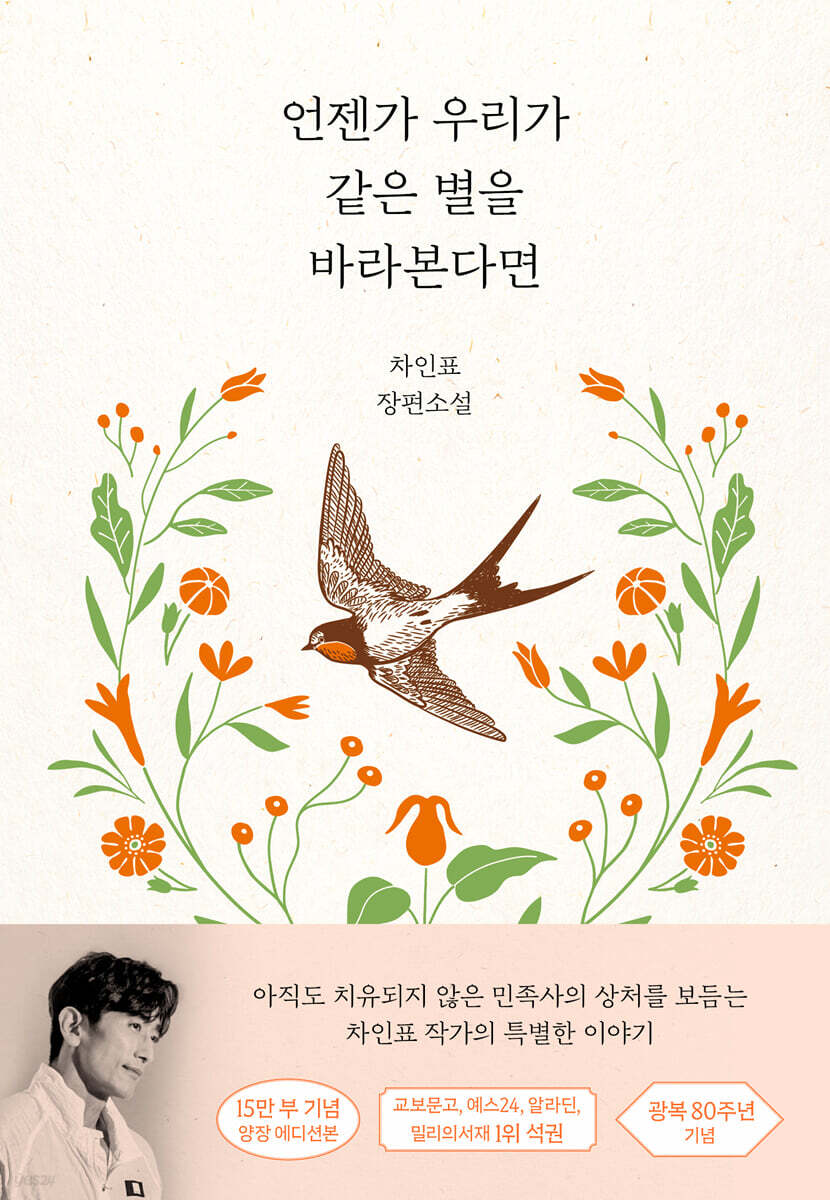
If We Look at the Same Star Someday (150,000-Copy Commemorative Hardcover Edition)
 |
Description
Book Introduction
Cha In-pyo's full-length novel, which received enthusiastic support and interest from readers in the second half of 2024.
"If Someday We Look at the Same Star"
150,000 copies commemorative hardcover special edition published!
"Someday We'll Look at the Same Star" is a story about the younger days of Grandma Suni, who was discovered on a small island in the Philippines after 70 years away from her homeland.
The author began writing to leave behind the story of our mother's mother and father's father, who endured the poverty and persecution of our country when it lost its sovereignty to Japan.
The story, which began as a twenty-page A4 paper, went through many twists and turns during the ten-year writing period, including losing data and having to start over from scratch. Afterwards, it was completed as a lyrical and beautiful novel based on truth and fact.
The novel is set in a tiger village at the foot of Mount Baekdu in the 1930s.
The story features Yong-i, a tiger hunter who came to the tiger village with his father to take revenge on Baekho, the tiger that harmed his mother and younger sibling; Soon-i, the village chief's granddaughter; and Kazuo, a Japanese military officer who was an art student.
The innocent young people of that era, who simply wanted to live ordinary lives of happiness, overcome the despair they face in the whirlwind of history through their faith, love, and dedicated choices toward one another, and go through a passionate time.
The author unfolds the theme of 'love, forgiveness, and reconciliation' with a serious and warm perspective, while also leading the story with a sense of speed and density centered around the three main characters.
Moreover, the meticulously detailed scene composition and the beautiful scenery of the Baekdu Mountain village, which were thoroughly researched, are so vivid that a movie keeps coming to mind while reading, demonstrating another meaningful literary achievement.
Through this novel, the author seems to ask those of us living in peaceful times, “What would it have been like if you had lived in that era…”, “What can we do for them now…”
Now, the special story of author Cha In-pyo begins, embracing those who bear the scars of our nation's history that must never be forgotten and have yet to heal.
※ This book is a hardcover edition commemorating the 150,000-copy sales and 80th anniversary of liberation of 『Someday We Look at the Same Star』 published in 2021.
The text, excluding the author's note, is identical to the first edition.
"If Someday We Look at the Same Star"
150,000 copies commemorative hardcover special edition published!
"Someday We'll Look at the Same Star" is a story about the younger days of Grandma Suni, who was discovered on a small island in the Philippines after 70 years away from her homeland.
The author began writing to leave behind the story of our mother's mother and father's father, who endured the poverty and persecution of our country when it lost its sovereignty to Japan.
The story, which began as a twenty-page A4 paper, went through many twists and turns during the ten-year writing period, including losing data and having to start over from scratch. Afterwards, it was completed as a lyrical and beautiful novel based on truth and fact.
The novel is set in a tiger village at the foot of Mount Baekdu in the 1930s.
The story features Yong-i, a tiger hunter who came to the tiger village with his father to take revenge on Baekho, the tiger that harmed his mother and younger sibling; Soon-i, the village chief's granddaughter; and Kazuo, a Japanese military officer who was an art student.
The innocent young people of that era, who simply wanted to live ordinary lives of happiness, overcome the despair they face in the whirlwind of history through their faith, love, and dedicated choices toward one another, and go through a passionate time.
The author unfolds the theme of 'love, forgiveness, and reconciliation' with a serious and warm perspective, while also leading the story with a sense of speed and density centered around the three main characters.
Moreover, the meticulously detailed scene composition and the beautiful scenery of the Baekdu Mountain village, which were thoroughly researched, are so vivid that a movie keeps coming to mind while reading, demonstrating another meaningful literary achievement.
Through this novel, the author seems to ask those of us living in peaceful times, “What would it have been like if you had lived in that era…”, “What can we do for them now…”
Now, the special story of author Cha In-pyo begins, embracing those who bear the scars of our nation's history that must never be forgotten and have yet to heal.
※ This book is a hardcover edition commemorating the 150,000-copy sales and 80th anniversary of liberation of 『Someday We Look at the Same Star』 published in 2021.
The text, excluding the author's note, is identical to the first edition.
- You can preview some of the book's contents.
Preview
index
1.
Fall 1931, Baekdu Mountain
- The Legend of the Tiger Village
- The Tiger Hunter and Sooni
- Hwang Po-su's plan
- Kazuo's first letter
- Yong-i and Soon-i's hearts
- Hulcheok's dream
- Come when the bell rings
- Between the snow-covered reed fields
- Kazuo's fourth letter
2.
Second breakup
- Sooni's Prayer
- The Last of the Six Legs
- In search of Mother Star
- Kazuo's ninth letter
- Wooden doll
- The Promise of the Wildflower Field
- Children who don't return
3.
Order to mobilize Korean female workers
- Kazuo's sixty-eighth letter
- 7 years later
- Ominous news
- Tiger Village Population Census
- Kazuo's sixty-ninth letter
- Stormy night
- Only one virgin
- Kazuo, drenched in sorrow
- Lieutenant Colonel Takemono's lengthy speech
- Sooni being dragged away
4.
Dragon's War
- Oath of Revenge
- Kazuo's seventy-first letter
- Kazuo made up his mind
- Farewell
- The night of the final battle
- In the middle of the Japanese army camp
- Rescue
- Search
- Meeting after 7 years
- Japanese army's dragon hunt
- How to forgive
5.
Into the fog of Baekdu Mountain
- Kazuo's operational instructions
- Hideout in the Red Pine Forest
- Bang! Bang! Bang!
- I'll definitely be back.
- Baekdu Mountain shrouded in fog
Backstory
Author's Note
Recommendation
Fall 1931, Baekdu Mountain
- The Legend of the Tiger Village
- The Tiger Hunter and Sooni
- Hwang Po-su's plan
- Kazuo's first letter
- Yong-i and Soon-i's hearts
- Hulcheok's dream
- Come when the bell rings
- Between the snow-covered reed fields
- Kazuo's fourth letter
2.
Second breakup
- Sooni's Prayer
- The Last of the Six Legs
- In search of Mother Star
- Kazuo's ninth letter
- Wooden doll
- The Promise of the Wildflower Field
- Children who don't return
3.
Order to mobilize Korean female workers
- Kazuo's sixty-eighth letter
- 7 years later
- Ominous news
- Tiger Village Population Census
- Kazuo's sixty-ninth letter
- Stormy night
- Only one virgin
- Kazuo, drenched in sorrow
- Lieutenant Colonel Takemono's lengthy speech
- Sooni being dragged away
4.
Dragon's War
- Oath of Revenge
- Kazuo's seventy-first letter
- Kazuo made up his mind
- Farewell
- The night of the final battle
- In the middle of the Japanese army camp
- Rescue
- Search
- Meeting after 7 years
- Japanese army's dragon hunt
- How to forgive
5.
Into the fog of Baekdu Mountain
- Kazuo's operational instructions
- Hideout in the Red Pine Forest
- Bang! Bang! Bang!
- I'll definitely be back.
- Baekdu Mountain shrouded in fog
Backstory
Author's Note
Recommendation
Detailed image

Into the book
Suni asks, pointing to a faint star floating among the large, bright stars.
“Dragon, do you see that yellow star over there? I call that star my mother star.
“My mom lives there.”
Yong-i looks at where Soon-i is pointing.
In the night sky that Yong-i sees, countless stars twinkle equally.
I can't tell which star Sooni is referring to.
“Which star?”
“There, a faintly blinking yellow star between the Seven Stars and the North Star.
“The warmest-looking star.”
In Sooni's eyes, the warm stars are visible, but in Yongi's eyes, they seem invisible.
“Where? Which star is the warmest?”
Sooni feels sorry for Yongi who cannot see the mother star that she can see.
(...)
“My mother said that before she passed away from illness.
It is said that the soul of a mother who passed away before her child becomes a star and watches over her child.
It's about taking care of your beloved child with warm starlight.
“Someday, when the child comes to see his mother, the mother and child who have met again will never be separated and will be together forever.”
--- pp.66-67
Kazuo's Ninth Letter
Mother, I was very saddened to hear in your letter that you were repairing the barn alone.
I feel guilty that I am forcing my mother, who has a disability, to carry such a heavy burden, and that I am the only one seeking a just cause.
Mom, I'm sorry.
If I were in Japan, I would have run over and helped you right away. How difficult must it be?
(...)
In any case, as an officer of the Imperial Japanese Army, I will faithfully carry out the duties my country demands of me and then return.
Mother, there are only two and a half years left.
In two and a half years, I will return to Japan and become a sore foot for my mother.
Until then, take care.
i love you.
--- pp.72-73
As the Japanese soldiers approach Suni, Hulcheok, who was standing beside the village chief and sobbing, blocks Suni's path.
"no.
“I can’t take you.”
"What's with this kid? Does he want to die? Get out of the way."
One of the soldiers aims his gun at Hulchuk's chest and threatens him.
“Don’t get out of the way.
You guys get out of the way.
How dare you take someone away like an object without even asking! Are you Sooni's father? Or her mother? Who the hell are you to tell Sooni to go here or there? Just go away, just go away.
You guys… …if you don’t go, you’re really going to get in trouble.
I'll tell Yong-i.
When Yong-i comes back, he'll beat all of you up.
“If Yong-i kicks your butt once, you’ll fly all the way to Japan.”
Takemono raises his pistol and aims it at Hulchuk.
The whimper may know that the gun is about to fire.
A whimper is just a whimper, he's not stupid.
--- p.140
“Dragon, can you please forgive Baekho now?”
Yong-i falls silent again.
It's crying silently.
(...)
“I think if you forgive Baekho, you will be able to see Mother Star.”
"I don't know.
How to forgive.
(...) I don't know how to forgive someone who hasn't even asked for it.”
Yong-i's face, which continues to speak intermittently, is filled with deep loneliness.
“Forgiveness is not done because Baekho asks for forgiveness, but because of Mother Star.
Because I miss Mom Star so much.
“Because my mom is so precious.”
Yong-i, who was quietly listening to Soon-i, had eyes filled with stars from the night sky.
Yong-i looks at Soon-i's face with those eyes without saying a word.
“Dragon, do you see that yellow star over there? I call that star my mother star.
“My mom lives there.”
Yong-i looks at where Soon-i is pointing.
In the night sky that Yong-i sees, countless stars twinkle equally.
I can't tell which star Sooni is referring to.
“Which star?”
“There, a faintly blinking yellow star between the Seven Stars and the North Star.
“The warmest-looking star.”
In Sooni's eyes, the warm stars are visible, but in Yongi's eyes, they seem invisible.
“Where? Which star is the warmest?”
Sooni feels sorry for Yongi who cannot see the mother star that she can see.
(...)
“My mother said that before she passed away from illness.
It is said that the soul of a mother who passed away before her child becomes a star and watches over her child.
It's about taking care of your beloved child with warm starlight.
“Someday, when the child comes to see his mother, the mother and child who have met again will never be separated and will be together forever.”
--- pp.66-67
Kazuo's Ninth Letter
Mother, I was very saddened to hear in your letter that you were repairing the barn alone.
I feel guilty that I am forcing my mother, who has a disability, to carry such a heavy burden, and that I am the only one seeking a just cause.
Mom, I'm sorry.
If I were in Japan, I would have run over and helped you right away. How difficult must it be?
(...)
In any case, as an officer of the Imperial Japanese Army, I will faithfully carry out the duties my country demands of me and then return.
Mother, there are only two and a half years left.
In two and a half years, I will return to Japan and become a sore foot for my mother.
Until then, take care.
i love you.
--- pp.72-73
As the Japanese soldiers approach Suni, Hulcheok, who was standing beside the village chief and sobbing, blocks Suni's path.
"no.
“I can’t take you.”
"What's with this kid? Does he want to die? Get out of the way."
One of the soldiers aims his gun at Hulchuk's chest and threatens him.
“Don’t get out of the way.
You guys get out of the way.
How dare you take someone away like an object without even asking! Are you Sooni's father? Or her mother? Who the hell are you to tell Sooni to go here or there? Just go away, just go away.
You guys… …if you don’t go, you’re really going to get in trouble.
I'll tell Yong-i.
When Yong-i comes back, he'll beat all of you up.
“If Yong-i kicks your butt once, you’ll fly all the way to Japan.”
Takemono raises his pistol and aims it at Hulchuk.
The whimper may know that the gun is about to fire.
A whimper is just a whimper, he's not stupid.
--- p.140
“Dragon, can you please forgive Baekho now?”
Yong-i falls silent again.
It's crying silently.
(...)
“I think if you forgive Baekho, you will be able to see Mother Star.”
"I don't know.
How to forgive.
(...) I don't know how to forgive someone who hasn't even asked for it.”
Yong-i's face, which continues to speak intermittently, is filled with deep loneliness.
“Forgiveness is not done because Baekho asks for forgiveness, but because of Mother Star.
Because I miss Mom Star so much.
“Because my mom is so precious.”
Yong-i, who was quietly listening to Soon-i, had eyes filled with stars from the night sky.
Yong-i looks at Soon-i's face with those eyes without saying a word.
--- pp.204-205
Publisher's Review
★ Commemorating the 80th Anniversary of Liberation ★
★ 2024 Korea's Top 3 Bookstores and Millie's Bookstore's Comprehensive Bestseller #1 ★
★ Selected as a 2024 Oxford University Korean Studies Essential Reading Course ★
★ tvN "You Quiz on the Block" Introduction ★
★ Overseas copyright export ★
A beautiful narrative about respect for life, reflection on good human nature, and forgiveness.
The story of Grandma Hoon, the inspiration for the creation
One day in 1997, the author heard on TV news that Grandma Hoon had returned to her home country and was reunited with her family 55 years after being forced into sexual slavery. Her heart was filled with pity, anger, and sorrow.
What would Grandma Hoon's life have been like if she hadn't been taken away by the Japanese military? She would have enjoyed the happiness of ordinary life, loved by her parents and neighbors.
You may have also enjoyed the happiness of meeting a good person, getting married, having children, and becoming a mother.
However, Grandma Hoon was caught up in the vortex of tragic history, lived a life of sacrifice through coercion and force, and almost lost her native language, and only returned to her hometown at the end of her life.
The author deeply resonated with the story of Grandma Hoon and the tragedy and irony of life that those who had to struggle to survive during the Japanese colonial period could not choose, and began writing with the hope that such pain and misfortune would never be repeated.
Stories and captivating characters that embody respect for life and a warm sense of solidarity.
This is a story steeped in lyricism that allows young people to deeply feel the injustice of the forced mobilization of comfort women during the Japanese colonial period, something they only encountered in textbooks.
It helps us realize the warmth of human nature and a sense of solidarity. _From "Recommendation" by Kang Hyun-gu (Korean language teacher at Gyeongmun High School)
“Tigers have been living in these mountains long before we built our villages and settled down.
Think about who is the host and who is the guest.
What would the world be like if we killed everything we could find, even if it was harmful to humans, a little inconvenient, or even a little beneficial? Even if it was not a human but an animal.
The world is a place where we live together.
“A person who cannot live with beasts cannot live with people either.” - From the text “The Legend of the Tiger Village”
“Oh my god, even a baby has six legs.
“Then what happened to that tiger cub?”
“My father told me to kill the cub because it would grow up to be a violent tiger like its mother.”
(...) This time, Sooni is silent.
“I lied and said I killed him.
“He told me to kill him, but when I looked into the tiger cub’s eyes, I couldn’t do it, so I sent him away without telling my father.”
Sooni breathes a sigh of relief.
I am grateful to the dragon for not killing the tiger cub. - From the text "The Last of the Six-legged Tiger"
“It’s alive! The rice ears haven’t broken yet.
“It’s covered in mud, but they’re all alive.”
People run into the field one by one.
(...) The people of Tiger Village and the Japanese soldiers work together.
(...) they will do it.
We will work together to raise up all the rice plants that have fallen like corpses.
(...) The revived rice ears will grow and produce more rice grains.
Those grains of rice will become a warm bowl of rice and sustain the life of someone who is tired and hungry.
So everyone will come back to life.
No matter how small the life, one living life becomes the starting point for saving another life.
The baby swallow seems to know very well that life is not a one-time thing but a continuity, that it is 'being alive' itself. - From the text "Only One Virgin"
Mother, if there is no place to return to, I will go down an invisible path.
If my plan succeeds, I feel I will be able to apologize to at least one of the millions of lives sacrificed for my country's vain desires.
Just as countless peaches grew on the dry branch that my mother spared without cutting it down, I only hope that from the life I save, new life will be born as much as we, Japan, have harmed. - From "Kazuo's Seventy-First Letter"
The keynotes running through this book can be broadly summarized as ‘respect for life’ and ‘forgiveness.’
The deep empathy and respect for nature and animals of the Baekdu Mountain Tiger Village people in the book, the Yong who secretly saved Yukbal's cub, Sooni who takes care of her grandfather while raising the abandoned baby Sammul, and the contents of the letters and actions of Japanese military officer Kazuo make us realize what warm human nature and solidarity are.
The author's upright and kind heart is projected onto each character, allowing us to simultaneously feel the essence of his ability to understand and deeply empathize with others, as well as his expressive power to embody this in specific and vivid characters.
Through these characters, we can get a glimpse of the world the author dreams of (a world where people with good hearts rely on each other, encourage each other, and live without losing hope).
Additionally, this book has the unique characteristic that there is no absolute evil, whether it be in beasts or humans.
It shows that everyone has their own circumstances and reasons for becoming like that, which evokes a warm sense of compassion.
The meaning of the star, the warmest "mother" in the world, and the arduous journey of life in search of the mother star.
“Dragon, do you see that yellow star over there? I call that star my mother star.
“My mom lives there.”
“Which star?”
“There, a faintly blinking yellow star between the Seven Stars and the North Star.
The warmest-looking star.
My mother said that before she passed away from illness.
It is said that the soul of a mother who passed away before her child becomes a star and watches over her child.
It's about taking care of your beloved child with warm starlight.
“Someday, when the child comes to see his mother, the mother and child who have met again will never be separated and will be together forever.”
"I see."
“Dragon, I hope that someday we can look at the same mother star no matter where we are.” - From the text “In Search of the Mother Star”
Sooni loses her mother to illness at a young age and believes that her mother has become a star and is caring for her with starlight.
Mother Star always watches over her children, but children can only see her if they have a clear mind, free from hatred and resentment.
Tiger hunter Yong-i's heart is filled with hatred for the white tiger that harmed his mother and younger sibling, and he cannot see his mother, Byeol. Soon-i feels sorry for Yong-i.
The two of them hope to see the warm star, the mother star, together someday, even if it is not right now.
In this book, ‘mother’ is a very important motif.
Yong-i and Soon-i grew up without a mother, and Soon-i's simple wish is to live as a mother and die as a mother.
The lack of a mother increases the longing for her, while at the same time, the mother becomes seen as another name for salvation.
In the six letters of Japanese military officer Kazuo, we can also see the unchanging ‘maternal love’ that permeates everything.
Moreover, even the ferocious tiger Six-legged was an infinitely loving mother who was indispensable to her cubs.
We all have a mother who gave us life.
The baby swallow, who appears in every major scene of the book, is a being who observes the various events taking place in the tiger village and the lives of the characters from a high place.
But the mother is a higher and more absolute love, comfort, forgiveness, and salvation that watches over and cherishes her children from a higher place than this baby swallow.
Mother, Mother Star, encapsulates all the fundamental goodness and beauty of the world.
“Dragon, can you please forgive Baekho now?”
Yong-i falls silent again.
It's crying silently.
“I think if you forgive Baekho, you will be able to see Mother Star.”
"I don't know.
How to forgive.
“I don’t know how to forgive someone who hasn’t even asked for it.”
Yong-i's face, which continues to speak intermittently, is filled with deep loneliness.
“Forgiveness is not done because Baekho asks for forgiveness, but because of Mother Star.
Because I miss Mom Star so much.
“Because my mother is so precious.” - From the text “How to Forgive”
Yong-i's father, Hwang Po-su, who had been chasing the white tiger all his life, is buried in the distant land of Siberia.
Yong-i is ultimately consumed by revenge against Baek-ho, who killed both of his parents, and even after seven years, he still cannot see his mother.
Sooni tells Yongi, who doesn't know how to forgive, that forgiveness isn't something you do because the other person asks for it, but that you have to forgive them first.
Perhaps this forgiveness includes not only forgiveness for Baekho, but also forgiveness for Yongi and the villagers who drove Yongi's father out, and, although it may be impossible, even forgiveness for the Japanese soldiers who took Sooni as a comfort woman.
Yong-i waits indefinitely for Soon-i, who was taken away as a comfort woman, and carves a tree to make an image of Soon-i and keeps it.
After many years, Sooni (Grandma Suni) returns home and discovers small letters written on the back of the wooden piece.
It's warm, Mom Star.
In the end, Yong-i must have seen his mother star later.
I will forgive those who did not ask for forgiveness.
This is the highlight of the novel, the moment when forgiveness is finally completed, and it shines sadly.
At the same time, it leaves a long aftertaste.
When you close the bookcase, it feels like Mother Star is warmly embracing and comforting the hearts of all those who are tired from the world.
Regarding this, author Kim Min-seop said, “The author’s good heart and attitude in saying that forgiveness can ultimately advance everyone’s life seems to ask what makes us human.
“More than anything, it makes me want to become a better person,” he says.
Overall: A beautifully cinematic novel that you will never forget.
"Someday We'll Look at the Same Star" is a beautiful narrative grounded in historical fact yet brimming with fairytale-like imagination, featuring captivating characters with good intentions who want to be together, research and insight into the depiction of nature against the backdrop of Baekdu Mountain, and compelling storytelling.
The author has unraveled the difficult subjects of 'the preciousness of life, good and evil, life and death, love and forgiveness' in a coherent and solid manner, making it impossible for readers to be drawn into the story in one breath.
Author Kim Min-sik said, “I met author Cha In-pyo while reading a book written by actor Cha In-pyo.
It was amazing.
How can we forgive someone who doesn't ask for forgiveness? The question the author raises resonates with me for a long time.
The combination of a poignant love story and a refreshing action film is also impressive.
He also praised it, saying, “It is a work that I would like to see made into a movie someday.”
Moreover, 『Someday We Will Look at the Same Star』 is a literary work that makes us feel the twists and turns of our modern and contemporary history with our hearts, following in the footsteps of Hwang Sun-won's 『Shower』, a pure love story between a boy and a girl, and Kwon Jeong-saeng's 『Sister Mongsil』, a story of a woman's growth that runs through a part of our difficult national history. It will become a history textbook that we must never forget.
★ 2024 Korea's Top 3 Bookstores and Millie's Bookstore's Comprehensive Bestseller #1 ★
★ Selected as a 2024 Oxford University Korean Studies Essential Reading Course ★
★ tvN "You Quiz on the Block" Introduction ★
★ Overseas copyright export ★
A beautiful narrative about respect for life, reflection on good human nature, and forgiveness.
The story of Grandma Hoon, the inspiration for the creation
One day in 1997, the author heard on TV news that Grandma Hoon had returned to her home country and was reunited with her family 55 years after being forced into sexual slavery. Her heart was filled with pity, anger, and sorrow.
What would Grandma Hoon's life have been like if she hadn't been taken away by the Japanese military? She would have enjoyed the happiness of ordinary life, loved by her parents and neighbors.
You may have also enjoyed the happiness of meeting a good person, getting married, having children, and becoming a mother.
However, Grandma Hoon was caught up in the vortex of tragic history, lived a life of sacrifice through coercion and force, and almost lost her native language, and only returned to her hometown at the end of her life.
The author deeply resonated with the story of Grandma Hoon and the tragedy and irony of life that those who had to struggle to survive during the Japanese colonial period could not choose, and began writing with the hope that such pain and misfortune would never be repeated.
Stories and captivating characters that embody respect for life and a warm sense of solidarity.
This is a story steeped in lyricism that allows young people to deeply feel the injustice of the forced mobilization of comfort women during the Japanese colonial period, something they only encountered in textbooks.
It helps us realize the warmth of human nature and a sense of solidarity. _From "Recommendation" by Kang Hyun-gu (Korean language teacher at Gyeongmun High School)
“Tigers have been living in these mountains long before we built our villages and settled down.
Think about who is the host and who is the guest.
What would the world be like if we killed everything we could find, even if it was harmful to humans, a little inconvenient, or even a little beneficial? Even if it was not a human but an animal.
The world is a place where we live together.
“A person who cannot live with beasts cannot live with people either.” - From the text “The Legend of the Tiger Village”
“Oh my god, even a baby has six legs.
“Then what happened to that tiger cub?”
“My father told me to kill the cub because it would grow up to be a violent tiger like its mother.”
(...) This time, Sooni is silent.
“I lied and said I killed him.
“He told me to kill him, but when I looked into the tiger cub’s eyes, I couldn’t do it, so I sent him away without telling my father.”
Sooni breathes a sigh of relief.
I am grateful to the dragon for not killing the tiger cub. - From the text "The Last of the Six-legged Tiger"
“It’s alive! The rice ears haven’t broken yet.
“It’s covered in mud, but they’re all alive.”
People run into the field one by one.
(...) The people of Tiger Village and the Japanese soldiers work together.
(...) they will do it.
We will work together to raise up all the rice plants that have fallen like corpses.
(...) The revived rice ears will grow and produce more rice grains.
Those grains of rice will become a warm bowl of rice and sustain the life of someone who is tired and hungry.
So everyone will come back to life.
No matter how small the life, one living life becomes the starting point for saving another life.
The baby swallow seems to know very well that life is not a one-time thing but a continuity, that it is 'being alive' itself. - From the text "Only One Virgin"
Mother, if there is no place to return to, I will go down an invisible path.
If my plan succeeds, I feel I will be able to apologize to at least one of the millions of lives sacrificed for my country's vain desires.
Just as countless peaches grew on the dry branch that my mother spared without cutting it down, I only hope that from the life I save, new life will be born as much as we, Japan, have harmed. - From "Kazuo's Seventy-First Letter"
The keynotes running through this book can be broadly summarized as ‘respect for life’ and ‘forgiveness.’
The deep empathy and respect for nature and animals of the Baekdu Mountain Tiger Village people in the book, the Yong who secretly saved Yukbal's cub, Sooni who takes care of her grandfather while raising the abandoned baby Sammul, and the contents of the letters and actions of Japanese military officer Kazuo make us realize what warm human nature and solidarity are.
The author's upright and kind heart is projected onto each character, allowing us to simultaneously feel the essence of his ability to understand and deeply empathize with others, as well as his expressive power to embody this in specific and vivid characters.
Through these characters, we can get a glimpse of the world the author dreams of (a world where people with good hearts rely on each other, encourage each other, and live without losing hope).
Additionally, this book has the unique characteristic that there is no absolute evil, whether it be in beasts or humans.
It shows that everyone has their own circumstances and reasons for becoming like that, which evokes a warm sense of compassion.
The meaning of the star, the warmest "mother" in the world, and the arduous journey of life in search of the mother star.
“Dragon, do you see that yellow star over there? I call that star my mother star.
“My mom lives there.”
“Which star?”
“There, a faintly blinking yellow star between the Seven Stars and the North Star.
The warmest-looking star.
My mother said that before she passed away from illness.
It is said that the soul of a mother who passed away before her child becomes a star and watches over her child.
It's about taking care of your beloved child with warm starlight.
“Someday, when the child comes to see his mother, the mother and child who have met again will never be separated and will be together forever.”
"I see."
“Dragon, I hope that someday we can look at the same mother star no matter where we are.” - From the text “In Search of the Mother Star”
Sooni loses her mother to illness at a young age and believes that her mother has become a star and is caring for her with starlight.
Mother Star always watches over her children, but children can only see her if they have a clear mind, free from hatred and resentment.
Tiger hunter Yong-i's heart is filled with hatred for the white tiger that harmed his mother and younger sibling, and he cannot see his mother, Byeol. Soon-i feels sorry for Yong-i.
The two of them hope to see the warm star, the mother star, together someday, even if it is not right now.
In this book, ‘mother’ is a very important motif.
Yong-i and Soon-i grew up without a mother, and Soon-i's simple wish is to live as a mother and die as a mother.
The lack of a mother increases the longing for her, while at the same time, the mother becomes seen as another name for salvation.
In the six letters of Japanese military officer Kazuo, we can also see the unchanging ‘maternal love’ that permeates everything.
Moreover, even the ferocious tiger Six-legged was an infinitely loving mother who was indispensable to her cubs.
We all have a mother who gave us life.
The baby swallow, who appears in every major scene of the book, is a being who observes the various events taking place in the tiger village and the lives of the characters from a high place.
But the mother is a higher and more absolute love, comfort, forgiveness, and salvation that watches over and cherishes her children from a higher place than this baby swallow.
Mother, Mother Star, encapsulates all the fundamental goodness and beauty of the world.
“Dragon, can you please forgive Baekho now?”
Yong-i falls silent again.
It's crying silently.
“I think if you forgive Baekho, you will be able to see Mother Star.”
"I don't know.
How to forgive.
“I don’t know how to forgive someone who hasn’t even asked for it.”
Yong-i's face, which continues to speak intermittently, is filled with deep loneliness.
“Forgiveness is not done because Baekho asks for forgiveness, but because of Mother Star.
Because I miss Mom Star so much.
“Because my mother is so precious.” - From the text “How to Forgive”
Yong-i's father, Hwang Po-su, who had been chasing the white tiger all his life, is buried in the distant land of Siberia.
Yong-i is ultimately consumed by revenge against Baek-ho, who killed both of his parents, and even after seven years, he still cannot see his mother.
Sooni tells Yongi, who doesn't know how to forgive, that forgiveness isn't something you do because the other person asks for it, but that you have to forgive them first.
Perhaps this forgiveness includes not only forgiveness for Baekho, but also forgiveness for Yongi and the villagers who drove Yongi's father out, and, although it may be impossible, even forgiveness for the Japanese soldiers who took Sooni as a comfort woman.
Yong-i waits indefinitely for Soon-i, who was taken away as a comfort woman, and carves a tree to make an image of Soon-i and keeps it.
After many years, Sooni (Grandma Suni) returns home and discovers small letters written on the back of the wooden piece.
It's warm, Mom Star.
In the end, Yong-i must have seen his mother star later.
I will forgive those who did not ask for forgiveness.
This is the highlight of the novel, the moment when forgiveness is finally completed, and it shines sadly.
At the same time, it leaves a long aftertaste.
When you close the bookcase, it feels like Mother Star is warmly embracing and comforting the hearts of all those who are tired from the world.
Regarding this, author Kim Min-seop said, “The author’s good heart and attitude in saying that forgiveness can ultimately advance everyone’s life seems to ask what makes us human.
“More than anything, it makes me want to become a better person,” he says.
Overall: A beautifully cinematic novel that you will never forget.
"Someday We'll Look at the Same Star" is a beautiful narrative grounded in historical fact yet brimming with fairytale-like imagination, featuring captivating characters with good intentions who want to be together, research and insight into the depiction of nature against the backdrop of Baekdu Mountain, and compelling storytelling.
The author has unraveled the difficult subjects of 'the preciousness of life, good and evil, life and death, love and forgiveness' in a coherent and solid manner, making it impossible for readers to be drawn into the story in one breath.
Author Kim Min-sik said, “I met author Cha In-pyo while reading a book written by actor Cha In-pyo.
It was amazing.
How can we forgive someone who doesn't ask for forgiveness? The question the author raises resonates with me for a long time.
The combination of a poignant love story and a refreshing action film is also impressive.
He also praised it, saying, “It is a work that I would like to see made into a movie someday.”
Moreover, 『Someday We Will Look at the Same Star』 is a literary work that makes us feel the twists and turns of our modern and contemporary history with our hearts, following in the footsteps of Hwang Sun-won's 『Shower』, a pure love story between a boy and a girl, and Kwon Jeong-saeng's 『Sister Mongsil』, a story of a woman's growth that runs through a part of our difficult national history. It will become a history textbook that we must never forget.
GOODS SPECIFICS
- Date of issue: April 25, 2025
- Format: Hardcover book binding method guide
- Page count, weight, size: 256 pages | 330g | 128*188*20mm
- ISBN13: 9791191061161
- ISBN10: 1191061167
You may also like
카테고리
korean


korean

![GQ KOREA Mark (Monthly): December [2025]](http://librairie.coreenne.fr/cdn/shop/files/8ef265dbbfbf186523ed75ba7319009d.jpg?v=1765340328&width=3840)


