

LLM AI Agent Development: Learn through 7 Projects
 |
Description
Book Introduction
The era of AI agents has arrived.
An agent is an artificial intelligence that can understand natural language, generate appropriate responses, and perform specific tasks.
Beyond being a simple content creation tool, it serves as a key link that seamlessly connects complex tasks.
This book comprehensively explores the creation of a flower delivery service, from the agent's technical framework and development tools to practical project examples and cutting-edge technological advancements.
Furthermore, by creating seven powerful agents, we analyze their design and implementation in detail, and even present the outlook and future trends for agent development. Leveraging cutting-edge technologies such as GPT-4, OpenAI Assistants API, LangChain, LlamaIndex, and MetaGPT, we will explore the remarkable roles agents can play in office automation, intelligent scheduling, and RAG.
Witness the agent's incredible performance firsthand and experience the infinite possibilities of the AI era.
An agent is an artificial intelligence that can understand natural language, generate appropriate responses, and perform specific tasks.
Beyond being a simple content creation tool, it serves as a key link that seamlessly connects complex tasks.
This book comprehensively explores the creation of a flower delivery service, from the agent's technical framework and development tools to practical project examples and cutting-edge technological advancements.
Furthermore, by creating seven powerful agents, we analyze their design and implementation in detail, and even present the outlook and future trends for agent development. Leveraging cutting-edge technologies such as GPT-4, OpenAI Assistants API, LangChain, LlamaIndex, and MetaGPT, we will explore the remarkable roles agents can play in office automation, intelligent scheduling, and RAG.
Witness the agent's incredible performance firsthand and experience the infinite possibilities of the AI era.
- You can preview some of the book's contents.
Preview
index
Translator's Preface xi
Recommendation xiii
Beta Reader Review xiv
Recommendation xvii
Starting with xix
About this book xxiii
CHAPTER 1 What is an agent and why is it an agent? 1
1.1 A Lecture That Sparks Imagination: Life 3.0 2
1.2 So, what exactly is an agent? 6
1.3 The Agent's Brain: LLM's General Reasoning Capabilities 11
__The human brain is amazing 12
__Pre-LLM Agent 13
__LLM is the agent's brain 14
__Highs of Expectations and Lows of Disappointment 17
__Knowledge, memory, understanding, expression, reasoning, reflection, generalization, self-improvement 20
Building AI Applications Based on __LLM's Inference Capabilities 24
1.4 Agent Sensing Abilities: Language Interaction and Multimodal Processing 26
__Language Interaction Skills 26
__Multi-mode processing capacity 26
__Combining language interaction skills and multimodal processing skills 27
1.5 Agent Execution Capabilities: Language Output Ability and Tool Usage Ability 28
__Language Output Ability 28
__Tool Usage Ability 29
__Realization of Concrete Intelligence 30
1.6 How Agents Improve Efficiency in Each Industry 31
__Automated Office Work Support 33
__Customer Service Revolution 33
__Personalized Recommendation 34
Process Automation and Resource Optimization 34
__Changes in Medical Services 35
1.7 New Business Models and Changes Brought by Agents 37
__Gartner's Eight Key Predictions 38
__AaaS 39
__Multi-agent collaboration 41
Self-Evolving Artificial Intelligence 42
__Development of Concrete Intelligence 44
1.8 Summary 45
CHAPTER 2 Agent-Based Systems Based on LLM 47
2.1 Four Key Elements of an Agent 47
2.2 Agent Planning and Decision-Making Abilities 51
2.3 Various memory mechanisms of agents 53
2.4 Agent's Core Technology: Tool Invocation 54
2.5 Agent's Inference Engine: ReAct-Based System 57
__What is ReAct? 57
__Implementing a Simple Agent Using a ReAct-Based System 61
__ReAct-based system-based prompt 65
__Create LLM instance 69
__Search Tool Definition 70
__Creating a ReAct Agent 71
__ReAct Agent Execution 72
2.6 Other Agent Cognitive-Based Systems 76
__Function call 76
__Planning and Execution 76
__Question and Answer 76
__Critical Revision 77
__Chain of Accidents 77
__Tree of Thought 77
2.7 Summary 78
CHAPTER 3 OpenAI API, LangChain, LlamaIndex 81
3.1 What is the OpenAI API? 83
__Talking about a company called OpenAI 83
__OpenAI API and Agent Development 89
__Example 92 of a Conversational Program Using the OpenAI API
Image Generation Example 101 Using the OpenAI API
__Notes on Using the OpenAI API 103
3.2 What is LangChain? 106
__Talking about LangChain 107
__LangChain's Six Modules 114
__LangChain and Agent Development 115
How to Use __LangSmith 117
3.3 What is LlamaIndex? 120
Talking about __LlamaIndex 120
__Developing AI based on LlamaIndex and Augmented Search Generation 121
__Simple LlamaIndex Development Example 126
3.4 Summary 130
CHAPTER 4 Agent 1: Automated Office Implementation - Creating Presentations Using the Assistants API and the DALL·E 3 Model 132
4.1 What is OpenAI's Helper? 134
4.2 Trying out the helper in the playground without coding 136
4.3 A Simple Example of the Assistants API 142
__Create a helper 143
__Creating a Dialogue Flow 149
__Add message 153
__Running the helper 157
__Show response 163
4.4 Creating a Simple Virtual Presentation 167
__Data Collection and Organization 168
__Creating an OpenAI Helper 169
__Automatically Generate Data Analysis Charts 172
__Automatically Generate Data Insights 179
__Automatically generate page titles 182
Creating a Presentation's First Page Image Using the __DALL·E 3 Model 183
__Automatically Generate Presentations 185
4.5 Summary 191
CHAPTER 5 Agent 2: Multifunctional Selection Engine - Function Calling 193
5.1 OpenAI's Function 195
What is the __Function Tool? 195
__Why the description of the function tool is important 196
Meaning of the __function tool definition example 198
What is a function call? 199
5.2 Defining Functions in Playgrounds 201
5.3 Implementing Function Calls Using the Assistants API 205
Creating a helper that can use the __function tool 207
__Running the helper directly without calling the function 210
__End the loop when the running session is in an action-required state 219
__Getting attribute information returned by the helper 221
__Calling a function through the return information of a helper 223
__Submit results and complete tasks 225
5.4 Implementing Tool Calls Using the ChatCompletion API 231
__Initializing the conversation and defining available functions 232
__First LLM call: After passing the conversation content and tool definition, get a response 233
__Calling the tool selected by the model and creating a new message 237
__Second LLM Call: Receive Final Response 241
5.5 Summary 244
CHAPTER 6 Agent 3: Collaboration between Reasoning and Action - Implementing Automatic Pricing Using LangChain's ReAct-Based Framework 246
6.1 ReAct-based System Review 247
6.2 Implementing ReAct Agents in LangChain 251
6.3 LangChain's Tools and Toolkit 253
6.4 ReAct Agent 256 that Sets Flower Prices
6.5 A Deep Dive into AgentExecutor's Execution Mechanism 263
Setting a breakpoint in __AgentExecutor 263
__First Thought: The Model Decides to Search 267
__First Action: Run a Search Using Tools 272
__Second Accident: The Model Decides to Calculate 276
__Second Action: Performing Calculations Using Tools 277
__Third Thought: The Model Completes the Task 279
6.6 Summary 280
CHAPTER 7 Agent 4: Separating Planning and Execution - Building a Smart Scheduler Using LangChain's Planning and Execution Agents 282
7.1 Proposals for Planning and Resolution Strategies 284
7.2 LangChain's Planning and Execution Agent 290
7.3 Implementing Logistics Management Using Planning and Execution Agents 291
__Defining a tool for automatic inventory allocation in the agent 291
__Creating a plan and execution agent and attempting to solve an unsolvable task 294
__Specify requests to have agents complete tasks 303
7.4 From Single Agent to Multi-Agent 309
7.5 Summary 309
CHAPTER 8 Agent 5: Knowledge Extraction and Integration - Implementing Augmented Search Generation Using LlamaIndex 311
8.1 What is Search Augmentation Generation? 313
__Prompt Engineering, Augmented Search Generation, Fine-Tuning 314
__Pipeline 316 in the search part from a technical perspective
__The Augmented Search Generation Process from a User Perspective 317
8.2 Search Augmentation Generation and Agent 319
8.3 Searching Financial Reports Using the ReAct Augmented Search Generation Agent 321
__Uploading an e-commerce company's financial report file 321
__Converting Financial Report Data to Vector Data 322
Building a Request Engine and Tools 324
Setting up LLM, the text generation engine 325
__Creating an Agent for Financial Information Retrieval 325
8.4 Summary 327
CHAPTER 9 Agent 6: Exploring Popular Agents on GitHub - AutoGPT, BabyAGI, CAMEL 329
9.1 AutoGPT 330
__AutoGPT Overview 330
__AutoGPT Practice 332
9.2 BabyAGI 338
__BabyAGI Overview 338
__BabyAGI Practice 341
9.3 CAMEL 356
__CAMEL Overview 356
__CAMEL Paper's Stock Trading Scenario 358
__CAMEL Practice 364
9.4 Summary 373
CHAPTER 10 Agent 7: Multi-Agent-Based Systems - AutoGen, MetaGPT 375
10.1 AutoGen 376
__Introducing AutoGen 377
__AutoGen Practice 379
10.2 MetaGPT 386
__Introducing MetaGPT 386
__MetaGPT Practice 388
10.3 Summary 395
APPENDIX A: The Birthplace of Next-Generation Agents: New Ideas from Academic Literature 397
A.1 Two high-quality agent-comprehensive papers 398
A.2 Recommended Papers: Agent Autonomous Learning, Multi-Agent Cooperation, Agent Reliability Assessment, Edge System Deployment, Embodied Intelligence Implementation 401
A.3 Summary 402
In conclusion 404
Search 407
Recommendation xiii
Beta Reader Review xiv
Recommendation xvii
Starting with xix
About this book xxiii
CHAPTER 1 What is an agent and why is it an agent? 1
1.1 A Lecture That Sparks Imagination: Life 3.0 2
1.2 So, what exactly is an agent? 6
1.3 The Agent's Brain: LLM's General Reasoning Capabilities 11
__The human brain is amazing 12
__Pre-LLM Agent 13
__LLM is the agent's brain 14
__Highs of Expectations and Lows of Disappointment 17
__Knowledge, memory, understanding, expression, reasoning, reflection, generalization, self-improvement 20
Building AI Applications Based on __LLM's Inference Capabilities 24
1.4 Agent Sensing Abilities: Language Interaction and Multimodal Processing 26
__Language Interaction Skills 26
__Multi-mode processing capacity 26
__Combining language interaction skills and multimodal processing skills 27
1.5 Agent Execution Capabilities: Language Output Ability and Tool Usage Ability 28
__Language Output Ability 28
__Tool Usage Ability 29
__Realization of Concrete Intelligence 30
1.6 How Agents Improve Efficiency in Each Industry 31
__Automated Office Work Support 33
__Customer Service Revolution 33
__Personalized Recommendation 34
Process Automation and Resource Optimization 34
__Changes in Medical Services 35
1.7 New Business Models and Changes Brought by Agents 37
__Gartner's Eight Key Predictions 38
__AaaS 39
__Multi-agent collaboration 41
Self-Evolving Artificial Intelligence 42
__Development of Concrete Intelligence 44
1.8 Summary 45
CHAPTER 2 Agent-Based Systems Based on LLM 47
2.1 Four Key Elements of an Agent 47
2.2 Agent Planning and Decision-Making Abilities 51
2.3 Various memory mechanisms of agents 53
2.4 Agent's Core Technology: Tool Invocation 54
2.5 Agent's Inference Engine: ReAct-Based System 57
__What is ReAct? 57
__Implementing a Simple Agent Using a ReAct-Based System 61
__ReAct-based system-based prompt 65
__Create LLM instance 69
__Search Tool Definition 70
__Creating a ReAct Agent 71
__ReAct Agent Execution 72
2.6 Other Agent Cognitive-Based Systems 76
__Function call 76
__Planning and Execution 76
__Question and Answer 76
__Critical Revision 77
__Chain of Accidents 77
__Tree of Thought 77
2.7 Summary 78
CHAPTER 3 OpenAI API, LangChain, LlamaIndex 81
3.1 What is the OpenAI API? 83
__Talking about a company called OpenAI 83
__OpenAI API and Agent Development 89
__Example 92 of a Conversational Program Using the OpenAI API
Image Generation Example 101 Using the OpenAI API
__Notes on Using the OpenAI API 103
3.2 What is LangChain? 106
__Talking about LangChain 107
__LangChain's Six Modules 114
__LangChain and Agent Development 115
How to Use __LangSmith 117
3.3 What is LlamaIndex? 120
Talking about __LlamaIndex 120
__Developing AI based on LlamaIndex and Augmented Search Generation 121
__Simple LlamaIndex Development Example 126
3.4 Summary 130
CHAPTER 4 Agent 1: Automated Office Implementation - Creating Presentations Using the Assistants API and the DALL·E 3 Model 132
4.1 What is OpenAI's Helper? 134
4.2 Trying out the helper in the playground without coding 136
4.3 A Simple Example of the Assistants API 142
__Create a helper 143
__Creating a Dialogue Flow 149
__Add message 153
__Running the helper 157
__Show response 163
4.4 Creating a Simple Virtual Presentation 167
__Data Collection and Organization 168
__Creating an OpenAI Helper 169
__Automatically Generate Data Analysis Charts 172
__Automatically Generate Data Insights 179
__Automatically generate page titles 182
Creating a Presentation's First Page Image Using the __DALL·E 3 Model 183
__Automatically Generate Presentations 185
4.5 Summary 191
CHAPTER 5 Agent 2: Multifunctional Selection Engine - Function Calling 193
5.1 OpenAI's Function 195
What is the __Function Tool? 195
__Why the description of the function tool is important 196
Meaning of the __function tool definition example 198
What is a function call? 199
5.2 Defining Functions in Playgrounds 201
5.3 Implementing Function Calls Using the Assistants API 205
Creating a helper that can use the __function tool 207
__Running the helper directly without calling the function 210
__End the loop when the running session is in an action-required state 219
__Getting attribute information returned by the helper 221
__Calling a function through the return information of a helper 223
__Submit results and complete tasks 225
5.4 Implementing Tool Calls Using the ChatCompletion API 231
__Initializing the conversation and defining available functions 232
__First LLM call: After passing the conversation content and tool definition, get a response 233
__Calling the tool selected by the model and creating a new message 237
__Second LLM Call: Receive Final Response 241
5.5 Summary 244
CHAPTER 6 Agent 3: Collaboration between Reasoning and Action - Implementing Automatic Pricing Using LangChain's ReAct-Based Framework 246
6.1 ReAct-based System Review 247
6.2 Implementing ReAct Agents in LangChain 251
6.3 LangChain's Tools and Toolkit 253
6.4 ReAct Agent 256 that Sets Flower Prices
6.5 A Deep Dive into AgentExecutor's Execution Mechanism 263
Setting a breakpoint in __AgentExecutor 263
__First Thought: The Model Decides to Search 267
__First Action: Run a Search Using Tools 272
__Second Accident: The Model Decides to Calculate 276
__Second Action: Performing Calculations Using Tools 277
__Third Thought: The Model Completes the Task 279
6.6 Summary 280
CHAPTER 7 Agent 4: Separating Planning and Execution - Building a Smart Scheduler Using LangChain's Planning and Execution Agents 282
7.1 Proposals for Planning and Resolution Strategies 284
7.2 LangChain's Planning and Execution Agent 290
7.3 Implementing Logistics Management Using Planning and Execution Agents 291
__Defining a tool for automatic inventory allocation in the agent 291
__Creating a plan and execution agent and attempting to solve an unsolvable task 294
__Specify requests to have agents complete tasks 303
7.4 From Single Agent to Multi-Agent 309
7.5 Summary 309
CHAPTER 8 Agent 5: Knowledge Extraction and Integration - Implementing Augmented Search Generation Using LlamaIndex 311
8.1 What is Search Augmentation Generation? 313
__Prompt Engineering, Augmented Search Generation, Fine-Tuning 314
__Pipeline 316 in the search part from a technical perspective
__The Augmented Search Generation Process from a User Perspective 317
8.2 Search Augmentation Generation and Agent 319
8.3 Searching Financial Reports Using the ReAct Augmented Search Generation Agent 321
__Uploading an e-commerce company's financial report file 321
__Converting Financial Report Data to Vector Data 322
Building a Request Engine and Tools 324
Setting up LLM, the text generation engine 325
__Creating an Agent for Financial Information Retrieval 325
8.4 Summary 327
CHAPTER 9 Agent 6: Exploring Popular Agents on GitHub - AutoGPT, BabyAGI, CAMEL 329
9.1 AutoGPT 330
__AutoGPT Overview 330
__AutoGPT Practice 332
9.2 BabyAGI 338
__BabyAGI Overview 338
__BabyAGI Practice 341
9.3 CAMEL 356
__CAMEL Overview 356
__CAMEL Paper's Stock Trading Scenario 358
__CAMEL Practice 364
9.4 Summary 373
CHAPTER 10 Agent 7: Multi-Agent-Based Systems - AutoGen, MetaGPT 375
10.1 AutoGen 376
__Introducing AutoGen 377
__AutoGen Practice 379
10.2 MetaGPT 386
__Introducing MetaGPT 386
__MetaGPT Practice 388
10.3 Summary 395
APPENDIX A: The Birthplace of Next-Generation Agents: New Ideas from Academic Literature 397
A.1 Two high-quality agent-comprehensive papers 398
A.2 Recommended Papers: Agent Autonomous Learning, Multi-Agent Cooperation, Agent Reliability Assessment, Edge System Deployment, Embodied Intelligence Implementation 401
A.3 Summary 402
In conclusion 404
Search 407
Detailed image

Into the book
Agents gain dynamic decision-making capabilities through a ReAct-based system.
When an agent encounters a problem that it cannot solve with its internal knowledge alone, it performs searches or invokes tools to expand its knowledge.
Beyond this, we leverage the flexibility of various tools to manipulate and transform multiple data sets, ultimately obtaining the data needed to make decisions.
After performing each step, the agent observes the outcome and incorporates new information into its next decision-making process, demonstrating remarkable learning and adaptability.
--- p.79
LlamaIndex's strategy is slightly different from LangChain's.
LlamaIndex isn't that 'big and comprehensive', but it's focused on developing AI-based search augmentation generation technology and building a multi-tenant search augmentation generation (RAG) system.
LlamaIndex-based enterprise solutions focus on removing technology and security barriers and empowering enterprises to leverage their data and enhance their service capabilities.
LlamaIndex's work focuses not only on technological development but also on applying these technologies to real-world businesses to improve operational efficiency and customer experience.
--- p.120
Of course, this could also be because LangChain has become so massive and expanded so comprehensively that it has become difficult to determine its direction.
There are many cases where details are particularly lacking, and if you look at LangChain's GitHub page, you'll see that there are thousands of open issues.
So, if you want to focus solely on enhancing document search and generation, the 'small and beautiful' LlamaIndex might be a better choice.
--- p.121
I modified the ReAct template slightly as shown above, and with this I was able to verify the GPT model's ability to understand non-English languages.
And even after editing this, there are times when you want to show off in English, so in those cases, you can emphasize that the prompt should be in Korean.
As these results show, within LangChain, the agent automatically formed a perfect flow of thoughts and actions, and provided the correct answers accordingly.
--- p.262
The planning and solving cognitive-based framework requires LLMs to solve problems in two steps.
This method involves first creating a plan to solve the problem, then creating a step-by-step action plan based on that plan, and then executing the plan to find the answer.
In other words, it is a method of first planning each step of the solution and then executing the planned steps.
Cognitive-based systems that plan and solve problems break them down into smaller subtasks and solve them according to a plan.
When an agent encounters a problem that it cannot solve with its internal knowledge alone, it performs searches or invokes tools to expand its knowledge.
Beyond this, we leverage the flexibility of various tools to manipulate and transform multiple data sets, ultimately obtaining the data needed to make decisions.
After performing each step, the agent observes the outcome and incorporates new information into its next decision-making process, demonstrating remarkable learning and adaptability.
--- p.79
LlamaIndex's strategy is slightly different from LangChain's.
LlamaIndex isn't that 'big and comprehensive', but it's focused on developing AI-based search augmentation generation technology and building a multi-tenant search augmentation generation (RAG) system.
LlamaIndex-based enterprise solutions focus on removing technology and security barriers and empowering enterprises to leverage their data and enhance their service capabilities.
LlamaIndex's work focuses not only on technological development but also on applying these technologies to real-world businesses to improve operational efficiency and customer experience.
--- p.120
Of course, this could also be because LangChain has become so massive and expanded so comprehensively that it has become difficult to determine its direction.
There are many cases where details are particularly lacking, and if you look at LangChain's GitHub page, you'll see that there are thousands of open issues.
So, if you want to focus solely on enhancing document search and generation, the 'small and beautiful' LlamaIndex might be a better choice.
--- p.121
I modified the ReAct template slightly as shown above, and with this I was able to verify the GPT model's ability to understand non-English languages.
And even after editing this, there are times when you want to show off in English, so in those cases, you can emphasize that the prompt should be in Korean.
As these results show, within LangChain, the agent automatically formed a perfect flow of thoughts and actions, and provided the correct answers accordingly.
--- p.262
The planning and solving cognitive-based framework requires LLMs to solve problems in two steps.
This method involves first creating a plan to solve the problem, then creating a step-by-step action plan based on that plan, and then executing the plan to find the answer.
In other words, it is a method of first planning each step of the solution and then executing the planned steps.
Cognitive-based systems that plan and solve problems break them down into smaller subtasks and solve them according to a plan.
--- p.288
Publisher's Review
Into the world of AI agents that will change the future
With recent advancements in AI technology, AI agents are moving beyond simple chatbots to become powerful tools that automate and optimize various tasks.
Enterprises will leverage AI agents to innovate in diverse areas, including office automation, customer service, personalized recommendations, process automation, resource optimization, and healthcare.
Learning and leveraging AI agent technology is becoming an essential skill for developers.
This book is designed to help you easily learn the core concepts and techniques of AI agent development through seven AI agent project examples that assist flower delivery services.
Beyond simple theoretical explanations, it covers in detail problem-solving methods and optimization strategies that arise during actual construction.
This practical guide will be useful to everyone, from developers who want to learn automation techniques using AI agents to researchers and planners who want to understand the latest trends in artificial intelligence.
Through this book, experience the potential of AI agents firsthand and prepare to grow at the center of future AI technology!
Target audience
● AI and software developers: Developers who want to gain practical experience by practicing AI agent development.
● Data Scientists and Researchers: Professionals who want to learn how to use LLM and RAG technologies to conduct intelligent searches and utilize data.
● IT planners and startup founders: Planners and startup executives who want to apply the latest AI technology to their services.
● General readers interested in AI agents: Those who want to experience how AI technology is applied in practice using LLM
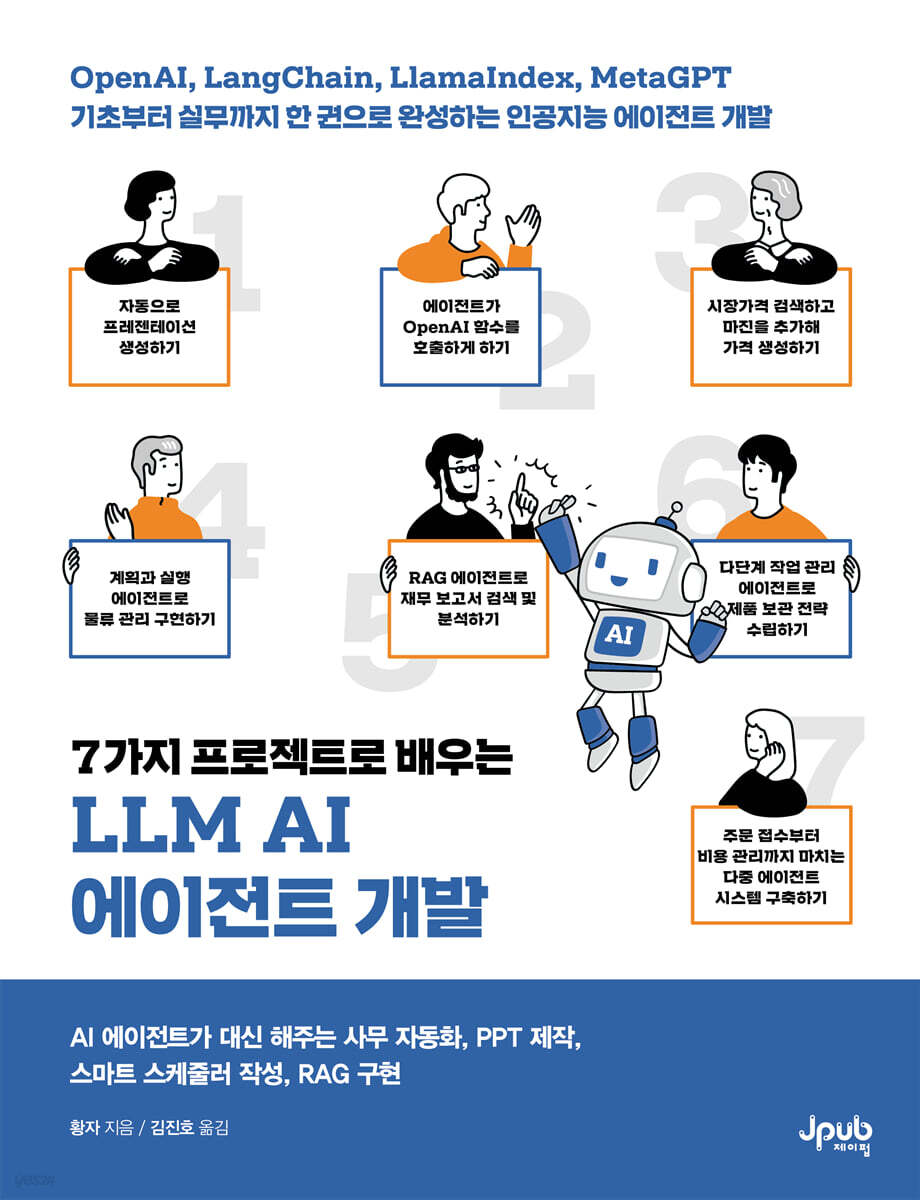
7 project cases
● Agent 1: Automatically generate presentations using the Assistants API and the DALL·E 3 model
● Agent 2: Make the agent call OpenAI functions using the OpenAI Assistants API.
● Agent 3: Generating prices using LangChain's ReAct-based system
● Agent 4: Implementing logistics management using LangChain's planning and execution agents
● Agent 5: Implement search augmentation using LlamaIndex and search and analyze financial reports
● Agent 6: Establishing a product storage strategy with the BabyAGI multi-step task management agent
● Agent 7: Building a multi-agent system that completes everything from order reception to cost management using AutoGen and MetaGPT.
With recent advancements in AI technology, AI agents are moving beyond simple chatbots to become powerful tools that automate and optimize various tasks.
Enterprises will leverage AI agents to innovate in diverse areas, including office automation, customer service, personalized recommendations, process automation, resource optimization, and healthcare.
Learning and leveraging AI agent technology is becoming an essential skill for developers.
This book is designed to help you easily learn the core concepts and techniques of AI agent development through seven AI agent project examples that assist flower delivery services.
Beyond simple theoretical explanations, it covers in detail problem-solving methods and optimization strategies that arise during actual construction.
This practical guide will be useful to everyone, from developers who want to learn automation techniques using AI agents to researchers and planners who want to understand the latest trends in artificial intelligence.
Through this book, experience the potential of AI agents firsthand and prepare to grow at the center of future AI technology!
Target audience
● AI and software developers: Developers who want to gain practical experience by practicing AI agent development.
● Data Scientists and Researchers: Professionals who want to learn how to use LLM and RAG technologies to conduct intelligent searches and utilize data.
● IT planners and startup founders: Planners and startup executives who want to apply the latest AI technology to their services.
● General readers interested in AI agents: Those who want to experience how AI technology is applied in practice using LLM
7 project cases
● Agent 1: Automatically generate presentations using the Assistants API and the DALL·E 3 model
● Agent 2: Make the agent call OpenAI functions using the OpenAI Assistants API.
● Agent 3: Generating prices using LangChain's ReAct-based system
● Agent 4: Implementing logistics management using LangChain's planning and execution agents
● Agent 5: Implement search augmentation using LlamaIndex and search and analyze financial reports
● Agent 6: Establishing a product storage strategy with the BabyAGI multi-step task management agent
● Agent 7: Building a multi-agent system that completes everything from order reception to cost management using AutoGen and MetaGPT.
GOODS SPECIFICS
- Date of issue: April 22, 2025
- Page count, weight, size: 436 pages | 858g | 188*245*21mm
- ISBN13: 9791194587200
You may also like
카테고리
korean


korean

![ELLE 엘르 스페셜 에디션 A형 : 12월 [2025]](http://librairie.coreenne.fr/cdn/shop/files/b8e27a3de6c9538896439686c6b0e8fb.jpg?v=1766436872&width=3840)


