

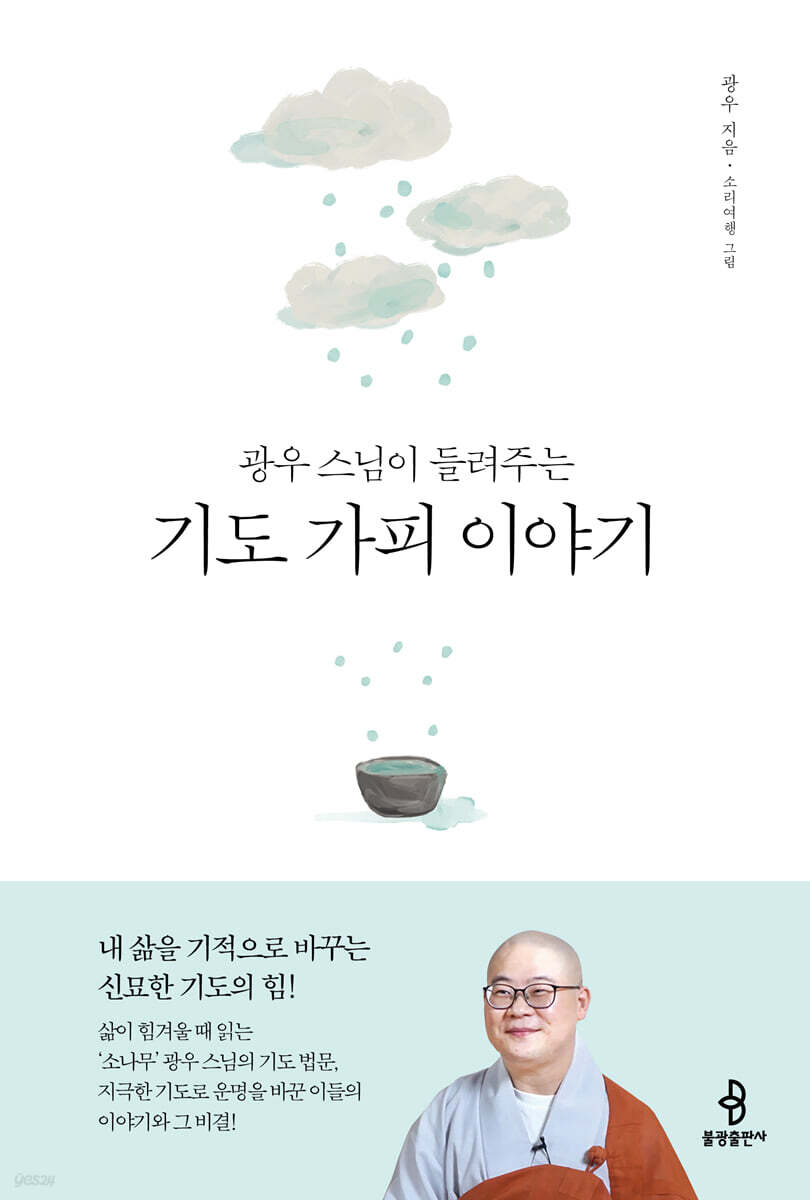
The story of prayer and healing told by Monk Gwangwoo
 |
Description
Book Introduction
When life gets tough, when there seems to be no solution to the adversity before us. Miraculous things happen when you 'pray'! The monk that Korean Buddhists most want to meet, BTN Buddhist TV's popular program "Pine Tree" hosted by Monk Gwangwoo Why We Need to Pray Right Now There is a television program that every Buddhist knows. It is BTN's "Pine Tree," which is ranked first in viewership ratings and popular search terms. Venerable Gwangwoo, who has hosted the program since its first broadcast in 2016, has been greatly loved by Buddhists and even viewers who are not interested in Buddhism for his entertaining, touching, and relatable sermons. The book, “Monk Gwangwoo’s Prayer Story of Healing,” written by a monk to help those who are helpless in the face of life’s adversities, has been published. Buddha said, 'We live according to the merits we have created.' This means that whether we bear good or bad fruit in life is determined by what we sow in the field of our hearts. This teaching, which speaks of the truth of karma, reincarnation, and cause and effect, is no different from the laws of the universe. But what kind of seeds are we planting now? How can we escape the shackles of evil karma, inherited through the seed of evil, time after time? Monk Gwangwoo says the answer lies in "fervent prayer." This is because sincere prayer practices such as chanting, prostrating oneself, reciting sutras, and practicing mantras contain the power of good deeds, good deeds, and merit that eliminate karma. This book conveys the profound and true power of prayer to the Buddha. What is special is that it contains the miraculous stories of those who changed their fate through extreme prayer practice. The stories of whale miracles, compiled by the author, the monk, from what he heard directly and indirectly and studied through ancient texts, are full of stories of people overcoming moments of crisis. Cases of healing conflicts with family members, overcoming illnesses of unknown causes, and escaping possession help us naturally understand the "everything about prayer" we've been curious about, while also providing a glimpse into the miraculous power of prayer practice directed toward the Buddha. The monk's sermon, which is kind and humorous without any difficult terms, also firmly tells us to get rid of the past habit of 'badmouthing others' and 'pray' instead of 'talking nonsense'. This is because the 'key to happiness' lies in the practice of prayer, which may seem trivial, but is actually quite something when put into practice. This book will empower those who are new to prayer to cultivate a desire to practice, and for those who want to give up on prayer, it will strengthen their resolve to continue. |
- You can preview some of the book's contents.
Preview
index
Entering
1.
Karma and destiny
Karma is always received, regardless of whether it comes early or late.
It's hard to be born as a human being
The unfortunate ones throw away the blessings that come to them.
You must use your mind well to receive blessings.
People who escaped fate
2.
The law of fate woven with grace and enmity
Meetings and partings are not accidents.
You must know that your family is your enemy.
Grace and resentment in reincarnation
3.
Reasons for Prayer
The best way to overcome life's obstacles
Buddhist life
People who overcame illness with the protection of the Buddha
The mysterious truth of prayer
The protection of the Buddha obtained in a dream
4.
The Miracle of Prayer
Avoiding the Three Evil Realms by Chanting the Name of Amitabha Buddha
The merits of the prayer of reciting the Buddha's name that leads to liberation from life and death
The mysterious protection of Avalokitesvara Bodhisattva
Surviving life through the protection of Avalokitesvara Bodhisattva
The protection and miraculous power of Ksitigarbha Bodhisattva
Repentance and the elimination of karma
The miracle of temple practice
The power of life gained by bowing to Buddha
The miraculous power of the "Shinmyojanggudaedharani"
Transmitting the spirit to heaven through the power of prayer
The "Gwangmyeong Mantra" that led the spirit to heaven
The virtues and protection of the Diamond Sutra
The merits of the Lotus Sutra
Going out
1.
Karma and destiny
Karma is always received, regardless of whether it comes early or late.
It's hard to be born as a human being
The unfortunate ones throw away the blessings that come to them.
You must use your mind well to receive blessings.
People who escaped fate
2.
The law of fate woven with grace and enmity
Meetings and partings are not accidents.
You must know that your family is your enemy.
Grace and resentment in reincarnation
3.
Reasons for Prayer
The best way to overcome life's obstacles
Buddhist life
People who overcame illness with the protection of the Buddha
The mysterious truth of prayer
The protection of the Buddha obtained in a dream
4.
The Miracle of Prayer
Avoiding the Three Evil Realms by Chanting the Name of Amitabha Buddha
The merits of the prayer of reciting the Buddha's name that leads to liberation from life and death
The mysterious protection of Avalokitesvara Bodhisattva
Surviving life through the protection of Avalokitesvara Bodhisattva
The protection and miraculous power of Ksitigarbha Bodhisattva
Repentance and the elimination of karma
The miracle of temple practice
The power of life gained by bowing to Buddha
The miraculous power of the "Shinmyojanggudaedharani"
Transmitting the spirit to heaven through the power of prayer
The "Gwangmyeong Mantra" that led the spirit to heaven
The virtues and protection of the Diamond Sutra
The merits of the Lotus Sutra
Going out
Detailed image
.jpg)
Into the book
Those who have accumulated little good fortune in their past lives are prone to become prematurely obsessed with the effectiveness of prayer.
As a result, doubts arise, such as, 'Is there really any spiritual power or blessing in prayer?'
These people need to plant a firm stake of faith in their hearts.
--- p.22
When someone dies, you can tell whether they went to heaven or hell by looking at the reactions of the people in the neighborhood.
If the people in the village are sad and feel sorry for him, then he has definitely gone to heaven.
On the contrary, if he were happy and proud, he would surely have fallen into hell.
It's a very natural thing.
--- p.29
Buddhism rejects the idea that fate is predetermined.
(…) The reason Buddha emphasized the karma of past lives and told us to create more blessings now was to teach us that we are ultimately the ones who create our own lives.
Well then, let me ask you a question.
What are you preparing to be born as in your next life?
--- p.36
If you have a lot of luck, things will go well no matter what you do, but if you don't have luck, things won't go well no matter what you do.
Also, there are times when the unfortunate commit foolish acts such as throwing away the opportunity to build up good fortune that was hard to come by.
--- p.44
We cannot use our minds as we please.
That is the limit of rebirth.
In Zen Buddhism, it is said that we are originally Buddhas, but because we do not use this mind well, we live as sentient beings.
If you use this mind well, you will be blessed, but if you use it wrong, you will be cursed.
--- p.49
There once was a very talented fortune teller.
If you look closely, people who are supposed to live well according to their fortune but actually have a hard time have something in common.
That's what I meant when I said it badly.
People who gossip a lot about others or say negative things about everything, even if they have good fortune, do not actually live as well as their fortune suggests.
--- p.63
Because Buddhism is a religion of enlightenment, it values wisdom.
But wisdom isn't something you can just polish.
To cultivate wisdom, you need a good teacher, the time and material resources to study, and good health.
You can cultivate wisdom only when you have these teacher's uniforms, time uniforms, food, clothing, and shelter uniforms, and health uniforms.
Therefore, Buddhism emphasizes that one must not only cultivate wisdom but also accumulate blessings as one's duty after being born as a human being.
--- p.65~66
“(…) While studying, I came across a saying that ‘a good physiognomy is not as good as a good bone appearance, and a good bone appearance is not as good as a good heart appearance.’
When I heard this, I had a great realization.
“If you have a good image, then a bad appearance is not a problem.”
--- p.72
They say that if you want to know whether you have created a lot of good karma or a lot of bad karma in your past life, or whether you have created a lot of blessings or a little blessings in your past life, you can find out by looking at the people around you.
In today's terms, it's like 'birds of a feather flock together'.
--- p.83
There is a famous saying in Buddhism: "Know that your family is your enemy."
Even if we met through bad karma, that is, if we met for revenge, if we were strangers, we could just live without seeing each other, but that doesn't work well with family.
So, family is a truly terrifying enemy.
--- p.101
If there is a problem between me and someone, I must change first.
In fact, there are many Buddhists who pray earnestly for their husbands, children, mothers-in-law, and daughters-in-law to change, but have no intention of changing themselves.
Then he asks, “I prayed so hard, so why hasn’t anything changed?”
At such times, the great monks say this:
“You do your best.”
--- p.107
If you hear a story about a gaphidam and just think, "That's an interesting story," without thinking much about it, it's no different from listening to an old story to kill time.
When you hear the story of the Gapyeong, it is meaningful only when you believe in it and that faith leads to the practice of prayer.
--- p.132
Different prayer practices have different ‘flavors.’
So, there are bound to be prayer methods that work well for you, prayer methods that you prefer.
Some people find peace of mind when they chant, while others prefer reading scriptures and praying.
But just as all these prayers eventually lead to fullness no matter what food you eat, they also lead to happiness, freedom, and even enlightenment through the cessation of karma.
_ Page 145
--- p.145
Whenever I have to give a sermon or lecture, I always say this.
Buddhism is not something you listen to with your ears or fill your head with.
Buddhism is about changing one's own destiny through prayer, eliminating karma, building up virtue, doing good deeds, and accumulating merit.
Therefore, Buddhism is not an academic discipline.
Buddhism is a practice in itself that can change my destiny.
--- p.158
“Monk, then if you get sick, you don’t have to go to the hospital. Instead, you can just pray.”
My answer is no.
I always tell people who think like that this:
'Go to the doctor for treatment, and the pharmacist for medicine!' If you're sick, you should see a doctor for treatment, and the pharmacist for medicine.
--- p.163~164
It is important to pray with the mindset of practicing to build up my fortune and eliminate my karma.
If you pray with the desire for a mysterious miracle rather than with the heart of practice, it will be difficult to pray consistently for a long time.
--- p.173
If you are feeling frustrated or have unresolved issues in life, let go of the thought that “if I pray, things will definitely work out.” Instead, pray with the mindset that “it is all my karma” and work on dissolving your karma.
Even if it doesn't seem to have any effect right away, if you pray consistently and persistently, you will definitely encounter this kind of miraculous blessing from the Bodhisattva.
--- p.181
As the saying goes, “A person who plays has to chant,” Buddhism says that chanting itself has merit, whether you believe it or not, or whether you know it or not.
(…) A great monk once said that chanting is the best and greatest insurance in the world.
--- p.200
People often say that when we're playing, we're chanting, but what do we actually do most when we're playing? Swearing at others.
What about your thoughts? Thinking about money, thinking about women, thinking about men—we all think about those things, don't we? If you let go of everything and focus solely on chanting, miracles will happen.
--- p.220~221
Buddhism has been called the religion of enlightenment, the religion of wisdom.
However, even devout Buddhists, when faced with difficult and painful situations, tend to want to escape from such situations rather than seek nirvana or liberation.
I, too, actively encourage prayer to Buddhists who are facing various difficulties.
To achieve enlightenment, practices such as Zen meditation or Vipassana are good, but to overcome the hardships of daily life, prayer practices that rely on the mysterious protection of the Buddha and Bodhisattva are good.
--- p.227
Regardless of whether the crisis before us is resolved or not, prayer dispels anxiety and impatience, bringing peace to the mind.
Above all, if the Buddha responds to your earnest prayers, you will surely receive gentle blessings in your life.
Believe that fact firmly.
As a result, doubts arise, such as, 'Is there really any spiritual power or blessing in prayer?'
These people need to plant a firm stake of faith in their hearts.
--- p.22
When someone dies, you can tell whether they went to heaven or hell by looking at the reactions of the people in the neighborhood.
If the people in the village are sad and feel sorry for him, then he has definitely gone to heaven.
On the contrary, if he were happy and proud, he would surely have fallen into hell.
It's a very natural thing.
--- p.29
Buddhism rejects the idea that fate is predetermined.
(…) The reason Buddha emphasized the karma of past lives and told us to create more blessings now was to teach us that we are ultimately the ones who create our own lives.
Well then, let me ask you a question.
What are you preparing to be born as in your next life?
--- p.36
If you have a lot of luck, things will go well no matter what you do, but if you don't have luck, things won't go well no matter what you do.
Also, there are times when the unfortunate commit foolish acts such as throwing away the opportunity to build up good fortune that was hard to come by.
--- p.44
We cannot use our minds as we please.
That is the limit of rebirth.
In Zen Buddhism, it is said that we are originally Buddhas, but because we do not use this mind well, we live as sentient beings.
If you use this mind well, you will be blessed, but if you use it wrong, you will be cursed.
--- p.49
There once was a very talented fortune teller.
If you look closely, people who are supposed to live well according to their fortune but actually have a hard time have something in common.
That's what I meant when I said it badly.
People who gossip a lot about others or say negative things about everything, even if they have good fortune, do not actually live as well as their fortune suggests.
--- p.63
Because Buddhism is a religion of enlightenment, it values wisdom.
But wisdom isn't something you can just polish.
To cultivate wisdom, you need a good teacher, the time and material resources to study, and good health.
You can cultivate wisdom only when you have these teacher's uniforms, time uniforms, food, clothing, and shelter uniforms, and health uniforms.
Therefore, Buddhism emphasizes that one must not only cultivate wisdom but also accumulate blessings as one's duty after being born as a human being.
--- p.65~66
“(…) While studying, I came across a saying that ‘a good physiognomy is not as good as a good bone appearance, and a good bone appearance is not as good as a good heart appearance.’
When I heard this, I had a great realization.
“If you have a good image, then a bad appearance is not a problem.”
--- p.72
They say that if you want to know whether you have created a lot of good karma or a lot of bad karma in your past life, or whether you have created a lot of blessings or a little blessings in your past life, you can find out by looking at the people around you.
In today's terms, it's like 'birds of a feather flock together'.
--- p.83
There is a famous saying in Buddhism: "Know that your family is your enemy."
Even if we met through bad karma, that is, if we met for revenge, if we were strangers, we could just live without seeing each other, but that doesn't work well with family.
So, family is a truly terrifying enemy.
--- p.101
If there is a problem between me and someone, I must change first.
In fact, there are many Buddhists who pray earnestly for their husbands, children, mothers-in-law, and daughters-in-law to change, but have no intention of changing themselves.
Then he asks, “I prayed so hard, so why hasn’t anything changed?”
At such times, the great monks say this:
“You do your best.”
--- p.107
If you hear a story about a gaphidam and just think, "That's an interesting story," without thinking much about it, it's no different from listening to an old story to kill time.
When you hear the story of the Gapyeong, it is meaningful only when you believe in it and that faith leads to the practice of prayer.
--- p.132
Different prayer practices have different ‘flavors.’
So, there are bound to be prayer methods that work well for you, prayer methods that you prefer.
Some people find peace of mind when they chant, while others prefer reading scriptures and praying.
But just as all these prayers eventually lead to fullness no matter what food you eat, they also lead to happiness, freedom, and even enlightenment through the cessation of karma.
_ Page 145
--- p.145
Whenever I have to give a sermon or lecture, I always say this.
Buddhism is not something you listen to with your ears or fill your head with.
Buddhism is about changing one's own destiny through prayer, eliminating karma, building up virtue, doing good deeds, and accumulating merit.
Therefore, Buddhism is not an academic discipline.
Buddhism is a practice in itself that can change my destiny.
--- p.158
“Monk, then if you get sick, you don’t have to go to the hospital. Instead, you can just pray.”
My answer is no.
I always tell people who think like that this:
'Go to the doctor for treatment, and the pharmacist for medicine!' If you're sick, you should see a doctor for treatment, and the pharmacist for medicine.
--- p.163~164
It is important to pray with the mindset of practicing to build up my fortune and eliminate my karma.
If you pray with the desire for a mysterious miracle rather than with the heart of practice, it will be difficult to pray consistently for a long time.
--- p.173
If you are feeling frustrated or have unresolved issues in life, let go of the thought that “if I pray, things will definitely work out.” Instead, pray with the mindset that “it is all my karma” and work on dissolving your karma.
Even if it doesn't seem to have any effect right away, if you pray consistently and persistently, you will definitely encounter this kind of miraculous blessing from the Bodhisattva.
--- p.181
As the saying goes, “A person who plays has to chant,” Buddhism says that chanting itself has merit, whether you believe it or not, or whether you know it or not.
(…) A great monk once said that chanting is the best and greatest insurance in the world.
--- p.200
People often say that when we're playing, we're chanting, but what do we actually do most when we're playing? Swearing at others.
What about your thoughts? Thinking about money, thinking about women, thinking about men—we all think about those things, don't we? If you let go of everything and focus solely on chanting, miracles will happen.
--- p.220~221
Buddhism has been called the religion of enlightenment, the religion of wisdom.
However, even devout Buddhists, when faced with difficult and painful situations, tend to want to escape from such situations rather than seek nirvana or liberation.
I, too, actively encourage prayer to Buddhists who are facing various difficulties.
To achieve enlightenment, practices such as Zen meditation or Vipassana are good, but to overcome the hardships of daily life, prayer practices that rely on the mysterious protection of the Buddha and Bodhisattva are good.
--- p.227
Regardless of whether the crisis before us is resolved or not, prayer dispels anxiety and impatience, bringing peace to the mind.
Above all, if the Buddha responds to your earnest prayers, you will surely receive gentle blessings in your life.
Believe that fact firmly.
--- p.250
Publisher's Review
“Never give up.
“The Buddha will surely answer your earnest prayers.”
When life gets tough, when there seems to be no solution to the adversity before us.
Miraculous things happen when you 'pray'!
Chanting, prostration, sutra chanting, mantra practice…
The miraculous power of prayer to change your life!
There's a television program that every Buddhist knows: BTN's "Pine Tree (Precious Me, Infinite Happiness)".
This program has been airing for three seasons since 2016 and still holds the top spot in viewership ratings and popular search rankings.
It is thanks to the easy and fun sermons of the host, Monk Gwangwoo, the stories of 'empathy' that are easy to listen to and make you nod your head, and the 'hope' that I too can be happy.
As if to prove this, the monk is the number one dharma master invited to temples across the country for dharma ceremonies, and is considered the most beloved figure that Korean Buddhists, regardless of generation, most want to meet.
This book, written by such a monk, is a solution for those who are unable to move in the face of life's adversities. It explains 'everything about praying to the Buddha and Bodhisattva' in a refreshing and humorous atmosphere without a single difficult sentence.
A mystical anecdote that awakens the profound and true power of prayer.
The most notable feature of this book is that it contains 92 anecdotes of people who changed their fates through sincere prayer practices such as chanting, prostration, sutra reading, and mantra practice.
The ancient stories of miracles that monks heard directly or indirectly, or gathered from ancient texts such as sutras, are full of stories of people who overcame life-threatening crises through prayer.
Cases of healing conflicts with family, stories of overcoming illnesses of unknown causes, and stories of those who have been freed from possession provide a natural understanding of the various aspects of prayer practice and an opportunity to dispel previous misconceptions and misunderstandings.
And above all, we can glimpse the miraculous power of prayer directed toward the Buddha.
Even though these miraculous events are mystical stories that defy common sense, there must be a reason why they have been talked about for so long by countless monks and Buddhists.
However, one cannot help but wonder how such power can be contained in seemingly simple things such as chanting the name of the Buddha, bowing to a Buddha statue, or copying a sutra.
What happens when you chant on a lazy tongue?
Buddhism says that the painful life unfolding before our eyes now is the result of the evil karma we have accumulated from some time in our previous life until now.
As the saying goes, "You live according to your own destiny," the truth is that whether you bear good or bad fruit depends on what you plant in your own mind.
This wisdom, called the teachings of karma, reincarnation, and cause and effect, is no different from the laws of the universe.
But what seeds are we planting now?
People often say that when we're playing, we're chanting, but what do we actually do most when we're playing? Swearing at others.
What do you think? Thinking about money, thinking about women, thinking about men—you all think about those things, right? _ From the text
The practice of prayer disciplines our foolishness.
Instead of having bad intentions, words, or actions such as slandering or harming others, one disciplines one's thoughts, body, and mouth by 'chanting (praying)' with one's 'idle mouth' and avoiding evil deeds.
Furthermore, it calms our anxiety and nervousness.
Ultimately, letting go of the cause of suffering is the most fundamental effect of prayer practice and the first step we must take.
Second, the practice of prayer leads us to the path of repentance.
“The evil deeds I have committed so far are like that boiling cauldron.
Just as one puts out the fire and pours cold water to cool a cauldron, I too sincerely repent and constantly do good deeds to cool down the evil deeds I have committed.” _ From the text
As this famous Buddhist parable suggests, repentance cools down the heat of the evil karma one has accumulated so far and opens the way to eliminating the obstacles caused by karma.
The basic attitude of repentance is 'I was wrong.'
It means that I deeply reflect on the sins I have committed, whether I knew it or not.
The action that replaces that feeling is prostration, or prostration.
The stories of Buddhists who have experienced bursting into tears for no reason while bowing to the Buddha are not coincidental.
The Five Commandments of Monk Gwangwoo's Prayer to Eliminate Karma and Change Destiny
Prayer, whether it be chanting, prostration, or sutra-singing, is the only way to discipline evil deeds and eliminate karma.
The monk says that the power of blessings, good deeds, and merits that melt away karma is concentrated in the practice of prayer.
If we add sincerity and earnestness to such prayers, the Buddha and Bodhisattva around us will naturally respond, and we will be able to achieve what we desire, just like the protagonists of the miracle stories.
Let us keep in mind the monk's five commandments of prayer that summarize the message of this book.
Understand the teachings of karma and reincarnation.
“The law of cause and effect is exact.
This is the law of the universe.
A true Buddhist must thoroughly believe that both good and bad relationships are the cause and effect of my own actions.”
ㆍPrayer is a lifelong task.
Practice like breathing
“It’s impossible to pray for just a few weeks.
Also, don't be overly excited or depressed by whether your prayers and practices are effective right now or not.
“The merit of prayer never leaks out.”
Prayer without faith is an empty shell.
“The strength to not stop praying even in difficult situations comes from faith.
Don't just chase the miracles in front of you.
“That’s not practice.”
ㆍUse your mind well on a daily basis
“The Buddha’s words can be summarized in one character: ‘mind (心)’.
There is a saying that a good physiognomy is not as good as a good mental state.
“For a person to act like a human being is the right way to create blessings and good deeds.”
ㆍAlways arouse the 'Bodhicitta' at the beginning and end of prayer.
“Sentient beings who have developed the mind of Bodhicitta are always protected by all Buddhas and Bodhisattvas, Dharma Guardians, and countless heavenly beings.
“The first step to true mind study is Bodhicitta.”
Now it is up to us whether we will receive the efficacy of prayer and the protection of the Buddha or not.
This book awakens our consciousness and offers us the opportunity to practice a life of prayer and move forward on the path to true happiness.
The sermons of Monk Gwangwoo will give those who are new to prayer a strong desire to practice, and for those who are already praying, they will strengthen their resolve to practice even when they feel like giving up.
“Do you want to be happy? Do you want to create a happy life? Build your own blessings.
Do good deeds.
Build up virtue.
“The power of blessings, good deeds, and merit will lead you to the path of true happiness.” _ From the text
“The Buddha will surely answer your earnest prayers.”
When life gets tough, when there seems to be no solution to the adversity before us.
Miraculous things happen when you 'pray'!
Chanting, prostration, sutra chanting, mantra practice…
The miraculous power of prayer to change your life!
There's a television program that every Buddhist knows: BTN's "Pine Tree (Precious Me, Infinite Happiness)".
This program has been airing for three seasons since 2016 and still holds the top spot in viewership ratings and popular search rankings.
It is thanks to the easy and fun sermons of the host, Monk Gwangwoo, the stories of 'empathy' that are easy to listen to and make you nod your head, and the 'hope' that I too can be happy.
As if to prove this, the monk is the number one dharma master invited to temples across the country for dharma ceremonies, and is considered the most beloved figure that Korean Buddhists, regardless of generation, most want to meet.
This book, written by such a monk, is a solution for those who are unable to move in the face of life's adversities. It explains 'everything about praying to the Buddha and Bodhisattva' in a refreshing and humorous atmosphere without a single difficult sentence.
A mystical anecdote that awakens the profound and true power of prayer.
The most notable feature of this book is that it contains 92 anecdotes of people who changed their fates through sincere prayer practices such as chanting, prostration, sutra reading, and mantra practice.
The ancient stories of miracles that monks heard directly or indirectly, or gathered from ancient texts such as sutras, are full of stories of people who overcame life-threatening crises through prayer.
Cases of healing conflicts with family, stories of overcoming illnesses of unknown causes, and stories of those who have been freed from possession provide a natural understanding of the various aspects of prayer practice and an opportunity to dispel previous misconceptions and misunderstandings.
And above all, we can glimpse the miraculous power of prayer directed toward the Buddha.
Even though these miraculous events are mystical stories that defy common sense, there must be a reason why they have been talked about for so long by countless monks and Buddhists.
However, one cannot help but wonder how such power can be contained in seemingly simple things such as chanting the name of the Buddha, bowing to a Buddha statue, or copying a sutra.
What happens when you chant on a lazy tongue?
Buddhism says that the painful life unfolding before our eyes now is the result of the evil karma we have accumulated from some time in our previous life until now.
As the saying goes, "You live according to your own destiny," the truth is that whether you bear good or bad fruit depends on what you plant in your own mind.
This wisdom, called the teachings of karma, reincarnation, and cause and effect, is no different from the laws of the universe.
But what seeds are we planting now?
People often say that when we're playing, we're chanting, but what do we actually do most when we're playing? Swearing at others.
What do you think? Thinking about money, thinking about women, thinking about men—you all think about those things, right? _ From the text
The practice of prayer disciplines our foolishness.
Instead of having bad intentions, words, or actions such as slandering or harming others, one disciplines one's thoughts, body, and mouth by 'chanting (praying)' with one's 'idle mouth' and avoiding evil deeds.
Furthermore, it calms our anxiety and nervousness.
Ultimately, letting go of the cause of suffering is the most fundamental effect of prayer practice and the first step we must take.
Second, the practice of prayer leads us to the path of repentance.
“The evil deeds I have committed so far are like that boiling cauldron.
Just as one puts out the fire and pours cold water to cool a cauldron, I too sincerely repent and constantly do good deeds to cool down the evil deeds I have committed.” _ From the text
As this famous Buddhist parable suggests, repentance cools down the heat of the evil karma one has accumulated so far and opens the way to eliminating the obstacles caused by karma.
The basic attitude of repentance is 'I was wrong.'
It means that I deeply reflect on the sins I have committed, whether I knew it or not.
The action that replaces that feeling is prostration, or prostration.
The stories of Buddhists who have experienced bursting into tears for no reason while bowing to the Buddha are not coincidental.
The Five Commandments of Monk Gwangwoo's Prayer to Eliminate Karma and Change Destiny
Prayer, whether it be chanting, prostration, or sutra-singing, is the only way to discipline evil deeds and eliminate karma.
The monk says that the power of blessings, good deeds, and merits that melt away karma is concentrated in the practice of prayer.
If we add sincerity and earnestness to such prayers, the Buddha and Bodhisattva around us will naturally respond, and we will be able to achieve what we desire, just like the protagonists of the miracle stories.
Let us keep in mind the monk's five commandments of prayer that summarize the message of this book.
Understand the teachings of karma and reincarnation.
“The law of cause and effect is exact.
This is the law of the universe.
A true Buddhist must thoroughly believe that both good and bad relationships are the cause and effect of my own actions.”
ㆍPrayer is a lifelong task.
Practice like breathing
“It’s impossible to pray for just a few weeks.
Also, don't be overly excited or depressed by whether your prayers and practices are effective right now or not.
“The merit of prayer never leaks out.”
Prayer without faith is an empty shell.
“The strength to not stop praying even in difficult situations comes from faith.
Don't just chase the miracles in front of you.
“That’s not practice.”
ㆍUse your mind well on a daily basis
“The Buddha’s words can be summarized in one character: ‘mind (心)’.
There is a saying that a good physiognomy is not as good as a good mental state.
“For a person to act like a human being is the right way to create blessings and good deeds.”
ㆍAlways arouse the 'Bodhicitta' at the beginning and end of prayer.
“Sentient beings who have developed the mind of Bodhicitta are always protected by all Buddhas and Bodhisattvas, Dharma Guardians, and countless heavenly beings.
“The first step to true mind study is Bodhicitta.”
Now it is up to us whether we will receive the efficacy of prayer and the protection of the Buddha or not.
This book awakens our consciousness and offers us the opportunity to practice a life of prayer and move forward on the path to true happiness.
The sermons of Monk Gwangwoo will give those who are new to prayer a strong desire to practice, and for those who are already praying, they will strengthen their resolve to practice even when they feel like giving up.
“Do you want to be happy? Do you want to create a happy life? Build your own blessings.
Do good deeds.
Build up virtue.
“The power of blessings, good deeds, and merit will lead you to the path of true happiness.” _ From the text
GOODS SPECIFICS
- Date of issue: August 30, 2024
- Page count, weight, size: 368 pages | 566g | 152*225*22mm
- ISBN13: 9791172610425
- ISBN10: 1172610428
You may also like
카테고리
korean


korean

![GQ KOREA Mark (Monthly): December [2025]](http://librairie.coreenne.fr/cdn/shop/files/8ef265dbbfbf186523ed75ba7319009d.jpg?v=1765340328&width=3840)


