

Thinking
 |
Description
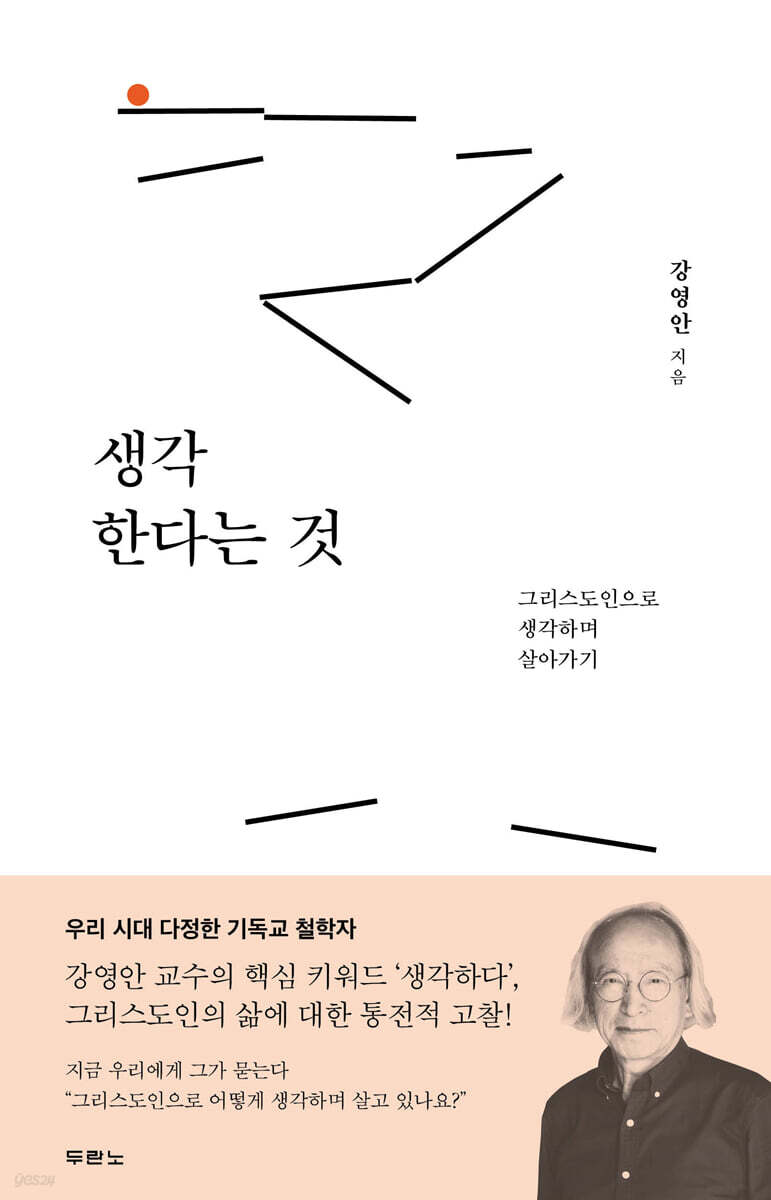
Book Introduction
A warm Christian philosopher of our time Professor Kang Young-an's key word is 'think'. A holistic reflection on the Christian life! He asks us now “How do you think and live as a Christian?” Professor Kang Young-an believes that philosophy begins with questions and that theologians are people who pray. He is a compassionate philosopher of our time who knows the depth and breadth of thought and reasoning from East and West, past and present, but guides us to the concrete and simple 'gospel thinking' of everyday life. Modern life, no matter where in the world, is a difficult and fierce struggle to survive each day. This is especially true for Christians. However, in this time of crisis, we may face a disastrous future where we may lose or be deprived of the ‘subject of thought’ and live without ‘God, the ruler of all things.’ At this very point, the author encourages us to live a life of questioning faith, and at the starting point, he kindly asks, "Are you living with thought?" What the author wants to share with Korean church members through 'thinking' is not 'knowledge' but 'the process of knowing God in detail, meeting Him, and living with Him.' Rather than not thinking at all, we have so many thoughts that we are actually struggling to stop them. However, I urge Christians to reflect on whether the thoughts that are most necessary for them are being properly thought through. The author covers a variety of languages, including Western philosophy, Eastern and Western classics, Hebrew, and Latin, and provides a wealth of guidance on the direction and method of thought across three chapters, tailored to the reader's level. |
- You can preview some of the book's contents.
Preview
index
As you go in
Chapter 1 What Happens If You Don't Think?
1. The misconception that faith and thought are mutually exclusive: anti-intellectualism
2. 'Don't think' vs. 'Think'
3 What Happens When You Don't Think?: Three Case Studies
Chapter 2: Thinking
1 The phenomenon called thought
2 So how do we understand thinking?
3 Ethics of Thought
Chapter 3: Thinking as a Christian
1 Thinking Christian
2 How Christians Should Think
3 Christians in the World
As I go out
Chapter 1 What Happens If You Don't Think?
1. The misconception that faith and thought are mutually exclusive: anti-intellectualism
2. 'Don't think' vs. 'Think'
3 What Happens When You Don't Think?: Three Case Studies
Chapter 2: Thinking
1 The phenomenon called thought
2 So how do we understand thinking?
3 Ethics of Thought
Chapter 3: Thinking as a Christian
1 Thinking Christian
2 How Christians Should Think
3 Christians in the World
As I go out
Detailed image
.png)
Into the book
For Christians, mere survival or success is not the goal of life.
The purpose of living in this world as one who has been called, sent, and loved by Jesus Christ is to live a life that responds and is responsible according to this identity.
To live like this, we must form a life that is one with Christ, who emptied himself, humbled himself, and sacrificed himself to save the whole world.
A Christian cannot think and live like a Christian without becoming one with Jesus Christ, who was incarnated, crucified, and resurrected.
Only when we have the mind of Jesus Christ within us can we have proper Christian thoughts and live humbly, lowering ourselves.
--- From "Entering"
But don't you wonder why we think that thinking, reflecting, examining, and questioning are contrary to faith or even detrimental to it? Is it truly possible for an act of faith to occur without thought or questioning? A counterexample can be found directly in the Bible.
Look at Acts 2.
When the gospel was first preached in Jerusalem, the people who heard Peter's sermon were pricked in their hearts and responded to Peter and the apostles with nothing other than a 'question.'
“Brothers, what shall we do?” (Acts 2:37).
--- p.19~20
What does it mean to repent? We understand it as admitting our mistakes, turning away from our wrongdoings, and becoming a new person.
You're not wrong.
But if you look at the word itself, the word 'repent' means 'to change one's mind'.
The problem is the thought, the way of thinking, and the life that follows from it.
A person does not completely change just by changing their outward behavior or actions.
Your thoughts, values, and beliefs must change completely.
Because our thoughts do not change, only our outward actions change, the power and fruit of the gospel are not revealed in our actual lives.
For the power of the gospel to be revealed, when you enter the church, you must not only bring your heart with you and leave your head outside the door, but also bring your head and heart into the church.
--- p.28
The devil thinks that he can easily draw people to his side as long as they don't think about it.
One of the things I do to avoid thinking is to keep books away from me.
In the first letter, Screwtape tells of his experiences.
One day, he had a 'patient' who was an atheist and enjoyed reading books at the British Museum.
But one day, while reading the book, I felt that the patient's thoughts were flowing in the wrong direction.
So, he says, he tried to keep him from thinking by putting the thought, 'I need to eat lunch,' in his mind, and he couldn't go any further in the other direction, and thanks to that, he is now safely in hell.
“Don’t let him read,” “Don’t let him think,” these are the words of advice Screwtape constantly gives to the demon Wormwood.
If you don't think, you can easily fall for the devil's temptations.
--- p.50
Differences in faith, as well as cultural and regional differences, are important in terms of ways of thinking and the direction of thought.
Is it a theistic faith? An atheistic faith? Within theistic faiths, is it Judaism? Islam? Or Christianity? Depending on your faith, your perspective on the world, life, and yourself, and the way you handle things, will differ.
Even within the Christian faith, differences in thought emerge depending on whether one is Roman Catholic or Protestant. Even within Protestantism, differences in thought emerge depending on whether one is an evangelical church in the Lutheran tradition or a Reformed church following Calvin.
--- p.78~79
Just as creative thinking is important for living together with others, so is the ability to build a community.
'Community thinking' can be defined as the ability to think about and practice what everyone who lives with others should know.
In other words, it can be said to be a way of thinking that lives toward establishing the 'common good'.
For example, we should not speak loudly in crowded places, we should repay money we borrow from others, we should not do things that others may dislike, we should help people in need, we should prioritize the interests of our neighbors and the community, especially the weak, over our own interests. We can call the thinking that allows us to know and act on these things “community thinking” or “thinking for the public good.”
Communitarian thinking, which pursues the public good, is an essential ability when living in community with others.
--- p.104~105
We cannot express how fortunate we are that we do not live our lives of faith alone, but are together with brothers and sisters of the same faith.
We must care for each other, be interested in each other, and strive to build each other up.
Even if we find ourselves in a situation in life that is unsatisfactory, we must not despair and hope in the hope to which God has called us.
You have to read, think, explore, and ponder.
You can't let your studying posture slip even for a moment.
We should not discuss for the sake of discussion or debate for the sake of debate, but rather discuss and debate to build each other up spiritually and make us men of God.
--- p.158
Faith is an act of our whole person.
Faith is not merely an activity of the intellect, nor of the emotions, nor of the will; it is a holistic activity involving the entire person.
Therefore, we cannot accept only intellectualism, which emphasizes only knowledge, or only mysticism, which emphasizes only the experiences, feelings, and emotions of the heart, or only practicalism, which emphasizes the determination of the will.
Intellect, mystery, and practice are all essential elements of faith.
You cannot speak of complete faith without either one or the other.
Whole faith equally values the will to believe in and rely on Jesus Christ alone, to trust Him alone ultimately, to feel a love for Him, to think and know who He is, what He wants from us, and how we should live and what we should focus on.
--- p.194
Paul urges us to be of one mind and in humility esteem others better than our own, looking not only to our own interests but also to the interests of others.
Here, 'mind' refers to thoughts.
Paul tells us to be of the same mind.
In the following verse 5, “Let this mind be in you which was also in Christ Jesus,” the word “mind” also refers to thoughts.
It is to ensure that we have the thoughts of Jesus, the way of thinking of Jesus, and the fundamental attitude of life of Jesus.
Jesus' fundamental attitude and way of thinking was humility, and Jesus' humility was put into practice by emptying himself, lowering himself, and even sacrificing himself to the point of death.
The purpose of living in this world as one who has been called, sent, and loved by Jesus Christ is to live a life that responds and is responsible according to this identity.
To live like this, we must form a life that is one with Christ, who emptied himself, humbled himself, and sacrificed himself to save the whole world.
A Christian cannot think and live like a Christian without becoming one with Jesus Christ, who was incarnated, crucified, and resurrected.
Only when we have the mind of Jesus Christ within us can we have proper Christian thoughts and live humbly, lowering ourselves.
--- From "Entering"
But don't you wonder why we think that thinking, reflecting, examining, and questioning are contrary to faith or even detrimental to it? Is it truly possible for an act of faith to occur without thought or questioning? A counterexample can be found directly in the Bible.
Look at Acts 2.
When the gospel was first preached in Jerusalem, the people who heard Peter's sermon were pricked in their hearts and responded to Peter and the apostles with nothing other than a 'question.'
“Brothers, what shall we do?” (Acts 2:37).
--- p.19~20
What does it mean to repent? We understand it as admitting our mistakes, turning away from our wrongdoings, and becoming a new person.
You're not wrong.
But if you look at the word itself, the word 'repent' means 'to change one's mind'.
The problem is the thought, the way of thinking, and the life that follows from it.
A person does not completely change just by changing their outward behavior or actions.
Your thoughts, values, and beliefs must change completely.
Because our thoughts do not change, only our outward actions change, the power and fruit of the gospel are not revealed in our actual lives.
For the power of the gospel to be revealed, when you enter the church, you must not only bring your heart with you and leave your head outside the door, but also bring your head and heart into the church.
--- p.28
The devil thinks that he can easily draw people to his side as long as they don't think about it.
One of the things I do to avoid thinking is to keep books away from me.
In the first letter, Screwtape tells of his experiences.
One day, he had a 'patient' who was an atheist and enjoyed reading books at the British Museum.
But one day, while reading the book, I felt that the patient's thoughts were flowing in the wrong direction.
So, he says, he tried to keep him from thinking by putting the thought, 'I need to eat lunch,' in his mind, and he couldn't go any further in the other direction, and thanks to that, he is now safely in hell.
“Don’t let him read,” “Don’t let him think,” these are the words of advice Screwtape constantly gives to the demon Wormwood.
If you don't think, you can easily fall for the devil's temptations.
--- p.50
Differences in faith, as well as cultural and regional differences, are important in terms of ways of thinking and the direction of thought.
Is it a theistic faith? An atheistic faith? Within theistic faiths, is it Judaism? Islam? Or Christianity? Depending on your faith, your perspective on the world, life, and yourself, and the way you handle things, will differ.
Even within the Christian faith, differences in thought emerge depending on whether one is Roman Catholic or Protestant. Even within Protestantism, differences in thought emerge depending on whether one is an evangelical church in the Lutheran tradition or a Reformed church following Calvin.
--- p.78~79
Just as creative thinking is important for living together with others, so is the ability to build a community.
'Community thinking' can be defined as the ability to think about and practice what everyone who lives with others should know.
In other words, it can be said to be a way of thinking that lives toward establishing the 'common good'.
For example, we should not speak loudly in crowded places, we should repay money we borrow from others, we should not do things that others may dislike, we should help people in need, we should prioritize the interests of our neighbors and the community, especially the weak, over our own interests. We can call the thinking that allows us to know and act on these things “community thinking” or “thinking for the public good.”
Communitarian thinking, which pursues the public good, is an essential ability when living in community with others.
--- p.104~105
We cannot express how fortunate we are that we do not live our lives of faith alone, but are together with brothers and sisters of the same faith.
We must care for each other, be interested in each other, and strive to build each other up.
Even if we find ourselves in a situation in life that is unsatisfactory, we must not despair and hope in the hope to which God has called us.
You have to read, think, explore, and ponder.
You can't let your studying posture slip even for a moment.
We should not discuss for the sake of discussion or debate for the sake of debate, but rather discuss and debate to build each other up spiritually and make us men of God.
--- p.158
Faith is an act of our whole person.
Faith is not merely an activity of the intellect, nor of the emotions, nor of the will; it is a holistic activity involving the entire person.
Therefore, we cannot accept only intellectualism, which emphasizes only knowledge, or only mysticism, which emphasizes only the experiences, feelings, and emotions of the heart, or only practicalism, which emphasizes the determination of the will.
Intellect, mystery, and practice are all essential elements of faith.
You cannot speak of complete faith without either one or the other.
Whole faith equally values the will to believe in and rely on Jesus Christ alone, to trust Him alone ultimately, to feel a love for Him, to think and know who He is, what He wants from us, and how we should live and what we should focus on.
--- p.194
Paul urges us to be of one mind and in humility esteem others better than our own, looking not only to our own interests but also to the interests of others.
Here, 'mind' refers to thoughts.
Paul tells us to be of the same mind.
In the following verse 5, “Let this mind be in you which was also in Christ Jesus,” the word “mind” also refers to thoughts.
It is to ensure that we have the thoughts of Jesus, the way of thinking of Jesus, and the fundamental attitude of life of Jesus.
Jesus' fundamental attitude and way of thinking was humility, and Jesus' humility was put into practice by emptying himself, lowering himself, and even sacrificing himself to the point of death.
--- p.199~200
Publisher's Review
Three questions we must face to live as Christians:
The answer holds the key to a holistic Christian life.
The author explains what happens when we don't think, why there is a misconception that faith and thought are mutually exclusive, how we should approach thought from a Christian perspective, and what the Christian way of thinking is.
I highly recommend this book to anyone who possesses intellectual curiosity and refinement, yet is curious about how to accept, organize, and develop their thoughts amidst the seemingly conflicting gaps between themselves and the Bible.
It is evangelical because it is filled with wisdom and thoroughly centered on God, the Bible, and the Church, and it helps people move from being self-centered to living a life of altruistic abundance, following the teachings of the Bible and the Church.
It reminds readers of choice and free will, responsibility and mission, and yet also of the community of faith that Christianity possesses, that is, a life for others, and leads them to find answers to their questions.
Another fascinating aspect is the rich expansion of thought that occurs as the thoughts of Descartes, Van Person, Emmanuel Levinas, Jacques Ellul, Kant, Hannah Arendt, and CS Lewis intersect with the vast words recorded in the Bible.
We can find concrete examples everywhere of how modern Christians can embrace Jesus' thoughts and fundamental attitude toward life, and how this can save themselves and their communities.
“If we live in unity with Christ, we will think and act in a way that overflows and shares with others rather than constantly trying to fill ourselves,” he says, explaining why “thinking” is the starting point and the end point of a lifestyle united with Christ.
This is a good book for individuals or communities who want to follow Jesus' way of life and thought through knowledge and faith to read and share.
For readers
- People interested in philosophy, theology, and humanities
- People who like to think but have lost the direction or purpose of their thoughts
- Those who wish to integrate Eastern and Western classics and ideas with biblical values.
- Pastors and leaders who wish to mature the faith community through knowledge and faith.
- Christians who want to examine their intellect and humanistic abilities through the lens of the Gospel
- A cultured person who wants to know Christ at the threshold of the church
- Those who want to share gospel thoughts and discussions with young children or generations who have many questions
The answer holds the key to a holistic Christian life.
The author explains what happens when we don't think, why there is a misconception that faith and thought are mutually exclusive, how we should approach thought from a Christian perspective, and what the Christian way of thinking is.
I highly recommend this book to anyone who possesses intellectual curiosity and refinement, yet is curious about how to accept, organize, and develop their thoughts amidst the seemingly conflicting gaps between themselves and the Bible.
It is evangelical because it is filled with wisdom and thoroughly centered on God, the Bible, and the Church, and it helps people move from being self-centered to living a life of altruistic abundance, following the teachings of the Bible and the Church.
It reminds readers of choice and free will, responsibility and mission, and yet also of the community of faith that Christianity possesses, that is, a life for others, and leads them to find answers to their questions.
Another fascinating aspect is the rich expansion of thought that occurs as the thoughts of Descartes, Van Person, Emmanuel Levinas, Jacques Ellul, Kant, Hannah Arendt, and CS Lewis intersect with the vast words recorded in the Bible.
We can find concrete examples everywhere of how modern Christians can embrace Jesus' thoughts and fundamental attitude toward life, and how this can save themselves and their communities.
“If we live in unity with Christ, we will think and act in a way that overflows and shares with others rather than constantly trying to fill ourselves,” he says, explaining why “thinking” is the starting point and the end point of a lifestyle united with Christ.
This is a good book for individuals or communities who want to follow Jesus' way of life and thought through knowledge and faith to read and share.
For readers
- People interested in philosophy, theology, and humanities
- People who like to think but have lost the direction or purpose of their thoughts
- Those who wish to integrate Eastern and Western classics and ideas with biblical values.
- Pastors and leaders who wish to mature the faith community through knowledge and faith.
- Christians who want to examine their intellect and humanistic abilities through the lens of the Gospel
- A cultured person who wants to know Christ at the threshold of the church
- Those who want to share gospel thoughts and discussions with young children or generations who have many questions
GOODS SPECIFICS
- Date of issue: July 24, 2024
- Page count, weight, size: 244 pages | 390g | 135*210*15mm
- ISBN13: 9788953148758
- ISBN10: 8953148758
You may also like
카테고리
korean


korean

![GQ KOREA Mark (Monthly): December [2025]](http://librairie.coreenne.fr/cdn/shop/files/8ef265dbbfbf186523ed75ba7319009d.jpg?v=1765340328&width=3840)


