

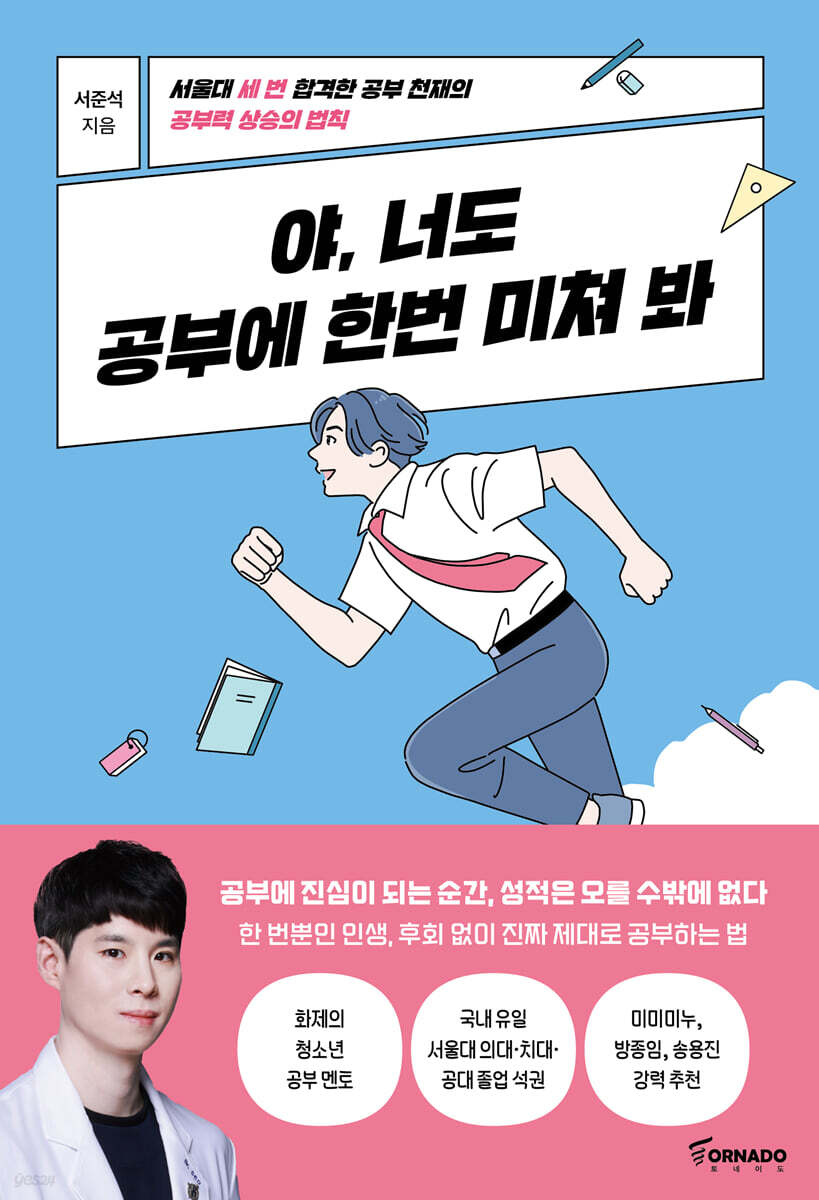
Hey, you should go crazy about studying too
 |
Description
Book Introduction
The moment you become serious about studying, your grades are bound to go up!
You only live once, so how to study properly and without regrets?
A popular study book by the author, the only one in Korea to have graduated from Seoul National University's medical school, dental school, and engineering school.
Mimi Minu, Korea's leading college entrance exam YouTuber, strongly recommends [Education Reporter TV] Editor-in-Chief Bang Jong-im.
Books recommended by Professor Song Yong-jin, who has led the International Mathematical Olympiad for over 20 years.
Author Seo Jun-seok, the only person in Korea to have graduated from Seoul National University's medical school, dental school, and engineering school, has published a study method book that summarizes his study secrets.
How did he manage to get into Seoul National University, a difficult university to get into, three times, and at the time he wanted, to the department he wanted?
This book contains the study habits that he developed through trial and error from elementary school through middle school to form a top-tier student, the strategic study secrets he learned while studying for three years with top students at Seoul Science High School, and the study strategies that helped him pass the entrance exams to Seoul National University College of Medicine and Seoul National University School of Dentistry in a short period of time.
Above all, it contains the author's passionate and strong determination to 'go crazy about studying for the sake of my life.'
Do you want to excel in your studies? Don't want to live a life of regret because of your studies? If so, listen to the author's powerful call to action in "Hey, You, Try Studying Crazy Too."
And let's follow the never-fail study roadmap he guides us through.
You only live once, so how to study properly and without regrets?
A popular study book by the author, the only one in Korea to have graduated from Seoul National University's medical school, dental school, and engineering school.
Mimi Minu, Korea's leading college entrance exam YouTuber, strongly recommends [Education Reporter TV] Editor-in-Chief Bang Jong-im.
Books recommended by Professor Song Yong-jin, who has led the International Mathematical Olympiad for over 20 years.
Author Seo Jun-seok, the only person in Korea to have graduated from Seoul National University's medical school, dental school, and engineering school, has published a study method book that summarizes his study secrets.
How did he manage to get into Seoul National University, a difficult university to get into, three times, and at the time he wanted, to the department he wanted?
This book contains the study habits that he developed through trial and error from elementary school through middle school to form a top-tier student, the strategic study secrets he learned while studying for three years with top students at Seoul Science High School, and the study strategies that helped him pass the entrance exams to Seoul National University College of Medicine and Seoul National University School of Dentistry in a short period of time.
Above all, it contains the author's passionate and strong determination to 'go crazy about studying for the sake of my life.'
Do you want to excel in your studies? Don't want to live a life of regret because of your studies? If so, listen to the author's powerful call to action in "Hey, You, Try Studying Crazy Too."
And let's follow the never-fail study roadmap he guides us through.
- You can preview some of the book's contents.
Preview
index
Recommendation
Prologue: The driving force behind my studies that helped me get into Seoul National University three times.
Everyone wants to be number one, but they don't study like one.
Part 1: From Ordinary to Great
First place Seo Jun-seok solves it
I didn't want to regret it later
The real study begins
There is no eternal skill.
What will the children of Daechi-dong learn?
Overcoming the mountain of study
My Study Roadmap
Part 2: Studying Crazy: The Fail-Proof "Real Study" Habit
Know-how comes from the butt
The power of one hour in the morning
Review time alone
Create your own rewards
Go crazy with details
How much time do I really focus?
When studying doesn't go as planned
Posture when making a mistake
If you start studying late
Study prodigies from Seoul Science High School and Seoul National University
Part 3: Study Secrets for Accepting Seoul National University Three Times
Subjects you are good at and subjects you are bad at
During the semester and during vacation
How to Use Class Time That School Doesn't Teach You
There's a hint in the textbook table of contents.
Three textbooks to review before the exam
Study Methods for Easy and Killer Questions
3-time reading study method
Copy the study habits of geniuses
My own cost-effective study method
Study tips for spare time
Part 4: Top-Ranking Subject-Specific Study Methods
The top score ultimately depends on the Korean language.
Anyone can become a top math student.
English is a battle of words
Social Studies Isn't a Battle of Memorization
Arm yourself with logical thinking when exploring science.
3-Step Science Exploration Study Method
Conclusion: If I were to go back to being a student and study again,
Prologue: The driving force behind my studies that helped me get into Seoul National University three times.
Everyone wants to be number one, but they don't study like one.
Part 1: From Ordinary to Great
First place Seo Jun-seok solves it
I didn't want to regret it later
The real study begins
There is no eternal skill.
What will the children of Daechi-dong learn?
Overcoming the mountain of study
My Study Roadmap
Part 2: Studying Crazy: The Fail-Proof "Real Study" Habit
Know-how comes from the butt
The power of one hour in the morning
Review time alone
Create your own rewards
Go crazy with details
How much time do I really focus?
When studying doesn't go as planned
Posture when making a mistake
If you start studying late
Study prodigies from Seoul Science High School and Seoul National University
Part 3: Study Secrets for Accepting Seoul National University Three Times
Subjects you are good at and subjects you are bad at
During the semester and during vacation
How to Use Class Time That School Doesn't Teach You
There's a hint in the textbook table of contents.
Three textbooks to review before the exam
Study Methods for Easy and Killer Questions
3-time reading study method
Copy the study habits of geniuses
My own cost-effective study method
Study tips for spare time
Part 4: Top-Ranking Subject-Specific Study Methods
The top score ultimately depends on the Korean language.
Anyone can become a top math student.
English is a battle of words
Social Studies Isn't a Battle of Memorization
Arm yourself with logical thinking when exploring science.
3-Step Science Exploration Study Method
Conclusion: If I were to go back to being a student and study again,
Detailed image

Into the book
Even students who usually study hard are surprised by the overwhelming learning atmosphere when they first step into the Daechi-dong classroom.
Daechi-dong classrooms are filled with the energy and passion of students concentrating on their studies.
Additionally, the strong sense of competition and mutual stimulation among students creates a natural synergy effect.
This atmosphere is a characteristic that is always emphasized among students and parents who have experienced Daechi-dong.
--- p.43
If you can develop this study habit from the beginning, you will be able to achieve tremendous study power later on.
If you study consistently, you will naturally develop your own study know-how.
If you combine a well-organized study method with the study habits of being able to concentrate in one place for long periods of time, the synergy effect will lead to a tremendous increase in grades.
--- p.62
Simply memorizing and understanding the content of lectures, lecture notes, or study guides is not enough.
In order to accurately select the correct answer to a problem in a real-life situation, you must go through the process of 'understanding and reviewing the concept -> solving the real-life problem -> reviewing the concept again.'
Only then can I make even the most difficult units that most students find 100% my own.
--- p.72
In my experience, it's effective to spend about 60% of your time on subjects you're weak in, and the remaining 40% on maintaining your strengths in the subjects you're good at.
If you consistently maintain high scores in subjects you are good at, you can feel more stable in your overall grades even if you receive somewhat lower scores in subjects you are weaker at.
--- p.121
The textbook table of contents is like a systematic map that organizes the learning content for a semester or a year.
This not only provides a learning direction, but also serves as a condensed version that summarizes the parts that are likely to appear on the exam.
However, many students do not consider this table of contents important.
When preparing for an internal exam, many people skip over the table of contents in the textbook and jump straight to the main text. This is a very inefficient approach.
The table of contents is the first key to understanding the structure of the vast contents of the textbook, and can be used as a starting point and summary for learning.
--- p.135
At this time, it is best to choose a workbook that has been published on the market for more than 5 years.
In many cases, the quality of problems in older workbooks has been verified over time.
This is because it has been consistently used by numerous teachers and students over a long period of time, and has become a recognized textbook for its exam trends and completeness of questions.
--- p.141
The second reading is a stage where you conduct in-depth study focusing on the important parts and parts you did not understand in the first reading.
In order to internalize what you have learned, you should read and organize it more thoroughly in an intensive reading format, rather than reading it quickly and skimming through it once.
Unlike the first reading, where I quickly read through the entire material and only highlighted the important parts, the second reading involves carefully reading the highlighted parts so that they are perfectly transferred to long-term memory.
Through this process, you can build your skills to be able to answer at least all of the questions that frequently appear on actual exams correctly.
--- p.150
Simply reading text doesn't stick in your memory for long, but writing it down by hand and drawing it, using multiple senses, imprints the information much more deeply in your brain.
The downside is that it can be time-consuming, but I recommend this method to students who haven't found other, less time-consuming memorization techniques effective.
Although this study method took a long time, it was the most perfect way to memorize a large amount of content among all the memorization methods.
--- p.157
In literary texts, there are often cases where the subject of a positive image and the subject of a negative image are in conflict.
Since most literary works, including poems, novels, and essays, follow this method, if you quickly read the passage while marking it with O and X, you will often find that the problem is surprisingly easy to solve.
--- p.178
After studying math for over 10 years, from elementary school to high school, and raising my math skills to the top level, I realized one thing.
The fact is that no matter how novel the idea or advanced mathematical thinking is, there are existing problems with similar solutions.
Even though the types of tests are different, if you look closely, you will definitely find a problem somewhere with a similar solution method.
--- pp.183-184
In this stage, we will focus on studying only the parts that are most likely to appear on the exam, out of the extensive exam scope that we painstakingly organized in Stage 1.
Those parts could be simple memorization parts, or they could be parts that require logical thinking and calculations, like physics or chemistry problems.
The important thing is that since the wide scope of the exam has been reduced by more than half, you should focus on studying this part and develop the ability to always get the correct answer when this range of content appears on the actual exam.
Daechi-dong classrooms are filled with the energy and passion of students concentrating on their studies.
Additionally, the strong sense of competition and mutual stimulation among students creates a natural synergy effect.
This atmosphere is a characteristic that is always emphasized among students and parents who have experienced Daechi-dong.
--- p.43
If you can develop this study habit from the beginning, you will be able to achieve tremendous study power later on.
If you study consistently, you will naturally develop your own study know-how.
If you combine a well-organized study method with the study habits of being able to concentrate in one place for long periods of time, the synergy effect will lead to a tremendous increase in grades.
--- p.62
Simply memorizing and understanding the content of lectures, lecture notes, or study guides is not enough.
In order to accurately select the correct answer to a problem in a real-life situation, you must go through the process of 'understanding and reviewing the concept -> solving the real-life problem -> reviewing the concept again.'
Only then can I make even the most difficult units that most students find 100% my own.
--- p.72
In my experience, it's effective to spend about 60% of your time on subjects you're weak in, and the remaining 40% on maintaining your strengths in the subjects you're good at.
If you consistently maintain high scores in subjects you are good at, you can feel more stable in your overall grades even if you receive somewhat lower scores in subjects you are weaker at.
--- p.121
The textbook table of contents is like a systematic map that organizes the learning content for a semester or a year.
This not only provides a learning direction, but also serves as a condensed version that summarizes the parts that are likely to appear on the exam.
However, many students do not consider this table of contents important.
When preparing for an internal exam, many people skip over the table of contents in the textbook and jump straight to the main text. This is a very inefficient approach.
The table of contents is the first key to understanding the structure of the vast contents of the textbook, and can be used as a starting point and summary for learning.
--- p.135
At this time, it is best to choose a workbook that has been published on the market for more than 5 years.
In many cases, the quality of problems in older workbooks has been verified over time.
This is because it has been consistently used by numerous teachers and students over a long period of time, and has become a recognized textbook for its exam trends and completeness of questions.
--- p.141
The second reading is a stage where you conduct in-depth study focusing on the important parts and parts you did not understand in the first reading.
In order to internalize what you have learned, you should read and organize it more thoroughly in an intensive reading format, rather than reading it quickly and skimming through it once.
Unlike the first reading, where I quickly read through the entire material and only highlighted the important parts, the second reading involves carefully reading the highlighted parts so that they are perfectly transferred to long-term memory.
Through this process, you can build your skills to be able to answer at least all of the questions that frequently appear on actual exams correctly.
--- p.150
Simply reading text doesn't stick in your memory for long, but writing it down by hand and drawing it, using multiple senses, imprints the information much more deeply in your brain.
The downside is that it can be time-consuming, but I recommend this method to students who haven't found other, less time-consuming memorization techniques effective.
Although this study method took a long time, it was the most perfect way to memorize a large amount of content among all the memorization methods.
--- p.157
In literary texts, there are often cases where the subject of a positive image and the subject of a negative image are in conflict.
Since most literary works, including poems, novels, and essays, follow this method, if you quickly read the passage while marking it with O and X, you will often find that the problem is surprisingly easy to solve.
--- p.178
After studying math for over 10 years, from elementary school to high school, and raising my math skills to the top level, I realized one thing.
The fact is that no matter how novel the idea or advanced mathematical thinking is, there are existing problems with similar solutions.
Even though the types of tests are different, if you look closely, you will definitely find a problem somewhere with a similar solution method.
--- pp.183-184
In this stage, we will focus on studying only the parts that are most likely to appear on the exam, out of the extensive exam scope that we painstakingly organized in Stage 1.
Those parts could be simple memorization parts, or they could be parts that require logical thinking and calculations, like physics or chemistry problems.
The important thing is that since the wide scope of the exam has been reduced by more than half, you should focus on studying this part and develop the ability to always get the correct answer when this range of content appears on the actual exam.
--- p.228
Publisher's Review
"Don't go crazy because of studying, go crazy about studying."
The only one in Korea to have won the Seoul National University College of Medicine, College of Dentistry, and College of Engineering!
The biggest driving force that helped me get into Seoul National University
The author, who had won awards in various competitions since elementary school, passed the entrance exam for Minjok History High School with the highest score, but went on to Seoul Science High School and was accepted to Seoul National University's College of Engineering through regular admission.
And after worrying about my future path, I started studying for the entrance exam again after 6 months in my 4th year of college and was accepted into Seoul National University School of Medicine and then Seoul National University School of Dentistry.
What is the secret to his study, given his impressive credentials that would make any Korean parent or student envious?
He emphasizes that no matter how smart you are, how excellent your learning curriculum is, or how excellent your lectures are, the shortcut to improving your grades lies in your mindset to study.
He was like that too.
Although I've always been number one since elementary school, it was when I realized the satisfaction and benefits of studying that I started to really enjoy it and decided to keep studying.
It is said that at that time, this thought came into his mind.
"Yes, if you want to live a life without regrets, let's go crazy about studying." From that moment on, his passionate and relentless study life began.
How do students at Daechi-dong, specialized high schools, and Seoul National University study?
Study habits and learning strategies that determine your study level
This book is a study bible that compiles not only the study habits and study methods that the author has personally acquired and proven from elementary school through the college entrance exam, but also the study strategies and study know-how of the top 0.1% students he met at Daechi-dong academies, Seoul Science High School, and Seoul National University.
The author explains a three-step review method to completely internalize what you learned in school or at an academy, study strategies based on grades for each subject, subjects that require prior study, and a vacation schedule, all of which help you solidify your study skills and systematically improve your grades.
In addition, the author introduces study secrets that are sure to improve grades, such as the 3-time reading study method that increases study ability directly proven by the author's experience and study geniuses around him, a cost-effective study method that increases efficiency in a short period of time, the table of contents study method that is most important but many students are not aware of, and the A4 paper study method and hippocampus memorization method that are the most effective for memorization.
On the long journey of study, everyone is bound to feel tired and lonely.
The author, who has served as a mentor to countless test-takers, provides detailed explanations of mental management and slump prescriptions that continuously motivate and promote rapid recovery, based on his own experience.
"I've never seen anything as effective as the author's study method." - Bang Jong-im, Editor-in-Chief of "Education Reporter TV"
"This book will be a ray of light during the arduous college entrance exam." - Mimi Minu, a college entrance exam YouTuber
Key points for each subject and practical exam know-how to ensure a good grade
A Seoul National University senior's study tips, proven with concrete results.
This book is generously filled with core study methods and practical test-taking strategies for each subject, proven through the success of not only the author but also the students he taught.
We explain, with specific, real-life examples, the know-how to avoid mistakes on easy questions, how to approach so-called killer questions, the textbooks to stick with until the exam, and tips to avoid mistakes on exam day.
It also provides step-by-step study methods and study tips to get a grade 1 in each subject on the College Scholastic Ability Test.
As a typical science student, the author contains study techniques proven by numerous successful experiences, including his own, ranging from how to improve grades in the Korean language section, which he found most difficult, to how to overcome the nervousness of the first period and demonstrate his abilities, to a method of studying math patterns that gradually raise the level of math and perfect it, to English basics and problem solving, and even a study method for social studies and science exploration with different strategies for each subject.
As you follow the study roadmap presented in this book, you will see yourself growing step by step, and you will no longer be afraid of studying or taking exams.
The only one in Korea to have won the Seoul National University College of Medicine, College of Dentistry, and College of Engineering!
The biggest driving force that helped me get into Seoul National University
The author, who had won awards in various competitions since elementary school, passed the entrance exam for Minjok History High School with the highest score, but went on to Seoul Science High School and was accepted to Seoul National University's College of Engineering through regular admission.
And after worrying about my future path, I started studying for the entrance exam again after 6 months in my 4th year of college and was accepted into Seoul National University School of Medicine and then Seoul National University School of Dentistry.
What is the secret to his study, given his impressive credentials that would make any Korean parent or student envious?
He emphasizes that no matter how smart you are, how excellent your learning curriculum is, or how excellent your lectures are, the shortcut to improving your grades lies in your mindset to study.
He was like that too.
Although I've always been number one since elementary school, it was when I realized the satisfaction and benefits of studying that I started to really enjoy it and decided to keep studying.
It is said that at that time, this thought came into his mind.
"Yes, if you want to live a life without regrets, let's go crazy about studying." From that moment on, his passionate and relentless study life began.
How do students at Daechi-dong, specialized high schools, and Seoul National University study?
Study habits and learning strategies that determine your study level
This book is a study bible that compiles not only the study habits and study methods that the author has personally acquired and proven from elementary school through the college entrance exam, but also the study strategies and study know-how of the top 0.1% students he met at Daechi-dong academies, Seoul Science High School, and Seoul National University.
The author explains a three-step review method to completely internalize what you learned in school or at an academy, study strategies based on grades for each subject, subjects that require prior study, and a vacation schedule, all of which help you solidify your study skills and systematically improve your grades.
In addition, the author introduces study secrets that are sure to improve grades, such as the 3-time reading study method that increases study ability directly proven by the author's experience and study geniuses around him, a cost-effective study method that increases efficiency in a short period of time, the table of contents study method that is most important but many students are not aware of, and the A4 paper study method and hippocampus memorization method that are the most effective for memorization.
On the long journey of study, everyone is bound to feel tired and lonely.
The author, who has served as a mentor to countless test-takers, provides detailed explanations of mental management and slump prescriptions that continuously motivate and promote rapid recovery, based on his own experience.
"I've never seen anything as effective as the author's study method." - Bang Jong-im, Editor-in-Chief of "Education Reporter TV"
"This book will be a ray of light during the arduous college entrance exam." - Mimi Minu, a college entrance exam YouTuber
Key points for each subject and practical exam know-how to ensure a good grade
A Seoul National University senior's study tips, proven with concrete results.
This book is generously filled with core study methods and practical test-taking strategies for each subject, proven through the success of not only the author but also the students he taught.
We explain, with specific, real-life examples, the know-how to avoid mistakes on easy questions, how to approach so-called killer questions, the textbooks to stick with until the exam, and tips to avoid mistakes on exam day.
It also provides step-by-step study methods and study tips to get a grade 1 in each subject on the College Scholastic Ability Test.
As a typical science student, the author contains study techniques proven by numerous successful experiences, including his own, ranging from how to improve grades in the Korean language section, which he found most difficult, to how to overcome the nervousness of the first period and demonstrate his abilities, to a method of studying math patterns that gradually raise the level of math and perfect it, to English basics and problem solving, and even a study method for social studies and science exploration with different strategies for each subject.
As you follow the study roadmap presented in this book, you will see yourself growing step by step, and you will no longer be afraid of studying or taking exams.
GOODS SPECIFICS
- Date of issue: February 17, 2025
- Page count, weight, size: 248 pages | 388g | 140*205*16mm
- ISBN13: 9791158513078
- ISBN10: 1158513070
You may also like
카테고리
korean


korean

![GQ KOREA Mark (Monthly): December [2025]](http://librairie.coreenne.fr/cdn/shop/files/8ef265dbbfbf186523ed75ba7319009d.jpg?v=1765340328&width=3840)


