

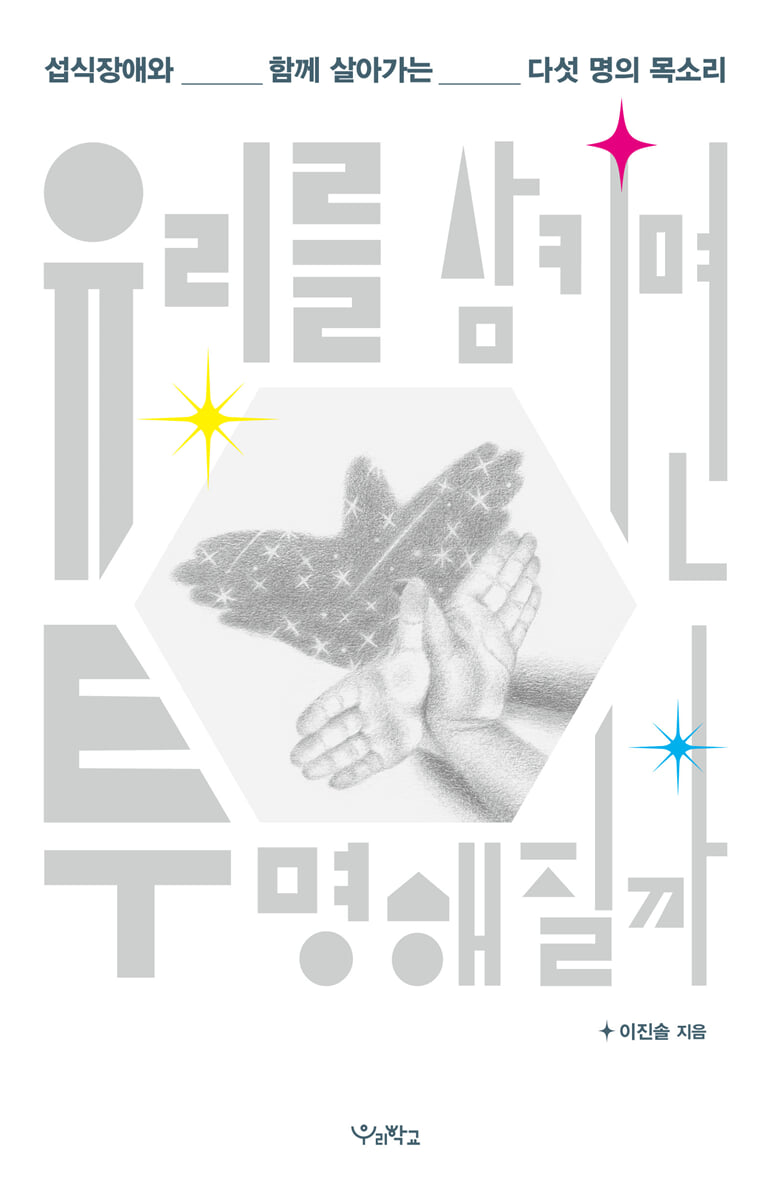
If you swallow glass, will it become transparent?
 |
Description
Book Introduction
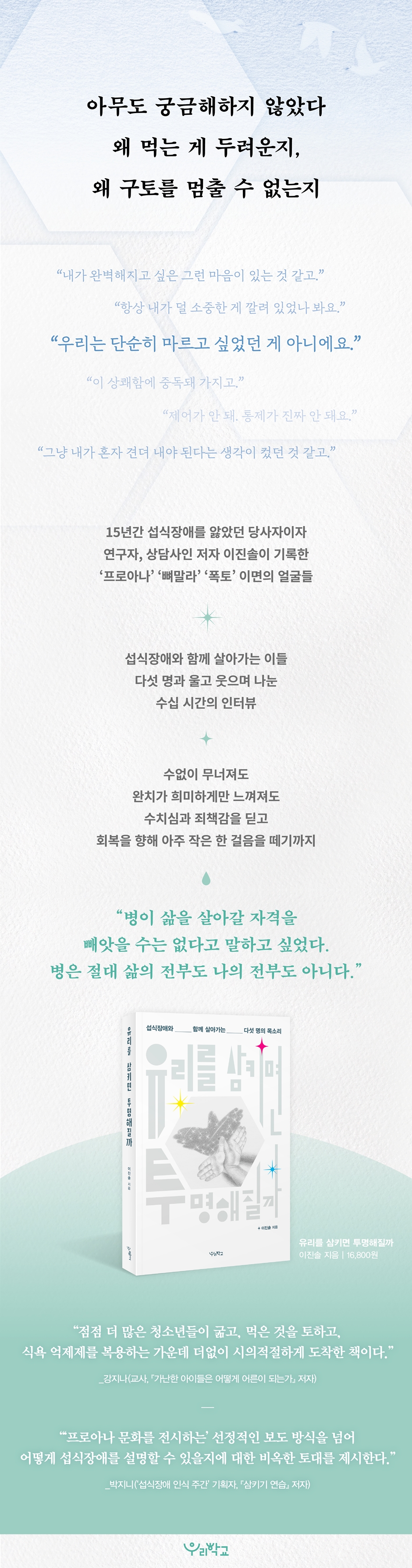
“I wanted to say that illness cannot take away the right to live.”
As a party, a researcher, and a counselor,
Stories of Five People with Eating Disorders
It is a sincere record of the struggle for recovery.
Thoughtful insights into a disease that is often overlooked
When people hear the word 'eating disorder', the first thing that comes to mind is dieting.
This is because the experiences shared behind 'successful' diets with titles like 'diet obsession' or 'barf side effects' are inevitably symptoms of eating disorders.
We binge eat, feel guilty afterward, exercise, and then become obsessed with dieting and binge eat.
Because of this, eating disorders have often been perceived as a side effect of harsh dieting.
But if eating disorders are simply a result of dieting, why can't people stop dieting even after reaching their target weight? Why do they eat food like a slurp, only to vomit it out, despite the pain and shame it brings? We need to start asking ourselves this question again.
Author Jinsol Lee, who has suffered from an eating disorder for 15 years, is a researcher who jumped into the field with the desire to give the voice of those with the disorder a voice in a situation where understanding of the disease is scarce, and a counselor who helps those with the same illness recover, met with five people with eating disorders.
This book, based on lengthy interviews with these individuals, meticulously details their encounters with eating disorders, their symptoms, the pain they endured while suffering from the illness, and their struggles to recover.
The genuine empathy that only those involved can share, and the thoughtful analysis that researchers can add, broaden the horizon of awareness of 'eating disorders,' which have previously been introduced only through provocative vocabulary and images.
I hope this book will serve as a helpful guide for those suffering from eating disorders and those around them who want to help them recover.
Eating disorders are not a disease that only people who are crazy about dieting get.
As a party, a researcher, and a counselor,
Stories of Five People with Eating Disorders
It is a sincere record of the struggle for recovery.
Thoughtful insights into a disease that is often overlooked
When people hear the word 'eating disorder', the first thing that comes to mind is dieting.
This is because the experiences shared behind 'successful' diets with titles like 'diet obsession' or 'barf side effects' are inevitably symptoms of eating disorders.
We binge eat, feel guilty afterward, exercise, and then become obsessed with dieting and binge eat.
Because of this, eating disorders have often been perceived as a side effect of harsh dieting.
But if eating disorders are simply a result of dieting, why can't people stop dieting even after reaching their target weight? Why do they eat food like a slurp, only to vomit it out, despite the pain and shame it brings? We need to start asking ourselves this question again.
Author Jinsol Lee, who has suffered from an eating disorder for 15 years, is a researcher who jumped into the field with the desire to give the voice of those with the disorder a voice in a situation where understanding of the disease is scarce, and a counselor who helps those with the same illness recover, met with five people with eating disorders.
This book, based on lengthy interviews with these individuals, meticulously details their encounters with eating disorders, their symptoms, the pain they endured while suffering from the illness, and their struggles to recover.
The genuine empathy that only those involved can share, and the thoughtful analysis that researchers can add, broaden the horizon of awareness of 'eating disorders,' which have previously been introduced only through provocative vocabulary and images.
I hope this book will serve as a helpful guide for those suffering from eating disorders and those around them who want to help them recover.
Eating disorders are not a disease that only people who are crazy about dieting get.
- You can preview some of the book's contents.
Preview
index
Recommendation
Entering
Interview
First story Dasom
Second Story Sea
Third story down
Fourth story reenactment
The fifth story, Yunseul
In conclusion
References
Entering
Interview
First story Dasom
Second Story Sea
Third story down
Fourth story reenactment
The fifth story, Yunseul
In conclusion
References
Detailed image
Into the book
When people think of eating disorders, the first thing that comes to mind is dieting, but my first encounter with eating disorders wasn't dieting.
Eating disorders were an emergency escape from problems I couldn't solve.
It was the only comfort I could find to vent my unresolved emotions.
--- From "Entering"
I remember the day I first saw Dasom on screen.
The sight of him secretly going outside, putting his phone on something like a fence, and shyly greeting his mother, wondering if she would hear the counseling.
We cried often, failed countless times, and still haven't completely broken free from our eating disorders.
--- From "The First Story, Dasom"
I wanted to tell them, 'You can live even if you don't get better. You can live even if you eat and vomit.'
Of course, this may sound irresponsible or idealistic.
Because it's asking a sick person to live in pain.
But I didn't want to tell you to live with illness, I wanted to say, 'Illness cannot take away the right to live.'
--- From "The Second Story, The Sea"
Down believes that eating disorders are a kind of 'incurable disease'.
It's better to think of it as a disease that can never be cured.
I feel like I've already tried everything I could and I'm living with the mindset that there's nothing I can do.
It doesn't really hurt when I meet people who criticize me for being weak-willed.
I think it's because I don't know much about this disease and I haven't experienced it that I can say such naive things.
I envy that innocence.
So, if someone were to dip their toes into this disease, I would definitely want to stop them, no matter what.
--- From "The Third Story, Down"
Even if we never get better, we will continue to live.
We'll live together, talking about eating and vomiting until you're sick of it, and not even hesitating to make some self-deprecating jokes.
If you're sick, you'll go to the hospital and get treatment if necessary.
You should get scaling done regularly and take your medication regularly to avoid suffering from irritable bowel syndrome.
We'll live hard with the disease, and then one day we'll meet again, chat for hours, cheer each other on in life, and then we'll part ways.
Isn't that kind of life not so bad? You can be happy even if it's not perfect or complete.
Of course, there is no such thing as a perfect and complete life in the first place.
--- From "The Third Story, Down"
When I experience symptoms of an eating disorder, I want to continue practicing understanding that "I feel like I'm being mean to myself, I don't like something," and keeping in mind the possibility that what I need right now might be something other than food.
Anyway, because we've been together for a long time, when we're apart, we stay apart, but when we come back every now and then, he's someone who makes me reflect on myself like this.
For Jaeyeon, eating disorder is something she is currently trying to get away from.
Even though we haven't completely broken up, I know that you have the will to distance yourself and are making an effort, so I don't want to push you around just because of the 'results'.
--- From "The Fourth Story, Reenactment"
People say it easily.
I need to accept myself as I am.
Yunseul wonders what 'the real me' is.
I think this is the kind of person I am, and I am just like that when I eat and vomit.
How on earth do other people find or recognize themselves? Even during counseling, when asked what emotions they're feeling or what they're thinking, they freeze.
What did I like? Who am I…?
Eating disorders were an emergency escape from problems I couldn't solve.
It was the only comfort I could find to vent my unresolved emotions.
--- From "Entering"
I remember the day I first saw Dasom on screen.
The sight of him secretly going outside, putting his phone on something like a fence, and shyly greeting his mother, wondering if she would hear the counseling.
We cried often, failed countless times, and still haven't completely broken free from our eating disorders.
--- From "The First Story, Dasom"
I wanted to tell them, 'You can live even if you don't get better. You can live even if you eat and vomit.'
Of course, this may sound irresponsible or idealistic.
Because it's asking a sick person to live in pain.
But I didn't want to tell you to live with illness, I wanted to say, 'Illness cannot take away the right to live.'
--- From "The Second Story, The Sea"
Down believes that eating disorders are a kind of 'incurable disease'.
It's better to think of it as a disease that can never be cured.
I feel like I've already tried everything I could and I'm living with the mindset that there's nothing I can do.
It doesn't really hurt when I meet people who criticize me for being weak-willed.
I think it's because I don't know much about this disease and I haven't experienced it that I can say such naive things.
I envy that innocence.
So, if someone were to dip their toes into this disease, I would definitely want to stop them, no matter what.
--- From "The Third Story, Down"
Even if we never get better, we will continue to live.
We'll live together, talking about eating and vomiting until you're sick of it, and not even hesitating to make some self-deprecating jokes.
If you're sick, you'll go to the hospital and get treatment if necessary.
You should get scaling done regularly and take your medication regularly to avoid suffering from irritable bowel syndrome.
We'll live hard with the disease, and then one day we'll meet again, chat for hours, cheer each other on in life, and then we'll part ways.
Isn't that kind of life not so bad? You can be happy even if it's not perfect or complete.
Of course, there is no such thing as a perfect and complete life in the first place.
--- From "The Third Story, Down"
When I experience symptoms of an eating disorder, I want to continue practicing understanding that "I feel like I'm being mean to myself, I don't like something," and keeping in mind the possibility that what I need right now might be something other than food.
Anyway, because we've been together for a long time, when we're apart, we stay apart, but when we come back every now and then, he's someone who makes me reflect on myself like this.
For Jaeyeon, eating disorder is something she is currently trying to get away from.
Even though we haven't completely broken up, I know that you have the will to distance yourself and are making an effort, so I don't want to push you around just because of the 'results'.
--- From "The Fourth Story, Reenactment"
People say it easily.
I need to accept myself as I am.
Yunseul wonders what 'the real me' is.
I think this is the kind of person I am, and I am just like that when I eat and vomit.
How on earth do other people find or recognize themselves? Even during counseling, when asked what emotions they're feeling or what they're thinking, they freeze.
What did I like? Who am I…?
--- From "The Fifth Story, Yunseul"
Publisher's Review
As a participant, researcher and counselor, I wrote:
The Other Faces of Eating Disorders
There is one person.
This person had suffered from an eating disorder for about 15 years, after first vomiting at the age of 16.
The vomiting that started once became two, then three, then every meal, and later I became afraid of eating itself.
Extreme restrictions soon led to uncontrollable binge eating.
At dawn when everyone was asleep, I hurriedly stuffed food into my mouth.
I sat down and devoured chicken, pizza, hamburgers, bibimbap, tteokbokki, ice cream, soda, and snacks.
When I had difficulty breathing due to the food reaching the end of my esophagus, I inevitably threw up.
I felt ashamed and guilty.
When I mustered up the courage to go to the hospital, I was met with comments like, “You’re already thin enough, so why are you vomiting after eating?”
No one wondered.
Why he is afraid to eat, why he can't stop vomiting.
After spending over a decade in the midst of his illness, he filmed a video revealing his eating disorder and vowing to move on from it.
Rather than hoping that things might get better, I just wanted to talk about it somewhere.
A video that I thought no one would see was unexpectedly seen by a lot of people.
I realized that countless people are struggling with this disease.
I felt relieved that I wasn't alone.
Three years later, in 2020, I enrolled in a master's program in counseling psychotherapy to study eating disorders.
My hope was that we would not just share our pain, but live together and move forward.
I wanted to find value beyond experience.
This book is based on the completed master's thesis.
A person who started out as an eating disorder sufferer, then became a researcher, and now a counselor.
Author Jinsol Lee interviewed five people with eating disorders for her thesis, and interviewed two more to compile her book.
So the book contains interviews with a total of five people (three existing interviewees and two new interviewees).
They were all women, aged between 27 and 33, and had suffered from eating disorders for between five and more than 10 years.
Sometimes I ate so much food that I could hardly breathe, and sometimes I exercised for hours without eating anything.
Sometimes, I would go back and forth between the two and throw up everything I had eaten.
People think that 'mukto (eating and throwing up)' or 'chew spit (chewing and spitting out)' are abnormal behaviors of those who are obsessed with dieting, but if you follow their voices, that stereotype will soon crumble.
This book is the result of delicately capturing the voices of those affected by eating disorders, as researchers, and counselors, who have dealt with the disease known as 'eating disorders', which until now had been introduced only with provocative vocabulary and images. It is also an honest record of the struggles of those who take a very small step toward recovery in the midst of a disease that is difficult to overcome, and above all, it is a thoughtful exploration of a disease that has not been properly named because it has been overshadowed by 'diet'.
I'm going on a diet
A disease that was not properly named
Exploring the depths of the heart
“The diet I started to get attention from my friends only made me look at myself with a harsher eye as time went on.
Checking what my body looks like in the mirror has become more important than sitting across from my friends, laughing and chatting.
(…) Eventually, the eating disorder became Dasom’s only friend and everything.
“I hoped losing weight would help me get along better with my friends, but all I was left with was an eating disorder.”
When people hear the word 'eating disorder', the first thing that comes to mind is dieting.
In a world where the body has become a capital, where weight control behaviors such as eating a "clean" diet and exercising regularly have become "self-management," and where "before-after" photos of who lost how much weight and in how long are constantly a hot topic, it's a natural association.
The five interviewees featured in this book also started out by dieting.
Everyone had different reasons for deciding to diet, but the reason they encountered an eating disorder was the same.
In fact, there are people who have developed eating disorders after 'successful' diets.
Experiences shared with titles like “diet obsession” or “barf side effects” are undoubtedly symptoms of eating disorders.
The unfulfilled appetite that builds up while eating a diet that is extremely limited in carbohydrates and salt leads to binge eating, and after binge eating, the person suffers from guilt, which leads to compulsive exercise, then to binge eating, and then to binge eating again.
But if eating disorders are simply a result of dieting, why can't people stop dieting even after reaching their target weight? Beyond simply being unable to stop, why do they continue to eat, gorging themselves on food, burdened by pain, guilt, and shame, only to end up throwing it up? This is where we must begin to question ourselves.
"So, does that mean he shouldn't diet? No, we need to consider why he started dieting.
“We must meet the young Yunseul who was teased and hurt, who couldn’t rely on anyone, couldn’t tell anyone how hard it was, and swallowed her tears alone under the blanket.”
If you only think of eating disorders as a 'side effect of extreme dieting' or a 'disease that dieters get', you will not be able to understand this disease.
I can't understand Down, who feels pleasure and relief when vomiting, or Bada, who tries to maintain her weight to cling to her mother's affection.
These are just five voices, but if we cannot understand even these, we cannot understand the disease called 'eating disorder', the number of patients of which is increasing day by day.
“I had to keep vomiting to avoid gaining weight.
At the time, I thought that was the most efficient method.
I would rather die than gain weight and lose it all.
“For Bada, eating disorders were a means of maintaining happiness before they became a disease.”
Embracing illness as a part of life
This book is not a story about overcoming (or being cured of) an eating disorder.
This is not a story about moving from a 'before' where I suffered from an eating disorder to a 'after' where I am living a healthy life after completely recovering from it.
Four out of five interviewees still suffer from eating disorders.
Some diseases are difficult to even recognize as 'diseases'.
Of course, treatment is a distant story.
Despite the seriousness of eating disorders, there is a lack of proper research, investigation, or treatment systems in Korea.
This is why the interviewees were in the midst of illness for such a long time, even though they wanted to recover more than anyone else.
Sometimes, I stopped treatment because I couldn't afford the cost of treatment (since non-covered treatment was the norm), sometimes because I was disappointed with the one-sided treatment method that didn't take the individual into consideration, and sometimes because I was hurt by the words of medical staff who were ignorant about eating disorders.
So to speak, this book is a story of long, winding tears that can never be captured in a 'before-after' image.
It is a three-dimensional picture of 'eating disorders', which have been portrayed in a stereotypical manner until now, and at the same time, it is a heartbreaking portrait of those who had no choice but to express their festering emotions through their bodies.
This is where this book shines.
Dozens of hours of interviews with five participants, filled with laughter and tears, do not revert to an unconditional self-affirming narrative.
It doesn't flow into mechanical compassion.
However, he simply delivers a calm message that illness cannot take away the right to live, that you can live even if you don't get better, and that you can get back up again even if you feel like you're barely recovering.
Embracing illness as a part of life.
The Other Faces of Eating Disorders
There is one person.
This person had suffered from an eating disorder for about 15 years, after first vomiting at the age of 16.
The vomiting that started once became two, then three, then every meal, and later I became afraid of eating itself.
Extreme restrictions soon led to uncontrollable binge eating.
At dawn when everyone was asleep, I hurriedly stuffed food into my mouth.
I sat down and devoured chicken, pizza, hamburgers, bibimbap, tteokbokki, ice cream, soda, and snacks.
When I had difficulty breathing due to the food reaching the end of my esophagus, I inevitably threw up.
I felt ashamed and guilty.
When I mustered up the courage to go to the hospital, I was met with comments like, “You’re already thin enough, so why are you vomiting after eating?”
No one wondered.
Why he is afraid to eat, why he can't stop vomiting.
After spending over a decade in the midst of his illness, he filmed a video revealing his eating disorder and vowing to move on from it.
Rather than hoping that things might get better, I just wanted to talk about it somewhere.
A video that I thought no one would see was unexpectedly seen by a lot of people.
I realized that countless people are struggling with this disease.
I felt relieved that I wasn't alone.
Three years later, in 2020, I enrolled in a master's program in counseling psychotherapy to study eating disorders.
My hope was that we would not just share our pain, but live together and move forward.
I wanted to find value beyond experience.
This book is based on the completed master's thesis.
A person who started out as an eating disorder sufferer, then became a researcher, and now a counselor.
Author Jinsol Lee interviewed five people with eating disorders for her thesis, and interviewed two more to compile her book.
So the book contains interviews with a total of five people (three existing interviewees and two new interviewees).
They were all women, aged between 27 and 33, and had suffered from eating disorders for between five and more than 10 years.
Sometimes I ate so much food that I could hardly breathe, and sometimes I exercised for hours without eating anything.
Sometimes, I would go back and forth between the two and throw up everything I had eaten.
People think that 'mukto (eating and throwing up)' or 'chew spit (chewing and spitting out)' are abnormal behaviors of those who are obsessed with dieting, but if you follow their voices, that stereotype will soon crumble.
This book is the result of delicately capturing the voices of those affected by eating disorders, as researchers, and counselors, who have dealt with the disease known as 'eating disorders', which until now had been introduced only with provocative vocabulary and images. It is also an honest record of the struggles of those who take a very small step toward recovery in the midst of a disease that is difficult to overcome, and above all, it is a thoughtful exploration of a disease that has not been properly named because it has been overshadowed by 'diet'.
I'm going on a diet
A disease that was not properly named
Exploring the depths of the heart
“The diet I started to get attention from my friends only made me look at myself with a harsher eye as time went on.
Checking what my body looks like in the mirror has become more important than sitting across from my friends, laughing and chatting.
(…) Eventually, the eating disorder became Dasom’s only friend and everything.
“I hoped losing weight would help me get along better with my friends, but all I was left with was an eating disorder.”
When people hear the word 'eating disorder', the first thing that comes to mind is dieting.
In a world where the body has become a capital, where weight control behaviors such as eating a "clean" diet and exercising regularly have become "self-management," and where "before-after" photos of who lost how much weight and in how long are constantly a hot topic, it's a natural association.
The five interviewees featured in this book also started out by dieting.
Everyone had different reasons for deciding to diet, but the reason they encountered an eating disorder was the same.
In fact, there are people who have developed eating disorders after 'successful' diets.
Experiences shared with titles like “diet obsession” or “barf side effects” are undoubtedly symptoms of eating disorders.
The unfulfilled appetite that builds up while eating a diet that is extremely limited in carbohydrates and salt leads to binge eating, and after binge eating, the person suffers from guilt, which leads to compulsive exercise, then to binge eating, and then to binge eating again.
But if eating disorders are simply a result of dieting, why can't people stop dieting even after reaching their target weight? Beyond simply being unable to stop, why do they continue to eat, gorging themselves on food, burdened by pain, guilt, and shame, only to end up throwing it up? This is where we must begin to question ourselves.
"So, does that mean he shouldn't diet? No, we need to consider why he started dieting.
“We must meet the young Yunseul who was teased and hurt, who couldn’t rely on anyone, couldn’t tell anyone how hard it was, and swallowed her tears alone under the blanket.”
If you only think of eating disorders as a 'side effect of extreme dieting' or a 'disease that dieters get', you will not be able to understand this disease.
I can't understand Down, who feels pleasure and relief when vomiting, or Bada, who tries to maintain her weight to cling to her mother's affection.
These are just five voices, but if we cannot understand even these, we cannot understand the disease called 'eating disorder', the number of patients of which is increasing day by day.
“I had to keep vomiting to avoid gaining weight.
At the time, I thought that was the most efficient method.
I would rather die than gain weight and lose it all.
“For Bada, eating disorders were a means of maintaining happiness before they became a disease.”
Embracing illness as a part of life
This book is not a story about overcoming (or being cured of) an eating disorder.
This is not a story about moving from a 'before' where I suffered from an eating disorder to a 'after' where I am living a healthy life after completely recovering from it.
Four out of five interviewees still suffer from eating disorders.
Some diseases are difficult to even recognize as 'diseases'.
Of course, treatment is a distant story.
Despite the seriousness of eating disorders, there is a lack of proper research, investigation, or treatment systems in Korea.
This is why the interviewees were in the midst of illness for such a long time, even though they wanted to recover more than anyone else.
Sometimes, I stopped treatment because I couldn't afford the cost of treatment (since non-covered treatment was the norm), sometimes because I was disappointed with the one-sided treatment method that didn't take the individual into consideration, and sometimes because I was hurt by the words of medical staff who were ignorant about eating disorders.
So to speak, this book is a story of long, winding tears that can never be captured in a 'before-after' image.
It is a three-dimensional picture of 'eating disorders', which have been portrayed in a stereotypical manner until now, and at the same time, it is a heartbreaking portrait of those who had no choice but to express their festering emotions through their bodies.
This is where this book shines.
Dozens of hours of interviews with five participants, filled with laughter and tears, do not revert to an unconditional self-affirming narrative.
It doesn't flow into mechanical compassion.
However, he simply delivers a calm message that illness cannot take away the right to live, that you can live even if you don't get better, and that you can get back up again even if you feel like you're barely recovering.
Embracing illness as a part of life.
GOODS SPECIFICS
- Date of issue: February 12, 2025
- Page count, weight, size: 252 pages | 322g | 135*210*16mm
- ISBN13: 9791167553171
- ISBN10: 1167553179
You may also like
카테고리
korean


korean

![GQ KOREA Mark (Monthly): December [2025]](http://librairie.coreenne.fr/cdn/shop/files/8ef265dbbfbf186523ed75ba7319009d.jpg?v=1765340328&width=3840)


