

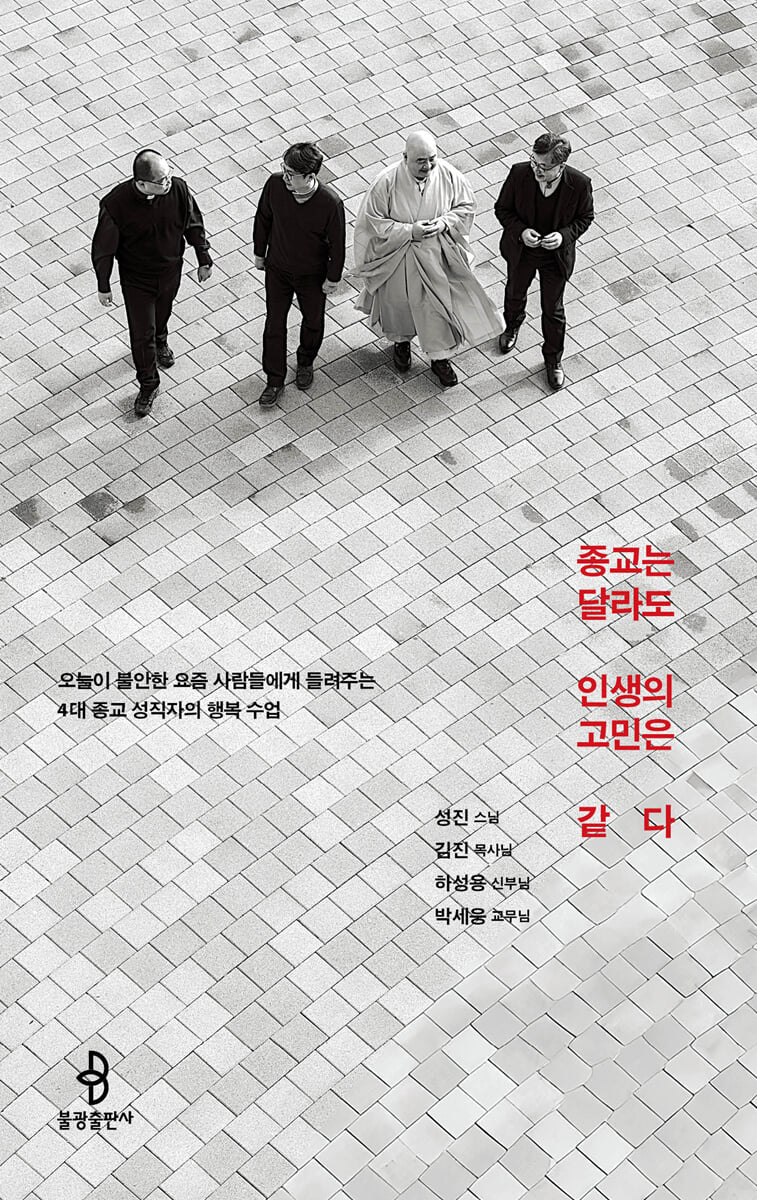
Religions may be different, but life's struggles are the same.
 |
Description
Book Introduction
The world's first 'Mannam Choir' comprised of clergy from the four major religions
A national healing talk by four people known as the Avengers of Religion.
An unchanging message of happiness in these uncertain times!
The 'Mannam Choir', formed in 2022, is the world's first singing group of the four major religions (Buddhism, Protestantism, Catholicism, and Won Buddhism) born with the dream of "a day when we can sing songs of peace in the midst of war, songs of abundance in the midst of poverty, and songs of healing in the midst of disease."
This book is a collection of conversations on the topic of 'happiness' between four national mentors and members of the Mannam Choir, who have delivered messages of courage and compassion to modern people through various TV broadcasts, radio, performances, and lectures.
In a world overflowing with words like 'frustration' rather than 'hope', and in an era where 'each for himself' is considered the ironclad rule of survival, it reminds us of the precious values in life that we must never lose.
This book contains the secrets of happiness as told by four priests who are full of positivity and confidence in existence and life. It is a collection of affirmations that emphasize that we can be happy at any time as long as we have faith and love for ourselves.
A national healing talk by four people known as the Avengers of Religion.
An unchanging message of happiness in these uncertain times!
The 'Mannam Choir', formed in 2022, is the world's first singing group of the four major religions (Buddhism, Protestantism, Catholicism, and Won Buddhism) born with the dream of "a day when we can sing songs of peace in the midst of war, songs of abundance in the midst of poverty, and songs of healing in the midst of disease."
This book is a collection of conversations on the topic of 'happiness' between four national mentors and members of the Mannam Choir, who have delivered messages of courage and compassion to modern people through various TV broadcasts, radio, performances, and lectures.
In a world overflowing with words like 'frustration' rather than 'hope', and in an era where 'each for himself' is considered the ironclad rule of survival, it reminds us of the precious values in life that we must never lose.
This book contains the secrets of happiness as told by four priests who are full of positivity and confidence in existence and life. It is a collection of affirmations that emphasize that we can be happy at any time as long as we have faith and love for ourselves.
- You can preview some of the book's contents.
Preview
index
introduction
happiness
Four Thoughts on Happiness
The happiest moment of my life
Happy things happen every day
A life that guards against laziness
There is no misfortune
The secret to happiness according to religion
[In a word!] Happiness is __
money
Is money the best condition for happiness?
A priest's monthly living expenses
The less you have, the happier you are
On absolute poverty
[In a word!] Money is __
relationship
If a person wants to avoid stress,
People Who Close Their Hearts: Reclusive Loners
People who want attention: spectators
Relationships: Is Enduring the Answer or Breaking It Off?
In a word!] The relationship is __
emotion
How should we view emotions?
The true meaning of self-esteem
To avoid being swayed by emotions
A very personal way to release emotions
[In a word!] Emotions are __
poisoning
Two Reasons for Addiction: Desire and Deprivation
Children Getting Sick: Drug Addiction
The Disease Called Blind Faith: Religious Addiction
Can clergy also become addicted?
Addiction is a shared problem for both individuals and society.
[In a nutshell!] Addiction is __
death
Reflect on death for the sake of life
Death is not the end
If I pray before closing my eyes, will I be saved?
[In a word!] Death is __
In conclusion
happiness
Four Thoughts on Happiness
The happiest moment of my life
Happy things happen every day
A life that guards against laziness
There is no misfortune
The secret to happiness according to religion
[In a word!] Happiness is __
money
Is money the best condition for happiness?
A priest's monthly living expenses
The less you have, the happier you are
On absolute poverty
[In a word!] Money is __
relationship
If a person wants to avoid stress,
People Who Close Their Hearts: Reclusive Loners
People who want attention: spectators
Relationships: Is Enduring the Answer or Breaking It Off?
In a word!] The relationship is __
emotion
How should we view emotions?
The true meaning of self-esteem
To avoid being swayed by emotions
A very personal way to release emotions
[In a word!] Emotions are __
poisoning
Two Reasons for Addiction: Desire and Deprivation
Children Getting Sick: Drug Addiction
The Disease Called Blind Faith: Religious Addiction
Can clergy also become addicted?
Addiction is a shared problem for both individuals and society.
[In a nutshell!] Addiction is __
death
Reflect on death for the sake of life
Death is not the end
If I pray before closing my eyes, will I be saved?
[In a word!] Death is __
In conclusion
Detailed image

Into the book
Because I exist, the world exists as a possibility.
Whether it's happiness or unhappiness, it has meaning because I exist.
In that sense, we possess something precious that cannot be exchanged for a billion dollars: the 'I', the premise that makes everything possible.
What a joy and gratitude this is.
I believe that satisfaction and gratitude toward the living, breathing me right now is the beginning and end of happiness.
--- p.23
Some people believe that the purpose of life is happiness.
No, it isn't.
Life comes first, happiness follows.
If you become too obsessed with happiness, your life may become unhappy.
Because happiness can also become a desire.
Mahatma Gandhi of India said, 'Happiness = Life - Desire.'
And at the same time, he emphasized non-possession.
As desires diminish, life itself becomes a source of happiness.
--- p.35
Everyone feels happy and joyful when they eat delicious food or watch funny videos.
However, if you are only immersed in the pleasure of the moment without consciously realizing it and feel it emotionally, then you are living a life of slavery.
A truly independent life is one in which you can do something whenever you want and stop when you don't want to.
I believe that when we live with such unhindered strength of mind, we can live a free life, unbound by either happiness or unhappiness.
--- p.42
I once prayed to God like this.
'God, even if I don't have money, please give me the strength to do your work.
Or please help me make a lot of money.
Or else, please put a rich person next to me.' It was when I was building an ashram in India.
Due to lack of funds for construction, it was left unfinished, but after about a year and a half, it was finally completed.
I finally realized what it meant to be, 'what's meant to be will be.'
--- p.62~63
In Buddhism, relationships are called karma.
Relationships are not forced.
It happens naturally.
You can't hold on to something forever just because you like it, and you can't throw it away right away just because you don't like it.
This world, the world of Saba, is entangled with such relationships.
But as we live without confidence, conviction, and clear values, relationships become increasingly difficult.
--- p.86
There is one crucial difference between those who live as slaves to their emotions and those who live as masters of their emotions.
The latter is precisely what makes it not so frequent or long-lasting.
The emotions themselves are not the problem.
The problem is your attitude towards emotions.
Sometimes people argue about whether they should express their emotions or hold them back.
That's not the point.
Knowing your emotions is key.
--- p.116
The organization I belong to is the Social Ministry Department of the Catholic Archdiocese of Seoul.
It is a place that oversees the work of serving the poor, the sick, and the marginalized.
(…) What is surprising and regrettable is that among those visiting hospitals recently, there are many young drug addicts.
Most people say they turn to drugs because of the pressure and stress of studying and getting good grades.
I think this clearly shows how sick our society is right now.
--- p.150
If we lived knowing that we would die someday, how precious would every moment of every day be?
This is why Buddhism talks about death, why it does not talk about life and death separately.
The purpose is to lead people to live a better life by seriously considering and reflecting on death.
Death is a conversation for a mature life.
--- p.170
The Pope said he wanted to give hope to those suffering from the same illness as he did.
Look.
I, the Pope, suffer from Parkinson's disease just like you.
It is not because you sinned or because God abandoned you that you are sick.
'He just happened to get sick.' Seeing that, I gained confidence in human dignity.
That human dignity does not depend on circumstances.
--- p.179
I know you're probably going through a lot right now, and you're probably feeling tired and worn out, but don't forget that being a beacon of hope for someone can make life more valuable and free you from suffering.
This is fine for now.
An open mind, hope for the future, and small steps, slow but steady, are all that is needed.
Whether it's happiness or unhappiness, it has meaning because I exist.
In that sense, we possess something precious that cannot be exchanged for a billion dollars: the 'I', the premise that makes everything possible.
What a joy and gratitude this is.
I believe that satisfaction and gratitude toward the living, breathing me right now is the beginning and end of happiness.
--- p.23
Some people believe that the purpose of life is happiness.
No, it isn't.
Life comes first, happiness follows.
If you become too obsessed with happiness, your life may become unhappy.
Because happiness can also become a desire.
Mahatma Gandhi of India said, 'Happiness = Life - Desire.'
And at the same time, he emphasized non-possession.
As desires diminish, life itself becomes a source of happiness.
--- p.35
Everyone feels happy and joyful when they eat delicious food or watch funny videos.
However, if you are only immersed in the pleasure of the moment without consciously realizing it and feel it emotionally, then you are living a life of slavery.
A truly independent life is one in which you can do something whenever you want and stop when you don't want to.
I believe that when we live with such unhindered strength of mind, we can live a free life, unbound by either happiness or unhappiness.
--- p.42
I once prayed to God like this.
'God, even if I don't have money, please give me the strength to do your work.
Or please help me make a lot of money.
Or else, please put a rich person next to me.' It was when I was building an ashram in India.
Due to lack of funds for construction, it was left unfinished, but after about a year and a half, it was finally completed.
I finally realized what it meant to be, 'what's meant to be will be.'
--- p.62~63
In Buddhism, relationships are called karma.
Relationships are not forced.
It happens naturally.
You can't hold on to something forever just because you like it, and you can't throw it away right away just because you don't like it.
This world, the world of Saba, is entangled with such relationships.
But as we live without confidence, conviction, and clear values, relationships become increasingly difficult.
--- p.86
There is one crucial difference between those who live as slaves to their emotions and those who live as masters of their emotions.
The latter is precisely what makes it not so frequent or long-lasting.
The emotions themselves are not the problem.
The problem is your attitude towards emotions.
Sometimes people argue about whether they should express their emotions or hold them back.
That's not the point.
Knowing your emotions is key.
--- p.116
The organization I belong to is the Social Ministry Department of the Catholic Archdiocese of Seoul.
It is a place that oversees the work of serving the poor, the sick, and the marginalized.
(…) What is surprising and regrettable is that among those visiting hospitals recently, there are many young drug addicts.
Most people say they turn to drugs because of the pressure and stress of studying and getting good grades.
I think this clearly shows how sick our society is right now.
--- p.150
If we lived knowing that we would die someday, how precious would every moment of every day be?
This is why Buddhism talks about death, why it does not talk about life and death separately.
The purpose is to lead people to live a better life by seriously considering and reflecting on death.
Death is a conversation for a mature life.
--- p.170
The Pope said he wanted to give hope to those suffering from the same illness as he did.
Look.
I, the Pope, suffer from Parkinson's disease just like you.
It is not because you sinned or because God abandoned you that you are sick.
'He just happened to get sick.' Seeing that, I gained confidence in human dignity.
That human dignity does not depend on circumstances.
--- p.179
I know you're probably going through a lot right now, and you're probably feeling tired and worn out, but don't forget that being a beacon of hope for someone can make life more valuable and free you from suffering.
This is fine for now.
An open mind, hope for the future, and small steps, slow but steady, are all that is needed.
--- p.195
Publisher's Review
If you're not happy now, you'll never be happy.
A conversation about happiness between four people and four different colors, told by the clergy of the four major religions!
Our society is currently going through a tunnel-like time.
We hear more despairing words than hopeful ones about people, work, and society, and we experience anxiety, anger, and frustration on a daily basis.
In an age where everything outside of ourselves is seen as an enemy or an obstacle, what kind of happiness can we possibly conceive of? Is it even possible to find and enjoy happiness in ordinary life? If you talk about happiness in this day and age, you'll likely be criticized by those around you for being out of touch with reality.
Otherwise, you may be misunderstood as someone who has a lot or has inherited a lot.
Yet, here, there are people who talk about happiness, even though they live a life where they have more things they don't have than things they do have, and where there are more restrictions than freedom.
These are four religious clergy who work under the name of 'Mannam Choir' and spread messages of happiness and peace to people around the world.
The co-authors of this book and members of the 'Mannam Jungchangdan', Seongjin, Jin Kim, Seongyong Ha, and Sewoong Park, are clergy members of Buddhism, Protestantism, Catholicism, and Won Buddhism, respectively.
After appearing together on several broadcast programs, they formed a choir in 2022 and have been actively working in broadcasting, media, lectures, and performances, injecting courage and hope into the lives of modern people with heartwarming songs and wise words.
"Even if religions are different, life's concerns are the same" is a book that compiles conversations on the topic of happiness between four clergy who are active as national mentors, transcending religious barriers.
In this book, the authors present a path to happiness based on their own beliefs, religious views, and deep reflections on life.
Starting with the definition of "what is happiness," it delves into why people these days feel unhappiness more often than happiness, and what individuals and society must do to live happy lives.
Although each person's criteria and conditions for happiness may differ, it reminds us of the absolute and unchanging values that no one should miss in order to become happy.
Perhaps it is the truth of life that we already knew, but which has gradually faded over time, and it rekindles our faith and confidence in existence and life.
In a world where even I can't believe
Living with unshakable faith
The Four Blessed Ecclesiastes of the Priest
This book talks about happiness, but also delves into the specific topics of money, relationships, emotions, addiction, and death.
These five topics were chosen as topics of conversation because they are real-world problems that modern people struggle with today, and are also essential elements that cannot be left out when talking about a happy life.
As authors have different religions and beliefs, their perspectives on each topic are quite different.
Yet, rather than clashing with each other, their views blend together naturally.
This book is also filled with the efforts to demonstrate that diverse ideas can coexist under a single goal, and the common ground that transcended religion to create the 'Mannam Choir'.
It is the recognition that difference does not necessarily mean wrong, and that healthy diversity is the nutrient that enriches our lives.
“It doesn’t matter whose answer is right or wrong.
I sincerely hope that readers of this book will not struggle to find just one 'right answer'.
Instead, I hope that even the words of one of us can convey warm comfort and hope.” - From the preface
A tender and delicate heart, and the courage to put it into action.
The secret to happiness that the authors emphasize in this book can be summarized in one word as follows.
The former leads to love and trust for oneself and others.
The latter leads to the practice of giving and sharing.
The reason the authors emphasize compassion and consideration for others is not simply because they are religious people who prioritize goodness and the public good.
This is because it is a universal truth of life that one life is connected to another, and that for one being to be happy, everything around him must also be happy.
These days, there are many people who want to be happy, but not many who live happily. People speak and act as if they would do anything to be happy.
But how many people among them fully know, believe, and follow this truth?
Perhaps we say we want happiness, but in reality we are running down a path that is far from it.
If you desperately want to be happy, if you are truly willing to do anything for it, I highly recommend you read this book carefully.
I will show you where happiness comes from and the way to it.
A conversation about happiness between four people and four different colors, told by the clergy of the four major religions!
Our society is currently going through a tunnel-like time.
We hear more despairing words than hopeful ones about people, work, and society, and we experience anxiety, anger, and frustration on a daily basis.
In an age where everything outside of ourselves is seen as an enemy or an obstacle, what kind of happiness can we possibly conceive of? Is it even possible to find and enjoy happiness in ordinary life? If you talk about happiness in this day and age, you'll likely be criticized by those around you for being out of touch with reality.
Otherwise, you may be misunderstood as someone who has a lot or has inherited a lot.
Yet, here, there are people who talk about happiness, even though they live a life where they have more things they don't have than things they do have, and where there are more restrictions than freedom.
These are four religious clergy who work under the name of 'Mannam Choir' and spread messages of happiness and peace to people around the world.
The co-authors of this book and members of the 'Mannam Jungchangdan', Seongjin, Jin Kim, Seongyong Ha, and Sewoong Park, are clergy members of Buddhism, Protestantism, Catholicism, and Won Buddhism, respectively.
After appearing together on several broadcast programs, they formed a choir in 2022 and have been actively working in broadcasting, media, lectures, and performances, injecting courage and hope into the lives of modern people with heartwarming songs and wise words.
"Even if religions are different, life's concerns are the same" is a book that compiles conversations on the topic of happiness between four clergy who are active as national mentors, transcending religious barriers.
In this book, the authors present a path to happiness based on their own beliefs, religious views, and deep reflections on life.
Starting with the definition of "what is happiness," it delves into why people these days feel unhappiness more often than happiness, and what individuals and society must do to live happy lives.
Although each person's criteria and conditions for happiness may differ, it reminds us of the absolute and unchanging values that no one should miss in order to become happy.
Perhaps it is the truth of life that we already knew, but which has gradually faded over time, and it rekindles our faith and confidence in existence and life.
In a world where even I can't believe
Living with unshakable faith
The Four Blessed Ecclesiastes of the Priest
This book talks about happiness, but also delves into the specific topics of money, relationships, emotions, addiction, and death.
These five topics were chosen as topics of conversation because they are real-world problems that modern people struggle with today, and are also essential elements that cannot be left out when talking about a happy life.
As authors have different religions and beliefs, their perspectives on each topic are quite different.
Yet, rather than clashing with each other, their views blend together naturally.
This book is also filled with the efforts to demonstrate that diverse ideas can coexist under a single goal, and the common ground that transcended religion to create the 'Mannam Choir'.
It is the recognition that difference does not necessarily mean wrong, and that healthy diversity is the nutrient that enriches our lives.
“It doesn’t matter whose answer is right or wrong.
I sincerely hope that readers of this book will not struggle to find just one 'right answer'.
Instead, I hope that even the words of one of us can convey warm comfort and hope.” - From the preface
A tender and delicate heart, and the courage to put it into action.
The secret to happiness that the authors emphasize in this book can be summarized in one word as follows.
The former leads to love and trust for oneself and others.
The latter leads to the practice of giving and sharing.
The reason the authors emphasize compassion and consideration for others is not simply because they are religious people who prioritize goodness and the public good.
This is because it is a universal truth of life that one life is connected to another, and that for one being to be happy, everything around him must also be happy.
These days, there are many people who want to be happy, but not many who live happily. People speak and act as if they would do anything to be happy.
But how many people among them fully know, believe, and follow this truth?
Perhaps we say we want happiness, but in reality we are running down a path that is far from it.
If you desperately want to be happy, if you are truly willing to do anything for it, I highly recommend you read this book carefully.
I will show you where happiness comes from and the way to it.
GOODS SPECIFICS
- Date of issue: January 4, 2024
- Page count, weight, size: 200 pages | 266g | 120*190*17mm
- ISBN13: 9791193454312
- ISBN10: 119345431X
You may also like
카테고리
korean


korean

![GQ KOREA Mark (Monthly): December [2025]](http://librairie.coreenne.fr/cdn/shop/files/8ef265dbbfbf186523ed75ba7319009d.jpg?v=1765340328&width=3840)


