

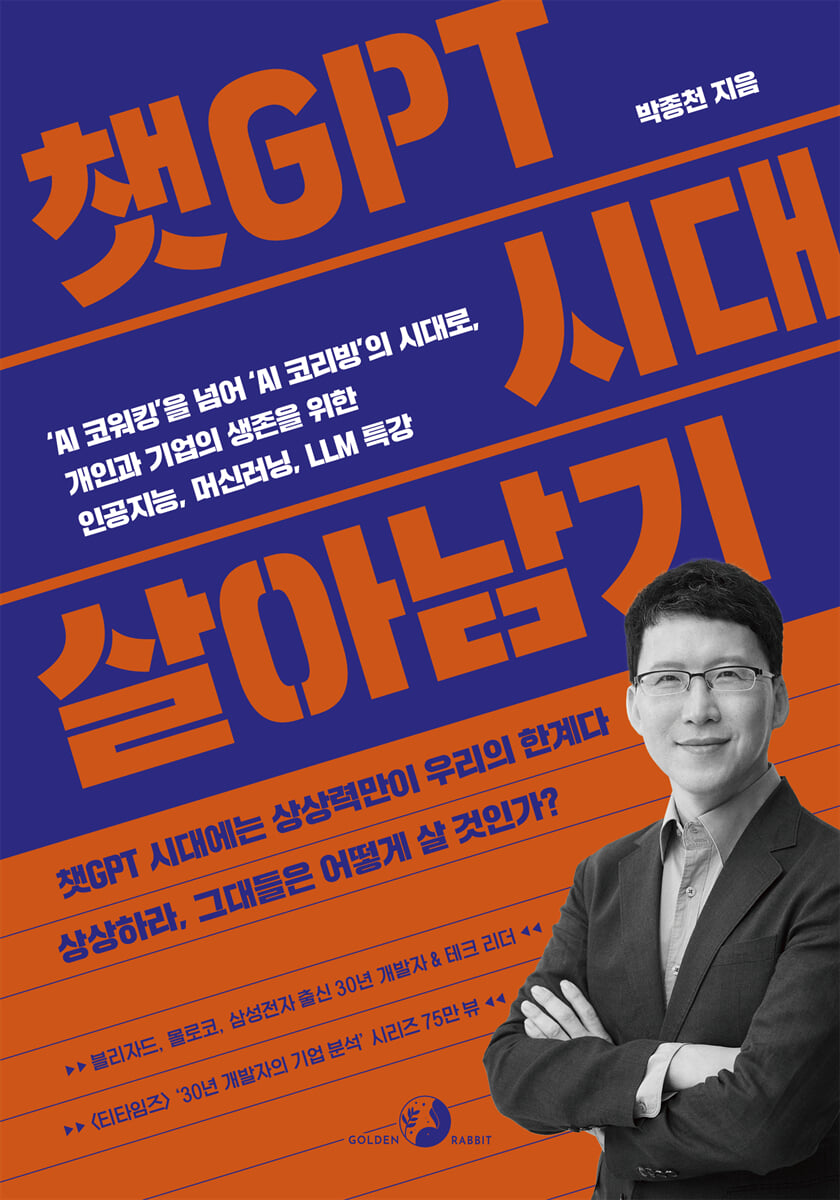
Surviving the Chat GPT Era
 |
Description
Book Introduction
AI is taking our jobs?
Jobs are being taken away not by AI, but by companies and people who are good at utilizing AI.
Discover essential AI survival knowledge and wisdom for both businesses and individuals, from a 30-year development leader.
In 2024, Jensen Huang said at the World Government Summit in Dubai, “There’s no need to teach kids to code anymore.”
The author applies this and says:
“It would be more helpful for working people to learn coding.
But if we don't learn AI, we can no longer survive.”
We have entered an era where even non-IT experts can use AI.
This book contains the survival knowledge and wisdom that businesses and individuals need to know right now, as we move beyond the era of "AI coworking," where we collaborate with artificial intelligence accelerated by ChatGPT, and into the era of "AI coliving," where we live with artificial intelligence.
Let's meet the author Jongcheon Park, a 30-year developer and tech leader from Blizzard, Moloco, and Samsung Electronics, and a regular guest on the [30-Year Developer's Corporate Analysis - Season 3 AI] series on the Tea Times TV YouTube channel, who guides us through business opportunities, utilization, technology, and survival strategies for the future.
Jobs are being taken away not by AI, but by companies and people who are good at utilizing AI.
Discover essential AI survival knowledge and wisdom for both businesses and individuals, from a 30-year development leader.
In 2024, Jensen Huang said at the World Government Summit in Dubai, “There’s no need to teach kids to code anymore.”
The author applies this and says:
“It would be more helpful for working people to learn coding.
But if we don't learn AI, we can no longer survive.”
We have entered an era where even non-IT experts can use AI.
This book contains the survival knowledge and wisdom that businesses and individuals need to know right now, as we move beyond the era of "AI coworking," where we collaborate with artificial intelligence accelerated by ChatGPT, and into the era of "AI coliving," where we live with artificial intelligence.
Let's meet the author Jongcheon Park, a 30-year developer and tech leader from Blizzard, Moloco, and Samsung Electronics, and a regular guest on the [30-Year Developer's Corporate Analysis - Season 3 AI] series on the Tea Times TV YouTube channel, who guides us through business opportunities, utilization, technology, and survival strategies for the future.
- You can preview some of the book's contents.
Preview
index
PART 1: Chat GPT, I'm Really Curious
__ 01 What is ChatGPT? Do I really need to know about it?
__ 02 Can we trust the results of ChatGPT?
__ 03 In the ChatGPT era, do I still need to learn Python?
__ 04 Chat GPT is a technology that emerged from the ground one day?
__ 05 How does ChatGPT understand and write text?
__ 06 How is ChatGPT different from a search engine?
__ 07 Is prompt engineering that important?
__ 08 Before reading further, a reminder of basic terms
PART 2: An Invitation to AI Coworking and AI Coliving
__ 01 The era of AI coworking and AI coliving is coming.
__ 02 A Land of Business Opportunities Sparked by AI
__ 03 AI thrives on high-quality data
__ 04 Let's protect data privacy
PART 3 Leaders Who Successfully Implemented Machine Learning
__ 01 'S&P 7' is used like this
__ 02 Why is Tesla's autonomous driving so different?
__ 03 AI Becomes a Game Changer in Gaming
__ 04 Carrots, a few hundred against tens of thousands
PART 4: ChatGPT Launch Ceremony in the AI Era
__ 01 GPT, kicking off light-speed power generation
__ 02 Learn about ChatGPT & GPT API
__ 03 Fine-tuning to make LLM smarter
__ 04 Try ChatGPT Coworking
__ 05 Controlling Hallucinations
__ 06 The era of AI coworking will arrive within the next five years.
PART 5: Business Changes Driven by ChatGPT
__ 01 Nvidia loses, and the Apple era returns.
__ 02 MS Leads the AI Coworking Era with Copilot
__ 03 App Copilot completes the work of 20 people in an instant
__ 04 LLM Evolving into a Native Organization and Companion AI
__ 05 Companies that make amazing use of LLM
__ 06 The most reliable way to introduce LLM to your company: AI Hackathon
PART 6 Can we trust ChatGPT?
__ 01 Do we need our own in-house LLM?
__ 02 LLM, Use it without getting twisted
__ 03 Who owns the copyright to works created using AI?
PART 7 Surviving the Future in the ChatGPT Era
__ 01 Will AI take my job?
__ 02 Will AI rule over humans?
__ 03 Should we develop AI from scratch?
__ 04 What should small tech companies do?
__ 05 AI .
In the age of robots, what kind of future will humanity face?
APPENDIX I AI Technology Notes for Adults Studying
__ 01 Let's learn about data, algorithms, and computing power.
__ 02 AI also has specialized fields
__ 03 How does AI find its own rules?
__ 04 How are machine learning and LLM technically different?
__ 05 The impact of parameters on AI performance
__ 06 Transformer Finding the Origin and Context of LLM
APPENDIX Ⅱ Six Prompt Techniques for Conversing with ChatGPT
APPENDIX Ⅲ Survival AI Mini Dictionary
__ 01 What is ChatGPT? Do I really need to know about it?
__ 02 Can we trust the results of ChatGPT?
__ 03 In the ChatGPT era, do I still need to learn Python?
__ 04 Chat GPT is a technology that emerged from the ground one day?
__ 05 How does ChatGPT understand and write text?
__ 06 How is ChatGPT different from a search engine?
__ 07 Is prompt engineering that important?
__ 08 Before reading further, a reminder of basic terms
PART 2: An Invitation to AI Coworking and AI Coliving
__ 01 The era of AI coworking and AI coliving is coming.
__ 02 A Land of Business Opportunities Sparked by AI
__ 03 AI thrives on high-quality data
__ 04 Let's protect data privacy
PART 3 Leaders Who Successfully Implemented Machine Learning
__ 01 'S&P 7' is used like this
__ 02 Why is Tesla's autonomous driving so different?
__ 03 AI Becomes a Game Changer in Gaming
__ 04 Carrots, a few hundred against tens of thousands
PART 4: ChatGPT Launch Ceremony in the AI Era
__ 01 GPT, kicking off light-speed power generation
__ 02 Learn about ChatGPT & GPT API
__ 03 Fine-tuning to make LLM smarter
__ 04 Try ChatGPT Coworking
__ 05 Controlling Hallucinations
__ 06 The era of AI coworking will arrive within the next five years.
PART 5: Business Changes Driven by ChatGPT
__ 01 Nvidia loses, and the Apple era returns.
__ 02 MS Leads the AI Coworking Era with Copilot
__ 03 App Copilot completes the work of 20 people in an instant
__ 04 LLM Evolving into a Native Organization and Companion AI
__ 05 Companies that make amazing use of LLM
__ 06 The most reliable way to introduce LLM to your company: AI Hackathon
PART 6 Can we trust ChatGPT?
__ 01 Do we need our own in-house LLM?
__ 02 LLM, Use it without getting twisted
__ 03 Who owns the copyright to works created using AI?
PART 7 Surviving the Future in the ChatGPT Era
__ 01 Will AI take my job?
__ 02 Will AI rule over humans?
__ 03 Should we develop AI from scratch?
__ 04 What should small tech companies do?
__ 05 AI .
In the age of robots, what kind of future will humanity face?
APPENDIX I AI Technology Notes for Adults Studying
__ 01 Let's learn about data, algorithms, and computing power.
__ 02 AI also has specialized fields
__ 03 How does AI find its own rules?
__ 04 How are machine learning and LLM technically different?
__ 05 The impact of parameters on AI performance
__ 06 Transformer Finding the Origin and Context of LLM
APPENDIX Ⅱ Six Prompt Techniques for Conversing with ChatGPT
APPENDIX Ⅲ Survival AI Mini Dictionary
Detailed image

Into the book
“There are two types of work processes that utilize the GPT API: ‘Custom Copilot,’ such as the CHATDA service developed by LG Electronics’ Home Appliances Division for data analysis, and ‘Commercial App Copilot,’ which is designed for all company work processes, such as Copilot for Microsoft 365 or Gemini for Google Workplace.
We'll cover custom copilots and commercial app copilots in more detail later. Using the GPT API effectively allows thousands of employees to work behind the scenes.
"What do you want to get thousands of employees to do? In the ChatGPT era, imagination is our only limit."
--- p.102
“Big tech companies like Google and OpenAI are in an advantageous position.
Because we already have a ton of data.
Specifically, if OpenAI's GPT model is installed on Apple's iPhone, Apple will be able to obtain data generated by iPhone users while sitting down and talking to GPT.
Isn't that incredible to imagine? If you ask Siri, "Hey, how about a trip to Rome?" she'll reply, "Well, the Colosseum collapsed, so there's nothing to see."
Then people will say, “What are you talking about? Your trip to Rome would be amazing!”
If this kind of everyday conversation data were to accumulate on a massive scale, it would be incredibly valuable.
While OpenAI has grown based on web data so far, it's now taking a leap forward with real-world data from real users.
At this point, wouldn’t it be appropriate to call it a companion AI that lives together with us?”
--- p.138
Only “LLM native organizations” will survive.
The important thing is to innovate the existing way of working.
It shouldn't stop at just emailing, chatting, and writing documents.
Imagine all your tasks—including human resources, accounting, and electronic approval—all done on a single platform, using natural language.
Just like Jarvis in the movie "Iron Man," Slack conversations with colleagues will automatically become meeting minutes, tasks derived from those conversations will be synced to your task management system, and if an issue requires approval, related forms will be automatically generated.
We don't know what systems are running behind the scenes, but we'll be able to solve everything just by conversing and collaborating in natural language.
This is what an ‘LLM native organization’ looks like.”
--- p.138
“AI tools like ChatGPT, GitHub Copilot, Cloud, and Gemini increase the productivity of business staff far more than executives.
This is because executives usually make judgments and give instructions, while the working-level staff are in charge of practical work.
So, with the help of AI tools, productivity at the practical level can be greatly improved.
This allows us to work more and focus on more important tasks. AI won't take our jobs, because it's not there yet.
But people in the same profession who are very good at utilizing AI will become their direct competitors.
Especially if our competitors are good at utilizing AI, our company will face big problems.
Therefore, studying and utilizing AI is essential for the competitiveness of my company and myself.”
--- p.166
“AI won't take our jobs. It's not there yet.
But people in the same profession who are very good at utilizing AI will become their direct competitors.
Especially if our competitors are good at utilizing AI, our company will face big problems.
Therefore, studying and utilizing AI is essential for the competitiveness of my company and myself.
As home appliances become smarter, some people's jobs may become more dangerous.
As cars become smarter, some people's jobs will become more dangerous.
Likewise, as AI improves, some people's jobs will become more at risk. If we can't surpass AI's capabilities, we shouldn't be threatened by it, but rather, we should be those who utilize it."
--- p.167
“On the one hand, AI is using massive amounts of human data.
Therefore, fair compensation for this is necessary.
If all of our social activities are digitized and used for AI learning, the government should provide a basic income and AI companies should be required to pay taxes.
The European Union is also currently pursuing the enactment of an "AI law" to ensure that AI does not infringe on personal information and intellectual property rights.
Some argue that AI creations should be granted the same level of copyright as humans.
“This is because AI has learned from the intellectual works created by humans, and we believe that the benefits should be returned to society.”
--- p.168
"While human-generated data has its limitations, machine-generated data presents a challenge. For AI to become intelligent enough to dominate humans, or to continue to do so, it will need ongoing, human-generated data.
Tesla CEO Elon Musk warned, "I think there needs to be regulatory oversight, probably at the national and international levels, to make sure we don't do something very stupid. With AI, we're summoning the devil." The increasing autonomy of AI risks making humanity subservient to it. We need to carefully manage how AI learns and how it's controlled. Co-piloting, where humans and AI collaborate, is becoming increasingly important, rather than 'fully AI-powered' AI working without human intervention.
--- p.171
"If each employee had a secretary, or if there were multiple secretaries for each job function, how much easier, faster, and more work could be done? Just as the advancement of automobiles freed us from distance limitations, advancements in AI will remove the limitations of speed and quality we can only imagine.
Ultimately, the advancement of AI will help each and every person become a superhuman, capable of handling ten to a hundred times more tasks more easily and quickly than before.”
We'll cover custom copilots and commercial app copilots in more detail later. Using the GPT API effectively allows thousands of employees to work behind the scenes.
"What do you want to get thousands of employees to do? In the ChatGPT era, imagination is our only limit."
--- p.102
“Big tech companies like Google and OpenAI are in an advantageous position.
Because we already have a ton of data.
Specifically, if OpenAI's GPT model is installed on Apple's iPhone, Apple will be able to obtain data generated by iPhone users while sitting down and talking to GPT.
Isn't that incredible to imagine? If you ask Siri, "Hey, how about a trip to Rome?" she'll reply, "Well, the Colosseum collapsed, so there's nothing to see."
Then people will say, “What are you talking about? Your trip to Rome would be amazing!”
If this kind of everyday conversation data were to accumulate on a massive scale, it would be incredibly valuable.
While OpenAI has grown based on web data so far, it's now taking a leap forward with real-world data from real users.
At this point, wouldn’t it be appropriate to call it a companion AI that lives together with us?”
--- p.138
Only “LLM native organizations” will survive.
The important thing is to innovate the existing way of working.
It shouldn't stop at just emailing, chatting, and writing documents.
Imagine all your tasks—including human resources, accounting, and electronic approval—all done on a single platform, using natural language.
Just like Jarvis in the movie "Iron Man," Slack conversations with colleagues will automatically become meeting minutes, tasks derived from those conversations will be synced to your task management system, and if an issue requires approval, related forms will be automatically generated.
We don't know what systems are running behind the scenes, but we'll be able to solve everything just by conversing and collaborating in natural language.
This is what an ‘LLM native organization’ looks like.”
--- p.138
“AI tools like ChatGPT, GitHub Copilot, Cloud, and Gemini increase the productivity of business staff far more than executives.
This is because executives usually make judgments and give instructions, while the working-level staff are in charge of practical work.
So, with the help of AI tools, productivity at the practical level can be greatly improved.
This allows us to work more and focus on more important tasks. AI won't take our jobs, because it's not there yet.
But people in the same profession who are very good at utilizing AI will become their direct competitors.
Especially if our competitors are good at utilizing AI, our company will face big problems.
Therefore, studying and utilizing AI is essential for the competitiveness of my company and myself.”
--- p.166
“AI won't take our jobs. It's not there yet.
But people in the same profession who are very good at utilizing AI will become their direct competitors.
Especially if our competitors are good at utilizing AI, our company will face big problems.
Therefore, studying and utilizing AI is essential for the competitiveness of my company and myself.
As home appliances become smarter, some people's jobs may become more dangerous.
As cars become smarter, some people's jobs will become more dangerous.
Likewise, as AI improves, some people's jobs will become more at risk. If we can't surpass AI's capabilities, we shouldn't be threatened by it, but rather, we should be those who utilize it."
--- p.167
“On the one hand, AI is using massive amounts of human data.
Therefore, fair compensation for this is necessary.
If all of our social activities are digitized and used for AI learning, the government should provide a basic income and AI companies should be required to pay taxes.
The European Union is also currently pursuing the enactment of an "AI law" to ensure that AI does not infringe on personal information and intellectual property rights.
Some argue that AI creations should be granted the same level of copyright as humans.
“This is because AI has learned from the intellectual works created by humans, and we believe that the benefits should be returned to society.”
--- p.168
"While human-generated data has its limitations, machine-generated data presents a challenge. For AI to become intelligent enough to dominate humans, or to continue to do so, it will need ongoing, human-generated data.
Tesla CEO Elon Musk warned, "I think there needs to be regulatory oversight, probably at the national and international levels, to make sure we don't do something very stupid. With AI, we're summoning the devil." The increasing autonomy of AI risks making humanity subservient to it. We need to carefully manage how AI learns and how it's controlled. Co-piloting, where humans and AI collaborate, is becoming increasingly important, rather than 'fully AI-powered' AI working without human intervention.
--- p.171
"If each employee had a secretary, or if there were multiple secretaries for each job function, how much easier, faster, and more work could be done? Just as the advancement of automobiles freed us from distance limitations, advancements in AI will remove the limitations of speed and quality we can only imagine.
Ultimately, the advancement of AI will help each and every person become a superhuman, capable of handling ten to a hundred times more tasks more easily and quickly than before.”
--- p.179
Publisher's Review
★ ChatGPT is widely used by over 80% of Fortune 500 companies.
★ S&P 7 companies are already generating profits by adopting AI.
★ How will you live in the Chat GPT era?
“AI isn’t a tool that turns 0 into 100, it’s a tool that turns 100 into 200.” You can still dig with a shovel, but someone with a backhoe license earns more money.
Some people may actually be eliminated because they are so good at digging.
Now is the era of AI.
We need to utilize AI tools as much as possible in our company work and expand our use cases by developing our own AI tools.
At the same time, you need to properly understand tools like ChatGPT and continue to use them in your work and personal life.
Andrew Moore, Google Cloud AI lead, predicted that “with advances in LLM technology, 80% of knowledge workers will be working collaboratively with AI assistants within the next five years.”
Over 80% of Fortune 500 companies use ChatGPT extensively for customer support, code writing, data analysis, and marketing content creation.
70% of new games released on Steam are made using AI technology.
For Amazon, AI product recommendations account for 35% of total sales. It's hard to imagine how AI will be utilized in the future.
I hope to find a clue to "survival" in the practical tools and strategies needed to transform into an "AI native organization" that can even control the hallucinations of ChatGPT, and into an "AI native human."
★ Are you saying AI is too difficult? It's really important, but you're scared to get started?
★ “What is this or that?” The same question is repeated over and over again.
★ This book contains answers to such concerns and questions.
If you're worried about AI being difficult and unfamiliar, it's time to let your guard down.
This book examines the fundamental concepts of AI technology, current applications, and offers a vision for the future.
It also provides specific suggestions for the capabilities and strategies needed to survive in the AI era.
This book was organized based on the questions I received so far, following the beginner's flow of consciousness.
You will find answers to questions about AI as a technology and AI as survival.
1.
Why should I use ChatGPT?
2.
What is ChatGPT?
3.
How do I use ChatGPT?
4.
What are other companies and people doing with ChatGPT?
5.
How will the future change?
6.
How should we respond to change?
To aid understanding, it is divided into seven parts: an overview is provided first, a detailed description by topic is provided, and reminder notes are provided.
In addition, it provides 『AI Technology Notes』, 『6 Prompt Techniques』, and 『Mini Dictionary』 as appendices.
It will be useful when you have questions or want to understand something more in depth.
In particular, 'PART 1' provides answers to 7 questions that linger in your mind.
As you read the author's insightful answers, you'll feel as if a fog has cleared.
★ If I don't have money, AI is irrelevant to my business?
★ With the advent of ChatGPT, even small businesses can now run AI-native businesses.
★ Let's explore five ways businesses can use ChatGPT and LLM technology.
In the past, when machine learning was the primary technology, the financial burden was too great for small businesses to adopt AI.
On the other hand, ChatGPT costs only $20 per month.
With the release of ChatGPT-4o Mini, using the API means AI usage fees are no longer a hurdle.
The author suggests five ways to introduce AI depending on the size and situation of the company: ① 'Direct LLM modeling', ② 'Using the GPT API', ③ 'Optimizing prompts using ChatGPT', ④ 'Fine-tuning', and ⑤ 'Using RAG, a method that combines information retrieval and text generation'.
Among these, ③ 'Prompt optimization using ChatGPT' and ② 'Using GPT API' are things that even individuals can practice.
★ So you're saying that small startups can't use it?
★ That's not true! Let's take a look at 'Carrot,' 'My Taro,' and other LLM use cases.
There is hardly a single tech company in our country that does not use AI.
‘Carrot’, which operates the Carrot Market, which is still in the hundreds of units, is one of them.
There is also Wonji Labs, which operates the MyTaro service.
Wonji Labs aims to become a superhuman startup that can do a lot with a small number of people by making the most of the LLM.
As a result, only a few people are successfully developing and operating the tarot service.
On the other hand, competitors have dozens of people working there.
Wonji Labs uses generative AI to create images used in tarot services, LLM to create text, and even video generation AI to create marketing banners and promotional videos.
You can also find examples of other domestic and foreign companies in the book.
★ ChatGPT can't be used because of hallucinations?
★ What we really need to be wary of is not the hallucinations of ChatGPT,
★ This is our illusion of looking at ChatGPT.
We are misunderstanding.
ChatGPT is not the only one experiencing hallucinations.
Hallucinations are a natural consequence of activity-based behavior.
Wouldn't it make sense not to use an airplane because it might crash? Fortunately, you don't have to risk your life using ChatGPT.
Above all, hallucinations are within the realm of control.
There is no need for a human to verify the results of ChatGPT.
For example, let's say you summarize 100 emails by calling the GPT API 100 times.
I'm asking ChatGPT again to check if I summarized it properly.
Using the GPT API during this process ensures you always get validated data!
★ So what's the conclusion?
★ Creating an LLM-native organization right away
★LLM Becoming a Native Human
In the LLM era, useful data is key.
Given useful data, conversations with colleagues in Slack will automatically become meeting minutes, tasks derived from those conversations will be synced to a task management system, and if an issue requires approval, related forms will be automatically generated.
We don't know what systems are running behind the scenes, but we'll be able to solve everything just by conversing and collaborating in natural language.
Imagine all your tasks, from human resources management to accounting and electronic approvals, all done on a single platform, using natural language.
Like Jarvis in the movie Iron Man!
This is exactly what an 'LLM native organization' looks like.
The same goes for individuals; they need to develop the habit of collecting and using high-quality data.
You can find specific methods in the book.
Author's Note
Even in the era of 'AI coworking' and 'AI coliving'
Let's become a company that survives and a human being.
Since 2023, a powerful ChatGPT typhoon has been blowing across the world.
Since then, we have experienced firsthand how technological innovation is transforming the way we live and work.
The rapid advancement of AI (artificial intelligence) is opening the door to unimaginable new possibilities and reshaping the business landscape.
In this rapidly changing environment, I wrote this book to help you prepare for the future and adapt successfully.
In my previous work, "Surviving as a Developer," I covered development, career, and survival strategies as a developer.
We focused on how the role of software developers is changing and how you can develop yourself within that changing landscape.
This book broadens the scope to discuss the changes that will occur across all occupations and industries in a future AI-driven business environment, and how to respond.
I have worked as a developer and manager at Hangul & Computer, Blizzard, Nexon, Samsung Electronics, Moloco, and Ryuid, building my career in word processing, games, advertising, and AI.
For nearly 30 years, I've had the opportunity to witness firsthand the impact of technological innovation in a rapidly changing business environment and how companies and individuals successfully adapt and thrive.
AI technology is already revolutionizing many industries.
From automating manufacturing, assisting with diagnosis and treatment in healthcare, to managing risk and developing investment strategies in finance, AI is fundamentally changing the way we work.
In particular, the shift in work environments toward coworking with AI is noteworthy.
'AI co-working' refers to an environment where humans and artificial intelligence collaborate.
This has become a crucial competency for individuals and is accelerating the pace of business.
It has become a core competitive advantage for companies.
This book examines the fundamental concepts of AI technology, current applications, and offers a vision for the future.
It also provides specific suggestions for the capabilities and strategies needed to survive in the AI era.
I have structured this book along the following stream of consciousness:
- 1.
Why should I use ChatGPT?
- 2.
What is ChatGPT?
- 3.
How do I use ChatGPT?
- 4.
What are other companies and people doing with ChatGPT?
- 5.
How will the future change?
- 6.
How should we respond to change?
The ChatGPT used in this book does not simply refer to the AI product developed by OpenAI.
As a leading figure in generative AI, it has been used as a synonym for LLM in technical terms.
Considering the reader's level of technical understanding, we intentionally use the pronoun "ChatGPT" in the beginning of the book instead of difficult technical terms to make the level of difficulty as low as possible.
As we move into the second half, more appropriate technical terms are used.
Additionally, we have attached technical details that were not covered in depth in the main text as an appendix.
The appendix of this book is largely divided into three parts:
Please refer to it when you have questions or want to understand the content in more depth.
- Appendix I: AI Technology Notes for Adults Studying
- Appendix II: 6 Prompt Techniques for Conversing with ChatGPT
- Appendix III: Survival AI Mini Dictionary
If you're not using ChatGPT yet, you should definitely do so.
And we need to imagine the world that ChatGPT will change and find ways and directions to respond.
In 1885, the first gasoline-powered automobile, the Motowagen, was developed.
At that time, people who rode horses ignored the possibility of automobiles.
In less than a hundred years, the roads were filled with cars.
No one can deny that it is a more convenient means of transportation than a horse.
ChatGPT service was made available to the public in November 2022.
Currently, over 80% of Fortune 500 companies use ChatGPT extensively for customer support, code writing, data analysis, marketing content creation, and more.
If you haven't used it yet, it's like riding a horse to work.
This book provides a clear understanding of the coming era of AI and provides practical tools and strategies needed to successfully adapt.
We hope to help individuals survive, as well as help companies become competitive in the future business environment and achieve sustainable growth.
★ S&P 7 companies are already generating profits by adopting AI.
★ How will you live in the Chat GPT era?
“AI isn’t a tool that turns 0 into 100, it’s a tool that turns 100 into 200.” You can still dig with a shovel, but someone with a backhoe license earns more money.
Some people may actually be eliminated because they are so good at digging.
Now is the era of AI.
We need to utilize AI tools as much as possible in our company work and expand our use cases by developing our own AI tools.
At the same time, you need to properly understand tools like ChatGPT and continue to use them in your work and personal life.
Andrew Moore, Google Cloud AI lead, predicted that “with advances in LLM technology, 80% of knowledge workers will be working collaboratively with AI assistants within the next five years.”
Over 80% of Fortune 500 companies use ChatGPT extensively for customer support, code writing, data analysis, and marketing content creation.
70% of new games released on Steam are made using AI technology.
For Amazon, AI product recommendations account for 35% of total sales. It's hard to imagine how AI will be utilized in the future.
I hope to find a clue to "survival" in the practical tools and strategies needed to transform into an "AI native organization" that can even control the hallucinations of ChatGPT, and into an "AI native human."
★ Are you saying AI is too difficult? It's really important, but you're scared to get started?
★ “What is this or that?” The same question is repeated over and over again.
★ This book contains answers to such concerns and questions.
If you're worried about AI being difficult and unfamiliar, it's time to let your guard down.
This book examines the fundamental concepts of AI technology, current applications, and offers a vision for the future.
It also provides specific suggestions for the capabilities and strategies needed to survive in the AI era.
This book was organized based on the questions I received so far, following the beginner's flow of consciousness.
You will find answers to questions about AI as a technology and AI as survival.
1.
Why should I use ChatGPT?
2.
What is ChatGPT?
3.
How do I use ChatGPT?
4.
What are other companies and people doing with ChatGPT?
5.
How will the future change?
6.
How should we respond to change?
To aid understanding, it is divided into seven parts: an overview is provided first, a detailed description by topic is provided, and reminder notes are provided.
In addition, it provides 『AI Technology Notes』, 『6 Prompt Techniques』, and 『Mini Dictionary』 as appendices.
It will be useful when you have questions or want to understand something more in depth.
In particular, 'PART 1' provides answers to 7 questions that linger in your mind.
As you read the author's insightful answers, you'll feel as if a fog has cleared.
★ If I don't have money, AI is irrelevant to my business?
★ With the advent of ChatGPT, even small businesses can now run AI-native businesses.
★ Let's explore five ways businesses can use ChatGPT and LLM technology.
In the past, when machine learning was the primary technology, the financial burden was too great for small businesses to adopt AI.
On the other hand, ChatGPT costs only $20 per month.
With the release of ChatGPT-4o Mini, using the API means AI usage fees are no longer a hurdle.
The author suggests five ways to introduce AI depending on the size and situation of the company: ① 'Direct LLM modeling', ② 'Using the GPT API', ③ 'Optimizing prompts using ChatGPT', ④ 'Fine-tuning', and ⑤ 'Using RAG, a method that combines information retrieval and text generation'.
Among these, ③ 'Prompt optimization using ChatGPT' and ② 'Using GPT API' are things that even individuals can practice.
★ So you're saying that small startups can't use it?
★ That's not true! Let's take a look at 'Carrot,' 'My Taro,' and other LLM use cases.
There is hardly a single tech company in our country that does not use AI.
‘Carrot’, which operates the Carrot Market, which is still in the hundreds of units, is one of them.
There is also Wonji Labs, which operates the MyTaro service.
Wonji Labs aims to become a superhuman startup that can do a lot with a small number of people by making the most of the LLM.
As a result, only a few people are successfully developing and operating the tarot service.
On the other hand, competitors have dozens of people working there.
Wonji Labs uses generative AI to create images used in tarot services, LLM to create text, and even video generation AI to create marketing banners and promotional videos.
You can also find examples of other domestic and foreign companies in the book.
★ ChatGPT can't be used because of hallucinations?
★ What we really need to be wary of is not the hallucinations of ChatGPT,
★ This is our illusion of looking at ChatGPT.
We are misunderstanding.
ChatGPT is not the only one experiencing hallucinations.
Hallucinations are a natural consequence of activity-based behavior.
Wouldn't it make sense not to use an airplane because it might crash? Fortunately, you don't have to risk your life using ChatGPT.
Above all, hallucinations are within the realm of control.
There is no need for a human to verify the results of ChatGPT.
For example, let's say you summarize 100 emails by calling the GPT API 100 times.
I'm asking ChatGPT again to check if I summarized it properly.
Using the GPT API during this process ensures you always get validated data!
★ So what's the conclusion?
★ Creating an LLM-native organization right away
★LLM Becoming a Native Human
In the LLM era, useful data is key.
Given useful data, conversations with colleagues in Slack will automatically become meeting minutes, tasks derived from those conversations will be synced to a task management system, and if an issue requires approval, related forms will be automatically generated.
We don't know what systems are running behind the scenes, but we'll be able to solve everything just by conversing and collaborating in natural language.
Imagine all your tasks, from human resources management to accounting and electronic approvals, all done on a single platform, using natural language.
Like Jarvis in the movie Iron Man!
This is exactly what an 'LLM native organization' looks like.
The same goes for individuals; they need to develop the habit of collecting and using high-quality data.
You can find specific methods in the book.
Author's Note
Even in the era of 'AI coworking' and 'AI coliving'
Let's become a company that survives and a human being.
Since 2023, a powerful ChatGPT typhoon has been blowing across the world.
Since then, we have experienced firsthand how technological innovation is transforming the way we live and work.
The rapid advancement of AI (artificial intelligence) is opening the door to unimaginable new possibilities and reshaping the business landscape.
In this rapidly changing environment, I wrote this book to help you prepare for the future and adapt successfully.
In my previous work, "Surviving as a Developer," I covered development, career, and survival strategies as a developer.
We focused on how the role of software developers is changing and how you can develop yourself within that changing landscape.
This book broadens the scope to discuss the changes that will occur across all occupations and industries in a future AI-driven business environment, and how to respond.
I have worked as a developer and manager at Hangul & Computer, Blizzard, Nexon, Samsung Electronics, Moloco, and Ryuid, building my career in word processing, games, advertising, and AI.
For nearly 30 years, I've had the opportunity to witness firsthand the impact of technological innovation in a rapidly changing business environment and how companies and individuals successfully adapt and thrive.
AI technology is already revolutionizing many industries.
From automating manufacturing, assisting with diagnosis and treatment in healthcare, to managing risk and developing investment strategies in finance, AI is fundamentally changing the way we work.
In particular, the shift in work environments toward coworking with AI is noteworthy.
'AI co-working' refers to an environment where humans and artificial intelligence collaborate.
This has become a crucial competency for individuals and is accelerating the pace of business.
It has become a core competitive advantage for companies.
This book examines the fundamental concepts of AI technology, current applications, and offers a vision for the future.
It also provides specific suggestions for the capabilities and strategies needed to survive in the AI era.
I have structured this book along the following stream of consciousness:
- 1.
Why should I use ChatGPT?
- 2.
What is ChatGPT?
- 3.
How do I use ChatGPT?
- 4.
What are other companies and people doing with ChatGPT?
- 5.
How will the future change?
- 6.
How should we respond to change?
The ChatGPT used in this book does not simply refer to the AI product developed by OpenAI.
As a leading figure in generative AI, it has been used as a synonym for LLM in technical terms.
Considering the reader's level of technical understanding, we intentionally use the pronoun "ChatGPT" in the beginning of the book instead of difficult technical terms to make the level of difficulty as low as possible.
As we move into the second half, more appropriate technical terms are used.
Additionally, we have attached technical details that were not covered in depth in the main text as an appendix.
The appendix of this book is largely divided into three parts:
Please refer to it when you have questions or want to understand the content in more depth.
- Appendix I: AI Technology Notes for Adults Studying
- Appendix II: 6 Prompt Techniques for Conversing with ChatGPT
- Appendix III: Survival AI Mini Dictionary
If you're not using ChatGPT yet, you should definitely do so.
And we need to imagine the world that ChatGPT will change and find ways and directions to respond.
In 1885, the first gasoline-powered automobile, the Motowagen, was developed.
At that time, people who rode horses ignored the possibility of automobiles.
In less than a hundred years, the roads were filled with cars.
No one can deny that it is a more convenient means of transportation than a horse.
ChatGPT service was made available to the public in November 2022.
Currently, over 80% of Fortune 500 companies use ChatGPT extensively for customer support, code writing, data analysis, marketing content creation, and more.
If you haven't used it yet, it's like riding a horse to work.
This book provides a clear understanding of the coming era of AI and provides practical tools and strategies needed to successfully adapt.
We hope to help individuals survive, as well as help companies become competitive in the future business environment and achieve sustainable growth.
GOODS SPECIFICS
- Date of issue: October 1, 2024
- Page count, weight, size: 224 pages | 147*210*13mm
- ISBN13: 9791191905878
You may also like
카테고리
korean


korean

![GQ KOREA Mark (Monthly): December [2025]](http://librairie.coreenne.fr/cdn/shop/files/8ef265dbbfbf186523ed75ba7319009d.jpg?v=1765340328&width=3840)


