

Robo-advisor implemented in Python
 |
Description
Book Introduction
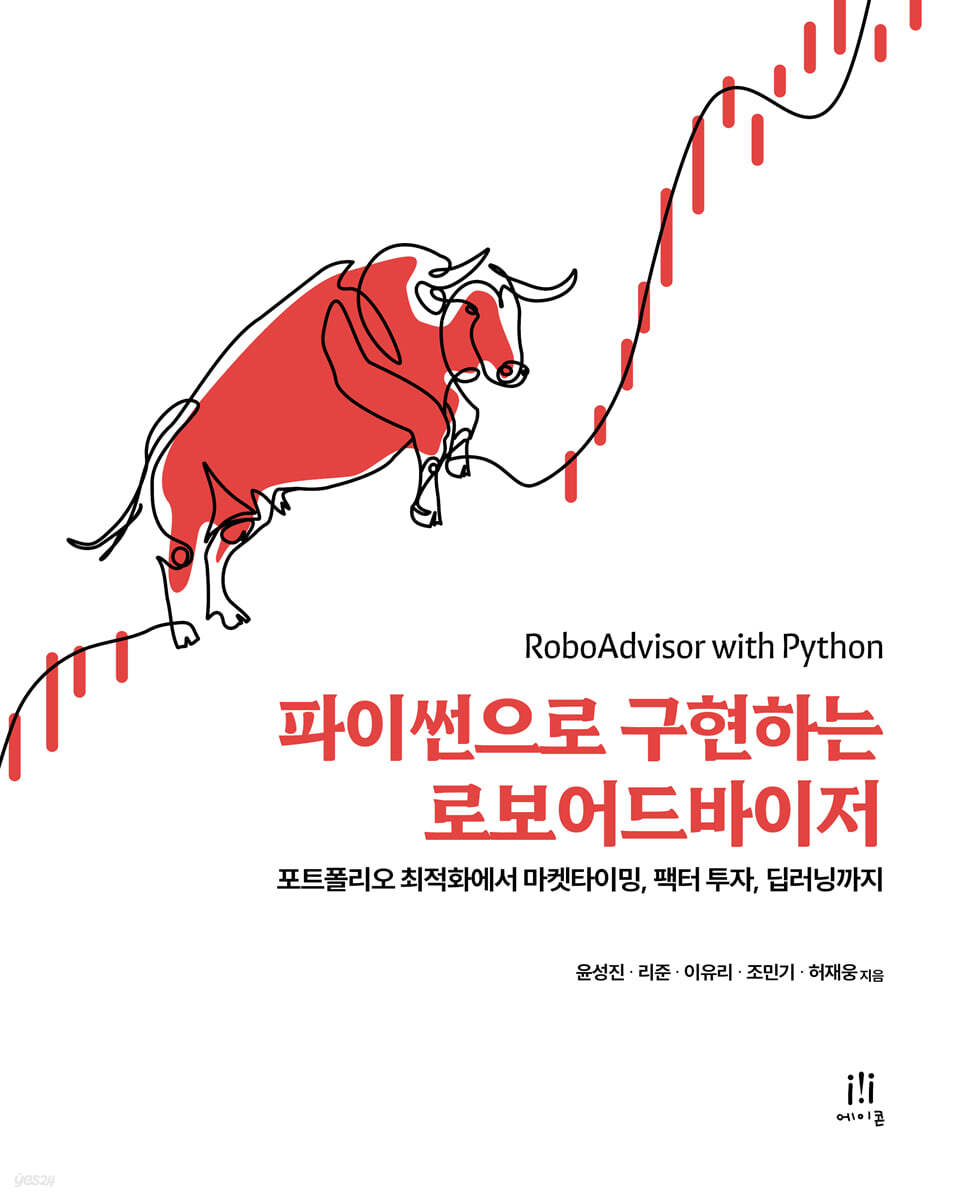
This book was written by financial AI researchers who developed the core engine of the robo-advisor system, and explains the main portfolio strategies that make up the robo-advisor along with Python code.
In particular, it covers a wide range of topics, from portfolio optimization strategies to market timing strategies, factor investment strategies, market monitoring, and deep learning forecasting. It also provides helpful guidance so that readers can easily understand and implement the programs themselves.
In particular, it covers a wide range of topics, from portfolio optimization strategies to market timing strategies, factor investment strategies, market monitoring, and deep learning forecasting. It also provides helpful guidance so that readers can easily understand and implement the programs themselves.
- You can preview some of the book's contents.
Preview
index
Chapter 1.
Investment Strategies for Beginner Quants
1.1 Beginner Investor Concerns
1.1.1 Definition of Assets and Investments
1.1.2 Key Attributes of Investments, Risks and Returns
1.1.3 Safe and Risky Assets
1.2 Modern Portfolio Theory
1.2.1 Portfolio theory that increases returns and reduces risk
1.2.2 Efficient Portfolio and Efficient Investment Line
1.2.3 Assumptions of Modern Portfolio Theory
1.2.4 Perfect Capital Market Assumption
1.2.5 Rational and reasonable investors
1.2.6 Mean-variance assumption
1.2.7 Risk Reduction Effect of Diversification
1.2.8 Advantages and Disadvantages of Modern Portfolio Theory
1.2.9 Alternatives to Modern Portfolio Theory
Chapter 2.
mean-variance model
2.1 Mean-variance model
2.1.1 Steps to run the mean-variance model
2.1.2 Hyperparameter Definition
2.1.3 Parameter estimation
2.1.4 Mean-variance model optimization
2.2 Asset Allocation Strategy
2.2.1 Process of implementing asset allocation strategies
2.2.2 Goal Setting
2.2.3 Market Data Collection
2.2.4 Selecting an Asset Class
2.2.5 Defining the Investment Universe
2.2.6 Asset Allocation
2.2.7 Order Execution
2.2.8 Periodic Rebalancing
2.2.9 Market Monitoring and Periodic Rebalancing
2.2.10 Portfolio Performance Monitoring
2.3 Development Preparation
2.3.1 Development Frameworks and Libraries
2.3.2 Directory and File Structure
References
Chapter 3.
Mean-Variance Strategy Implementation and Simulation Analysis
3.1 Implementing the Mean-Variance Strategy
3.1.1 Data Collection
3.1.2 Mean-variance optimization
3.1.3 Transaction Flow Modeling
3.1.4 Mean-Variance Simulation
3.2 Simulation Analysis
3.2.1 Preprocessing of simulation results
3.2.2 Portfolio Performance Indicators
3.2.3 Simulation Analysis through Visualization
References
Chapter 4.
Market Timing Strategy
4.1 What is a market timing strategy?
4.2 Moving Average Strategy
4.2.1 Investment Methods Using Moving Averages
4.2.2 Moving Average Calculation Method
4.2.3 Implementing a Moving Average Strategy
4.2.4 Moving Average Strategy Simulation
4.3 Momentum Strategy
4.3.2 Momentum Strategies and Notation
4.3.2 Relative Momentum Strategy
4.3.3 Medium-term momentum strategy
4.3.4 Absolute Momentum Strategy
4.3.5 Dual Momentum Strategy
4.3.6 52-Week High Momentum Strategy
4.3.7 Implementing a Momentum Strategy
4.3.8 Momentum Strategy Simulation
References
Chapter 5.
Market monitoring and regular rebalancing
5.1 The Need for Market Monitoring
5.1.1 What is Market Monitoring?
5.1.2 Benefits of Market Monitoring
5.1.3 Market Monitoring Methods
5.2 Technical Indicator Model
5.2.2 Rate of increase and decrease
5.2.3 Moving Average Convergence Diffusion
5.3 Analysis of technical indicator model execution results
5.3.1 Analysis Overview
5.3.2 ETF-based rebalancing
5.3.3 Mean-Variance Strategy-Based Rebalancing
5.3.4 Comparison of simulation results
Chapter 6.
Factor strategy
6.1 Background of Factor Investing
6.1.1 CAPM
6.1.2 Parma French Factor Model
6.2 Factor Investing
6.2.1 Revisiting the Momentum Strategy
6.2.2 Value Stock Strategy
6.2.3 Dividend Strategy
6.2.4 Small-Cap Strategy
6.2.5 Lowball Strategy
6.2.6 Investment by Supply and Demand Subject
References
Chapter 7.
Multi-factor strategy
7.1 Factor-based situation
7.1.1 Daily Profit by Strategy
7.1.2 Game phase and clusters
7.1.3 Clustering
7.1.4 Setting Strategy Weights
7.2 Phase Prediction
7.2.1 Macroeconomic Data
7.2.2 Cluster Prediction Using Random Forests
7.2.3 Evaluating Predictions
7.3 Multifactor Simulation
7.3.1 Preparing a Portfolio
7.3.2 Strategy Execution
References.
Chapter 8.
Market monitoring through deep learning predictions
8.1 Building a Deep Learning Prediction Model
8.1.1 Analysis
8.1.2 Deep Learning Model
8.1.3 RNN
8.1.4 SCINet
8.1.5 NLinear
8.2 Deep Learning Prediction Model Simulation
8.2.1 Deep Learning Overview
8.2.2 ETF-based rebalancing
8.2.3 Mean-Variance Strategy-Based Rebalancing
8.2.4 Comparison of simulation results
References
Chapter 9.
Advanced Optimization Strategies
9.1 Black-Litterman Algorithm
9.1.1 Black-Litterman Strategy Theory
9.1.2 Implementing the Black-Litterman Strategy
9.1.3 Black-Litterman Strategy Simulation
9.2 Risk Parity Algorithm
9.2.1 Black-Litterman Strategy and Risk Parity Strategy
9.2.2 Risk Parity Strategy Theory
9.2.3 Implementing a Risk Parity Strategy
9.2.4 Risk Parity Strategy Simulation
References
Investment Strategies for Beginner Quants
1.1 Beginner Investor Concerns
1.1.1 Definition of Assets and Investments
1.1.2 Key Attributes of Investments, Risks and Returns
1.1.3 Safe and Risky Assets
1.2 Modern Portfolio Theory
1.2.1 Portfolio theory that increases returns and reduces risk
1.2.2 Efficient Portfolio and Efficient Investment Line
1.2.3 Assumptions of Modern Portfolio Theory
1.2.4 Perfect Capital Market Assumption
1.2.5 Rational and reasonable investors
1.2.6 Mean-variance assumption
1.2.7 Risk Reduction Effect of Diversification
1.2.8 Advantages and Disadvantages of Modern Portfolio Theory
1.2.9 Alternatives to Modern Portfolio Theory
Chapter 2.
mean-variance model
2.1 Mean-variance model
2.1.1 Steps to run the mean-variance model
2.1.2 Hyperparameter Definition
2.1.3 Parameter estimation
2.1.4 Mean-variance model optimization
2.2 Asset Allocation Strategy
2.2.1 Process of implementing asset allocation strategies
2.2.2 Goal Setting
2.2.3 Market Data Collection
2.2.4 Selecting an Asset Class
2.2.5 Defining the Investment Universe
2.2.6 Asset Allocation
2.2.7 Order Execution
2.2.8 Periodic Rebalancing
2.2.9 Market Monitoring and Periodic Rebalancing
2.2.10 Portfolio Performance Monitoring
2.3 Development Preparation
2.3.1 Development Frameworks and Libraries
2.3.2 Directory and File Structure
References
Chapter 3.
Mean-Variance Strategy Implementation and Simulation Analysis
3.1 Implementing the Mean-Variance Strategy
3.1.1 Data Collection
3.1.2 Mean-variance optimization
3.1.3 Transaction Flow Modeling
3.1.4 Mean-Variance Simulation
3.2 Simulation Analysis
3.2.1 Preprocessing of simulation results
3.2.2 Portfolio Performance Indicators
3.2.3 Simulation Analysis through Visualization
References
Chapter 4.
Market Timing Strategy
4.1 What is a market timing strategy?
4.2 Moving Average Strategy
4.2.1 Investment Methods Using Moving Averages
4.2.2 Moving Average Calculation Method
4.2.3 Implementing a Moving Average Strategy
4.2.4 Moving Average Strategy Simulation
4.3 Momentum Strategy
4.3.2 Momentum Strategies and Notation
4.3.2 Relative Momentum Strategy
4.3.3 Medium-term momentum strategy
4.3.4 Absolute Momentum Strategy
4.3.5 Dual Momentum Strategy
4.3.6 52-Week High Momentum Strategy
4.3.7 Implementing a Momentum Strategy
4.3.8 Momentum Strategy Simulation
References
Chapter 5.
Market monitoring and regular rebalancing
5.1 The Need for Market Monitoring
5.1.1 What is Market Monitoring?
5.1.2 Benefits of Market Monitoring
5.1.3 Market Monitoring Methods
5.2 Technical Indicator Model
5.2.2 Rate of increase and decrease
5.2.3 Moving Average Convergence Diffusion
5.3 Analysis of technical indicator model execution results
5.3.1 Analysis Overview
5.3.2 ETF-based rebalancing
5.3.3 Mean-Variance Strategy-Based Rebalancing
5.3.4 Comparison of simulation results
Chapter 6.
Factor strategy
6.1 Background of Factor Investing
6.1.1 CAPM
6.1.2 Parma French Factor Model
6.2 Factor Investing
6.2.1 Revisiting the Momentum Strategy
6.2.2 Value Stock Strategy
6.2.3 Dividend Strategy
6.2.4 Small-Cap Strategy
6.2.5 Lowball Strategy
6.2.6 Investment by Supply and Demand Subject
References
Chapter 7.
Multi-factor strategy
7.1 Factor-based situation
7.1.1 Daily Profit by Strategy
7.1.2 Game phase and clusters
7.1.3 Clustering
7.1.4 Setting Strategy Weights
7.2 Phase Prediction
7.2.1 Macroeconomic Data
7.2.2 Cluster Prediction Using Random Forests
7.2.3 Evaluating Predictions
7.3 Multifactor Simulation
7.3.1 Preparing a Portfolio
7.3.2 Strategy Execution
References.
Chapter 8.
Market monitoring through deep learning predictions
8.1 Building a Deep Learning Prediction Model
8.1.1 Analysis
8.1.2 Deep Learning Model
8.1.3 RNN
8.1.4 SCINet
8.1.5 NLinear
8.2 Deep Learning Prediction Model Simulation
8.2.1 Deep Learning Overview
8.2.2 ETF-based rebalancing
8.2.3 Mean-Variance Strategy-Based Rebalancing
8.2.4 Comparison of simulation results
References
Chapter 9.
Advanced Optimization Strategies
9.1 Black-Litterman Algorithm
9.1.1 Black-Litterman Strategy Theory
9.1.2 Implementing the Black-Litterman Strategy
9.1.3 Black-Litterman Strategy Simulation
9.2 Risk Parity Algorithm
9.2.1 Black-Litterman Strategy and Risk Parity Strategy
9.2.2 Risk Parity Strategy Theory
9.2.3 Implementing a Risk Parity Strategy
9.2.4 Risk Parity Strategy Simulation
References
Detailed image

Publisher's Review
◈ What this book covers ◈
◆ Convert financial theory into Python code and gain practical understanding through practice.
◆ Risk and return, the main attributes of investment
Modern portfolio theory that maximizes returns and minimizes risk
◆ The mean-variance model, an asset allocation strategy in modern portfolio theory
◆ Market timing strategy that determines the timing of buying/selling based on market conditions
◆ Market monitoring and key market indicators to enhance the ability to respond to investment risks
Factor investment strategy, an investment method that analyzes factors that determine returns
◆ Multi-factor strategy that comprehensively analyzes various factors
Market monitoring and response strategies through deep learning predictions
Black-Litterman Risk Parity Optimization Strategy: Breaking Through the Limitations of the Mean-Variance Model
◈ Target audience of this book ◈
◆ People who want to build a foundation from basic quantitative theory to the latest time series algorithms
◆ People who want to implement portfolio theory
◆ People who want to run and verify various asset allocation algorithms with implemented codes along with conceptual explanations.
◈ Author's Note ◈
Last year, our team, which researches and develops financial AI solutions, discussed the idea of sharing our experience and knowledge with those interested in building robo-advisors.
While there are already books on quantitative investing on the market and readily available online, we all agreed that a book based on the experience of building and operating the core engine of a robo-advisor would be of practical help to people.
So the team members got together and each took on a topic and started writing a manuscript.
However, it was not easy to express the knowledge in the heads of five authors consistently and naturally as if it were in the head of one person, and it required a lot of effort to work on the manuscript in the midst of a busy daily life.
As I teach artificial intelligence courses in graduate school, I often meet students interested in financial AI, and some of them want to create their own robo-advisors.
Talking with them, I realized that many people, even if they have financial knowledge, are not familiar with development, or conversely, even if they have development skills, they have to acquire financial knowledge separately, so they cannot attempt quantitative investment but keep it as a dream.
So I thought this book would be a good guide for those people.
This book uses an experiential story-based approach to explain financial theory so that even those new to it can easily follow and understand it.
And the code was written as concisely as possible, boldly omitting detailed exception handling and revealing the main logic.
Additionally, the code is explained line by line so that you can understand and follow it semantically, and you can see in detail which step is currently being implemented.
Additionally, the main algorithms of robo-advisors are arranged in increasing difficulty throughout the book, allowing readers to gradually approach them as their level of understanding increases.
Readers who wish to extend or deepen the algorithms presented in this book are encouraged to analyze the referenced documents and open sources.
─ Yoon Seong-jin
After building a career in traditional and quantitative investment at a Chinese securities firm for about six years, I suddenly had to move to Korea due to personal reasons.
Originally majoring in mathematics and statistics, I came to Korea to earn a degree in computer science and joined an IT company to take on a new challenge.
Fortunately, I was fortunate enough to work with my current colleagues, and was appointed as a financial AI researcher, where I began working on developing a robo-advisor.
I decided to build a robo-advisor, but achieving the results I wanted still required staying up all night and racking my brain.
This experience gave me a deep understanding that the combination of theory and practice is key to success in fields where technology and finance intersect.
As I gained practical experience, I discovered that there was a lack of books covering the practical aspects of robo-advisor development, which led me to write this book.
By sharing this knowledge, we hope to help readers gradually acquire the core concepts and techniques of quantitative investing and develop more intelligent and efficient investment strategies.
─ Lee Jun
It's already been four years since I became fascinated with stock investing and started investing.
My first investment was in my mid-20s, when I invested 1 million won in a robo-advisor.
I remember starting out with high hopes for artificial intelligence at the time, but then suffering losses for no apparent reason and eventually recovering my investment.
That experience led to a deep study of artificial intelligence and investment strategies, which became the background for this book.
Through repeated investment failures and successes, I have realized that the knowledge I have gained is more valuable than the money I lost, and so I want to share my knowledge and insights through this book.
I hope this book will serve as a guide to 'reasonable investment' for many investors who have invested without knowledge and experienced losses.
─ Lee Yuri
"Can we perfectly predict the financial market?" This is a question that anyone who has studied economics has probably thought about at least once.
This book covers market analysis and programming, utilizing a variety of methods, including portfolio optimization, market timing, factor investing, and deep learning.
While these methods can be used as tools to predict the market, they cannot always lead to successful investments.
It would be great if everyone reading this book could always make a profit from stock investing. However, because stock investing isn't like a mathematical formula with a set of correct answers, some people may experience moments of failure and frustration.
This book does not provide the right answers to stock investing, and such a book does not exist.
However, I hope this book will help you analyze the market from various perspectives, implement those methods through programming, and establish your own investment philosophy and methods.
─ Jo Min-ki
By the end of this book, some readers will think of risk and volatility as synonymous concepts.
The logic is that a good portfolio exists within the balance of expected return and risk, and if an investor seeks safety, he or she can adjust the portfolio by increasing the weight of risk.
In Chapter 1, we defined the concept of risk using uncertain future cash flows, but I don't think anyone who understands formulas and writes code to match them will have time to think deeply about the meaning of risk.
What would it be like to buy farmland that was previously priced at $2,000 per acre for $600? If farmland transactions are infrequent, the volatility of the land will increase as I undercut the price, making my investment risky.
So, should I have purchased that farmland at a price closer to $2,000 to reduce the volatility of my assets? At Berkshire Hathaway's annual meeting in 2007, Warren Buffett recounted the anecdote above, stating that volatility is not a measure of risk.
Instead, he said, risk arises when investors don't fully understand the economics of the investment.
As this book aims to implement a robo-advisor that operates in the stock market, it develops its argument by interpreting risk in the stock market as volatility.
The author is also not knowledgeable enough to dispute the concept of volatility, which has been validated by economists.
However, I would like to apologize to the readers for the gap between actual investment and mathematics.
Finance is too mathematical to be understood intuitively, and too flexible to be understood logically.
However, economists adopted mathematics as a tool to understand finance, and financial engineering was born as a result.
This book offers readers several ways to profit from financial engineering, tailored to such financial engineering.
I hope this book will serve as a reference for readers considering investing.
─ Heo Jae-woong
◆ Convert financial theory into Python code and gain practical understanding through practice.
◆ Risk and return, the main attributes of investment
Modern portfolio theory that maximizes returns and minimizes risk
◆ The mean-variance model, an asset allocation strategy in modern portfolio theory
◆ Market timing strategy that determines the timing of buying/selling based on market conditions
◆ Market monitoring and key market indicators to enhance the ability to respond to investment risks
Factor investment strategy, an investment method that analyzes factors that determine returns
◆ Multi-factor strategy that comprehensively analyzes various factors
Market monitoring and response strategies through deep learning predictions
Black-Litterman Risk Parity Optimization Strategy: Breaking Through the Limitations of the Mean-Variance Model
◈ Target audience of this book ◈
◆ People who want to build a foundation from basic quantitative theory to the latest time series algorithms
◆ People who want to implement portfolio theory
◆ People who want to run and verify various asset allocation algorithms with implemented codes along with conceptual explanations.
◈ Author's Note ◈
Last year, our team, which researches and develops financial AI solutions, discussed the idea of sharing our experience and knowledge with those interested in building robo-advisors.
While there are already books on quantitative investing on the market and readily available online, we all agreed that a book based on the experience of building and operating the core engine of a robo-advisor would be of practical help to people.
So the team members got together and each took on a topic and started writing a manuscript.
However, it was not easy to express the knowledge in the heads of five authors consistently and naturally as if it were in the head of one person, and it required a lot of effort to work on the manuscript in the midst of a busy daily life.
As I teach artificial intelligence courses in graduate school, I often meet students interested in financial AI, and some of them want to create their own robo-advisors.
Talking with them, I realized that many people, even if they have financial knowledge, are not familiar with development, or conversely, even if they have development skills, they have to acquire financial knowledge separately, so they cannot attempt quantitative investment but keep it as a dream.
So I thought this book would be a good guide for those people.
This book uses an experiential story-based approach to explain financial theory so that even those new to it can easily follow and understand it.
And the code was written as concisely as possible, boldly omitting detailed exception handling and revealing the main logic.
Additionally, the code is explained line by line so that you can understand and follow it semantically, and you can see in detail which step is currently being implemented.
Additionally, the main algorithms of robo-advisors are arranged in increasing difficulty throughout the book, allowing readers to gradually approach them as their level of understanding increases.
Readers who wish to extend or deepen the algorithms presented in this book are encouraged to analyze the referenced documents and open sources.
─ Yoon Seong-jin
After building a career in traditional and quantitative investment at a Chinese securities firm for about six years, I suddenly had to move to Korea due to personal reasons.
Originally majoring in mathematics and statistics, I came to Korea to earn a degree in computer science and joined an IT company to take on a new challenge.
Fortunately, I was fortunate enough to work with my current colleagues, and was appointed as a financial AI researcher, where I began working on developing a robo-advisor.
I decided to build a robo-advisor, but achieving the results I wanted still required staying up all night and racking my brain.
This experience gave me a deep understanding that the combination of theory and practice is key to success in fields where technology and finance intersect.
As I gained practical experience, I discovered that there was a lack of books covering the practical aspects of robo-advisor development, which led me to write this book.
By sharing this knowledge, we hope to help readers gradually acquire the core concepts and techniques of quantitative investing and develop more intelligent and efficient investment strategies.
─ Lee Jun
It's already been four years since I became fascinated with stock investing and started investing.
My first investment was in my mid-20s, when I invested 1 million won in a robo-advisor.
I remember starting out with high hopes for artificial intelligence at the time, but then suffering losses for no apparent reason and eventually recovering my investment.
That experience led to a deep study of artificial intelligence and investment strategies, which became the background for this book.
Through repeated investment failures and successes, I have realized that the knowledge I have gained is more valuable than the money I lost, and so I want to share my knowledge and insights through this book.
I hope this book will serve as a guide to 'reasonable investment' for many investors who have invested without knowledge and experienced losses.
─ Lee Yuri
"Can we perfectly predict the financial market?" This is a question that anyone who has studied economics has probably thought about at least once.
This book covers market analysis and programming, utilizing a variety of methods, including portfolio optimization, market timing, factor investing, and deep learning.
While these methods can be used as tools to predict the market, they cannot always lead to successful investments.
It would be great if everyone reading this book could always make a profit from stock investing. However, because stock investing isn't like a mathematical formula with a set of correct answers, some people may experience moments of failure and frustration.
This book does not provide the right answers to stock investing, and such a book does not exist.
However, I hope this book will help you analyze the market from various perspectives, implement those methods through programming, and establish your own investment philosophy and methods.
─ Jo Min-ki
By the end of this book, some readers will think of risk and volatility as synonymous concepts.
The logic is that a good portfolio exists within the balance of expected return and risk, and if an investor seeks safety, he or she can adjust the portfolio by increasing the weight of risk.
In Chapter 1, we defined the concept of risk using uncertain future cash flows, but I don't think anyone who understands formulas and writes code to match them will have time to think deeply about the meaning of risk.
What would it be like to buy farmland that was previously priced at $2,000 per acre for $600? If farmland transactions are infrequent, the volatility of the land will increase as I undercut the price, making my investment risky.
So, should I have purchased that farmland at a price closer to $2,000 to reduce the volatility of my assets? At Berkshire Hathaway's annual meeting in 2007, Warren Buffett recounted the anecdote above, stating that volatility is not a measure of risk.
Instead, he said, risk arises when investors don't fully understand the economics of the investment.
As this book aims to implement a robo-advisor that operates in the stock market, it develops its argument by interpreting risk in the stock market as volatility.
The author is also not knowledgeable enough to dispute the concept of volatility, which has been validated by economists.
However, I would like to apologize to the readers for the gap between actual investment and mathematics.
Finance is too mathematical to be understood intuitively, and too flexible to be understood logically.
However, economists adopted mathematics as a tool to understand finance, and financial engineering was born as a result.
This book offers readers several ways to profit from financial engineering, tailored to such financial engineering.
I hope this book will serve as a reference for readers considering investing.
─ Heo Jae-woong
GOODS SPECIFICS
- Date of issue: July 31, 2024
- Page count, weight, size: 456 pages | 188*235*21mm
- ISBN13: 9791161758275
- ISBN10: 1161758275
You may also like
카테고리
korean


korean

![GQ KOREA Mark (Monthly): December [2025]](http://librairie.coreenne.fr/cdn/shop/files/8ef265dbbfbf186523ed75ba7319009d.jpg?v=1765340328&width=3840)


