

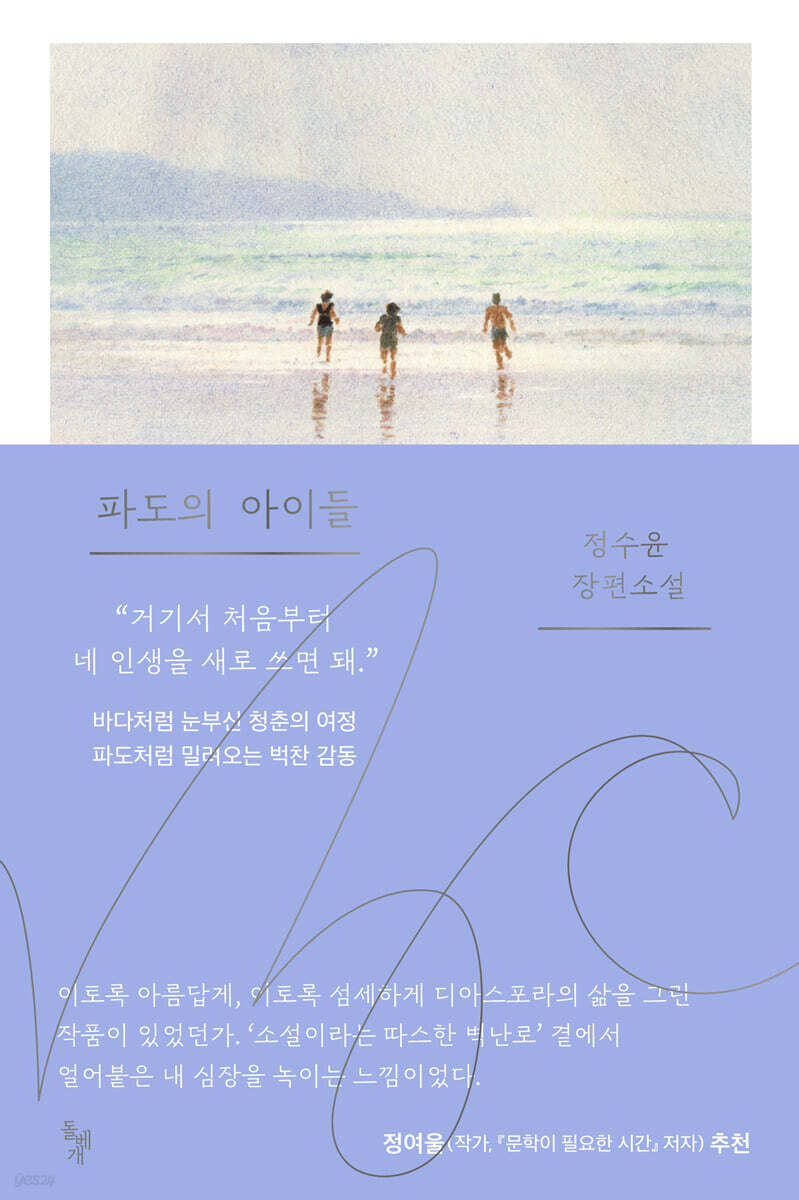
Children of the Waves
 |
Description
Book Introduction
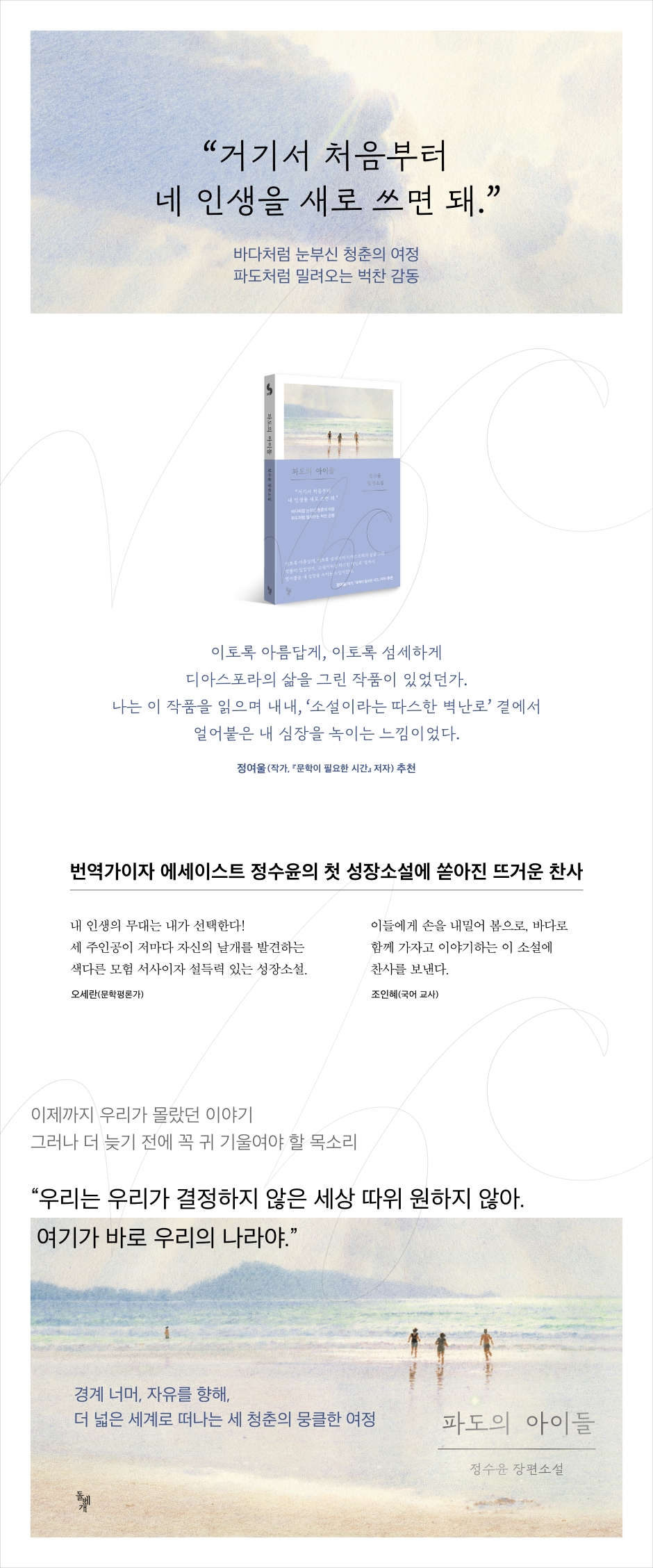
“You can start your life over from there.” Beyond the border, towards freedom, A touching journey of three young people into a new world. The first full-length novel, "Children of the Waves," by Jeong Su-yoon, a trusted translator and essayist who has translated masterpieces of Japanese literature, including Natsume Soseki and Dazai Osamu, has been published. "Children of the Waves" depicts the journey of three teenage protagonists, Seol, Gwangmin, and Yeoreum, as they leave their hometown in North Korea to find a new life. The story of the growth of three young people who, despite the harsh reality presented to them, chose to choose their future according to their own will until the end, unfolds vividly. Based on the author's sincere research over 13 years of interviews with over 100 North Korean defectors, the book captures the hardships, frustrations, and separations they faced, as well as the desperation that ultimately prevented them from giving up. |
- You can preview some of the book's contents.
Preview
index
Children of the Waves
Author's Note
Recommendation
Author's Note
Recommendation
Detailed image
Into the book
A blue line that continues endlessly while gently shaking.
A thin line of water stretching out to meet the sky.
It was a horizon.
It's the sea... ... .
It was the first time I saw the sea in my life.
It was so beautiful that I couldn't describe it.
--- p.202
I just wanted to see the sea, I wanted to live by the sea, so I left.
When Gwangmin said he could see the sea in the distance, everything suddenly became clear within me.
Let's go right now.
To see the sea.
--- p.206
We walked in one direction without saying a word.
Towards a place that cannot be seen, but is believed to exist.
(…) Our scales sometimes sparkled in the moonlight.
As I rowed through the moonlight, I thought.
There might not be an ocean at the end of this road.
As has always been the case on our path so far, the things we want to get always run away the further we get.
Perhaps the name "sea" is nothing more than a beautiful illusion created by someone.
Freedom, peace, and such dreamlike names always pass us by without substance.
--- p.209
The sea greeted us all equally.
In the same language.
Conveying the same meaning.
Hello, hello, hello.
I ran towards the sea in joy.
(…) When I looked here, I saw that they were all one.
You and me, water and fish, moon and sea.
It's all one.
Everything is connected.
We brought it to our noses to smell it, reached out to hold it, and even tried to eat it, but we still didn't fully understand the ocean.
But one thing was clear: it existed.
The sea… … the sea really… … existed in this world.
It was swaying like this.
It's been rippling since long before I was born, and probably even after I die.
Just looking at this sea, which connects something forever, made my heart feel warm.
--- pp.210-211
“We don’t want a world we didn’t decide for ourselves.
“This is our country!”
(…)
The three of us shouted together, with all our hearts, as loud as we could, toward the night sea.
“This is our country!”
Thud, thud, thud.
We heard.
The sound of the sea approaching us and responding with its whole body.
In this sea, everything was starting again.
A thin line of water stretching out to meet the sky.
It was a horizon.
It's the sea... ... .
It was the first time I saw the sea in my life.
It was so beautiful that I couldn't describe it.
--- p.202
I just wanted to see the sea, I wanted to live by the sea, so I left.
When Gwangmin said he could see the sea in the distance, everything suddenly became clear within me.
Let's go right now.
To see the sea.
--- p.206
We walked in one direction without saying a word.
Towards a place that cannot be seen, but is believed to exist.
(…) Our scales sometimes sparkled in the moonlight.
As I rowed through the moonlight, I thought.
There might not be an ocean at the end of this road.
As has always been the case on our path so far, the things we want to get always run away the further we get.
Perhaps the name "sea" is nothing more than a beautiful illusion created by someone.
Freedom, peace, and such dreamlike names always pass us by without substance.
--- p.209
The sea greeted us all equally.
In the same language.
Conveying the same meaning.
Hello, hello, hello.
I ran towards the sea in joy.
(…) When I looked here, I saw that they were all one.
You and me, water and fish, moon and sea.
It's all one.
Everything is connected.
We brought it to our noses to smell it, reached out to hold it, and even tried to eat it, but we still didn't fully understand the ocean.
But one thing was clear: it existed.
The sea… … the sea really… … existed in this world.
It was swaying like this.
It's been rippling since long before I was born, and probably even after I die.
Just looking at this sea, which connects something forever, made my heart feel warm.
--- pp.210-211
“We don’t want a world we didn’t decide for ourselves.
“This is our country!”
(…)
The three of us shouted together, with all our hearts, as loud as we could, toward the night sea.
“This is our country!”
Thud, thud, thud.
We heard.
The sound of the sea approaching us and responding with its whole body.
In this sea, everything was starting again.
--- pp.212-213
Publisher's Review
Translator and essayist Jeong Su-yoon's debut novel receives rave reviews.
“Has there ever been a work that depicted the life of the diaspora so beautifully and so delicately?
While reading this work, I felt like I was sitting next to the 'warm fireplace called a novel'.
“It felt like my frozen heart was melting.”
* Recommended by Jeong Yeo-ul (author of "Time for Literature")
A story we never knew before
But there is a voice that must be heard before it is too late.
Now we are running towards a land that we do not even know exists in the world.
In that land, we can go anywhere, meet anyone, eat, drink, and wear anything.
Above all, in that land we can live as ourselves.
Just as you were born.
(Pages 8-9)
The story unfolds as the stories of the three main characters intersect.
'Seol', who begins the first chapter, crosses the Tumen River with the determination that it will be her last attempt after two failed attempts to defect from North Korea, but she is put in danger by human trafficking and barely escapes.
As a child of a high-ranking North Korean official, Gwang-min, who enjoys a comfortable life without any shortcomings and dreams of becoming a world-class soccer player like Son Heung-min, is suddenly thrown into crisis when his mother's brokering activities are discovered.
The last protagonist, 'Summer', is continuing her precarious days in China even after leaving North Korea.
The three people who dreamed of living freely, “just as they were born,” as themselves, finally reach the blue sea for the first time in their lives after going through hardships.
The narrative does not end with escaping North Korea and arriving in South Korea, and the independent voices of the young characters who declare the "sea" as their country rather than taking sides between the "North" and the "South" are impressive.
Amidst growing social interest in the lives of immigrants, the fact that works that delve deeply into the lives of North Korean defectors are still rare is another reason why we should not miss this novel.
A protagonist of his own narrative with unique dignity, not an object of tragedy
Diaspora narratives are gaining increasing attention in literature and various other fields of art.
"Children of the Waves" surpasses previous North Korean immigrant narratives and reaches a point of literary advancement.
This work vividly depicts the sorrow endured by those who chose to leave their families and hometowns, but does not portray only the painful aspects of these individuals, stereotyping them into tragic characters.
The author establishes the three main characters in the novel as subjects of his own narrative, each with a variety of emotions and three-dimensional voices.
While studying abroad in Japan, Jeong Su-yoon became aware of the existence of those living in the other half of the Korean Peninsula, beyond the border, and began to build friendships with friends who had left North Korea to face their real lives, not just through media reports.
The vivid images of the characters in the work, who sing and dance with friends, sometimes wish to have pretty clothes, and dream of becoming a great soccer player like Son Heung-min, were made possible through such encounters.
The unique dignity and true face of each and every person, which cannot be defined solely by a nation or ideology, leave an unforgettable impression.
Literature that thinks outside and expands the world beyond boundaries
"Children of the Waves" helps us realize that the narrative of the diaspora and North Korean migrants is not a distant story far removed from us, but rather a story of our neighbors and friends who live alongside us, forming a community.
While conveying a sense of themes that are urgently needed in Korean society today, it is also outstanding in its depth as a narrative and literary impact.
The fast-paced plot unfolds along the protagonists' urgent journey, providing a powerful and captivating power that stands out among recent realistic narratives.
It also shines with its virtue as a coming-of-age novel that does not lose faith in 'dreams' and 'courage'.
The "open ending" of this work is not merely rhetorical; it is a dynamic request that readers who accompany the three characters on their journey hope to move forward toward an "open tomorrow" in their own lives after closing the book.
Just like the last sentence of the novel, which says, “Everything was starting again” while listening to “the sound of the sea answering with my whole body,” the author, through “crossing boundaries” within the work, extends a hand to readers living in reality outside the work, asking them to courageously cross the solid boundaries that surround us together.
By reading "Children of the Waves," readers can think about the outside world and experience a literary world that expands their understanding.
It is now our turn to respond with a dazzling welcome like the sea to the three young people who have risked their lives to arrive before us.
From the author's note
The three friends in the story are characters I created based on the youth and young adults I met in the North.
I wanted to write about the separations and inhumane treatment these three friends endure before they leave their hometown and enjoy freedom at sea.
I wanted to write about the great journey to find freedom, about how precious human life is, and about the sorrow of youth being driven to the brink of death.
Like every other teenager on the planet, they loved their family and friends and were adventurous, and I always felt like maybe that was me.
That feeling led me to write this book.
(…)
We want to live in an open country.
I want to live in a place that accepts everyone generously, like the vast blue sea.
I'm tired of fighting without even trying to communicate with each other.
We want to live in a warmer and more peaceful country than we do now.
We can create a brighter and freer country.
I wanted to say through this book that we should create such a world in the future.
“Has there ever been a work that depicted the life of the diaspora so beautifully and so delicately?
While reading this work, I felt like I was sitting next to the 'warm fireplace called a novel'.
“It felt like my frozen heart was melting.”
* Recommended by Jeong Yeo-ul (author of "Time for Literature")
A story we never knew before
But there is a voice that must be heard before it is too late.
Now we are running towards a land that we do not even know exists in the world.
In that land, we can go anywhere, meet anyone, eat, drink, and wear anything.
Above all, in that land we can live as ourselves.
Just as you were born.
(Pages 8-9)
The story unfolds as the stories of the three main characters intersect.
'Seol', who begins the first chapter, crosses the Tumen River with the determination that it will be her last attempt after two failed attempts to defect from North Korea, but she is put in danger by human trafficking and barely escapes.
As a child of a high-ranking North Korean official, Gwang-min, who enjoys a comfortable life without any shortcomings and dreams of becoming a world-class soccer player like Son Heung-min, is suddenly thrown into crisis when his mother's brokering activities are discovered.
The last protagonist, 'Summer', is continuing her precarious days in China even after leaving North Korea.
The three people who dreamed of living freely, “just as they were born,” as themselves, finally reach the blue sea for the first time in their lives after going through hardships.
The narrative does not end with escaping North Korea and arriving in South Korea, and the independent voices of the young characters who declare the "sea" as their country rather than taking sides between the "North" and the "South" are impressive.
Amidst growing social interest in the lives of immigrants, the fact that works that delve deeply into the lives of North Korean defectors are still rare is another reason why we should not miss this novel.
A protagonist of his own narrative with unique dignity, not an object of tragedy
Diaspora narratives are gaining increasing attention in literature and various other fields of art.
"Children of the Waves" surpasses previous North Korean immigrant narratives and reaches a point of literary advancement.
This work vividly depicts the sorrow endured by those who chose to leave their families and hometowns, but does not portray only the painful aspects of these individuals, stereotyping them into tragic characters.
The author establishes the three main characters in the novel as subjects of his own narrative, each with a variety of emotions and three-dimensional voices.
While studying abroad in Japan, Jeong Su-yoon became aware of the existence of those living in the other half of the Korean Peninsula, beyond the border, and began to build friendships with friends who had left North Korea to face their real lives, not just through media reports.
The vivid images of the characters in the work, who sing and dance with friends, sometimes wish to have pretty clothes, and dream of becoming a great soccer player like Son Heung-min, were made possible through such encounters.
The unique dignity and true face of each and every person, which cannot be defined solely by a nation or ideology, leave an unforgettable impression.
Literature that thinks outside and expands the world beyond boundaries
"Children of the Waves" helps us realize that the narrative of the diaspora and North Korean migrants is not a distant story far removed from us, but rather a story of our neighbors and friends who live alongside us, forming a community.
While conveying a sense of themes that are urgently needed in Korean society today, it is also outstanding in its depth as a narrative and literary impact.
The fast-paced plot unfolds along the protagonists' urgent journey, providing a powerful and captivating power that stands out among recent realistic narratives.
It also shines with its virtue as a coming-of-age novel that does not lose faith in 'dreams' and 'courage'.
The "open ending" of this work is not merely rhetorical; it is a dynamic request that readers who accompany the three characters on their journey hope to move forward toward an "open tomorrow" in their own lives after closing the book.
Just like the last sentence of the novel, which says, “Everything was starting again” while listening to “the sound of the sea answering with my whole body,” the author, through “crossing boundaries” within the work, extends a hand to readers living in reality outside the work, asking them to courageously cross the solid boundaries that surround us together.
By reading "Children of the Waves," readers can think about the outside world and experience a literary world that expands their understanding.
It is now our turn to respond with a dazzling welcome like the sea to the three young people who have risked their lives to arrive before us.
From the author's note
The three friends in the story are characters I created based on the youth and young adults I met in the North.
I wanted to write about the separations and inhumane treatment these three friends endure before they leave their hometown and enjoy freedom at sea.
I wanted to write about the great journey to find freedom, about how precious human life is, and about the sorrow of youth being driven to the brink of death.
Like every other teenager on the planet, they loved their family and friends and were adventurous, and I always felt like maybe that was me.
That feeling led me to write this book.
(…)
We want to live in an open country.
I want to live in a place that accepts everyone generously, like the vast blue sea.
I'm tired of fighting without even trying to communicate with each other.
We want to live in a warmer and more peaceful country than we do now.
We can create a brighter and freer country.
I wanted to say through this book that we should create such a world in the future.
GOODS SPECIFICS
- Date of issue: June 27, 2024
- Page count, weight, size: 220 pages | 376g | 140*210*14mm
- ISBN13: 9791192836720
- ISBN10: 1192836723
You may also like
카테고리
korean


korean

![GQ KOREA Mark (Monthly): December [2025]](http://librairie.coreenne.fr/cdn/shop/files/8ef265dbbfbf186523ed75ba7319009d.jpg?v=1765340328&width=3840)


