

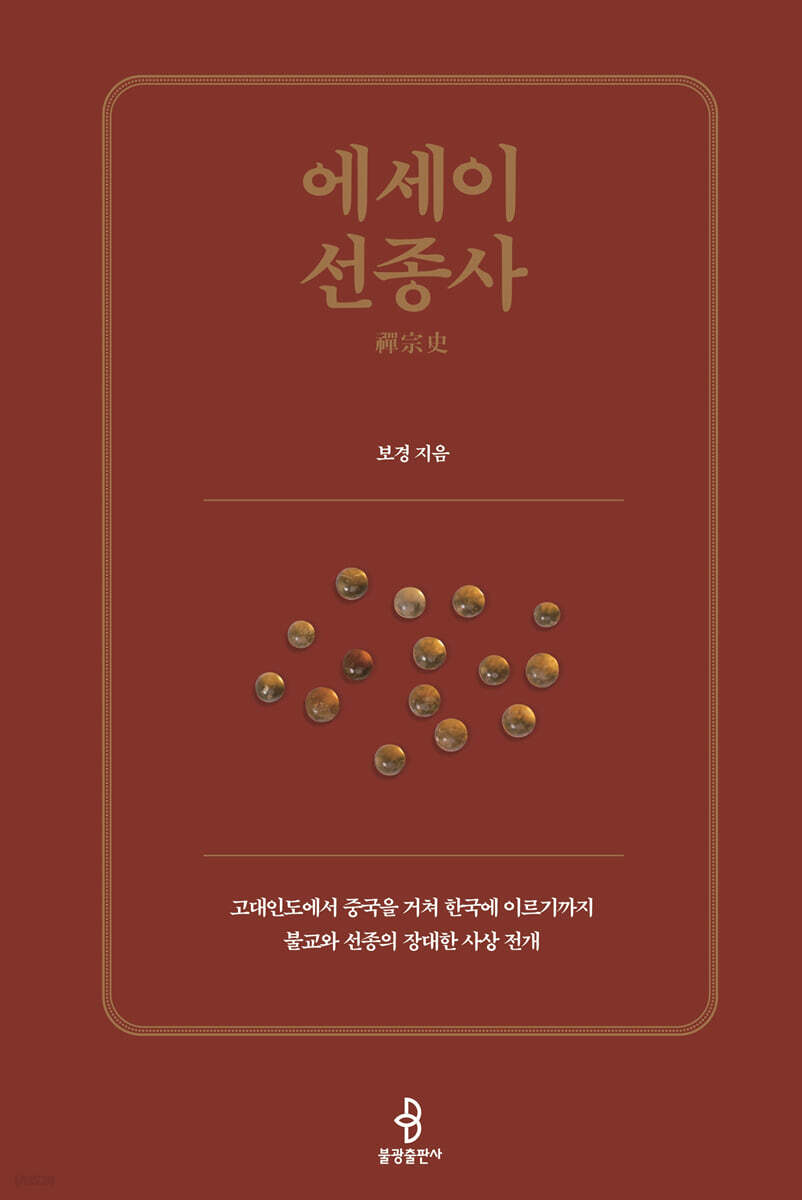
Essay on Zen Buddhism
 |
Description
Book Introduction
The world of Zen as told by the best essayist, Monk Bogyeong.
The grand history and thought of Zen Buddhism are contained in this one volume!
Theory without practice is empty, practice without theory is blind.
Only through constant effort, backed by deep understanding, can we achieve what we want in life.
The same goes for Buddhist practice.
Without a clear understanding of what I am practicing, why I am practicing, and how I am practicing, I am likely to get lost and wander.
This book illuminates the path for those who wish to embark on a journey of Zen.
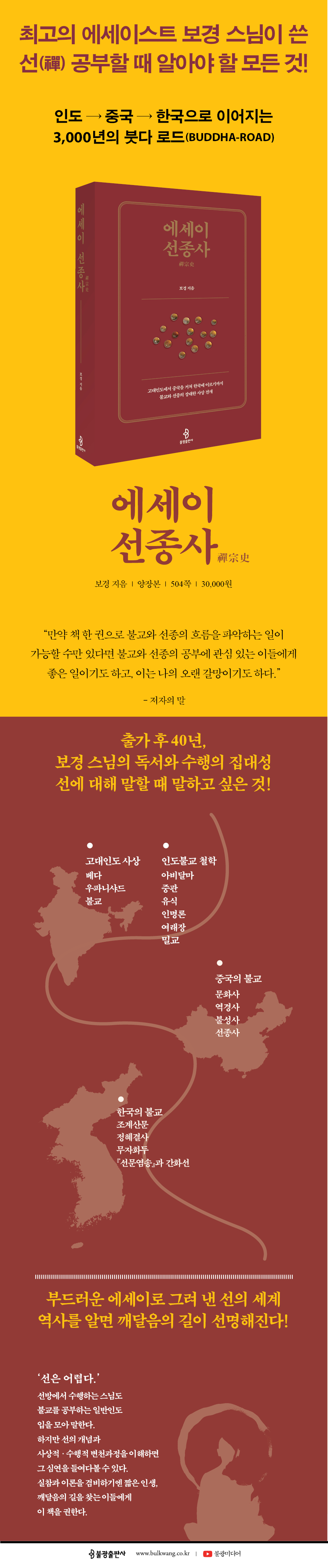
It clearly explains how Seon Buddhism was born in the flow of long history, what ideological and practical changes it has undergone, and what the core of Korean Seon Buddhism is today.
'Zen is difficult.' This is what Zen monks and people studying Korean Buddhism all say.
This is a metaphor for the hardships of Zen practice, but it also means that the meaning of Zen is ambiguous and the concept is difficult to grasp.
This book will quench that thirst.
Before you rush to sit down and meditate, open this book first.
Knowing exactly and doing right is the fastest way to get there.
The grand history and thought of Zen Buddhism are contained in this one volume!
Theory without practice is empty, practice without theory is blind.
Only through constant effort, backed by deep understanding, can we achieve what we want in life.
The same goes for Buddhist practice.
Without a clear understanding of what I am practicing, why I am practicing, and how I am practicing, I am likely to get lost and wander.
This book illuminates the path for those who wish to embark on a journey of Zen.
It clearly explains how Seon Buddhism was born in the flow of long history, what ideological and practical changes it has undergone, and what the core of Korean Seon Buddhism is today.
'Zen is difficult.' This is what Zen monks and people studying Korean Buddhism all say.
This is a metaphor for the hardships of Zen practice, but it also means that the meaning of Zen is ambiguous and the concept is difficult to grasp.
This book will quench that thirst.
Before you rush to sit down and meditate, open this book first.
Knowing exactly and doing right is the fastest way to get there.
- You can preview some of the book's contents.
Preview
index
introduction
Ⅰ Origins of Indian Thought
1.
Ancient Indian ThoughtVedic Thought and RitualUpanishadic ThoughtVedic Thought and Buddhism
2.
Background of the emergence of Buddhism
Ⅱ Development of Indian Buddhist Philosophy
1.
Collection of the Scriptures
2.
The beginning and development of Indian philosophy
3.
On the Abhidharma philosophy, the Abhidharma-kośa-sūtra, the five aggregates, the twelve bases, and the eighteen realms
4.
The early teachings of the Madhyamaka school and the theory of dependent origination, the emptiness of Yongsu's philosophy of dependent origination, the theory of the philosophy of dependent origination as the middle way, the theory of extinction and the theory of the two realities of existence and the division of reality
5.
The five stages of the practice of yoga, path, consciousness, and no economy, the eighth stage of alaya-vijnana, the seventh stage of manas-vijnana, the sixth stage of consciousness, mind, possession, consciousness, and three stages of consciousness.
6.
Anthropology Definition of anthropology Scope of anthropology Recognition relationship
7.
Tathagatagarbha thought
8.
esoteric Buddhism
Ⅲ Chinese History and Thought
1.
The significance of history and the history of ideas
2.
Ancient Chinese history and culture: Xiang Zhou (feudalism, quasi-official system, patriarchal system, rites and music system, history); the Hundred Schools of Thought contended during the Spring and Autumn Period and the Warring States Period (Confucianism, Mohism, Taoism, Legalism); Jin-Confucianism (moral view, theory of nature, learning); the ideological aspects of the Han Empire and their significance (Emperor Wu of Han, Dong Zhongshu, the law of truth, exegesis, Shuowen Zhizi, Taoism)
Ⅳ Chinese History of Buddhism
1.
An Overview of Translation, Standards and the Challenges of Translation, The Age of Adversity, and the Behind-the-Scenes of Adversity
2.
The history of Chinese history and representative figures by era The beginning of the history of the history of the history of the history of the history of the history of the Three Kingdoms period, Ji-gyeom and Gang-seung-hui The characteristics of Buddhism in the Yang-jin period (Chuk-beop-ho, Bul-do-jing, Do-an, Kumara-jip, Seung-jo and Chuk-do-saeng, Dam-mu-cham) Buddhism in the Northern and Southern Dynasties period (Guna-vatara, Bodhi-ryu-ji, Jin-je) Buddhism in the Sui and Tang periods, the completion of Sinicization (Hyeon-jang, Shil-chan-nanda, Yi-jeong) Buddhism in the Five Dynasties and Ten Kingdoms period The upheaval of the Song Dynasty and the rise of Zen Buddhism Buddhism in the nomadic peoples of the Liao Dynasty and Jin Dynasty Buddhism Buddhism in the Jin Dynasty Buddhism flowing into the Ming and Qing Dynasties
V Chinese Buddhist Temple
1.
An overview of Chinese Buddhist history: the definition and basic development of Buddhist nature; an overview of the historical studies of the Northern and Southern Dynasties; and the historical studies of the Buddhist nature.
2.
The debate on Buddha-nature: From Buddha-nature to Dharma-nature; the existence of Buddha-nature and the possibility of Buddhahood; is it inherently present or acquired through cultivation?; Cheontae and Avatamsaka, the sacred scriptures and the sacred qi; the question of the instantaneous mind, the instantaneous Buddha; the problem of sudden enlightenment and the score; the Pure Land of the Mind; the competition through conciseness; what the development of the Chinese theory of Buddha-nature suggests
Ⅵ Chinese Zen Buddhism
1.
An Overview of Seonjong Temple: What I Want to Say When Talking About Seon
2.
The Light of Zen Buddhism and History of Zen BuddhismThe Light of Zen Buddhism and History of Zen Buddhism
3.
The development of the Tathagata Zen, the realization based on the teachings of the Tathagata Zen, the reason why the 『Nangga Sutra』 and the five schools of self-teaching came from the west, the transmission of the later generations of Dharma and the formation of the Nangga sect, the Dongsan Dharma Gate, the foundation of the Seon sect, the division of Seon into the Southern and Northern sects
4.
The historical significance of the Zen Buddhism of the ancestors, deepened by the investigation of the Zen Buddhism, the designer of the Southern Zen Buddhism, Ha Taek-sin-hoe, whose name is also brilliant, the Sixth Patriarch Hui-neng and the Platform Sutra, Hui-neng's thoughts as seen through the Platform Sutra
5.
The establishment of Chinese Zen Buddhism and the development of the Zen lineage are based on the Jogye. How much is the price of rice in Yeolleung? Does grinding the Seon bricks of the Cheongwon event and Seokdu Heecheon lineage make a mirror? The Seon masters of the Nam-ak Hoeyang and Ma-jo-do Il-hong-ju sect establish the Seonwon Cheonggyu. Have a cup of tea at Baekjanghoehae. Namjeon and Joju.
6.
The meaning of the five seven-fold line of the Bundeungseon, the first month of the year, the meaning of the Bundeungseon, the meaning of the Bangwon-mookgye Cheyongsangchang Imjejong, the meaning of the Gibongjunyeol Ohyeokmunroejodongjong, the meaning of the Myomilhoeho Myoyongchinjeolunmunjong, the meaning of the Honggiseomsak high-risk Junbeop-anjong, the meaning of the Munseong-odo Gyeonsaekmyeongsim
7.
The wind of the Song Dynasty, from the Munjaseon to the Mujahwadu, the proponents of Munjaseon (Bunyang Seonso, Seol Du-jung-hyeon, Won Oh-geuk-geun)
8.
The Ganhwaseon and the Daehyejonggoganhwaseon are like this. The life of the line is the life of the line.
9.
Silent Ship, a philosophy that says to just sit
Ⅶ The Development of Korean Seon Buddhism
1.
The opening of Jogyesanmun
2.
Sammun practice and meditation
3.
Recognition of the Mujahwadu
4.
Publication of the Seonmun Yeomsong and the establishment of the Ganhwa Seon system
· Conclusion
Ⅰ Origins of Indian Thought
1.
Ancient Indian ThoughtVedic Thought and RitualUpanishadic ThoughtVedic Thought and Buddhism
2.
Background of the emergence of Buddhism
Ⅱ Development of Indian Buddhist Philosophy
1.
Collection of the Scriptures
2.
The beginning and development of Indian philosophy
3.
On the Abhidharma philosophy, the Abhidharma-kośa-sūtra, the five aggregates, the twelve bases, and the eighteen realms
4.
The early teachings of the Madhyamaka school and the theory of dependent origination, the emptiness of Yongsu's philosophy of dependent origination, the theory of the philosophy of dependent origination as the middle way, the theory of extinction and the theory of the two realities of existence and the division of reality
5.
The five stages of the practice of yoga, path, consciousness, and no economy, the eighth stage of alaya-vijnana, the seventh stage of manas-vijnana, the sixth stage of consciousness, mind, possession, consciousness, and three stages of consciousness.
6.
Anthropology Definition of anthropology Scope of anthropology Recognition relationship
7.
Tathagatagarbha thought
8.
esoteric Buddhism
Ⅲ Chinese History and Thought
1.
The significance of history and the history of ideas
2.
Ancient Chinese history and culture: Xiang Zhou (feudalism, quasi-official system, patriarchal system, rites and music system, history); the Hundred Schools of Thought contended during the Spring and Autumn Period and the Warring States Period (Confucianism, Mohism, Taoism, Legalism); Jin-Confucianism (moral view, theory of nature, learning); the ideological aspects of the Han Empire and their significance (Emperor Wu of Han, Dong Zhongshu, the law of truth, exegesis, Shuowen Zhizi, Taoism)
Ⅳ Chinese History of Buddhism
1.
An Overview of Translation, Standards and the Challenges of Translation, The Age of Adversity, and the Behind-the-Scenes of Adversity
2.
The history of Chinese history and representative figures by era The beginning of the history of the history of the history of the history of the history of the history of the Three Kingdoms period, Ji-gyeom and Gang-seung-hui The characteristics of Buddhism in the Yang-jin period (Chuk-beop-ho, Bul-do-jing, Do-an, Kumara-jip, Seung-jo and Chuk-do-saeng, Dam-mu-cham) Buddhism in the Northern and Southern Dynasties period (Guna-vatara, Bodhi-ryu-ji, Jin-je) Buddhism in the Sui and Tang periods, the completion of Sinicization (Hyeon-jang, Shil-chan-nanda, Yi-jeong) Buddhism in the Five Dynasties and Ten Kingdoms period The upheaval of the Song Dynasty and the rise of Zen Buddhism Buddhism in the nomadic peoples of the Liao Dynasty and Jin Dynasty Buddhism Buddhism in the Jin Dynasty Buddhism flowing into the Ming and Qing Dynasties
V Chinese Buddhist Temple
1.
An overview of Chinese Buddhist history: the definition and basic development of Buddhist nature; an overview of the historical studies of the Northern and Southern Dynasties; and the historical studies of the Buddhist nature.
2.
The debate on Buddha-nature: From Buddha-nature to Dharma-nature; the existence of Buddha-nature and the possibility of Buddhahood; is it inherently present or acquired through cultivation?; Cheontae and Avatamsaka, the sacred scriptures and the sacred qi; the question of the instantaneous mind, the instantaneous Buddha; the problem of sudden enlightenment and the score; the Pure Land of the Mind; the competition through conciseness; what the development of the Chinese theory of Buddha-nature suggests
Ⅵ Chinese Zen Buddhism
1.
An Overview of Seonjong Temple: What I Want to Say When Talking About Seon
2.
The Light of Zen Buddhism and History of Zen BuddhismThe Light of Zen Buddhism and History of Zen Buddhism
3.
The development of the Tathagata Zen, the realization based on the teachings of the Tathagata Zen, the reason why the 『Nangga Sutra』 and the five schools of self-teaching came from the west, the transmission of the later generations of Dharma and the formation of the Nangga sect, the Dongsan Dharma Gate, the foundation of the Seon sect, the division of Seon into the Southern and Northern sects
4.
The historical significance of the Zen Buddhism of the ancestors, deepened by the investigation of the Zen Buddhism, the designer of the Southern Zen Buddhism, Ha Taek-sin-hoe, whose name is also brilliant, the Sixth Patriarch Hui-neng and the Platform Sutra, Hui-neng's thoughts as seen through the Platform Sutra
5.
The establishment of Chinese Zen Buddhism and the development of the Zen lineage are based on the Jogye. How much is the price of rice in Yeolleung? Does grinding the Seon bricks of the Cheongwon event and Seokdu Heecheon lineage make a mirror? The Seon masters of the Nam-ak Hoeyang and Ma-jo-do Il-hong-ju sect establish the Seonwon Cheonggyu. Have a cup of tea at Baekjanghoehae. Namjeon and Joju.
6.
The meaning of the five seven-fold line of the Bundeungseon, the first month of the year, the meaning of the Bundeungseon, the meaning of the Bangwon-mookgye Cheyongsangchang Imjejong, the meaning of the Gibongjunyeol Ohyeokmunroejodongjong, the meaning of the Myomilhoeho Myoyongchinjeolunmunjong, the meaning of the Honggiseomsak high-risk Junbeop-anjong, the meaning of the Munseong-odo Gyeonsaekmyeongsim
7.
The wind of the Song Dynasty, from the Munjaseon to the Mujahwadu, the proponents of Munjaseon (Bunyang Seonso, Seol Du-jung-hyeon, Won Oh-geuk-geun)
8.
The Ganhwaseon and the Daehyejonggoganhwaseon are like this. The life of the line is the life of the line.
9.
Silent Ship, a philosophy that says to just sit
Ⅶ The Development of Korean Seon Buddhism
1.
The opening of Jogyesanmun
2.
Sammun practice and meditation
3.
Recognition of the Mujahwadu
4.
Publication of the Seonmun Yeomsong and the establishment of the Ganhwa Seon system
· Conclusion
Detailed image
Into the book
Suffering is inevitable when we are born as humans, and if this is repeated forever within the cycle of reincarnation, existence itself becomes suffering.
Therefore, the question of how to stop reincarnation and achieve eternal liberation has been a defining element of all Indian religions and philosophies since the Upanishadic period.
Ultimately, the problem of liberation becomes established as the highest value of Indian religious philosophy.
--- p.25
The reason why Buddhism cannot exclude the Vedic thought of the Indian tradition is that since it happened on the same soil, the thoughts that were learned will not disappear even if time passes.
However, the Vedic tradition is established with Brahman and Atman as its basic framework and does not give up this claim.
However, Buddhism was silent on metaphysical issues and instead established the fundamental doctrines of the five aggregates, twelve bases, eighteen realms, and twelve links of dependent origination, calling the empirical and phenomenal realm the dharma.
This was a position that explained the laws of existence and the universe from the perspective of causal relationships rather than as fixed entities.
--- p.30~31
The Heart Sutra begins with the statement, “When Avalokitesvara Bodhisattva practiced the Prajna Paramita, he reflected on the emptiness of the five aggregates and was freed from all suffering.”
It is a great awakening to see that the five skandhas are empty.
It is to realize that the study and practice we do is ultimately empty of the five aggregates.
The existence of a country is a compound of the five aggregates, and each of these five elements is further broken down into many elements and explained.
The five aggregates are the five basic categories that explain everything we experience in early Buddhist teachings.
--- p.60
If the West was an individual-centered consciousness, China was moving towards a collective consciousness.
For a group, order is the highest priority.
Without order, the group will collapse.
To truly understand why Chinese society is so obsessed with order, we must understand this process.
That order is the example.
If you don't know the example, you don't know the spirit or culture of the Chinese people.
All the pictures of the history of thought drawn by the Chinese are painted on this canvas called example.
--- p.144~145
It would not be an exaggeration to say that the translation of Buddhist scriptures itself is a process of synergy, as the interpretation of two languages with completely different linguistic structures and cultures is by no means a simple process.
To understand adversity, you must understand the struggle.
And the process is equally important.
It was Xuanxue that provided the framework for such translation during the difficult times.
Xuanxue is the thought that regards the nothingness of Laozi and Zhuangzi as the origin of the world and the foundation of Tao.
--- p.240
Cheontae says that living beings and Buddha are mutually complete, Hwaeom says that the nature of the Tathagata exists, and Seon says that the mind is Buddha, but the basis of all of this is the theory of Buddha-nature.
Zen Buddhism is usually said to be a product of Chinese Buddhism, but Zen Buddhism can actually be said to be the idea of Buddha nature.
To discuss the history of Chinese Buddhism, it is essential to understand the debate over the originality and origin of Buddhism that arose in the Northern and Southern Dynasties.
If we explain Buddha-nature as a cause, Buddha-nature is original, and if we explain Buddha-nature as a result, Buddha-nature is the cause.
The difference in perspective is that the former assumes that Buddha-nature and Buddhahood already exist at the starting stage, while the latter assumes that Buddha-nature can only be manifested once the result of Buddhahood is achieved.
--- p.311
Xuanxue progressed from the theory of nullity, which emphasized nothingness, to the theory of cultivating Confucianism, which revered existence, to the theory of poisonous fire, which rejected existence and non-existence and unified existence and non-existence.
The core issue ultimately boils down to the question of existence and non-existence in all three religions: Confucianism, Buddhism, and Taoism.
The person who broke through this solid wall of existence and non-existence was Seungjo, a disciple of Kumarajiva.
He is considered to be the founder of Chinese Prajnaparamita and the one who brought an end to the Buddhism of the past.
And the philosophical discussion of Hyeonhak was also concluded with that.
--- p.320~321
Seon Buddhism advocates the attainment of enlightenment through mindful observation and sudden enlightenment.
Therefore, the idea that one can attain enlightenment immediately through Zen meditation without necessarily relying on scriptures became widespread after the mid-Tang Dynasty.
If it's concise and easy to follow, it's easy to follow, and if it's easy to follow, it lasts a long time.
So, if Zen Buddhism has only one sitting position, there is nothing to envy in the world.
I, who had just become a monk at the age of twenty, was like that too.
I felt that even if the world were to end with just one mistake in human history, I would have no regrets.
--- p.349
Chinese ships originated in India, but are different from Indian ships.
Many of the terms, methods, and contents of Chinese Zen came from India, but they were all newly transformed and developed under the influence of the historical conditions and traditional ideological culture of Chinese society.
Zen Buddhism is also a product of Sinicization of Indian Buddhism, but it did not exist in India in the same way as Zen Buddhism.
Chinese Zen has become a major component of Chinese Buddhism and Chinese culture, attracting increasing attention from people.
--- p.373
Personally, I would like to focus on the fact that the reason Zen Buddhism was able to succeed was because its methodology was clear and it was possible to embody Zen meditation.
In other words, the definition of Ganhwa Seon as contemplating the topic means that Seon has been taken to the next level.
In Korea, the current line is recognized as a simplified line and the simplified line is recognized as a line.
It is difficult to condense meditation or prayer into a single word.
However, it is safe to say that the line has become a living thing by showing the topic.
The point is not that the topic itself makes something possible, but that it can speak concisely about good.
Just as a nation must create a myth to survive, in the Zen Buddhism, the topic is myth, art, and religion.
--- p.471
Daehye suggests that we should not read dead lines, but rather use live lines.
This expression is not a small word for Daehye.
This is a classification of the relationship between masters and disciples that emerged during the development of the Southern School since the Tang and Five Dynasties.
If you answer the question the scholar mentioned directly or leave it open so that the meaning can be understood from the text itself, it becomes a four-paragraph essay.
Instead, it is better to avoid giving a direct answer to the student's question and answer with an answer that is the opposite of what was said or with an unexpected statement.
In fact, it has no particular meaning in itself, but it is installed as a symbolic substitute to arouse suspicion by hiding the meaning.
Therefore, the question of how to stop reincarnation and achieve eternal liberation has been a defining element of all Indian religions and philosophies since the Upanishadic period.
Ultimately, the problem of liberation becomes established as the highest value of Indian religious philosophy.
--- p.25
The reason why Buddhism cannot exclude the Vedic thought of the Indian tradition is that since it happened on the same soil, the thoughts that were learned will not disappear even if time passes.
However, the Vedic tradition is established with Brahman and Atman as its basic framework and does not give up this claim.
However, Buddhism was silent on metaphysical issues and instead established the fundamental doctrines of the five aggregates, twelve bases, eighteen realms, and twelve links of dependent origination, calling the empirical and phenomenal realm the dharma.
This was a position that explained the laws of existence and the universe from the perspective of causal relationships rather than as fixed entities.
--- p.30~31
The Heart Sutra begins with the statement, “When Avalokitesvara Bodhisattva practiced the Prajna Paramita, he reflected on the emptiness of the five aggregates and was freed from all suffering.”
It is a great awakening to see that the five skandhas are empty.
It is to realize that the study and practice we do is ultimately empty of the five aggregates.
The existence of a country is a compound of the five aggregates, and each of these five elements is further broken down into many elements and explained.
The five aggregates are the five basic categories that explain everything we experience in early Buddhist teachings.
--- p.60
If the West was an individual-centered consciousness, China was moving towards a collective consciousness.
For a group, order is the highest priority.
Without order, the group will collapse.
To truly understand why Chinese society is so obsessed with order, we must understand this process.
That order is the example.
If you don't know the example, you don't know the spirit or culture of the Chinese people.
All the pictures of the history of thought drawn by the Chinese are painted on this canvas called example.
--- p.144~145
It would not be an exaggeration to say that the translation of Buddhist scriptures itself is a process of synergy, as the interpretation of two languages with completely different linguistic structures and cultures is by no means a simple process.
To understand adversity, you must understand the struggle.
And the process is equally important.
It was Xuanxue that provided the framework for such translation during the difficult times.
Xuanxue is the thought that regards the nothingness of Laozi and Zhuangzi as the origin of the world and the foundation of Tao.
--- p.240
Cheontae says that living beings and Buddha are mutually complete, Hwaeom says that the nature of the Tathagata exists, and Seon says that the mind is Buddha, but the basis of all of this is the theory of Buddha-nature.
Zen Buddhism is usually said to be a product of Chinese Buddhism, but Zen Buddhism can actually be said to be the idea of Buddha nature.
To discuss the history of Chinese Buddhism, it is essential to understand the debate over the originality and origin of Buddhism that arose in the Northern and Southern Dynasties.
If we explain Buddha-nature as a cause, Buddha-nature is original, and if we explain Buddha-nature as a result, Buddha-nature is the cause.
The difference in perspective is that the former assumes that Buddha-nature and Buddhahood already exist at the starting stage, while the latter assumes that Buddha-nature can only be manifested once the result of Buddhahood is achieved.
--- p.311
Xuanxue progressed from the theory of nullity, which emphasized nothingness, to the theory of cultivating Confucianism, which revered existence, to the theory of poisonous fire, which rejected existence and non-existence and unified existence and non-existence.
The core issue ultimately boils down to the question of existence and non-existence in all three religions: Confucianism, Buddhism, and Taoism.
The person who broke through this solid wall of existence and non-existence was Seungjo, a disciple of Kumarajiva.
He is considered to be the founder of Chinese Prajnaparamita and the one who brought an end to the Buddhism of the past.
And the philosophical discussion of Hyeonhak was also concluded with that.
--- p.320~321
Seon Buddhism advocates the attainment of enlightenment through mindful observation and sudden enlightenment.
Therefore, the idea that one can attain enlightenment immediately through Zen meditation without necessarily relying on scriptures became widespread after the mid-Tang Dynasty.
If it's concise and easy to follow, it's easy to follow, and if it's easy to follow, it lasts a long time.
So, if Zen Buddhism has only one sitting position, there is nothing to envy in the world.
I, who had just become a monk at the age of twenty, was like that too.
I felt that even if the world were to end with just one mistake in human history, I would have no regrets.
--- p.349
Chinese ships originated in India, but are different from Indian ships.
Many of the terms, methods, and contents of Chinese Zen came from India, but they were all newly transformed and developed under the influence of the historical conditions and traditional ideological culture of Chinese society.
Zen Buddhism is also a product of Sinicization of Indian Buddhism, but it did not exist in India in the same way as Zen Buddhism.
Chinese Zen has become a major component of Chinese Buddhism and Chinese culture, attracting increasing attention from people.
--- p.373
Personally, I would like to focus on the fact that the reason Zen Buddhism was able to succeed was because its methodology was clear and it was possible to embody Zen meditation.
In other words, the definition of Ganhwa Seon as contemplating the topic means that Seon has been taken to the next level.
In Korea, the current line is recognized as a simplified line and the simplified line is recognized as a line.
It is difficult to condense meditation or prayer into a single word.
However, it is safe to say that the line has become a living thing by showing the topic.
The point is not that the topic itself makes something possible, but that it can speak concisely about good.
Just as a nation must create a myth to survive, in the Zen Buddhism, the topic is myth, art, and religion.
--- p.471
Daehye suggests that we should not read dead lines, but rather use live lines.
This expression is not a small word for Daehye.
This is a classification of the relationship between masters and disciples that emerged during the development of the Southern School since the Tang and Five Dynasties.
If you answer the question the scholar mentioned directly or leave it open so that the meaning can be understood from the text itself, it becomes a four-paragraph essay.
Instead, it is better to avoid giving a direct answer to the student's question and answer with an answer that is the opposite of what was said or with an unexpected statement.
In fact, it has no particular meaning in itself, but it is installed as a symbolic substitute to arouse suspicion by hiding the meaning.
--- p.473
Publisher's Review
The path of goodness where there is no place to ask or listen,
If you know in advance, you won't get lost!
Essays on the History of Zen Buddhism: A Quick Read
Buddhism is a familiar subject to Koreans.
However, Zen, which can be said to be the essence of Korean Buddhism, is not as familiar as one might think.
When people think of Zen, they think of a monk sitting in a neat posture meditating, Zen questions and answers that are so vague that they are almost impossible to understand, and enlightenment.
But what are Zen meditation, Zen dialogue, and enlightenment, and why are they necessary? Asking practitioners often yields a difficult-to-facilitate answer.
It just feels like something solemn and distant.
This book unfolds the history of Zen Buddhism in a gentle essay format, guiding us into the world of Zen.
Starting from the Vedic and Upanishad thought of India, it reconstructs a long panorama of thought that extends through early Buddhism and sectarian Buddhism to Chinese Buddhism and Korean Buddhism, into a vivid and clear line of Zen Buddhism history.
A line that is difficult to explain in words and reasoning suddenly appears in the landscape of a powerful flow.
How many books can a person read and even experience in their lifetime?
Even putting aside the history of Buddhism, it is not easy for those who are interested in Zen meditation, other than those who practice or meditate professionally, to understand the history of Seon Buddhism.
(Omitted) If it were possible to understand the flow of Buddhism and Zen Buddhism in one book, it would be a good thing for those interested in studying Buddhism and Zen Buddhism, and this has also been my long-held desire.
- From the introduction
As the author says, this book aims to help those who study and practice Zen Buddhism grasp the essence of Zen.
If you start by clearly understanding the concept of what good is, you will be less likely to get lost and wander on the difficult journey of practice.
This awareness of the problem originated, above all, from my experience as a monastic practitioner.
In the days when the saying, "If you open your mouth, you will make a mistake" was held up as a creed, Monk Bogyeong recalled the past when he looked at many materials to resolve various questions that arose during meditation, but there was no book that could give him a clear understanding. He wrote this book with the hope that it would serve as a guide for future Seon students.
A book that summarizes 40 years of practice and study after leaving home.
Crossing the boundaries of reason and adding depth to lines
Monk Bogyeong, who received public attention and praise as the best essayist in Korean Buddhism with his bestselling cat essay trilogy (『One Day a Cat Came to Me』, 『Time to Read Cats』, and 『The Happiness Cats Give, Joyfully and Cheerfully』).
In fact, the monk is a practitioner and scholar who has devoted himself to Zen practice and Buddhist studies more deeply than anyone else.
I have been devoted to Zen for over 40 years since I became a monk when I was just 20.
While practicing Zen in the Zen room, I also studied the 800-year-old prose of Songgwangsa Temple.
What makes Monk Bogyeong's exploration of Zen special is that he explored various thoughts surrounding him, going beyond the inside and outside of Zen.
This attitude as a student is also reflected in this book.
As you know, Zen Buddhism is a form of Buddhism that the Chinese have adapted and transformed to fit their culture and values.
However, this book does not only deal with Chinese Buddhism.
First, let's talk about the flow of ancient Indian thought that goes from 'Veda-Upanishad-Abhidharma-Madhyamaka-Viññāṇa'.
This is because, in order to fully understand the birth and transformation of Chinese Buddhism, we must know what the roots of Buddhism were when it was introduced to China and how the Chinese people accepted it.
Based on this, the book broadly covers ancient Chinese thought and culture, Confucianism, Taoism, the history of the Book of Changes, the history of Buddhism, and the history of Seon Buddhism, and finally concludes with the development of Korean Seon Buddhism.
The first thing I realized when I first turned twenty was that I had to spend my time wisely.
And the belief that studying will always have its moment to shine has been the strength that has sustained me to this day.
- From the concluding remarks
Monk Bogyeong had been picturing his current appearance since he was twenty years old, when he first became a monk.
At the age of 60, what kind of person will I be when I turn 40 in the traditional Korean age?
By then, I hoped to have my studies organized and be able to share what I had learned with others.
This book is the fruition of Monk Bogyeong's long-held wish and the definitive edition that summarizes his studies to date.
I hope that many Buddhists will use this book, which embodies the years of experience of Monk Bogyeong, who devoted his life to reading ten thousand books and interpreting Buddhism through humanities, as a friend and further refine their own practice and studies.
If you know in advance, you won't get lost!
Essays on the History of Zen Buddhism: A Quick Read
Buddhism is a familiar subject to Koreans.
However, Zen, which can be said to be the essence of Korean Buddhism, is not as familiar as one might think.
When people think of Zen, they think of a monk sitting in a neat posture meditating, Zen questions and answers that are so vague that they are almost impossible to understand, and enlightenment.
But what are Zen meditation, Zen dialogue, and enlightenment, and why are they necessary? Asking practitioners often yields a difficult-to-facilitate answer.
It just feels like something solemn and distant.
This book unfolds the history of Zen Buddhism in a gentle essay format, guiding us into the world of Zen.
Starting from the Vedic and Upanishad thought of India, it reconstructs a long panorama of thought that extends through early Buddhism and sectarian Buddhism to Chinese Buddhism and Korean Buddhism, into a vivid and clear line of Zen Buddhism history.
A line that is difficult to explain in words and reasoning suddenly appears in the landscape of a powerful flow.
How many books can a person read and even experience in their lifetime?
Even putting aside the history of Buddhism, it is not easy for those who are interested in Zen meditation, other than those who practice or meditate professionally, to understand the history of Seon Buddhism.
(Omitted) If it were possible to understand the flow of Buddhism and Zen Buddhism in one book, it would be a good thing for those interested in studying Buddhism and Zen Buddhism, and this has also been my long-held desire.
- From the introduction
As the author says, this book aims to help those who study and practice Zen Buddhism grasp the essence of Zen.
If you start by clearly understanding the concept of what good is, you will be less likely to get lost and wander on the difficult journey of practice.
This awareness of the problem originated, above all, from my experience as a monastic practitioner.
In the days when the saying, "If you open your mouth, you will make a mistake" was held up as a creed, Monk Bogyeong recalled the past when he looked at many materials to resolve various questions that arose during meditation, but there was no book that could give him a clear understanding. He wrote this book with the hope that it would serve as a guide for future Seon students.
A book that summarizes 40 years of practice and study after leaving home.
Crossing the boundaries of reason and adding depth to lines
Monk Bogyeong, who received public attention and praise as the best essayist in Korean Buddhism with his bestselling cat essay trilogy (『One Day a Cat Came to Me』, 『Time to Read Cats』, and 『The Happiness Cats Give, Joyfully and Cheerfully』).
In fact, the monk is a practitioner and scholar who has devoted himself to Zen practice and Buddhist studies more deeply than anyone else.
I have been devoted to Zen for over 40 years since I became a monk when I was just 20.
While practicing Zen in the Zen room, I also studied the 800-year-old prose of Songgwangsa Temple.
What makes Monk Bogyeong's exploration of Zen special is that he explored various thoughts surrounding him, going beyond the inside and outside of Zen.
This attitude as a student is also reflected in this book.
As you know, Zen Buddhism is a form of Buddhism that the Chinese have adapted and transformed to fit their culture and values.
However, this book does not only deal with Chinese Buddhism.
First, let's talk about the flow of ancient Indian thought that goes from 'Veda-Upanishad-Abhidharma-Madhyamaka-Viññāṇa'.
This is because, in order to fully understand the birth and transformation of Chinese Buddhism, we must know what the roots of Buddhism were when it was introduced to China and how the Chinese people accepted it.
Based on this, the book broadly covers ancient Chinese thought and culture, Confucianism, Taoism, the history of the Book of Changes, the history of Buddhism, and the history of Seon Buddhism, and finally concludes with the development of Korean Seon Buddhism.
The first thing I realized when I first turned twenty was that I had to spend my time wisely.
And the belief that studying will always have its moment to shine has been the strength that has sustained me to this day.
- From the concluding remarks
Monk Bogyeong had been picturing his current appearance since he was twenty years old, when he first became a monk.
At the age of 60, what kind of person will I be when I turn 40 in the traditional Korean age?
By then, I hoped to have my studies organized and be able to share what I had learned with others.
This book is the fruition of Monk Bogyeong's long-held wish and the definitive edition that summarizes his studies to date.
I hope that many Buddhists will use this book, which embodies the years of experience of Monk Bogyeong, who devoted his life to reading ten thousand books and interpreting Buddhism through humanities, as a friend and further refine their own practice and studies.
GOODS SPECIFICS
- Date of issue: November 30, 2023
- Format: Hardcover book binding method guide
- Page count, weight, size: 504 pages | 824g | 152*225*35mm
- ISBN13: 9791193454114
- ISBN10: 1193454115
You may also like
카테고리
korean


korean

![GQ KOREA Mark (Monthly): December [2025]](http://librairie.coreenne.fr/cdn/shop/files/8ef265dbbfbf186523ed75ba7319009d.jpg?v=1765340328&width=3840)


